
Punggol Digital District gives families a concrete way to answer a familiar question: “Where will I use what I learn at school?” Start with something a child can notice, such as a sign, a shaded walkway or a building. Then connect it to reading, measurement, scientific questions and the people who make a place work. A useful first outcome is one well-explained observation.
The district itself is a business and innovation district, with the Singapore Institute of Technology (SIT) campus integrated into it. It is not a primary or secondary school. For parents comparing schools in Punggol, it offers a local setting for exploring interests; a school’s actual teaching, student support and daily fit still need to be assessed directly.
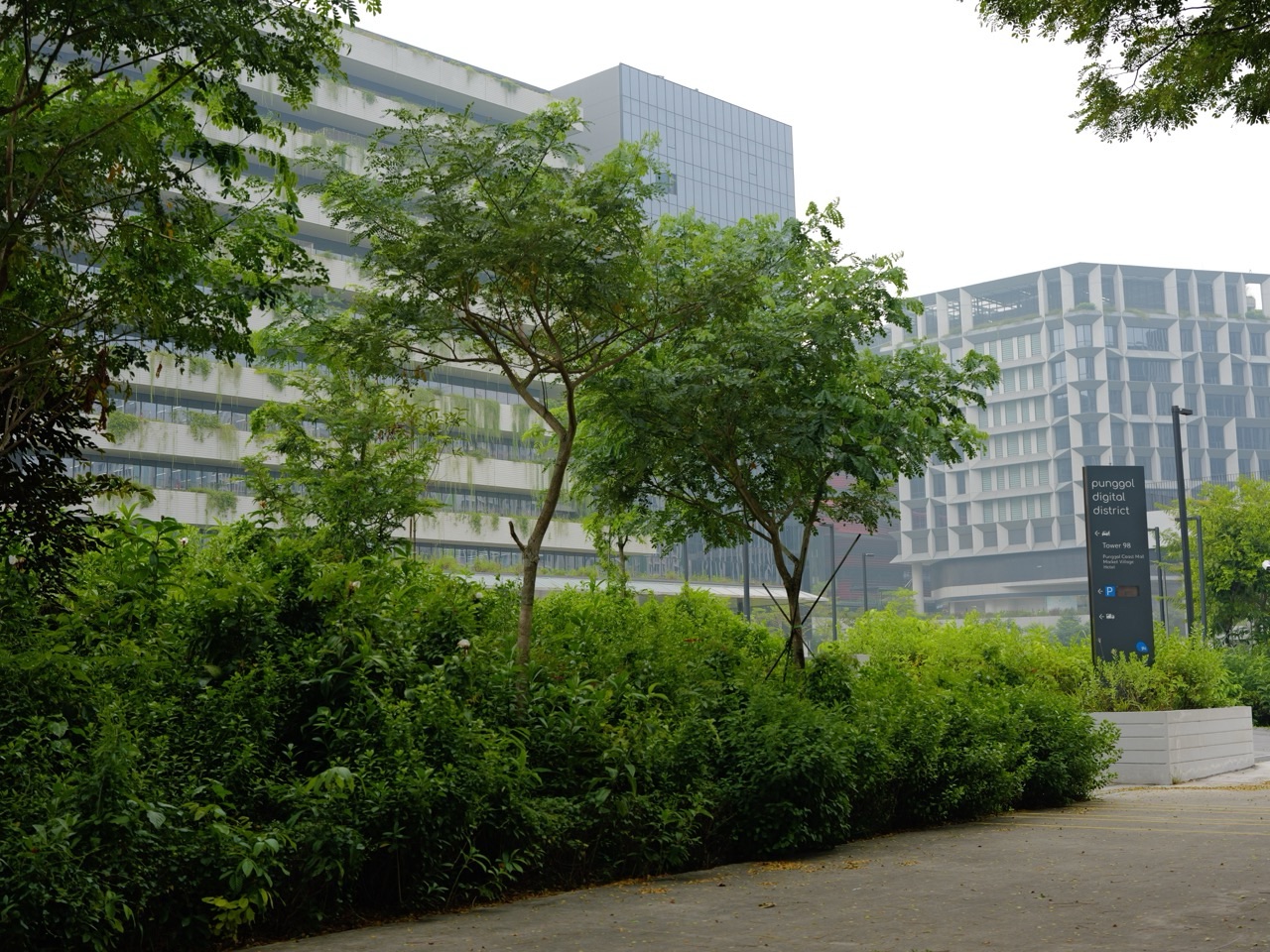
Our photograph shows a Punggol Digital District wayfinding sign beside a walkway, planted edges and large building façades. Begin there: what can you see, what are you wondering, and what would you need to check? Those three questions connect a neighbourhood photograph to habits that matter in English, Mathematics, Science and later study.
Photograph: Punggol Digital District wayfinding sign, walkway, planting and building façades. Photo: eduKate.
Choose your next question
Read the photograph · Connect school subjects · Explore future pathways
Contents
1–3 · Observe and connect
1. Read the photograph before reading a career promise
2. Understand what makes Punggol Digital District distinctive
4–6 · Try, explore and continue
4. Try a twenty-minute observation and design activity
The sign on the right gives the place a name. The buildings show repeated shapes. Trees and dense planting frame the walkway. These are observations available in the photograph; they give a younger child plenty to describe without needing technical vocabulary first.
Try a short conversation: “Which detail helped you identify the place?” Then: “What might make this walkway comfortable to use?” The second question invites a hypothesis. Shade could matter, but the picture alone cannot tell us the temperature, the air movement or how comfortable the path feels at another time of day.
This distinction is useful school practice. In English, the student supports an inference with a detail. In Science, the student separates an observation from an explanation. In Mathematics, the student notices that a photograph without a scale cannot establish a building’s actual dimensions.
Let the child choose one detail and explain it in two sentences. A teenager could add a third sentence naming missing evidence. There is no need to turn the whole walk into a worksheet; one thoughtful exchange gives you something specific to return to later.
According to JTC’s district overview, Punggol Digital District is a 50-hectare business park bringing together industry, education and the community. Its technology focus includes cybersecurity, artificial intelligence, robotics and financial technology. Its integration with SIT is intended to help ideas and expertise move between the university and businesses.
JTC explains that the Open Digital Platform, developed with GovTech, connects different district systems and supports experimentation through a digital twin. In everyday language, a digital twin is a digital representation used to examine aspects of a real system. This gives students a useful question: how can a model help us test a change before making it?
The SIT campus officially opened on 16 September 2025. SIT’s opening announcement describes a setting for applied learning and collaboration on real problems. Our separate SIT Punggol Campus profile introduces the university within this school photo series.
For a family, the educational value is the chance to make an abstract idea discussable. A young child can ask why buildings need electricity. An older student can ask what measurements would help a building manager decide whether a change is useful. These are eduKate learning suggestions, not advertised access to a district laboratory or a school partnership.
A place becomes educational when a student does something with it: reads carefully, makes a comparison, proposes a test or explains a choice. Use the examples below at the child’s present level. They are optional learning prompts, not a claim about what any particular Punggol school assigns.
| Subject | Question to explore | Small piece of evidence |
|---|---|---|
| English | How would you explain this place to someone who has never visited? | A paragraph with a clear main idea and two accurate details. |
| Mathematics | How can we compare two routes fairly? | A labelled comparison using measured distances or clearly stated hypothetical values. |
| Science | What information would help us investigate shade and temperature? | A proposed method that identifies what to measure and what to keep consistent. |
| Geography | How might locating a university and businesses together affect a neighbourhood? | A simple annotated map and one benefit to investigate. |
| Computing and design | What should a useful digital sign tell a first-time visitor? | A paper prototype with a reason for each piece of information. |
The same activity can reveal different starting points. A child who has good observations but cannot explain them may need vocabulary. A child who chooses an appropriate calculation but mixes metres and minutes needs help with units. The eduKate vocabulary hub and Primary Mathematics learning continuity guide offer different routes from those two observations.
If you are comparing school programmes, use our Punggol primary-school ALP and LLP comparison to identify questions about participation and progression. Ask what children actually do, how they receive feedback and which opportunities are available to everyone. A programme name becomes more useful when you understand the experience behind it.
Here is a small activity you can do using the photograph at home. It needs paper and a pencil; access to a campus building, company office or live data system is unnecessary.
First five minutes: notice. Write three things visible in the photograph. Keep each statement concrete: “There is a direction sign beside the walkway” is more precise than “Everything is high-tech.” Choose one question the photograph cannot answer.
Next five minutes: define a user. Imagine a first-time visitor trying to find a destination. What information would they need? Sketch a clearer sign or a simple route card. Label the destination, direction and any information that would still need checking against an actual map.
Next five minutes: test the explanation. Give the sketch to someone else. Ask them to explain the intended next step. If they hesitate, find out which word, arrow or missing detail caused the uncertainty. Revise that part.
Final five minutes: reflect. Complete two sentences: “I changed ___ because ___” and “To check whether this works in the real place, I would need ___.” This produces a small record of reasoning rather than a drawing judged only on appearance.
For an optional Mathematics extension, suppose a fictional route is 600 metres and a person walks at a constant 60 metres per minute. The model gives 600 ÷ 60 = 10 minutes. Then ask what the model leaves out: crossings, waiting, turns or rest stops. These numbers are invented for practice and are not a travel estimate for the photographed location.
A child who enjoys the activity may be interested in several different kinds of work. Designing the sign could lead to questions about communication or design. Comparing routes could lead to planning or data. Investigating building comfort could lead to engineering. Treat those responses as clues for the next experience.
Ask a teenager which part they liked: finding information, calculating, making a prototype, explaining an idea or improving it after feedback. A short project can help them describe their interests more accurately than choosing a job title from a list.
When an actual course decision approaches, move from curiosity to current entry requirements. SIT’s undergraduate admissions guidance provides routes for different qualifications and directs applicants to programme-specific requirements. It describes an assessment that considers aptitude alongside academic preparation. Read the requirements for the particular course and application year.
Living nearby or attending a school in Punggol should not be treated as an admission entitlement, an internship promise or a guarantee of employment. The practical advantage a family can use now is familiarity: a local place can make further study and different kinds of work easier to picture.
For a wider family discussion, continue with how to choose a school in Singapore. Keep the student’s readiness, interests, support needs and feasible next step together when comparing options.
Choose one follow-up, based on what the student actually found difficult. Practise explaining an observation if the reasoning stayed in their head. Revisit units if the calculation became muddled. Try a second design if the student enjoyed testing and improving an idea.
For a younger learner, a book and a conversation can be enough. Our One Punggol library learning guide suggests ways to continue a question beyond the classroom. For an older reader who wants the district’s economic context, explore Punggol Digital District and the smart district economy.
Where schoolwork shows a recurring difficulty, bring a recent example to the teacher or tutor. At eduKate, the purpose of a small 3-pax tutorial is to make the student’s reasoning visible enough to respond to it: clarify a term, repair a method or provide the next suitable challenge. Start with that diagnosis before deciding how much extra practice is useful.
Parents who want help identifying that starting point can arrange an eduKate parent–student consultation. Bring the question the student asked, their small activity and a piece of current schoolwork. Together, those examples give a more useful starting conversation than a broad label such as “weak in Maths”.
The photograph can stay simple: a sign, a walkway, buildings and trees. The learning grows when the student can explain one more thing about it, recognise what remains unknown and decide how to find out.
Sources and further checking
Official sources checked on 10 October 2026. The photograph supports visual observations only; the activity and subject connections are independent eduKate suggestions. Consult the official programme and admissions pages for current requirements.
JTC: Punggol Digital District overview
JTC: Open Digital Platform explanation