
Which Punggol primary schools have sustainability, recycling, gardening or environmental Science programmes? Start with published school programmes rather than a generic claim that every Punggol school teaches the same thing. Greendale Primary School describes an environmental Learn · Live · Lead approach, including EcoStewards, food-waste reduction, recycling, composting, hydroponics and student outreach. Punggol Primary School has its GreeNovation Applied Learning Programme, while Punggol Green Primary School describes planting, urban-farming methods and an annual Eco-Warrior Week.
These are genuine 2026 school descriptions, not a guarantee that every child attends a named club or that each activity runs on the same date. For parents comparing schools, the better questions are what all students experience, which activities are electives or CCAs, how the programme connects to Mathematics and Science, and whether children learn to observe, explain and solve problems rather than simply repeat slogans about caring for the planet.
Punggol is a particularly useful place to explore these ideas because its neighbourhood links housing, waterfront paths, parks, community spaces and new technology developments. Families can talk about rainwater, plants, biodiversity, waste and city design from safe public areas, but should keep official school outings and informal family observations separate. This guide connects the programmes to authentic learning and shows how a child can move from curiosity into evidence-based explanation and responsible action.
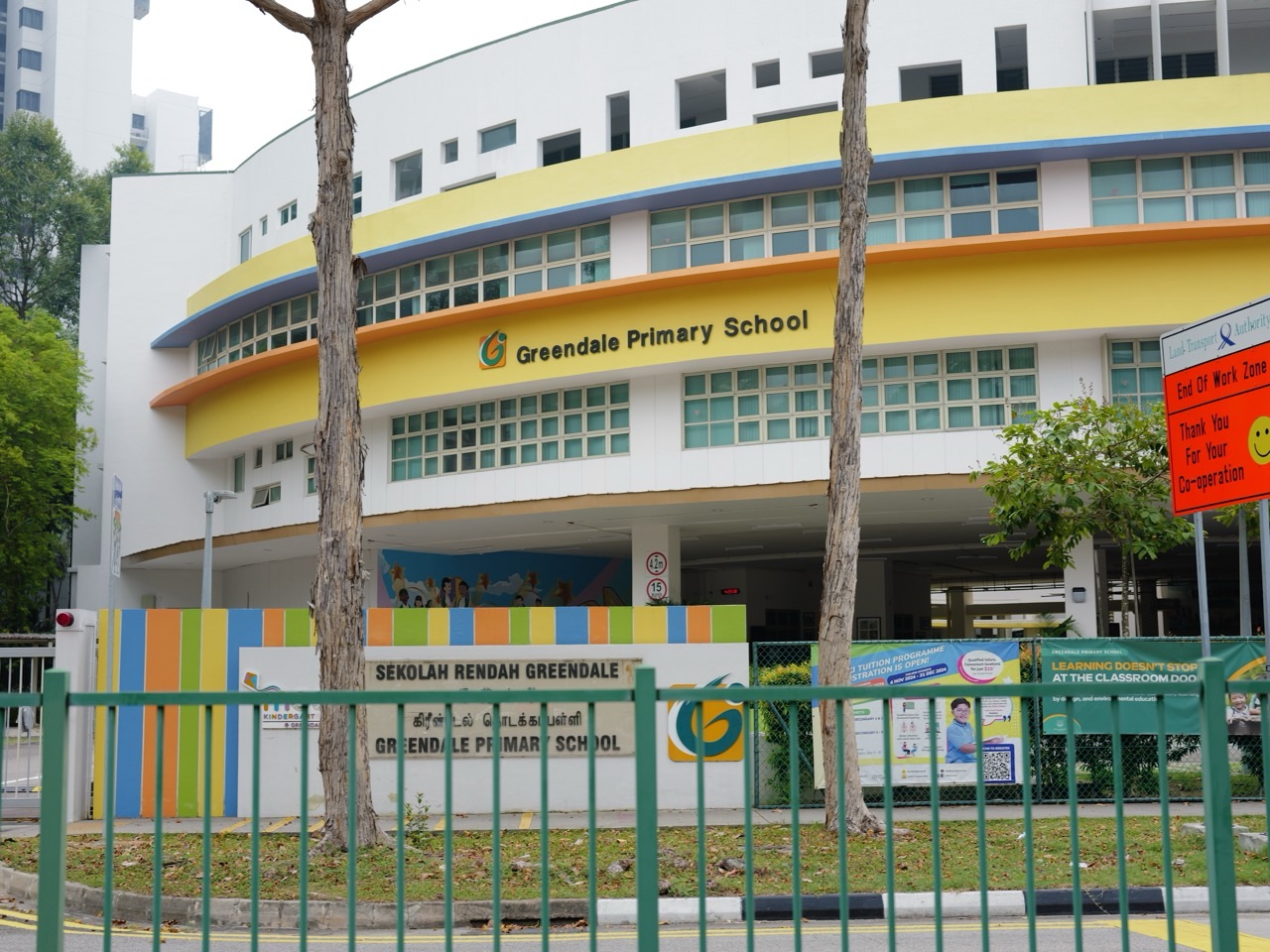
Local photograph: Greendale Primary School exterior in Punggol. It represents a campus entrance, not a particular school gardening session, programme participant or current field-trip schedule.
Choose your reading route
Article contents
Sections 1–6
1. Three Punggol school approaches that are genuinely different
2. Why a school garden can be a Science laboratory
3. Food waste, recycling and water are linked systems
4. Safe observation around Punggol Waterway and Coney Island
5. From green activities to higher-order thinking
6. How parents can judge programme fit without chasing a green badge
Greendale Primary’s Science and Environmental Education programme describes learning about environmental issues, acting through responsible habits and leading positive change. Its named initiatives include Plate2Planet food waste, recycling of different materials, worm composting, hydroponics and rice planting. Environmental Ambassadors and club members also have roles. These examples show how a school may combine everyday habits with inquiry and student leadership.
Punggol Primary’s GreeNovation Applied Learning Programme takes an interdisciplinary environmental route. The school describes a six-year progression connecting environmental Art, Science and green learning journeys. Students are encouraged to observe, compare, classify, analyse real data, make inferences, collaborate and propose solutions to environmental problems. A child learns that good sustainability thinking involves evidence and design, not simply reciting a list of green behaviours.
Punggol Green Primary’s Science curriculum page features student environmental learning and urban-farming techniques, with its signature Eco-Warrior Week. Its separate IGNITE STEM programme emphasises hands-on making, design thinking and collaborative problem-solving. Environmental learning can therefore intersect with engineering, creativity and communication.
There is no need to declare one programme “best” for every child. A curious gardener, a young designer and a student who loves experiments might connect with different activities. Check each school’s current cohort access, resources and participation rules before making a school-choice decision.
- Greendale Primary: published Learn · Live · Lead and EcoStewardship activities.
- Punggol Primary: GreeNovation ALP across environmental Art, Science and inquiry.
- Punggol Green Primary: environmental Science, planting and STEM innovation.
- Identify which activities are whole-school and which require separate participation.
- Avoid converting programme descriptions into unverified performance rankings.
A school garden can feel like decoration until students begin asking questions. Why does one plant grow differently from another? What do roots need? How do light, water, nutrients and the growing medium interact? What can be measured fairly? These are the beginnings of Science: observations that lead to explanations and testable ideas.
Greendale’s published hydroponics and composting activities and Punggol Green Primary’s vertical planting, hydroponics and aquaponics examples provide a useful picture of urban growing methods. A family should not claim that a particular plant is currently growing at a specific school without seeing an up-to-date programme notice. Instead, focus on the kinds of skills such activities can teach.
A good learning task might compare two conditions while keeping other relevant factors as stable as possible, and record changes over an appropriate period. For younger children, this can be a drawing and a simple observation log. For older primary pupils, it can involve a table, a controlled comparison and a conclusion that acknowledges uncertainty. The goal is not to run an unsafe home experiment or promise a perfectly controlled classroom setting.
The important distinction is between what a student saw and what they inferred. “The leaves were yellow” is an observation. “The plant lacked a nutrient” is an explanation that would need more evidence. That habit later supports PSLE Science questions that ask students to connect data to a concept.
- Record the question before making a conclusion.
- Describe what was observed without inventing a cause.
- Compare conditions fairly where practical and permitted.
- Use pictures, measurements or a simple table as evidence.
- Explain what remains uncertain and what could be checked next.
Environmental education can become shallow when each issue is taught as a separate slogan. In the real world, food waste connects to household choices, collection systems, resource use and possible composting. Water quality connects to rain, drains, land use, plants and responsible behaviour. Recycling depends not only on good intentions but on which materials are accepted and how they are prepared. Each subject becomes more interesting when children trace the connections.
Greendale’s food-waste and recycling programme offers a clear local example. Students can ask what happens to uneaten food, why some items belong in a particular collection stream and what choices reduce the problem before disposal. Parents can have the same conversation at home without claiming that the school has a specific collection schedule beyond what it currently publishes.
Singapore’s national water agency PUB describes its Active, Beautiful, Clean Waters programme as a way to integrate waterways with better environments and community spaces. The Sengkang Floating Wetland educational materials show how plants, water quality and urban infrastructure can be studied together in the Punggol Reservoir catchment. A child’s interest in the nearby waterfront can therefore open a conversation about engineering, ecology and public responsibility.
Rather than memorising “reduce, reuse, recycle” as a final answer, ask the student where the waste begins and which intervention would actually make a difference. A good Science explanation identifies mechanisms. A good civic action respects the systems already in place.
- Trace waste or water from its origin through the next step.
- Check current collection rules rather than relying on colour alone.
- Connect environmental action to material and energy use.
- Use PUB and school education resources for accurate context.
- Ask how a change could be evaluated, not just announced.
Punggol’s waterfront paths and surrounding green spaces can make environmental questions concrete. A child can notice how people share a route, why guardrails or signs appear near water, how plants occupy different spaces or what kinds of birds are visible from a public path. These are opportunities for observation, not invitations to enter waterways or disturb habitats.
Coney Island Park is managed by NParks, and its official visitor page includes opening hours, designated trails, accessibility notes and wildlife safety advice. The published information says to remain on designated paths and avoid feeding wildlife. It also notes that some terrain may be rugged. A family or organiser should check current access and weather before visiting and avoid taking children into unsafe or restricted areas.
Students do not need to collect plants, touch nests, enter water or approach animals to learn meaningful Science. They can sketch a leaf from a permitted viewpoint, describe a bird’s behaviour at a distance or compare the shade and heat of two open public spaces without harming the environment. The observations should be age-appropriate and supervised when necessary.
Our neighbourhood Science observation guide and Punggol Waterway student-life guide offer more context. A family outing remains distinct from a school-organised learning journey, which follows its own approval, safety and supervision procedures.
- Use publicly permitted trails and follow posted park rules.
- Observe wildlife from a respectful distance.
- Do not collect flora or fauna or feed wild animals.
- Stay out of water unless an authorised activity is specifically provided.
- Check official opening, accessibility and weather information before a visit.
A child can enjoy planting a seed without yet understanding the relationships that determine growth. Moving from activity to learning involves asking what the student believes, what evidence they can find, what alternative explanations exist and whether the result supports the original idea. This is the same reasoning used in a well-designed Science investigation or a strong Geography discussion.
The local programmes provide several angles. Punggol Primary’s GreeNovation stresses inquiry and problem-solving; Greendale combines ecological habits with learner agency; Punggol Green’s IGNITE links STEM design with creative collaboration. These are programme descriptions, not scientific proof of outcomes for individual pupils. The family can use the activities as opportunities to ask sharper questions rather than assume programme participation guarantees high grades.
English enters the picture when pupils describe observations, argue for a change or explain a trade-off. Mathematics appears when students count, compare quantities, make graphs or reason about measurement. Art and design help represent proposed solutions. The most useful learning is therefore connected: ideas travel between subjects instead of remaining confined to one colourful project.
At eduKate we call that learning continuity. An observation about plant growth should remain usable when a child later reads a graph or encounters a new Science question. A student who can explain the relationship without copying a familiar worksheet has gained a transferable skill.
- Ask pupils to explain an observation in complete sentences.
- Compare what the evidence supports with what it cannot prove.
- Use simple measurements or representations when appropriate.
- Encourage alternative explanations and constructive feedback.
- Revisit the concept later in a different context.
If you are considering a Punggol school partly because of its environmental learning, ask how the programme works for an ordinary pupil. Does every level experience some activities? Which opportunities depend on a CCA or selection? How much time is allocated to practical inquiry? What does a child do after a project ends? These questions reveal more than a promotional photograph or a list of awards.
Balance programme interest with the child’s daily life. An excellent environmental programme may be appealing, but a long commute, difficult care arrangements or a mismatch with the child’s support needs still matter. A school is an ecosystem in itself: curriculum, teachers, classmates, CCAs, parent communication and travel routines all contribute to learning.
Our Punggol ALP and LLP comparison and school open-house questions help families compare programme promises with practical details. The Punggol Digital District and career pathways guide links scientific habits with later study, technology and work.
The happiest result is not a child who can recite the school’s environmental mission statement. It is a curious pupil who knows how to observe the world, test an idea fairly, care for shared spaces and explain why responsible actions matter. Punggol’s schools and neighbourhood provide many opportunities to begin that journey.
Frequently asked questions
Which Punggol primary schools have publicly documented environmental programmes?
Greendale Primary describes Learn · Live · Lead and EcoStewards; Punggol Primary describes GreeNovation; Punggol Green Primary describes environmental Science, urban planting and the IGNITE STEM programme. Confirm current year-level access with each school.
Can parents use Coney Island for a child’s Science project?
Families can undertake safe, permitted observation on designated trails, subject to current NParks rules. Do not collect protected plants or animals, feed wildlife, enter restricted areas or assume a family visit is an authorised school fieldwork activity.
Does attending a school with an environmental ALP guarantee better PSLE Science?
No. Programme participation can offer useful experiences, but examination outcomes depend on many factors, including actual conceptual understanding, practice and learning support.
Continue exploring Punggol education
Continue with Greendale Primary School, neighbourhood Science observation, ALP and LLP programmes, Punggol Waterway Park and Punggol Digital District and future pathways.
Sources and editorial notes
- Greendale Primary School: Science and Environmental Education (updated July 2026).
- Punggol Primary School: GreeNovation Applied Learning Programme (updated August 2026).
- Punggol Green Primary School: Science and Eco-Responsible Lifestyle (updated September 2026).
- Punggol Green Primary School: IGNITE Applied Learning Programme (August 2026).
- NParks: Coney Island Park Visitor Information (current trail and safety guidance).
- PUB: Active, Beautiful, Clean Waters Programme.
Independent eduKateSG guide using publicly available government and school sources. Programme arrangements, registration routes and parent participation change over time. Confirm details through the child’s school and approved channels. Featured school-exterior photographs do not describe a particular student’s participation.