
Northshore Plaza can be part of an ordinary Punggol school day: a family errand, an agreed meeting or a short food stop before heading home. Make the visit purposeful. Know where you are meeting, what you need and how long the stop can take before adding it to the afternoon.
HDB describes Northshore Plaza as its first seafront New Generation Neighbourhood Centre in an HDB estate. Its community connections matter to families because a neighbourhood centre sits within everyday residential life. A convenient place still needs a clear plan when a child begins using it independently.
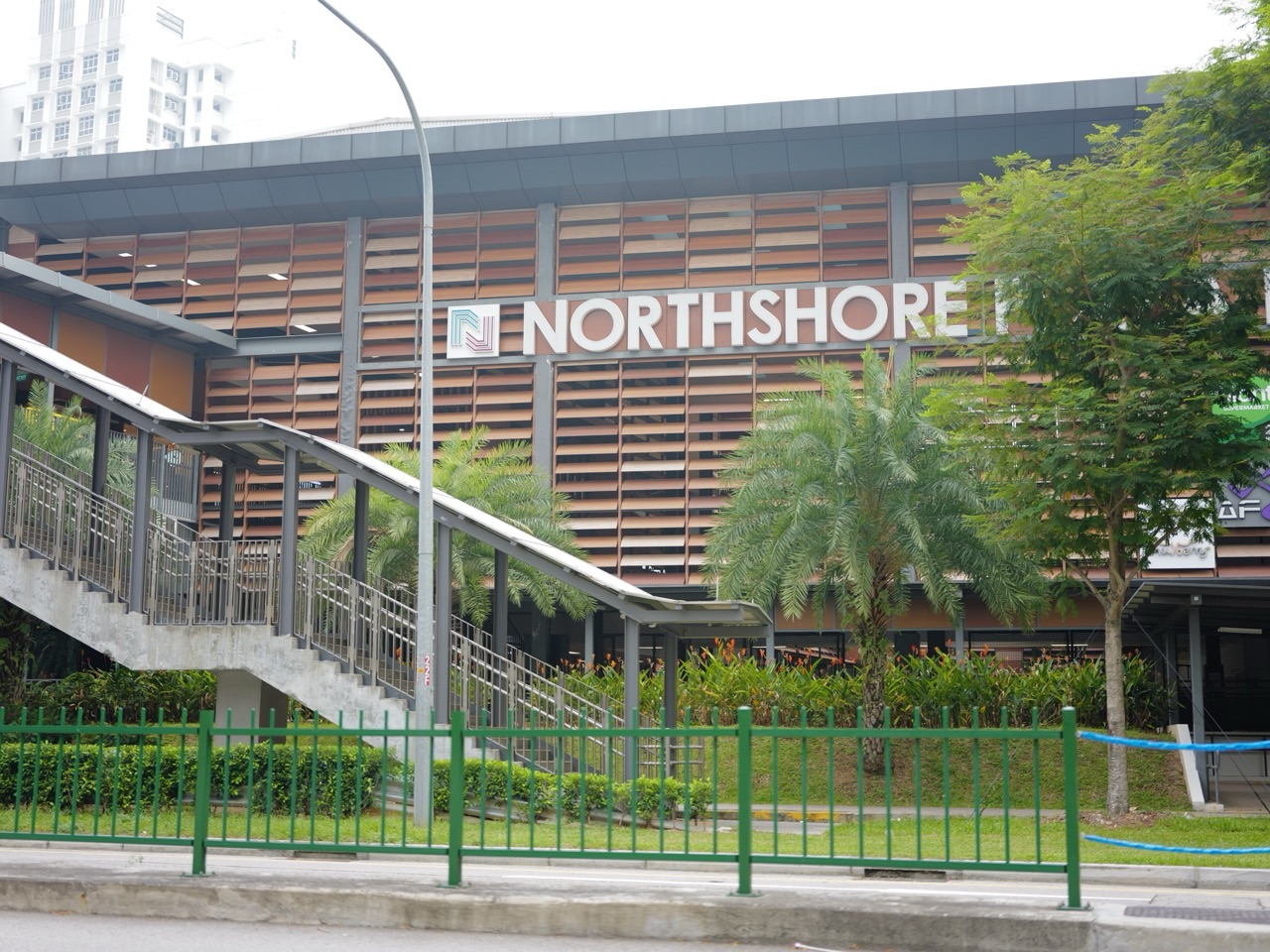
Our uploaded photograph shows the Northshore lettering, a broad façade, planting, railings and an elevated walkway. These visible details introduce the place. Current shop availability, opening hours and offers need separate checks; the photograph cannot establish them.
Northshore Plaza’s lettered façade, an elevated walkway, planting and roadside railings. Photo: eduKate.
Choose your reading route
Understand the setting · Try a practical activity · Find the next useful support
Article contents
Sections 1–3
1. Where Northshore Plaza fits in a Punggol student’s day
Sections 4–6
4. The photograph becomes an English observation exercise
Think of a neighbourhood centre as a place used between other commitments. An errand after school is different from a weekend outing. Ask whether today’s visit solves a practical need or simply adds another stop when everyone is tired.
HDB’s published material describes connections between the Northshore housing precincts, Northshore Plaza and Samudera LRT. This helps explain why the plaza appears in everyday Northshore journeys. It does not provide the exact time from every school or block.
Use a current map to plan the route from the child’s actual starting point. Check crossings and the appropriate level or entrance. A useful route is one that the child can explain and repeat.
“At Northshore Plaza” can be too vague. Agree on a named public meeting point, the level and a time. If a business is used as a landmark, confirm that it still exists and that the chosen spot is suitable for waiting.
The photograph illustrates why a landmark can be recognisable without being enough for a meeting. Large lettering identifies the development; the walkway and multiple levels still leave choices about where to stand.
For a younger child, practise the handover with an adult. For an older student meeting friends, agree how changes will be communicated. Do not let a familiar neighbourhood name replace a clear arrangement.
Keep entrances, walkways and accessibility routes clear while waiting. Students learn neighbourliness through these small decisions: notice other users, move aside when needed and leave shared places ready for the next person.
Before a food or shopping stop, decide what the money is for and what can be spent. Separate a planned purchase from an extra purchase. Families can use their own limits without comparing them with what friends buy.
An invented example: a student has an eight-dollar budget and chooses a five-dollar item and a one-dollar drink. Six dollars is spent and two dollars remains. These figures are a mathematics exercise, not Northshore Plaza prices.
An older student can compare the total cost of two choices, including any additional charges shown. If a price is unclear, ask before paying. Reading the full information is part of practical literacy.
Discuss choices without making every purchase a test. “What did you choose, and why?” can invite a sensible explanation. A student may value convenience, taste, cost or simply having enough time to get home.
| Everyday situation | Learning connection | Simple question |
|---|---|---|
| Compare two displayed prices | Subtraction and decision-making | How much is the difference? |
| Plan two purchases | Addition and budgeting | What remains from the budget? |
| Read a notice | English comprehension | What action does it ask for? |
| Locate a meeting point | Directions and representation | Which landmark confirms the place? |
Begin with five visible nouns: lettering, walkway, railing, tree and façade. Add precise modifiers only where the picture supports them. A student can describe the walkway’s position without guessing its exact height or destination.
Compare two sentences. “There are things outside a mall” gives little information. “An elevated walkway crosses in front of Northshore Plaza’s lettered façade” gives the reader a clearer scene.
Now ask for a question: does the walkway connect to the place we need? A photograph may raise that question, but a current map or site information is needed to answer it. This habit prevents confident writing from drifting beyond the evidence.
Use eduKate’s vocabulary resources to build a short word set around movement, places and directions. Return to the photograph a few days later and ask the student to explain the same scene from memory.
A brief stop with friends can help a student feel connected to the neighbourhood. Agree the destination, spending limit and home time before the visit. Give the child a way to decline a change of plan without embarrassment.
Useful phrases can be rehearsed: “I need to leave now”, “That is outside my budget”, or “I need to check before going somewhere else”. These are everyday communication skills, not scripts for a particular incident.
Parents can ask about the outing with interest rather than an interrogation. “What did you do?” and “Was the meeting point easy to find?” are concrete enough to produce useful answers.
If a route or arrangement repeatedly causes confusion, simplify it. Independence can grow through a smaller, repeatable task before a longer visit. The goal is a child who understands the plan, not one who has been hurried into a bigger responsibility.
For a broader map of the town, eduKatePunggol’s neighbourhood guide distinguishes the everyday areas people refer to. Treat neighbourhood descriptions as orientation, then check the specific address and route.
For shopping-oriented information, the existing Northshore Plaza guide is a related route. Confirm current tenants and hours with the relevant business before a visit. This student-life article concentrates on using the place thoughtfully.
At home, let the student explain one real decision from the outing. How did they find the meeting point? What did they spend? Which instruction was unclear? Everyday explanation gives a parent a view of language and reasoning without inventing an assessment.
If a persistent learning difficulty appears, check a recent school task before choosing support. book a consultation if targeted teaching would help. The neighbourhood remains somewhere to live and enjoy, while tuition addresses the specific gap.
Sources and review
Reviewed 10 October 2026. Official sources support the place and policy facts; activities and illustrative calculations are eduKate suggestions. Follow current official visitor, transport and school instructions for a particular visit.
HDB: Punggol neighbourhood centres
HDB: Developing liveable and sustainable towns, Annual Report 2021/2022