
Punggol Coast MRT can be useful for a student travelling to the northern part of Punggol, including the Digital District area. The best station for a school journey is the one that works for the actual destination and door-to-door route. Check the final walk before choosing it just because its name appears closer on a town map.
Punggol Coast and Punggol are separate North East Line stations. LTA’s opening factsheet records Punggol Coast beginning passenger service on 10 December 2024 as the line’s new terminal. A message saying only “meet at Punggol MRT” should therefore be clarified if the intended meeting is at Punggol Coast.
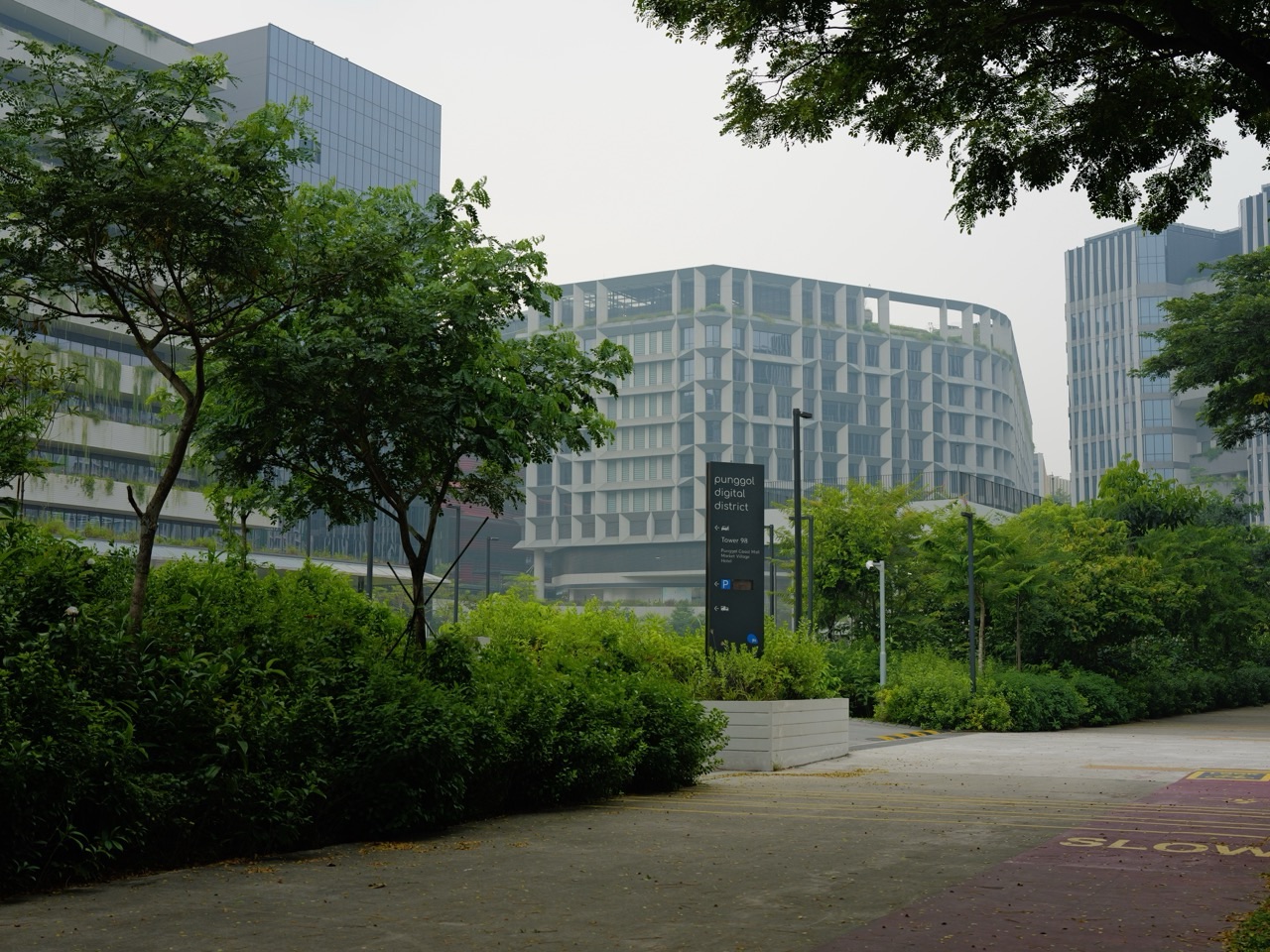
Our photograph shows Punggol Digital District’s buildings and planted pedestrian surroundings. It provides context for the area served by the station. It does not show a station entrance, demonstrate a walking time or establish access to any building.
Buildings, planting, a path and a wayfinding sign at Punggol Digital District. The photograph shows the district, not an MRT entrance or platform. Photo: eduKate.
Choose your reading route
Understand the setting · Try a practical activity · Find the next useful support
Article contents
Sections 1–3
1. Punggol Coast MRT: the facts that matter to students
Sections 4–6
4. Read the neighbourhood through the photograph
LTA places Punggol Coast station in Punggol Digital District and identifies two entrances: one along New Punggol Road and another within the district. The December 2024 factsheet also describes covered connections to nearby transport facilities. Consult a current station map for the entrance that matches your destination.
The station’s opening improved rail connectivity to SIT and the JTC Business Park. That is a useful town-level fact, but a student still needs to locate the correct campus building, school gate or meeting point.
An entrance name, a destination pin and a return plan are more helpful than memorising a general claim that a place is “near MRT”. For a first visit, arrange the meeting at a specific public point and check the route in advance.
Write the journey as separate stages: leaving home, reaching the first stop, waiting, travelling, transferring where needed and walking to the final destination. A direct rail trip can still involve a longer walk at the far end.
Compare routes at the time the student will use them. A quiet weekend visit may not show the conditions of a weekday arrival or a journey after CCA. Try the route with the student and record what actually happens.
Use the following table as a family worksheet. It deliberately contains no estimated local travel times. Those depend on the starting point, destination, service conditions and individual pace.
| Journey stage | What to record | Question to resolve |
|---|---|---|
| Home to first stop | Actual walking time and crossings | Can the student repeat it comfortably? |
| Waiting and travel | Observed wait, ride and any transfer | Does the route work at the needed time? |
| Station to destination | Entrance used and final walk | Is this the correct gate or building? |
| Return journey | After-school or after-CCA conditions | Does the return route differ? |
Start by doing the route together. Let the student lead a familiar section and explain the next decision: which direction, which entrance and what landmark confirms that it is correct. A child who silently follows an adult may not yet know how to repeat the trip.
On a later practice, ask the student to identify where they would pause to check a map and how they would contact home. Agree what to do if a phone is unavailable. Keep instructions simple enough to remember.
Use a clear check-in arrangement suited to the child. For example, agree on a message after reaching the destination and a message before the return trip. This is a family planning suggestion, not a school requirement.
Do not assume an unfamiliar building is open because its exterior is accessible. Follow signs and the institution’s visitor arrangements. A commute should lead to a known destination rather than an improvised walk through campus.
The Digital District image shows buildings at different distances, trees, shrubs and a sign beside a path. It invites students to think about wayfinding: which information would they need to select the correct path?
Have a student draw a simple sketch of the visible scene. Label what can be seen and leave unverified routes blank. Then compare the sketch with an official or current map. A perspective photograph and a map represent the same place in different ways.
English practice can be practical too. Ask for a direction that includes a starting point, an action and a landmark. “Walk there” is incomplete; “From the agreed meeting point, follow the mapped path to the named entrance” is easier to check.
For a broader discussion of school subjects and the district, use the Punggol Digital District learning and career-pathways guide. Here the immediate aim is getting to the correct destination with less confusion.
Use actual journey observations to compare commitments. In an invented example, a 35-minute outward trip plus a 35-minute return is 70 minutes a day. Across five school days that is 350 minutes, or five hours and fifty minutes. These are illustrative figures, not station travel times.
The calculation helps a family see why a small difference can matter. Also compare reliability, ease of transfers and the child’s experience. The fastest recorded trip may not be the one that feels manageable every day.
Keep some journeys free of revision. A student standing, navigating or feeling tired needs attention for the trip itself. If reading during travel is comfortable, a few pages may be pleasant; it should not become a compulsory way to recover every minute.
Read the school journey and after-school routine guide when deciding how an additional class fits. Account for the trip to that class and the trip home, rather than looking only at the lesson duration.
If the larger question is secondary-school choice, the posting groups and subject-level guide separates admission and subject arrangements. A convenient station is one practical consideration alongside the school’s suitability.
the wider Punggol student-life guide helps connect travel with meals, activities and rest. For a quieter learning destination on another day, the One Punggol library learning guide offers a separate route. Avoid assuming that every place in Punggol belongs on the same afternoon itinerary.
A difficult commute and a difficult subject require different solutions. Observe the journey first; examine schoolwork separately. A child may need a simpler route, help understanding an instruction, or a missing prerequisite retaught.
If a learning gap persists, book a consultation with a recent work sample and the real weekly timetable. eduKate’s support should fit the student’s life as well as the topic they are learning.
Sources and review
Reviewed 10 October 2026. Official sources support the place and policy facts; activities and illustrative calculations are eduKate suggestions. Follow current official visitor, transport and school instructions for a particular visit.
LTA: Punggol Coast station opening factsheet, 10 December 2024