
What is Values in Action (VIA) in Singapore schools, and how can a Punggol parent help a child complete meaningful community service? VIA is more than collecting volunteer hours. It is a part of Character and Citizenship Education that guides students to notice real needs, act responsibly, work with others and reflect on what their contribution changed. In Punggol, a child might practise care through classroom cleanliness, show appreciation to school staff, learn about food support or join a school-organised community project. The relevant activity should come from the school’s actual programme and approval, not a parent’s assumption that any public activity counts.
Local schools offer concrete examples. Punggol Cove Primary School’s 2026 CCE programme describes Values in Action that progresses through self, family, school and community—including cleanliness initiatives and its Walkathon @ Waterway (Walk for Rice). Punggol View Primary School publishes VIA themes including helping people in need, building community connections and environmental responsibility. At secondary level, Punggol Secondary School connects recognised service and reflection with its LEAPS 2.0 framework.
This guide explains how VIA differs from ordinary chores, why the preparation–action–reflection loop matters, how parents can help without taking over the child’s project, what older students need to know about service records, and how Punggol’s community can become an authentic context for learning care and responsibility. The best outcome is not a flattering photo of the student helping someone. It is a young person who understands how to contribute respectfully, safely and consistently.
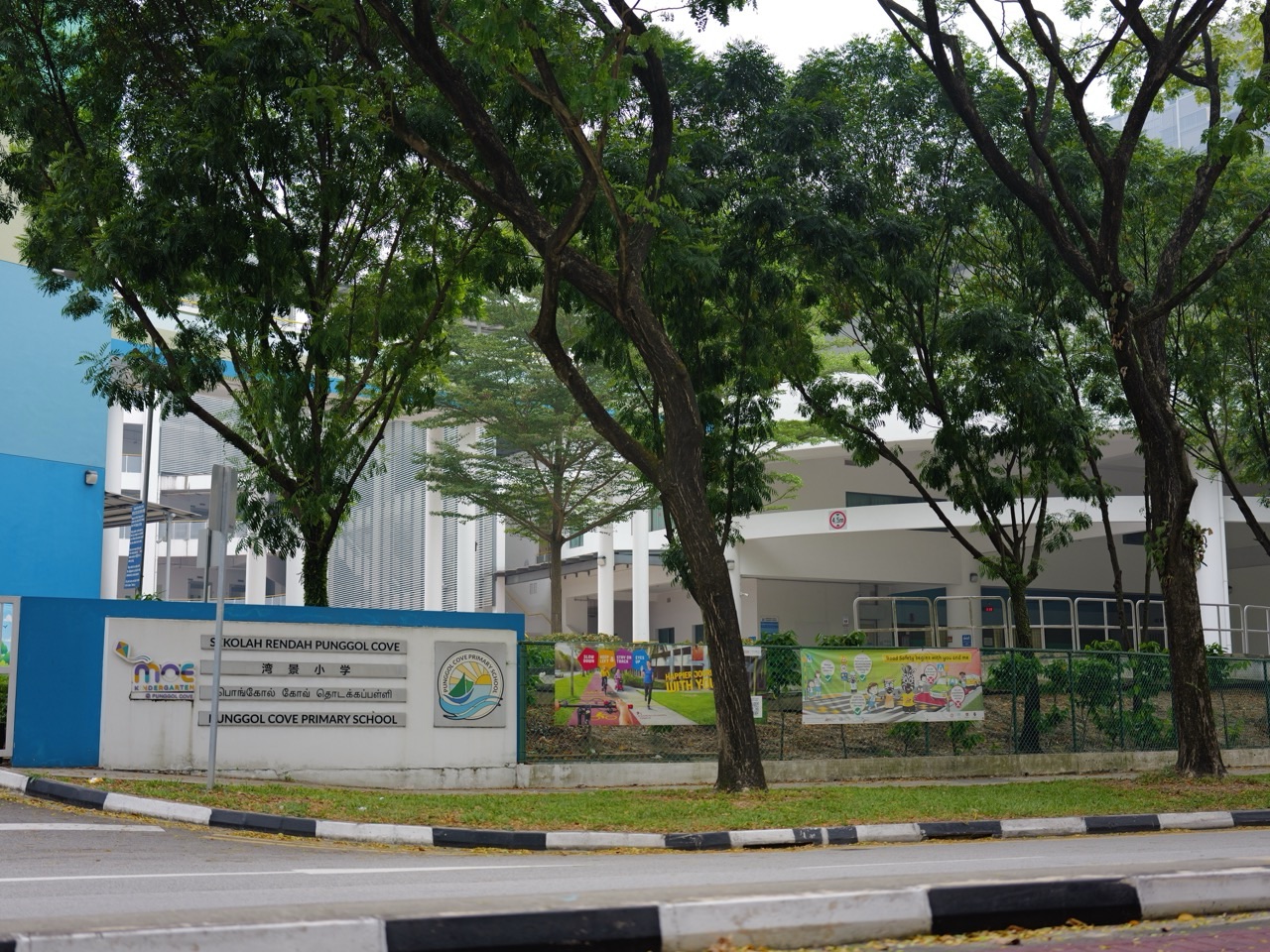
Local photograph: Punggol Cove Primary School exterior. It documents a school in the neighbourhood, not an individual student, activity or service partnership.
Choose your reading route
Meaningful service · How to do VIA · Citizenship and continuity
Article contents
Sections 1–6
1. Values in Action is service learning, not a points-collection exercise
2. How Punggol primary schools translate values into action
3. The preparation, action and reflection loop
4. What secondary school LEAPS 2.0 expects from service
SECTION 1 OF 6
Values in Action is service learning, not a points-collection exercise
A service activity becomes educational when pupils understand why they are doing it. Picking up litter may be an important practical action, but the learning deepens when a child notices what causes waste, considers who uses the shared space, follows safe rules and reflects on what could prevent the problem from returning. The act matters; the reasoning around it helps the lesson remain useful.
MOE’s Primary Character and Citizenship Education syllabus links student participation in VIA and other experiences to ownership of learning, social responsibility and leadership. VIA is therefore not a separate status competition. It is part of the broader work of helping children become thoughtful people who care about others and their communities.
Punggol Cove Primary’s CCE guide defines VIA in terms of meaningful community contribution, student ownership and reflection. That combination gives parents a useful test. If an adult plans every step, performs the activity and writes the reflection, what exactly did the child learn? On the other hand, leaving a child to organise unfamiliar community work alone may be unsafe or unrealistic. The right amount of guidance changes with age.
A good VIA question starts with need: who would benefit, how do we know, what can we realistically do, and which school or community rules apply? Hours and records come later when they are relevant to the school’s official recognition.
- Identify a genuine need before choosing an activity.
- Use school-approved and age-appropriate opportunities.
- Ask the child to take a suitable share of ownership.
- Include planning, action and reflection.
- Measure contribution respectfully, not by social-media attention.
At Punggol Cove Primary, published VIA examples move from cleanliness in the child’s own surroundings towards larger communal contribution. The school lists cleanliness at school and at home, canteen cleanliness, and the Walkathon @ Waterway (Walk for Rice). The structure helps students recognise that responsibility can begin with familiar spaces before reaching a wider community. The existence of a published programme does not mean every year level attends the same event or that an outside family can join without permission.
Punggol View Primary’s 2026 CCE page describes appreciation to non-teaching staff, cleanliness efforts, support for people in need, community relationships and environmental sustainability as aspects of Values in Action. The school’s wider R³ICH values—Respect, Responsibility, Resilience, Integrity, Care and Harmony—provide a language for discussing why these behaviours matter. The goal is for children to practise rather than merely memorise them.
Punggol Green Primary and Punggol Primary likewise publish whole-school character approaches. Punggol Primary’s CCE programme emphasises healthy relationships, reflective learning and student voice. Punggol Green Primary’s CCE page connects school values with empathy, citizenship and meaningful contribution. These examples show different emphases across schools, not a league table of kindness.
Parents can use the school’s current CCE or VIA page to understand the educational purpose, then ask the form teacher how the child’s cohort participates. Never infer that a service activity offers a certificate or LEAPS level without official confirmation.
- Punggol Cove Primary: responsibility from self and family to school and community.
- Punggol View Primary: people, community and environmental contributions.
- Punggol Primary: character, relationships and reflection.
- Punggol Green Primary: values, empathy and active citizenship.
- Verify each school’s current activities and participation arrangements.
A simple way to understand service learning is through three stages. Preparation asks what the need is and how to respond appropriately. Action is the authorised contribution. Reflection asks what happened, what the child learned and what could improve next time. Each stage matters. Rushing straight to action may produce a well-intentioned but unhelpful project; reflecting without ever acting can leave the experience abstract.
Imagine a class wants to show appreciation to the people who keep its school clean. Before writing cards or arranging an activity, pupils should learn what those staff actually do and what expression of thanks is welcome. During the project, they can organise tasks and communicate respectfully. Afterward, they can discuss how respect and maintenance of shared spaces could continue throughout the year. The most meaningful result might be a lasting change in behaviour, not a single event.
For older pupils, the task could involve observing a neighbourhood issue, gathering appropriate information, discussing possibilities with an authorised partner and deciding which small intervention is realistic. Projects involving vulnerable people, money collection, food distribution or outdoor work require proper adult and organisational oversight. Parents should not send children to visit strangers, distribute donated goods or gather sensitive personal stories independently.
Some learning is visible in a clear report; other learning appears later when a child notices a problem without being told. Encourage honest reflection instead of polished claims of personal heroism. A student can admit that their original plan was not especially useful and explain what they would change. That is good thinking.
- Preparation: understand the need, stakeholders and boundaries.
- Action: contribute through approved tasks.
- Reflection: identify outcomes, difficulties and next steps.
- Seek permission for photographs, donations and personal data.
- Let the child describe their own learning in their own words.
At secondary level, Values in Action is connected with co-curricular development and the official LEAPS 2.0 Service domain. Punggol Secondary School’s 2026 page explains that students contribute at least six hours each school year to the community and that recognised VIA projects include planning, action and reflection. That is the school’s published framework, not proof that every independently arranged volunteer activity can be credited automatically.
MOE’s LEAPS 2.0 document defines service achievement levels using prescribed amounts of contribution and, for higher levels, completed VIA projects or student-initiated projects. Parents should not estimate a child’s Service level by adding every informal good deed or converting a group chat message into volunteer hours. The school determines which contributions are recognised and how records are checked.
There is an important difference between being a considerate person and achieving an admissions-related criterion. Helping a sibling without expecting credit is meaningful, but it is not necessarily a school-recorded VIA activity. Likewise, a genuine school service project may have an approved recognition route. The child should be encouraged to contribute for appropriate reasons while also keeping reliable records where the framework requires them.
Our LEAPS 2.0 and CCA bonus points guide explains all four assessment domains and the Excellent, Good and Fair criteria. Service is one part of a whole framework, not a shortcut to two bonus points.
- Understand the school’s current VIA minimum and approved projects.
- Record planning, service and reflection where required.
- Check which contributions the school officially recognises.
- Do not count unverified external volunteering automatically.
- Keep service values separate from admission-point pressure.
Parents naturally want to help a project succeed. They can provide a safe journey, help the child understand instructions, discuss what the beneficiary might need and ensure that any permission forms are completed. But when the adult designs every activity, contacts every participant, handles every decision and writes the reflection, the learning opportunity can quietly disappear.
A better role is to be a coach. Ask, “Who are we trying to help?” “How do you know this is wanted?” “What could go wrong?” “Which part can you do yourself?” and “What did the person or group actually experience?” The child may need help putting these thoughts into age-appropriate words. That is different from supplying a heroic script to recite.
Privacy and dignity must be protected. Avoid photographing service beneficiaries merely to prove that the child participated. Do not post other people’s names, difficulties or home circumstances publicly. Follow the school’s and community partner’s photo consent, safeguarding and donation-handling rules. The people receiving support are not props for a portfolio.
The Punggol Parent Support Groups guide explains appropriate school–home partnership boundaries. Families with limited time can still support the child’s values through consistent home responsibilities, respectful communication and careful attention to the school’s approved activities.
- Assist with safety, permission and realistic planning.
- Leave age-appropriate decisions to the student.
- Protect beneficiary dignity and personal information.
- Ask questions rather than writing the student’s reflection.
- Respect school and community partner rules.
A child’s education contains more than subject marks. They must learn how to interpret other people’s needs, collaborate, take responsibility and make decisions in the presence of uncertainty. Those abilities become important later in school projects, employment, community life and family care. Values in Action gives students a structured opportunity to practise such responsibilities while they are still learning with support.
Punggol’s combination of homes, public libraries, neighbourhood spaces, schools, parks and changing technology infrastructure provides many opportunities to notice how communities depend on cooperation. A pupil may see a well-maintained path and appreciate the people who keep it safe. Another may recognise why a library’s borrowing rules help everyone use shared books. The lesson is not that every public place must become an unsupervised VIA venue; it is that civic responsibility is visible in ordinary life.
This connects to eduKate’s learning continuity idea. A child who learns the meaning of respect in CCE should still remember it in a class group chat. A student who understands environmental care should practise it when nobody is watching. A pupil who has developed clear English explanation can use it to communicate sensitively with a community partner. Knowledge becomes valuable when it survives the change of setting.
Tuition may support academic subjects, but it cannot replace the growth that comes from appropriate real responsibilities. A strong young learner understands both how to solve a problem on paper and how to act thoughtfully when other people are affected. That is a meaningful outcome worth carrying beyond any award.
- Connect school values with daily actions.
- Support learning through reflection and responsibility.
- Notice how service relates to English, Science and Social Studies.
- Respect public facilities and others’ dignity.
- Value sustained contribution more than a one-time certificate.
Frequently asked questions
What is VIA in Punggol primary and secondary schools?
Values in Action is part of character and citizenship education. It develops social responsibility through appropriate service, student ownership and reflection, with activities varying by school and age.
Can my child count any volunteer work towards LEAPS?
Not automatically. Secondary school LEAPS Service recognition depends on school-approved activities and the applicable framework. Ask the school’s CCA or VIA team which records qualify.
Do younger primary pupils need to complete a fixed number of volunteer hours?
Do not apply an older secondary school’s LEAPS hours rule to a primary pupil. Follow the child’s primary school VIA curriculum and age-appropriate participation arrangements.
Continue reading
Explore LEAPS 2.0 and service records, student leadership, One Punggol community activities, green learning and sustainability and parent school partnership.
Sources and accuracy notes
- Punggol Cove Primary School: Character and Citizenship Education (updated August 2026; VIA domains and programmes).
- Punggol View Primary School: Character and Citizenship Education (updated August 2026; VIA themes).
- Punggol Primary School: CCE overview (updated August 2026).
- Punggol Secondary School: LEAPS domains and service (updated July 2026).
- MOE: Primary CCE syllabus (VIA and student-development experiences).
- MOE: LEAPS 2.0 framework (secondary service recognition).
Independent eduKateSG parent guide. Co-curricular activities, policies and school programmes may change; verify the current requirements with the school and MOE. Uploaded school-exterior photos do not document a pupil’s CCA, service record or admission points.