
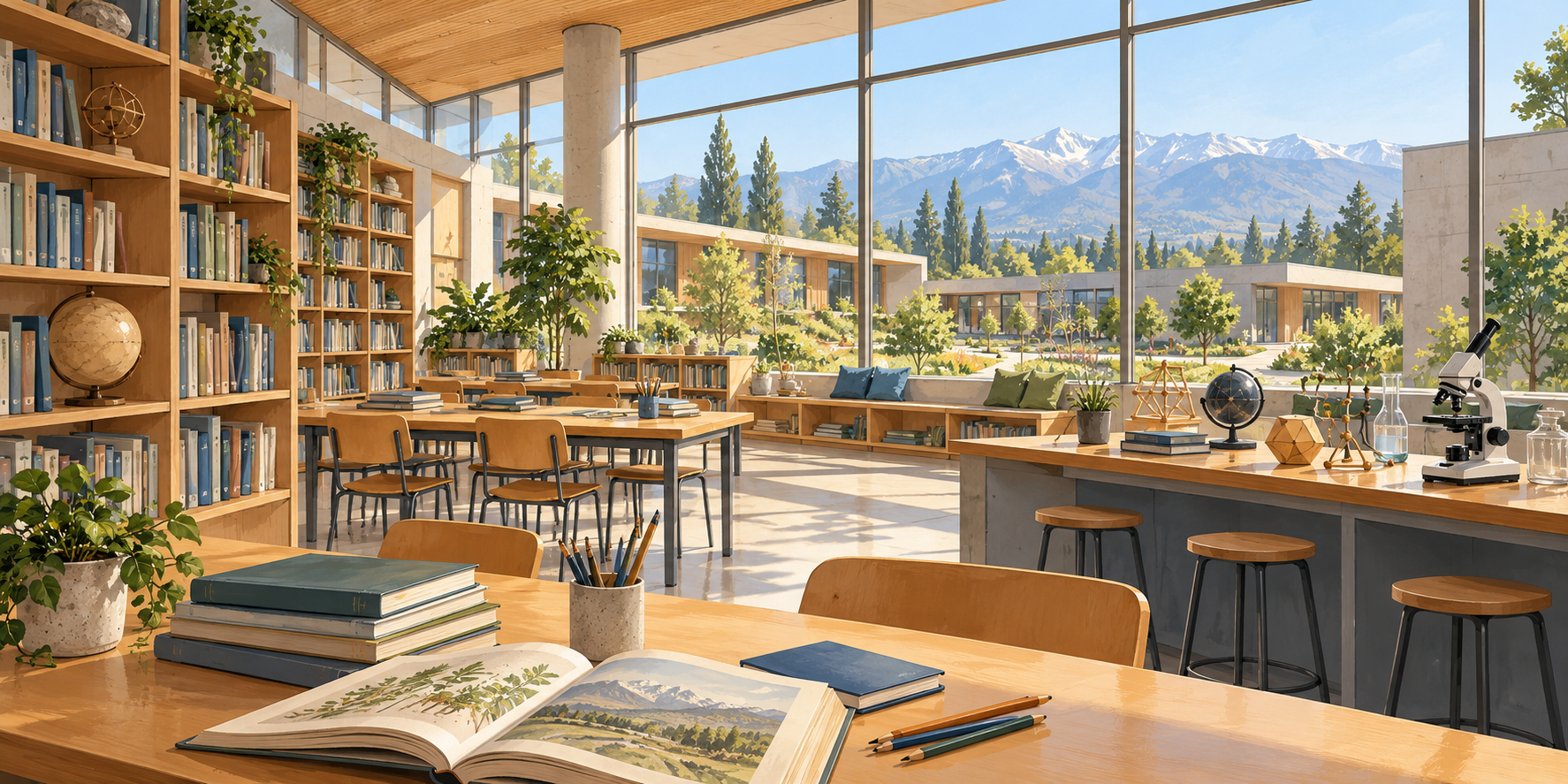
Schools of Chile in 2026 have eight years of educación básica (1°–8° básico) followed by four years of educación media (1°–4° medio). Chile’s 2026 legislation explicitly postponed an earlier plan to change that structure to six plus six until the 2030 school year. The current school map is therefore 8 + 4, and treating seventh básico as the first year of media would be an error in a 2026 admission or transfer decision.
Chile’s real school makeup includes *public schools run through municipalities or Local Public Education Services (SLEP), privately operated state-subsidised schools (particulares subvencionados*), fully private fee-paying schools (particulares pagados), public or subsidised technical-professional lycées, artistic programmes, rural and multigrade schools, and alternative or adult education**. Preschool (educación parvularia) sits before básica, with prekínder and kínder common names. The System of School Admission (SAE) governs entry to participating publicly funded schools, while a fully private school has its own admissions route.
For secondary learners, the distinction between general academic (humanístico-científica), technical-professional and artistic media is significant. Successful school completion leads to a Licencia de Enseñanza Media; completing a technical programme and the associated titling conditions can lead to an additional professional technician qualification. The Prueba de Acceso a la Educación Superior (PAES) is a university admissions examination, not the licence of secondary completion. Start with Chile’s school-age entry requirements, the official admissions portal, and the 2026 consolidated education law.
Schools of Chile: immediate answers
| Institution or stage | Age or programme | What matters |
|---|---|---|
| Sala cuna and jardín infantil | Early childhood | Licensed provision, care, curriculum and accessibility |
| Prekínder / kínder | Normally ages 4 and 5 by 31 March | Preschool education, not a substitute for first básico |
| Escuela básica | Grades 1–8 | Foundational and later basic education, local administration |
| Liceo humanístico-científico | Media, 1°–4° | General academic secondary, licence and later PAES options |
| Liceo técnico-profesional | Media, with specialisation | Occupational field, practical requirements and technician title |
| Liceo artístico | Approved specialist media | Arts pathway and recognised completion |
| Establecimiento público | School-specific range | Municipal or SLEP network and SAE admissions |
| Particular subvencionado | Approved publicly subsidised private provision | SAE, inclusion, regulations and actual support |
| Particular pagado | Fully privately funded | Its own entry, fees and recognised school programme |
| EPJA / adult education | Alternative and completion pathways | Different age and certification requirements |
Read what you need: [school types](#what-a-chilean-school-name-really-means) · [preschool](#preschool-prekinder-and-kinder) · [básica](#basic-education-years-1-to-8) · [media](#media-years-1-to-4) · [SAE](#sae-admissions-in-the-2026-to-2027-transition) · [technical schools](#technical-professional-liceos-and-the-technician-title) · [PAES](#paes-is-an-admissions-test-not-a-school-diploma).
What a Chilean school name really means
An escuela básica commonly provides some or all of the eight basic grades. A liceo can provide the secondary stage, a combined stage or specialist programmes. A colegio is a broad everyday term and does not itself identify a legal provider, its grade range or the eventual certificate.
For real school choice, ask three questions. Who operates or funds this campus? Which exact grades and modalities does it teach? Which recognised award or transfer record does the student obtain? A school may be highly regarded but lack the technical or language programme that an individual learner needs.
In Chile, the financing and operator categories are especially important. A publicly funded school may be administered by a SLEP as education services transfer from municipalities under the New Public Education framework. Another state-subsidised school may have a private sostenedor. A fully private school may not participate in the same admissions platform.
This is why one list of “best Chilean schools” cannot replace the official provider category, exact academic programme, current admission rules, class size, learning support and family travel conditions.
The current 8 + 4 structure, not the future 6 + 6
The current stages are eight years of básica, from 1° to 8°, and four years of media, from 1° to 4°. The numbering resets at media. A learner who has completed 8° básico enters 1° medio, the ninth formal school year.
A school page that says media starts in seventh grade may be describing the proposed six-year media arrangement from a historical document. Law 21.806, published 5 February 2026, deferred that change to 2030. The current consolidated law records the date, and institutions should use the existing system for 2026–2027 placement.
This is not a trivial technicality. It determines the school stage attached to the report, available campus, requirements for transferring between school types and expectations of subject learning.
For international comparisons, take the child’s actual curriculum record, not only a translated year number. A first-year Chilean medio student and an overseas student called “Year 9” can be of similar age but need a careful subject-coverage check.
Preschool: prekínder and kínder
Preschool, or educación parvularia, includes early care and educational programmes for younger children. Common school-stage terms include prekínder at approximately age four and kínder at approximately five. First básico normally begins when a child is six by 31 March of the school year, according to the official entry guidance.
Prekínder and kínder are not ordinary Grade 1. Children build language, curiosity, early mathematical ideas, motor skills, emotional security and social participation. Effective early education uses stories, play, exploration, movement, observation and conversation rather than extended timed test papers.
A child who can recite “one to thirty” but cannot explain which of two groups has more still needs quantitative understanding. A child who speaks clearly but struggles with print may need age-appropriate pre-reading experience, not an assumption that they cannot learn.
Families should compare the programme, safety, teacher preparation, accessibility, actual hours, child-to-adult ratio and transition support. A free or subsidised preschool service and a privately funded early-years centre can have different admission and practical arrangements.
School-entry dates and the real birthday cutoff
The official age-requirements page states the normal minimum ages: four for prekínder, five for kínder and six for first básico, with a 31 March cutoff. Parents should not rely on an outdated handbook offering a broader June discretion for first básico if it conflicts with current guidance.
Age rules govern enrolment. They do not fully describe learning readiness. A child who meets the age threshold may still need support for reading, group routines or language; a slightly older child is not necessarily behind.
Parents should gather the child’s identity and previous-study records, confirm the actual institution’s application process and check whether the family needs to use SAE or another process.
When transferring a child from abroad, do not settle placement solely by birthday. The receiving institution must review the prior curriculum and completed learning under applicable procedures.
Basic education: Years 1 to 8
Educación básica combines early and later foundational learning. In 1°–4° básico, pupils develop decoding and comprehension, numbers and operations, early science, social understanding, language and physical development. Later basic grades deepen mathematics, writing, investigative science, history and independent learning.
A child who reads a paragraph aloud fluently might still fail to identify its main claim or supporting evidence. Another could understand a scientific phenomenon orally but struggle to write about it in academic Spanish. These require different teaching strategies.
Mathematics is also cumulative. Place value, fractions and multiplication lead into proportional reasoning, algebra and data interpretation. The school should be able to show how teachers diagnose a repeated misconception rather than simply assigning more worksheets.
Families can request information about curriculum coverage, teacher feedback, additional support and student progress. The school has a responsibility to teach effectively, not merely advance a pupil through grade numbers.
Early basic years: how numeracy should work
Consider the question: five boxes hold six pencils each. The total is 30 pencils. If one box is donated, the classroom has four boxes remaining, so 24 pencils are left. The arithmetic is straightforward, but its meaning matters.
A pupil who writes 29 may have subtracted one pencil rather than one box. A teacher can draw the five groups of six, cross out one group and ask why six pencils are removed. This is a conceptual misconception, not simply a careless arithmetic slip.
Next change the story: four packets of eight notebooks with two packets donated. The answer is 16 notebooks. A child who explains both has transferred the grouping principle to a new context.
These are original instructional examples, not official Chilean SIMCE or school assessment items. They illustrate how families can judge a school’s ability to turn procedural performance into genuine understanding.
Fifth through eighth básico: increasing academic independence
The later basic grades introduce more demanding subject explanations, algebraic reasoning, geometry, probability, measurement and analysis of information. Pupils need to read to learn and then write what they have understood.
A student who can calculate 3/4 of 20 as 15 but cannot solve an equivalent water-tank problem may have a fragile understanding of the fraction. The teacher can use diagrams of four equal parts and then test the concept with different numbers.
A science teacher should develop careful reasoning: what did the pupil observe, what might explain the observation, and which other factors could affect the result? This skill supports later work in both scientific and technical secondary programmes.
The Grade 8 transition should involve evaluating the next school’s actual media offer. A child can be academically ready but still need support with the new timetable, larger campus, daily journey and subject decisions.
The difference between school grades and SIMCE
SIMCE is a national learning assessment administered through Chile’s education-quality system. It provides information about specified subjects and school levels, but it is not the Licencia de Enseñanza Media, PAES or a guarantee of the quality of every classroom.
A school’s raw test result can be affected by intake composition, educational support and many contextual factors. Parents should avoid reducing school choice to a league table built from one year’s score.
Use the Agencia de Calidad de la Educación to understand current assessment information. Then ask teachers how their classroom practice supports reading comprehension, mathematics reasoning and improvement after errors.
A child with a lower result may need a targeted learning plan, not a permanent label. Likewise, a school with strong average scores must still demonstrate that it can serve the particular child.
Media: Years 1 to 4
Enseñanza media normally runs from 1° to 4° medio, approximately ages fourteen through seventeen for an uninterrupted learner. It is compulsory alongside básica, and can be delivered through general academic, technical-professional or artistic modalities under relevant rules.
Media is not simply four more years of identical compulsory subjects. Students make decisions about specialisation, technical training, senior assessment and postsecondary possibilities. A pupil choosing media should understand what the programme actually teaches and what qualification it produces.
A school advertising engineering preparation may have a strong science programme but not every advanced subject. A technical lycée may develop workshop-based competencies that a general academic campus does not offer. Both must maintain recognised learning and appropriate student support.
For a student intending to progress abroad, record the precise title of the final certificate and any separate technical title rather than describing all outcomes as a generic “high school diploma”.
Humanístico-científica: the general academic modality
The humanístico-científica modality offers general academic preparation through subjects such as mathematics, language and literature, sciences, social subjects and elective studies under the approved programme.
It can be a suitable preparation for many university routes, but the receiving programme still determines prerequisites, examination weights and admission conditions. A pupil planning engineering might need stronger mathematics and physics; a future humanities applicant might benefit from advanced reading, writing and critical argument.
Good teaching should encourage pupils to interpret unfamiliar problems, explain solutions and reflect on mistakes. A school that only asks students to memorise sample answers may produce weaker transfer even if pupils can complete routine exercises.
Parents should ask whether the school supports PAES preparation appropriately without presenting PAES as a replacement for learning in the secondary curriculum.
Technical-professional liceos and the technician title
Educación Media Técnico-Profesional (EMTP) combines general secondary education with defined technical training. Students may specialise in particular sectors or occupational areas. An attractive programme name should be checked against actual resources and authorised professional outcomes.
Completing fourth medio and obtaining a Licencia de Enseñanza Media is distinct from the process of earning a technical title. Depending on the programme, that title can require completion of supervised professional practice and other conditions. A school must explain the route rather than imply every graduate automatically receives both documents on the same day.
The Mineduc technical-professional overview describes its goals and structure. Individual schools must confirm available specialisations, teachers, practical placements, equipment and certification procedures.
A family should compare the actual technical course with the learner’s further-study plans. Some technical pupils later apply to professional institutes, technical training centres or universities, subject to the receiving institution’s rules.
An original technical mathematics example
A technical class has a drawing at scale 1:5. An actual component is 45 centimetres long, so the drawing should be 9 centimetres long. A student who writes 225 centimetres has multiplied without interpreting the scale.
The teacher can ask the student to explain that one unit on the drawing represents five of the same units in reality. Now change the drawing size to seven centimetres; the actual length is 35 centimetres.
In a real technical workshop, the learner must also measure accurately, label units, follow safety rules and verify tolerances. A correct number is only one part of technical competence.
This is an original worked explanation, not an official Chilean vocational examination question. It shows what families should look for when evaluating practical instruction.
Artistic secondary education and specialisation
Some Chilean secondary institutions offer approved artistic modalities, with specialised learning in music, visual arts, performance or related fields. This can be an excellent fit for learners with particular interests, but it is not automatically the same programme as a general academic or technical-professional liceo.
A family should examine the actual authorised curriculum, audition or aptitude procedures, teachers, practice facilities and final secondary certification. Students may need to balance demanding artistic work with general academic subjects.
The correct question is not whether the school is “creative,” but whether it develops skill, theory, constructive feedback and a recognised next step.
For higher education, arts programmes can have portfolios or auditions in addition to standard academic eligibility. Students should check the receiving institution before choosing a media programme solely by reputation.
Public schools, municipalities and SLEP
Chile’s public education management is changing through the Nueva Educación Pública framework, which transfers local public education services from municipal administration to Servicios Locales de Educación Pública (SLEP) according to a staged schedule.
A school being public does not reveal its exact administrative operator at every date. Families should determine whether the school belongs to a municipal or SLEP network and which office handles enrolment, support and complaints.
The Dirección de Educación Pública supplies information about the local services and transition. The school itself must confirm current operational details, safeguarding and academic provision.
This is an example of why publishing one timeless paragraph describing every public school as municipally run would be inaccurate in 2026.
Particulares subvencionados versus particulares pagados
A particular subvencionado is a privately operated school receiving state subsidy under the relevant rules. It normally participates in the publicly funded-school admission framework, including SAE when within scope.
A particular pagado is fully privately funded and has a separate school admissions process; its complete costs and educational programme should be checked directly. Private fees alone are not evidence of higher teaching quality.
The family should compare the school’s actual grade coverage, student-support arrangements, evaluation process, learning environment and transport. A public subsidy or independent fee schedule is an administrative characteristic, not a guarantee of a child’s academic success.
For any school, ask which final qualification it awards and whether the curriculum and examination pathway match the student’s next destination.
SAE admissions in the 2026 to 2027 transition
The Sistema de Admisión Escolar (SAE) coordinates applications to participating public and publicly subsidised schools. Families rank preferences and outcomes depend on applicable priorities, available places and system procedures. The main application process should not be confused with an open-ended promise of a place in a particular school.
The official SAE platform provides the current calendar, eligible schools and procedures. A regional Mineduc report from 4 August 2026 described the opening of 2027 school admission applications for participating establishments.
Submitting preferences, receiving a result and completing enrolment are distinct stages. A family that assumes an application automatically registers the child may miss an essential confirmation step.
If the first result is unsuitable, look up the official complementary or regularisation procedure, such as Anótate en la Lista, rather than trusting an unofficial broker who promises a vacancy.
What SAE does not cover
A common misconception is that every school in Chile must use SAE in precisely the same way. Fully private schools have their own admissions arrangements, and some specialist or stage-specific options may involve additional legal requirements.
A child moving from abroad needs both a lawful school admission process and the necessary study-record or identity documentation. An application form is not an equivalence determination.
For a family whose child has learning needs, the first school decision should also include the actual support that can be provided. A high-prestige preference is not helpful if the chosen programme cannot serve the learner effectively.
The correct authority is the current SAE platform or receiving institution, depending on the school’s provider category.
The Licencia de Enseñanza Media: school completion
The Licencia de Enseñanza Media confirms successful completion of recognised secondary education under applicable requirements. It is different from an individual school’s mid-year transcript, a technical professional title and the PAES university admission test.
International families should keep the original Chilean title, the actual subjects and grades, and any supplementary technical documentation. Translating the credential simply as “diploma” may conceal differences in programme or award.
Completing media is a major milestone but does not automatically entitle a pupil to every higher-education programme. University and technical institutions apply specific entry, selection and recognition conditions.
The family should work backwards from the intended receiving institution before selecting senior school subjects or assuming that one examination score can settle everything.
PAES is an admissions test, not a school diploma
The Prueba de Acceso a la Educación Superior (PAES) is used for eligible centralised university admission in Chile. It includes compulsory and elective components under the applicable admission cycle, while programmes can specify subject tests and weights.
PAES should not be confused with the school-completion licence. A learner can complete school while still needing to satisfy university selection requirements, and universities can weigh PAES with school results and other factors.
The official DEMRE PAES site and the university access platform explain current tests, selection and applications. A family should check the intended programme, not follow a generic claim that any high PAES result is sufficient.
Academic preparation involves strong literacy, mathematics and interpretation of evidence. Timed exam work helps after concepts are secure, but does not compensate for years of missing prerequisite learning.
NEM and Ranking: different factors from PAES
For centralised university admission, Chile commonly uses Notas de Enseñanza Media (NEM), Ranking and PAES scores with programme-specific weightings. A student should not treat a PAES number alone as an unconditional university-offer score.
NEM represents school-grade information converted according to the relevant framework. Ranking is intended to recognise school performance relative to context and is calculated under its own rules. Universities choose eligible combinations and weights within applicable policies.
One especially important time distinction: the revised Ranking formula is scheduled for Admission 2028, not an immediate change in every 2027 application calculation. See the official NEM and Ranking guidance.
A family should use the actual admission cycle and target programme’s published weighting table rather than old examples from a different course or year.
CFT, IP and universities are different institutions
Chile’s postsecondary landscape includes Centros de Formación Técnica (CFT), Institutos Profesionales (IP) and universities, with different qualifications, professional purposes and admissions arrangements.
Admission to technical and professional institutes is not automatically governed by the same centralised PAES selection process as university degrees. The Ministry’s 2027 technical-professional admission guidance highlighted institutions opening enrolment without requiring PAES.
A school learner choosing between a technical media route and a general academic route should examine which further programmes will accept their record, subjects and practical competencies. A technical qualification can be valuable without being the same as a university degree.
Recognition, accreditation and financial aid are separate checks. An institution’s advertisement does not replace a current official programme record.
Gratuidad and education funding
Chile has higher-education financing mechanisms, including gratuidad, scholarships and student credit. These arrangements have household, institution and programme eligibility conditions. They are not proof that every applicant can attend any private university without tuition or other costs.
The official student-benefits portal explains the gratuidad framework. The FUAS process has its own application dates and documentation. A funding decision and a university admission result are different steps.
For school-aged children, families should separately consider transport, meals, uniforms, digital devices and available student-support schemes. The nominal tuition category is not necessarily the full cost of participation.
A responsible education adviser distinguishes school eligibility, admission, scholarship or public benefit approval and practical affordability.
Inclusion, PIE and additional support
Chile’s Programa de Integración Escolar (PIE) supports educational participation for certain students with special educational needs under applicable rules. Its presence and specific available support should be checked at the actual school.
A learner with reading difficulties may need explicit literacy instruction; a child with a mobility impairment may need accessible facilities; a newcomer may need Spanish academic language support. These are different needs and should not be treated as interchangeable.
The Mineduc PIE guidance can help families understand procedures, but an individual school’s support and authorised determinations matter.
Good inclusion means the child can participate and learn with appropriate adjustments, not merely that the school’s marketing says everyone is welcome.
Rural and multigrade schools
Some rural communities are served by smaller or multigrade schools, where pupils from more than one school year may learn in a coordinated classroom arrangement. That design is not automatically poor quality, but it needs careful teaching so each learner works at an appropriate level.
The school should have a clear plan for reading and numeracy, age-appropriate challenge and evaluation. A pupil in a combined class must still make progress toward the recognised curriculum.
Travel, weather, teacher continuity and future media choices can affect families in sparsely populated areas. An accessible and supportive basic school may be a strong option, but the eventual media programme could be farther away.
Parents should plan the future Grade 8–9 transition early rather than judge one school by the location of its building alone.
Adult education and returning learners
Chile has Educación de Personas Jóvenes y Adultas (EPJA) and recognised education-validation routes for learners who need to complete or formalise schooling outside the ordinary age-and-grade sequence.
These options have programme-specific conditions. They are not automatically the same as moving from 4° medio into a university or private skills course. A student should request the exact recognised award and its intended use.
The Mineduc EPJA information describes adult learning. Families should contact the relevant provider about eligibility, year level and examination arrangements.
A returning learner may have substantial work and practical skills while needing formal academic reading or mathematics for certification. Respectful assessment builds from those strengths.
A worked case: choosing between two secondary liceos
A pupil completing 8° básico is considering a general liceo and a technical-professional one. They enjoy computing, but their mathematics teacher reports inconsistent algebra.
The family first compares official programmes, daily travel, teacher and laboratory quality, student support, eventual qualifications and target further study. Then the teacher asks the pupil to solve 3(x + 4) = 30. Divide by three: x + 4 = 10, so x = 6. Substitution verifies the result.
A pupil who instead writes 3x + 4 = 30 may not understand distribution. This is a teachable prerequisite, not automatic evidence that the student cannot pursue computing or engineering.
The choice should align with programme recognition and a realistic improvement plan, not prestige alone.
A worked case: media technical completion versus a technician title
A student has successfully completed 4° medio at a technical-professional liceo and holds the Licencia de Enseñanza Media. The family assumes the professional technical title is already issued.
The institution should explain whether the programme requires a práctica profesional or additional titling steps. The learner may need to complete that process and submit the necessary evidence before the specific technical title is awarded.
The family should ask whether the receiving higher-education institution accepts the media licence, the technical title or both for its selected course. No school can guarantee external credit recognition simply from the programme name.
This case illustrates how school completion, professional certification and further admission are different decisions.
Four-week transition plan
Week 1 — Identify the educational route. Record the school sector, exact basic/media year, current curriculum, language, marks and planned qualification. Diagnose literacy and mathematics with short work samples.
Week 2 — Repair the first misconception. Use models for fractions, algebra or geometry. If reading comprehension is the obstacle, practise identifying the meaning and evidence of short subject passages.
Week 3 — Test learning in a different context. A ratio learned with prices should work with map scales or measurements. A science explanation should apply to a second observation.
Week 4 — Confirm the official process. Recheck progress and verify SAE enrolment, subjects, technical titling or PAES requirements as applicable. A tutoring plan improves readiness but cannot secure a school or university place.
The school day: Jornada Escolar Completa is not an exam credential
Some Chilean families encounter the term Jornada Escolar Completa (JEC), or an extended school day, while others attend establishments with different approved hours or shift arrangements. This is a timetable and school-organisation question, not an alternative diploma and not proof that every pupil receives more effective instruction. A longer day can provide opportunities for reading, scientific experiments, arts and teacher feedback; it can also leave a child tired if learning time is poorly organised. Ask for the actual daily timetable and which hours are supervised learning, meals, breaks, transport and extracurricular activity.
A good comparison includes how the school uses time for pupils who need support as well as those ready for additional challenge. Are teachers able to follow up on a Grade 7 fraction misconception? Is there time for independent reading, practical science and genuine feedback? The right response to a weak subject result may be explicit teaching, rather than simply adding another hour of identical worksheets. Daily travel and rest matter alongside classroom time.
Liceos Bicentenario and school reputation: what the label does not prove
Chile’s Liceos Bicentenario initiative is another term families may encounter while comparing secondary schools. It describes a school-improvement and quality-oriented network rather than a separate nationwide school-leaving examination. Its presence in a school’s name should prompt questions about the programme, teacher practice, leadership, curriculum and measured outcomes; it should not be turned into an automatic guarantee of entry to a particular university or of suitability for every child.
Published school outcomes need context. A school may have a selective or distinctive intake, particular subject strengths or a student population facing different learning barriers. A parent considering a technically oriented child should inspect the available media modality before ranking schools by an abstract score. A learner with a disability or changing instructional language may value concrete support arrangements more than an undated reputation.
When interviewing the school, ask for recent samples of pupil work, remediation practices, transparent subject information and how the institution handles complaints. Verify actual current admissions through SAE or the applicable provider; a programme’s recognition cannot replace the correct application.
A transfer checklist for a student arriving from overseas
An overseas learner may not initially hold the same Chilean identity or school documents as a local pupil. Mineduc has information on the Identificador Provisorio Escolar (IPE) and related guardian identification arrangements, and on matrícula provisoria where the rules permit a temporary placement. Families should obtain those procedures from the official authority rather than pay someone who promises to bypass documents. Temporary administrative arrangements, validation of studies and permanent student records have different functions.
Prepare a file containing the child’s original school record, current course list, completed school year, recent writing and mathematics samples, language of instruction and any disability or learning-support documentation. Ask the receiving school to explain the proposed Chilean grade and what learning will need bridging. A student confident in scientific reasoning may need academic Spanish vocabulary without repeating the entire science curriculum. A child whose reading has been interrupted may need structured literacy teaching rather than simply being placed in the lowest available year.
The outcome should be a lawful, documented school placement and an achievable learning plan. A tutor’s assessment can guide teaching but is not a Ministry-issued equivalence or an SAE school-place offer. Verify new application and enrolment dates for the real intake year instead of reusing a 2026 notice.
Common mistakes about Chile’s schools
“Seventh básico became first medio in 2026.” No. The six–six structural change was deferred to 2030.
“Every school uses SAE.” Fully private paid schools have separate admission arrangements.
“All public schools are still run by municipalities.” The SLEP transition means some are run through Local Public Education Services.
“SIMCE is the secondary school diploma examination.” It is a school learning assessment, not the completion licence.
“PAES must be passed to graduate from media.” PAES is an admissions examination, not the secondary school licence.
“A technical school graduate automatically has the technician title.” The titling route may require further steps, including practice.
“Gratuidad pays every higher-education expense for everybody.” Eligibility and expense coverage require separate verification.
Frequently asked questions
How many years of básica does Chile have in 2026?
How many years of media?
When does the planned six–six structure start?
What is the minimum first-básico age?
What is SAE?
What is a particular subvencionado?
Do technical-professional schools award a different school licence?
What is PAES?
Can technical media students enter university?
What should parents check first?
Continue through the world schools series
Read Understanding the Education System of Chile and How Education System of Chile Works for the broader education framework. Compare a different decentralised system in Schools of Canada and another South American route in Schools of Argentina.
The eduKate education hub and Clementi small-group first-principles teaching reference explain how families can diagnose the actual skill needed rather than choose a school or tutor from slogans.
Official sources and fact-check register
- Chile consolidated school education law, including February 2026 amendment — 8+4 school structure and deferral of six+six to 2030.
- Mineduc — school entry ages — preschool and first-básico age cutoffs.
- Sistema de Admisión Escolar — current publicly funded school application procedures.
- Dirección de Educación Pública — SLEP management transition.
- Agencia de Calidad — SIMCE — national school assessment.
- Mineduc — technical-professional media — media technical route and titling.
- DEMRE — PAES — university admission examinations.
- Mineduc — NEM and Ranking — distinct admission factors and cohort changes.
- Mineduc — gratuidad — higher education funding eligibility.
- Mineduc — PIE — educational inclusion.
- Mineduc — EPJA — adult completion programmes.
- eduKateSG — Chile education-system companion — source-backed national overview.
Reviewed 18 October 2026. Current structure and admissions are distinguished from the legislated future 2030 stage change; school completion from technical titling and PAES; publicly subsidised schools from fully private schools; announced support from actual individual eligibility. Worked examples are original and not claimed to be PAES, SIMCE or Mineduc assessment items.