
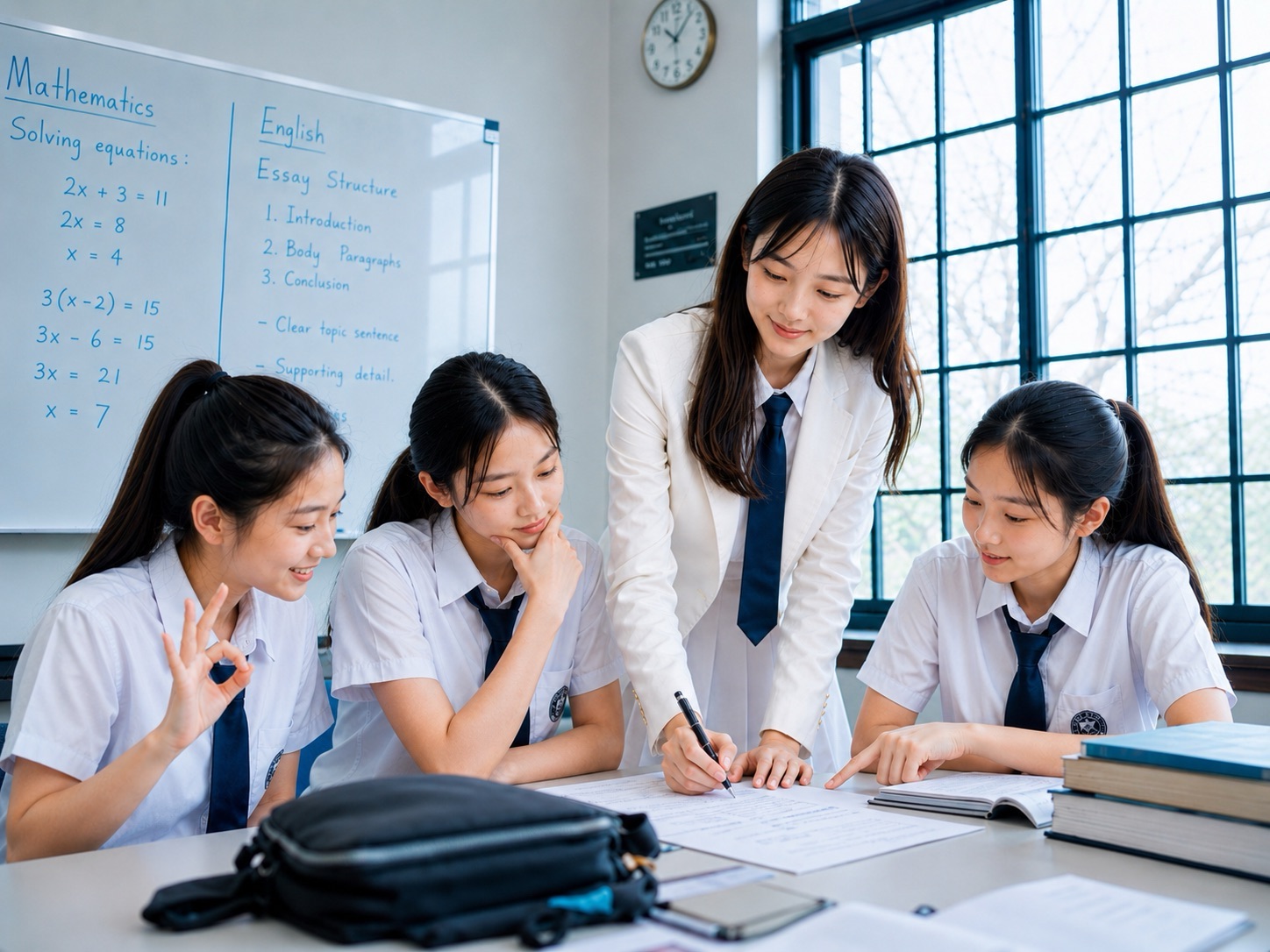
This supporting article helps parents evaluate progress through independent working across Secondary 2 topics. The Bukit Timah Secondary 2 Mathematics tuition programme guide is the main Bukit Timah programme account. Use this page for evidence of learning progress and the Number and Algebra pillar for deeper prerequisite connections.
For students arriving from Secondary 1, use Algebra Control Before the Sec 2 Climb. For the wider local hierarchy, use the Bukit Timah Secondary Mathematics and A-Math directory.
Under Full Subject-Based Banding, students may take subjects at different levels. We therefore use the student’s actual school Mathematics level and course materials rather than treating “Secondary 2” as one identical syllabus experience for every learner.
eduKateSG High Performance Secondary 2 Mathematics Tutorials help students repair weak foundations, strengthen algebra, improve problem-solving habits and prepare for the important Sec 3 jump. Through diagnosis, targeted teaching and careful correction, students learn to move from confusion toward clearer working, stronger confidence and better test performance. Whether a child needs Rescue, Growth or Distinction-level stretch, our tutorials build the bridge from lower-secondary Mathematics into upper-secondary readiness.
Secondary 2 Mathematics is the bridge year.
Secondary 1 introduces the child to secondary-school Mathematics.
Secondary 2 decides whether the foundation becomes strong enough for upper secondary.
This is the year where algebra must stop feeling new. Geometry must become more disciplined. Graphs must become clearer. Word problems must become more structured. Statistics and probability must be handled with precision. Students must begin to think more independently, because Secondary 3 will not wait for them.
For many students, Secondary 2 is where hidden weaknesses surface.
A child may have survived Sec 1 by following examples.
But in Sec 2, the questions begin to demand more control.
The student must connect topics.
They must handle longer working.
They must recognise methods.
They must prepare for G2 or G3 Mathematics expectations.
They must also begin building the foundations that may later support Additional Mathematics where appropriate.
This is why Sec 2 Math tuition should not be treated as ordinary homework support.
It is a transition system.
A good Sec 2 Math tutor helps the student stabilise weak foundations, strengthen algebra, build confidence with unfamiliar questions, prepare for upper-secondary Mathematics, and move towards high performance with clearer habits and better thinking.
Secondary 2 is not the final exam year.
But it is the year that decides how difficult the final exam years will become.
Secondary 2 is where the bridge starts to carry weight
Secondary 1 is the landing.
Secondary 2 is the bridge.
By Secondary 2, the student is no longer new to secondary school.
They understand the timetable better.
They understand homework expectations better.
They understand their teachers better.
They understand the school environment better.
But Mathematics becomes more serious.
The topics are no longer just introductory.
Algebra becomes more important.
Graphs become more connected.
Geometry requires more reasoning.
Problems become longer.
Mistakes become more expensive.
Questions may no longer look exactly like the worked example.
This is where some students begin to separate.
Not because one child is clever and another is not.
But because some students have built enough structure, while others are still surviving on memory.
Secondary 2 reveals the difference.
A student who only memorised methods in Sec 1 may struggle when Sec 2 questions change form.
A student who copied algebra steps without understanding may start making repeated errors.
A student who avoided word problems may now find that avoidance is no longer possible.
A student who rushed working may now lose marks because the solution has too many moving parts.
This is why Sec 2 matters.
It is the year where the bridge begins to carry real weight.
The real problem in Sec 2 Math is accumulation
When parents see a Sec 2 Mathematics problem, they often focus on the current topic.
The child is struggling with algebra.
The child is struggling with graphs.
The child is struggling with geometry.
The child is struggling with probability.
But the current topic is often not the whole problem.
Secondary Mathematics accumulates.
A weakness from Primary school affects Sec 1.
A weakness from Sec 1 affects Sec 2.
A weakness from Sec 2 affects Sec 3.
A weakness from Sec 3 affects the national examination year.
Mathematics does not forget.
It carries everything forward.
That is why a Sec 2 student may be struggling with a new topic because of an old weakness.
The visible problem may be graphs.
But the root problem may be algebra.
The visible problem may be geometry.
But the root problem may be careless reading.
The visible problem may be word problems.
But the root problem may be poor translation from language to symbols.
The visible problem may be probability.
But the root problem may be weak fractions and ratio.
A good Sec 2 Math tutor must look underneath the visible topic.
That is where real improvement begins.
Why Secondary 2 feels harder than Secondary 1
Secondary 1 often gives students time to adjust.
Secondary 2 begins asking more of them.
The student is expected to know how to organise working.
They are expected to handle algebra more comfortably.
They are expected to understand mathematical language.
They are expected to follow multi-step solutions.
They are expected to revise more independently.
They are expected to prepare for tests with less hand-holding.
This is a large jump for some students.
They may not complain immediately.
Instead, the signs appear quietly.
Homework takes longer.
Mistakes repeat.
Marks fluctuate.
The child says the lesson made sense, but the worksheet does not.
The child becomes slower.
The child avoids certain topics.
The child copies corrections without understanding them.
The child starts calling everything careless.
Secondary 2 is not always loud.
Sometimes the damage is quiet.
That is why parents should watch carefully.
Sec 2 Math tuition should not only chase the next test
A weak test is important.
But a weak test is also information.
It tells us something about the student’s system.
The question is not only:
“How do we prepare for the next test?”
The better question is:
“What did this test reveal?”
Did the student lose marks because of weak algebra?
Poor working?
Slow timing?
Weak question reading?
Misunderstood concepts?
Careless signs?
Poor revision?
Lack of confidence?
Inability to handle variations?
Weak explanation?
If the tutor only prepares the child for the next test, the student may improve temporarily.
But if the underlying weakness remains, it will return.
High-performance Sec 2 tuition must do both.
It must help with immediate school demands.
And it must build the system for upper-secondary Mathematics.
The short-term goal is better performance.
The long-term goal is mathematical strength.
The tutor’s first job: diagnose the bridge
A good Sec 2 Math tutor begins by asking:
What kind of bridge is this student standing on?
Is the bridge stable?
Is it cracked?
Is it too narrow?
Is it strong in some areas and weak in others?
Can it carry the weight of Sec 3 Mathematics?
Can it eventually support Additional Mathematics if the student is suitable?
Can it handle examination pressure later?
This is not dramatic language.
It is exactly how Mathematics works.
If the foundation is weak, upper-secondary Mathematics becomes stressful.
If the foundation is strong, the student has more options.
A tutor must therefore diagnose early.
Can the student handle algebraic manipulation?
Can the student solve equations cleanly?
Can the student interpret graphs?
Can the student reason in geometry?
Can the student write enough working?
Can the student translate word problems?
Can the student identify the topic being tested?
Can the student revise independently?
Can the student recover after making a mistake?
These answers decide the tuition pathway.
The three Sec 2 Math pathways
Secondary 2 students usually fall into three broad support modes.
Repair.
Build.
Extend.
These are not labels.
They are working modes.
A student may need Repair in algebra, Build in geometry, and Extend in statistics.
Another student may need Repair emotionally because confidence has collapsed.
Another student may need Extend because they are ready for stronger G3 work and future Additional Mathematics thinking.
The purpose is not to judge the child.
The purpose is to know what kind of help actually works.
Because in Secondary 2, wrong support wastes time.
And by Secondary 3, the cost becomes larger.
Pathway 1: Repair
Repair is for the student whose foundation is not stable.
This student may have passed Sec 1 but did not truly master the material.
They may struggle to simplify expressions.
They may make repeated sign errors.
They may not understand equations.
They may panic when graphs appear.
They may avoid geometry reasons.
They may forget formulas quickly.
They may need help starting many questions.
They may say:
“I don’t know what to do.”
“I understand when teacher explains, but I cannot do it alone.”
“I forgot everything.”
“I am just careless.”
“I do not like Math.”
These statements often mean the student is overloaded.
The first task is not to push harder.
The first task is to repair.
What Repair students need
Repair students need visibility.
They must see exactly where the problem begins.
Is the weakness in Primary school basics?
Is it Sec 1 algebra?
Is it negative numbers?
Is it fractions?
Is it equations?
Is it poor working habits?
Is it weak question reading?
Is it low confidence?
Is it lack of revision routine?
Without diagnosis, tuition becomes guessing.
Repair tuition must slow down at the correct points.
Not everywhere.
Only where the foundation breaks.
A student who is weak in algebra does not need endless general practice.
They need algebra repair.
A student who is careless with signs does not need scolding.
They need line control.
A student who cannot start word problems does not need more answers.
They need translation training.
A student who has lost confidence does not need shame.
They need small wins.
How Repair tuition should work
Repair tuition should rebuild from the strongest available point.
Sometimes this means going backwards.
That is not failure.
It is engineering.
If the student cannot handle fractions, equations will suffer.
If the student cannot handle negative numbers, algebra will suffer.
If the student cannot write working clearly, long questions will suffer.
If the student cannot read the question carefully, every topic will suffer.
A good tutor repairs the root.
The lesson should be structured.
First, identify the leak.
Then reteach the concept.
Then guide the student through examples.
Then let the student attempt independently.
Then correct the working.
Then repeat with variation.
Then revisit later so the repair does not disappear.
Repair is not quick patching.
Repair is rebuilding.
Repair does not mean the student is weak
Parents should be careful.
Repair does not mean the child is weak.
It means something in the mathematical system needs attention.
A capable student may need Repair after a difficult school term.
A hardworking student may need Repair because Sec 1 algebra was never fully understood.
A confident student may need Repair after suddenly meeting harder Sec 2 topics.
A student may need Repair in only one chapter.
The point is not to define the child.
The point is to help the child move.
A repaired student can become a strong student.
But only if the repair is honest.
Pathway 2: Build
Build is for the student who can cope, but is not yet strong.
This is the most common Sec 2 profile.
The student may pass tests.
They may complete homework.
They may understand lessons.
But the marks are unstable.
They lose marks in new question types.
They make repeated careless mistakes.
They struggle when topics are mixed.
They are not failing, but not improving enough.
They can do examples, but not variations.
They rely too much on memory.
This student does not need emergency rescue.
But they need structure.
Build students are often close to a breakthrough.
They have enough foundation to improve.
But they need better habits and stronger thinking.
What Build students need
Build students need consistency.
They need to move beyond “I can do this example” into “I understand what this question is testing.”
That is a major jump.
They need to strengthen:
Algebra control.
Geometry reasoning.
Graph interpretation.
Word problem translation.
Working discipline.
Topic connection.
Timed practice.
Mistake analysis.
Revision habits.
Confidence with unfamiliar questions.
Build tuition should not be too slow.
But it should not be careless either.
The tutor must stretch the student just enough to expose weaknesses.
Then repair those weaknesses carefully.
This is how performance rises.
How Build tuition should work
Build tuition should move through four stages.
Teach.
Attempt.
Correct.
Connect.
First, the tutor teaches the concept clearly.
Then the student attempts questions independently.
Then the tutor corrects not only the answer, but the thinking.
Then the tutor connects the topic to other topics.
This connection is important.
Sec 2 Mathematics is not a set of separate boxes.
Algebra connects to graphs.
Ratio connects to proportion.
Geometry connects to measurement.
Statistics connects to interpretation.
Probability connects to fractions.
Equations connect to word problems.
Patterns connect to algebraic representation.
A student who sees connections becomes stronger.
A student who memorises isolated methods becomes fragile.
Build tuition must create connection.
Build students must stop hiding behind careless
The word careless appears very often in Sec 2.
But careless is not always careless.
If a student makes the same mistake repeatedly, it is a pattern.
If a student loses signs in every algebra question, that is not random.
If a student misreads questions when under time pressure, that is not only carelessness.
If a student forgets units in measurement questions, that is a habit problem.
If a student cannot explain geometry reasons, that is a communication problem.
If a student gets stuck whenever the question changes form, that is route recognition weakness.
A good tutor does not accept “careless” too quickly.
The tutor opens the mistake.
What kind of careless?
Where did it happen?
Why did it happen?
What must change next time?
That is how careless becomes correctable.
Pathway 3: Extend
Extend is for the student who is already doing reasonably well and needs stronger challenge.
This student may be aiming for high G3 performance.
They may be preparing for a possible Additional Mathematics pathway in Sec 3.
They may be fast, confident and accurate in routine work.
They may enjoy Mathematics.
But they still need guidance.
Strong students can also develop bad habits.
They may skip steps.
They may rush.
They may assume too much.
They may become overconfident.
They may avoid explaining their reasoning.
They may practise only questions that feel comfortable.
They may not be ready for truly unfamiliar problems.
Extend tuition prevents strong students from becoming shallow.
It gives them depth.
What Extend students need
Extend students need useful difficulty.
Not impossible questions for show.
Useful difficulty.
They need questions that make them think harder.
They need:
Non-routine problems.
Multi-step algebra.
Deeper graph questions.
Geometry reasoning.
Higher-level word problems.
Mixed-topic challenges.
Speed with accuracy.
Presentation discipline.
Early exposure to upper-secondary thinking.
Extend students must learn that being good is not enough.
They must become reliable.
Reliability means they can perform even when the question is unfamiliar, longer or slightly uncomfortable.
That is the beginning of high performance.
How Extend tuition should work
Extend tuition should be deliberate.
The tutor should identify the student’s remaining leaks.
Does the student rush easy questions?
Does the student skip important working?
Does the student struggle to explain?
Does the student only know standard methods?
Does the student avoid challenging geometry?
Does the student make careless algebra errors?
Does the student lose focus in long questions?
Does the student understand why the method works?
Once the leak is identified, the tutor gives the right stretch.
Not random hard work.
Targeted stretch.
The goal is not to impress the student.
The goal is to strengthen the student.
Sec 2 algebra is the upper-secondary gatekeeper
If Sec 1 algebra is the gateway, Sec 2 algebra is the gatekeeper.
By Sec 2, algebra should become more fluent.
The student must simplify expressions.
Expand brackets.
Factorise where needed.
Solve equations.
Substitute into formulae.
Work with graphs.
Translate words into symbols.
Handle negative signs.
Handle fractions inside algebra.
Maintain clean working across several lines.
This is the foundation for upper-secondary Mathematics.
A student with weak Sec 2 algebra will struggle badly later.
In Sec 3 E-Math, algebra becomes more demanding.
In Additional Mathematics, algebra becomes the operating language of the subject.
That is why algebra repair in Sec 2 is extremely valuable.
It prevents future collapse.
Why students fear algebra
Students fear algebra because it is abstract.
Numbers feel solid.
Letters feel strange.
The student cannot always calculate immediately.
They must think in relationships.
They must hold structure.
They must understand that two expressions can be equivalent even when they look different.
They must know why an equation remains balanced.
They must track every sign and bracket.
This requires discipline.
A good tutor makes algebra visible.
The student learns what each line is doing.
Not just how to copy the next line.
That is the difference between imitation and understanding.
Graphs are where algebra becomes visual
Graphs often trouble Sec 2 students because they connect different forms of thinking.
There is the equation.
There is the table.
There is the coordinate plane.
There is the shape.
There is the gradient.
There is the intercept.
There is the relationship between variables.
A student may understand each part separately but not how they connect.
This is why graphs are important.
Graphs teach students that Mathematics can move between symbols and pictures.
This is a major upper-secondary skill.
A student who understands graphs early will have an easier time later with functions, coordinate geometry and curve behaviour.
A student who memorises graph procedures without understanding may struggle later.
The tutor must teach the connection.
Geometry trains proof-like discipline
Sec 2 Geometry is not only about shapes.
It is about reasoning.
The student must justify.
Why are the angles equal?
Why are the lines parallel?
Why is this triangle congruent?
Why is this property valid?
Why does this measurement follow?
This is where many students lose marks.
They can see the answer.
But they cannot explain it properly.
Secondary Mathematics rewards communication.
The student must show enough reasoning for the marker to follow.
This matters later.
Proof-like discipline begins quietly in lower secondary Geometry.
A student who learns to reason clearly becomes stronger across Mathematics.
Word problems reveal thinking quality
Many students dislike word problems.
They say the question is confusing.
Sometimes the issue is language.
Sometimes the issue is Mathematics.
Often, it is translation.
The student must translate words into relationships.
They must decide what is known.
What is unknown.
What is being asked.
What equation or method can represent the situation.
What the final answer means.
This is not simple.
It requires patience.
A student who rushes word problems usually misses the structure.
A good tutor teaches the child how to slow down at the correct moment.
Read.
Mark the information.
Define the unknown.
Build the relationship.
Solve.
Check whether the answer makes sense.
This is how word problems become manageable.
Statistics and probability train careful interpretation
Statistics and probability may appear less frightening than algebra.
But they require precision.
Students must read graphs accurately.
Interpret data carefully.
Understand averages.
Compare information.
Use probability language properly.
Avoid assumptions.
Pay attention to context.
These topics are important because they train real-world mathematical thinking.
Not all Mathematics is symbolic manipulation.
Some Mathematics is interpretation.
Some Mathematics is decision-making.
Some Mathematics is reading information properly.
Sec 2 is a good time to build this habit.
G2 and G3 pathways in Secondary 2
Under the current secondary structure, students may offer subjects at different levels.
For Mathematics, this means parents should understand the student’s current level of demand.
A G2 Mathematics student may need careful strengthening, confidence-building and steady skill development.
A G3 Mathematics student may need faster pace, deeper reasoning, stronger algebra and more challenging problem exposure.
But the level alone does not tell the whole story.
A G2 student may be ready to grow strongly.
A G3 student may still have weak foundations.
A student may be G3 overall but need Repair in algebra.
A student may be G2 overall but ready for Extend in certain topics.
This is why tuition must be diagnostic.
The tutor should not teach only the label.
The tutor should teach the student.
Sec 2 and future Additional Mathematics
Secondary 2 is the year before upper-secondary subject pathways become more serious.
For students who may eventually take Additional Mathematics, Sec 2 matters greatly.
A-Math does not begin from nowhere.
It depends heavily on lower-secondary algebra and mathematical confidence.
A student who enters Sec 3 with weak algebra may feel overwhelmed very quickly.
A student who enters Sec 3 with strong algebra, clean working and good problem-solving habits has a better chance of coping.
This does not mean every Sec 2 student must be forced towards A-Math.
Not every student needs the same future.
But every student benefits from a strong foundation.
A strong Sec 2 foundation gives the child options.
Weak foundations remove options quietly.
The danger of waiting until Sec 3
Many parents wait until Sec 3 to seek help.
Sometimes that works.
But often, Sec 3 becomes more stressful than expected.
The jump is larger.
The pace is faster.
The topics are heavier.
Examination pressure starts becoming real.
The child may be taking more demanding subject combinations.
A-Math may enter the picture.
E-Math becomes more serious.
Science becomes more demanding.
English expectations rise.
Repair is still possible in Sec 3.
But repair is harder when the load is heavier.
That is why Sec 2 is such a useful intervention year.
There is still time to repair calmly.
There is still time to build habits.
There is still time to stretch capable students.
There is still time to prepare the bridge before upper-secondary pressure arrives.
High performance means readiness, not rushing
High-performance Sec 2 Math tuition does not mean rushing into upper-secondary topics blindly.
It means building readiness.
Readiness means the student can handle the next level when it arrives.
The student can manipulate algebra.
The student can reason in geometry.
The student can interpret graphs.
The student can translate word problems.
The student can show working clearly.
The student can correct mistakes.
The student can revise independently.
The student can face unfamiliar questions without giving up.
That is high performance.
Not panic.
Not endless worksheets.
Not difficulty for show.
Readiness.
The mistake ledger becomes more important in Sec 2
Sec 2 students should begin keeping track of mistakes properly.
This is not punishment.
It is intelligence.
The student records the mistakes they keep making.
Sign errors.
Expansion mistakes.
Wrong formula.
Weak factorisation.
Poor graph reading.
Missing geometry reasons.
Misread word problems.
Forgotten units.
Probability misunderstanding.
Slow topics.
Questions that could not be started.
Over time, patterns appear.
The student begins to see the problem clearly.
This changes the conversation.
Instead of saying:
“I am bad at Math.”
The student can say:
“I lose signs when expanding brackets.”
That is much better.
Because a specific mistake can be repaired.
A vague fear cannot.
Sec 2 students must learn how to revise
Many students do not know how to revise Mathematics.
They think revision means reading notes.
But Mathematics is not learned by reading alone.
The student must attempt.
They must correct.
They must revisit.
They must compare methods.
They must redo mistakes.
They must test themselves.
They must practise under time.
They must learn why a solution works.
A good tutor teaches revision behaviour.
Before a test, the student should know:
Which topics are weak?
Which mistakes repeat?
Which formulas must be remembered?
Which question types need practice?
Which school corrections must be redone?
Which timed drills should be attempted?
Which questions require explanation?
This is how revision becomes strategic.
Not last-minute panic.
How eduKateSG High Performance Secondary 2 Mathematics Tutorials Work
Secondary 2 Mathematics is one of the most important bridge years in secondary school.
It is not only a year of more chapters.
It is the year where the student’s mathematical system begins to show its strength or its weakness.
By Secondary 2, students must move beyond basic lower-secondary comfort and begin preparing for the demands of upper-secondary Mathematics.
Algebra becomes more important.
Graphs become more structural.
Geometry becomes more precise.
Statistics and probability require clearer interpretation.
Word problems become less direct.
Questions begin to test reasoning, not only memory.
This is why eduKateSG High Performance Secondary 2 Mathematics Tutorials are built around diagnosis, foundation strength, thinking habits and performance training.
We do not treat Secondary 2 Mathematics as a worksheet race.
We treat it as a bridge.
A bridge from Secondary 1 adjustment into Secondary 3 readiness.
A bridge from basic method-following into independent mathematical thinking.
A bridge from “I can do it when it looks familiar” into “I can recognise what the question is asking”.
Some students need Rescue.
Some need Growth.
Some need Distinction training.
At eduKateSG, our Secondary 2 Mathematics tutorials help students catch up, keep up and move ahead by building the mathematical control they need before upper secondary begins.
Secondary 2 is the bridge year
Secondary 1 is often a transition year.
Students enter secondary school.
They adjust to new teachers, new classmates, new timetables, new expectations and a more abstract style of Mathematics.
Some students cope well.
Some appear to cope well but quietly develop gaps.
Some survive by memorising methods.
Some depend heavily on worked examples.
Some become slower because algebra is no longer as direct as primary school Mathematics.
Then Secondary 2 arrives.
This is where the system begins to tighten.
The student is no longer simply adjusting.
They must now build.
Secondary 2 Mathematics is important because it prepares the student for the heavier demands of Secondary 3.
If Secondary 2 foundations are weak, Secondary 3 Mathematics becomes much harder.
If Secondary 2 algebra is shaky, upper-secondary algebra becomes painful.
If graph reading is weak, functions and coordinate geometry become confusing.
If reasoning habits are poor, exam questions become frightening.
This is why Secondary 2 is not a waiting room.
It is a launchpad.
High performance does not mean rushing
High performance does not mean forcing the student to do difficult work before they are ready.
That is not high performance.
That is noise.
High performance means the student learns with clarity, depth and control.
They understand the concept.
They can apply the method.
They can recognise variations.
They can explain their thinking.
They can correct mistakes.
They can work under time.
They can prepare for the next academic stage.
A high-performance Secondary 2 student is not only fast.
They are stable.
They know what they are doing.
This is the core of eduKateSG’s tutorial approach.
We build students properly so that speed, confidence and results can grow from real understanding.
The first job is diagnosis
Every Secondary 2 student arrives with a different mathematical profile.
Some are strong in arithmetic but weak in algebra.
Some can solve equations but struggle with word problems.
Some understand in class but freeze during tests.
Some score well in easy questions but collapse when the question is unfamiliar.
Some rush and make careless mistakes.
Some are careful but too slow.
Some are quiet and do not ask for help.
Some want distinction-level performance but still leak marks.
This is why tutorials must begin with diagnosis.
We look at how the student thinks.
How do they start a question?
Do they recognise the topic?
Can they choose a method?
Can they write clear working?
Where do mistakes repeat?
Do they understand the concept or only copy the method?
Do they panic when the question changes?
Can they check their answer?
Diagnosis makes tuition precise.
Without diagnosis, the student may do more work without fixing the real problem.
With diagnosis, every lesson has a clearer purpose.
We look at the working, not only the final answer
In Mathematics, the answer is important.
But the working tells us more.
A student may get the correct answer by luck.
A student may get the wrong answer because of one small sign error, even though the concept is sound.
A student may write the correct method but skip too many steps.
A student may copy a solution without understanding the route.
A student may show messy working that becomes dangerous under exam pressure.
So we study the working.
The working reveals the student’s mathematical habits.
Does the student organise information?
Do they write equations properly?
Do they handle brackets carefully?
Do they show enough steps?
Do they know why the method works?
Do they check units, signs or conditions?
Do they understand what the answer means?
Secondary 2 Mathematics is where these habits must be corrected.
If they are not corrected now, they travel into Secondary 3.
And by then, the cost becomes higher.
The eduKateSG tutorial pathway: Build, Connect, Train
Our High Performance Secondary 2 Mathematics Tutorials work through three major movements.
Build.
Connect.
Train.
Build means strengthening the foundations.
This includes algebra, equations, graphs, geometry, number sense, statistics and problem-solving habits.
Connect means helping students see how topics relate.
Algebra connects to graphs.
Graphs connect to equations.
Geometry connects to reasoning.
Statistics connects to interpretation.
Word problems connect to modelling.
Train means preparing students to perform.
This includes mixed questions, timed practice, error correction, test strategy and mark protection.
A student who only builds may understand slowly but struggle under test pressure.
A student who only trains may practise many questions but repeat the same mistakes.
A strong tutorial programme must do both.
Build the system.
Then train the performance.
Step 1: Strengthen algebra control
Algebra is the main gatekeeper in Secondary 2 Mathematics.
Students who control algebra well usually move into Secondary 3 with more confidence.
Students who are weak in algebra often struggle later.
Algebra is not only one chapter.
It is the language of secondary Mathematics.
Students need algebra for equations.
They need it for graphs.
They need it for word problems.
They need it for geometry expressions.
They need it for functions later.
They need it for Additional Mathematics if they take it in upper secondary.
This is why our tutorials pay close attention to algebra.
Expansion.
Factorisation.
Simplification.
Equations.
Inequalities where relevant.
Substitution.
Changing expressions.
Reading algebraic statements.
Writing mathematical relationships.
The student must not only know the steps.
They must understand the structure.
A student who understands algebra can move.
A student who memorises algebra becomes fragile.
Step 2: Repair weak foundations early
Secondary 2 is still early enough to repair.
That is the good news.
If a student is weak in Secondary 2, it does not mean the student is doomed.
It means the repair must begin now.
Waiting too long is dangerous.
Because Mathematics is cumulative.
A weak Sec 1 foundation affects Sec 2.
A weak Sec 2 foundation affects Sec 3.
A weak Sec 3 foundation affects Sec 4.
So we repair early.
If fractions are weak, fix them.
If negative numbers are careless, fix them.
If algebraic manipulation is messy, fix it.
If graph reading is poor, fix it.
If word problems create panic, fix the reading routine.
If geometry reasoning is unclear, fix the explanation.
Repair is not a setback.
Repair is how students become stronger.
Step 3: Teach concepts clearly
Some students can follow procedures without understanding concepts.
This may work for a while.
But it does not build high performance.
When the question changes, the student becomes lost.
So our tutorials aim to make concepts visible.
What does an equation represent?
Why does graph shape matter?
What does gradient tell us?
Why does factorisation help?
What is the relationship between variables?
What does a statistical average actually describe?
What does a geometry statement prove?
What is the question really asking?
When students understand meaning, they become more flexible.
They are less dependent on identical examples.
They can handle variation.
That is the beginning of mathematical maturity.
Step 4: Train route recognition
Many Secondary 2 students can do a question when the topic is obvious.
But they struggle in tests because the question does not announce itself clearly.
This is why route recognition matters.
Route recognition means the student can identify what kind of thinking a question requires.
Is this an algebra question?
Is this a graph question?
Is this a geometry reasoning question?
Is this a ratio or proportion question?
Is this a statistics interpretation question?
Is this a word problem that needs an equation?
Is this a question that requires a diagram?
Is this asking for calculation or explanation?
Students who recognise routes start faster.
They panic less.
They make better decisions.
Route recognition is not magic.
It is trained through good questioning, varied practice and proper review.
Step 5: Correct repeated mistakes
Many students do not improve because they repeat the same mistakes.
They lose signs.
They forget brackets.
They copy numbers wrongly.
They misread questions.
They skip working.
They write equations incorrectly.
They make arithmetic slips.
They do not check answers.
They call everything careless.
But careless is too vague.
At eduKateSG, we help students identify the exact mistake.
A sign-control problem is different from a concept problem.
A reading problem is different from an algebra problem.
A timing problem is different from a careless copying problem.
A student cannot fix what they cannot name.
Once the mistake is named, it can be trained.
That is how marks begin to improve.
Step 6: Build test confidence
Secondary 2 students often lose confidence quietly.
They may not say much.
They may simply become slower.
They may avoid homework.
They may stop volunteering answers.
They may become anxious before tests.
They may say, “I’m just bad at Math.”
That sentence is dangerous.
Because it turns a repairable problem into an identity.
Good tuition must break that belief.
The student is not “bad at Math”.
The student has specific weaknesses.
Specific weaknesses can be repaired.
Confidence grows when the student begins to see progress.
They can start questions.
They can correct mistakes.
They can explain methods.
They can do variations.
They can complete timed practice.
They can recover from wrong answers.
Confidence is not motivational decoration.
It is built through technical control.
Rescue, Growth and Distinction in Secondary 2 Mathematics
Not every Secondary 2 student needs the same kind of tutorial.
Some need Rescue.
Some need Growth.
Some need Distinction training.
These are not labels for the child.
They are support modes.
A student may need Rescue in algebra but Growth in geometry.
Another may need Growth overall but Distinction-level challenge in certain topics.
Another may begin in Rescue and move towards Growth.
The goal is not to judge the student.
The goal is to teach the correct next step.
Rescue Tutorials: when the student is losing control
Rescue is for students who are struggling.
They may be failing or nearly failing.
They may not understand school lessons.
They may avoid Mathematics homework.
They may copy answers.
They may forget methods quickly.
They may feel embarrassed to ask questions.
They may have weak Sec 1 foundations.
They may believe that Mathematics is no longer for them.
For Rescue students, the first goal is stability.
We do not begin by drowning them in difficult papers.
We rebuild the base.
Basic algebra.
Equation solving.
Graph understanding.
Word problem reading.
Geometry reasoning.
Careful working.
Small wins.
The student must first feel:
“I can still learn this.”
That is the beginning of recovery.
Growth Tutorials: when the student can cope but cannot stabilise
Growth is for students who are not lost, but not consistent.
They may pass, but the marks move up and down.
They can do basic questions but struggle with harder variations.
They understand in class but underperform in tests.
They make repeated careless mistakes.
They need better structure.
For Growth students, the goal is consistency.
We strengthen route recognition.
We train different question forms.
We correct repeated mistakes.
We improve working.
We introduce mixed practice.
We build timing habits.
We help the student explain thinking more clearly.
The student should move from:
“I can do it when it looks familiar.”
To:
“I know what this question is really asking.”
That is Growth.
Distinction Tutorials: when the student needs high performance
Distinction is for students who are already capable but want stronger performance.
They may be aiming for top marks.
They may be preparing for G3 strength.
They may want to enter Secondary 3 with confidence.
They may need more challenge than school practice provides.
They may lose small marks through carelessness, slow timing or incomplete working.
For Distinction students, the goal is precision.
Harder questions.
Faster route recognition.
Cleaner working.
Better checking.
Stronger explanation.
Mixed-topic practice.
Test strategy.
Mark protection.
At high performance levels, the student must not only know more.
They must leak less.
That is how strong marks are protected.
Why Secondary 2 tutorials must prepare for Secondary 3
Secondary 2 is important because Secondary 3 is coming.
This matters.
In Secondary 3, Mathematics becomes more demanding.
Students may enter G2 or G3 subject pathways.
Some may also take Additional Mathematics depending on school criteria, subject combination and readiness.
Upper-secondary Mathematics requires stronger algebra, better graph sense, clearer reasoning and more independent problem-solving.
If Secondary 2 is weak, Secondary 3 feels like a sudden wall.
But if Secondary 2 is strong, Secondary 3 becomes more manageable.
This is why our tutorials are not only about the next test.
They are about the next phase.
We want students to enter upper secondary with stronger foundations.
Not panic.
Why we teach ahead when students are ready
Some students are ready to move ahead.
They have stable foundations.
They learn quickly.
They want higher performance.
They need challenge.
They are preparing for stronger upper-secondary pathways.
For these students, tutorials can move ahead carefully.
But moving ahead is not rushing.
The student must still understand.
The goal is not to show off difficult work.
The goal is to create readiness.
When a student learns ahead properly, school lessons become revision and reinforcement.
This gives the student breathing room.
And breathing room matters.
A student who is not always chasing can think more calmly.
Why we slow down when students need repair
Other students need the opposite.
They need to slow down.
Not because they are weak.
Because the foundation is not secure.
A rushed student may appear to finish topics but understand very little.
That is not progress.
Sometimes the most powerful tutorial move is to return to the earlier concept and repair it properly.
If algebra is weak, rebuild algebra.
If graph reading is weak, reteach graph meaning.
If geometry reasoning is unclear, slow down the logic.
If word problems cause confusion, train the reading sequence.
Slow at the right moment is not slow.
It is strategic.
How a typical tutorial works
A Secondary 2 Mathematics tutorial may include several layers.
First, we identify the focus.
This may be algebra, graphs, geometry, statistics, probability, word problems, test review or mixed practice.
Then we check the student’s current control.
Can the student start?
Can they explain the method?
Can they handle the working?
Can they recognise variations?
Can they correct mistakes?
Then we teach or repair.
If the concept is weak, we explain it clearly.
If the method is known but unstable, we strengthen it.
If the student is ready, we increase challenge.
Then the student practises.
They attempt questions actively.
They write working.
They correct mistakes.
They explain thinking.
Then we review.
The review is where the lesson becomes improvement.
Why small-group tutorials help
Small-group tutorials work well for Secondary 2 Mathematics because students still need close attention.
In a large class, a student can hide.
They can copy answers.
They can nod without understanding.
They can avoid asking questions.
They can look busy but remain confused.
In a small group, the tutor can see more.
Who cannot start?
Who is rushing?
Who is making repeated algebra errors?
Who needs more explanation?
Who is ready for harder work?
Who is losing confidence?
Who is careless only under time pressure?
The group also gives students peer energy.
They see others learning.
They hear different questions.
They realise that mistakes are part of improvement.
This creates a better learning environment.
Why homework and practice must be purposeful
Practice matters.
But not all practice helps equally.
A student who does only easy questions may feel confident but not grow.
A student who does only difficult questions may feel defeated.
A student who does random questions may not repair the real weakness.
So practice must be selected.
Rescue students need rebuilding questions.
Growth students need variation and consistency questions.
Distinction students need challenge and mark-protection questions.
The right question at the right time teaches.
The wrong question at the wrong time creates noise.
High-performance tuition is not about volume alone.
It is about precision.
Why corrections matter more than the number of questions
Many students think improvement comes from doing many questions.
That is only partly true.
Improvement comes from doing, correcting and learning.
A student who does ten questions but repeats the same error has not improved much.
A student who does five questions and identifies a repeated mistake may improve more.
Correction is where the learning becomes sharper.
What went wrong?
Was it concept?
Was it algebra?
Was it reading?
Was it timing?
Was it presentation?
Was it careless copying?
Can the student redo the question without help?
This is why our tutorials value corrections.
A mistake is useful only when it teaches the student not to repeat it.
The Mistake Ledger for Secondary 2 Mathematics
A Mistake Ledger helps students see patterns.
For Secondary 2 Mathematics, common categories include:
Sign errors.
Bracket errors.
Expansion mistakes.
Factorisation mistakes.
Equation setup errors.
Wrong substitution.
Misread word problem.
Graph scale error.
Gradient misunderstanding.
Geometry reasoning gap.
Poor diagram use.
Statistics interpretation error.
Probability misunderstanding.
Skipped working.
Time pressure error.
Careless copying.
Incomplete final answer.
The Mistake Ledger turns vague frustration into clear repair.
Instead of saying:
“I am bad at Math.”
The student can say:
“I keep making bracket errors in algebra.”
That is better.
Because bracket errors can be fixed.
How we prepare students for school tests
School tests are important because they reveal readiness.
But students should not prepare by panic.
They need a system.
First, identify tested topics.
Then revise core concepts.
Then practise standard questions.
Then practise variations.
Then do mixed questions.
Then review mistakes.
Then train timing.
Then protect easy marks.
This is how preparation becomes structured.
A test should not feel like a surprise attack.
It should feel like a challenge the student has trained for.
Why mixed-topic practice matters
Many students perform well in chapter practice.
Then they struggle in tests.
This happens because tests mix topics.
The student must switch.
From algebra to graphs.
From geometry to equations.
From statistics to interpretation.
From word problems to algebraic modelling.
Mixed practice trains the switching.
It teaches students to recognise what the question wants without being told the chapter.
This is a major step in Secondary 2.
It prepares students for upper secondary, where mixed-topic thinking becomes even more important.
What parents should watch for
Parents do not need to teach Secondary 2 Mathematics.
But they can notice signs.
Your child may need help if they:
Take very long to finish homework.
Can follow examples but cannot do questions alone.
Keep making algebra mistakes.
Avoid word problems.
Panic before tests.
Say they are careless after every paper.
Score well in worksheets but poorly in tests.
Cannot explain their method.
Rely too much on answer keys.
Have unstable marks.
Lose confidence when questions look unfamiliar.
Do not know what to revise.
These are not signs of hopelessness.
They are signs that the student needs clearer structure and better training.
The parent’s role
Parents can support Secondary 2 Mathematics progress without becoming the tutor.
They can help by creating routine.
Regular attendance.
Consistent homework.
Calm test review.
Less panic after one bad mark.
More focus on mistake patterns.
Encouragement to ask questions.
Support for correction and redo work.
Parents should ask better questions.
Not only:
“What score did you get?”
But:
“What mistake repeated?”
“Which topic is still weak?”
“Can you redo the corrected question?”
“Did you know how to start?”
“Was the problem concept, algebra, reading or time?”
These questions create clarity.
And clarity helps improvement.
Why Secondary 2 students need emotional steadiness
Secondary 2 students are still young.
They may not express academic stress clearly.
They may appear lazy when they are actually confused.
They may appear careless when they are actually overwhelmed.
They may appear quiet when they are embarrassed.
They may avoid work because every attempt feels like failure.
Good tuition must recognise this.
The goal is not to scold the child into performance.
The goal is to build the system so the child can perform.
When the student knows what to do, the resistance often drops.
Confidence returns when confusion reduces.
High performance is built through small repeated improvements
High performance does not arrive suddenly.
It is built.
One cleaner algebra line.
One better diagram.
One corrected graph.
One properly explained geometry step.
One word problem started correctly.
One careless mistake removed.
One test paper reviewed properly.
One timed practice completed calmly.
Small improvements accumulate.
That is how students become stronger.
Parents sometimes want a dramatic jump.
That can happen.
But usually, the jump is built quietly before it becomes visible.
The student’s habits improve first.
Then the marks follow.
The civilisation lesson: Secondary 2 is where the bridge is strengthened
Every strong system needs bridges.
A bridge connects what came before to what comes next.
Secondary 2 Mathematics is that bridge.
It connects lower-secondary adjustment to upper-secondary seriousness.
It connects basic method to deeper reasoning.
It connects school learning to future subject choices.
It connects confidence to performance.
If the bridge is weak, the student struggles later.
If the bridge is strong, the student crosses with more confidence.
This is why Secondary 2 matters.
It is not just another school year.
It is a construction year.
A properly taught child carries the structure forward.
High performance begins before upper secondary
High-performance Secondary 2 Mathematics is not about rushing children into difficult work blindly.
It is about building them properly.
Strong foundations.
Clear concepts.
Clean algebra.
Better route recognition.
Good correction habits.
Test confidence.
Upper-secondary readiness.
At eduKateSG, our Secondary 2 Mathematics Tutorials are designed to help students move from confusion to control.
Some students need Rescue.
Some need Growth.
Some need Distinction training.
But every student needs to be seen clearly.
Once the student is seen clearly, the teaching becomes more precise.
Once the teaching becomes more precise, the student begins to improve.
That is how high performance is built.
Not by panic.
Not by random worksheets.
Not by memorising without understanding.
But by diagnosis, repair, practice, correction and steady training.
Secondary 2 is the bridge.
Build it well.
And the student walks into Secondary 3 stronger.
Why small-group tuition works well for Sec 2
Secondary 2 students need both attention and pace.
A small group can provide this balance.
In a large class, the student can hide.
They can copy the answer.
They can nod without understanding.
They can stay quiet.
They can leave with the same weakness.
In a small group, the tutor can observe the student’s working.
The tutor can see who needs Repair.
Who is ready to Build.
Who needs Extend.
Who is rushing.
Who is afraid to ask.
Who is making the same algebra mistake again.
The group also gives students useful peer energy.
They see others attempting, struggling, correcting and improving.
This matters.
It makes effort normal.
It makes correction less embarrassing.
It helps students realise that improvement is built.
What parents should look for in a Sec 2 Math tutor
Parents should look for a tutor who can diagnose.
Not just solve.
A tutor who can solve the question is useful.
But a tutor who can see why the child cannot solve the question is far more useful.
Look for a tutor who checks algebra foundations.
Corrects working habits.
Explains clearly.
Trains reasoning.
Builds confidence.
Tracks repeated mistakes.
Understands G2 and G3 demands.
Prepares students for upper-secondary Mathematics.
Knows when to repair, build or extend.
A good Sec 2 tutor does not teach every student the same way.
The tutor teaches the next correct step.
That is what makes tuition effective.
The parent’s role in Sec 2
Parents do not need to teach every topic.
But parents can observe patterns.
Is the child avoiding Mathematics?
Is homework taking too long?
Are marks fluctuating?
Does the child understand corrections?
Does the child always say careless?
Does the child become anxious before tests?
Does the child refuse to attempt harder questions?
Does the child copy solutions without being able to explain them?
Does the child still struggle with Sec 1 algebra?
These signs matter.
They help parents know when support is needed.
The goal is not to panic.
The goal is early correction.
A small leak in Sec 2 is easier to repair than a major collapse in Sec 3.
The civilisation lesson: bridges must be maintained before they fail
A bridge does not fail only on the day it breaks.
It fails slowly.
A small crack appears.
Then another.
Then water enters.
Then pressure builds.
Then the structure weakens.
Then one day, under load, the bridge gives way.
Mathematics works like that too.
A student does not suddenly become weak in Sec 3.
Usually, the signs were already there.
Weak algebra.
Messy working.
Poor confidence.
Avoidance.
Careless habits.
No revision system.
Fear of unfamiliar questions.
Sec 2 is the maintenance year.
Fix the cracks early.
Strengthen the bridge.
Prepare it for heavier traffic.
That is what good tuition does.
It does not wait for collapse.
It builds before the storm.
How eduKateSG approaches Sec 2 Math tuition
At eduKateSG, Sec 2 Math tuition should help students catch up, keep up and move ahead.
Some students need to catch up because Sec 1 foundations are weak.
Some need to keep up because school pace is beginning to feel heavier.
Some need to move ahead because they are capable and should prepare for stronger Sec 3 pathways.
The lesson must match the student.
Repair where the foundation is weak.
Build where the student is unstable.
Extend where the student is ready.
This is how students grow properly.
Not through generic worksheets.
Not through panic.
Not through pressure for its own sake.
Through correct teaching.
The final goal: upper-secondary readiness
The final goal of Sec 2 Math tuition is not only a better Sec 2 test score.
It is upper-secondary readiness.
The student should enter Sec 3 with stronger algebra.
Cleaner working.
Better confidence.
Better revision habits.
Stronger problem-solving.
Better topic connections.
Less fear of unfamiliar questions.
More independence.
This matters because Sec 3 is a different environment.
The pace increases.
The expectations rise.
The subject choices matter more.
The examination horizon becomes clearer.
A strong Sec 2 student enters Sec 3 prepared.
A weak Sec 2 student enters Sec 3 already behind.
That is the difference.
Closing thought: Secondary 2 decides the strength of the bridge
Secondary 2 Mathematics is not a waiting year.
It is not just the year between Sec 1 and Sec 3.
It is the bridge year.
It carries the child from lower-secondary adjustment into upper-secondary demand.
If the bridge is weak, the next stage becomes stressful.
If the bridge is strong, the child has options.
A good Sec 2 Math tutor understands this.
The tutor does not only ask for more practice.
The tutor diagnoses.
Repairs.
Builds.
Extends.
Corrects.
Connects.
Prepares.
For one student, the next correct step is algebra repair.
For another, it is geometry reasoning.
For another, it is confidence with word problems.
For another, it is G3-level stretch.
For another, it is preparation for future Additional Mathematics.
The best tuition sees the student clearly.
Then it teaches the next correct step.
That is high-performance Secondary 2 Math tuition.
Not noise.
Not panic.
Not worksheets without repair.
A stronger bridge.
A stronger student.
A better future.
Compare the help required, not only the final answer
A student may complete 2x + 3 = 11 correctly after someone supplies the first operation. That is different from independently choosing to subtract 3 and divide by 2, obtaining x = 4. Ask for a fresh attempt without the worked solution beside it.
Then compare y = 2x + 3. Here the task may be to find y when x = 4, giving y = 11, rather than to solve for x. The changed instruction tests whether the student interprets the relationship instead of repeating the preceding layout.
Record an independent start, valid working and a check suitable for the question. Return to a related task later to see whether the idea remains available. Use the revision-routine pillar to plan follow-up and the diagnosis pillar if the first decision is unclear. The Secondary 2 Mathematics master index collects all support routes.