
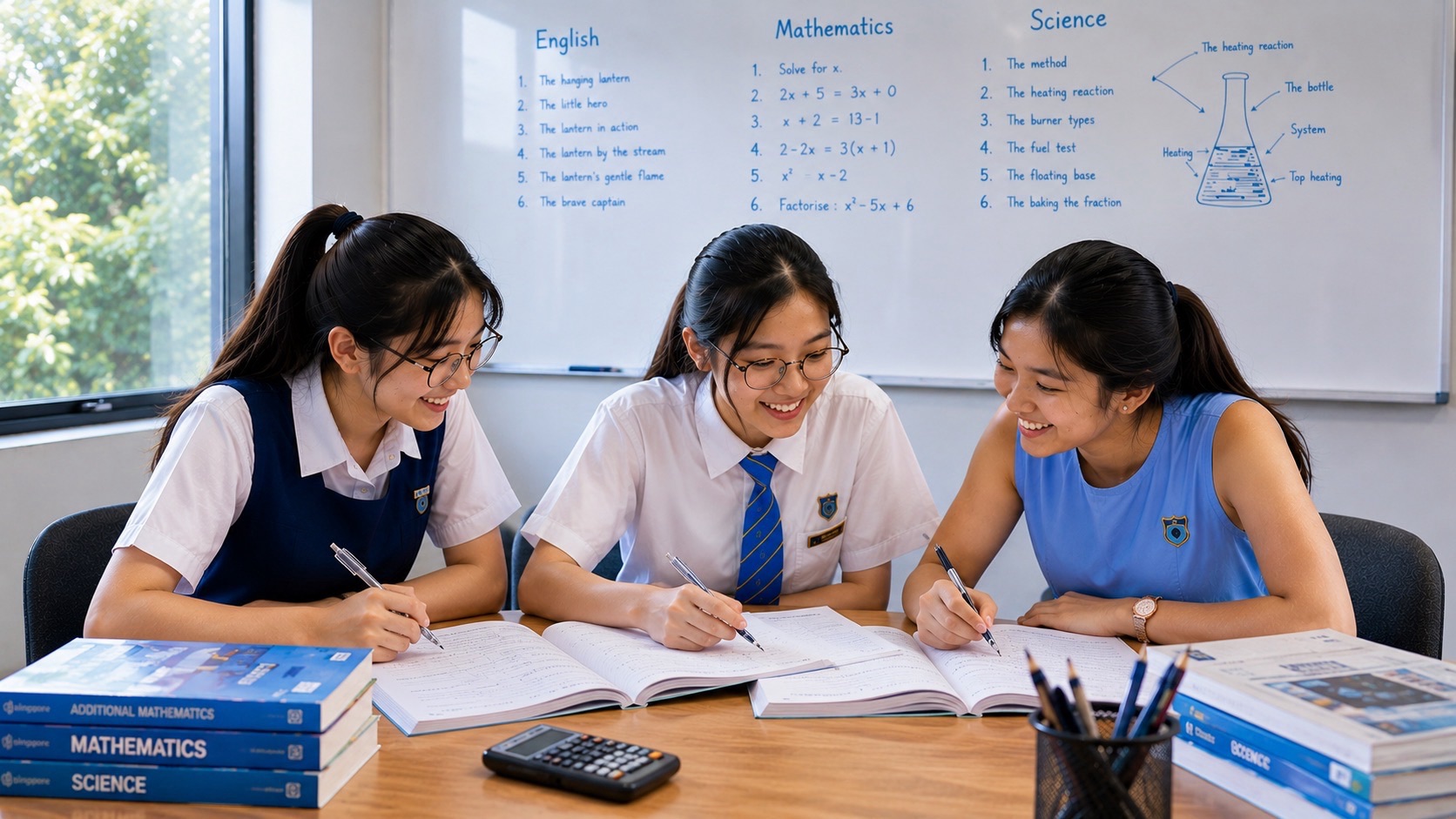
SEC Examination Mathematics tuition for Beach Road families should prepare a student for the Mathematics subject level actually being examined while strengthening the skills that determine reliable performance: conceptual understanding, arithmetic fluency, algebra, graphs, geometry, statistics, problem-solving, written working, calculator control, accuracy, checking and examination confidence. Parents searching for SEC Maths tuition in Singapore, G1 Mathematics tuition, G2 Mathematics tuition or G3 Mathematics tuition are often looking for the same practical outcome: a student who can recognise the mathematical structure of a question, choose an appropriate method and complete the work independently under assessment conditions.
From 2027, the Singapore-Cambridge Secondary Education Certificate brings the former N(T), N(A) and O-Level certificates into one SEC qualification, while students continue to sit individual subjects at G1, G2 or G3. SEAB lists 2027 Mathematics as K110 at G1, K210 at G2 and K310 at G3. A useful SEC Mathematics programme therefore begins by confirming the student’s actual subject level and current official syllabus, then using school evidence to identify the first weak link rather than treating every low mark as the same problem.
This Beach Road page is a local examination-discovery route inside eduKateSG’s existing Mathematics system. It does not imply a physical eduKateSG branch in Beach Road, and it does not replace the established Secondary 1–4 Mathematics owners, Additional Mathematics owners, the Mathematics Learning Hub or the Examinations & Assessment Hub. Its narrower job is to explain how diagnostic gap repair, mixed practice, timed execution, visible working and checking can be organised for the current G1/G2/G3 SEC transition.
What the SEC Transition Changes
The SEC changes the qualification structure, but it does not turn Mathematics into one common paper for every student. Subject level still matters. A learner taking G1 Mathematics should not be prepared as though the G2 or G3 syllabus were automatically the target, and a learner taking G3 Mathematics needs preparation that respects the depth, notation and problem demands of that level. The correct starting point is the actual subject level shown by the student’s school programme and current official syllabus.
That distinction also protects the site architecture. SEC examination tuition is an assessment-performance route, not a substitute for year-specific Secondary 1, Secondary 2, Secondary 3 or Secondary 4 teaching. A student may still need a year-level owner for systematic concept development, while this page focuses on reliability when knowledge must be retrieved, selected, expressed and checked under examination conditions.
Confirm the Actual Mathematics Level First
Before prescribing practice, confirm whether the student is preparing for G1, G2 or G3 Mathematics and which school assessments are currently being used. It is easy to waste time by practising material that is too easy, too advanced, or simply outside the student’s present examination route. Level confirmation is therefore not administrative detail; it is the first diagnostic control because it defines what knowledge and performance evidence should be compared.
The tutor should then collect the student’s recent marked scripts, classwork, correction work and topic history. A single total score hides too much. Two students with the same mark may have completely different profiles: one may lose marks through algebraic manipulation, another through question interpretation, another through incomplete working, and another because basic numerical facts consume too much working memory.
Start with Evidence, Not a Label
Descriptions such as weak in Maths, careless or not confident are too broad to guide repair. A stronger diagnosis asks where the first unreliable step appears. Does the student misunderstand the concept, retrieve a fact too slowly, select the wrong method, misread a relationship, perform an operation inaccurately, omit necessary working, round incorrectly, mishandle units or fail to check an answer that should have looked unreasonable?
The purpose of diagnosis is not to produce a longer list of faults. It is to identify the earliest useful point of intervention. If the first error occurs when translating words into a mathematical representation, drilling the final algebraic steps may improve familiarity without repairing the actual bottleneck. If the first error is arithmetic execution, teaching more advanced heuristics may simply place more load on an already unstable foundation.
Conceptual Understanding before Compression
Procedures become fast only after relationships become stable. A student who has memorised a sequence of steps but cannot explain why the steps preserve equality, proportionality, area, angle, average or probability is vulnerable when the surface form changes. SEC preparation should therefore test whether the student can reconstruct a method from mathematical meaning rather than recognise only the worksheet pattern in which it was first taught.
Conceptual understanding does not mean abandoning fluency. The goal is compression with meaning: the student sees enough structure that an efficient method becomes available quickly. When a learner can explain why a transformation is valid, compare two solution routes and predict the effect of changing a quantity, the procedure is more likely to survive unfamiliar wording or a changed diagram.
Number Sense Still Matters in Secondary Mathematics
Secondary Mathematics is more symbolic than Primary Mathematics, but number sense remains underneath nearly every topic. Students need a feel for magnitude, sign, proportional change and reasonable size so they can detect answers that are mathematically possible yet implausible. A learner who enters a calculator command and accepts any displayed value has surrendered an important source of error detection.
Useful practice includes estimation before exact calculation, comparing nearby values, checking whether a negative result fits the context, and asking how an answer should change when an input grows or shrinks. These habits create a numerical expectation that can challenge an incorrect procedure before the mistake travels through the rest of the solution.
Place Value, Decimals and Standard Form
Place value does not disappear after Primary school. It reappears in decimals, measurement, significant figures and standard form. Students who are uncertain about powers of ten can make large errors while still producing neatly written working. The tutor should therefore check whether the student understands the size of a number, not merely whether a calculator can display it.
A practical diagnostic asks the learner to order values written in different forms, convert between ordinary notation and standard form, and estimate the effect of multiplying or dividing by powers of ten. The explanation is more informative than the final answer because it shows whether the place-value structure is available for later scientific and mathematical work.
Arithmetic Fluency as Working-Memory Protection
Secondary Mathematics still depends on accurate number work. Fractions, signed numbers, decimals, percentages, ratio and estimation repeatedly appear inside larger questions. If these operations require excessive attention, the student has less capacity available for the main reasoning task. Arithmetic fluency therefore matters not because every question should be rushed, but because reliable basic operations protect the thinking needed for algebra and multi-step problem solving.
Useful practice alternates short retrieval work with application. The student might first calculate with signed numbers or fractions in isolation, then use the same operations inside an equation, a percentage question or a geometric context. The transfer condition matters: fluency should remain available when the operation is not announced by the exercise title.
Fractions, Ratio and Percentage as Connected Structures
Fractions, ratio and percentage should not live in separate mental compartments. They all express relationships between quantities. A student who sees only separate chapter procedures may know how to execute a percentage calculation but fail to recognise the same multiplicative structure when the question is expressed as a ratio or fractional change. Examination preparation should therefore include conversion, comparison and representation across forms.
A strong diagnostic task changes the representation while preserving the relationship. For example, the tutor can ask the student to describe the same proportional situation using a fraction, a ratio, a percentage and a simple diagram. If one representation breaks the understanding, the repair is conceptual rather than merely procedural. Mixed practice then tests whether the learner can identify the relationship without a topic label.
Rates and Proportional Reasoning
Rates describe how one quantity changes relative to another. Students meet them in speed, price, density-style comparisons and many everyday contexts. The difficulty is often not arithmetic but identifying which quantities should be compared and keeping the units attached to the relationship.
A useful habit is to name the rate in words before calculating. Instead of writing only a division sign, state what the result will mean: kilometres per hour, dollars per item, units per minute or another appropriate relationship. This makes unit checking natural and helps the student notice when the numerator and denominator have been reversed.
Algebraic Reliability
Algebra is often where earlier numerical weaknesses become visible. The symbols are not the problem by themselves; they increase the amount of structure the learner must preserve. Equality, inverse operations, substitution, expansion, factorisation, manipulation and equation solving all require the student to change the form of an expression without changing the mathematical relationship it represents.
SEC preparation should inspect each algebraic line as a decision. Why was this term moved, combined, expanded or divided? What remained invariant? Where could a sign change or distribution error occur? Students become more reliable when they can explain the purpose of a transformation and when written working makes each change visible enough to inspect.
Equations and Unknown Quantities
An equation is not an instruction to move numbers around; it states a relationship that is true under particular values. Students who understand this can solve more flexibly because they know that any valid operation must preserve equality. Students who rely on surface rules may perform well on familiar forms but become uncertain when the unknown appears in a different place or the equation contains fractions, brackets or several operations.
Practice should therefore include standard forms, altered forms and explanation prompts. After solving, the learner substitutes the answer back into the original relationship where appropriate. This is a powerful checking habit because it does not merely repeat the same method. It tests the solution against the condition that defined the problem.
Formula Substitution without Losing Meaning
Substitution appears simple, yet it exposes several habits at once: identifying the correct formula, matching variables to quantities, preserving units, using brackets correctly and evaluating in an appropriate order. Students who treat formula work as blind replacement are vulnerable when the subject of the formula changes or when a negative value is substituted.
The tutor should ask the learner to state what each symbol represents and predict the approximate result before calculation. This makes the formula a mathematical relationship rather than a string of letters. Once substitution is stable, rearrangement and multi-step use become easier because the student can see what the symbols are doing.
Graphs and Functions as Relationships
Graphs compress relationships into visual form. A student needs to read coordinates, scale, gradient, intercept, shape, change and context without assuming that every graph means the same thing. Examination questions may require movement between an equation, a table, a graph and a verbal description. Each representation carries the same underlying relationship in a different surface form.
The tutor can diagnose graph weakness by asking the student to describe what changes and what stays fixed when one representation is converted into another. A learner who can plot points but cannot explain the meaning of a gradient needs a different repair from one who understands the relationship but makes scale errors. Mixed representation tasks make those distinctions visible.
Coordinates, Gradient and Intercepts
Coordinate work is reliable when the student sees points and lines as geometric and algebraic objects at the same time. Gradient describes a rate of change, while an intercept describes where a relationship meets an axis. Memorising a formula is useful, but the formula becomes more robust when the student can connect its numerator and denominator to vertical and horizontal change.
Practice should include reading from graphs, constructing graphs from data or equations, and checking whether a calculated gradient matches the visual direction and steepness of the line. The visual representation provides an independent reasonableness check, especially when a sign error would reverse the direction.
Geometry and Diagram Discipline
Geometry rewards students who separate what is given from what merely looks true in a diagram. Angles, lengths, parallel lines, similarity, congruence, area and volume require precise use of properties rather than visual guesswork. A diagram is a representation of information; unless the question establishes a property, appearance alone is not evidence.
Good working names the relationship being used. The student should be able to state why an angle is equal, why a pair of triangles can be compared, or why a formula applies. This habit improves accuracy and also makes correction more useful, because the tutor can see whether the problem lies in property knowledge, selection, arithmetic or communication.
Measurement, Units and Scale
Many avoidable losses occur after the main mathematics is already correct. Units are omitted, quantities are converted inconsistently, scale factors are applied to the wrong dimension, or an answer is rounded before all operations are complete. These errors are not trivial because they show that the student is treating symbols as detached from measured quantities.
A useful routine is to write the unit beside intermediate quantities when it helps preserve meaning, delay rounding until the appropriate stage, and check whether the final unit matches the quantity being asked for. Estimation can provide a second layer of evidence: even when the exact calculation is complex, the approximate size of the answer should remain plausible.
Area, Surface Area and Volume
Area and volume require attention to dimensionality. A scale factor that doubles a length does not simply double every associated measure. Students need to distinguish one-dimensional length, two-dimensional area and three-dimensional volume rather than applying one rule indiscriminately.
A strong diagnostic asks the learner to predict how a change in length should affect area or volume before inserting numbers. This reveals whether the student sees the geometric relationship. The exact formula can then be used with greater control because the expected direction and approximate size of change are already known.
Statistics and Data Interpretation
Data questions require more than applying a formula. Students need to read tables, charts and summaries, identify what a statistic describes and avoid conclusions that the data do not support. Mean, median, range and other summaries answer different questions about a dataset. A change in one value may affect these summaries differently.
SEC preparation should include interpretation before calculation. Ask what the data represent, which comparison is meaningful and what information is missing. The arithmetic may be straightforward, yet the reasoning can fail if the learner compares incompatible groups or treats a summary as though it described every individual value.
Probability and Reasonable Outcomes
Probability requires students to connect numerical values with possible outcomes. A probability should sit within a coherent sample space, and answers should be checked against basic bounds and the structure of the event. When learners memorise isolated formulas without understanding the event being counted, they are more likely to double-count, omit possibilities or interpret the result incorrectly.
Useful practice begins with explicit sample spaces and gradually reduces the support. The tutor asks the student to explain why outcomes are included, whether they are equally likely where that assumption is used, and how the probability should change if the conditions change. Explanation helps reveal whether the number is understood or merely produced.
Mathematical Language and Question Reading
A Mathematics examination is also a reading task. Terms such as at least, no more than, difference, increase, decrease, proportional, consecutive, corresponding and estimate constrain the mathematical model. A student can possess the required Mathematics and still lose marks if the language is converted into the wrong relationship.
Question reading should therefore be trained as translation. Identify the quantities, relationships, conditions and target. Then decide what representation makes those relationships easier to inspect: an equation, table, graph, diagram or labelled sketch. The representation is not decorative. It is an external thinking surface that reduces the amount the learner must hold mentally.
Model Drawing as a Relationship Tool
Bar models are associated strongly with Primary Mathematics, but the deeper habit remains useful in Secondary work: represent known and unknown quantities so their relationships become visible. Older students may use algebra, tables, graphs or geometric sketches more often, yet the principle is the same. A representation should reduce ambiguity before calculation begins.
For some percentage, ratio or word problems, a quick model can expose the whole-part structure more clearly than immediately defining several variables. The tutor should not force one representation on every question. The skill is choosing the simplest representation that makes the relationship inspectable.
Multi-Step Problems
Multi-step problems create difficulty because an intermediate result must be interpreted before the next method is chosen. Students often rush from one calculation to another without deciding what the first answer represents. This can produce technically correct arithmetic that is connected to the wrong quantity.
A disciplined approach labels intermediate results. After each step, the student states what has just been found and why it is useful. This slows the early reasoning slightly but often speeds the entire solution because it prevents wandering. With practice, the labels become shorter as the structure becomes more familiar, while the habit of preserving meaning remains.
Method Selection before Calculation
Many examination errors begin before the first line of arithmetic. The learner sees a familiar number pattern and starts calculating before deciding which mathematical relationship applies. Strong SEC preparation therefore separates method selection from execution. The student should be able to say what the question is about and why a particular route is appropriate before committing to a long calculation.
One useful drill presents several questions but asks only for the first valid step or the proposed method. No full solution is required initially. This makes strategic knowledge visible without letting later arithmetic hide the decision. Once method selection improves, complete solutions are reintroduced and tested under mixed conditions.
Worked Examples and Faded Support
Worked examples are useful when the student studies the decisions inside them rather than copies the surface pattern. The tutor can ask what each line achieved, which relationship justified it, and what would change if one condition were altered. This turns the example into a model of reasoning rather than a script to reproduce.
Support should then be reduced. A partially completed example may leave the key decision blank; the next problem may change the context; a later problem may appear in a mixed set with no hint about the method. The important evidence is whether the student can reconstruct the route after the example is no longer visible.
Written Working as External Memory
Clear working is not only for the marker. It protects the student. A long question places demands on working memory, and written lines allow information to be stored outside the mind. Good working makes substitutions, transformations, intermediate quantities and units visible enough to inspect. It also makes recovery easier when the learner notices that something has gone wrong.
The aim is not to write every thought. The aim is to record the decisions that matter. Students can learn to distinguish useful working from clutter by asking whether a later reader could reconstruct the mathematical route. Over time, efficient working becomes a performance tool: concise enough to preserve time, explicit enough to support checking.
Calculator Control
A calculator can reduce routine computation, but it does not choose the model, define the expression or interpret the output. Students need to enter expressions accurately, use brackets deliberately, recognise when exact form should be preserved and notice when a displayed answer is inconsistent with the scale of the problem.
Calculator practice should therefore include prediction before entry. Estimate the sign and approximate magnitude, then calculate. If the result conflicts with the prediction, inspect both the input and the reasoning. This creates a two-source checking process: mathematical expectation and machine output support each other rather than the calculator becoming an unquestioned authority.
Exact Values, Rounding and Significant Figures
Premature rounding can create avoidable differences in later steps. The safest general habit is to preserve sufficient accuracy through the working and round when the question or mathematical context requires it. Students also need to distinguish decimal places from significant figures and to understand that exact forms may be preferable when the calculation is still in progress.
The checking question is simple: what level of precision does this answer claim, and is that precision justified by the task? Units, context and instructions all matter. A student who treats rounding as a final presentation decision rather than an automatic reflex is less likely to accumulate unnecessary numerical error.
Checking by Independent Evidence
Repeating the same calculation often repeats the same mistake. Strong checking changes the evidence source. Substitute a solution back into an equation, estimate the magnitude, use an inverse operation, compare with a graph, inspect units, test a simple boundary case or solve by a second method when time permits. The best check depends on the structure of the question.
Students can build a small repertoire of checks and practise choosing among them. This prevents the vague instruction check your work from becoming a final glance at the page. A check is useful when it can actually disagree with the first solution and reveal a problem.
Time Management and Start Latency
Time pressure is not solved only by working faster. Some students lose minutes before they begin because they repeatedly reread a difficult question without creating a representation or attempting a first valid step. Others spend too long protecting one hard item and leave easier marks untouched.
Timed practice should record start latency, completion time and recovery behaviour rather than only total score. The student learns a decision rule for when to continue, when to mark a question for return and how to re-enter it later. The objective is steady paper completion, not frantic speed.
School Assessments as Diagnostic Evidence
School assessments provide useful evidence because they reveal how the learner performs under the school’s current teaching sequence and conditions. The tutor should not treat every school paper as a perfect model of the final SEC examination, but the marked script can show recurring errors, missing concepts, slow retrieval, weak communication and timing patterns.
After each assessment, classify the lost marks by mechanism. Then choose a small number of high-leverage repairs. If ten errors stem from the same algebraic weakness, they should not be recorded as ten unrelated problems. Grouping errors by cause turns the script into a map for practice.
Mixed Practice and Topic Switching
Topic-by-topic practice is useful while a concept is being learned, but examinations require the student to identify the topic independently. Mixed practice removes the label and forces method selection. A page may move from algebra to geometry to statistics to percentage, requiring the learner to recognise the structure before applying a procedure.
The transition should be staged. Begin with a small mixture of recently learned topics, then widen the range and introduce older material. The student should explain why a method was chosen. Over time, this builds discrimination: knowing not only how to perform a procedure, but when it is the right one.
Retrieval without the Chapter Heading
A common illusion of readiness appears when students can solve a question immediately after seeing several examples of the same type. The chapter heading and surrounding questions act as powerful cues. In an examination, those cues disappear.
Retrieval practice should therefore include delayed return and changed presentation. The student meets a concept after time has passed, among unrelated questions, and with altered numbers or context. If the method still comes to mind and can be explained, the knowledge is becoming usable rather than merely familiar.
Diagnostic Gap Repair
Diagnostic gap repair begins with the earliest missing prerequisite that still matters to the current task. A Secondary student struggling with equations may need an algebraic repair, but the true gap could also be signed-number arithmetic, fraction operations, equality or reading the problem. Repairing the wrong layer wastes effort and can make the learner feel that improvement is mysterious.
The tutor should use short probes that isolate competing explanations. Change one feature at a time: remove awkward arithmetic, simplify the wording, provide a diagram, ask for the first step only, or let the student explain without calculating. The pattern of success and failure shows where instruction should begin.
The Error Ledger
An error ledger is useful when it records mechanisms rather than embarrassment. Each entry can state the question type, first wrong decision, likely cause, corrected principle and a later retest date. Categories might include concept, retrieval, interpretation, method selection, arithmetic, algebra, representation, unit, rounding, checking or time control.
The retest is essential. Correcting a script while the solution is visible proves only that the student can follow the correction. A later changed question tests whether the repair has become retrievable. The ledger becomes shorter and more useful when repeated causes are consolidated rather than counted separately.
Alicia: Knowledge That Arrives Too Slowly
Alicia often understands a method once prompted, but retrieval is slow enough that simple steps consume too much of the paper. Her issue is not a lack of ability or a need for harder worksheets. The diagnostic task is to identify which foundational facts and procedures should become faster while preserving conceptual understanding.
Her practice combines brief retrieval sets with immediate application in mixed questions. The tutor watches whether speed improves without accuracy collapsing. When a fact is retrieved more efficiently, the saved attention becomes available for the larger problem. Confidence follows evidence: she sees that she can begin without waiting for a prompt.
Tricia: Strong Calculation, Fragile Interpretation
Tricia can execute algebra accurately after the correct equation has been formed, yet she sometimes translates the question into the wrong relationship. More algebra drills would strengthen a skill she already possesses while leaving the main bottleneck untouched.
Her repair focuses on quantities, conditions and representations before calculation. She explains the relationship in ordinary language, sketches or labels when useful, then writes the equation. Only after the model is agreed does she solve it. Changed-context questions test whether the interpretation skill transfers beyond the original wording.
Kai Kai: One Difficult Question Disrupts the Paper
Kai Kai can perform well across most topics but sometimes spends too long on a difficult item. The cost is not limited to that question; it reduces time for later work and can unsettle checking. His preparation therefore includes recovery behaviour as part of Mathematics performance.
During timed sets, he practises identifying a valid first step, setting a sensible limit for unproductive effort and leaving a clear marker for return. When he comes back, he rereads from the quantities and conditions rather than continuing the previous confusion. The goal is controlled persistence and steady completion.
Three Students, One Small Group
A three-student Mathematics tutorial can preserve a common lesson while giving each learner a different diagnostic constraint. Alicia may need quicker retrieval, Tricia may need more deliberate question translation and Kai Kai may need stronger time recovery. They can still work on the same mathematical topic because the tutor changes what is observed and what support is reduced.
Small-group teaching is most useful when the tutor can see working, ask for explanations and alter the next question quickly. The group should not become three parallel private lessons, nor should every learner receive identical practice regardless of need. Shared mathematical discussion and individual diagnosis can coexist.
A 1.5-Hour SEC Mathematics Lesson
A practical lesson can begin with a short retrieval and diagnostic check, move into one targeted repair, then apply that repair in mixed examination-style work. The final part should include an independent or timed segment so the tutor can see what survives after explanation and guided practice.
The sequence matters more than the exact minute count. Diagnosis should inform instruction; instruction should lead to application; application should be followed by reduced support; reduced support should produce evidence for the next lesson. This creates a loop in which practice is selected because of observed need rather than because the next worksheet happens to be available.
Four Weeks before a School Assessment
With four weeks available, the first week should identify the highest-leverage gaps and restore missing concepts. The second can strengthen retrieval and standard application. The third should increase mixed practice and timing. The fourth should emphasise realistic paper conditions, checking and selective repair rather than introducing a large new catalogue of tricks.
The plan changes when evidence changes. If a concept remains unstable, it deserves more repair time. If accuracy is strong but time is poor, timed mixed sets become more useful. A calendar is a framework, not a reason to ignore the student’s actual performance.
The Final Week
In the final week, students often benefit more from consolidation than from panic-driven volume. Review recurring error categories, practise representative mixed questions, rehearse calculator and checking habits, and preserve enough rest for clear thinking. A late flood of unfamiliar methods can reduce confidence and interfere with routes that were already working.
Short, high-quality sessions can include retrieval, one or two demanding problems, a checking routine and a clear stop point. The student should enter the assessment knowing what to do when a question is unfamiliar: identify the quantities, represent the relationship, attempt a valid first step, keep working visible and move on when necessary.
Homework that Produces Useful Evidence
Homework is most useful when it shows what the student can do between lessons without immediate rescue. A long sheet completed with extensive hints may generate less useful evidence than a shorter set that reveals which methods can be retrieved independently. The amount of work should therefore be matched to the learning purpose.
One approach is to mark questions by support level: independent, small hint, substantial help or unresolved. The tutor can then inspect the pattern at the next lesson. This turns homework into information about independence rather than a simple completion count.
Corrections that Become New Learning
Correction work should not stop at copying the right answer. The learner needs to identify the first wrong decision, state the corrected principle and then solve a changed question later without the original solution in view. Otherwise, the correction may measure recognition rather than learning.
A useful correction sequence is brief: classify the error, repair the mechanism, complete one near example, then schedule a delayed mixed retest. When the student succeeds later under changed conditions, the correction has produced stronger evidence that the route is becoming retrievable.
Parent Support without Taking Over
Parents can support SEC Mathematics by asking about evidence rather than demanding a particular number of worksheets. Which errors keep repeating? Which concepts are now stable? What can the student do without prompting? What happens on mixed questions? How is timing changing? These questions encourage a more precise conversation about progress.
At home, the aim is to protect conditions for independent work. Help can clarify the task or provide a suitable resource, but the learner still needs to perform the mathematical decisions. If every difficult step is rescued immediately, the homework may look complete while the underlying capability remains uncertain.
Examination Confidence as a Result of Reliability
Confidence is useful when it is grounded in repeated evidence. A student becomes more secure after retrieving methods without labels, completing mixed sets, recovering from difficult questions, checking answers effectively and seeing fewer repeated errors over time. Confidence built only from reassurance is fragile because the assessment eventually removes the reassuring voice.
The tutor can make improvement visible through small performance receipts: fewer algebra sign errors, faster start times, more complete working, better unit discipline, stronger mixed-topic accuracy and successful delayed retests. These are concrete reasons for the learner to trust the process.
Questions Families Should Ask
A useful SEC Mathematics tuition programme should be able to explain how it confirms the student’s G1, G2 or G3 level, diagnoses errors, separates concept weakness from execution weakness, handles school assessments, develops mixed-paper readiness and checks whether learning survives reduced support. It should also be clear about the boundary between ordinary year-level teaching and specific examination preparation.
Parents can also ask how the tutor responds when a student already knows a topic. Good tuition should not force unnecessary repetition simply because a worksheet exists. The next task should increase independence, transfer, precision or speed in a way justified by evidence from the learner’s work.
Official Routes and Sibling Mathematics Pages
For official 2027 SEC subject information, families should use SEAB’s current G1, G2 and G3 syllabus pages: G1 syllabuses, G2 syllabuses and G3 syllabuses. These official pages control current subject codes and syllabus documents.
Within eduKateSG, the subject map remains the Mathematics Learning Hub, while broader assessment routes remain in the Examinations & Assessment Hub. Beach Road local foundation siblings are Primary 1 Mathematics Tuition, Primary 2 Mathematics Tuition and Primary 3 Mathematics Tuition.
Closing Principle
SEC Mathematics preparation is strongest when every practice task has a reason. Confirm the level, locate the first unreliable step, repair it, mix it with neighbouring topics, reduce support, test it again after a delay and place it under realistic assessment constraints. The goal is not the largest possible worksheet count. The goal is a learner who can make correct mathematical decisions when the question no longer looks familiar.
For Beach Road families, this local page is simply the discovery route into that system. The Mathematics itself remains the national subject architecture, and the most useful tuition decision is the one that makes the student’s next mathematical action more independent, more accurate and more explainable.