
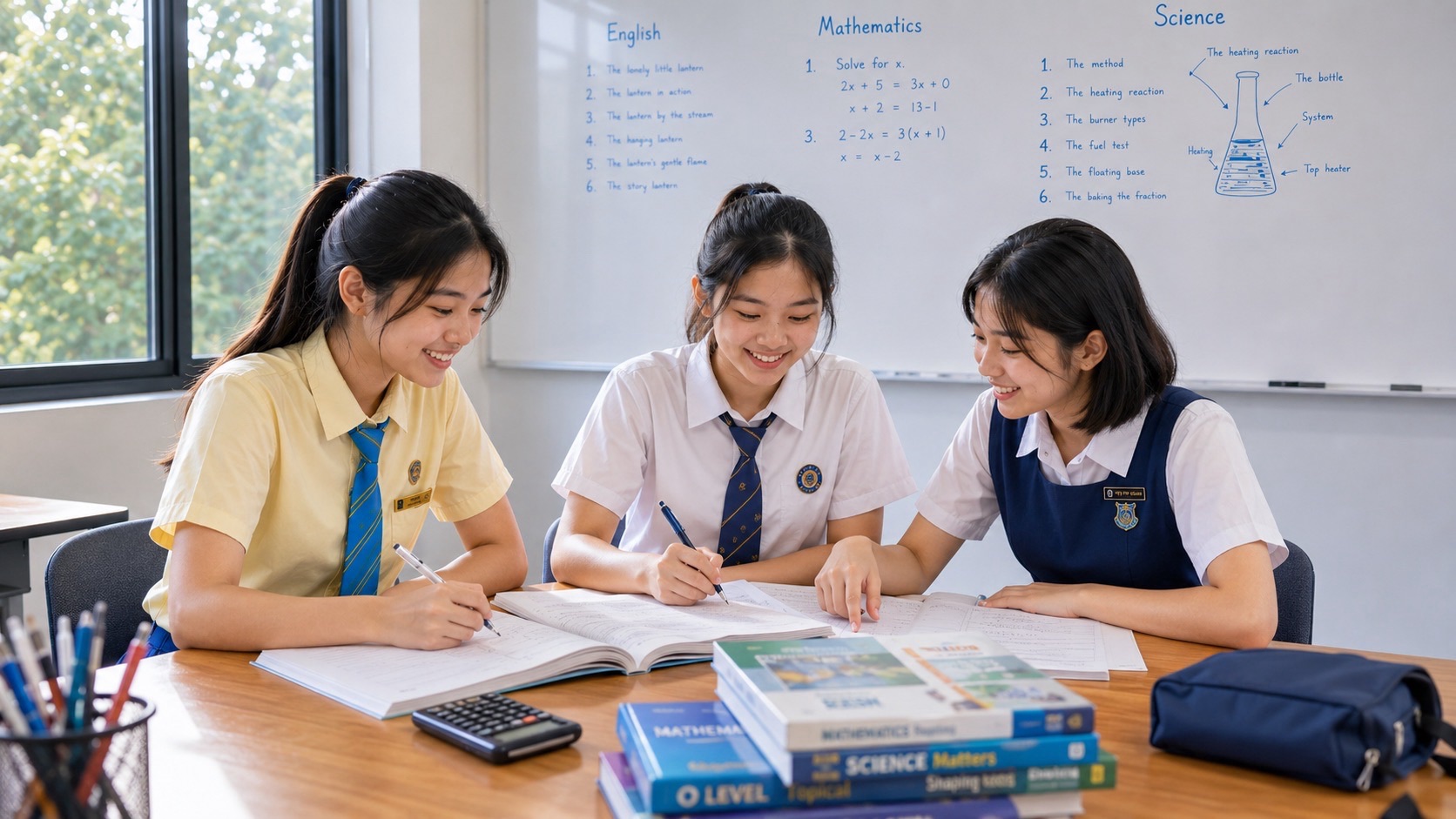
Secondary 2 Mathematics tuition for Bendemeer families should be designed around consolidation rather than acceleration. By the second year of secondary school, students have already met algebra, directed numbers, ratio, percentage, geometry, graphs and statistics, but many can still succeed only when questions arrive in familiar chapter order. Secondary 2 is the year to turn separate procedures into a connected system so that a student can recognise which idea is needed, retrieve it without prompting and combine it with another idea when the question changes form.
Parents searching for Secondary 2 Mathematics tuition in Bendemeer, Sec 2 Math tutoring, G1/G2/G3 Mathematics support, lower-secondary E-Math preparation or small-group Mathematics classes are usually asking a readiness question: can their child use algebra, ratio, graphs, geometry and data reliably enough to enter upper secondary without carrying a backlog of hidden weaknesses?
This page is the Bendemeer year-specific Secondary 2 route within eduKateSG. Bendemeer is a local discovery context rather than a claim that eduKateSG operates a physical branch there. It complements the national Secondary 2 Mathematics Tuition owner, the Mathematics Learning Hub, How Mathematics Works, and the existing SEC Examination Mathematics Tuition | Bendemeer route.
Secondary 2 is where isolated skills become a network
Adrian can simplify an expression in one worksheet and solve a percentage question in another. His difficulty appears when a problem requires both. The ingredients are familiar, but the sequence is not. This is why Secondary 2 should deliberately connect topics instead of treating every chapter as an isolated folder.
Good tuition asks what relationship survives across topics. Algebra can express ratio. Graphs can express equations. Percentage change can be represented with multipliers. Geometry often depends on a chain of justified conditions. Once students notice these connections, unfamiliar questions become less intimidating.
Start with a mixed diagnostic
Jo completes twelve short problems with no topic labels: an equation, a ratio-total question, percentage change, graph interpretation, geometry reasoning, statistics and several algebraic manipulations. Where she hesitates is often more informative than whether she eventually gets the answer.
A mixed diagnostic separates three issues: missing knowledge, weak method selection and unreliable execution. The repair for each is different. Teaching more content will not fix a student who already knows the method but cannot identify when to use it.
Algebraic equivalence should become dependable
Different-looking expressions can represent the same quantity. The forms 4(x+3) and 4x+12 are equivalent for every value of x. Ben learns to see expansion and factorisation as transformations between equivalent forms rather than unrelated tricks.
Substitution can sometimes be used as a check. If he suspects an expansion is wrong, he can insert a simple value such as x=2 into both expressions. A mismatch proves that the transformation failed. This does not replace algebraic reasoning, but it gives the learner a useful verification tool.
Algebraic fractions expose ordinary fraction weaknesses
Aisha sees x/3+x/4 and tries to add denominators. The repair is not “more algebra”; it is fraction meaning. A common denominator of 12 gives 4x/12+3x/12=7x/12. The symbols have changed, but fraction laws have not.
Secondary 2 tuition should watch for these hidden dependencies because they later reappear in equations, formulae and upper-secondary algebra.
Linear equations now require sequence choice
Ryan solves 3(x-2)=2x+5 by expanding first: 3x-6=2x+5, then x=11. Another valid route might manipulate the equation differently. The important point is that every line remains equivalent to the previous one.
Students should compare routes and ask which one keeps signs, fractions and brackets easiest to audit. Method choice is becoming part of mathematical competence.
Graphs are relationships, not pictures
If y=3x-2, the equation gives a rule, a table gives selected pairs, and a graph displays the relationship geometrically. Mira learns to move among all three forms. She also asks what the gradient means: when x increases by one, y increases by three.
This representational flexibility will matter in coordinate geometry and later function work. A student who can only plot points mechanically has not yet captured the relationship.
Upper-secondary readiness is independence
Clara does not need to begin every Secondary 3 chapter early. A better test is whether she can start mixed problems without a chapter heading, retrieve old methods after several weeks, explain a correction and recognise when a prerequisite is missing.
A student who is “ahead” but depends on examples beside every question may be less ready than an on-level student who can select methods independently.
Keep Additional Mathematics separate
Some students may later take Additional Mathematics, but main Mathematics consolidation should not be turned into premature A-Math drilling. Strong algebra, graphs, proportional reasoning and geometry are the best preparation.
The existing Additional Mathematics Tuition architecture remains separate because it serves a distinct syllabus and search intent.
Factorisation should be taught as structural reversal
Factorisation becomes much easier to retain when it is connected directly to expansion. If 6(2x+5) expands to 12x+30, then 12x+30 can be factorised to 6(2x+5). Ethan checks a factorised answer by expanding it immediately. This makes factorisation a reversible relationship rather than a one-way trick.
The habit matters because upper-secondary algebra is full of situations where a useful form must be chosen deliberately. Expanded form can reveal individual terms; factorised form can reveal common structure. Secondary 2 is a good year to make students ask which form helps the next step.
Simultaneous conditions require a model before a method
Suppose two notebooks and a pen cost $11 while one notebook and two pens cost $10. Let n represent the notebook price and p the pen price. Then 2n+p=11 and n+2p=10. The two equations are not arbitrary; they encode two conditions that must both remain true.
Adrian first checks whether his equations match the story. Only then does he solve. This separation between modelling and solving is powerful because a perfectly executed algebra method cannot rescue a wrong model.
Direct proportion is about a constant ratio
If y is directly proportional to x, then y/x stays constant for non-zero x. Writing y=kx gives the relationship a reusable form. If y=20 when x=5, then k=4 and y=4x.
Jo can now move from a context to an equation and from the equation to a graph. She sees that the proportionality constant is not another formula to memorise; it is the invariant that explains the relationship.
Inverse proportion requires an assumption check
For a fixed journey distance, average speed and travel time can form an inverse relationship: if the speed doubles while the distance remains unchanged, the idealised travel time halves. The phrase “fixed distance” is part of the model.
Ben learns to state the condition instead of applying y=k/x whenever two quantities appear to move in opposite directions. Mathematical models are useful because their assumptions are explicit.
Percentage multipliers organise repeated change
A 12% increase can be written as multiplication by 1.12; a 12% decrease as multiplication by 0.88. If a $500 item rises by 12% and then falls by 12%, the calculation is 500×1.12×0.88=$492.80, not $500.
Aisha explains why the changes do not cancel: the second percentage acts on the new amount. Multiplier notation helps her preserve the correct base and later supports compound growth, depreciation and financial contexts.
Similarity depends on matching corresponding parts
Students often remember that similar figures have proportional sides but pair the wrong sides. Ryan writes the corresponding vertices in matching order before creating a proportion. If triangle ABC is similar to DEF, then A corresponds to D, B to E and C to F.
Once correspondence is explicit, scale-factor reasoning becomes safer. This also prepares the student for area and volume scale factors, where a linear scale change affects two or three dimensions.
Pythagoras begins with the right angle
The equation a²+b²=c² applies to a right-angled triangle, with c as the hypotenuse opposite the right angle. Clara marks the right-angle symbol and labels the hypotenuse before substituting any numbers.
This simple routine prevents a common mistake in compound diagrams where several triangles are visible. The student should identify the relevant structure before reaching for a formula.
Trigonometry should begin with side relationships
Sine, cosine and tangent describe ratios between sides relative to a chosen angle in a right-angled triangle. Opposite and adjacent therefore depend on the angle being used; the hypotenuse is fixed.
Mira redraws a cluttered diagram, marks the target angle and labels the three sides before selecting a ratio. Calculator use comes only after the mathematical relationship is clear. This protects students from pressing buttons before they have modelled the triangle.
Statistics should move from calculation to interpretation
Two data sets can share the same mean while having very different spreads. A large outlier can pull the mean without changing the median as dramatically. Ethan compares the summaries and asks what each one hides.
This is an important Secondary 2 shift: a student should not only calculate a statistic but understand what claim the statistic can reasonably support.
Probability starts by defining the outcome space
Before writing a probability fraction, list or describe the possible outcomes. For two coin tosses, the equally likely ordered outcomes are HH, HT, TH and TT. The probability of exactly one head is therefore 2/4=1/2.
Adrian learns that probability becomes unreliable when the denominator is chosen by instinct. Defining the sample space makes the reasoning inspectable and prepares him for changing sample spaces later.
Mixed problems are chains of decisions
A question may increase the length of a rectangle by 20% and then ask for its new area. The student must identify the original length, apply the percentage change to that quantity, preserve the unchanged width and then use the area formula.
Jo writes a one-line plan before calculating. This prevents a common failure mode in which every individual procedure is known but the order is wrong.
Retrieval should be scheduled, not left to chance
If a topic disappears after its chapter test, forgetting is predictable. A weekly retrieval set can include current content, material from the previous month and one or two older dependencies.
Ben’s set is short enough to complete consistently. The goal is not to create another pile of homework; it is to make important methods available when later topics depend on them.
Interleaving removes method cues gradually
Blocked practice is useful while a method is first being learned. After that, questions should be mixed in stages. Aisha may first practise only direct proportion, then direct versus inverse proportion, and finally a set where proportional reasoning appears among algebra and geometry.
Each stage removes a cue. By the end, the student must identify the mathematical structure from the question itself.
Correction should produce a rule for the next attempt
Writing “careless” beside a wrong answer does not change future behaviour. Ryan writes a specific control point: “I matched non-corresponding sides,” “I used the original base for the second percentage,” or “I treated diameter as radius.”
Before the next mixed set, he scans these controls. The correction process becomes prospective: it is designed to influence the next decision, not merely explain the last failure.
A three-student lesson should preserve individual evidence
Small-group tuition works only when the teacher can still see each student’s reasoning. Adrian may need help selecting a method, Jo may need a fraction repair, and Ben may need to slow down his algebraic working even if all three are solving the same problem set. The shared task creates efficiency, but the diagnostic response should remain individual.
The teacher should know which error belongs to which learner, whether it is recurring, and whether a later mixed question shows genuine repair. That is more important than simply finishing the same worksheet together.
School tests should be classified by error mechanism
A Secondary 2 mark is useful only after the lost marks are unpacked. A student can lose ten marks because of one missing concept, ten different arithmetic slips, poor time allocation or repeated misreading of question language. Those situations need different interventions.
Clara reviews a test using categories: knowledge gap, wrong method, incomplete working, execution error, question-reading error and time-pressure omission. The categories turn a vague result into a practical repair map.
Build a four-week consolidation cycle
Week one begins with a mixed diagnostic and repairs two high-impact dependencies. Week two combines current school content with retrieval of those repaired ideas. Week three increases method-selection demand through mixed questions. Week four uses fresh independent problems to see whether the repair transfers without prompts.
Mira does not repeat the same worksheet until it becomes familiar. She meets the same mathematical structure in different numbers, contexts and formats. Transfer is the test.
A weekly routine should be small enough to survive busy weeks
Secondary 2 students juggle multiple subjects, activities and school deadlines. A plan that requires long daily Mathematics sessions often collapses. Ethan uses three short sessions outside tuition: retrieval, mixed practice and correction. Each has a clear role.
During assessment periods, the sessions can lengthen. During busy weeks, the structure remains. Consistency keeps dependencies active and reduces the need for emergency relearning.
Parents can monitor independence without teaching Mathematics
Ask the student to show one corrected question and explain the first wrong decision. Ask which older topic returned this week. Ask whether a mixed problem could be started without a chapter heading. Ask what recurring error is being watched.
These questions reveal how learning is organised. They are more informative than checking only whether homework was completed.
Worked example: simultaneous ticket conditions
Adult tickets cost $12 and student tickets cost $8. Fifty tickets are sold for $480. Let a be the number of adult tickets and s the number of student tickets. Then a+s=50 and 12a+8s=480. Substitute s=50-a into the second equation: 12a+8(50-a)=480, giving 4a=80, so a=20 and s=30.
Check both original conditions. Twenty plus thirty gives fifty tickets, and 20×12+30×8 gives $480. A solution is more trustworthy when it satisfies the model that produced it.
Worked example: repeated percentage change
A laptop costs $900. Its price rises by 5% and later receives a 12% discount. The new price is 900×1.05×0.88=$831.60. The final price is lower than the original even though the increase occurred first.
Adrian writes the multipliers before entering a calculator. This prevents him from subtracting percentages as if they acted on the same base.
Worked example: area scale factor
Two similar rectangles have a length scale factor of 5:3. The corresponding area scale factor is 25:9. If the smaller area is 36 cm², the larger area is 36×25/9=100 cm².
Jo initially wants to multiply by 5/3. Drawing two dimensions makes the square relationship visible. The lesson is not simply another rule; it connects dimensional change to measurement.
Worked example: mean from total
The mean of eight scores is 17, so their total is 8×17=136. A ninth score of 26 is added, making the total 162. The new mean is 162/9=18.
Ben translates mean into total before modifying the data set. This is a dependable strategy because the mean itself is not an independent quantity; it is total divided by count.
Worked example: choose Pythagoras before trigonometry
A right triangle has legs 9 cm and 12 cm. The hypotenuse is √(9²+12²)=15 cm. No angle information is needed, so trigonometry would add unnecessary complexity.
Aisha learns that method choice should follow the information structure. A question containing a triangle does not automatically mean “use sine, cosine or tangent”.
Method-selection drills target a different skill from calculation
Give ten short problems and ask the student to name the likely method before solving: percentage multiplier, factorisation, Pythagoras, direct proportion, mean-from-total, simultaneous equations. The drill isolates recognition.
Ryan then solves only the items he found hardest to classify. This saves time and focuses practice on the actual bottleneck rather than repeating arithmetic he already controls.
Formula rearrangement deserves explicit practice
Upper-secondary Mathematics frequently requires changing the subject of a formula. Secondary 2 students benefit from treating this as equation solving with symbols. If v=u+at and the target is a, subtract u from both sides and divide by t: a=(v-u)/t, assuming t is non-zero.
Clara narrates the transformation rather than memorising a rearranged version. This builds a transferable algebra skill useful across Mathematics and Science.
Algebraic working should remain inspectable
Students often try to save time by compressing several transformations into one line. Compression is safe only after accuracy is stable. Mira uses one meaningful transformation per line when signs, brackets or fractions are involved.
The extra visibility helps her locate the first invalid step during correction. Later, when the process is reliable, she can shorten routine parts without hiding the logic.
Calculator fluency should not replace number sense
A calculator is useful for awkward arithmetic, trigonometric values and checking, but it cannot decide whether the entered expression represents the question correctly. Ethan estimates before pressing equals. If he expects an answer near 50 and the display shows 0.005, he stops.
This estimate-check habit becomes increasingly valuable as calculations become longer in upper secondary.
Units should travel with quantities
Length, area, volume, speed and rates carry different units. Adrian writes units during working rather than adding them only at the end. If a speed is 60 km/h and a time is 30 minutes, he converts the time before multiplying.
Keeping units visible can expose modelling errors. A result measured in square centimetres cannot answer a perimeter question.
Geometry reasons should become part of normal working
Jo writes “vertically opposite angles”, “angles on a straight line” or “corresponding angles in parallel lines” beside the relevant step. The reason makes the calculation more than visual guessing.
As geometry becomes more complex, this habit helps students build multi-step arguments from established relationships.
Graph interpretation should include rate and intercept meaning
A graph is not finished when points are plotted. Ben asks what the slope represents and what the intercept means in context. A straight-line distance-time graph, for example, can encode a constant speed through its gradient.
Interpretation keeps graphical Mathematics connected to real relationships instead of reducing it to drawing technique.
Build an upper-secondary dependency map
Before the end of Secondary 2, the student should know which foundations repeatedly support later work. Fractions feed algebraic fractions. Linear equations feed formula rearrangement and simultaneous equations. Ratio and proportion feed scale and rate. Coordinate work feeds graphs and later analytic geometry. Geometry reasons feed trigonometric and mensuration decisions. A dependency map makes revision selective instead of random.
Aisha writes one example beside each dependency and marks it green, amber or red. The colours are temporary evidence, not labels. A red dependency becomes a repair target; once fresh mixed questions are handled independently, it can move.
Separate fluency work from reasoning work
Some practice should become quick: arithmetic facts, fraction equivalences, algebraic simplification and routine substitution. Other questions deserve slower thought because the main challenge is modelling or method choice. Mixing these goals under one timer can distort learning.
Ryan uses short timed fluency bursts but keeps unfamiliar modelling questions untimed at first. Once the representation is consistently correct, he adds time pressure. Speed follows stability.
Use error recurrence as a better signal than error count
Ten different mistakes across a difficult test may matter less than the same sign error appearing five times over a month. Recurrence suggests that a control rule has not yet become habitual.
Clara tracks only repeated mechanisms. If “lost negative sign after expansion” appears again, the next practice set deliberately contains negative multipliers. The aim is to test the repair under the same pressure that exposed it.
Fresh questions are required to test transfer
A student can memorise the shape of a familiar worksheet. Transfer is stronger evidence: the same principle appears with different numbers, context, diagram orientation or wording, and the student still recognises it.
Mira completes a new ratio-and-algebra problem three days after the lesson with no notes. That delayed, fresh attempt tells the tutor more than repeating yesterday’s example.
Worked example: rearranging a formula
Given A=πr², make r the subject. Divide by π to get A/π=r², then take the positive square root when r represents a physical radius: r=√(A/π). The steps are ordinary equation transformations, but the context also tells us which root is meaningful.
Ethan learns to combine algebra with interpretation. A mathematically possible value may still be unsuitable for the quantity being modelled.
Worked example: direct proportion from a context
The cost C of identical notebooks is directly proportional to the number n purchased. Six notebooks cost $15. Then C=kn and 15=6k, so k=2.50. The model is C=2.5n. Ten notebooks cost $25.
Adrian checks the unit of k: dollars per notebook. The constant now has meaning, not just a numerical value.
Worked example: inverse relationship
A fixed job requires 24 worker-hours under an idealised model. If four equally productive workers share the job, the time is 6 hours; if six workers share it, the time is 4 hours. Worker number multiplied by time remains 24.
Jo also states the model limitation: real teamwork may include coordination costs, unequal productivity or tasks that cannot be divided perfectly. The mathematics is useful because the assumptions are known.
Worked example: algebraic fractions with restrictions
Consider (x+2)/5 + (x-1)/10. The common denominator is 10, giving 2(x+2)/10+(x-1)/10=(3x+3)/10. Ben expands carefully and combines like terms only after the denominators match.
As algebraic fractions become more complex, the same discipline remains: establish a valid common denominator, preserve brackets, simplify only when factors genuinely cancel, and note values that make a denominator zero when relevant.
Worked example: geometry chain
Two parallel lines are cut by a transversal. An angle is 118°. A corresponding angle is also 118°. Its adjacent angle on a straight line is 62°. Aisha writes the reason for each step. The arithmetic is trivial; the chain of relationships is the real Mathematics.
This is exactly why students should not rely on how a diagram looks. Conditions and properties carry the argument.
Worked example: probability after one outcome changes the sample space
A bag contains 3 red and 2 blue counters. One counter is removed without replacement. If the first counter is red, four counters remain: 2 red and 2 blue. The probability of blue on the second draw, given that information, is therefore 2/4=1/2.
Ryan learns to update both numerator and denominator when the physical situation changes. This prepares him for later tree diagrams and conditional reasoning.
A readiness interview can reveal hidden dependence
Ask the student to choose one difficult question and explain it without looking at notes. Ask why the method fits, where an error would most likely occur and how the answer can be checked. The explanation reveals whether knowledge is active or merely familiar.
Clara may solve correctly but struggle to explain why. That does not erase the correct work; it identifies a depth target before upper secondary.
Do not confuse confidence with evidence
A student may feel very confident after completing a familiar practice set. Another may feel uncertain despite performing well on fresh mixed questions. For planning purposes, independent performance is stronger evidence than self-report alone.
Mira keeps confidence and accuracy as separate notes. When confidence is low but evidence is strong, encouragement is appropriate. When confidence is high but transfer is weak, more varied practice is needed.
Use school vocabulary and official syllabus language carefully
Families may use familiar phrases such as E-Math, lower-secondary Math, G2 Mathematics or G3 Mathematics when searching. Tuition should translate those search terms into the actual school subject and current assessment route rather than assuming they are interchangeable.
Official 2027 SEAB listings identify Mathematics as K110 at G1, K210 at G2 and K310 at G3. The current official pages should be checked whenever examination-year accuracy matters.
Secondary 2 is a good year to improve written mathematical communication
Clear working is not decorative. It lets the student and teacher inspect reasoning. Define variables, align equations, label units, state geometry reasons and separate transformations. A solution that can be audited is easier to repair.
Ethan’s work becomes slightly longer but much easier to check. Over time, he learns where concise notation is safe and where additional visibility protects accuracy.
Create a pre-Secondary 3 transition file
The file should contain a one-page dependency map, recurring error controls, several successful mixed questions and a short list of topics that still need monitoring. It should not be a giant archive.
Adrian’s file tells the next stage of learning exactly where to start. This prevents the first weeks of upper secondary from being spent rediscovering old weaknesses.
How to choose Secondary 2 Mathematics tuition from Bendemeer
Families comparing Secondary 2 Mathematics tuition in Bendemeer should ask whether old dependencies are diagnosed, whether retrieval is scheduled, whether mixed questions are used and whether upper-secondary readiness is judged by independence. Search phrases such as Secondary 1–4 Mathematics, E-Math, A-Math, G2/G3 and small-group tuition are common in current Singapore results, but labels do not show how learning is actually repaired.
Ask the tutor what happens after a wrong answer. Ask how old topics return. Ask whether students explain method choice. Ask how the programme prevents premature A-Math work from replacing main-Mathematics consolidation.
Common Secondary 2 questions
Should my child begin Secondary 3 work early? Only if core skills are stable. Independent mixed performance is a stronger readiness signal than chapter position.
How much practice is enough? Enough to establish fluency, test method selection and revisit repaired weaknesses. More questions are not automatically better.
What if marks are inconsistent? Compare the question mix and error mechanisms. A changing score may reflect paper difficulty, not regression.
Should we prepare for A-Math now? Preserve strong algebra and reasoning first. Additional Mathematics remains a separate subject route and should be planned separately where applicable.
How quickly should improvement appear? Behavioural improvements—faster starts, clearer working, fewer recurring errors—often appear before a large score jump.
Progress should be measured on fresh independent work
At the end of a repair cycle, do not test only with questions copied from the lesson. Use fresh examples with altered numbers and contexts. Remove the worked example. Mix the topic with unrelated questions. Add a reasonable time limit only after the method is stable.
If Jo remains accurate under these changed conditions, the knowledge is becoming transferable. If performance collapses, identify which support condition was still carrying the work.
Secondary 2 should finish with a more organised learner
Adrian retrieves older methods instead of relearning them. Jo recognises proportion inside unfamiliar contexts. Ben checks algebraic equivalence. Aisha repairs fraction dependencies before they contaminate later algebra. Ryan separates speed from reasoning. Mira interprets graphs and data. Clara states geometry reasons. Ethan carries units and checks estimates.
The year has succeeded when the student enters Secondary 3 with fewer hidden dependencies and a reliable learning system, not merely with an early preview of upper-secondary chapters.
Continue through the Bendemeer Mathematics routes
Use the Mathematics Learning Hub for the wider map, How Mathematics Works for the learning system, and SEC Examination Mathematics Tuition | Bendemeer for the existing examination-intent route. Secondary 3 Mathematics Tuition | Bendemeer takes the next step: upper-secondary reorganisation, current G1/G2/G3 alignment and a deliberately separate Additional Mathematics branch.
A final mixed assessment should test recognition, not memory of the worksheet
The last Secondary 2 review should deliberately change the conditions under which the student learned the material. Use fresh numbers, altered diagrams, unfamiliar contexts and a mixed order. Remove notes and examples. Ask the student to name the mathematical structure before solving selected questions. This reveals whether the method is genuinely available or still attached to a familiar cue.
If Aisha solves a direct-proportion problem only when the word “proportion” appears, recognition is still fragile. If Ryan applies a percentage multiplier correctly in a new context and explains the reference quantity, the learning is more transferable. The assessment should record these distinctions rather than reduce everything to a single percentage score.
Readiness for Secondary 3 should include recovery skills
Upper secondary will contain difficult lessons, difficult papers and temporary setbacks. Readiness therefore includes the ability to recover from an error without abandoning the topic. A student should know how to identify the first invalid step, locate the missing prerequisite, practise a small repair set, and retest with a fresh problem.
Clara uses this cycle after a weak geometry quiz. She does not redo the whole textbook. She identifies that corresponding-angle conditions were not secure, repairs that dependency, then completes three fresh mixed geometry questions. The process is efficient because it targets the mechanism rather than the emotion of the mark.
Secondary 2 should finish with a clear next-year starting point
The handover into Secondary 3 should name the learner’s stable foundations, active risk areas and preferred checking routines. It should also distinguish main Mathematics from any future Additional Mathematics work so that the two subjects do not become confused. The result is a concise map for the first upper-secondary term.
When the learner can retrieve old methods, choose among them, explain the reason for a correction and sustain accuracy after cues are removed, Secondary 2 has done its job. The next stage can focus on upper-secondary reorganisation rather than emergency repair.
Use one last dependency audit before the year closes
Before Secondary 2 ends, ask the student to complete a short audit without notes: simplify an algebraic expression with brackets, rearrange a simple formula, solve one proportional-reasoning problem, interpret a graph, justify a geometry step and explain one statistics result in words. The purpose is not to create another examination. It is to sample the foundations most likely to be reused in upper secondary.
If a weakness appears, record it as a named dependency rather than a broad judgement. “Formula rearrangement becomes unreliable when fractions appear” is actionable. “Weak at Mathematics” is not. Ethan carries only these named dependencies into his Secondary 3 transition file, together with one successful repaired example for each.
This final audit also tells the tutor what not to reteach. Stable knowledge should be retrieved periodically, not endlessly restarted. That keeps upper-secondary tuition focused on new organisation, current course demands and the specific repairs that evidence still justifies.
That discipline keeps the year focused on durable mathematical control: recognising structure, choosing methods, showing reasoning clearly, checking results and carrying only verified weaknesses forward.