
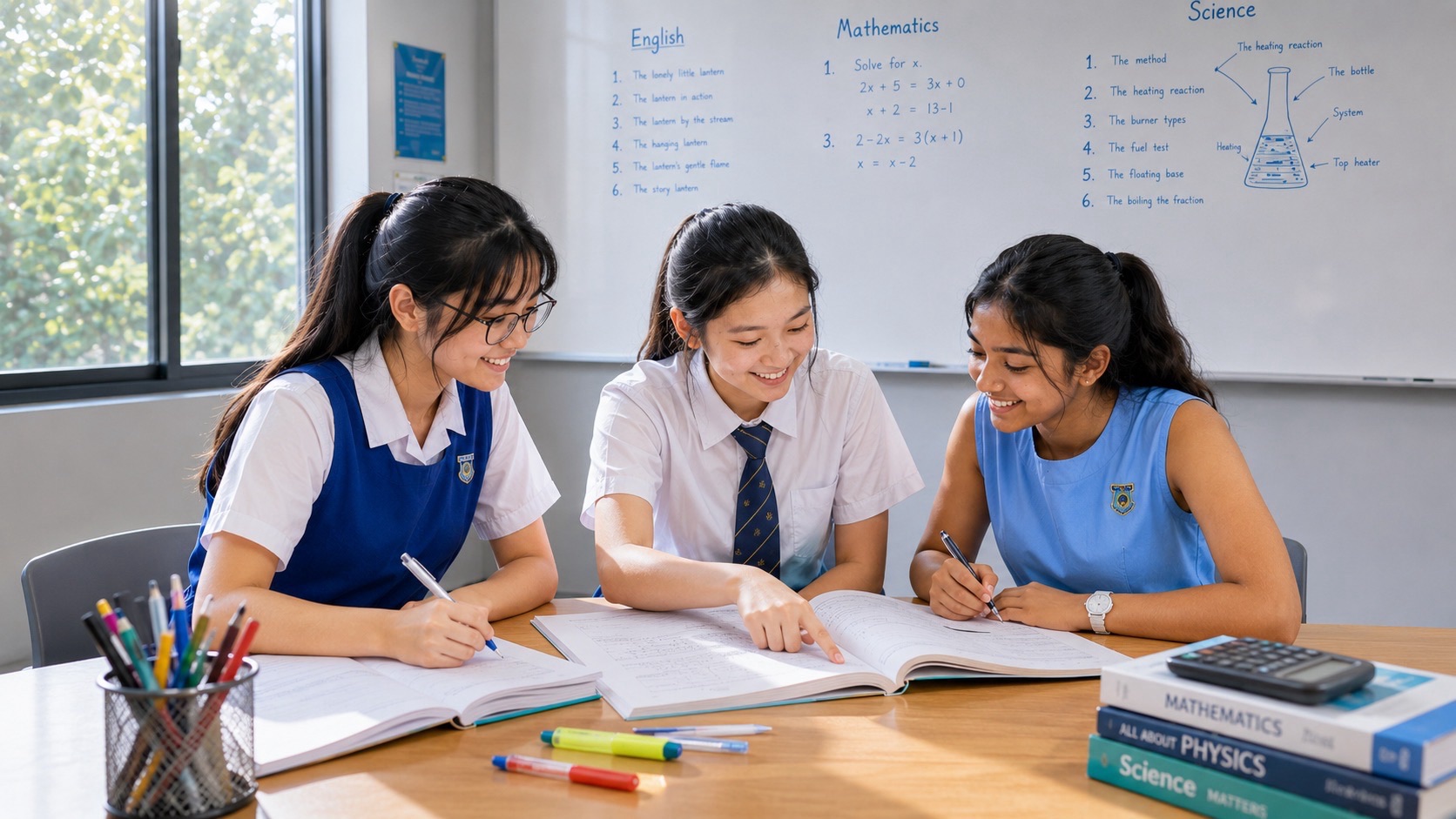
Your child has an idea, writes one sentence and then stops. Before adding more homework, Secondary 1 English tuition should identify the missing move: choosing a point, finding a useful detail or explaining how the detail supports that point. A short spoken explanation beside a short written attempt often shows where to begin.
A Secondary 1 English tutor can help a learner turn a thought into a paragraph without making every paragraph sound identical. The first goal is a reader who can follow the idea. That usually requires a clear focus, relevant support and a connection between the two, with sentence work targeted at the point where meaning becomes uncertain.
These Secondary 1 English tutorials for parents in Singapore show how to practise that process in manageable steps. You will find original paragraph examples, questions to ask at home and a way to discuss support using your child's own work. Start with the problem the paragraph actually shows, rather than asking for longer writing immediately.
eduKate Singapore · Secondary 1 English
Find the next step that fits your child
Start with the parent concern, inspect a worked decision or go to the questions closest to your situation.
Read the parent decisionChoose the teaching target
Language, tutorial support and home practiceInspect the first worked decisions
Read original examples and revisionsTry fresh content
Check purpose, transfer and feedbackDiscuss the next step
Parent questions and further guidance
Full chapter index · Original worked practice · Diagnose a Secondary English answer
Chapter index
Parent decisions and the teaching route · Chapters 1–8
- Find the point where the paragraph stops
- Give the paragraph one job
- Choose a detail that does real work
- Write the explanation rather than repeating the opening
- Use sentence control to protect the idea
- Let structure follow purpose
- Choose support that builds independence
- Keep home practice small enough to reveal thinking
Read, select and explain · Chapters 9–15
Transfer, review and next steps · Chapters 16–24
- Practice 8: A useful contrast
- Practice 9: The point is hidden
- Practice 10: Different purpose, different detail
- Practice 11: A sentence carrying too much
- Practice 12: Feedback becomes an action
- Practice 13: An alternative can work
- Practice 14: A later independent check
- Questions parents ask about this decision
- Choose the next useful learning step
A blank line after a first sentence can hide several different problems. The learner may have no further idea, may have too many competing ideas, or may know the explanation but struggle to turn it into a sentence. Ask the child to explain the intended paragraph aloud before offering a model. Listen for a specific point and a detail that belongs to it. If the spoken account is clear, the next teaching step may be sentence construction. If it is a collection of unrelated events, begin with focus.
Use a small sample completed independently. A paragraph revised by several adults tells you less about the student's first decisions. Keep the original, the spoken explanation and the revised attempt together. Those three pieces make the next tutorial conversation concrete. They also prevent a family from assuming that silence means laziness when the child is struggling with a particular move.
| What the work shows | Closer teaching target | Fresh check |
|---|---|---|
| Clear spoken point, stalled draft | Sentence construction | A fresh written paragraph |
| Several unrelated details | Focus and selection | One point with relevant support |
| Point and example, no link | Explanation | A new example with an explicit relationship |
A paragraph becomes easier to develop when its job can be stated in ordinary words. It might explain why a character hesitated, show how a place changed or support a recommendation. The job should fit the assignment. A narrative paragraph may advance an action or reveal a response; an explanatory paragraph may develop a reason. One universal formula will not serve every purpose equally well.
Ask what the reader should understand by the end of this paragraph. Then examine whether each sentence helps that understanding. A detail can be interesting but belong elsewhere. Moving it is often a better revision than forcing a connection. For a learner who writes many disconnected points, the first exercise can be choosing one point and developing it fully. The next paragraph can carry the next point. This gives the student permission to leave useful material for later.
A supporting detail should help the reader see why the point is reasonable. If the point concerns a student's responsibility, a detail about returning borrowed equipment is more useful than a description of the student's colourful bag. If the point concerns the atmosphere of a room, a physical detail may be exactly what is needed. Relevance depends on the paragraph's purpose.
Offer two plausible details and ask the child which one helps the current point. Require a short reason for the choice. This is a manageable thinking exercise before drafting. It can expose a learner who chooses the most memorable detail without considering its function. Do not insist on several examples when one precise example is enough for the school task. A long list of evidence without explanation can leave the paragraph just as thin as it was before.
The sentence after an example often repeats the topic sentence: this shows it is important because it is important. The child may recognise that an explanation is expected without knowing what to explain. Ask what the example reveals about the point. What changed? What problem became easier? What does the action suggest about a person's priorities? These questions provide a route into reasoning.
An explanation need not be abstract or ornate. A clear cause and effect can be enough. If equipment was returned before the next lesson, other students could begin promptly. That connection supports a point about consideration for others. It adds meaning rather than repeating the word considerate. The tutor should model this reasoning aloud, then withdraw the model on a new example. Otherwise the child may learn the sentence but miss the decision that produced it.
A clear idea can be obscured by a sentence that has no stable subject, an unclear pronoun or several events joined without order. Read the sentence for meaning first. Who acted? What did that person do? What happened because of it? If these answers are uncertain, split the sentence or name the actor. This repair can be more useful than substituting advanced vocabulary.
Keep a small number of language targets. A learner who regularly shifts tense may need one tense check; a learner who uses it for several possible objects may need a reference check. Correcting every feature at once makes the paragraph difficult to learn from. Ask the child to explain why the repair helps the reader. The aim is to build a choice the learner can use again, rather than produce a perfect paragraph through adult editing.
Opening point, supporting detail and explanation can be a helpful starting sequence. It is a teaching aid rather than a rule that every paragraph must have exactly three sentences. A narrative may need a short line for emphasis. A comparison may need paired evidence. A paragraph about a cause may need to establish a condition before describing its effect.
Parents can ask whether the paragraph performs its job before asking whether it follows a memorised pattern. If the meaning is accurate and the progression is clear, discuss why the chosen structure works. If it does not, use a small rearrangement exercise. Put the sentences on separate lines and ask which order makes the relationship easiest to follow. This makes organisation visible without requiring a whole new essay. A tutor can then extend the same decision into longer writing when the learner is ready.
In a tutorial, a tutor can ask the learner to say the point, choose support, draft and explain one revision. In a small group, students can compare two possible details or report what they understood from a peer's paragraph. The value depends on purposeful feedback and an independent follow-up, rather than on the group size alone. Ask how the teacher will tell whether your child can use the method on unfamiliar content.
Bring an untouched paragraph and a marked school task to a consultation. Explain whether the work was timed and how much help was given. Ask for the first target and a practical way to review it. Confirm current lesson arrangements directly. A sensible discussion should describe observable learning decisions. It should not turn one paragraph into a guaranteed prediction about examination results or assume that every Secondary 1 learner needs the same route.
A brief paragraph exercise can be useful when it has one clear target. Ask the child to explain a reason for a familiar school decision, then write a short response. On another day, use a different decision and see whether the explanation survives without the previous model. You are looking for a relevant point and a developed connection, not a fixed number of difficult words.
Stop before practice becomes a prolonged editing session. Note the help that was needed and take that information to the tutor. If a child can speak clearly but consistently stalls in writing, say so. If the child writes fluently but cannot explain the paragraph's purpose, say that instead. These distinctions lead to different lessons. Return later to a comparable independent task and inspect what has changed. Progress may first appear as a stronger decision within a modest paragraph.
This is original illustrative practice. The suggested response demonstrates a teaching decision; it is not an official answer, marking scheme or report of a real student result.
Read the task before choosing the sentence
Before looking for an impressive expression, say what the reader needs from this particular response. The task may require a reason, a comparison, a recommendation or an account of change. Those demands can overlap, but they are not interchangeable. A response can be fluent and still fail to perform the requested action. Begin by circling the action and underlining the subject. Then identify any boundary: a named person, a period of time, a particular part of a passage or a condition that limits the claim.
Use the worked example as a conversation about decisions. Ask the learner to explain what belongs before showing the suggested revision. If the learner chooses correctly but cannot form a sentence, the next lesson concerns expression. If the learner confidently chooses irrelevant material, start with reading the task. These observations are more useful than telling the child to be careful.
After the first attempt, change one feature of the instruction. A reason can become an effect; a general judgement can become a judgement about a particular group. The student should notice which part of the answer must change. That small comparison makes the task visible. Keep the instruction alongside both attempts, so a later review can distinguish a misunderstanding of the question from a difficulty writing the intended answer.
Practice context
The library opened an extra borrowing desk during recess. Students waited for less time and returned to class promptly.
Task
Explain how the extra desk helped students.
Attempt to inspect
The desk was useful because libraries are useful.
A suggested stronger response
The extra desk shortened the borrowing queue, allowing students to return to class promptly.
Why the decision is stronger
The revision connects the changed arrangement to a specific benefit. It does not rely on a general statement about libraries.
Fresh independent application
Explain how a second water refill point could affect a lunchtime queue.
This is original illustrative practice. The suggested response demonstrates a teaching decision; it is not an official answer, marking scheme or report of a real student result.
Make the relationship visible
Ideas often arrive as a list: a problem, a detail, another detail and a conclusion. The reader needs to know how they connect. Is the second detail evidence for the first, a consequence, an exception or a contrast? Naming that relationship before drafting helps the student select a suitable sentence structure. It also prevents a connector from being inserted merely because it sounds formal.
Try a spoken explanation using ordinary words. Ask what caused what, what changed and what stayed the same. Then write a sentence that preserves the relationship. A connector such as because, although or therefore is useful only when the information on either side supports it. Adding therefore cannot turn an unrelated event into a consequence.
Read the revised sentence backwards through its logic. If a claim describes a result, find the cause that justifies it. If it describes a contrast, identify the expectation that has been interrupted. This is a meaning check, not a demand for elaborate vocabulary. On a fresh example, remove the connector and ask the student to supply one with an explanation. Accept more than one construction when each is accurate. A child who can defend the relationship is developing control; a child who remembers one phrase may still need another example.
Practice context
Before leaving the art room, Mei checked that the shared brushes were clean and placed them where the next group could find them.
Task
Develop a point about consideration.
Attempt to inspect
Mei is considerate. She cleaned brushes. She is very considerate.
A suggested stronger response
Mei showed consideration by cleaning and arranging the shared brushes, so the next group could begin without sorting out her materials.
Why the decision is stronger
The last clause explains the effect on others, which is the missing link in the first attempt.
Fresh independent application
Describe a different action that makes a shared classroom easier for the next user.
This is original illustrative practice. The suggested response demonstrates a teaching decision; it is not an official answer, marking scheme or report of a real student result.
Keep the scope of the claim accurate
Small words carry large responsibilities. Some, usually, only, before and may can change a statement substantially. A revision that removes them may become shorter or smoother while becoming less accurate. Encourage the student to inspect the boundary of every claim. Who is included? When is it true? Does the source describe certainty, possibility or a limited observation?
A useful practice is to write a deliberately overgeneral version and compare it with a careful one. Ask the learner to identify the extra promise made by the first. This turns an invisible language choice into a visible decision. It also shows why precision can matter more than a rare synonym. An ordinary word in a well controlled sentence often communicates more than a sophisticated word chosen for appearance.
When revising, preserve both the main idea and its important limits. Do not add qualifications that the source or argument does not support. Too many cautious words can make a clear claim unnecessarily vague. The aim is proportion: firm where the evidence is firm, limited where it is limited. Later, present a new situation with a different boundary and ask for an independent sentence. Watch whether the learner checks the new facts or simply copies the previous wording.
Practice context
A school garden has shaded benches, a bright sign and a long history. Students use the benches to rest during hot afternoons.
Task
Support a point about comfort.
Attempt to inspect
The garden is comfortable because its sign is bright and its history is long.
A suggested stronger response
The shaded benches make the garden comfortable by giving students a place to rest away from the afternoon sun.
Why the decision is stronger
The selected detail directly supports comfort. The other information may serve another paragraph.
Fresh independent application
Choose a relevant detail for a paragraph about the garden being easy to locate.
This is original illustrative practice. The suggested response demonstrates a teaching decision; it is not an official answer, marking scheme or report of a real student result.
Explain the missing middle
A student may state a point and provide an example but leave the reader to supply the connection. That gap is often the reason an answer feels thin. Ask what the example shows about the point. The explanation should add a relationship rather than repeat the opening in different words. It might show a cause, a consequence, a changed attitude or a condition under which the claim holds.
Use a three sentence trial: the point, the selected detail and the explanation. This is a diagnostic exercise rather than a compulsory paragraph formula. Some tasks need a shorter response; others need several linked moves. The trial helps reveal which move the learner cannot yet make. Once the relationship becomes clear, combine or rearrange sentences to suit the actual task.
Parents can help by asking a neutral question: what does this detail help your reader understand? Avoid supplying the explanation immediately. Let the child try, pause and revise. If the answer remains circular, return to the detail and ask what happened because of it. A later attempt should use different content, so the improvement does not depend on recalling the model. Keep the early and later versions together. The comparison should show an added line of reasoning, not simply an increase in length.
Practice context
Arun paused outside the audition room, checked his prepared lines twice and waited for his name to be called.
Task
Show his nervousness through relevant details.
Attempt to inspect
Arun was nervous. He was very nervous and felt nervous.
A suggested stronger response
Arun checked his lines twice while waiting outside the audition room, as though one last rehearsal might steady him before his turn.
Why the decision is stronger
The response develops the feeling through observed behaviour and a cautious interpretation.
Fresh independent application
Show anticipation using a different action before a school performance.
This is original illustrative practice. The suggested response demonstrates a teaching decision; it is not an official answer, marking scheme or report of a real student result.
Select before expanding
The easiest material to remember is not always the material the task needs. A colourful example can distract from a quieter but more relevant detail. Make selection an explicit stage. Write two short notes: material that answers the instruction and material that belongs to the general topic but does not answer it. The second note is useful because it reveals why a tempting detail should be left aside.
Ask the student to justify one inclusion and one exclusion. A sound justification refers to the question or the source relationship. It does not rely on whether the detail sounds impressive. This check is particularly helpful when a learner writes a great deal but receives feedback about relevance. Adding further sentences can deepen the wrong route unless the selection changes first.
Do not treat every omitted detail as a mistake. A focused response has to leave things out. The important question is whether the omitted information would alter the required meaning or remove necessary support. On a fresh task, offer several plausible details and ask for a small selection before drafting. Then inspect whether the written response actually uses that selection. Planning has value when it guides the answer; a careful plan followed by an unrelated draft needs a different teaching conversation.
Practice context
A paragraph begins: Walking to school solves every transport problem. The supporting example describes one family avoiding a short car trip.
Task
Limit the opening to what the example can support.
Attempt to inspect
Walking solves every problem for everyone.
A suggested stronger response
For families living nearby, walking to school can reduce the need for a short car journey.
Why the decision is stronger
The claim now names the group and the limited benefit. The example does not prove a universal solution.
Fresh independent application
Write a similarly limited point about borrowing a book instead of buying it.
This is original illustrative practice. The suggested response demonstrates a teaching decision; it is not an official answer, marking scheme or report of a real student result.
Use plain language to test understanding
When a student cannot explain a sentence in familiar words, polishing its vocabulary is premature. Ask for a simple account of the intended meaning. This does not mean that all final writing must remain simple. It means that the learner should understand the idea before choosing how to express it. A clear plain version gives the tutor something reliable to develop.
Compare the plain version with a more formal alternative. Identify what changed: precision, rhythm, emphasis or the relationship between ideas. If the formal version changes the facts, return to the plain one. If it merely adds length, ask whether the extra language helps the reader. The best revision depends on the task and audience, rather than on a universal preference for difficult words.
Have the student explain the revised sentence without looking at it. This exposes expressions that have been copied without understanding. Later, change the example while keeping the same reasoning demand. A learner who can express the new idea accurately has more useful control than one who can reproduce the old sentence exactly. Praise the decision that improved clarity, such as naming the actor or explaining the cause. That feedback is specific enough to guide another attempt and does not require the parent to become the editor.
Practice context
The classroom felt crowded. The teacher moved unused boxes into storage. Students could reach their shelves more easily.
Task
Organise a paragraph showing improvement.
Attempt to inspect
Students could reach shelves. Boxes existed. The room was crowded.
A suggested stronger response
The classroom initially felt crowded because unused boxes blocked the shelves. Moving the boxes into storage made the shelves easier to reach.
Why the decision is stronger
The order establishes the problem, action and result. Each sentence contributes a stage of the explanation.
Fresh independent application
Organise a short account of improving an untidy equipment corner.
This is original illustrative practice. The suggested response demonstrates a teaching decision; it is not an official answer, marking scheme or report of a real student result.
Distinguish two ideas before joining them
Combining sentences is useful only when their meanings remain distinct where necessary. Two details may describe different causes, different people or different stages of an event. Joining them with and can hide those distinctions. Before combining, label what each detail contributes. Decide whether the task needs both contributions and whether one sentence can carry them accurately.
Try two versions: a compact combined sentence and two clear separate sentences. Compare them for meaning rather than length alone. Does the combined version suggest that an action caused a result when it merely happened earlier? Does it attach a reason to the wrong person? Does it make two separate benefits sound like one? These are practical questions a student can answer by returning to the source or plan.
There is no prize for combining every sentence. A short, accurate pair may be better than an overloaded line. Equally, keeping every detail separate can waste space or interrupt a developing thought. The teaching target is choice. Ask the learner to explain why this particular pair should be joined or separated. On a later example, change the relationship between the details. That change tests whether the learner has understood the decision rather than memorised a sentence pattern.
Practice context
Ravi lent Dan a ruler after Dan misplaced his. He thanked him when he finished.
Task
Make the final action clear.
Attempt to inspect
He thanked him because he was helpful.
A suggested stronger response
After finishing his work, Dan thanked Ravi for lending him the ruler.
Why the decision is stronger
Naming both people removes uncertainty about who borrowed, helped and thanked.
Fresh independent application
Clarify a similar exchange involving a classmate sharing notes.
This is original illustrative practice. The suggested response demonstrates a teaching decision; it is not an official answer, marking scheme or report of a real student result.
Revise one decision at a time
A page covered with corrections can leave a child unsure where to begin. Choose the decision most likely to improve the next response. It might be relevance, completeness, the connection between evidence and claim, or a sentence that reverses the meaning. Name that target in a short instruction and ask for a revision that addresses it directly.
Keep other observations in reserve. They are not ignored; they are sequenced. If the main interpretation is wrong, correcting every comma first will not make the answer useful. If the interpretation is sound but the subject of a sentence is unclear, a focused language repair may be enough. The tutor should be able to explain why the chosen target comes first.
After revision, ask the student to point to the changed decision. An answer such as I used better words is too broad when the actual improvement concerns a missing reason. State the improvement precisely, then try a fresh task where the same decision matters. This second attempt checks whether feedback has become usable knowledge. If it has not, reduce the task or model the reasoning more explicitly. Do not interpret difficulty transferring feedback as unwillingness. The student may have understood the corrected example without yet understanding how to recognise a similar need elsewhere.
Practice context
Lina used to interrupt group discussions. This term she writes down questions and waits until a speaker finishes.
Task
Develop a paragraph about change.
Attempt to inspect
Lina is different now. She writes things.
A suggested stronger response
Lina now waits for a speaker to finish before asking her written questions, showing greater care for other group members than she did when she interrupted.
Why the decision is stronger
The comparison identifies the earlier and later behaviour and explains the significance.
Fresh independent application
Describe a change in how a student prepares for a lesson.
This is original illustrative practice. The suggested response demonstrates a teaching decision; it is not an official answer, marking scheme or report of a real student result.
Check the reader’s likely interpretation
A writer knows the intended meaning, so a sentence can feel clearer to the writer than to someone else. Ask the student to read as a person encountering the response for the first time. Who does a pronoun refer to? What does this or that point towards? Which event happened first? Does the final sentence follow from the information actually written on the page?
One useful check is to cover the plan and explain the response using only the draft. If an essential idea exists only in the student's head, the reader cannot recover it reliably. Add the missing information or replace a vague reference with a precise noun. Do not expand every sentence indiscriminately. The repair should remove a particular ambiguity.
An adult reader can report what they understood without dictating a replacement sentence. For example, I thought the organisers cancelled the activity, but you said the students chose not to attend. The learner can then investigate where that interpretation arose. This preserves ownership of the revision. On the next example, ask for the same reader check before feedback is given. Gradually the student should catch some uncertainties independently. A useful sign of progress is a justified self correction, even when the final response still has other features to improve.
Practice context
A paragraph describes a student finding a missing label, identifying a box and returning it to the science room.
Task
Make the paragraph focus visible.
Attempt to inspect
There was a label. There was a box. There was a room.
A suggested stronger response
By checking the loose label against the box, the student worked out where the equipment belonged and returned it to the science room.
Why the decision is stronger
The response organises the details around solving a small problem.
Fresh independent application
Use three details to explain how a student found the owner of a lost folder.
This is original illustrative practice. The suggested response demonstrates a teaching decision; it is not an official answer, marking scheme or report of a real student result.
Change the content while keeping the skill
A model becomes valuable when its reasoning travels to new content. Repeating the same example can create a convincing appearance of progress because the learner remembers the wording. For a transfer check, keep the underlying demand but change the situation, actors and details. The student then has to identify what the method is doing rather than retrieve a familiar answer.
Make the change manageable. If the first example concerns a simple cause, do not immediately introduce a dense passage containing several causes and exceptions. Begin with a different simple cause, then increase complexity once the response is secure. This sequence helps distinguish a difficulty applying the method from a difficulty understanding the new material.
Record how much help was given. A response completed after several guiding questions cannot be compared directly with an independent one. Both are useful evidence, but they show different stages of learning. In a later lesson, withdraw one prompt and inspect what happens. If the learner can explain the new decision, support can reduce gradually. If the learner copies the old structure despite changed facts, return to meaning. The purpose of transfer is practical independence, not a surprise test designed to catch the child out.
Practice context
A hall has wide doors, a high ceiling and chairs arranged in pairs for an activity.
Task
Explain why the chair arrangement helps paired discussion.
Attempt to inspect
The hall helps discussion because its ceiling is high.
A suggested stronger response
Arranging chairs in pairs gives each student a nearby partner, making it easier to begin a focused discussion.
Why the decision is stronger
The relevant arrangement supports the stated activity. A physical description alone would serve a different purpose.
Fresh independent application
Choose a detail that would support a paragraph about entering the hall safely.
This is original illustrative practice. The suggested response demonstrates a teaching decision; it is not an official answer, marking scheme or report of a real student result.
Make the practice conditions honest
A strong answer produced with unlimited discussion tells us something different from a shorter answer written alone. Keep the conditions visible: whether the source was available, whether notes were permitted, whether an adult supplied a phrase and whether time was limited. This prevents a family from mistaking guided work for independent readiness or dismissing useful guided progress because it is not yet fluent.
Start untimed when the learner needs to understand a new decision. Add time pressure only after the basic method makes sense. Otherwise, rushing may reinforce guessing or incomplete responses. When practising under a time limit, use the school's actual expectations where relevant and agree what the exercise is meant to reveal. A short teaching drill is not a substitute for a complete assessment.
Compare like with like when reviewing progress. Two independent attempts on comparable tasks provide a fairer picture than a heavily corrected homework paragraph and an unseen test response. If conditions differ, explain the difference rather than forcing a conclusion. A tutor can use this information to decide whether the next lesson should improve understanding, reduce dependence on prompts or build fluency. Each is a legitimate target, but they require different practice.
Practice context
The class planted seedlings and the rain came and they checked them and some grew and they were pleased.
Task
Clarify action and result.
Attempt to inspect
They planted and rain and checked and pleased.
A suggested stronger response
After planting the seedlings, the class checked them regularly. Seeing new leaves appear gave the students a visible result for their care.
Why the decision is stronger
Separating the sequence makes the actions and the reason for satisfaction easier to follow without claiming rain was the only cause.
Fresh independent application
Clarify a long sentence about preparing and presenting a class display.
This is original illustrative practice. The suggested response demonstrates a teaching decision; it is not an official answer, marking scheme or report of a real student result.
Turn feedback into a question the learner can answer
Feedback becomes useful when it tells the student what to inspect next. Develop your point is often too broad by itself. A more usable question is: what does this example show about the reason you gave? Likewise, be more precise can become: which group does your claim describe? A specific question directs attention to a decision without supplying the entire answer.
Ask the learner to answer the feedback question orally before revising. If the spoken answer is sound, help translate it into writing. If the spoken answer is still vague, use another example or return to the source. This sequence avoids treating every difficulty as a vocabulary problem. It also gives the tutor information about where understanding stops.
Keep a small record of recurring questions. Two or three active checks are usually easier to use than a long list of every past mistake. Retire a check when fresh independent work shows that the decision is becoming reliable. Bring it back if a harder task exposes the same issue. An error log should guide action, not become a catalogue of faults. Its value lies in the next attempt: does the student notice the relevant feature and respond differently without needing the old correction beside the page?
Practice context
Feedback says: Explain why this detail supports your point. The paragraph recommends labelling shared folders.
Task
Revise the reasoning rather than the adjective.
Attempt to inspect
Labelling is extremely wonderful and excellent.
A suggested stronger response
Clear labels help students return shared folders to the correct place, so the next person can find the right materials.
Why the decision is stronger
The revision answers the feedback by explaining a practical consequence.
Fresh independent application
Apply the same feedback to a recommendation about a classroom noticeboard.
This is original illustrative practice. The suggested response demonstrates a teaching decision; it is not an official answer, marking scheme or report of a real student result.
Test a reasonable alternative
A suggested answer is one way to demonstrate a sound decision. It should not close down other accurate responses. Invite the student to offer an alternative and explain how it meets the same demand. Two versions may select different relevant details, organise the point differently or use different sentence structures. Compare them using meaning, relevance and completeness rather than resemblance to the model.
This comparison is especially useful for a child who thinks English is a guessing game in which the teacher has one secret sentence. The tutor can make the standard more visible: an interpretation needs support; a claim needs an appropriate boundary; a response needs to perform the requested action. Flexibility becomes possible within those requirements.
Some alternatives fail for a clear reason. Explain that reason using the instruction or source, not personal preference. A sentence may sound elegant but attribute an action to the wrong person. Another may be accurate but leave out the requested effect. Let the student repair the alternative rather than abandoning it immediately. This builds judgement about why an answer works. On a fresh task, ask for one defensible route first. Generating several options is useful only when it helps decision making, not when it postpones the act of writing.
Practice context
A paragraph argues that practising a presentation aloud helps preparation.
Task
Support the point with one defensible reason.
Attempt to inspect
Practising is good because good practice is good.
A suggested stronger response
Practising aloud can reveal sentences that are difficult to say, giving the speaker a chance to revise them before the presentation.
Why the decision is stronger
This is one valid reason. Checking the length or noticing unclear transitions could support another paragraph.
Fresh independent application
Offer a different relevant reason without repeating the suggested one.
This is original illustrative practice. The suggested response demonstrates a teaching decision; it is not an official answer, marking scheme or report of a real student result.
Review after a gap and choose the next step
An immediate correction shows that the learner can respond to support in the moment. A later attempt helps show what remains available without that support. Return after a reasonable gap with fresh content and the same central demand. Do not reveal the old model first. Ask the student to explain the task, make the key decision and write the response.
Inspect the result in layers. Is the meaning relevant? Is it complete enough for this instruction? Can a reader follow the relationship? Are language errors interfering with that meaning? This order keeps the review focused. A response can improve in one layer while still needing work in another. Name the change honestly rather than reducing the whole attempt to success or failure.
Use the evidence to decide what moves next. If the main decision is secure, add complexity or reduce prompting. If it is inconsistent, return to a smaller comparison. If the method works untimed but collapses under pressure, practise fluent execution on familiar demands before adding new ones. Parents do not need to design a full programme from this review. They need a clear question to take to the teacher or tutor: what can my child now do independently, and which decision should the next lesson strengthen?
Practice context
The learner previously explained the benefit of organising brushes. A fresh task concerns putting sports equipment into labelled baskets.
Task
Write a new paragraph without copying the brush example.
Attempt to inspect
Brushes help the next art group, so sports is helpful.
A suggested stronger response
Labelled baskets help students find and return sports equipment, reducing confusion when the next activity begins.
Why the decision is stronger
The relationship transfers, but the content and consequence have been adapted to the new situation.
Fresh independent application
Explain a fresh benefit of arranging a classroom reading shelf.
Does a clear paragraph need a fixed formula?
A simple point, detail and explanation sequence can help a beginner see the required moves. Treat it as a starting tool. The actual purpose may call for a narrative action, a comparison or a different order. Ask whether the reader can follow the idea and whether the support fits the point. A tutor should eventually help the child make these choices independently rather than make every paragraph look identical.
Should I ask for a longer paragraph?
First inspect why the paragraph is short. If an explanation is missing, help the child develop that connection. If the task has already been answered clearly, extra sentences may add repetition. Length becomes useful when it carries necessary meaning. Ask what the next sentence would help the reader understand before setting a larger word target. Follow the school assignment for any required length.
My child speaks well but cannot write it. What next?
Keep a brief spoken explanation beside the written attempt. Ask the child to identify the exact thought that was difficult to express. The tutor can then work on constructing that sentence, linking it to the previous one and checking the reader’s interpretation. Avoid taking the spoken answer and writing the entire paragraph for the child. The learning target is the move from an understood idea to an independent written response.
Should we learn advanced vocabulary first?
Vocabulary matters when it makes the intended meaning more precise. Begin with accurate, clear language and identify where a more exact word would help. An impressive word that changes the meaning or cannot be explained is not a useful upgrade. Keep the original sentence and the revision, then ask what difference the new word makes. The answer should refer to meaning rather than difficulty or appearance.
Can a small group help paragraph writing?
A purposeful group can compare evidence choices, discuss what a reader understood and practise independent revisions. The useful question is how each child receives feedback and applies it to fresh content. Ask about the teaching routine and the way individual needs are tracked. Confirm current arrangements directly with the centre. Group size alone does not tell you whether the lesson will address your child’s particular difficulty.
How much should I correct at home?
Choose one decision that matters for the paragraph’s meaning. Report what you understood and ask a question that helps the child inspect it. Leave a record of other concerns for the tutor. If you correct everything, the final page may become stronger while giving little information about what the child can do alone. Preserve an independent version and note any support given.
What should we bring to a consultation?
Bring an unedited paragraph, the assignment instruction and a marked school sample where available. Explain whether the work was timed and whether someone helped plan or edit it. Ask the tutor to name the first teaching target and how a fresh attempt will be reviewed. This gives the discussion a concrete starting point. It is more informative than describing the child only as weak in writing.
How will we recognise progress?
Look for a clearer independent decision: a focused point, better selected support, an explanation that adds meaning or a sentence that the reader can follow. Compare tasks of similar demand and note the conditions. A guided correction and an unseen response show different things. Progress may appear within a modest paragraph before it becomes consistent across a whole composition. Ask what the next lesson should strengthen once the first target becomes reliable.
Choose one independent sample and locate the decision that needs the closest attention. Use a small worked comparison, then change the content and inspect a fresh attempt. Bring the instruction, original response and feedback to the teacher or tutor. Ask what your child can now do independently and which teaching target should come next. Keep the discussion grounded in observable work and the actual school context.
Diagnose a Secondary English answer
Read the established Secondary English tuition guide
Browse the focused Secondary English learning index