
Secondary 1 G1 Mathematics Tutor Bukit Timah. Work backwards from a percentage, find the whole and avoid the discount reversal trap. This is a practical reader guide for parents and students, not a promise that every school teaches the topic in the same week.
The one-minute answer
Did you know? A 20% discount cannot be reversed by adding 20% to the discounted price. The second calculation uses a different base. That single insight unlocks several Secondary 1 G1 Mathematics percentage questions.
Always name the whole
Imagine a fictional shop where a notebook set costs $60 before a 20% discount. The discount is $12, and the new price is $48. Now reverse the question: the $48 is 80% of the original amount. The original is $48 ÷ 0.80 = $60.
The mistake is to calculate $48 × 1.20 = $57.60. That adds 20% of 48, not 20% of 60. Ask the learner to identify which amount represents 100% before touching the calculator.
A bar can show the missing 100%
Draw one bar for the original price and divide it conceptually into 100 equal percentage units. After a 20% reduction, the surviving portion is 80%. Label that remaining bar $48. Since 80% equals 48, one per cent equals 48 ÷ 80 = $0.60 and 100% equals $60.
The bar representation and the decimal method should lead to the same result. A tutor can alternate them to check whether the pupil understands the base rather than following one memorised procedure.
More than 100% is not impossible
G1 percentage work also includes percentages greater than 100%. For example, 120% of 50 is 1.20 × 50 = 60. The answer is larger because 120% represents the whole plus another fifth.
A helpful habit is to estimate first. Before calculating 120% of 50, the student should predict an answer a little above 50. Before calculating 25% of 80, the student can recognise a quarter and predict 20.
A quick test for percentages in words
Underline the amount being compared, circle the words “of”, “increase”, “decrease” or “remaining”, and write a small note: 100% = ? Then choose either multiplication to find a part or division to recover the whole.
One of the easiest ways to spot a misunderstanding is to change the question. After solving a 20% discount, ask about a 20% increase from the original amount. The base must be stated anew.
What a three-pupil tutorial changes
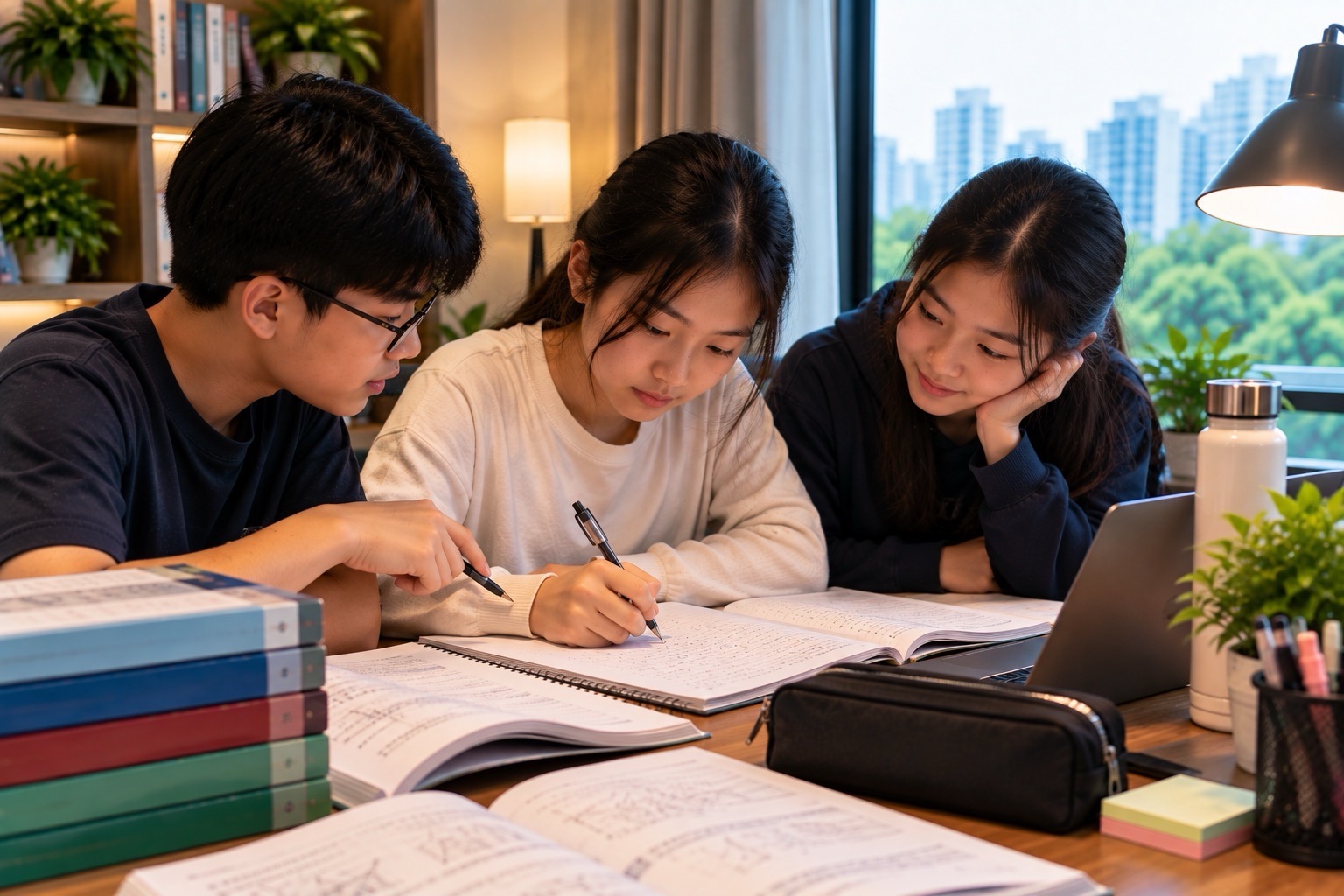
A tutor can ask all three students to solve a short question independently, then compare their chosen 100% reference. One may have the right arithmetic but the wrong whole. Another may misread “remaining”. A third may be accurate but unable to explain.
The small-group approach at eduKateSG near Sixth Avenue MRT focuses on finding those first wrong decisions, reteaching the meaning and checking a different problem later. Extra worksheets cannot replace the missing interpretation.
A five-minute home check
If 75% of a quantity is 30, the whole is 40. If $90 increases by 10%, it becomes $99. If 120% of a number is 60, the number is 50. Ask your child to write the 100% reference next to each answer.
To test transfer, give the same figures in a new story. The goal is to understand percentages as relationships, not memorise three answer patterns.
Frequently asked questions
Are reverse percentages suitable for G1? G1 Secondary 1 includes finding the whole from a percentage part. Use the student’s school sequence and teaching expectations when selecting questions.
Why doesn’t adding 20% undo a 20% reduction? Because the second 20% is calculated from a smaller amount. The starting base changed.
Should a tutor insist on calculator speed? First establish which quantity is 100%, then build fluent and accurate calculations.
What to read next
Explore related quick guides in this four-part G1 Mathematics series: Why Negative Numbers Change the Rules; Ratios You Can Draw Before You Calculate; Algebra Letters Without the Guesswork.
For the classroom approach, read the original eduKateSG three-student Secondary 1 Mathematics tutorial and the Bukit Timah Secondary Mathematics small-group guide. Both describe the existing tuition approach; this article does not change those pages.
For curriculum scope, see the Ministry of Education G1 Mathematics syllabus. Under Full Subject-Based Banding, G1 is a subject level, not a label for a child’s potential. Schools vary in teaching sequence and assessment arrangements.
Next useful step: If repeated errors are affecting your child’s schoolwork, bring a recent marked question and ask which first wrong decision should be repaired. Enquire about a suitable G1 Mathematics group, timetable and availability at eduKateSG near Sixth Avenue MRT.