
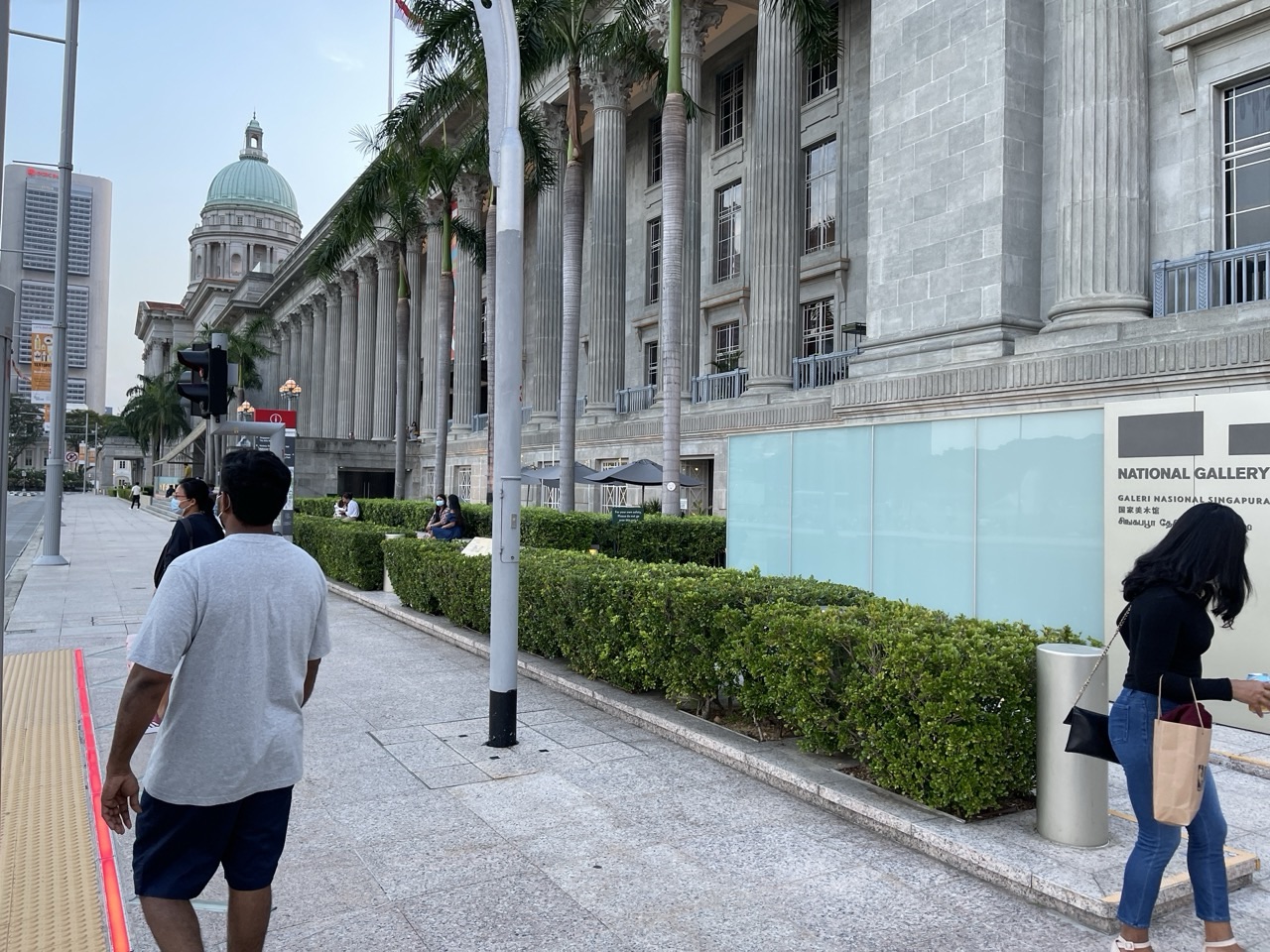
Did you know the building most people call City Hall was completed in 1929 as the Municipal Building, while the adjoining former Supreme Court was opened in 1939? Today both are part of National Gallery Singapore. Just three dates create a useful Secondary 1 History lesson: a present-day landmark can contain several older histories, and each historical claim needs its correct source.
For City Hall, Raffles City, the Padang and nearby Civic District families, eduKateSG’s premium three-student History tutorials develop evidence reading, chronology, change and continuity. The weekly 1.5-hour sessions are near Sixth Avenue MRT, not at City Hall MRT. Local sites help pupils practise thinking; the child’s actual school History chapters determine the assessed material.
Our tutorial model follows the immutable Clementi three-student learning reference. Civic District dates in this guide are supported by NHB’s former City Hall and Supreme Court account and the Padang monument history rather than guesses from modern photographs.
What happens in a Secondary 1 G3 History tutorial?
We start with a real piece of marked school work rather than a memorisation race. Some pupils describe a photograph accurately but offer an unsupported inference. Others give a correct date for a building but mistakenly assign it to the institution that occupied it earlier. We diagnose whether the obstacle is reading, chronology, evidence or cause-and-consequence writing.
In a premium three-student lesson near Sixth Avenue MRT, each learner produces an individual answer, receives a correction and attempts a different, unseen school-relevant source. A 1.5-hour weekly lesson can be focused without turning into another full school day. Our lesson venue is not City Hall MRT or the Civic District.
Full Subject-Based Banding: what Secondary 1 G3 means
Under Full Subject-Based Banding, G3 describes a subject’s level of demand rather than the ability of a whole person. Secondary 1 History builds historical enquiry, source interpretation, change and continuity, and explanation. A lower-secondary pupil’s classroom assignments should not be replaced by final-year standalone SEC papers just because both contain the word History.
The first SEC examination will be in 2027, and later students follow their own cohort’s rules. The tutor checks current school chapters and actual feedback before selecting material. A student learning source inference should not be pushed into sophisticated national-paper timing before the foundational skill is secure.
Why a name can outlive the building’s original purpose
Today City Hall identifies a major MRT interchange and part of Singapore’s civic area. The historic City Hall itself was originally called the Municipal Building and was completed in 1929. It received the name City Hall in 1951 when Singapore gained city status.
This illustrates a simple historical distinction: when a structure was built and when it acquired its present name are different events. A present-day map may accurately label City Hall but cannot prove that the name was already used for the Municipal Building in 1929. Check the source’s date.
Before the 1929 Municipal Building: town government already existed
Singapore’s Municipal Council dates to the nineteenth century and was responsible for functions including water, gas, electricity and local infrastructure. It occupied earlier premises before moving into the new Municipal Building. A public service existed before the familiar landmark that later housed it.
Students should separate institutional origins from the construction of a famous office. That is a transferable skill: a school’s founding, a church’s establishment, a library collection’s beginning and its latest building may occur in different years.
1827: an early courthouse near the modern Civic District
The former Parliament House began as a building completed in 1827 for merchant John A. Maxwell, then was used for official court purposes. It later served as a legislative and parliamentary building. Its current identity as the Arts House is another stage in its history.
A photograph of today’s Arts House cannot by itself establish exactly how the 1827 courthouse operated. Historians combine architectural records, institutional accounts and dated evidence for the particular enquiry. A location’s continuity does not mean its function remained unchanged.
St Andrew’s Cathedral and the difference between two church buildings
The Anglican presence in colonial Singapore predates the present cathedral. An earlier church on the site was consecrated in 1838 but later became unsafe and was demolished. The present church was consecrated in 1862 and subsequently acquired cathedral status in 1870.
These dates answer different questions. Students practise asking whether a source describes the first church, the current building or a later status change. Otherwise an apparently confident answer may merge different structures into one fictional timeline.
Why an architectural drawing is not a diary
A nineteenth-century plan of a church or public building reveals design choices and intended spaces. It cannot establish what every visitor felt or how faithfully the finished structure followed each line. A diary, a building inspection and a photograph would answer different questions.
The tutor asks children to identify exactly what is visible, then make one cautious inference. The aim is not to discourage interpretation but to explain the bridge between a source clue and a claim. Unsupported guesses should be clearly labelled as guesses.
1862: the old Town Hall was a different building from City Hall
Victoria Theatre began as the Town Hall, completed in 1862. Its civic and social functions later changed as a separate memorial hall and clock tower were added. That site should not be confused with the later 1929 Municipal Building despite their related public roles.
Historical labels often sound similar. The tutor checks address, physical site and chronology before allowing students to conclude that a museum entry contradicts another. ‘Town Hall opened in 1862’ and ‘City Hall was completed in 1929’ can both be correct.
1905 and 1909: memorial hall, clock tower and theatre remodelling
The Victoria Memorial Hall was built in the early twentieth century in memory of Queen Victoria; the original Town Hall was remodelled and renamed Victoria Theatre, with major work completed in 1909. The joined buildings tell a story of adaptation rather than a single all-at-once founding.
A student should read whether a date refers to the new hall, the clock tower or renovations to the existing theatre. A neat timeline must not erase distinctions between parts of a complex. Dates become meaningful when attached to specific actions.
1929: what the Municipal Building was intended to do
The Municipal Building provided offices for those responsible for municipal services. Its imposing façade also conveyed a certain image of colonial authority. Those two functions—administrative work and symbolic display—can coexist, but each requires a different kind of evidence.
An official opening account may show what administrators celebrated, whereas records of water supply or road maintenance are better suited to investigating service outcomes. An impressive façade alone is not proof that every neighbourhood received equal services.
1939: the adjoining former Supreme Court opened later
The former Supreme Court was completed and opened in 1939, ten years after the Municipal Building. The two neoclassical buildings are now linked inside the National Gallery Singapore, but they were not constructed as one building in 1929.
Students use this difference to practise chronology and physical identification. A photograph showing both buildings after 1939 cannot prove that the Supreme Court already stood there in 1929. A site name in a present-day caption sometimes compresses multiple architectural phases.
The Supreme Court stands where an earlier hotel once existed
NHB identifies the former Hotel de l’Europe as a notable earlier occupant of the Supreme Court site. A building’s location can have successive commercial, governmental and cultural roles over time. It would be inaccurate to say that the court occupied an entirely unused plot.
A strong source-based enquiry asks what records document each earlier use. A later museum wall label can help identify the sequence but is not itself a nineteenth-century eyewitness account of the hotel.
The Padang is a field with more than one kind of history
The Padang has long been used for recreation and sport, including cricket and other games. It was also a public space for official ceremonies and community gatherings. A field can support everyday activity while also becoming the setting for national milestones.
If a photograph depicts a football game on the Padang, it may be strong evidence of a particular sporting moment. It does not automatically show what was happening there on a day of wartime surrender or political celebrations. Context and date matter.
1887: a public statue and a later relocation
A statue of Stamford Raffles was unveiled on the Padang during the celebration of Queen Victoria’s Golden Jubilee in 1887 and was later relocated near Victoria Memorial Hall in 1919. A statue can therefore be both a surviving object and a reminder of changing public commemorations.
A dated photograph showing a statue in one position may be accurate even when the statue is seen elsewhere in a modern image. Students learn to distinguish an object’s origin, movement and present location.
1939 and 1945 were different civic moments
The Supreme Court’s opening in 1939 and Japan’s formal surrender in Singapore in September 1945 are separate events at neighbouring civic landmarks. They should not be fused simply because both are associated with the Civic District.
We build separate timelines for architecture, government and wartime events, then ask where they intersect. Chronological accuracy does not require memorising every façade detail; it requires matching a claim to the event being discussed.
The 1951 name change did not create the Municipal Council
When the Municipal Building became City Hall in 1951, the building’s name changed to reflect Singapore’s city status. This did not erase the council’s earlier decades of work. A renaming is a historical action and may be significant, but it is not automatically a founding date.
Students examine the verbs ‘formed’, ‘opened’, ‘renamed’, ‘moved’ and ‘reused’. This habit improves reading across many History sources that appear to present different years for an institution.
1959: City Hall steps become a public political stage
On 3 June 1959, Lee Kuan Yew addressed a mass rally at the Padang from City Hall’s steps in celebration of internal self-government. Singapore’s first Cabinet was sworn in during 1959, and Yusof Ishak’s installation as Yang di-Pertuan Negara was another distinct milestone.
A photograph of a large crowd can show attendance at one event, not that every resident shared an identical opinion. To understand the political development, students must identify the event, timing and source perspective rather than equating a crowd with unanimous support.
1963 and 1965: a timeline, not one timeless ‘independence’
Singapore’s merger with Malaysia was proclaimed in September 1963, and separation occurred in August 1965. These were distinct constitutional and political developments, not simply two names for the same day.
Even at Secondary 1, children can practise careful chronological labels. The aim is not to pre-teach every future assessment detail but to prevent a later source about merger from being treated as though its author knew exactly what would happen in 1965.
The National Gallery Singapore opened much later
The former City Hall and former Supreme Court were converted into the National Gallery Singapore, which opened in 2015. The modern museum connects two older buildings; the transformation did not mean they were first built in 2015.
A current photograph proves something about today’s gallery façade, not necessarily the internal courtrooms or offices of 1939. Pupils compare current visual evidence with appropriately dated records and explain the limits of each.
Conservation status and construction dates are separate
The two historic civic buildings were gazetted as National Monuments in 1992, long after their original construction. Conservation protects the significance of surviving structures but does not rewrite the events that took place in them.
A pupil should not say the buildings were built in 1992 because a heritage sign uses that year. The tutor asks what the legal date actually refers to, just as a discoverer’s date may differ from the age of an archaeological find.
Historical significance is significant to someone, for a reason
The Municipal Building can matter to public service history, the Supreme Court to legal history, the Padang to public gathering and National Gallery to cultural life. Which is ‘most important’ depends on the question’s criterion and whose experience is being examined.
We teach students to name the criterion—consequences, duration, breadth of impact or what an event reveals about its time—before making a judgement. A favourite landmark does not automatically become historically significant without relevant evidence.
A historical investigation that can actually be answered
A useful school exercise asks, ‘How did the public functions of the two civic buildings change between 1929 and 2015?’ Start with NHB’s histories of the Municipal Building, Supreme Court and National Gallery; add dated plans or photographs if appropriate.
The pupil writes what each source proves, where interpretation begins and what remains unknown. A vague question such as ‘Why was City Hall always the best place?’ assumes a conclusion and lacks a clear evidential route.
What a contemporary source can and cannot establish
An official opening programme can record what happened during a ceremony and how organisers presented it. It cannot independently reveal every participant’s private beliefs. A family photograph can show one visit and may be limited for explaining a whole government’s intentions.
Students learn to answer ‘useful for what?’ in ordinary language. They can value a source and still name one precise limitation, instead of rejecting it because it does not answer everything.
Transfer the City Hall method to the actual school chapter
City Hall makes source skills concrete, but the student’s school may be studying a different Singapore History period or theme. After a local timeline exercise, the tutor changes to a genuine source from the required school topic.
The pupil must still identify provenance, use a relevant clue, explain chronology and avoid unsupported claims without mentioning City Hall unnecessarily. That independent transfer is the point of teaching locally.
A manageable home practice routine
Parents can ask the learner to pick one marked school paragraph and underline the phrase that supports its inference. Then ask whether a second source would be needed for a broader claim about all people or long-term outcomes.
Ten purposeful minutes on evidence is more useful than copying another page of notes without knowing the error. The child’s own school feedback should determine what happens at tuition next.
What a 1.5-hour premium three-student History lesson can look like
- First 10 minutes: recall one date, historical person and relevant clue from the school chapter.
- Next 15 minutes: inspect a real marked paragraph and identify the earliest factual or inferential error.
- Next 20 minutes: use a carefully dated source to model one missing historical-thinking move.
- Next 20 minutes: every student writes independently on a fresh school-topic source.
- Next 15 minutes: compare interpretations, remove unsupported claims and correct dates.
- Final 10 minutes: unseen transfer, a short error log and one manageable home task.
This is an illustrative structure. The tutor should change it for a pupil whose reading is weak, for another who struggles with chronology and for one who has accurate facts but no evidence-based inference. A three-student format must preserve individual work.
An eight-week Secondary 1 historical-thinking progression
- Week 1: audit actual school chapters and examine a genuine marked answer.
- Week 2: distinguish visual description from inference supported by a clue.
- Week 3: identify source creator, date, audience and purpose.
- Week 4: separate institutions, buildings, moves and name changes.
- Week 5: compare the same location at two dates for change and continuity.
- Week 6: explain actor, decision and consequence in a short paragraph.
- Week 7: conduct a small question-led historical investigation using several sources.
- Week 8: demonstrate the skills independently on new school-relevant material.
A weekly plan is not an exam-grade promise. Improvement is demonstrated when the student can answer a different historical source correctly and explain how their earlier error was repaired.
Original fictional source laboratory: twelve mini-exercises
All the miniature documents here are original fictional teaching prompts, not real 1959 speeches, archive captions or SEAB past questions. We keep exercises clearly labelled and use authentic documents for historical factual claims.
Practice 1: A nineteenth-century courthouse
Fictional source: Fictional 1827 notice assigns a private house to court use.
Question: Does the notice show every later use? Tutor’s reasoning: No. It records one change of function.
Independent task: Name a later source for Parliament House.
Practice 2: Church plans
Fictional source: Fictional 1837 drawing shows an intended chapel.
Question: Can we infer all pews were eventually installed? Tutor’s reasoning: A plan reveals design, not full implementation.
Independent task: Suggest a dated opening record.
Practice 3: Town Hall poster
Fictional source: Fictional 1862 opening poster advertises offices and performances.
Question: Is this evidence of City Hall’s 1929 opening? Tutor’s reasoning: No; the sites and institutions differ.
Independent task: Label the two buildings separately.
Practice 4: A statue photograph
Fictional source: Fictional 1887 image shows a statue at the Padang.
Question: Can it establish its location in 2026? Tutor’s reasoning: Not without later evidence of movement.
Independent task: Create a two-date object timeline.
Practice 5: Memorial hall advertisement
Fictional source: Fictional 1905 notice promises a splendid public hall.
Question: Does it prove every citizen approved? Tutor’s reasoning: An advertisement shows intended presentation, not consensus.
Independent task: Identify its likely audience.
Practice 6: Municipal office plan
Fictional source: Fictional 1928 blueprint marks utility departments.
Question: Does it prove utilities reached all households? Tutor’s reasoning: It shows intended institutional organisation.
Independent task: Name a service-delivery record.
Practice 7: A City Hall photograph
Fictional source: Fictional 1930 image shows the Municipal Building façade.
Question: Can it show the adjacent 1939 court as completed? Tutor’s reasoning: Not if the court had not yet opened.
Independent task: Check source date and location.
Practice 8: A court opening notice
Fictional source: Fictional 1939 programme announces a new Supreme Court.
Question: Does the programme prove every trial was fair? Tutor’s reasoning: It establishes an opening, not outcomes of all cases.
Independent task: Specify evidence needed for court practices.
Practice 9: A 1951 announcement
Fictional source: Fictional circular says the Municipal Building is now City Hall.
Question: Did the Municipal Council begin in 1951? Tutor’s reasoning: No; rename and original formation differ.
Independent task: Explain the distinction.
Practice 10: A 1959 crowd photograph
Fictional source: Fictional image shows many people at the Padang.
Question: Does attendance imply universal agreement? Tutor’s reasoning: No. It shows a crowd at that moment.
Independent task: Look for different political viewpoints.
Practice 11: A 1992 heritage notice
Fictional source: Fictional order protects two historic civic buildings.
Question: Were they constructed in 1992? Tutor’s reasoning: No; protection and building dates differ.
Independent task: Write two separate timeline entries.
Practice 12: A 2015 museum brochure
Fictional source: Fictional leaflet promotes newly opened gallery spaces.
Question: Does it prove the court did not previously exist? Tutor’s reasoning: No; adaptive reuse preserves an older structure.
Independent task: Compare an original plan and modern photo.
The most common mistakes when using City Hall sources
- ‘Town Hall opened in 1862, therefore City Hall was built in 1862’ → distinguish two different buildings.
- ‘City Hall was renamed in 1951, therefore the municipal government began in 1951’ → separate renaming from institutional history.
- ‘The two gallery buildings opened in 1929’ → remember that the Supreme Court followed in 1939.
- ‘The Padang crowd photograph proves every resident agreed’ → describe only what the evidence establishes.
- ‘National Gallery opened in 2015, so the earlier courts cannot have existed’ → recognise adaptive reuse.
- ‘National Monument in 1992 means built in 1992’ → distinguish conservation from construction.
Frequently asked questions: Secondary 1 G3 History City Hall
Is learning Civic District dates enough for a school History examination? No. Local heritage is an accessible source-method exercise. The actual MOE and school syllabus must drive preparation.
Does G3 require complete final-year SEC papers from Secondary 1? No. Lower-secondary source enquiry and chronological accuracy should develop before later examination pathways are confirmed.
How can a parent see improvement? A pupil can use one decisive source clue, state a bounded inference and repeat the method on unfamiliar school material.
Where does the class meet? The small-group tutorials described here are near Sixth Avenue MRT, not in City Hall. Travel and the child’s timetable should be considered.
Official historical records and further learning
Learn more from NHB’s Former City Hall, Former City Hall and Supreme Court, the Padang monument history, St Andrew’s Cathedral history, Former Parliament House, Victoria Theatre and Concert Hall and National Gallery Singapore’s historic buildings. The MOE lower-secondary G2/G3 History syllabus governs the appropriate learning stage; consult SEAB’s G3 directory for later subject entries.
The small-group teaching approach is explained in the immutable Clementi reference. Families may contact eduKate Singapore with the learner’s genuine marked school work.
Continue the Secondary 1–4 G3 History sequence in City Hall
Secondary 2 G3 History tuition City Hall, Secondary 3 G3 History tuition City Hall, Secondary 4 G3 History tuition City Hall. The next grades develop wartime and post-war source comparison, international History causation and registered-SEC examination strategy.