
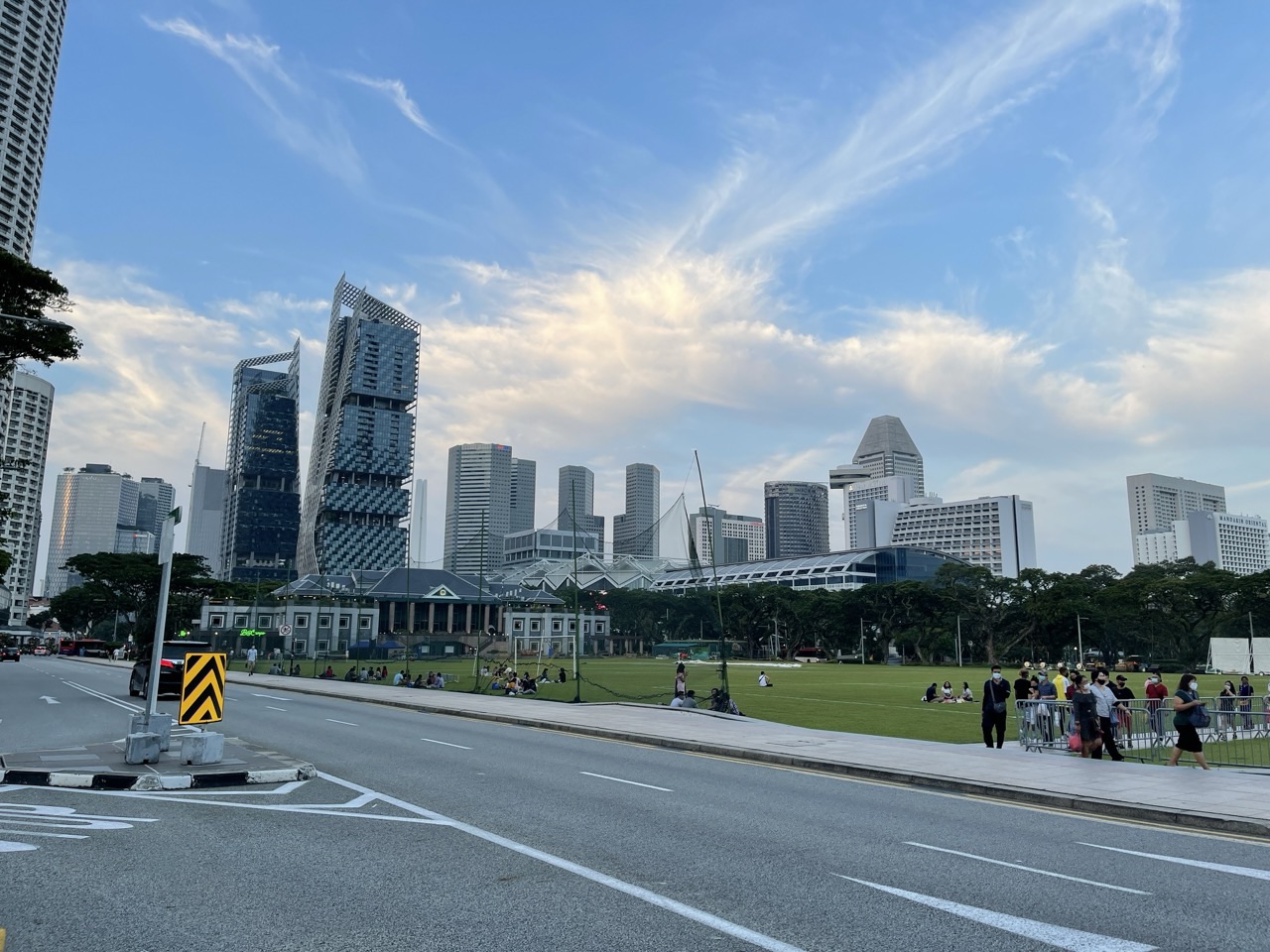
Did you know Singapore’s 1942 surrender and the 1945 Japanese surrender took place in the same war but involved different sides, circumstances and venues? Near City Hall, the Municipal Building and the Padang became landmarks of the end of the Japanese Occupation on 12 September 1945. For a Secondary 2 G3 History pupil, that distinction turns a familiar place into an exercise in chronology and source evaluation.
This article explains how eduKateSG uses marked school scripts to strengthen wartime and post-war History skills: source inference, purpose, comparison, reliability and historical causation. Our premium three-student tutorials run weekly for 1.5 hours near Sixth Avenue MRT, not City Hall MRT. Local history teaches method; the school’s actual topics remain the assessed foundation.
The format follows the immutable Clementi small-group tutorial reference. Historical claims here are grounded in NHB’s Former City Hall history, the Padang monument record and the national World War II account.
Inside the Secondary 2 G3 History tutorial
A student might remember that Singapore surrendered in February 1942, then become confused when a heritage label says Japanese forces surrendered at City Hall in September 1945. The two statements describe opposite sides at different times. We start with the pupil’s genuine marked source response and find whether the problem is chronology, identification of an actor, inference or comparison.
During a premium three-student weekly lesson, each pupil reconstructs the source’s context, writes a corrected claim and attempts a different school-topic question independently. Sessions last 1.5 hours and are near Sixth Avenue MRT, not in City Hall. The lesson should strengthen transferable History skills rather than become a trivia tour.
A lower-secondary course is not a final-year paper
At Secondary 2, History source skills include making supported inferences, identifying purpose, comparing viewpoints, assessing usefulness and explaining what a document can and cannot establish. The teacher’s sequence may include war and post-war Singapore, so the child’s actual assessed chapters are the first reference.
Students should not automatically be drilled in future SEC standalone K330 paper timing at this stage. The national examination system changes from 2027 and the pupil’s own cohort may have later specifications. Historical thinking is the foundation; examination strategy follows when the registered subject and relevant year are known.
February 1942 and September 1945 belong to different surrenders
On 15 February 1942 British-led forces surrendered Singapore to Japan. In September 1945, after the Japanese defeat in World War II, Japanese authorities formally surrendered Singapore to Allied command. The dates represent distinct actions, political situations and participants.
The first writing exercise is simple: one line with the year and surrendering force, one line naming who received the surrender, and a short explanation of what changed between the two. A pupil who writes ‘Singapore surrendered to Britain in 1942’ needs factual repair before deeper evaluation.
The pre-war Municipal Building becomes an Occupation headquarters
City Hall opened in 1929 as the Municipal Building, initially housing colonial municipal administration. During the Japanese Occupation of 1942–1945, the premises were used as a headquarters of the occupying municipal authorities.
The same façade can survive while political control and administrative functions change. A photograph taken in 1930 does not prove who occupied a room in 1943. Students learn to date the source and distinguish original institutional purpose from wartime use.
An air-raid shelter tells us about a particular need
When Singapore came under air attack, the Municipal Building offered shelter to people in the vicinity. NHB records that the building was opened to members of the public seeking safety. That can reveal how a civic building responded to an emergency without describing every resident’s experience.
A record of official shelter arrangements does not establish that every person could reach them or that every shelter was equally secure. To investigate experiences, pupils need testimony and contemporaneous records from affected groups. The answer should reflect the evidence’s scope.
The Supreme Court under Occupation was not the same institution as after 1945
The old Supreme Court opened in 1939. During the Occupation it operated as Syonan Kotohoin, the Japanese administration’s highest court. When British administration returned, judicial institutions changed again and war-crimes trials were held in the post-war period.
A courtroom photograph alone cannot reveal whether a case occurred under British, Japanese or later independent Singaporean administration. The student must identify the political authority and the source date before comparing legal practices.
Japanese military surrender on 12 September 1945
NHB identifies 12 September 1945 as the formal surrender ceremony at the Municipal Building, where General Seishiro Itagaki represented Japanese command before Admiral Lord Louis Mountbatten. A victory parade took place on the neighbouring Padang.
This is not the same as the worldwide surrender ceremony on USS Missouri on 2 September 1945. Students should specify whether a question concerns the global event, a local formal ceremony or an earlier capitulation. ‘The war ended in 1945’ is insufficient for a place-and-date source.
A photograph of a victory parade has evidential limits
The Padang was filled with official and public activity during the September 1945 ceremony. A photograph could show uniforms, flags, troop movements and crowds at the particular moment captured. It cannot automatically reveal how every family coped with wartime losses or scarcity.
We encourage careful language: ‘A crowd is visible’ is direct observation; ‘some participants appeared to celebrate’ may be a reasonable inference depending on the image; ‘all Singaporeans were delighted and completely recovered’ would overreach. The significance of a photograph depends on the question.
An official surrender record and a civilian diary answer different questions
An authenticated military ceremony record is strong evidence of who participated in the official act and which date it occurred. An individual’s diary may reveal uncertainty, relief, fear or practical problems that an official record omits.
Students should not rank one type as permanently superior. The source suited to investigating the formal transfer of control is different from the source suited to studying a family’s experience. Usefulness must be justified in relation to an enquiry.
The court and war-crimes trials after the Occupation
The former Supreme Court was among the venues used for war-crimes trials after Japanese rule ended. That post-war use helps explain the changing legal and political context and the effort to address wartime offences.
A student should not assume that a trial’s existence establishes a particular verdict or that every wartime wrong was prosecuted. Records of charges, testimony, decisions and implementation are needed for those claims. Chronological care also helps distinguish a 1942 order from a 1946 judicial process.
St Andrew’s Cathedral in wartime had several functions
During the 1942 invasion the cathedral’s nave was used as an emergency hospital for wounded people. It also continued to hold religious services during much of the Occupation, and its grounds were used to grow vegetables.
A student can explain continuity and change simultaneously: the institution remained a place of worship while its physical space also met urgent medical and food needs. ‘The cathedral closed throughout the war’ would be inaccurate, as would pretending that it served every possible resident.
A vegetable garden does not prove food shortages were solved
Growing food in the cathedral’s grounds can reveal a response to difficult circumstances. It cannot by itself demonstrate that the activity produced enough food for all residents or ended rationing problems.
The tutor asks learners to separate the act of planting from the yields, distribution and effects. A source showing an official plan for self-sufficiency reveals an intention; independent evidence is required for the outcome. The same reasoning applies to a school garden, public policy or agricultural campaign.
Victoria Theatre and Concert Hall changed functions too
NHB records that the historic civic complex began as a nineteenth-century Town Hall and later included the Victoria Memorial Hall. Post-war political meetings, war-crimes processes and later cultural uses form distinct stages of the same civic space.
A modern concert photograph is useful for studying current presentation, not automatically for determining which trial took place inside a room in 1946. A precise history answer locates the institution and the date before interpreting its significance.
The end of occupation did not mean an instant return to normal
After Japan’s defeat in 1945, Singapore faced shortages, reconstruction demands and changes in government. Some buildings resumed or changed roles while households continued dealing with losses. A political transfer does not guarantee immediate material recovery.
A stronger explanation traces actors and consequences over time. The student should not use the word ‘liberated’ as though it answers every question about food, jobs or public institutions. Different evidence is required to study each experience.
1955: partial self-government was not the same as 1959
The former Parliament House was renovated to create a legislative chamber, and elections in 1955 marked a stage of partial internal self-government. Singapore attained full internal self-government in 1959. These changes differed in governmental powers and political circumstances.
The tutor teaches the pupil to identify the formal status of Singapore when each political source was produced. A 1955 assembly speech should not be paraphrased as though the political arrangements of 1959 were already in force.
The June 1959 rally and the December ceremony are distinct
A mass rally took place at the Padang on 3 June 1959 as Singapore celebrated full internal self-government. On 3 December, Yusof Ishak was installed as Yang di-Pertuan Negara and new state symbols were introduced during National Loyalty Week.
Both happened in 1959, but they commemorated different milestones. Date alone is not enough; the event description must be exact. A student may need to distinguish crowds celebrating an election outcome from a constitutional installation ceremony.
1963 merger, 1965 separation: do not collapse the years
Singapore joined Malaysia in 1963. It separated and became an independent republic on 9 August 1965. In the Civic District, rallies and statements accompanied these developments, which should be interpreted within their correct political settings.
An early 1963 campaign leaflet may tell us why a leader wanted merger, but cannot prove what every citizen believed or that the author foresaw 1965 separation. The historian reconstructs the choices available at the time rather than substituting hindsight.
A modern civic gallery has a separate cultural meaning
Former City Hall and the old Supreme Court became the National Gallery Singapore in 2015. Today’s visitors experience restored buildings with cultural exhibitions, a different public role from their earlier municipal and judicial uses.
A current exhibition panel can be a useful later interpretation of the wartime site. It is not itself a contemporaneous 1945 account unless it reproduces an authentic original item, and that item’s provenance should still be checked.
A source’s maker can influence its emphasis
A Japanese wartime announcement, a British victory report and a civilian memoir may focus on completely different aspects of the same period. Their authors had different knowledge, interests and audiences. This does not automatically make any one claim false.
Pupils should infer purpose from words, date and historical context, then test important factual propositions with independent evidence where possible. ‘It is biased’ is an opening observation, not a complete reliability judgement.
Comparison requires a shared issue, not just a shared country
A 1942 military report and a 1945 rebuilding leaflet both concern Singapore but may have little direct claim in common. Before writing ‘agree’ or ‘disagree’, the student should specify the issue and which part of each source addresses it.
An effective comparison uses precise evidence from both. When an apparent disagreement arises because dates or groups differ, the student should say so rather than force one source into error. Historians compare propositions, not only titles or document types.
Reliability and usefulness are different judgements
Reliability is about how far a claim can be trusted, considering provenance, knowledge, context and corroboration. Usefulness asks what a source contributes to a specific enquiry. A partisan document could be very useful for revealing official propaganda while requiring caution about its allegations.
We teach the pupil to complete two separate sentences: ‘It is useful for finding out … because …’ and ‘Its claim about … is limited because …’. That precision prevents sweeping statements that a source must be entirely accepted or entirely discarded.
Cause and consequence require an explanatory middle step
If an essay says the British surrendered because conditions were difficult, it needs detail about what the difficulties were and how they affected commanders’ decisions. Similarly, a statement that Singapore gained self-government because people wanted freedom ignores the actors and institutional decisions involved.
The tutor trains a claim–evidence–mechanism paragraph: identify the factor, specific event, actor’s response and consequence. A list of possible causes is not enough if it never explains how any of them operated.
A manageable local Historical Investigation
A focused question is: ‘How did the Municipal Building’s role change between February 1942 and September 1945?’ Start with NHB’s City Hall monument history, the wartime account and carefully dated archival records if available.
The pupil must identify which evidence establishes wartime administration and which establishes formal surrender. The investigation should not claim to represent every civilian’s experience or infer people’s feelings from building facades alone.
Why independent transfer matters more than another model answer
After discussing City Hall’s different wartime and post-war roles, each learner answers a previously unseen school-topic source. The new question might address a policy, a personal letter or another historical setting.
The tutor checks whether the pupil can still identify actor, chronology, purpose and evidence limits without copying the City Hall example. A corrected unfamiliar answer is stronger evidence of improvement than a polished retelling of local heritage.
A practical home routine for wartime History
Parents can ask their child to explain two dates: who surrendered on 15 February 1942 and who surrendered on 12 September 1945. Then ask which source would support each statement and what the source cannot establish about daily life.
This short reasoning practice should be respectful of the suffering of wartime communities. It makes chronology meaningful rather than turning war into a list of disconnected dates or dramatic images.
The 1.5-hour three-student History lesson: a practical flow
- First 10 minutes: dated factual recall from the pupil’s school chapter.
- Next 15 minutes: inspect a genuine teacher-marked source response for the earliest error.
- Next 20 minutes: model one purpose, comparison or reliability task using bounded evidence.
- Next 20 minutes: each pupil answers an unfamiliar school-topic source independently.
- Next 15 minutes: correct unsupported generalisations and chronological mistakes.
- Final 10 minutes: an unseen transfer question, error log and targeted home practice.
The timings are illustrative. A pupil who misidentifies the two wartime surrenders needs factual chronology before an advanced reliability judgement. Another with accurate facts but weak comparison needs targeted evidence writing. Three learners may require different exercises.
An illustrative ten-week Secondary 2 correction route
- Week 1: verify the school syllabus and diagnose real marked answers.
- Week 2: distinguish 1942 defeat, Occupation and 1945 Japanese surrender.
- Week 3: identify wartime source makers, audiences and contexts.
- Week 4: make evidence-supported inference rather than paraphrase.
- Week 5: compare two sources about the same issue.
- Week 6: evaluate source usefulness for a clearly stated enquiry.
- Week 7: assess reliability and independent corroboration.
- Week 8: construct an actor–decision–consequence paragraph.
- Week 9: plan a modest evidence-led Historical Investigation.
- Week 10: attempt a new school-relevant source set and review transfer.
The pupil’s progress and school timetable determine the next steps; ten weeks does not guarantee a grade. The relevant change is whether the learner can answer a different source after correction.
Twelve original fictional source exercises for Historical thinking
All short documents below are original fictional classroom prompts, not real wartime statements, victims’ accounts or SEAB past-paper questions. They make reasoning explicit before the tutor moves to actual historical records.
Practice 1: Air-raid shelter
Fictional source: Fictional February 1942 notice opens municipal rooms to civilians.
Question: Does the notice prove every civilian could enter? Reasoning: No. It records intended access, not universal experience.
Independent task: Suggest a civilian record.
Practice 2: A military order
Fictional source: Fictional 1942 directive tells soldiers to defend a particular road.
Question: Does issuing the order prove success? Reasoning: No. Order and result are distinct.
Independent task: Identify operational evidence.
Practice 3: A wartime court note
Fictional source: Fictional 1943 register records hearings under a new authority.
Question: Can it stand for all judicial decisions? Reasoning: One entry has limited scope.
Independent task: Check institution and date.
Practice 4: A victory parade photo
Fictional source: Fictional 1945 photograph shows flags at a civic field.
Question: Whose surrender must be identified? Reasoning: Use the date to distinguish Japan’s 1945 surrender from Britain’s in 1942.
Independent task: Write a precise caption.
Practice 5: An official proclamation
Fictional source: Fictional 1945 speech promises swift recovery to all families.
Question: Did the speech achieve recovery? Reasoning: A promise requires separate outcome evidence.
Independent task: Name a later welfare record.
Practice 6: A civilian account
Fictional source: Fictional 1945 diary expresses relief and food concerns.
Question: Can it represent all residents? Reasoning: It reveals a person’s stated experience.
Independent task: Find a different group view.
Practice 7: An emergency clinic
Fictional source: Fictional 1942 church account says patients were treated in the nave.
Question: Does that prove regular religious use ended forever? Reasoning: No. Temporary medical use can coexist with other activities.
Independent task: Ask for a service record.
Practice 8: A food garden
Fictional source: Fictional 1943 photograph shows vegetables on public grounds.
Question: Does it establish adequate nutrition? Reasoning: One garden cannot show citywide supply.
Independent task: Suggest ration or harvest evidence.
Practice 9: A 1955 assembly
Fictional source: Fictional legislative pamphlet describes newly introduced internal powers.
Question: Is this full 1959 self-government? Reasoning: No; identify the 1955 stage.
Independent task: Make a two-step timeline.
Practice 10: A 1959 rally
Fictional source: Fictional photograph shows a large crowd at a political event.
Question: Does it prove everybody supported a party? Reasoning: Attendance is not unanimous agreement.
Independent task: Suggest an alternative viewpoint.
Practice 11: A 1963 argument
Fictional source: Fictional pamphlet promises merger will solve political disagreements.
Question: Can it prove the 1965 outcome? Reasoning: No; intentions and results differ.
Independent task: Use contemporary language carefully.
Practice 12: A modern museum label
Fictional source: Fictional 2026 wall text describes a 1945 event.
Question: Is the label a 1945 primary witness? Reasoning: No. It is a later researched interpretation.
Independent task: Trace a contemporaneous underlying record.
Five expensive Secondary 2 source mistakes
- ‘Japan surrendered to Britain in 1942’ → identify the different surrendering sides in 1942 and 1945.
- ‘The Municipal Building was always under one government’ → distinguish pre-war, Occupation and post-war uses.
- ‘An official order shows all residents obeyed’ → separate policy announcement from compliance.
- ‘The rally shows everyone had identical politics’ → distinguish a photographed crowd from a whole population.
- ‘A 2026 museum label witnessed the 1945 event’ → distinguish original evidence from later interpretation.
What parents in the City Hall area can practise
Ask your child to write two accurate sentences with ’15 February 1942′ and ’12 September 1945′. In each sentence identify the actors, event and location. Then ask which source could establish the official act, and what different source would be needed to describe the experiences of ordinary families.
Another short exercise is to turn ‘Source A is biased and useless’ into a specific response about what that source reveals and what remains unproved. Fewer, carefully corrected statements can be more valuable than copying pages of generic notes.
Frequently asked questions about Secondary 2 G3 History City Hall
Was the British surrender signed at City Hall in 1942? No. The 1942 surrender sequence involved the Fort Canning decision and the Ford Factory; the formal Japanese surrender ceremony in 1945 was at the Municipal Building.
Is local City Hall history all my child needs to revise? No. It is a source-skills illustration and should not replace the school syllabus.
Is a propaganda document automatically unreliable for every enquiry? No. It can be valuable for studying official messaging, though particular claims about public reaction need testing.
Where do lessons meet? Near Sixth Avenue MRT in the referenced three-student programme, not at City Hall.
Official sources and further learning
Read NHB’s Former City Hall history, the Padang monument account, Former City Hall and Supreme Court, NHB’s World War II article, St Andrew’s Cathedral, Victoria Theatre and Concert Hall and the former Parliament House. These histories provide specific chronology; the MOE lower-secondary G2/G3 History syllabus sets the learning framework.
For future examinations check the SEAB SEC G3 directory. The immutable Clementi reference defines the lesson model; share genuine marked work with eduKate Singapore to discuss tuition suitability.
Continue the Secondary 1–4 G3 History sequence in City Hall
Secondary 1 G3 History tuition City Hall, Secondary 3 G3 History tuition City Hall, Secondary 4 G3 History tuition City Hall. The earlier guide develops historical enquiry; later stages build causal world-history explanations and the correct SEC source-based and essay techniques.