
Did you know that the name Dhoby Ghaut preserves the memory of Indian laundrymen who washed clothes near an old watercourse? A National Museum photograph dating to about 1890 makes a vanished occupation visible. That is an ideal first lesson for Secondary 1 G3 History: a familiar place name can open a question, but the evidence must decide what can be concluded.
The surrounding Fort Canning area also contains much older history, including artefacts linked to fourteenth-century regional trade. In eduKateSG’s three-student History tutorials, these local examples help students learn chronology, provenance, source inference and what evidence does not show. Lessons are near Sixth Avenue MRT, not at Dhoby Ghaut MRT, with a 1.5-hour weekly small-group approach.
The class design follows the immutable eduKateSG Clementi small-group reference. Every learner’s real school chapter and marked response determines the next exercise; local heritage cannot replace the MOE syllabus.
What happens in a Secondary 1 G3 History tutorial?
The tutor begins with the child’s real History worksheet, source response or teacher-marked paragraph. A student may describe a photograph accurately but claim it represents everybody in Singapore. Another may confuse the year an artefact was created with the year someone found it. Both have gaps, yet they need different repairs. Each learner practises an inference, receives precise feedback, then answers another source without the worked model.
Three-student teaching near Sixth Avenue MRT means the tutor can see the child’s thinking rather than a group answer. The weekly session is 1.5 hours. A Dhoby Ghaut family should check the commute and school timetable: the programme is not advertised as meeting at Dhoby Ghaut MRT. Local landmarks illustrate historical methods; the actual school History syllabus remains central.
Full Subject-Based Banding means a subject-level G3 course
G3 describes the level at which a pupil studies a subject under Full Subject-Based Banding. It is not a single ability label for the whole child and it does not mean every Secondary 1 learner is preparing directly for a final-year national standalone History paper. The tutor first checks the school’s chapter sequence and the pupil’s current level.
Singapore’s first SEC cohort sits the new examination in 2027. Families planning later pathways should consult official updates for their own cohort, while present Secondary 1 work develops chronology, source inference, change and continuity, and question-led historical investigation.
Why a transport interchange remembers a forgotten occupation
The name Dhoby Ghaut carries a trace of the work done around this part of town. Dhobies were Indian laundrymen; ghaut or ghat refers to a place or steps by a watercourse. National Heritage Board collection records show that washermen washed clothes near the stream and left laundry to dry in open areas.
The lesson is not simply to memorise the name’s origin. The student asks who recorded the occupation, when the evidence was created, whose experiences are visible and what the evidence cannot reveal. A familiar station name becomes a starting question about ordinary working lives rather than merely a train stop.
The circa-1890 Dhoby Ghaut photograph: what can be seen?
The National Museum holds an image catalogued as ‘Laundry drying at Dhoby Ghaut’, dated around 1890. The collection description explains the work performed by Indian laundrymen beside Sungei Bras Bassa. This is evidence of a trade and a specific historical setting, not a complete census of every laundry worker.
A photograph is especially useful for the appearance of drying areas or working arrangements visible within the frame. It cannot alone prove daily pay, total worker numbers, religious beliefs or how every customer treated the workers. Those claims need separate sources. The student must keep inference bounded.
Stamford Canal and an earlier watercourse are not simply the same picture
The old laundry trade is associated with a stream flowing through the vicinity, subsequently modified as the city developed. A contemporary road or drain layout does not establish how the bank appeared at the time of the historic photograph. Infrastructure changes require dated maps and appropriate records.
The tutor asks the pupil to write two labels: ‘location at the time of source’ and ‘present-day landmark used to identify that location’. Mixing those labels can introduce anachronism. Modern transport routes are not proof of where a nineteenth-century worker stood.
Every occupation leaves a partial evidence trail
Historical records often devote more attention to rulers, officials and large buildings than to the routines of workers. A photograph of dhobies is therefore valuable, but it is still one view and may reflect the photographer’s interests. The photograph can show people performing or preparing work without telling us everything about their living conditions.
Good enquiry asks what sources are missing: wage records, letters, advertisements for laundry services, oral histories recorded later, or municipal documents about waterways. A pupil learns that the absence of a document should not be filled with an invented confident story.
Dhoby Ghaut in a wider Orchard heritage landscape
NHB’s Orchard Heritage Trail notes that the district was on the outskirts of the earlier colonial town and records several kinds of historical activity, including trades, worship and horse-carriage services. That variety means the locality was not simply an empty space before trains and malls.
A useful timeline places different histories side by side without claiming they were identical. A carriage proprietor and a laundry worker might occupy the same broad district but experience very different working conditions. Historical significance requires acknowledging whose life is being discussed.
A religious shrine is not proof of every worker’s faith
The Orchard Heritage Trail also describes the former Sri Sivan Temple area and people who worked near the watercourse. A religious site can reveal community institutions and connections, but a pupil should not assume every laundry worker belonged to one faith because they worked nearby.
To make a population-level claim, historians would need additional community records and careful definitions. The tutor practises the difference between ‘some worshippers included laundrymen’ and ‘all laundrymen worshipped there’. Small words make large differences in source accuracy.
Fort Canning is near Dhoby Ghaut but has a much older history
Fort Canning Hill, earlier called Bukit Larangan, contains evidence of fourteenth-century settlement and regional trade. Archaeological investigations that began in 1984 have unearthed ceramics, pottery and other objects revealing activity well before the British arrived in 1819.
This helps correct a common beginner’s claim that Singapore’s history began in 1819. British colonial government is an important later phase, but objects from centuries earlier establish that people traded and lived here before that arrival. The pupil must distinguish a convenient political starting point from the full span of historical evidence.
The year an artefact was unearthed is not its manufacturing year
If pottery made around the fourteenth century was excavated in 1984 or a later dig, those dates describe different events. The archaeological discovery is modern; the object’s historical origin is much older. Confusing them can make an accurate museum label sound contradictory.
Students build a two-column chart: when the object was used in the past, and when researchers recovered or studied it. Dating methods and archaeological context explain how an earlier origin might be inferred. The pupil should not guess an exact year when the source only supports a century.
Ceramics from other regions suggest trade, but need careful interpretation
NHB describes imported ceramics from China and other parts of Asia found at Fort Canning. Their presence helps historians infer networks of contact and exchange in fourteenth-century Singapore. An individual imported fragment does not reveal which merchant carried it or what price was paid.
We practise the bridge from clue to claim: ‘Because this object originated elsewhere and was found here, it supports contact with that wider region.’ That is more defensible than inventing an eyewitness account of a specific voyage.
Oral traditions and archaeological objects answer different questions
Traditions connect Bukit Larangan with Malay rulers. Archaeological finds support significant early settlement, but they do not automatically verify every name and event in a later narrative. Historians compare different kinds of material with appropriate respect for the questions each can answer.
The pupil learns that an artefact and a story may complement rather than replace each other. When a source says a royal figure was ‘believed’ to be associated with a place, the wording preserves uncertainty that should not disappear in a student’s answer.
1822: Government Hill is a later stage of the same landscape
By 1822 the British had developed Government Hill and built a bungalow for Raffles. The site subsequently served colonial governors, before major military constructions changed its use. A pupil should separate the original historical landscape from its later colonial functions.
A present-day fort wall cannot, without context, establish the layout of the fourteenth-century settlement. Each historical layer has its own sources. In a useful chronology, a later structure should not erase an earlier story.
1859 and 1861: distinguish fort construction from completion
NHB’s archaeological account dates the British fort’s building to 1859, while its Civic District heritage description refers to Fort Canning as completed in 1861. These need not be conflicting dates: one can refer to construction and the other to completion. A careful pupil checks precisely which milestone is named.
Historical enquiry often requires recognising the difference between a proposal, start of work, first use and official completion. Rather than selecting one date because it appears first in search results, students read the source wording and explain the possible distinction.
1887: the National Museum opens as something else
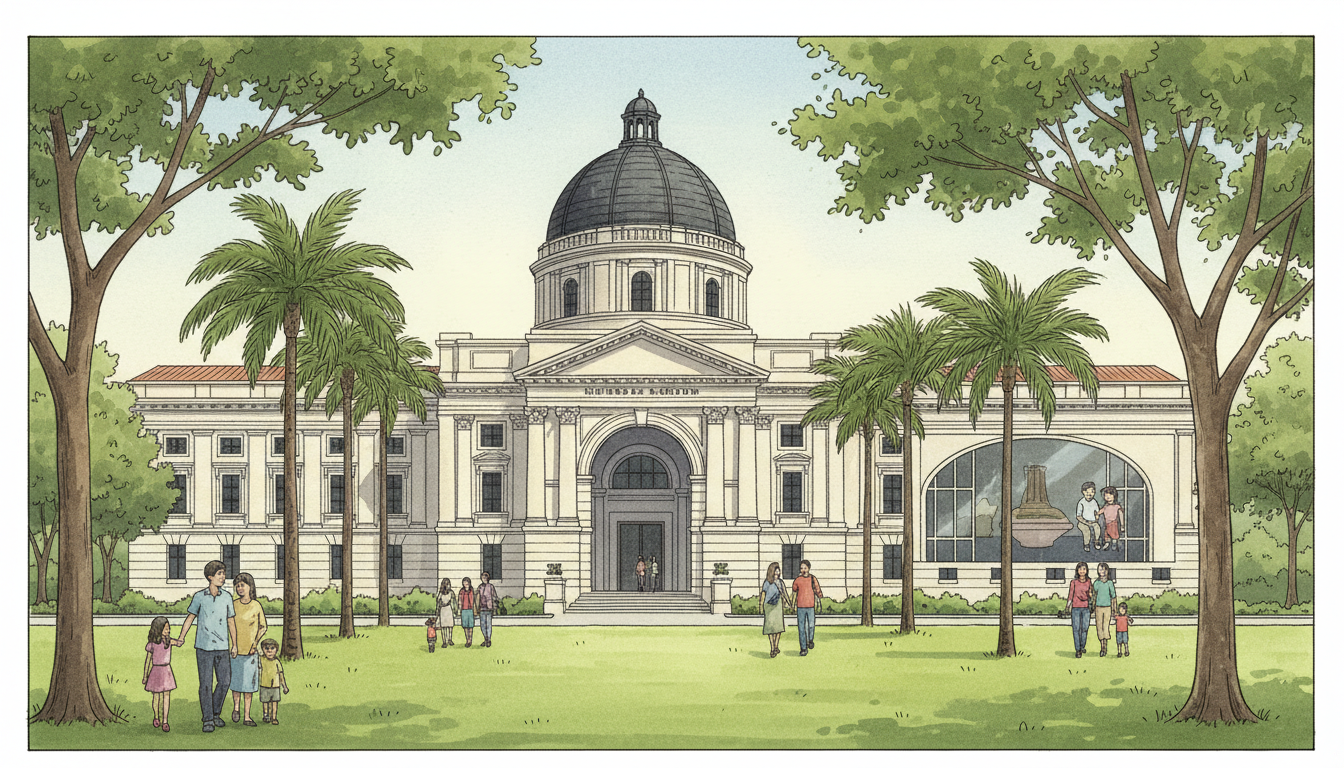
The building now called the National Museum of Singapore opened at Stamford Road on 12 October 1887 as the Raffles Library and Museum. Its earlier institution and present identity are linked, but the present name is not the name used at the nineteenth-century opening.
The story also began before the building: plans for libraries and collections were discussed earlier and the combined institutional arrangements developed before the dedicated Stamford Road premises. An institution can predate its building, just as a physical building can outlast changes in an institution’s mission.
1959 and 1960: self-government is not the same as a museum renaming
Singapore attained full internal self-government in 1959. The museum’s name changed in 1960, along with its national role. These are connected but different events. The answer to ‘When did Singapore attain self-government?’ is not 1960 simply because the National Museum adopted a new name then.
A pupil practises listing actor, event and date on separate lines. A historical consequence often follows a political milestone later, and the reason needs explanation rather than an assumed instant result.
1972: a museum’s collection priorities can change
The institution refocused in 1972 towards Singapore history, ethnography and art, while natural history collections were transferred elsewhere. That change in mandate affected what kinds of stories visitors would encounter, but it did not mean Singapore lacked natural history before that date.
The tutor asks which document could explain the administration’s stated rationale and which later exhibition records might show implementation. A plan for a museum is not itself a visitor survey showing how all people experienced the new galleries.
1992 and 2006: preservation and redevelopment are different milestones
The National Museum was gazetted as a National Monument in 1992. A redevelopment programme between 2003 and 2006 added modern facilities while preserving the historic building; it reopened in 2006. Neither date is the construction year of the original 1887 structure.
This is a practical change-and-continuity exercise: physical architecture, legal protection, use and historical narrative can evolve on different schedules. A photograph from one period cannot replace documents from all others.
A present-day museum label is a later historical interpretation
A label that explains a fourteenth-century artefact in 2026 is not a document written by a fourteenth-century merchant. It can be researched and informative, but the author and production context are modern. The artefact itself may be much older.
Children practise separating primary material from later synthesis without assuming that one kind is automatically more truthful for every enquiry. The best source depends on the question: production method, place of discovery, trade route or modern interpretation.
Historical significance is not simply what is famous today
Dhoby Ghaut is now a recognisable MRT interchange. That makes it familiar but does not mean only transport deserves study. Laundry labour, community institutions, pre-colonial trade and later public education all matter under different criteria.
The pupil states a criterion—effects on daily livelihoods, breadth of trade networks, changes in governance or long-term preservation—before arguing why a development matters. ‘My favourite landmark is important’ is personal preference, not yet an evidence-supported historical judgement.
A manageable Historical Investigation near Dhoby Ghaut
Consider the question: ‘What does the circa-1890 photograph tell us about laundry work around Dhoby Ghaut, and what remains unknown?’ Begin with the museum catalogue record, then compare a contemporary map and another independent source if available. The child identifies the photograph’s provenance and records limitations.
This is more answerable than ‘How did everyone in Singapore feel about Dhoby Ghaut?’ A focused investigation defines a time, group and evidence base without assuming that a source can answer every part of the question.
How the local example transfers to the school’s actual topic
After learning to distinguish discovery date from creation date, the tutor gives the pupil an unseen archaeological, written or visual source from their actual school History chapter. The question may concern early trade, colonial administration or another required topic. The child has to use the same reasoning without referring irrelevantly to Dhoby Ghaut.
Independent transfer is the proof of useful tuition. Repeating an excellent worked answer about the National Museum does not show whether the pupil can handle a new source they have not seen before.
A ten-minute home source routine
Ask: Who made this source? When? What clue supports your inference? Which statement would require another source? The child can answer in four short sentences and identify one uncertainty. That is a better foundation than copying pages of notes without diagnosing the misunderstanding.
Parents need not know the precise dates of every landmark. They can help by asking for the evidence behind a claim, then allowing the pupil to check the school text or a suitable historical reference.
Inside the weekly 1.5-hour three-student lesson
- First 10 minutes: retrieve one historical claim, its date and supporting clue.
- Next 15 minutes: inspect the pupil’s own school-marked answer.
- Next 20 minutes: demonstrate the missing inference, provenance or chronology move.
- Next 20 minutes: each student writes independently on an unfamiliar school-topic source.
- Next 15 minutes: discuss differences in interpretations and correct overclaims.
- Final 10 minutes: an unseen transfer task, error log and small home assignment.
The stages are illustrative. A child missing essential factual background may need more retrieval before a complex source task. A child with secure facts but poor inference needs an evidence-based correction. Three pupils are not handed a single answer to copy.
An illustrative eight-week foundation pathway
- Week 1: school chapters and writing diagnosis.
- Week 2: observation versus inference from photographs.
- Week 3: who made a source, when and for whom.
- Week 4: separate artefact age from excavation date.
- Week 5: compare continuity and change across historical periods.
- Week 6: write a claim, clue and explanation paragraph.
- Week 7: investigate a focused historical question using several sources.
- Week 8: transfer the skill to unfamiliar school work.
This is a possible sequence, not a guarantee of a particular mark. The school calendar, child’s knowledge and actual independent work determine the pace.
Original fictional source laboratory: twelve exercises
Each passage is original fictional classroom material, not a real 1890 letter, a museum archival transcript, an MOE source or a SEAB exam question. Students practise the reasoning step on a controlled example and then work with an authentic source.
Practice 1: The washerman’s photograph
Fictional source: A fictional 1890 photograph shows clothes drying by a stream.
Question: Does it tell us everyone’s wages? Reasoning: The image supports observations about visible work but not income.
Independent task: Identify a payroll or advertisement that might help.
Practice 2: The unnamed waterway
Fictional source: A fictional map places a stream near a road in 1850.
Question: Is it an exact 2026 street map? Reasoning: No, production year and map purpose matter.
Independent task: Name two features to compare with a dated modern map.
Practice 3: The laundry invoice
Fictional source: A fictional receipt lists clothes washed for one household.
Question: Can it establish all residents’ laundry habits? Reasoning: One customer’s transaction is not a representative sample.
Independent task: Suggest a second independent record.
Practice 4: A temple invitation
Fictional source: A fictional 1880 notice invites selected workers to a festival.
Question: Does it establish that all workers shared one religion? Reasoning: No, participation or invitation applies only to the stated group.
Independent task: Explain what a community record could add.
Practice 5: The 14th-century ceramic
Fictional source: A fictional excavation label notes an imported ceramic fragment.
Question: Does it identify the precise merchant? Reasoning: No, provenance may support trade but not a person’s identity.
Independent task: State one cautious inference about exchange.
Practice 6: The 1984 archaeological dig
Fictional source: A fictional museum card says a centuries-old fragment was found in 1984.
Question: Which date belongs to the object? Reasoning: The excavation year is not necessarily its manufacture year.
Independent task: Write both dates with correct labels.
Practice 7: A Government Hill sketch
Fictional source: A fictional 1822 drawing depicts a colonial bungalow.
Question: Did it prove the hill was uninhabited before 1819? Reasoning: No, later construction cannot erase earlier settlement.
Independent task: Name the archaeological evidence needed.
Practice 8: A fort construction notice
Fictional source: A fictional 1859 document announces new fort work.
Question: Can it prove the finished fort was open immediately? Reasoning: Announcement or commencement is not completion.
Independent task: Identify a later completion record.
Practice 9: The 1887 museum programme
Fictional source: A fictional opening invitation announces a library and museum.
Question: Did the institution first exist in that instant? Reasoning: A purpose-built facility may postdate earlier collection activity.
Independent task: Name a prior institutional record.
Practice 10: A 1960 renaming note
Fictional source: A fictional notice announces the National Museum’s new name.
Question: Does this date self-government? Reasoning: No, 1959 and 1960 are different milestones.
Independent task: Write a precise two-step chronology.
Practice 11: A modern museum photograph
Fictional source: A fictional 2026 photograph shows a historic façade and a newer wing.
Question: Can it show the building in 1887? Reasoning: It shows present structure with different construction phases.
Independent task: Seek an older dated image.
Practice 12: An unfamiliar school source
Fictional source: A fictional 15th-century maritime inventory lists overseas objects.
Question: What transfers from the Dhoby Ghaut exercise? Reasoning: Provenance, era, precise evidence, bounded inference and uncertainty.
Independent task: Write one inference and one limitation.
Six common source mistakes and useful repairs
- A photograph of some workers is called proof of every worker’s income → identify the source’s actual scope.
- A source from 1984 is treated as evidence that its artefact was made in 1984 → split discovery and origin dates.
- British arrival in 1819 is said to mark the beginning of all Singapore history → test earlier archaeological evidence.
- A colonial building is assumed to have kept one function forever → follow dated changes in institutions.
- A museum text written later is called a first-hand medieval witness → identify the modern author and the original object.
- Two sources about the same hill are said to agree without comparing claims → find the common historical question.
Frequently asked questions for Dhoby Ghaut parents
Is Dhoby Ghaut laundry history in the SEC final-year History paper? It is used here to teach lower-secondary historical skills, not claimed as a standalone prescribed national exam case.
Does a modern museum make a source automatically true? Museum accounts can offer carefully researched guidance, but pupils should still ask what evidence underlies a specific interpretation.
Where does tuition take place? In the referenced three-student programme near Sixth Avenue MRT. Dhoby Ghaut families should consider the travel and school commitments.
How will I know my child has improved? They can make a new inference from an unseen school source, point to the supporting clue and explain one limitation without copying the tutor.
Official sources and further reading
Read the National Museum collection: Laundry drying at Dhoby Ghaut, c.1890, Indian washmen collection record, NHB Orchard Heritage Trail, Fort Canning archaeological account, Fort Canning Park historical entry, National Museum heritage entry and National Library’s explanation of the place name. For actual school learning objectives see the MOE lower-secondary G2/G3 History syllabus and check later national pathways in the SEAB G3 directory.
The immutable three-student tuition reference describes the lesson model. Families may use eduKate Singapore to discuss a genuine marked History task.
Continue the Secondary 1–4 G3 History learning sequence in Dhoby Ghaut
Secondary 2 G3 History tuition Dhoby Ghaut, Secondary 3 G3 History tuition Dhoby Ghaut, Secondary 4 G3 History tuition Dhoby Ghaut. Each stage advances from enquiry to wartime source comparison, upper-secondary historical argument and the proper examination-year requirements.