
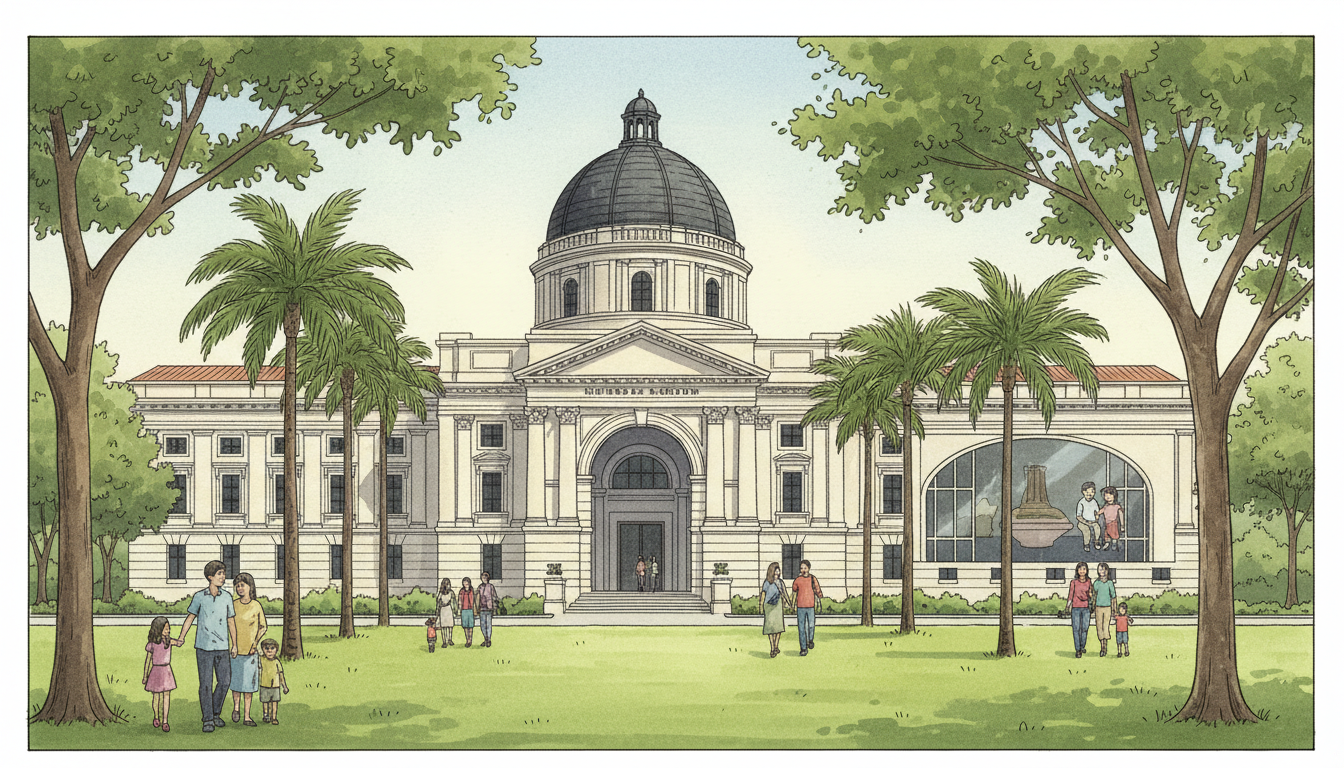
Did you know Singapore’s National Museum began as a colonial library-and-museum institution, then changed its national role after self-government? The building’s 1887 opening, the 1959 political milestone and the 1960 renaming are all real but different events. Secondary 3 G3 History asks students to show this kind of precision while analysing much larger international and Southeast Asian questions.
eduKateSG teaches premium weekly 1.5-hour, three-student History tutorials for families in Dhoby Ghaut and nearby neighbourhoods, with lessons near Sixth Avenue MRT rather than at Dhoby Ghaut. Students learn accurate case knowledge, source evaluation and claim–evidence–mechanism essays. Local stories about museums, wartime media and archaeological artefacts illustrate methods; the actual SEC subject syllabus remains authoritative.
The immutable Clementi small-group tutorial reference establishes the teaching approach. For the 2027 SEC, check K330 History against K336 Humanities (Social Studies, History) before choosing exercises. Later examination cohorts must use their own issued requirements.
What actually happens in a Secondary 3 G3 History tutorial?
The tutor starts with the pupil’s own school-marked essay and source response. A student might quote historical information correctly yet fail to explain its causal significance. Another might place a Malayan event inside a question about Vietnam, use a late memoir as if contemporaneous, or confuse an author’s purpose with evidence that their claim was true.
The first intervention depends on the error. We rebuild actor-specific chronology when knowledge is weak, model inference when the source is misunderstood, and practise claim–evidence–mechanism writing when the essay lacks explanation. Every pupil in the three-student class finishes with a new individual answer, not a shared polished script.
Confirm K330 versus K336 before choosing historical cases
For the 2027 Singapore-Cambridge SEC, G3 standalone History K330 is separate from Humanities (Social Studies, History) K336. Standalone History contains two History papers, whereas combined Humanities includes one History component and a Social Studies component. Overlapping historical thinking skills do not make their prescribed country options or total revision obligations identical.
A Secondary 3 student may be sitting a later SEC cohort. We use the published 2027 specifications as an explicit reference and check the student’s actual examination year and school entry before prescribing materials. Getting the code wrong can turn a busy revision schedule into work on irrelevant cases.
The difference between local history and examinable History content
Dhoby Ghaut contains useful evidence about nineteenth-century laundry work, colonial institutions and wartime landmarks. These help students learn source purpose and chronology because the modern neighbourhood remains familiar. That does not make every local event a prescribed K330 or K336 essay topic.
For actual upper-secondary assessment, the school and SEAB syllabus control the case studies. The tutor states this boundary openly: we borrow the historical method from Dhoby Ghaut, then apply it to the relevant territory, government and period in the examinable world-history source.
A colonial museum is evidence of how institutions collected knowledge
The building now known as the National Museum opened in 1887 as the Raffles Library and Museum. NHB’s museum history describes its early emphasis on natural history, ethnology and regional collections in a colonial setting. What was collected and categorised can tell historians about institutional priorities.
Yet an old museum inventory cannot automatically establish what every community thought about its representation. A colonial collecting authority and the people whose objects or lives were described may have different perspectives. The tutor uses this to teach source origin and the limitations of any one institutional account.
The museum’s later national mission shows continuity and change
After Singapore achieved full internal self-government in 1959, the museum’s name changed in 1960. Its mandate later shifted towards national history, ethnography and art, with collections reassigned in 1972. One structure could carry different institutional purposes across political eras.
For an evaluation paragraph, the student asks which dimension changed—mission, name, governance, collection or building—and which persisted. A historical judgement needs a stated criterion rather than ‘everything changed’. This reasoning transfers to changing international institutions studied in class.
A source created later may describe an event accurately
A modern NHB heritage page describing the 1887 museum opening is not an 1887 eyewitness document. It can accurately synthesise archival records, but its production date and purpose differ from an original opening invitation or colonial administrative report.
When an SEC-style source task asks reliability or usefulness, the pupil identifies both the time of the event and the source’s creation. A carefully researched later explanation is not necessarily false; it just answers some historical questions better than others.
The 1890 Dhoby Ghaut photograph is an example of source limits
The National Museum holds a photograph catalogued around 1890 showing laundry drying around Dhoby Ghaut. It provides evidence of Indian dhobies’ work near a historical watercourse. The photograph does not tell us how every laundry worker was paid or how all customers perceived the occupation.
In the tutorial, the student first makes a bounded inference from a visible detail. Then we ask what additional record might test incomes or working conditions. A single visual source cannot support an entire population narrative, however plausible the narrative might sound.
Evidence of fourteenth-century trade was discovered much later
Archaeological work at nearby Fort Canning, beginning in 1984, revealed pottery and other objects linked to fourteenth-century settlements and Asian trading networks. The objects’ age is not the same as the date of excavation or exhibition.
This provides a strong analogy for source evaluation: historians infer contact and exchange from material evidence, but one imported ceramic fragment does not reveal a precise merchant’s motives. Overconfident reconstruction is not improved by using sophisticated historical vocabulary.
Colonial Southeast Asia requires specific territories and actors
The published 2027 K330 Paper 1 includes European control in Southeast Asia and the challenges to it, with prescribed British Malaya and an alternative country study involving Dutch Indonesia or French Vietnam. Those cases require their own chronological and administrative detail; they are not three interchangeable descriptions of ‘colonial Asia’.
We annotate place, historical actor, decision and local response before drafting any paragraph. Students then explain a mechanism with correct evidence rather than substitute a fact from another territory merely because all three were influenced by European empires.
Economic interest is a factor only when connected to action
A paragraph that says ‘colonial powers wanted trade’ may identify a motive but does not explain an intervention. The pupil should name a particular government or institution, the economic or strategic interest, the specific measure taken and how it affected people or authority in that territory.
We use the local analogy of a museum or trade network only to demonstrate how an institution’s objectives and actions differ. The actual essay must use source knowledge from the prescribed colonial case and show how the chosen factor caused or contributed to the outcome.
The Paris Peace Settlement had competing aims
After the First World War, the powers at the peace negotiations did not all seek identical results. A student should distinguish proposals, terms that were agreed, immediate reactions and subsequent effects. An early speech expressing hope for stability is evidence of a position, not proof that the outcome was guaranteed.
A strong answer moves beyond ‘the settlement was harsh’ into specific mechanisms: a term affected an actor’s options or grievances, which influenced a subsequent choice, which then shaped international stability. Each link must be factually grounded.
Collective security requires an explanation of enforcement
A popular memorised sentence says the League of Nations failed because it was weak. That is circular unless the pupil explains constraints on decision-making, willingness of member states to act and how aggressors understood the credibility of collective enforcement.
The tutor asks a concrete question: what action was proposed, what was implemented, how did other states respond and what consequence followed? A resolution expressing concern is not automatically successful deterrence. This intention-versus-outcome distinction transfers from local institutional sources to world history.
Authoritarian Germany and militarist Japan are separate case histories
Germany’s and Japan’s interwar political pathways had differing institutions, leaders and events. A student should not place the same economic, party or military explanation into both cases without checking the relevant historical actors and dates.
We rebuild each country’s chronology separately before a comparative task. When an essay asks about the causes of tension or war, the pupil then selects the country-specific evidence relevant to the question, rather than provide a generic list of ‘nationalism, propaganda and economic pressure’.
Appeasement cannot be explained entirely by hindsight
Because students know that World War II later occurred, they may interpret every 1930s concession as evidence that the decision-maker intended a war or knew a conflict was inevitable. The historian must ask what leaders believed at the time, what constraints they faced and which alternatives appeared plausible.
A balanced paragraph distinguishes short-term intentions, the likely impact of an actual decision and later results. When evaluating appeasement, the pupil weighs factors with a stated criterion instead of simply applying a moral adjective to every actor.
Origins of World War II: causes must be traced, not listed
Long-term political conditions and immediate aggressive decisions contributed in different ways to escalating international conflict. Simply reproducing a chronology of events or several treaty names can miss the underlying causal question.
The tutor uses a small chain: condition, actor, decision, opposing response and effect on tension. Each link requires the correct historical episode. When the command word changes from ‘explain’ to ‘how far’, the pupil must additionally weigh the factor against a plausible alternative.
The Cathay’s wartime media role illustrates purpose and audience
The nearby Cathay cinema opened in 1939 and later housed Japanese media and propaganda offices during the Occupation. A propaganda film can reveal a regime’s message and target audience, but it cannot by itself measure public agreement or prove every wartime statement it contains.
This local example helps students see why a source with a persuasive purpose can remain useful to historians. We then transfer the same question to an actual world-history source: what attitude did this author seek to create, and which wording and context show that intention?
The YMCA demonstrates the danger of treating one building as one story
The original YMCA premises provided education and recreation before the war but were used for detention and torture by Japanese military police during the Occupation. The same site was repurposed in a radically different political setting.
A later history about that site is valuable, but a present-day building photograph cannot reconstruct all wartime experiences. The tutor asks the child to date the document and distinguish institution, physical structure and occupant. That control is useful in source-based studies of changing regimes.
Inferences and purposes are different tasks
Inference asks what a source suggests based on a precise clue. Purpose asks why someone produced it for an audience in the relevant setting. A tourist advertisement, museum display and wartime official message may all be persuasive in different ways; none should be labelled with an automatic one-sentence answer.
The tutor insists that the student’s inference connect to a specific source detail. A purpose answer must go further by identifying the likely audience response intended and contextualising the message. The existence of a message does not demonstrate that the desired response occurred.
Reliability depends on the particular historical claim
An official source may be reliable for showing that a policy was announced while insufficient for evaluating whether it worked. A memoir may reveal a participant’s experience while giving uncertain figures years later. A museum account may synthesise careful archival research but still reflect choices about emphasis.
A pupil should specify which proposition is being evaluated before considering authorship, date, access and corroboration. Writing ‘biased, therefore false’ often misses the source’s legitimate evidential value.
Usefulness and reliability should not be collapsed
Useful evidence answers part of a historical enquiry. Reliable evidence supports a specific claim with a defensible degree of confidence. A propaganda poster could be highly useful for understanding the regime’s intended narrative while weak evidence that ordinary people agreed with it.
We practise: ‘This source is useful for studying X because its content reveals Y; however it cannot establish Z without further evidence.’ This is much more precise than attaching permanent positive or negative labels to the whole document.
Source comparison is about a shared issue
A museum’s account of a colonial institution and a participant’s diary may approach the same decision from different positions. Comparing them requires identifying the specific issue and selecting evidence from each, not simply noting that one is official and one is personal.
Apparent contradictions can also result from different time periods. Two accounts need not disagree if they describe the same building under different governments. A source-by-source list is weaker than an issue-centred comparison.
Corroboration requires separate supporting evidence
Two online pages may repeat one earlier historical claim. Their agreement does not necessarily provide two independent witnesses. In an examination case study, the student should identify whether documents were produced independently, had relevant knowledge and support the same proposition.
A good corroboration answer is narrow and transparent: which source supports which detail, and where do doubts remain? The pupil avoids claiming that two sources agree just because they both mention a famous leader or a general theme.
The Cold War: explain a decision within a crisis
Paper 2 in standalone K330 concerns the post-war world, including Cold War developments. A student should be able to name the actor, perceived threat, decision, opposing response and resulting escalation or reduction for the relevant prescribed example.
An essay sentence such as ‘both sides wanted power’ is not enough. The tutor asks how a specific event changed the calculation of leaders and whether other historical factors mattered. A list of crises without causal explanation leaves the question partly unanswered.
Decolonisation: avoid one regional formula
Political movements across Southeast Asia worked under different colonial authorities and historical circumstances. A statement that every country gained independence by the same means ignores differences in local agency, negotiations, conflict and international pressure.
The learner identifies the territory first, then the movement, authorities and decisions involved. Only after that can a carefully supported regional comparison be written. The most elegant generalisation cannot replace accurate case knowledge.
Secondary 3 timed tasks should start with accuracy
Some students benefit from short five- to ten-minute source tasks before whole exam simulations. For instance, a pupil may first plan a claim and evidence, then write one evaluated comparison, then attempt an original ten-mark essay plan.
We time the response only after the historical content and reasoning moves are sound. More minutes spent typing an unsupported statement will not improve its historical accuracy. A fresh changed question checks whether the pupil can adapt rather than recall a model.
What meaningful progress looks like to parents
The parent can ask the tutor to point to a specific error in one marked paragraph, the correction taught, and an independent paragraph where it no longer appears. Examples include clearer chronology, more precise source purpose, correct territory and a causal explanation that explicitly answers the question.
This is better evidence than the number of worksheets completed. A weekly home routine may include factual retrieval and a ten-minute new paragraph, followed by one question: ‘How do you know this was the cause rather than simply another event?’
Inside a practical 1.5-hour three-student History lesson
- Opening 10 minutes: retrieve the correct actor, date and territory from the current chapter.
- Next 15 minutes: inspect an actual school-marked source or essay and identify the first defect.
- Next 20 minutes: model one inference, comparative or causal writing move.
- Next 20 minutes: each student writes an unfamiliar subject-relevant response independently.
- Next 15 minutes: challenge assumptions, wrong contexts and incomplete mechanisms.
- Final 10 minutes: change the task wording and test transfer without the model.
The sequence is illustrative. Some pupils need a longer factual repair; others need to learn how to evaluate a source without confusing purpose and truth. Three students can share a discussion while still requiring separate written feedback.
Twelve-week Secondary 3 evidence-and-explanation pathway
- Weeks 1–2: verify examination cohort and registered History or Combined Humanities subject.
- Weeks 3–4: rebuild prescribed territory, actor and event chronologies.
- Weeks 5–6: infer purpose and compare evidence from sources of different origins.
- Weeks 7–8: assess usefulness, reliability and independent corroboration.
- Weeks 9–10: write detailed causal and evaluative essay paragraphs.
- Week 11: practise a new command word under manageable time limits.
- Week 12: answer unfamiliar school-topic sources and plan the next correction cycle.
This is not a guarantee of a particular grade within twelve weeks. Teaching should change according to actual assessment dates and each student’s demonstrated progress.
Original fictional source laboratory: fourteen exercises
The following short documents are original fictional classroom prompts. They are not reproductions of archival documents, quotations from real politicians, museum labels or SEAB past-paper questions. Their purpose is to isolate a reasoning move before transferring to authentic historical evidence.
Practice 1: An 1887 museum prospectus
Fictional source: A fictional colonial notice calls for collecting important specimens from the region.
Question: What is its historical purpose? Tutor’s reasoning: It reveals institutional priorities and a target audience, not universal community agreement.
Independent transfer: Name a source from a represented community.
Practice 2: A fourteenth-century ceramic
Fictional source: A fictional exhibit describes a pot discovered near Fort Canning in 1984.
Question: Which dates are distinct? Tutor’s reasoning: Manufacture and excavation belong to different periods.
Independent transfer: Propose a cautious exchange inference.
Practice 3: A colonial railway petition
Fictional source: A fictional 1902 merchant asks officials for transport links in a named colony.
Question: Does a proposal prove the railway succeeded? Tutor’s reasoning: It reveals an aim; implementation needs further evidence.
Independent transfer: Find one later transport record.
Practice 4: A colonial Malaya circular
Fictional source: A fictional administrator states a new policy will benefit local producers.
Question: What must the student identify? Tutor’s reasoning: The territory, actor, mechanism and affected community.
Independent transfer: Avoid importing Vietnamese events.
Practice 5: An Indonesian nationalist speech
Fictional source: A fictional speaker criticises Dutch political control.
Question: Can it represent every resident’s view? Tutor’s reasoning: No, it documents a speaker or movement’s position.
Independent transfer: Name another political voice.
Practice 6: A peace delegate’s promise
Fictional source: A fictional 1919 speech announces that peace terms will prevent another war.
Question: Does it establish later peace? Tutor’s reasoning: It shows stated hopes, not guaranteed consequences.
Independent transfer: Identify a contemporaneous reaction.
Practice 7: A League announcement
Fictional source: A fictional resolution condemns aggression but names no effective enforcement.
Question: Is declaration the same as implementation? Tutor’s reasoning: No, examine what member states actually did.
Independent transfer: Suggest a later policy record.
Practice 8: An unemployment poster
Fictional source: A fictional 1932 campaign advertisement blames hardship on political opponents.
Question: What evidence can it provide? Tutor’s reasoning: Party rhetoric and strategy, not unbiased causal proof.
Independent transfer: Use independent economic context.
Practice 9: Two appeasement editorials
Fictional source: Fictional 1938 newspapers disagree about whether a concession reduces tension.
Question: How should they be compared? Tutor’s reasoning: Use the same policy issue and identify each claim with evidence.
Independent transfer: Avoid knowing the ending in place of contemporary context.
Practice 10: A Japanese wartime film
Fictional source: A fictional government-screened 1943 film claims all residents welcome its rule.
Question: What is it useful for? Tutor’s reasoning: Official messaging, not measured popular consent.
Independent transfer: Name a civilian source.
Practice 11: A Cold War broadcast
Fictional source: A fictional 1960s statement alleges imminent intervention by another state.
Question: Can allegation become fact automatically? Tutor’s reasoning: No, separate threat perception from verified planning.
Independent transfer: Find diplomatic corroboration.
Practice 12: A decolonisation proclamation
Fictional source: A fictional movement promises instant prosperity after self-government.
Question: What is the main limitation? Tutor’s reasoning: Promises and future outcomes differ.
Independent transfer: Identify a post-change evidence type.
Practice 13: A Dhoby Ghaut source mismatch
Fictional source: A fictional pupil cites a museum’s 1960 rename as proof of a 1959 political event.
Question: How is it repaired? Tutor’s reasoning: The institution and political milestones are different facts.
Independent transfer: Write them separately.
Practice 14: An unseen school source
Fictional source: A fictional conference telegram involves leaders from another continent.
Question: What transfers from local sources? Tutor’s reasoning: Provenance, date, claim, audience and bounded inference—not Dhoby Ghaut history.
Independent transfer: Write one careful conclusion.
Two original upper-secondary essay prompts
Original practice question A: ‘How far did weaknesses of collective security matter more than the actions of aggressive states in increasing international tension in the 1930s?’ A student should identify a criterion for relative importance, explain the relevant institutional weaknesses using prescribed historical cases, trace how states actually reacted and weigh aggressive decisions with a justified conclusion. It is not enough to write that both were important.
Original practice question B: ‘Explain how perceptions of threat could lead governments to escalate a Cold War dispute.’ The student selects a prescribed crisis, identifies the actors, their decisions and reactions, and explains the mechanism of escalation. A follow-up changes the command to ‘how far’, requiring weighed alternatives rather than the same paragraph copied unchanged.
A ten-minute home exercise for Dhoby Ghaut families
Ask your child to choose one source sentence from an unfamiliar school topic. They should explain what it suggests, why they think that and which other evidence could change their judgement. Then ask them to show whether the answer uses the correct territory, time period and historical actor.
Parents do not need to memorise the upper-secondary syllabus to ask what evidence supports a claim. A tutor should show the child that improvement requires more than attractive historical vocabulary: it needs independent accuracy on a different question.
Frequently asked questions: Secondary 3 G3 History Dhoby Ghaut
Can a student use K330 and K336 revision books interchangeably? Not without checking scope. They represent different 2027 SEC subjects and K336 includes Social Studies.
Is the Fort Canning or National Museum timeline itself a compulsory K330 essay case? It is used here for source-method illustration. The prescribed international and Southeast Asian History content must be revised separately.
Do memorised essays guarantee good answers? No. The question can change its command, actor or territory, and the pupil must respond with relevant evidence and argument.
Where is the class held? The referenced premium small-group programme meets near Sixth Avenue MRT. Dhoby Ghaut families should assess realistic travel.
Official History documents and Dhoby Ghaut heritage references
The SEAB 2027 G3 subject directory, standalone K330 syllabus and combined K336 syllabus govern national subject distinctions. Local learning examples are documented in NHB’s National Museum history, history of Singapore museums, Dhoby Ghaut laundry photograph, Fort Canning archaeology account, Fort Canning historical entry, Cathay Building monument account and YMCA heritage record.
The immutable eduKateSG three-student reference explains the class structure. Families may discuss their child’s subject and marked script through eduKate Singapore.
Continue the Secondary 1–4 G3 History learning sequence in Dhoby Ghaut
Secondary 1 G3 History tuition Dhoby Ghaut, Secondary 2 G3 History tuition Dhoby Ghaut, Secondary 4 G3 History tuition Dhoby Ghaut. The lower-secondary stages build historical enquiry and wartime comparison; Secondary 4 moves to syllabus-accurate synthesis, essay choice and timed examination technique.