
Fast summary for Jurong West parents
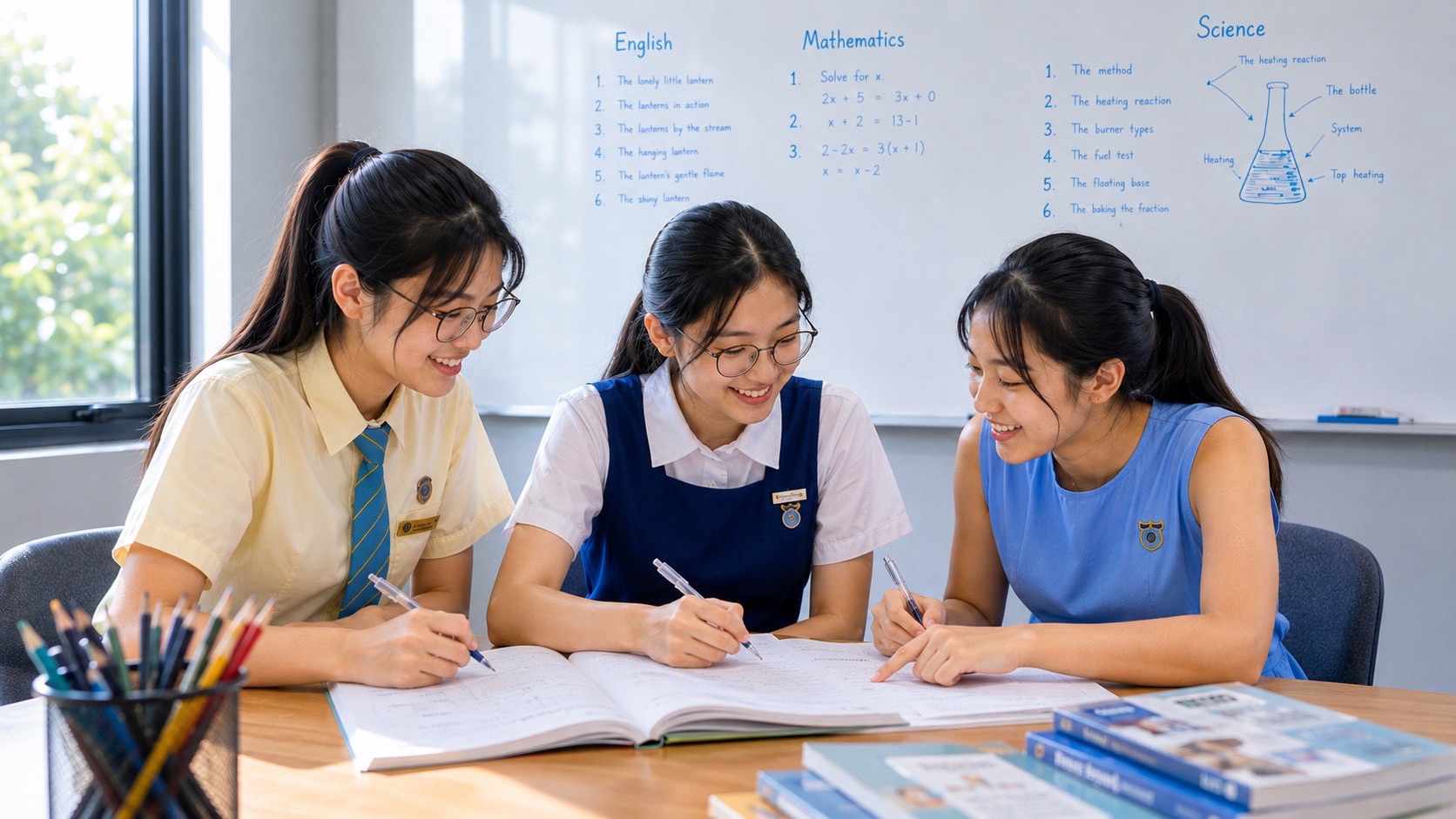
Secondary 1 Mathematics small groups tuition in Jurong West may help a child who understands examples but struggles to choose a method when a new question combines algebra, ratio and numerical reasoning. A three-pupil tutorial gives a tutor opportunities to watch individual working and respond to the first mistake. The benefit is specific feedback, not merely a smaller class. Parents should check whether the current G1, G2 or G3 Mathematics level is matched and whether the weekly travel, fees and homework are sustainable. A class can also cause comparison, pressure and dependence on hints. The goal is an independent learner, not a guaranteed grade.
Should a family enrol before trying school support?
Many Secondary 1 pupils learn successfully from school teaching, asking questions and revising consistently. An extra lesson is not automatically necessary after one disappointing test. First examine the errors: did the learner misread a condition, choose the wrong equation, make a sign error or simply run out of time? Each calls for different help. A parent can bring one recent school exercise and one unfamiliar question to a prospective tutor. If school consultation and manageable home practice are enough, the family can avoid adding time and cost. If a persistent misconception remains unresolved, focused small-group instruction may be worthwhile.
The Primary 6 to Secondary 1 bridge
Primary-school models and arithmetic remain valuable, but Secondary 1 pupils increasingly work with letters and explain why equations are equivalent. Suppose four equal quantities and three extra units make thirty-one. A bar model contains four identical boxes and three loose units; algebra writes 4x + 3 = 31. Subtract three to obtain 4x = 28 and x = 7. The learner should know what x represents and why the three appears only once. A capable tutor connects the story, picture and equation rather than relying on slogans such as “move the number across.”
A mixed diagnostic reveals method-selection problems
Try four no-hint questions without chapter headings: 5/6 – 1/3, -4 + 11 – 9, simplify 2(a + 4), and solve 3x – 5 = 16. The answers are 1/2, -2, 2a + 8 and x = 7. Ask the child to explain how they chose each operation. A wrong fraction answer may signal a missing common-unit concept; an incorrect expansion may reveal a misunderstanding of brackets. A correct result without an explanation can still indicate fragile knowledge. The tutor should use the first invalid step to select the next teaching task and then test a changed example independently.
Worked example: percentages depend on the base
An imaginary item costs $64 after a 20% discount. The sale price is 80% of the original, so 0.8p = 64 and p = 80. Checking, twenty percent of eighty is sixteen, leaving sixty-four. A common error is adding 20% of sixty-four, which applies the percentage to the reduced rather than original amount. Ask “percent of what?” before teaching a formula. In a changed problem where $64 is the price after a 20% increase, the equation becomes 1.2p = 64, giving p = 53⅓. These figures are original teaching examples, not actual local prices.
How a three-pupil tutorial can improve transfer
With three pupils, a tutor may inspect intermediate steps, hear a learner explain the chosen relationship and identify a misconception before it spreads through a worksheet. Students can compare a diagram, table and equation for the same problem. But peer explanation should be followed by independent work. A pupil who listens to a good solution may still be unable to choose the method alone. A strong lesson therefore ends with an unfamiliar question that does not announce which chapter applies. A class of three that merely copies the tutor’s working may provide little of this benefit.
Full Subject-Based Banding matters for tuition fit
Full Subject-Based Banding has applied to Singapore Secondary 1 cohorts since 2024. Students may study subjects at G1, G2 or G3 levels under school arrangements. The Posting Group used for admission should not replace checking the actual Mathematics subject level and current school tasks. Some prerequisites overlap, but depth and pacing differ. SEAB states that the Singapore-Cambridge Secondary Education Certificate begins in 2027 for relevant graduating cohorts at the respective levels. The immediate task for a current Secondary 1 pupil is to master the school programme, not to rush through eventual national examination papers. See MOE and SEAB.
Worked example: a fixed fee is not a ratio
A fictional service costs $5 per visit plus a one-time $12 registration charge. For n visits, the cost is C = 5n + 12. Four visits cost $32, while eight cost $52, not $64. Doubling the number of visits does not double the total because the fixed charge stays the same. A pupil who doubles the first bill has treated a non-proportional relationship as proportional. The tutor can separate the variable and fixed parts in a table, then ask the child to construct a changed model, such as $3 per visit plus $7 once, giving C = 3n + 7.
When a group of three is still a mismatch
One pupil may need fraction repair, another may know the algebra but misread word problems, and a third may be ready for extension. An identical worksheet does not meet those needs. A tutor can use a common concept and differentiated tasks, but should be honest if the group becomes unsuitable. A student requiring intensive foundational rebuilding may need one-to-one help; a confident independent learner may need only school extension or occasional consultation. A small class is a format, not an automatic personalised programme. Parents should ask how grouping is reviewed when school progress changes.
The danger of dependence on hints
Tutors can unintentionally provide the first line, name the formula or point to the relevant example. A pupil may complete the worksheet without learning to select a method independently. When a school paper removes those cues, the learner becomes stuck. Good teaching moves from demonstration to guided practice, then a fresh problem without hints and a delayed check several days later. Record whether help was needed; a correct answer produced with constant prompts is not the same as independent mastery. Parents can support this by letting the child attempt schoolwork before offering a leading hint.
The opportunity cost of an extra evening
Jurong West families should count the full door-to-door commitment, including travel from school or home, a 90-minute tutorial, meals, waiting and any homework afterward. A lesson may be academically sound but unsustainable if the pupil regularly loses sleep or has to rush ordinary school assignments. Ask for the exact venue and current timetable; an estate name in an article does not confirm an eduKateSG classroom in Jurong West. Ask also for current fees, materials, missed-class rules and withdrawal terms. A higher price or smaller class does not guarantee stronger learning.
First-step questions for parents
Before paying, ask the tutor to show the first invalid line in the child’s independent work and explain what it reveals. Ask how the actual G1, G2 or G3 Mathematics level guides the next tasks. Find out how the three pupils are differentiated, how often no-hint questions are attempted and how progress will be reviewed. Confirm the real teacher, address, timing and complete costs. Most importantly, ask when the tutor would recommend reducing or stopping tuition. A responsible programme should aim to make learners more independent rather than creating a permanent reliance on paid help.
Worked example: three representations of a break-even decision
An imaginary activity offers two plans. Plan A costs six dollars per session without a joining fee. Plan B costs four dollars per session plus a one-off sixteen-dollar fee. For n sessions their costs are A = 6n and B = 4n + 16. To find the same total, solve 6n = 4n + 16, giving 2n = 16 and n = 8. Both plans cost forty-eight dollars at eight sessions. At five sessions A costs thirty while B costs thirty-six; at ten sessions A costs sixty while B costs fifty-six. A student who always chooses the lower per-session price has not considered the fixed charge. A tutor can show these relationships as equations, a table and two graph lines. The aim is to explain why the preferred plan changes at eight visits, not to memorise the number eight. Change the joining fee to twenty dollars and require a new answer without hints. The lesson teaches how to form and interpret a relationship; the prices are made up for teaching, not real Jurong West quotations.
Worked example: ratios change when quantities change
Imagine red and blue counters in the ratio 3:5, with forty counters altogether. Eight ratio parts represent forty objects, so one part is five. There are fifteen red and twenty-five blue. Add five red counters and the new numbers become twenty and twenty-five, producing a ratio of 4:5. A pupil who keeps writing 3:5 has failed to update the relationship. Next return to the original quantities and remove five blue counters. The new numbers are fifteen and twenty, so the ratio is 3:4. These two changes involve the same number five but produce different outcomes. Ask the child to explain what changed before using any calculation. A skilled tutor may use a drawing first, then numerical quantities and finally a ratio statement. The independence test should change the amounts and identify a different part to alter. The learner must read the action rather than simply repeat a divide-by-parts formula. This is a useful example of why unfamiliar wording reveals more than repeatedly practising one worksheet pattern.
Worked example: a bracket error and a mathematical check
Simplify -2(3a – 4). The distributive rule applies the multiplier to both terms, giving -6a + 8. A pupil might write -6a – 8 after treating the negative four incorrectly. Use a = 1 as a check: the original is -2(3 – 4) = 2, while the correct expression is -6 + 8 = 2. The incorrect expression would give -14, demonstrating that it is not equivalent for this input. Now contrast -2(3a + 4), which gives -6a – 8. The small change in the bracket creates an important sign difference. The tutor should ask the learner to explain that difference in words and then solve another example with different coefficients. A numerical substitution can reveal a false algebraic statement, but the distributive rule is the general explanation. This is an opportunity to teach both checking and underlying structure rather than simply write a correction in red ink.
Worked example: geometry can reveal two distinct errors
Two adjacent angles on a straight line measure (3x + 15)° and (2x – 5)°. They add to 180°, so 3x + 15 + 2x – 5 = 180. Simplify to 5x + 10 = 180, giving x = 34. The angles are 117° and 63°, which add to 180°. A student who sets the total to ninety degrees has selected an incorrect geometry property. A student who selects 180 but loses the minus five has an algebraic execution problem. Those two pupils do not require identical teaching. The first needs to identify the given geometric relationship and explain the applicable angle rule. The second needs practice in combining terms and keeping signs. A well-managed group can diagnose both while assigning individual follow-up tasks. The tutor should then use a changed diagram without saying which property applies. The child needs to write the reason before the equation and check the answer against the original geometry. Correct mathematical communication is part of the solution.
The value and limitation of peer explanation
A group of three may allow students to hear different methods for the same idea. One child can propose a diagram, another can form an equation, and the third can check a numerical case. The tutor helps the learners distinguish a genuinely equivalent method from a coincidental answer. This can expand mathematical flexibility and make the reasoning visible. But small groups can also create uncomfortable comparison. If a quick pupil speaks every time, the others may become passive or embarrassed. Good teaching allows silent individual working before discussion and allocates opportunities carefully. Mistakes should be treated as information rather than evidence that a child is permanently weak. Most importantly, the discussion must be followed by a changed independent task. A learner can understand a peer’s explanation while hearing it and still struggle to reproduce it later. The tutor should record no-hint performance separately from guided success. That distinction is a better indicator of lasting benefit than how engaged the group appeared during conversation.
Why timed work must follow conceptual repair
School assessments involve time limits, but speeding up an incorrect method does not create understanding. A learner may be slow because the concept is new, because arithmetic is not yet fluent, or because the pupil has difficulty identifying which relationship a story represents. A tutor should diagnose the cause before prescribing a clock. First require a valid, independently explained solution. Next practise similar ideas with varied wording so the learner can select a method without a chapter title. Only when the reasoning is reasonably stable should short timed sets be used to improve execution. The checking habit can be trained alongside timing: estimate the size of an answer, substitute an equation solution, or verify the units of a measurement. Parents should not assume that taking longer means a child lacks ability. Different errors demand different support. A tutor who can explain whether the bottleneck is interpretation, calculation or test management is providing more useful information than one who merely assigns repeated speed drills.
A purposeful ninety-minute lesson that tests independence
A good session might begin with an unfamiliar retrieval question on an earlier topic. The tutor watches how each student begins and identifies whether a misunderstanding has returned. After a short diagnostic, the teacher explains the missing principle through a concrete representation and a clear symbolic method. Contrasting examples show when the rule applies and when it does not. The students then work at differentiated levels. One may need fraction foundations, another word-problem translation and a third an extension asking for a counterexample. A brief peer discussion lets students compare approaches, followed by a quiet changed question solved without hints. The tutor records the type of help required and chooses a small follow-up task. This is an illustration, not a statement that every provider allocates exact minute segments in this way. An advertised ninety-minute tutorial is only valuable when it produces genuine mathematical decisions, specific feedback and evidence that dependence is decreasing. Passive copying for ninety minutes is not independent practice.
A twelve-week progression and a six-week check
During the first fortnight, establish an independent baseline and identify two or three recurring errors. The next weeks repair the earliest missing prerequisites and connect the corrected idea to the school chapter. Avoid accelerating simply to finish syllabus pages. From weeks five to eight, combine old and new topics, change question wording and reduce hints. Short explanations of why a step is valid should accompany computations. By week six, review no-hint examples and ask whether the child can begin questions that were previously difficult. In later weeks, introduce unfamiliar applications and modest time controls once accuracy is secure. A delayed question is useful because it tests whether the skill survives beyond the tutorial. At the end of a term, consider the complete evidence: reasoning, repeated mistakes, schoolwork, rest, travel and the learner’s confidence. Tuition may continue, change group, reduce in frequency or end. An educator should be prepared to recommend less tuition when the child is independently capable.
What parents should measure beyond school grades
School marks matter but are affected by paper difficulty, topic coverage, test conditions and the child’s preparation. A learner may genuinely improve in algebra yet meet a difficult geometry paper next. Conversely, a familiar test may produce higher marks without establishing that the student can solve unfamiliar problems. A single grade is therefore an incomplete measure of teaching quality. Collect a small portfolio of independent work. Record whether the learner chose a sensible first step, kept equality valid, handled signs correctly, used appropriate units and checked the final answer. Compare with a baseline using different but similar questions. The amount of tutor prompting should be visible, not hidden. Parents should ask whether the child is sleeping adequately and maintaining ordinary school and family routines. Higher marks accompanied by chronic exhaustion are not the only outcomes worth noticing. A good programme sets educational goals without promising a fixed improvement date or treating tuition as a permanent necessity.
A practical home routine and ten parent questions
A family can support learning through two or three brief independent tasks rather than a second full lesson at home. Revisit a corrected error, practise one current school idea, and later offer a mixed question without a chapter heading. If the answer is wrong, identify the earliest invalid line and write a concise explanation. A note such as “I counted the fixed fee for every item” is more useful than the vague word “careless.” Before enrolling, ask: What is the exact learning gap? Does the class match G1, G2 or G3 Mathematics? Will the tutor inspect intermediate steps? Can each child solve unfamiliar work without hints? How are different readiness levels managed? Is peer discussion respectful? What is the confirmed tutor and teaching address? What is the complete fee and missed-lesson policy? How much homework will be added? When will progress be reviewed and when might tuition stop? These questions allow parents to compare tuition with school consultation and independent practice rather than equating more paid time with better learning.
Frequently asked questions
Does every Secondary 1 pupil need Mathematics tuition? No. School teaching and regular independent revision can be sufficient. Are three pupils automatically better than one-to-one? No. A group offers peer learning, while individual help may suit a highly specific need. Can pupils at different subject levels share a group? The tutor must match each pupil’s actual G1, G2 or G3 expectations and readiness. How quickly will grades improve? There is no guaranteed timeframe. Does this article confirm an eduKateSG Jurong West venue? No; ask the operator for the actual location and current available seats. Is more homework automatically better? No; targeted, checked practice matters more than quantity. What suggests tuition is working? More independent starts, fewer repeated errors, sound reasoning and better transfer after a delay.
Research limitations, sources and the next step
The Education Endowment Foundation’s small-group tuition review reports positive average impacts, but also shows variation by subject, implementation and group composition. Those findings are not a grade guarantee for a specific Singapore Secondary 1 pupil in a weekly ninety-minute class. The appropriate decision depends on the child’s actual needs, teaching quality and sustainable schedule. Bring a recent school problem and an unaided attempt to a consultation. Ask what went wrong, how it would be repaired and how a changed task would prove independent mastery. Confirm the actual classroom, current fee and review date. The immutable eduKateSG Clementi reference describes the established three-pupil approach; the Bukit Batok guide offers related advice. Neither link establishes a Jurong West vacancy. Official curriculum context comes from MOE and SEAB. All numerical examples in this guide are original.