
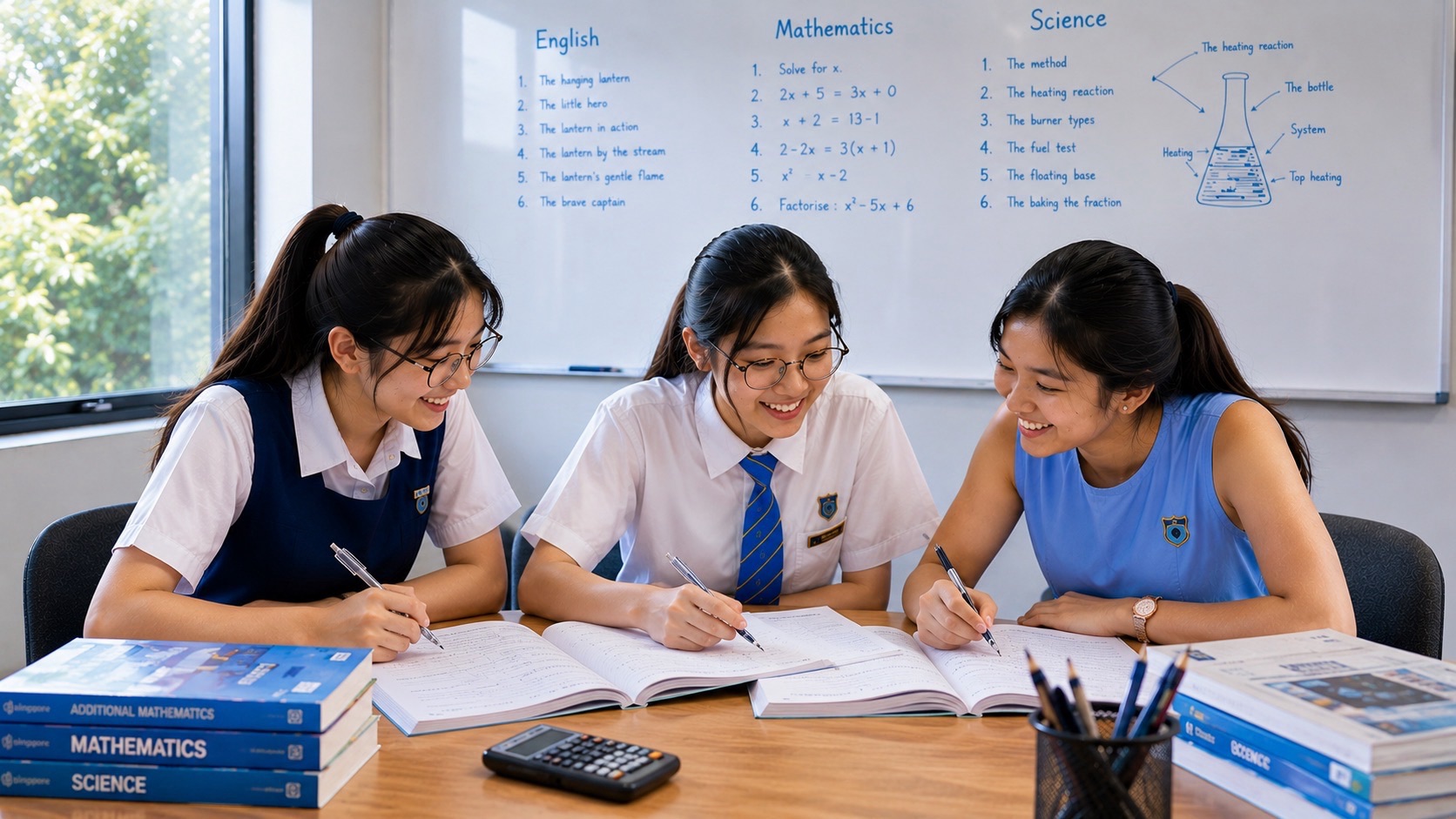
Secondary 1 Mathematics tuition for Bendemeer families should solve the real transition problem rather than simply add more worksheets. A student leaving Primary 6 has already learned arithmetic, fractions, ratio, percentage, geometry and data, but Secondary 1 changes the language used to express those ideas. Numbers may now be negative, unknown quantities are represented by letters, relationships are written as equations, and familiar questions can require several connected representations before a method becomes visible. Good Secondary 1 Mathematics tuition therefore starts by checking how a learner reads notation, explains equality, handles directed numbers and turns words into algebra.
Parents searching for Secondary 1 Mathematics tuition in Bendemeer, a Sec 1 Math tutor, lower-secondary Mathematics support, G1/G2/G3 Mathematics help or small-group algebra tuition often describe the same puzzle: their child could complete Primary 6 work but now hesitates on apparently simple questions. That hesitation is useful evidence. The student may still know how to calculate yet be unsure how to interpret symbols, preserve equivalence, choose a representation or start without a chapter label telling them what to do.
This is the Bendemeer year-specific route within eduKateSG’s wider Mathematics system. Bendemeer is the family’s local search and planning context; this page does not claim that eduKateSG operates a physical branch in Bendemeer. It does not replace the national Secondary 1 Mathematics Tuition owner, the Mathematics Learning Hub, or How Mathematics Works. For examination-focused local intent, the existing SEC Examination Mathematics Tuition | Bendemeer route remains separate.
Secondary 1 changes what it means to “know” Mathematics
At Primary 6, Ben may recognise 36 ÷ 4 immediately. In Secondary 1, he can meet 4x = 36 and freeze even though the underlying division is familiar. The difficulty is representational. The symbol x stands for a quantity whose value is constrained by a relationship. If Ben understands that both sides of an equation describe the same amount, dividing both sides by four is not a trick; it is an operation that preserves equality.
Jo may have the opposite problem. She can solve 4x = 36 because she remembers “move the four and divide”, but she cannot explain the relationship. That shortcut feels efficient until she meets 4(x + 3) = 36. If she treats algebra as moving symbols, she may write x + 3 = 32. If she treats the equation as a balanced relationship, she divides both sides by four first, obtains x + 3 = 9, and then finds x = 6.
The first goal of Secondary 1 tuition is therefore not speed. It is to make the learner’s mathematical actions meaningful enough that the same principles survive unfamiliar questions.
Begin with a dependency check, not a chapter race
A strong Secondary 1 programme should inspect the knowledge that later algebra will reuse. Can the student work accurately with fractions? Can the student distinguish ratio from difference? Does percentage reasoning preserve the correct base? Can the student interpret a coordinate, read a scale and state a simple geometric reason? These are not “primary-school topics” that have expired. They are dependencies.
Aisha, for example, may manipulate simple algebra correctly but lose marks whenever fractions enter. If tuition ignores this because the class is currently studying expressions, the weakness returns later in algebraic fractions, equations, proportion and probability. Ryan may be fluent with calculations but misread “decrease by 20%” as “subtract 20”. That same weak reference-point reasoning will affect compound percentage change.
Diagnosis should therefore ask two questions at once: what is the current Secondary 1 topic, and which earlier idea is preventing the student from using it reliably?
Directed numbers need a number-line model before sign rules
Negative numbers often look easy because students quickly memorise rules. Yet a learner can recite “negative times negative is positive” while still misreading -3 – 5 or comparing -2 and -7 incorrectly. The repair begins with order and movement.
Place -7, -2, 0 and 4 on a number line. Ask Clara which is greater: -2 or -7. If she says -7 because 7 is larger than 2, the issue is not multiplication signs. It is magnitude versus order. Ask what happens when a temperature at 2°C falls by 6°C. The movement crosses zero and ends at -4°C. Once negative values have spatial and contextual meaning, symbolic rules attach to something the student can reason about.
Only then should tuition compress the idea into efficient procedures. Rules are useful after meaning is stable; before that, they can hide misunderstandings.
Equality should be taught as a relationship
Many students unconsciously read the equals sign as “now calculate the answer”. Secondary algebra requires a stronger interpretation: the expression on the left has the same value as the expression on the right.
Ethan sees 7 + 5 = 9 + 3 and accepts it because both sides are 12. Now change the statement to 7 + 5 = x + 3. The unknown is not mysterious. It is whatever value makes the two sides equal. That framing supports equation solving, formulae and later simultaneous equations.
A useful tuition habit is to ask, “What operation would preserve this equality?” rather than, “What number do we move?” If both sides are divided by the same non-zero number, equality is preserved. If the same quantity is added to both sides, equality is preserved. This language gives the student a principle rather than a fragile mnemonic.
Algebraic notation should describe quantities, not decorate them
When Adrian sees 3a, he should be able to say “three groups of a” or “three times the quantity a”. When he sees a + 3, he should know that this is a different relationship. Students who treat both as collections of symbols are vulnerable to writing 3a + 2 = 5a.
Use concrete descriptions. If a notebook costs d dollars, three notebooks cost 3d dollars. If delivery adds $2, the total is 3d + 2. Ask the student to tell the story represented by the expression. Then reverse the task: give a story and ask for an expression.
This two-way movement between language and notation is one of the most important Secondary 1 habits because later topics repeatedly demand it.
Like terms depend on algebraic units
A student who sees 4x + 3x can think of four x-units plus three x-units, giving seven x-units. The same logic explains why 4x + 3 cannot become 7x: x-units and ordinary units are not alike.
Mira may complete ten like-term exercises correctly yet fail on 5a + 2b + 3a – b because she reads from left to right rather than by algebraic type. Tuition should ask her to classify terms first. Which terms are a-terms? Which are b-terms? What signs belong to each term? The grouping process matters more than speed.
This also creates a clean path to polynomial work later. Students are not just “collecting letters”; they are combining compatible algebraic quantities.
Substitution means replacing a symbol with its full value
Substitution becomes error-prone when negative values are involved. Suppose p = -3 and the expression is 2p² + 5. A student who writes 2 × -3² + 5 may rely on a calculator and lose control over order of operations. Writing 2(-3)² + 5 makes the replacement visible and protects the sign.
Leonie is not part of this Mathematics cast; instead, Clara provides the useful contrast here. Clara writes brackets around every substituted negative value. Ryan does not. Their answers may match on easy examples, but Clara’s written structure is safer when expressions become more complicated.
Good tuition makes such habits explicit. Reliability grows from small conventions repeated before the examination year.
Expansion should preserve every term in a bracket
When students first expand 3(x + 4), the main risk is distributing to only the first term. A visual area model or repeated-addition explanation can make the structure clear: three copies of x + 4 contain 3x and 12.
Then move to negative multipliers. In -2(3x – 5), each term inside the bracket is multiplied by -2. The result is -6x + 10. If a student changes only one sign, ask them to state the multiplication applied to each term rather than memorising “change the signs”.
This precision matters because later factorisation is the reverse process. If expansion is understood as structure, factorisation becomes recognisable rather than mysterious.
Factorisation should be introduced as reversing multiplication
For 6x + 9, ask Ben what common factor both terms contain. Taking out 3 gives 3(2x + 3). Now expand the answer to verify it. That immediate reverse check is powerful because it turns factorisation from a one-way procedure into a relationship between two equivalent forms.
Students should learn to ask why one form might be more useful than another. Expanded form can make individual terms visible. Factorised form can expose a common structure. Later Mathematics depends heavily on choosing useful forms, so Secondary 1 is a good time to begin that habit.
Equation solving should show a legal chain of equivalent statements
Consider 5x – 7 = 18. Instead of teaching “move -7 across and change sign”, write:
5x – 7 = 18
5x = 25
x = 5
Then ask what happened between lines. Seven was added to both sides, then both sides were divided by five. The visible chain helps students check their own work and later supports more complicated equations.
Aisha may reach the correct answer mentally but omit steps. That is not always a problem, yet if the omitted step is where errors normally occur, writing it is useful. The goal is not maximum writing. It is enough working to make reasoning inspectable.
Word problems require the unknown to be defined before equations are written
Many weak algebra solutions begin with an equation but no clear definition of the variable. If “a ticket costs x dollars” is stated first, the rest of the model becomes easier to audit.
Suppose three tickets and a $4 booking fee cost $31. Define x as the price of one ticket. Then 3x + 4 = 31, so 3x = 27 and x = 9. Finally, answer the original question with the correct unit: one ticket costs $9.
Adrian may be able to solve the equation but still model the story wrongly. Tuition should therefore separate modelling from solving. First ask whether the equation accurately represents the situation. Only then solve it.
Ratio remains important because it connects arithmetic to algebra
Ratio problems are useful transition tools. If red and blue counters are in the ratio 3:5 and there are 32 counters altogether, the total number of parts is 8. One part is 4, so the counts are 12 and 20.
Now express the same relationship algebraically. Let one part be k. Then red = 3k, blue = 5k and 8k = 32. This connects familiar part-whole reasoning with an equation.
Jo sees that algebra is not replacing ratio; it is giving her another language for the same structure. That recognition reduces the sense that Secondary 1 is a collection of unrelated new rules.
Percentage questions depend on identifying the reference quantity
A 20% increase and a 20-percentage-point increase are not the same idea. Nor does a 20% increase followed by a 20% decrease return a quantity to its starting value.
Take $100. Increase by 20% to get $120. Then decrease $120 by 20%, which is $24, producing $96. The second percentage uses a different base.
Students who understand this reference-point principle are better prepared for discounts, profit and loss, reverse percentage, compound change and later financial contexts.
Coordinates introduce Mathematics as relationships between variables
A coordinate is not just two numbers in brackets. The ordered pair tells us how far to move horizontally and vertically from an origin within a defined coordinate system.
Ask Ethan to plot (3, -2) and (-2, 3). If he swaps the coordinates, the error reveals that order has not been internalised. Ask him to describe the movement from one point to another and how the signs matter.
Once coordinates are secure, graphs can be introduced as collections of related pairs. That idea will later support linear graphs, gradient, intercepts and functions.
Graphs should be read before they are drawn
Students often focus on plotting accurately but fail to interpret what a graph is saying. A useful lesson asks both directions. Given a table, draw the graph. Given the graph, describe the relationship.
If y = 2x + 1, ask what happens to y when x increases by one. Ask where the graph crosses the y-axis. Ask what points satisfy the equation. These questions develop relational thinking rather than mechanical plotting.
Geometry requires reasons, not faith in a diagram
Secondary 1 geometry should begin the shift from “it looks equal” to “it must be equal because…”. Diagrams may not be drawn to scale, so visual appearance cannot be the final justification.
Mira sees two angles that look the same. Instead of accepting the picture, ask whether they are vertically opposite angles, corresponding angles under parallel-line conditions, or part of another known relationship. The reason should be stated.
This is the beginning of proof discipline. A student learns that geometry is a connected argument built from conditions and properties.
Measurement should keep units attached to quantities
Area, perimeter and volume errors often come from treating formulae as number machines. Ask what is being measured. Length uses linear units. Area uses square units. Volume uses cubic units.
When a diagram mixes centimetres and metres, conversion should occur deliberately. When a formula contains radius and diameter, the student should identify which quantity is given. A correct calculation with the wrong unit is still not a complete mathematical answer.
Data questions should connect computation to interpretation
Mean, median and mode are not interchangeable labels. Each summarises data differently. Ask why one measure might be more representative in a data set with an extreme value.
Ryan calculates a mean correctly but cannot explain what it represents. A stronger response is to describe the mean as the value each observation would have if the total were redistributed equally while the number of observations stayed fixed. That interpretation helps later when students solve missing-data questions involving totals and averages.
Probability starts with a clearly defined event
Before writing a fraction, students should identify the possible outcomes and the event being counted. If a bag contains 3 red, 2 blue and 5 green counters, there are 10 counters in total. The probability of red is 3/10 under the assumption that each counter is equally likely to be selected.
Then ask what changes if a counter is removed and not replaced. Secondary 1 students do not need to rush ahead into complicated probability trees, but they should begin to notice when the sample space changes.
Mixed-topic questions reveal more than chapter practice
Chapter practice answers the question, “Can you do this method when I tell you which method to use?” Mixed practice asks a harder question: “Can you identify the method when the topic label is removed?”
Clara may score 90% in a worksheet headed “Linear Equations” but struggle on a mixed set containing percentage, ratio, algebra and geometry. That does not mean the earlier practice was useless. It means recognition has not transferred.
Good tuition gradually removes cues. The student should learn to identify mathematical structure from the question itself.
A three-student class can preserve individual diagnosis
Small-group tuition is only useful when the class does not become a miniature lecture hall. Three students may work on the same Secondary 1 topic while receiving different diagnostic prompts.
Adrian may need to explain why a transformation preserves equality. Jo may need to slow down and show signs clearly. Ben may need a prerequisite fraction repair before continuing. The shared topic creates efficiency, but the teacher still has to identify the first point where each learner’s reasoning diverges.
This is why group size matters less than evidence quality. The teacher must be able to see enough of each student’s working to respond precisely.
Build a weekly routine that survives school life
A realistic Secondary 1 routine can be compact. One session reviews a recent concept and repairs errors. A short independent retrieval set is completed later in the week. A mixed set revisits older ideas. One correction session converts mistakes into rules for the next attempt.
Aisha does not need three hours every night. She needs enough spaced contact that knowledge is retrieved before it fades and enough mixed practice that method choice becomes independent.
Corrections should identify the first wrong decision
Copying a model solution is not the same as repairing an error. Ask where the solution first became invalid. Was the question misread? Was a negative sign lost? Was the wrong base used for percentage? Was a formula remembered incorrectly? Did the student choose an unsuitable method?
Ethan writes a one-line correction note beside each important error: “I treated diameter as radius,” “I combined unlike terms,” or “I used the new total as if it were the original base.” These notes are more useful than writing “careless”. They identify a mechanism that can be checked next time.
G1, G2 and G3 are subject-level routes
Singapore’s current secondary system uses subject levels G1, G2 and G3. These levels should be discussed accurately and without turning them into labels for the whole student. Families should look at the actual Mathematics course the student is taking, the school’s guidance and the current syllabus rather than assuming that one phrase describes every subject.
For deeper explanations, use eduKateSG’s existing G1/G2/G3 Mathematics resources and the official SEAB SEC syllabus pages. In 2027, SEAB lists Mathematics as K110 at G1, K210 at G2 and K310 at G3. The distinction matters most when planning towards the correct assessment route.
Secondary 1 is not the year to rush into A-Math
Some families worry that a student will “fall behind” unless Additional Mathematics content begins early. That is usually the wrong priority. Strong Secondary 1 foundations in algebra, equations, graphs, ratio, geometry and reasoning create the platform from which later Additional Mathematics becomes manageable.
Premature A-Math exposure can create the appearance of acceleration while leaving ordinary algebra unstable. The existing Additional Mathematics tuition architecture should remain separate because it serves a different subject intent, especially from upper secondary onwards.
Failure pattern: the student can follow but cannot start
This student looks competent during a worked example. The teacher writes the first step, and the student completes the rest. On a test, the blank page becomes the problem.
Repair this with “first-move practice”. Present ten short questions from different topics and require only the first valid step: define the unknown, write the formula, identify the base, draw the diagram, state the relevant angle relationship, or substitute a value. Starting is a skill that can be trained separately.
Failure pattern: the student rushes symbolic work
Some students understand the method but compress three algebraic steps into one line and lose a sign. Telling them to “be careful” rarely changes the behaviour.
Create a visible rule: one transformation per line when signs or fractions are involved. Ryan may initially feel slower, but his work becomes auditable. Once accuracy stabilises, safe compression can return.
Failure pattern: the student depends on chapter headings
If every worksheet says “Percentage”, “Algebra” or “Angles”, the learner receives a cue that examinations may not provide. To remove this dependency, build mixed sets where question order is deliberately unpredictable.
Ask the student to label the structure only after reading the question: “This is a ratio-total problem,” “This is an equation with brackets,” “This is a geometry-reason question.” Naming the structure strengthens selection.
What parents can observe without teaching the lesson
Parents do not need to become Mathematics tutors to monitor progress. Ask the child to show one corrected question and explain the first error. Ask whether the weekly mixed set is becoming more independent. Ask whether the student can identify why a method works rather than only recite steps.
Look for changes in behaviour: fewer blank starts, clearer working, fewer repeated sign errors, better checking, and more accurate explanation. These are often earlier indicators than a dramatic test-score jump.
How to choose Secondary 1 Mathematics tuition from Bendemeer
Families comparing Secondary 1 Mathematics tuition in Bendemeer should ask practical questions. Does the tutor diagnose prerequisite weaknesses or simply follow the school chapter? Is algebra explained through relationships or shortcuts? Are students given mixed retrieval? Does the tutor inspect written working? How are errors recorded and revisited?
Search results across Singapore commonly use phrases such as Secondary 1–4 Mathematics, E-Math, A-Math, small-group classes and G2/G3 support. Those labels are useful discovery terms, but the teaching quality still depends on whether the programme can diagnose and repair the learner’s actual mathematical decisions.
Bendemeer is a location context, not a substitute for educational fit. A nearby class that rehearses procedures mechanically may be less useful than a programme that makes the student’s reasoning visible and correctable.
Questions Bendemeer families often ask
Should my child memorise algebra rules? Some rules must eventually become fluent, but rules should be connected to meaning first. “Do the same thing to both sides” is more durable than “move it over and change the sign”.
How much homework is enough? Enough to retrieve, mix and correct important ideas without overwhelming school responsibilities. Quality and spacing matter more than sheer volume.
What if my child is weak in fractions? Repair them now. Fraction weakness can reappear in equations, percentages, probability, ratio and later algebraic fractions.
Should we start examination papers immediately? Not as the main tool. Early Secondary 1 learning benefits more from strong topic foundations plus gradually mixed questions. Full-paper reliability becomes more important later.
What if school and tuition teach different methods? Compare the reasoning. If both are mathematically valid, the student can choose the clearer method while respecting school requirements. Conflicting shortcuts should be resolved by checking the underlying principle.
A seven-day Secondary 1 repair cycle
Day 1: Learn or repair one concept through explanation and worked examples.
Day 2: Complete a short independent set without notes.
Day 3: Correct errors and identify the first wrong decision.
Day 4: Retrieve two older topics in a small mixed set.
Day 5: Practise one modelling or word problem that requires choosing the representation.
Day 6: Complete a timed but short mixed set.
Day 7: Explain one difficult question aloud and write one rule for the next attempt.
The cycle is deliberately simple. Consistency is more valuable than a heroic revision session followed by six days of silence.
Secondary 1 should build a Mathematics operating system
By the end of the year, the strongest change is not that the student has memorised more formulae. The student should have a better operating system for learning Mathematics: read carefully, define quantities, choose a representation, preserve relationships, show enough working, check units and signs, test whether an answer is reasonable, and repair errors by mechanism.
Adrian learns to justify algebraic moves. Jo stops treating the equals sign as an instruction to calculate. Ben links ratio to algebra. Aisha repairs fractions instead of hiding them. Ryan slows symbolic work enough to keep signs visible. Mira states geometry reasons. Clara uses brackets carefully during substitution. Ethan turns corrections into future checks.
Those habits create the foundation for Secondary 2 consolidation and the much larger organisational demands of upper secondary.
Continue through the Bendemeer Mathematics routes
Use the Mathematics Learning Hub for the wider subject map, How Mathematics Works for the underlying learning system, and SEC Examination Mathematics Tuition | Bendemeer for the existing examination-intent local route. The next year-specific step is Secondary 2 Mathematics Tuition | Bendemeer, where the focus moves from transition into consolidation, mixed-method selection and readiness for upper secondary.
A diagnostic should separate knowledge, representation and execution
Three students can miss the same question for completely different reasons. Adrian may not know the required idea. Jo may know the idea but misread the notation. Ben may understand both yet execute the arithmetic inaccurately. If all three are given the same correction sheet, only one problem may actually be addressed. A good Secondary 1 diagnostic therefore asks what kind of failure occurred. Knowledge failures require teaching. Representation failures require translation between words, symbols, diagrams and graphs. Execution failures require slower written routines, checking and targeted fluency.
This distinction matters because parents often see only the final mark. A mark tells us how many responses were accepted; it does not tell us why the lost marks occurred. Tuition becomes more efficient when every important error is classified before more practice is assigned.
Worked example: translate before solving
Suppose a question says, “The sum of three consecutive integers is 72.” A student who rushes to arithmetic may guess numbers. A stronger Secondary 1 approach defines the first integer as n, so the next two are n + 1 and n + 2. The equation is n + (n + 1) + (n + 2) = 72. Simplifying gives 3n + 3 = 72, so 3n = 69 and n = 23. The integers are 23, 24 and 25.
Now check the original condition: they are consecutive and their sum is 72. The checking step matters because algebra is a model of the words. A correct equation should return an answer that fits the stated situation.
Worked example: preserve the percentage base
A shop increases a price of $80 by 15%. Fifteen per cent of $80 is $12, so the new price is $92. If the shop later gives a 15% discount, the discount is not $12 again; it is 15% of $92, or $13.80. The final price is $78.20.
Mira initially expects the two changes to cancel. Writing the bases beside each percentage corrects the misconception: 15% of 80 and 15% of 92 are different amounts. This habit of naming the reference quantity becomes important in repeated percentage change, reverse percentage and financial Mathematics later.
Worked example: a geometry answer needs a reason
Two straight lines intersect. One angle is 68°. The vertically opposite angle is also 68°, not because it looks the same but because vertically opposite angles are equal. Each adjacent angle is 112° because angles on a straight line sum to 180°.
Clara writes the numerical answer first and the reason second. Over time, reverse the order in practice: identify the relationship, state the relevant property, then calculate. This makes the student less dependent on visual appearance and creates the reasoning discipline needed for more complex geometry.
Worked example: units can expose an impossible answer
A rectangular floor measures 4.2 m by 3.5 m. Its area is 14.7 m². If a student writes 14.7 m, the number is correct but the quantity is wrong. The unit tells us what kind of measurement has been calculated. If the same floor is covered with square tiles, area—not perimeter—controls the approximate number of tiles required.
Ethan uses a final three-part check on measurement questions: What quantity did I calculate? What unit belongs to it? Does the size of the answer make sense? This takes seconds and prevents a class of avoidable mistakes.
Build fluency without turning every lesson into speed training
Fluency means that important procedures can be carried out accurately with manageable mental effort. It does not mean racing through every question. Some knowledge should become quick: multiplication facts, fraction equivalences, basic algebraic simplification and common percentage relationships. Other work should remain deliberately slower because it requires modelling, interpretation or reasoning.
Ryan benefits from two clocks. A short fluency set has a time target because automaticity is the goal. A modelling problem has no initial time pressure because he first needs to build the correct representation. Later, once method selection is stable, timing can be introduced. This prevents speed from becoming a substitute for understanding.
Keep a dependency notebook rather than a mistake scrapbook
A long notebook filled with copied wrong answers is rarely useful. Instead, record recurring dependencies. “Negative signs in substitution.” “Fraction addition before algebraic fractions.” “Define unknown before writing equation.” “Check radius versus diameter.” Each note names a reusable control point.
Aisha reviews five such controls before a mixed set. The notebook becomes shorter as some weaknesses stabilise and new ones appear. The purpose is not to catalogue failure; it is to build a compact map of what deserves attention.
Secondary 1 progress should transfer to unseen questions
A student has not fully mastered an idea merely because the latest worksheet looks correct. Transfer is stronger evidence. Can the student solve the same structure when the numbers change, when the context changes, when the diagram is rotated, when the relevant topic is not named, or when two ideas are combined?
That is why the end of a learning cycle should contain fresh questions that were not rehearsed line by line. If Jo can expand expressions only when the worksheet heading says “Expansion”, the skill is still cue-dependent. If she recognises the structure inside a mixed set and explains why distribution applies, the knowledge is becoming usable.
A monthly mixed review should reveal whether foundations are becoming automatic
At the end of each month, give the student a compact mixed review containing directed numbers, algebraic simplification, one equation, one ratio or percentage problem, one coordinate or graph item, one geometry-reason question and one data question. Do not arrange the questions in chapter order. The purpose is to see whether the student can retrieve and select methods when the topic cue has disappeared.
Adrian may discover that algebra is now fluent but percentage bases still need deliberate attention. Jo may start equations independently but continue to lose negative signs during substitution. Ben may know every method but need a clearer first-step routine for word problems. The review should therefore end with one or two targeted controls for the next month rather than a generic instruction to “practise more”.
The Secondary 1 handover should state what is stable and what still needs watching
Before moving into Secondary 2, create a one-page handover. List foundations that are stable, dependencies that still need retrieval, and recurring errors that require a checking rule. Add two fresh mixed problems that the student can now solve independently. The document gives the next year a starting point.
This prevents the common cycle in which each new school year restarts from a vague impression of strength or weakness. Mathematics learning becomes cumulative: evidence from one stage informs the next stage.
Use fresh questions to prove that a repair has transferred
A repaired mistake should be tested on a question the student has not seen before. If Ben corrects an equation only by copying the teacher’s exact steps, the correction has not yet demonstrated transfer. Give him a structurally similar equation with different numbers, a different arrangement and no topic label. If he can identify the relationship, choose a legal first move, preserve equality and explain why the move works, the repair is beginning to become independent knowledge.
The same principle applies across Secondary 1. A percentage repair should survive a new context. A directed-number repair should survive a number-line question and an algebra substitution. A geometry repair should survive a rotated diagram. A ratio repair should survive both a table and a word problem. Freshness matters because memory for the previous answer can disguise weakness.
End each month with a short transfer audit
Once a month, give a small mixed set containing recent material, older dependencies and one unfamiliar combination. Record not only the score but the student’s starting behaviour, method choice, working visibility and checking. Adrian may improve first by starting more questions independently even before his score changes dramatically. Jo may reduce repeated sign errors. Aisha may finally retrieve fraction knowledge without prompting. Those are meaningful indicators because they show the learning system changing.
Secondary 1 Mathematics tuition should leave the learner better able to learn the next topic, not merely better able to repeat the last one. That is the standard that makes the year a foundation for Secondary 2 rather than a twelve-month race through worksheets.