
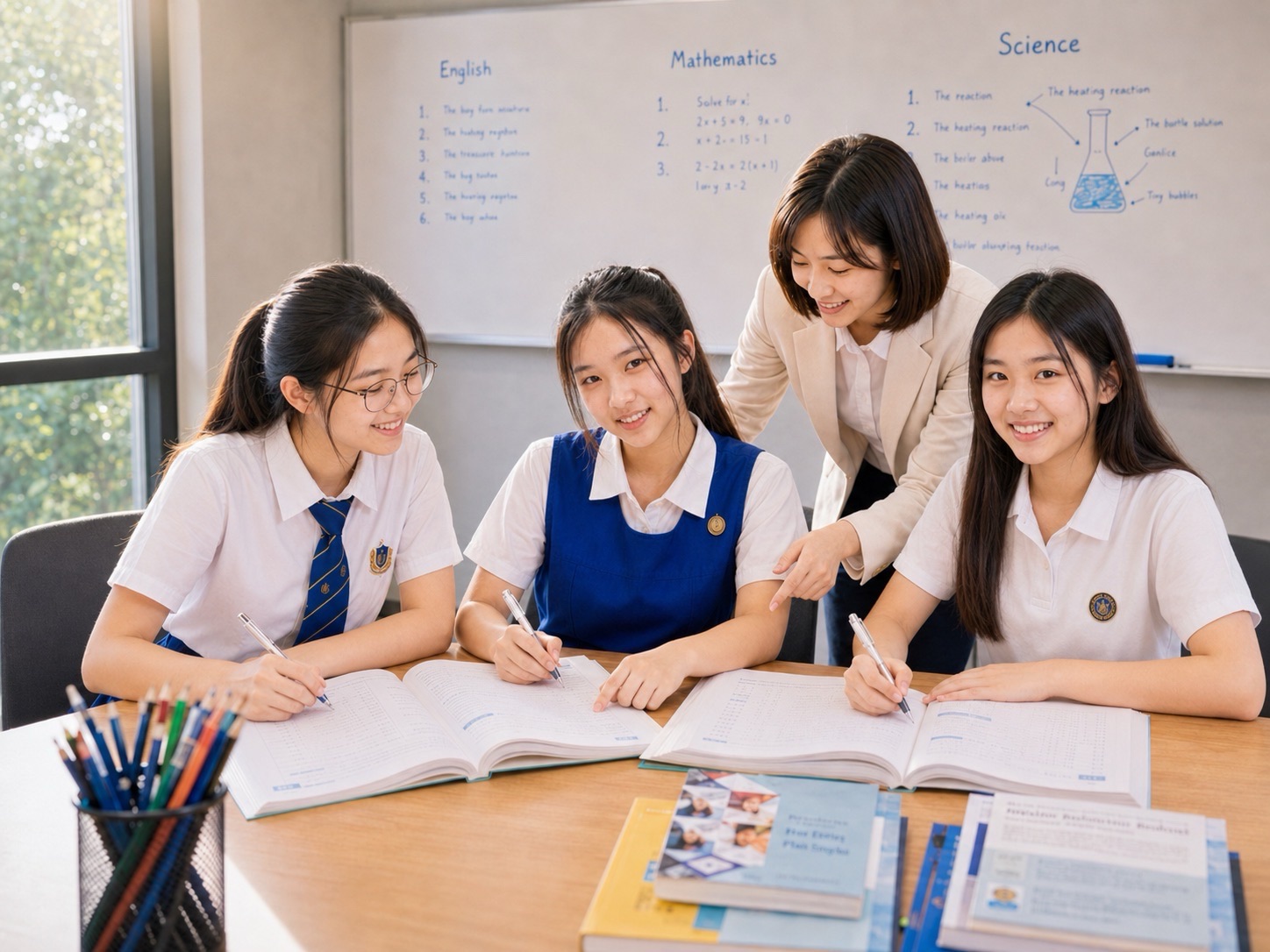
Secondary 1 Mathematics tuition for Bishan students. Premium three-student tutorials near Sixth Avenue MRT, with careful PSLE-to-Secondary bridging, algebra foundations and close tutor guidance.
A confident beginning in Secondary 1 Mathematics requires more than a new textbook.
It requires a careful transition.
At eduKateSG, we provide premium three-student Secondary 1 Mathematics tuition for Bishan students travelling to our Bukit Timah teaching location near Sixth Avenue MRT. Each 1.5-hour lesson combines clear explanation, carefully sequenced practice and close inspection of the student’s mathematical working.
The purpose is not simply to give students more questions.
It is to help them understand the new mathematical environment they have entered.
Students learn to:
- read algebraic notation accurately;
- work confidently with negative numbers;
- understand equations as balanced relationships;
- organise longer solutions;
- interpret formal mathematical language;
- distinguish between similar-looking methods;
- explain why each step is valid; and
- approach unfamiliar questions without immediately losing direction.
Our Secondary 1 Mathematics tuition is suitable for Bishan students who need to:
- repair gaps carried forward from Primary 6;
- adjust to algebra and symbolic Mathematics;
- strengthen fractions, ratio and percentage;
- improve accuracy and written presentation;
- keep pace with the school programme;
- learn selected topics slightly ahead of school;
- prepare more carefully for weighted assessments; or
- establish a stronger foundation before Secondary 2.
Class size is limited to three students.
Lessons are usually conducted for 1.5 hours each week, with teaching materials, guided corrections, selected continuation work and assessment support incorporated according to the learner’s needs.
The usual first step is a parent–student consultation.
Immediate Concerns of a Secondary 1 Mathematics Parent and Student in Bishan—and How eduKateSG Can Help
Secondary 1 Mathematics often begins with excitement. A student has entered secondary school, received a new timetable and started learning in a more independent environment.
Then, within the first few months, the concerns begin.
The Mathematics questions appear longer. Algebra becomes more prominent. Teachers move through topics quickly. Homework requires more steps, and the methods that worked comfortably in Primary 6 may no longer produce the same results.
For parents and students in Bishan, this is usually not a sign that the child has suddenly become weak in Mathematics. It is often a sign that the learning system has changed.
Secondary 1 Mathematics introduces a different level of abstraction, independence and mathematical communication. Students must not only calculate correctly. They must understand unfamiliar representations, organise several steps, select suitable methods and present their working clearly.
The immediate concern is therefore not simply whether the student is passing.
The more important question is whether the student is building the mathematical foundation required for Secondary 2, Secondary 3, E-Mathematics, Additional Mathematics and the later national examinations.
Concern 1: “My Child Did Well in Primary School—Why Is Secondary 1 Mathematics Suddenly Difficult?”
This is one of the most common concerns among Secondary 1 parents.
Primary Mathematics gives students a strong numerical foundation, but Secondary Mathematics gradually changes the language of the subject.
Students begin working more frequently with:
- algebraic expressions;
- negative numbers;
- number patterns;
- equations;
- inequalities;
- geometrical reasoning;
- ratios and rates;
- percentages in more complex situations;
- graphs and coordinates;
- mathematical notation.
The questions may also be less direct.
A student who previously recognised a familiar problem type may now need to interpret the question, identify the mathematical structure and decide which concept to apply.
This change can feel sudden.
A student may understand individual classroom examples but struggle when the numbers, wording or arrangement of the question changes. This indicates that the student has learned the procedure but has not yet developed full conceptual control.
At eduKateSG, we return to the underlying mathematical idea.
Students are shown:
- what the concept means;
- why the method works;
- how the steps are connected;
- how the same concept appears in different questions;
- how to check whether an answer is reasonable.
This allows students to move beyond memorising isolated examples.
Concern 2: “My Child Does Not Understand Algebra”
Algebra is often the first major pressure point in Secondary 1 Mathematics.
Numbers are replaced by letters. Expressions must be simplified. Terms must be classified. Brackets must be expanded, and equations must be solved through a sequence of balanced operations.
A student may say:
“I understood it in class, but I cannot do the homework.”
What the student often means is that the classroom example made sense while the teacher was explaining it, but the student cannot reproduce the reasoning independently.
Common algebra difficulties include:
- confusing terms with factors;
- combining unlike terms;
- forgetting negative signs;
- misunderstanding the meaning of an algebraic expression;
- moving terms across an equation without understanding balance;
- expanding brackets incorrectly;
- applying arithmetic rules inconsistently;
- skipping working steps;
- becoming lost when several operations appear together.
These errors should not be dismissed as carelessness.
Repeated algebra errors usually reveal an unstable internal structure. If the foundation is not repaired in Secondary 1, the same weaknesses may later affect simultaneous equations, coordinate geometry, quadratic expressions, graphs and Additional Mathematics.
eduKateSG teaches algebra from first principles.
Instead of asking students to memorise that a term “changes sign when it crosses the equals sign,” we teach the equation as a balanced mathematical relationship. Students learn what operation is being performed on both sides and why the equality remains valid.
The aim is not merely to complete the current worksheet.
It is to give the student a reliable algebraic system that remains useful throughout secondary school.
Concern 3: “My Child Keeps Making Careless Mistakes”
Parents often see marks being lost through:
- copied numbers;
- missing units;
- incorrect signs;
- skipped steps;
- premature rounding;
- calculation errors;
- incomplete answers;
- inaccurate diagrams;
- answers written in the wrong form.
The natural response is to tell the student to “be more careful.”
However, carelessness is often a symptom rather than the complete explanation.
A student may make repeated mistakes because:
- too much information is being held in working memory;
- the method is not fully automatic;
- the student is rushing because of low confidence;
- the working is disorganised;
- the student cannot see where one mathematical stage ends and another begins;
- there is no checking routine;
- the student is trying to perform several operations mentally.
At eduKateSG, we teach students to reduce the cognitive load of Mathematics.
Working is arranged clearly. Intermediate steps are written down. Signs and units are checked deliberately. Students learn to estimate answers before calculation and review whether the final answer is mathematically sensible.
A reliable student is not one who never makes mistakes.
A reliable student is one who has a system for finding and correcting mistakes.
Concern 4: “My Child Understands During Tuition but Cannot Perform in School”
This usually indicates that the student is receiving too much guidance during practice.
When a tutor explains every step immediately, the lesson may feel smooth. However, the student may not be doing enough independent retrieval and decision-making.
True understanding becomes visible when the student can:
- begin the question without prompting;
- identify the relevant topic;
- select a suitable method;
- complete the steps accurately;
- explain the reasoning;
- recover after becoming stuck;
- check the final answer.
At eduKateSG, support is gradually adjusted.
A new concept may begin with careful explanation and guided practice. Once the student understands the structure, assistance is reduced. The student must then retrieve the method, apply it independently and explain the choices made.
This transition from supported work to independent work is essential.
Tuition should not become a permanent crutch. It should develop the student’s ability to function confidently without constant prompting.
Concern 5: “My Child Is Too Quiet to Ask Questions”
Secondary 1 students may hesitate to ask questions for many reasons.
They may feel embarrassed. They may not know how to describe what they do not understand. They may worry that everyone else already understands. Some students simply remain silent and copy the working from the board.
In a large class, a quiet student can appear attentive while significant gaps are developing.
eduKateSG’s small-group environment allows the tutor to observe each student more closely.
A tutor can notice when a student:
- pauses at the same type of step;
- copies without understanding;
- avoids particular questions;
- gives an answer without being able to explain it;
- relies excessively on another student;
- stops working after the first difficulty.
With a maximum of three students in a small group, there is more room for individual questioning, correction and explanation.
Students are encouraged to verbalise their reasoning. The tutor can then identify precisely where the mathematical chain has broken.
Sometimes the problem is not the whole topic.
It may be one misunderstood sign, one missing arithmetic skill or one incorrect assumption. Once identified, the difficulty can often be repaired calmly.
Concern 6: “The School Is Moving Too Quickly”
Secondary school schedules can feel compressed.
A topic may be introduced, practised and tested within a relatively short period. If the student misses several lessons, misunderstands an early concept or requires more time to process abstract ideas, the class may move ahead before the foundation is stable.
Mathematics is cumulative.
A weakness in directed numbers can affect algebra. Weak algebra can affect equations. Weak equations can affect graphs and later problem-solving.
The concern is not only the current chapter.
It is the accumulation of unresolved gaps.
eduKateSG teaches ahead of the school schedule whenever possible. This gives the student a first encounter with the concept before it appears in school.
When the school teacher introduces the topic, the student is not seeing everything for the first time. The lesson becomes a second exposure, allowing the student to listen more carefully, answer questions and consolidate the concept.
Learning ahead should not mean rushing through the syllabus.
It means creating enough familiarity for the student to learn with confidence when the topic arrives in school.
Concern 7: “My Child’s Mathematics Results Are Inconsistent”
A student may score well in one test and perform poorly in the next.
This can confuse parents because the student appears capable, but the results do not remain stable.
Inconsistent performance may be caused by:
- uneven topic mastery;
- dependence on familiar question formats;
- weak retention;
- poor test preparation;
- insufficient mixed practice;
- difficulty transferring concepts;
- anxiety during timed work;
- incomplete correction of previous mistakes.
A student may perform well immediately after learning a topic but forget the method several weeks later. This is not yet secure mastery.
At eduKateSG, students revisit concepts through active recall, spaced practice and mixed-question work.
Instead of completing one topic once and leaving it behind, important ideas are brought back into later lessons. Students learn to recognise concepts even when questions from several chapters are mixed together.
This creates stronger retention and more dependable examination performance.
Concern 8: “My Child Can Do Routine Questions but Cannot Do Word Problems”
Word problems require students to translate language into Mathematics.
The student must determine:
- what information is given;
- what information is required;
- which details are relevant;
- how the quantities are related;
- which operation or equation represents the situation;
- whether the final answer makes sense in context.
Many students begin calculating before they have understood the problem.
They may search for keywords, select an operation too quickly or imitate a previous question that looks similar.
eduKateSG teaches students to slow down at the interpretation stage.
Students learn to identify the mathematical structure before performing the calculation. They may draw a diagram, define a variable, organise information in a table or rewrite the relationship in simpler language.
The purpose is to make the hidden structure visible.
Once students learn how to represent the problem, the calculation often becomes much easier.
Concern 9: “My Child Has Lost Confidence in Mathematics”
A student who repeatedly gets stuck may begin to protect themselves emotionally.
They may say:
- “I am just bad at Math.”
- “I do not understand anything.”
- “There is no point trying.”
- “The teacher goes too fast.”
- “I always make mistakes.”
These statements should be taken seriously, but they should not be accepted as permanent descriptions of the student.
Mathematical confidence is usually built through evidence.
The student needs to experience a sequence of successful moments:
- understanding a small concept;
- completing a question independently;
- explaining the method correctly;
- recognising a previous mistake;
- solving a more difficult variation;
- performing reliably under mild time pressure.
eduKateSG does not build confidence through empty reassurance.
We build it through properly structured learning.
When students can see that their methods are improving, confidence becomes more stable and realistic.
Concern 10: “Should We Wait Until the Results Become Worse?”
Parents sometimes hesitate because the student is still passing.
However, a passing mark does not always indicate a secure foundation.
A student may pass because:
- the test covered familiar questions;
- easier sections compensated for weak areas;
- the student memorised recent examples;
- the topic was less demanding;
- the mistakes have not yet accumulated.
The most effective time to intervene is often before the student reaches a crisis.
Early support in Secondary 1 allows time to:
- repair Primary Mathematics gaps;
- establish algebra properly;
- improve written presentation;
- create better study routines;
- strengthen independent problem-solving;
- prepare for Secondary 2;
- assess possible readiness for Additional Mathematics later.
Starting early does not mean creating unnecessary pressure.
It means giving the student sufficient time to learn properly.
What Secondary 1 Mathematics Should Achieve
Secondary 1 should not be treated as merely a year to survive.
It is the year in which students should begin developing a new mathematical identity.
By the end of the year, a student should be moving towards the ability to:
- use mathematical notation accurately;
- understand foundational algebra;
- work confidently with positive and negative numbers;
- organise multi-step solutions;
- interpret graphs and geometrical information;
- explain mathematical reasoning;
- identify and correct errors;
- retain concepts across several months;
- approach unfamiliar questions calmly;
- learn with increasing independence.
These abilities form the groundwork for the more demanding secondary years.
How eduKateSG Supports Secondary 1 Mathematics Students in Bishan
For families in Bishan looking for more personalised Mathematics support, eduKateSG provides a small-group learning environment with a maximum of three students.
Our lessons are designed around several principles.
We Teach from the Beginning
We do not assume that every student has the same foundation.
When necessary, we return to arithmetic, fractions, ratios, percentages, number operations or Primary Mathematics concepts before moving into the secondary topic.
This prevents students from building new knowledge on unstable foundations.
We Teach for Understanding
Students are not only shown what steps to copy.
They learn why the method works, when it should be used and how to recognise the same idea in a different form.
We Teach Ahead Where Appropriate
Students benefit from meeting important concepts before they are formally taught in school.
This reduces the pressure of first exposure and improves classroom readiness.
We Keep the Group Small
With no more than three students, the tutor can observe the working process, question each student and respond to individual gaps.
The student cannot remain invisible in the lesson.
We Strengthen Independent Thinking
Students are expected to attempt, explain, correct and retry.
Support is available, but the long-term aim is independence.
We Build Examination Readiness Gradually
Accuracy, timing, question selection and checking routines are developed progressively. Students first learn the concept properly, then apply it under increasingly demanding conditions.
When Parents Should Consider Additional Support
A Secondary 1 student may benefit from structured Mathematics support when:
- homework regularly takes too long;
- algebra causes persistent confusion;
- the student relies heavily on parents or answer keys;
- test marks fluctuate significantly;
- the student cannot explain completed working;
- careless mistakes appear repeatedly;
- earlier topics are quickly forgotten;
- the student avoids Mathematics;
- school corrections are copied but not understood;
- confidence is declining;
- the student is already falling behind the school pace.
Parents do not need to wait for failure before acting.
A calm, early intervention is usually easier than repairing a large accumulation of gaps later.
A More Reassuring Way to View the Secondary 1 Transition
Secondary 1 Mathematics is not difficult simply because the student is incapable.
It is difficult because the subject is becoming more abstract, connected and demanding.
Students are being asked to move from concrete calculations towards symbolic reasoning. They must manage more information, make more decisions and become more independent.
That transition takes time.
With the right teaching, a student can learn to see Mathematics not as a collection of unpredictable questions, but as a structured system of relationships, rules and reasoning.
The immediate task is to stabilise the foundation.
The longer-term aim is to develop a student who can think mathematically, work carefully and approach unfamiliar problems without fear.
For Secondary 1 parents and students in Bishan, eduKateSG provides the close guidance, small-group attention and structured progression needed to make that transition with greater clarity and confidence.
The Core Aim of eduKateSG’s Tutor in Class for Secondary 1 Mathematics Tuition for Bishan
The core aim of an eduKateSG tutor in a Secondary 1 Mathematics class is not simply to help a student complete more questions.
It is to help the student become mathematically stable.
Secondary 1 is the year in which Mathematics begins to change its character. In Primary School, students may have relied on familiar models, repeated methods and strong arithmetic instincts. In Secondary School, they are expected to work with algebraic symbols, negative numbers, formal mathematical language, multi-step reasoning and increasingly abstract relationships.
A student who once felt comfortable with Mathematics may suddenly become uncertain.
The difficulty is not always caused by a lack of ability. More often, the student has entered a new mathematical environment before learning how to operate confidently within it.
The tutor’s first responsibility is therefore to guide the transition carefully.
At eduKateSG, the purpose of Secondary 1 Mathematics Tuition for Bishan students is to establish the foundations, habits and reasoning systems that will continue supporting the student through Secondary 2, Secondary 3, Secondary 4 and the eventual demands of E-Mathematics, Additional Mathematics or other upper-secondary pathways.
The class is designed to help the student understand what Mathematics is asking, recognise the structure inside each problem, select an appropriate method and carry the solution through accurately.
That is the central work.
To Make the Secondary 1 Transition Manageable
Secondary 1 Mathematics is not simply Primary 6 Mathematics with harder numbers.
It introduces a different way of thinking.
Students begin working with letters that represent unknown or changing quantities. They must understand that a negative sign can describe direction, value or an operation. They meet mathematical statements that must be interpreted rather than merely calculated.
The tutor’s role is to make this transition visible.
Instead of allowing the student to feel that Mathematics has suddenly become confusing, the tutor explains what has changed and why the new methods are necessary.
For example, algebra may initially appear unfamiliar because the answer is no longer immediately numerical. Yet algebra is not an arbitrary collection of letters. It is a language for describing patterns, quantities and relationships efficiently.
When the student understands this purpose, algebra becomes less intimidating.
The tutor helps the student move gradually from concrete numerical examples to symbolic representation. A rule is introduced through something the student can recognise, followed by carefully selected examples that reveal how the rule behaves.
The aim is not to rush the student into advanced questions.
The aim is to make the new mathematical environment feel organised, readable and learnable.
To Build the Foundations from the Beginning
Strong Secondary Mathematics depends on a surprisingly small number of core ideas being understood exceptionally well.
These include:
- operations with positive and negative numbers;
- factors, multiples and prime factorisation;
- fractions, decimals, ratios and percentages;
- algebraic notation;
- simplifying expressions;
- substitution;
- solving equations;
- mathematical communication;
- estimation and checking;
- translating words into mathematical relationships.
If these foundations remain unstable, later chapters become harder than they need to be.
A student may struggle with linear equations not because equations are beyond them, but because negative numbers are still uncertain. Another may make repeated algebraic mistakes because the meaning of a term, coefficient or like term was never made sufficiently clear.
The tutor therefore does not treat early mistakes as isolated incidents.
Each error is examined for what it reveals.
A wrong answer may come from careless arithmetic, but it may also show that the student has misunderstood the structure of the question. The tutor identifies the difference.
At eduKateSG, students are taught from the beginning of an idea. The tutor establishes the meaning, demonstrates the method, checks the student’s understanding and only then increases the complexity.
This creates a secure learning sequence:
understand the concept, practise the method, explain the reasoning, apply it independently and transfer it into unfamiliar questions.
A strong foundation is not slow teaching.
It is efficient teaching because it reduces the need to repair the same weaknesses repeatedly later.
To Teach the Student How to Read Mathematics
Many Secondary 1 students do not struggle because they cannot calculate.
They struggle because they cannot yet read a mathematical question accurately.
Mathematics has its own vocabulary, sentence structure and conventions. Words such as “evaluate”, “express”, “hence”, “determine”, “in terms of” and “at most” carry specific instructions.
A student may know the relevant formula but still answer incorrectly because an important condition was overlooked.
The tutor therefore teaches the student to pause before calculating.
What information has been given?
What is the question asking for?
Which values are fixed?
Which quantities are changing?
Is there a diagram, pattern or relationship that must first be interpreted?
Does the final answer require a unit, an exact value or a particular form?
This reading process becomes part of the student’s mathematical routine.
The tutor may ask the student to restate a problem in simpler language, identify the unknown, underline the important conditions or describe the intended method before beginning.
These are not additional steps that waste time.
They prevent the student from solving the wrong problem.
As the student becomes more experienced, the process becomes faster and increasingly automatic. The student begins to recognise familiar structures even when the surface wording changes.
This is one of the most important signs of mathematical maturity.
To Develop Algebraic Thinking Early
Algebra is one of the defining transitions of Secondary 1 Mathematics.
It is also one of the areas where students can develop habits that either support or obstruct them for several years.
A student may initially think of algebra as arithmetic with letters. This is only the beginning.
Algebra requires the student to see relationships, preserve equality, understand equivalence and operate according to structure.
The tutor teaches the student why only like terms can be combined, why brackets affect every term inside them, why changing one side of an equation requires a corresponding operation on the other, and why substitution must respect the original expression.
The student is not merely taught to “move a term across and change the sign”.
Such shortcuts may appear convenient, but they can weaken understanding if the student cannot explain what is actually happening.
Instead, the tutor builds the underlying logic.
An equation is a balanced statement. Solving it means preserving that balance while isolating the unknown. Once the student understands this, the method becomes more reliable and adaptable.
This approach becomes especially valuable when the student later encounters more complicated equations, simultaneous equations, algebraic fractions and functions.
The work completed in Secondary 1 is therefore not confined to Secondary 1.
It establishes the student’s future algebraic intelligence.
To Create Accurate Mathematical Habits
A capable student can still lose many marks through poor mathematical habits.
Common examples include:
- omitting working;
- writing equal signs inaccurately;
- skipping steps mentally;
- copying numbers incorrectly;
- dropping negative signs;
- using unclear notation;
- failing to include units;
- rounding too early;
- not checking whether an answer is reasonable.
The tutor pays close attention to how the student works, not only whether the final answer is correct.
Good presentation supports good thinking.
When steps are arranged clearly, the student can identify errors more easily. The tutor can also see where the reasoning changed direction. This makes feedback more precise.
Students are taught to write one logical step after another, use symbols correctly and keep their work readable.
They also learn checking strategies.
Can the answer be substituted back into the equation?
Does the magnitude make sense?
Should the answer be positive or negative?
Does the result match the information in the diagram?
Would an estimate produce a similar value?
Checking is not treated as something done only when time remains.
It is part of responsible mathematical work.
The goal is for accuracy to become a habit rather than a last-minute instruction.
To Identify the Real Cause of a Student’s Mistakes
Two students may produce the same wrong answer for entirely different reasons.
One may have misunderstood the concept. Another may understand it but have made an arithmetic slip. A third may have chosen the correct method but presented the steps in a confusing order.
The tutor must know which problem is present before deciding how to respond.
Repeating the whole chapter is not always necessary. Giving more worksheets is not always helpful. Sometimes the student needs one precise explanation at the point where the misunderstanding began.
In a small-group setting, the tutor can observe how each student approaches a problem.
Does the student begin immediately without reading?
Does the student hesitate because the method is unknown?
Does the student rely too heavily on memorised examples?
Can the student explain why a step is valid?
Does the student lose accuracy when the question becomes longer?
These observations allow the tutor to intervene intelligently.
The correction is then matched to the cause.
A conceptual misunderstanding requires reconstruction. A procedural weakness requires guided practice. A careless habit requires a checking routine. A confidence issue may require smaller successful steps before returning to the full question.
This is one of the central advantages of attentive teaching.
The tutor is not merely marking answers.
The tutor is reading the student’s mathematical behaviour.
To Keep Students Ahead Without Making Learning Fragile
At eduKateSG, students are generally taught ahead of the school schedule.
The purpose is not to race through the syllabus or create unnecessary pressure.
It is to give the student time.
When a concept is first introduced during tuition, the student can ask questions, test the method and make mistakes in a calm environment. When the same topic later appears in school, it is no longer completely unfamiliar.
The student can listen with greater confidence and use the school lesson as reinforcement.
This creates repeated contact with the concept:
first exposure, guided understanding, school reinforcement, practice and later review.
Learning ahead works only when the foundation remains secure. Moving too quickly can create the illusion of progress while leaving gaps underneath.
The tutor therefore balances pace with stability.
A student who is ready may progress into more complex applications. A student who needs further consolidation receives targeted practice before moving forward.
The objective is not to complete chapters as early as possible.
The objective is to help the student arrive at each school topic prepared enough to benefit from it fully.
To Make the Student an Active Participant
Mathematics cannot be learned well through passive observation alone.
A student may watch a tutor solve several examples and feel that everything is clear. The difficulty often appears only when the student attempts a question independently.
For this reason, the tutor does not perform all the mathematical thinking on the student’s behalf.
Students are expected to attempt, explain, compare, justify and correct.
The tutor may ask:
Why did you choose this method?
What does this term represent?
Where did the negative sign come from?
Can the expression be written another way?
How do you know the answer is reasonable?
What would change if this value were doubled?
Such questions make the student’s thinking visible.
They also prevent superficial learning, where the student can imitate a familiar example but cannot adapt when the question changes.
In a three-student small group, each student has space to participate. The tutor can move between direct instruction, individual checking and carefully guided discussion.
Students may observe alternative methods from their classmates, but they are still accountable for their own understanding.
The room becomes a place where thinking is expected.
Not knowing immediately is acceptable. Remaining passive is not.
To Build Confidence from Competence
Mathematical confidence should not be created through reassurance alone.
It should be built through evidence.
A student becomes genuinely confident when they can understand a new idea, complete a method correctly, recover from an error and solve a question independently.
The tutor therefore creates a sequence of achievable but meaningful challenges.
The work should not be so easy that the student learns nothing. It should not be so difficult that every lesson feels like failure.
The appropriate level lies just beyond what the student can currently manage alone.
With guidance, the student reaches the answer. With practice, the student begins to require less help. Eventually, the student can perform the process independently.
This is how confidence becomes stable.
The student begins to think:
I may not know the answer immediately, but I know how to begin.
That belief is far more useful than simply thinking, “I am good at Mathematics.”
It gives the student a method for responding to uncertainty.
To Prepare Students for More Than the Next Test
School assessments matter, and students must learn to perform accurately under examination conditions.
However, the tutor’s work cannot be limited to predicting the next test.
Secondary 1 is part of a longer academic journey.
The student will eventually face more abstract algebra, geometry, graphs, mensuration, statistics, probability and multi-topic questions. Some students may proceed to Additional Mathematics, where weak early algebra becomes especially costly.
The tutor therefore considers the future value of every topic.
A chapter on number patterns may develop the ability to generalise. A chapter on angles may strengthen diagram interpretation and logical deduction. A chapter on ratio may support later work in similarity, rate and proportion.
The student should not leave a topic knowing only how to answer one narrow question type.
The student should understand the mathematical idea well enough to recognise it again in a new setting.
This is the difference between temporary test preparation and durable mathematical education.
To Teach Problem-Solving as a Process
Students sometimes believe that strong Mathematics students simply see answers immediately.
In reality, effective problem-solvers often follow disciplined processes.
They organise the information, test possibilities, draw diagrams, form equations, look for patterns and revise an approach when necessary.
The tutor makes these processes explicit.
When a student is stuck, the tutor does not always reveal the next step immediately. A carefully chosen prompt may be more valuable:
What do you already know?
Can you represent the information differently?
Is there a smaller version of the problem you can solve first?
Which part of the question resembles something you have seen before?
Can an unknown quantity be represented by a letter?
These prompts help the student learn how to restart their own thinking.
Over time, the tutor’s questions become the student’s internal questions.
That is a major educational outcome.
The student becomes less dependent on someone else to begin the solution.
To Use Mistakes Productively
A good Mathematics classroom does not try to eliminate every mistake before it happens.
It uses mistakes to improve the student’s thinking.
When a student gives an incorrect answer, the tutor examines the reasoning respectfully. The purpose is not to embarrass the student or move quickly to the correct method.
The class considers where the reasoning stopped being valid.
Was the error caused by an incorrect assumption?
Was a rule applied in the wrong context?
Did the student overlook a restriction?
Did the arithmetic change while the algebra remained correct?
This process teaches students that errors contain information.
They reveal which part of the system needs attention.
Students who fear mistakes may hide their working, avoid difficult questions or wait for others to answer. Students who learn to examine mistakes calmly become more resilient.
They are willing to attempt unfamiliar questions because an imperfect first attempt is treated as part of the learning process.
The tutor’s aim is not to create a class where students never make mistakes.
It is to create students who know how to detect, understand and correct them.
To Balance Individual Attention with Small-Group Learning
Each Secondary 1 student arrives with a different mathematical history.
One may be strong in arithmetic but uncertain in algebra. Another may understand concepts well but work too slowly. A third may complete routine questions confidently but struggle when several topics are combined.
The tutor must teach the shared syllabus while responding to these individual differences.
The three-student small-group structure allows this balance.
A concept can be introduced to the group, after which the tutor observes each student’s attempt. Support can then be adjusted.
One student may receive a simpler numerical example. Another may be challenged to explain the general rule. A third may need correction in notation or presentation.
At the same time, students benefit from hearing how others think.
A classmate’s question may reveal an issue they had not noticed. A different method may show that Mathematics is structured but not always rigid. Explaining a solution to another student can also strengthen one’s own understanding.
The small group remains personal without becoming isolated.
Each student is seen, but each student also learns within a thoughtful academic community.
To Strengthen Independence
Tuition should not create permanent dependence on the tutor.
Its deeper purpose is to help the student become increasingly capable of learning and solving independently.
At the beginning, the tutor may provide substantial guidance. The student may require reminders about notation, question interpretation and the order of operations.
As the student improves, some of this support is deliberately removed.
The tutor may ask the student to select the method, plan the working or explain the answer before receiving feedback.
This gradual release is important.
A student who performs well only when a tutor is beside them has not yet gained full control of the skill.
The desired progression is:
“I can do this with help.”
Then:
“I can do this with a small prompt.”
Eventually:
“I can recognise, solve and check this independently.”
That independence is one of the most valuable outcomes of effective tuition.
To Establish a Reliable Weekly Learning Rhythm
Progress in Mathematics is rarely created by one dramatic lesson.
It is built through consistent contact with ideas.
The tutor helps students maintain a reliable rhythm of learning: new understanding, guided practice, independent work, correction and review.
Earlier topics are revisited so that knowledge remains accessible. Questions may be interleaved across chapters to prevent the student from depending on obvious topic labels.
This matters because examination papers do not always announce which method should be used.
The student must recognise the structure independently.
A strong learning rhythm also makes improvement calmer.
Instead of attempting to recover several months of uncertainty shortly before an examination, the student strengthens understanding each week.
Small corrections are made before they become large gaps.
By the time assessments arrive, revision becomes a process of organising and sharpening knowledge rather than relearning entire chapters.
To Help Parents See What Progress Actually Looks Like
Progress in Secondary 1 Mathematics is not always reflected immediately in a dramatic rise in marks.
Sometimes the earliest improvements appear in the student’s behaviour.
The student begins working without avoiding the question. Steps become clearer. Fewer signs are dropped. The student can explain why a method works. Homework requires less prompting. Mistakes become easier to correct.
These changes indicate that the mathematical system is becoming more stable.
Marks usually become more reliable when these underlying improvements are maintained.
The tutor therefore looks beyond a single score.
An assessment result is useful, but it must be interpreted. Was the student unable to understand the questions? Did time run out? Were the methods correct but the calculations inaccurate? Was the content known but poorly presented?
The aim is to understand what the result reveals and decide what should happen next.
Parents do not simply need to hear that the student should “practise more”.
They need to know what is being strengthened, why it matters and how the work is progressing.
The Core Aim: A Student Who Can Think Mathematically
The central aim of eduKateSG’s Secondary 1 Mathematics tutor is to develop a student who can approach Mathematics with clarity.
This student does not depend entirely on memorised examples.
The student can read the problem, identify its structure, select a method, organise the working, check the result and learn from errors.
The student understands that Mathematics is not a collection of disconnected chapters. It is a connected system in which earlier ideas support later ones.
The student also begins to understand that difficulty is not evidence of inability.
It is often a signal that the problem must be represented differently, broken into smaller parts or connected to an earlier principle.
This is the mindset that allows a student to continue growing.
A Calm and Deliberate Beginning to Secondary Mathematics
Secondary 1 is an important year, but it does not need to feel overwhelming.
With careful teaching, the student can enter the new syllabus gradually and confidently.
The tutor’s work is to bring order to the transition.
Concepts are taught from their foundations. Algebra is made meaningful. Mathematical language is explained. Errors are examined. Methods are practised until they become reliable. Students are encouraged to think, speak and work independently.
The immediate goal is stronger Secondary 1 Mathematics performance.
The larger goal is a student who is properly prepared for the years ahead.
At eduKateSG, the tutor is not merely helping the student finish today’s worksheet.
The tutor is building the mathematical architecture that the student will continue using long after the lesson has ended.
A More Important Transition Than It First Appears
Secondary 1 Mathematics is sometimes treated as a slightly harder version of Primary Mathematics.
That description misses the deeper change.
The student is entering a different mathematical language.
In Primary school, many questions can be approached through:
- arithmetic;
- bar models;
- repeated procedures;
- visual comparison;
- familiar word-problem structures; and
- direct calculation.
These methods remain useful.
However, Secondary Mathematics requires the student to move beyond them.
Students begin working with:
- letters representing quantities;
- positive and negative values;
- algebraic expressions;
- formal equations;
- mathematical inequalities;
- coefficients and constants;
- geometric notation;
- coordinate systems;
- longer logical chains; and
- questions combining several mathematical ideas.
The difficulty is therefore not only that the questions become harder.
The student must also learn a new way of representing thought.
A child who performed well for PSLE Mathematics may still feel uncertain in Secondary 1. This does not automatically mean that the child has become weaker or less hardworking.
The student may simply be trying to solve a Secondary-school problem using a Primary-school operating system.
That approach may work briefly.
It becomes less reliable as the Mathematics grows more abstract.
A well-designed Secondary 1 Mathematics tuition programme helps the student complete this transition deliberately rather than leaving it to chance.
The Hidden Mathematics Problem: Arithmetic Must Become Structure
Consider the calculation:
3 × 8 = 24
A Primary-school student may see three groups of eight or a straightforward multiplication fact.
In Secondary 1, the same numerical relationship may appear as:
3x = 24
The arithmetic remains familiar.
However, the student must now understand that:
xrepresents an unknown quantity;3xmeans three multiplied byx;- an equation states that two expressions have equal value;
- any valid operation must preserve that equality;
- the unknown can be isolated systematically; and
- the final answer can be checked through substitution.
The student is no longer only calculating.
The student is operating inside a system of mathematical rules.
This distinction matters.
A student may memorise the instruction:
Move the number to the other side and change the sign.
That shortcut may appear successful in a simple equation.
However, it becomes unreliable when the student encounters:
- brackets;
- fractions;
- negative coefficients;
- unknown terms on both sides;
- formula manipulation; or
- several operations in one equation.
The problem is not necessarily a lack of practice.
The student has memorised the movement without understanding the mathematical relationship being preserved.
At eduKateSG, we return to the underlying principle.
Students learn why an operation is valid before they are expected to carry it out quickly.
Clarity comes first.
Accuracy follows.
Speed is developed after the structure has become dependable.
Why Bishan Parents Choose 3-Pax Mathematics Tuition
Bishan families have access to many educational choices.
The more useful question is therefore not simply whether Mathematics tuition is available.
It is whether the learning environment allows the tutor to see what is actually happening inside the student’s thinking.
In Mathematics, the wrong answer is only the final visible result.
The tutor must locate the reasoning error that produced it.
A student may have:
- misunderstood what the question was asking;
- selected the wrong operation;
- forgotten a Primary-school foundation;
- misread a negative sign;
- distributed a multiplier across only one term;
- cancelled quantities incorrectly;
- copied an exponent wrongly;
- mistaken an expression for an equation;
- applied the correct formula to the wrong measurement;
- omitted a unit;
- skipped a necessary line of working; or
- understood the concept but organised the solution poorly.
These mistakes may produce similar marks.
They do not have the same cause.
They should not receive the same correction.
In a large class, the lesson may need to continue once the answer has been shown.
In a three-student tutorial, the tutor can pause and inspect the precise point at which the student’s reasoning moved away from the correct path.
What a three-student class allows
- Immediate feedback during practice
- Frequent individual questioning
- Close inspection of written working
- Pacing matched more carefully to the students
- Less opportunity to remain silent when confused
- Targeted questions for different learners
- Calm comparison of alternative methods
- Faster identification of recurring mistakes
- More deliberate preparation before school assessments
- A clearer transition from guided work to independent work
The class is small by design.
It remains personal without removing the useful energy of learning beside other students.
A child can observe another method, explain an idea, compare approaches and discover that mistakes can be corrected calmly.
There is enough discussion to make learning active.
There is enough attention to keep the teaching precise.
Secondary 1 Mathematics Under Full Subject-Based Banding
Under Full Subject-Based Banding, Mathematics is offered at G1, G2 and G3 subject levels. Students may therefore encounter different depths, pacing and question demands depending on their subject level and school programme.
Our Secondary 1 Mathematics tuition is not built around one generic worksheet sequence for every student.
We consider:
- the student’s Mathematics subject level;
- the school’s current topic order;
- the strength of the student’s Primary 6 foundation;
- the pace at which new topics are being introduced;
- upcoming weighted assessments;
- the student’s recent schoolwork;
- recurring error patterns;
- the amount of independent practice the student can manage; and
- whether the student requires repair, stabilisation or extension.
A student who understands the concepts but repeatedly loses marks through poor accuracy requires a different intervention from a student who remains uncertain with fractions, division or negative numbers.
Similarly, a student who is already coping comfortably should not simply receive a larger pile of routine questions.
That student may require:
- greater depth;
- unfamiliar applications;
- more demanding reasoning;
- stronger explanation habits;
- comparison of solution methods; and
- preparation for increasingly abstract Mathematics.
The lesson must meet the student at the correct point.
What We Teach in Secondary 1 Mathematics Tuition
Schools may arrange topics in different sequences.
Our tutorials coordinate with the student’s school programme while protecting the mathematical foundations required for later work.
Numbers and numerical structure
Students develop stronger control over:
- positive and negative numbers;
- number lines;
- order of operations;
- factors and multiples;
- prime factorisation;
- squares, cubes and roots;
- fractions and rational numbers;
- approximation;
- estimation;
- recurring numerical patterns; and
- checking whether an answer is reasonable.
Some of these areas may appear familiar after Primary school.
However, they become more demanding when combined with algebra.
A student who remains uncertain when subtracting negative numbers will not become stable simply because letters have been added to the question.
The number foundation must remain active.
Algebraic language
Students learn to understand and use:
- variables;
- constants;
- coefficients;
- terms;
- like and unlike terms;
- algebraic expressions;
- substitution;
- simplification;
- expansion;
- basic factorisation;
- simple formulae; and
- linear equations.
We treat algebra as a language.
Before students can manipulate it fluently, they must understand what the symbols mean.
They learn:
- how terms are formed;
- why like terms can be combined;
- why unlike terms cannot;
- how brackets affect an expression;
- what substitution represents;
- how an equation differs from an expression; and
- why mathematical operations must follow valid rules.
This prevents algebra from becoming a collection of unexplained movements.
Equations and mathematical balance
Students practise:
- solving simple linear equations;
- solving equations containing brackets;
- working with negative values;
- managing equations involving fractions;
- forming equations from written information;
- checking solutions through substitution; and
- presenting each step clearly.
The balance principle is taught explicitly.
Rather than telling students that a term changes magically when it crosses an equal sign, we show that the same valid operation is performed while equality is preserved.
This explanation may take slightly longer at the beginning.
It saves considerable confusion later.
Ratio, rate and percentage
Primary-school knowledge is extended into more formal applications involving:
- equivalent ratios;
- comparison of quantities;
- unit rates;
- direct proportion;
- percentage increase and decrease;
- reverse percentage;
- speed and rate;
- conversion between fractions, decimals and percentages; and
- translating written relationships into mathematical form.
Students often recognise the numbers but struggle to identify the relationship.
The tutor therefore helps them determine:
- what the quantities represent;
- which value is the original amount;
- whether the relationship is additive or multiplicative;
- what remains constant; and
- whether the final answer should be larger or smaller.
Geometry and mensuration
Students strengthen their understanding of:
- angle properties;
- parallel lines;
- triangles;
- quadrilaterals;
- polygons;
- perimeter;
- area;
- surface area;
- volume;
- geometric notation;
- scale and proportion; and
- interpreting diagrams accurately.
Diagrams are not treated as decoration.
Students learn to mark, label and use them as reasoning tools.
A well-annotated diagram can reduce the amount of information the student must hold mentally.
It can also reveal relationships that are difficult to notice from the written question alone.
Coordinates, graphs and data
Depending on the student’s school sequence, lessons may include:
- the Cartesian plane;
- coordinates;
- plotting points;
- reading horizontal and vertical scales;
- interpreting tables;
- recognising graphical relationships;
- statistical representations;
- averages;
- data comparison; and
- drawing conclusions from information.
The purpose is not only to draw a graph correctly.
The student must understand what the graph communicates.
They learn to ask:
- What does each axis represent?
- What scale is being used?
- What is increasing or decreasing?
- Which values can be compared?
- Is the relationship constant?
- What conclusion is supported by the data?
- What conclusion cannot be made?
Our First-Principles Teaching Method
A strong Secondary 1 Mathematics programme should do more than demonstrate a method and assign a long row of similar questions.
Students need a structure that keeps the knowledge usable after the explanation has ended.
1. Locate the exact weakness
We avoid broad descriptions such as:
My child is weak in algebra.
A student described as weak in algebra may actually be struggling with:
- negative-number control;
- multiplication and division;
- fraction operations;
- order of operations;
- symbolic reading;
- expansion;
- understanding equality;
- written interpretation;
- working-memory overload;
- poor presentation; or
- confidence under time pressure.
Each cause requires a different response.
We inspect schoolwork, ask focused questions and observe how the student begins the problem.
The first line of working is often revealing.
It shows what the student noticed, what the student ignored and which mathematical structure the student believed was present.
2. Rebuild from the first unstable point
When an earlier skill is interfering with the present topic, we return to it.
This is not moving backwards.
It is restoring the floor beneath the current work.
A student struggling with algebraic fractions may first need to stabilise ordinary fraction operations.
A student struggling with equations may need clearer control over:
- inverse operations;
- negative numbers;
- equality; or
- the order in which operations should be reversed.
Once the missing connection is repaired, the current topic often becomes lighter.
The student no longer has to fight the new idea and the old gap at the same time.
3. Use the Fencing Method
We begin inside a clear mathematical boundary.
For example, a student learning equations may first work with:
- positive whole numbers;
- one operation;
- one unknown;
- a clean equation; and
- straightforward checking.
Once that structure is secure, we may introduce:
- negative values;
- several operations;
- brackets;
- fractions;
- unknowns on both sides; and
- written applications.
Each added condition changes the problem in a visible way.
The student learns:
- where the original method still applies;
- what must now be adjusted;
- why the adjustment is necessary; and
- where careless shortcuts begin to fail.
Complexity is introduced deliberately rather than appearing all at once.
4. Move from visible meaning to abstract notation
Where useful, we apply a Concrete–Representational–Abstract progression.
A mathematical idea may begin with:
- a physical quantity or familiar situation;
- a diagram, number line, balance model or table; and
- formal notation and symbolic manipulation.
This is useful when a student can perform a memorised procedure but cannot explain its meaning.
The representation creates a bridge.
Once the relationship is understood, the student can work more efficiently with symbols alone.
5. Ask students to think aloud
Students are regularly asked to explain:
- what the question is asking;
- what information has been provided;
- which quantity is unknown;
- which relationship matters;
- why a particular method is suitable;
- what each line of working achieves;
- whether another method is possible; and
- whether the final answer is sensible.
Explanation makes thinking visible.
A student may produce a correct answer for the wrong reason.
Another may understand the central idea but become lost during execution.
Listening to the explanation helps the tutor identify the difference.
It also teaches students to organise their own thought process before committing to a solution.
6. Retrieve and interleave
A concept is not considered stable simply because the student completed it successfully during the original lesson.
Older ideas are revisited.
Earlier and newer topics are mixed.
The student must decide which method applies instead of being told that every question belongs to the chapter currently open on the desk.
This is important because school assessments do not always announce the method.
The student must recognise the mathematical structure independently.
Interleaving also reveals whether two similar-looking methods have been confused.
7. Establish examination discipline early
Secondary 1 is an appropriate year to build habits that will later become difficult to repair under upper-secondary pressure.
Students learn to maintain:
- one logical step per line;
- correct use of the equal sign;
- neat substitution;
- protected negative signs;
- clearly expanded brackets;
- labelled diagrams;
- correct units;
- careful copying;
- reasonable estimation;
- controlled calculator use;
- sensible time allocation; and
- final-answer checking.
Written working is not treated as an optional decoration around the answer.
It is part of mathematical communication.
Clear working helps the student think, helps the tutor diagnose and helps the examiner follow the valid method.
Why Choose eduKateSG’s Small Groups Secondary 1 Mathematics Tutor for Bishan?
Secondary 1 Mathematics is often the first point at which students realise that being able to calculate is not the same as being able to think mathematically.
In primary school, many questions can still be approached through familiar models, arithmetic methods and repeated practice. Once students enter secondary school, Mathematics becomes more symbolic, abstract and interconnected. Algebra begins to sit underneath almost every major topic. Students must explain relationships, manipulate expressions, interpret unfamiliar questions and decide which mathematical method should be used.
For families in Bishan, choosing the right Secondary 1 Mathematics tutor is therefore not simply about finding more worksheets or extending study hours. It is about placing the student in an environment where the foundations of secondary Mathematics are taught properly from the beginning.
At eduKateSG, our small-group Secondary 1 Mathematics tuition is designed to help students make this transition carefully, confidently and intelligently.
Secondary 1 Is a Mathematical Transition Year
A student may have performed reasonably well in Primary 6 Mathematics and still find Secondary 1 challenging.
This does not necessarily mean that the student has suddenly become weaker. The nature of the subject has changed.
Students are expected to move from:
- numbers to variables;
- direct calculations to multi-step reasoning;
- familiar question formats to unfamiliar applications;
- isolated topics to connected mathematical systems;
- remembering procedures to selecting and adapting procedures;
- showing an answer to presenting a complete mathematical argument.
This transition can feel deceptively gentle at first. The opening topics may appear manageable, but small misunderstandings can accumulate quickly. A student who is uncertain about negative numbers, algebraic notation or the order of operations may later struggle with equations, coordinates, graphs and geometry.
Secondary 1 is therefore an important year for building the mathematical language and habits that will support the student throughout secondary school.
Why Choose Small-Group Mathematics Tuition?
A small-group class offers a balance that is difficult to achieve in a large classroom.
Students still benefit from discussion, comparison and shared problem-solving, but the tutor can observe each learner closely. The class is small enough for questions to be noticed, misconceptions to be corrected and explanations to be adjusted.
At eduKateSG, our small groups are kept to a maximum of three students.
This allows the tutor to see how each student is thinking rather than looking only at whether the final answer is correct.
Two students may arrive at the same incorrect answer for completely different reasons. One may have misunderstood the concept. Another may understand the concept but make careless algebraic errors. A third may know the method but fail to recognise when it should be used.
These students should not receive the same correction.
In a three-student class, the tutor can identify the difference and respond appropriately.
Personal Attention Without Removing Independence
Good Mathematics tuition should not make students dependent on constant assistance.
The purpose of close guidance is to help students become increasingly independent.
During lessons, the tutor may initially break a difficult question into smaller decisions:
- What information has been given?
- What is the question asking for?
- Which topic or concept is involved?
- What relationship can be formed?
- Which method is likely to work?
- How can the final answer be checked?
Over time, students learn to ask these questions for themselves.
This is an important difference between simply showing a student how to complete a worksheet and teaching the student how to approach Mathematics.
The objective is not to have the tutor standing beside the learner forever. The objective is to build a learner who can enter an examination, face an unfamiliar question and create a sensible path forward.
We Teach From the Beginning
Some students enter Secondary 1 carrying gaps from primary school. Others have strong arithmetic skills but have not yet developed a secure understanding of algebra. Some can perform standard methods but struggle when the wording changes.
At eduKateSG, we do not assume that every student has mastered every prerequisite simply because the school has moved on.
We teach from the beginning.
This means checking and strengthening important foundations such as:
- number sense;
- factors and multiples;
- fractions, decimals and percentages;
- ratios and rates;
- negative numbers;
- mathematical notation;
- order of operations;
- estimation;
- units and conversions;
- logical presentation of working.
When these foundations are secure, new secondary-level concepts become easier to understand.
Mathematics is cumulative. A weak foundation rarely remains isolated. It affects the next topic, which then affects another. Strengthening the beginning is often the most efficient way to improve the later stages.
Algebra Is Taught as a Language
For many Secondary 1 students, algebra is the first major source of uncertainty.
Letters appear in place of numbers. Familiar arithmetic signs begin to carry new meaning. Students are asked to simplify expressions, substitute values, form equations and describe relationships using symbols.
A student may memorise a few rules and still remain confused.
At eduKateSG, algebra is taught as a language.
Students learn what each symbol represents, why algebraic conventions exist and how an expression communicates a relationship. They are shown the difference between an expression, an equation, a term, a coefficient and a variable.
They also learn why:
- (3a) means three groups of (a);
- (a + a + a) can be written as (3a);
- (a \times a) becomes (a^2);
- unlike terms cannot be combined;
- the same operation must be applied carefully across an equation;
- substitution requires attention to brackets and negative signs.
When students understand the language, algebra stops appearing like a collection of arbitrary rules.
It becomes a system that can be read, interpreted and used.
Concepts Are Connected, Not Taught as Isolated Chapters
Secondary Mathematics becomes easier when students can see how topics are connected.
Negative numbers are not only one chapter. They appear in algebra, coordinates, graphs and measurement.
Fractions are not only a primary-school topic. They return in algebraic manipulation, ratios, rates, probability and later equations.
Geometry is not merely about memorising angle facts. It involves relationships, logical deduction and clear mathematical communication.
At eduKateSG, lessons help students build these connections.
A student should gradually understand that Mathematics is not a stack of unrelated chapters. It is a network. Each secure concept increases the number of questions the student can understand and solve.
This connected understanding is particularly valuable when examination questions combine more than one topic.
Students Are Taught Ahead of the School Schedule
One of the central features of eduKateSG’s Mathematics programme is that students are taught ahead of school whenever appropriate.
Learning a topic before it appears in school gives the student several advantages.
The first school lesson is no longer the first exposure. Instead of trying to understand the vocabulary, notation, concept and method simultaneously, the student is already familiar with the main structure.
This allows the school lesson to become a second encounter.
The student can listen more confidently, notice additional details and participate more actively. Homework becomes reinforcement rather than emergency learning.
Being ahead does not mean rushing through the syllabus.
It means creating time.
That additional time can be used to:
- clarify difficult concepts;
- correct misconceptions;
- practise different question types;
- revisit earlier topics;
- prepare for school assessments;
- build speed without sacrificing accuracy.
A student who learns ahead carefully often experiences school Mathematics with less anxiety because the subject feels familiar rather than constantly new.
Clear Explanations Before Intensive Practice
Practice is important, but practice alone does not guarantee understanding.
A student can complete many similar questions by copying a pattern without knowing why the method works. This may produce temporary success in routine exercises, but the difficulty returns when the question is presented differently.
At eduKateSG, explanation comes before repetition.
The tutor first establishes:
- what the concept means;
- why the method works;
- how the steps are connected;
- when the method should be used;
- where students commonly make mistakes;
- how the answer can be checked.
Practice then strengthens that understanding.
This produces more reliable learning because students are not merely remembering the appearance of a solution. They understand the mathematical structure beneath it.
Immediate Correction of Misconceptions
Small errors matter in Secondary 1 Mathematics.
A student who repeatedly writes incorrect algebraic notation may gradually accept it as normal. A misunderstanding involving negative signs may affect dozens of later questions. An incomplete habit of showing working may cause marks to be lost even when the student has the correct idea.
In a small group, the tutor can correct these problems early.
Corrections can be made while the student is still solving the question, before the wrong method becomes deeply established.
The tutor can ask:
- Why did you choose this operation?
- What does this variable represent?
- Which rule are you applying?
- Does your answer make sense?
- Can the method be shown more clearly?
- Is there another way to verify the result?
These questions encourage students to examine their own thinking.
The purpose is not merely to prevent one mistake. It is to improve the process that produced the mistake.
Strong Working Habits Are Built Early
Secondary Mathematics requires disciplined presentation.
Students must learn to:
- write one logical step at a time;
- use equal signs correctly;
- maintain accurate notation;
- include units;
- label diagrams;
- organise information;
- avoid unnecessary mental jumps;
- check whether the final answer is reasonable.
These habits are easier to build in Secondary 1 than to repair in Secondary 4.
At eduKateSG, working is treated as part of the solution, not as an optional addition. Clear working helps the tutor understand the student’s reasoning, helps the student locate errors and helps examiners award method marks where appropriate.
Good presentation also reduces careless mistakes because the student’s thinking is visible and organised.
Students Learn to Handle Unfamiliar Questions
One of the biggest differences between average and stronger Mathematics students is not simply the number of formulas they know.
It is how they respond when a question looks unfamiliar.
Some students panic when the wording changes. Others immediately search for a memorised template. Stronger students pause, identify the available information and reconstruct the problem using concepts they already understand.
This flexibility can be taught.
In our small-group lessons, students are gradually exposed to questions that require them to:
- translate words into mathematical statements;
- identify hidden relationships;
- connect more than one topic;
- compare possible methods;
- explain why a method is valid;
- recognise irrelevant information;
- check whether an answer is realistic.
The goal is not to make every lesson unnecessarily difficult. It is to help students become comfortable with productive uncertainty.
A student does not need to recognise the exact question. The student needs to recognise the mathematics inside it.
Confidence Is Built Through Competence
Many students say they are “not good at Mathematics” when what they are actually experiencing is repeated uncertainty.
They may not know where to begin. They may work too slowly. They may make frequent mistakes and then become afraid to attempt harder questions.
Confidence cannot be created through encouragement alone.
It grows when the student has evidence of improvement.
A student becomes more confident after learning how to simplify an expression correctly, solve a question independently, explain a method clearly or recover from an error without giving up.
At eduKateSG, we build confidence through competence.
The tutor supports the student, but the student is expected to think, attempt and explain. Each successful piece of independent work becomes evidence that improvement is possible.
The Small Group Encourages Mathematical Conversation
Mathematics is often treated as a silent subject, but explaining a method can reveal whether a student truly understands it.
In a small group, students may be asked to describe:
- how they interpreted the question;
- why they selected a particular method;
- where an error occurred;
- whether another solution is possible;
- which method is more efficient.
Listening to another student’s reasoning can also be valuable. A student may see a different method, notice a mistake that resembles their own or learn how to present an explanation more clearly.
Because the group is small, participation remains purposeful. Students are not hidden inside a large class, and the tutor can ensure that each learner remains engaged.
Lessons Can Respond to the Student’s Actual School Progress
Students from different schools may encounter topics in different sequences or receive assessments at different times.
A small-group structure gives the tutor greater flexibility to respond to immediate needs while maintaining the longer-term programme.
For example, lessons may include:
- preparation for an upcoming school topic;
- revision before a weighted assessment;
- correction of errors from a recent test;
- strengthening of a weak prerequisite;
- extension work for a student progressing quickly;
- consolidation after a demanding school week.
This does not mean abandoning structure whenever a test approaches. It means connecting the student’s immediate school responsibilities with a coherent plan for long-term mathematical development.
Preparation Extends Beyond the Next Test
A good Secondary 1 Mathematics programme should improve current school performance, but it should also prepare the student for what comes next.
The habits developed in Secondary 1 influence the student’s readiness for:
- more complex algebra;
- simultaneous equations;
- graphs and functions;
- advanced geometry;
- trigonometry;
- statistical reasoning;
- Additional Mathematics;
- upper-secondary examination conditions.
Students who understand algebraic structure, present working clearly and approach unfamiliar questions calmly are better positioned for the increasing demands of Secondary 2, Secondary 3 and Secondary 4.
The aim is therefore larger than one examination result.
We are building the student’s mathematical operating system.
A Calm, Focused Learning Environment
Students learn better when the lesson feels purposeful rather than chaotic.
Our small-group format creates a calm environment where the tutor can maintain a clear pace, notice hesitation and allow sufficient time for careful explanation.
Students are encouraged to ask questions without feeling that they are interrupting a large class. At the same time, the lesson remains academically focused. The small setting is not casual supervision. It is structured teaching with clear objectives.
This balance is particularly important for students who are quiet, cautious or reluctant to admit that they do not understand.
In a class of three, silence is visible.
The tutor can check whether the student is thinking confidently, uncertain about the instructions or simply waiting for someone else to answer.
Who May Benefit From eduKateSG’s Secondary 1 Mathematics Tuition?
Our Bishan Secondary 1 Mathematics programme may be suitable for students who:
- are preparing to enter Secondary 1;
- have recently entered secondary school and feel overwhelmed;
- performed well in primary school but find algebra unfamiliar;
- understand lessons but lose marks through careless working;
- rely heavily on memorised methods;
- struggle to begin unfamiliar questions;
- need stronger foundational Mathematics;
- require more individual attention than a large class can provide;
- want to learn ahead of the school schedule;
- are aiming to build a strong base for upper-secondary Mathematics.
Students do not need to be failing before tuition becomes useful.
Early support can prevent small uncertainties from becoming larger gaps. It can also help a capable student develop greater accuracy, independence and depth.
Why Bishan Families May Choose eduKateSG
Families looking for Secondary 1 Mathematics tuition in Bishan often want more than a convenient weekly class.
They want to know that the tutor will notice their child.
They want concepts to be explained properly, mistakes to be corrected carefully and progress to be built over time. They want a programme that supports school performance without turning Mathematics into endless mechanical drilling.
eduKateSG’s small-group model is designed around these priorities.
With a maximum of three students, we are able to combine:
- close tutor attention;
- structured syllabus progression;
- foundations-first teaching;
- learning ahead of school;
- careful algebra development;
- guided problem-solving;
- examination preparation;
- independent thinking;
- clear mathematical presentation.
The class remains small enough to be personal and structured enough to be academically serious.
The Right Outcome Is a More Capable Student
The value of Mathematics tuition should eventually be visible beyond the tuition classroom.
The student should become better able to:
- follow school lessons;
- complete homework independently;
- explain mathematical reasoning;
- identify and correct errors;
- manage unfamiliar questions;
- revise with greater purpose;
- prepare for assessments calmly;
- connect new topics to earlier learning.
Marks matter, but stronger marks should arise from stronger mathematical ability.
At eduKateSG, the aim is not to create a student who can only solve questions that have already been demonstrated. It is to develop a student who understands the principles, recognises relationships and can make good decisions when the path is not immediately obvious.
Choosing the Right Start for Secondary Mathematics
Secondary 1 is one of the best times to establish a strong mathematical foundation.
The syllabus is becoming more abstract, but there is still time to slow down, clarify the beginning and build good habits before upper-secondary demands intensify.
With the right guidance, students can learn that Mathematics is not a subject of mysterious rules or fixed talent.
It is a structured language that becomes more manageable when ideas are taught in the correct order, practised carefully and connected meaningfully.
For Bishan families seeking a focused and personal Secondary 1 Mathematics learning environment, eduKateSG’s three-student small groups provide the attention, structure and intellectual care needed to help students begin secondary Mathematics properly.
The purpose is simple: to teach the student well enough that confidence, independence and stronger performance can follow.
When to Start eduKateSG’s Small Groups Secondary 1 Mathematics Tuition for Bishan?
The best time to begin Secondary 1 Mathematics tuition is not determined only by the school calendar. It depends on whether the student is ready for the transition from Primary Mathematics to the faster, more abstract and increasingly independent style of learning expected in secondary school.
For many Bishan students, the ideal starting point is during the November and December school holidays before Secondary 1 begins. This provides enough time to strengthen important Primary Mathematics foundations, introduce algebra gently and help the student enter secondary school with familiarity rather than uncertainty.
However, this does not mean every student must begin tuition before Secondary 1. Some students are mathematically secure, organised and able to adapt independently. Others may need support only after the first few weeks of school reveal how they are responding to the new pace.
The right time to start is the point at which tuition can still be used to build capability—not merely repair a growing backlog.
Why the Transition to Secondary 1 Mathematics Matters
Secondary 1 Mathematics is not simply a more difficult version of Primary 6 Mathematics.
It introduces a different mathematical language.
Students begin working more extensively with:
- negative numbers;
- algebraic expressions;
- equations;
- number patterns;
- ratio and rates in more complex settings;
- geometrical reasoning;
- data representation;
- mathematical notation;
- multi-step applications.
In Primary Mathematics, many questions are presented through recognisable situations. Students may use model drawing, arithmetic procedures or familiar problem-solving patterns.
In Secondary Mathematics, students are increasingly expected to represent relationships symbolically. A quantity may no longer be given as a known number. It may be represented by (x), (y), (n) or another variable.
This can feel like a small change on paper, but it is a major change in thinking.
A student who was comfortable calculating:
[
8 + 5
]
must now understand what it means to simplify:
[
8x + 5x
]
The student is no longer working only with numbers. The student is learning how to operate on mathematical structures.
That transition is easier when it is introduced carefully, with sufficient explanation and guided practice.
The Ideal Starting Period: November or December Before Secondary 1
For many families, the year-end holidays offer the most comfortable starting point.
The purpose is not to rush through the entire Secondary 1 syllabus before school begins. It is to create a reliable bridge between Primary 6 and Secondary 1 Mathematics.
A well-designed bridging period can be used to:
- identify important Primary Mathematics gaps;
- revise fractions, decimals, percentages and ratio;
- strengthen number sense;
- introduce negative numbers;
- explain the purpose of algebra;
- establish correct mathematical notation;
- develop orderly working habits;
- prepare students for secondary-school question presentation.
This gives students time to learn without the pressure of simultaneous school homework, tests and competing subjects.
At eduKateSG, the aim is to make the first encounter with Secondary Mathematics calm and intelligible. Students should understand why the new methods work, not merely imitate a sequence of steps.
When school begins, the topics are therefore not completely unfamiliar. The student can listen more confidently because there is already a basic mental framework in place.
This is particularly useful for students who need time to become comfortable with new ideas before they can use them fluently.
Starting in January: A Strong and Practical Choice
January is also an excellent time to begin.
The student is learning the same broad topics in school and tuition, allowing both environments to reinforce each other. Tuition can clarify the underlying concept, strengthen the lesson taught in school and prepare the student for what comes next.
Starting in January works especially well when the student:
- is entering a school with a demanding academic pace;
- is uncertain about algebra;
- tends to need repeated explanation;
- makes frequent careless errors;
- struggles to organise working clearly;
- becomes anxious when a topic moves quickly;
- needs a stable weekly study routine.
The first weeks of Secondary 1 can appear manageable because introductory chapters may feel familiar. Some students therefore assume the year will remain easy.
The difficulty often becomes more visible when several topics begin interacting. A student may understand integers in isolation and algebra in isolation, but struggle when negative numbers appear inside an algebraic expression.
Beginning tuition in January allows these small misunderstandings to be corrected before they combine.
Should a Strong PSLE Mathematics Student Start Early?
A strong PSLE result is an encouraging indicator, but it does not automatically guarantee a smooth transition into Secondary Mathematics.
Primary and Secondary Mathematics reward overlapping but not identical abilities.
A student may have performed well in PSLE Mathematics because of:
- strong arithmetic accuracy;
- familiarity with common question types;
- effective model drawing;
- extensive examination practice;
- good memory for procedures.
Secondary Mathematics increasingly requires:
- symbolic reasoning;
- flexible manipulation;
- comfort with abstraction;
- careful use of notation;
- explanation of mathematical relationships;
- connection of several concepts within one question.
A student with strong Primary Mathematics foundations may adapt quickly and require little external support. Another student with the same PSLE Achievement Level may find algebra unfamiliar or become less accurate when expected to present longer solutions.
The decision should therefore be based on the student’s learning behaviour, not the grade alone.
Strong students may begin early when the purpose is to develop deeper mathematical fluency, prevent complacency and learn ahead at a sensible pace. They should not be placed under unnecessary pressure merely to complete more worksheets.
For advanced students, good tuition should create intellectual depth rather than additional volume.
Starting During Term 1
Some parents prefer to allow their child several weeks to settle into secondary school before deciding whether tuition is necessary.
This is reasonable.
Secondary 1 students are adapting to much more than Mathematics. They are learning to manage:
- a new school environment;
- different teachers;
- subject-based classrooms;
- co-curricular activities;
- longer travelling times;
- more homework;
- new friendships;
- increased personal responsibility.
Beginning tuition during Term 1 may be appropriate when the student initially appears independent but begins showing signs of difficulty.
These signs may include:
- homework taking much longer than expected;
- repeated confusion over algebraic notation;
- correct answers accompanied by incomplete working;
- frequent sign errors involving negative numbers;
- inability to explain a method;
- dependence on answer keys;
- avoidance of unfamiliar questions;
- declining confidence;
- inconsistent quiz or weighted-assessment results.
The important point is to respond to the pattern rather than wait for a major failure.
One poor quiz is not always a crisis. A repeated inability to understand the same family of concepts is more significant.
Starting during Term 1 gives the tutor sufficient time to rebuild the concept while the amount of missed material is still manageable.
Starting After the First Weighted Assessment
The first weighted assessment can provide useful information, but the score should not be examined in isolation.
A student may receive a satisfactory mark despite having fragile understanding. This can happen when the tested questions are familiar or when the student has memorised procedures without understanding the relationships involved.
Conversely, a capable student may perform below expectations because of:
- poor time management;
- unfamiliar presentation;
- careless arithmetic;
- incomplete working;
- anxiety;
- misreading questions.
The assessment script is often more informative than the final percentage.
Parents should look at the nature of the errors:
Conceptual errors
The student does not understand the underlying idea or chooses an unsuitable method.
Procedural errors
The student understands the topic but cannot carry out the steps reliably.
Presentation errors
The student reaches the answer mentally but does not show sufficient or logical working.
Careless errors
The student knows what to do but loses marks through signs, copying, arithmetic or notation.
Transfer errors
The student succeeds with familiar examples but cannot apply the concept when the question is presented differently.
If the assessment reveals a repeated conceptual or transfer problem, tuition should begin promptly. These weaknesses tend to affect later chapters because Mathematics is cumulative.
Starting in the Middle of Secondary 1
It is still possible to begin tuition in Term 2 or Term 3.
At this stage, however, the tuition programme may need to perform two jobs simultaneously:
- support the topics currently being taught in school; and
- repair earlier weaknesses that are preventing progress.
For example, a student struggling with algebraic equations may not have a problem with equations alone. The underlying difficulty may involve:
- weak understanding of negative numbers;
- poor arithmetic fluency;
- confusion about equality;
- incorrect use of inverse operations;
- untidy working.
Simply assigning more equation questions will not solve the full problem.
At eduKateSG, we look beneath the visible mistake. The tutor identifies which earlier idea is unstable and rebuilds it before expecting the student to handle more advanced work.
Starting mid-year can be effective when the intervention is structured. It becomes less effective when the student is given random revision worksheets without a clear diagnosis of what has gone wrong.
Waiting Until the End-of-Year Examinations
Parents sometimes wait until the year-end examination results before seeking help.
This may be suitable when the student has generally coped well and the final result reveals only a limited area for improvement.
However, waiting until the end of the year carries a risk when the warning signs have already been visible for several months.
By then, the student may have accumulated weaknesses across:
- integers;
- algebra;
- ratio;
- percentages;
- geometry;
- graphs;
- word problems.
The problem is no longer one chapter. It is the connection between chapters.
There may also be an emotional cost. A student who has struggled quietly for most of the year may begin to believe that they are simply “not good at Mathematics”.
That belief can be more difficult to correct than the original mathematical gap.
Early support protects not only marks but also the student’s willingness to engage with difficult work.
When Tuition May Not Be Necessary
Tuition should have a clear educational purpose.
A Secondary 1 student may not need regular tuition when the student:
- understands lessons independently;
- completes homework accurately;
- asks teachers for help when needed;
- retains earlier concepts;
- performs consistently across different question types;
- manages time and corrections responsibly;
- remains confident when facing unfamiliar problems.
In such cases, parents can continue observing without adding another weekly commitment.
A student should not attend tuition simply because classmates are attending. Additional lessons are useful only when they improve understanding, discipline, confidence or mathematical range.
The objective is not to fill every available hour. It is to provide the right instruction at the right time.
Why Small Groups Are Particularly Useful in Secondary 1
Secondary 1 students often need more than a lecture.
They need opportunities to attempt a method, make a mistake, explain their thinking and receive immediate correction.
In a small group of up to three students, the tutor can observe details that are easily missed in a larger class:
- whether the student understands the question;
- where the working first becomes inaccurate;
- whether notation is being used correctly;
- whether the student is relying on memorisation;
- whether the answer was obtained through reasoning or guessing;
- whether the student can repeat the method independently.
A small group also allows students to hear how others approach the same question.
One student may notice a pattern. Another may ask the question that everyone else was hesitant to raise. A third may explain a method in a way that strengthens the entire group’s understanding.
The group remains small enough for individual attention while giving students the benefits of mathematical conversation.
This is especially valuable at Secondary 1, when students are learning how to express abstract reasoning clearly.
What eduKateSG Focuses on at the Beginning
When a Secondary 1 student joins eduKateSG’s small-group Mathematics tuition, the first priority is not to produce an impressive quantity of completed work.
The first priority is to understand the student.
The tutor observes:
- the student’s arithmetic fluency;
- accuracy with fractions and percentages;
- understanding of ratio;
- comfort with negative numbers;
- readiness for algebra;
- quality of written working;
- response to unfamiliar questions;
- ability to retain a corrected method.
From there, instruction is organised from the foundation upwards.
A student who has weak number sense may require a different starting point from a student who is mathematically strong but careless. A student who understands concepts but lacks confidence should not be taught in the same way as a student who has memorised procedures without understanding them.
Small-group instruction allows these differences to be managed carefully.
Learning Ahead Without Rushing
eduKateSG teaches ahead of the school schedule, but learning ahead does not mean racing through chapters.
The purpose is to create preparation time.
When students encounter a topic before it appears in school, they can:
- become familiar with the vocabulary;
- understand the central concept;
- practise the basic method;
- identify confusing areas;
- revisit the idea before an assessment.
This creates a layered learning process.
The first encounter introduces the topic. The school lesson reinforces it. Homework strengthens it. Revision retrieves it. Assessment tests whether it can be applied independently.
This is more reliable than encountering a topic for the first time shortly before a test.
The aim is controlled readiness, not premature acceleration.
A Practical Starting Guide for Bishan Parents
Start during November or December when:
- the student is anxious about the transition;
- Primary Mathematics foundations are uneven;
- algebra is likely to feel unfamiliar;
- the student benefits from gradual preparation;
- the family wants a calm bridging period.
Start in January when:
- the student needs consistent weekly guidance;
- the school pace is expected to be demanding;
- the student learns best through repeated explanation;
- parents want tuition and school learning to reinforce each other.
Start during Term 1 when:
- homework is becoming difficult;
- the student cannot explain what was taught;
- careless and conceptual errors are recurring;
- confidence is beginning to decline.
Start after the first assessment when:
- the script reveals weak understanding;
- the student cannot transfer methods to unfamiliar questions;
- marks are inconsistent despite considerable effort;
- corrections are not being retained.
Start immediately, regardless of month, when:
- the student has stopped attempting difficult questions;
- earlier gaps are obstructing current topics;
- Mathematics has become a source of persistent distress;
- the student is relying entirely on copying or memorisation;
- the backlog is increasing from week to week.
The Best Time Is Before the Difficulty Becomes an Identity
A student can recover from a weak topic.
It is harder to recover after the student has concluded that Mathematics is something they cannot do.
This is why timing matters.
The purpose of starting tuition early is not to place a Secondary 1 student into an examination race. It is to give the student enough time to understand the subject properly, make corrections safely and develop competence before the academic demands intensify.
For Bishan families considering eduKateSG’s Small Groups Secondary 1 Mathematics Tuition, the most favourable starting window is usually before Secondary 1 begins or during the first term.
However, the correct decision remains individual.
Some students need an early bridge. Some need regular structure. Some need targeted intervention only after school begins. Others may not need tuition at all.
The principle is simple: begin when support can still create confidence, clarity and durable mathematical foundations.
When Secondary 1 Mathematics is properly taught from the beginning, students do more than keep up with school. They learn how to think mathematically—and that foundation will continue supporting them through the more demanding years ahead.
Fastest Way to Improve with Small Groups Sec 1 Math Tuition for Bishan?
The fastest way to improve in Secondary 1 Mathematics is not to complete more worksheets in less time.
It is to identify precisely where the student’s understanding begins to weaken, repair that point properly, and then rebuild the subject in the correct sequence.
For families looking for Small Groups Sec 1 Math Tuition for Bishan, this distinction matters. A student can appear to be struggling with algebra, percentages or geometry when the true difficulty began much earlier—with fractions, negative numbers, mathematical language, careless working or an inability to translate a question into a usable equation.
When these underlying gaps are left unresolved, additional practice may create activity without producing reliable improvement.
At eduKateSG, our Secondary 1 Mathematics tuition in small groups is designed to shorten this learning route. We teach from the foundations, organise each topic clearly and help students understand how one mathematical idea connects to the next.
The aim is not simply to help a student survive the next test. It is to build a mathematical system that can continue working through Secondary 2, Secondary 3 and eventually the national examinations.
Why Secondary 1 Mathematics Can Suddenly Feel Difficult
Secondary 1 is a major transition year.
In primary school, students may have relied on familiar models, repeated question formats and methods that were practised many times. In secondary school, Mathematics becomes more symbolic, abstract and interconnected.
Students are expected to:
- work confidently with positive and negative numbers;
- manipulate algebraic expressions;
- form and solve equations;
- understand ratios, rates and percentages;
- interpret geometrical properties;
- present logical mathematical working;
- move between words, diagrams, tables and equations;
- apply familiar concepts in unfamiliar situations.
A student who performed reasonably well in Primary 6 may therefore find Secondary 1 Mathematics unexpectedly demanding.
This does not necessarily mean that the student has become weaker.
It often means that the subject has changed faster than the student’s learning system.
The fastest improvement begins by helping the student adapt to this new mathematical environment.
The Fastest Route Is to Find the First Point of Failure
When a Secondary 1 student gets a question wrong, the visible mistake is not always the real problem.
For example, a student may be unable to solve:
[
3x – 7 = 14
]
The immediate assumption may be that the student does not understand equations. However, the deeper difficulty could be one of several things:
- uncertainty about inverse operations;
- weak understanding of negative numbers;
- poor arithmetic fluency;
- confusion about what the equal sign means;
- difficulty organising working;
- anxiety when letters appear in Mathematics.
Giving the student twenty more equations will not necessarily solve these problems.
A more effective tutor studies the student’s working and asks:
Where did the reasoning first become unstable?
Once that point is identified, the tutor can return to the necessary concept, explain it clearly and reconnect it to the current topic.
This is considerably faster than allowing the student to repeat the same misunderstanding across an entire worksheet.
Small Groups Allow the Tutor to See the Student’s Thinking
In a large class, a student’s final answer may be marked right or wrong without anyone examining how the answer was produced.
In a very small group, the tutor can observe much more:
- how the student begins the question;
- whether the student understands the mathematical instruction;
- which method the student selects;
- where hesitation begins;
- whether the student checks the answer;
- whether a correct answer was obtained through sound reasoning or chance.
eduKateSG keeps its small-group classes tightly limited, typically to a maximum of three students.
This creates enough space for students to learn alongside peers while still receiving close individual attention.
The tutor can move between explanation, observation, questioning and correction. Each student can be asked to explain a step, defend a method or identify why another approach may not work.
This active mathematical conversation makes learning more visible.
And when thinking becomes visible, it becomes easier to improve.
Step One: Stabilise Primary Mathematics Foundations
The fastest Sec 1 improvement sometimes begins with Primary 5 or Primary 6 Mathematics.
This is not a step backwards.
It is a controlled repair.
Secondary Mathematics assumes that students are already comfortable with:
- whole-number operations;
- multiplication and division facts;
- fractions and mixed numbers;
- decimals;
- percentages;
- ratios;
- order of operations;
- basic geometry;
- interpreting word problems.
If these areas remain slow or uncertain, every new topic becomes more difficult than it needs to be.
Consider algebraic fractions, percentage change or rate questions. These may appear to be new secondary-level concepts, but they still depend heavily on fraction and ratio fluency.
A student who must stop repeatedly to remember basic operations has less mental capacity available for the new reasoning.
At eduKateSG, we therefore repair prerequisite knowledge when necessary. We do not ignore a weak foundation simply because it belongs to an earlier level.
The objective is to make the current topic easier by strengthening the knowledge beneath it.
Step Two: Teach Algebra as a Language
Algebra is often the first major fracture point in Secondary 1 Mathematics.
Students suddenly encounter letters, expressions, coefficients, terms, equations and mathematical statements that look unfamiliar.
Some begin memorising procedures:
“Move this to the other side.”
“Change the sign.”
“Collect the terms.”
These shortcuts may occasionally produce the correct answer, but they often create fragile understanding. Once the question changes slightly, the student becomes unsure.
The faster route is to teach algebra as a language with consistent rules.
Students should understand:
- what a variable represents;
- why (3x) means three groups of (x);
- the difference between an expression and an equation;
- why only like terms can be combined;
- how the balance of an equation is maintained;
- why the same operation must be performed on both sides;
- how substitution connects a letter to a numerical value.
Once students understand the structure, algebra becomes less mysterious.
Instead of memorising disconnected steps, they begin to see a logical system.
This is a central part of our approach to Small Groups Sec 1 Math Tuition for Bishan students. We slow down at the correct point so that students can move faster afterwards.
Step Three: Correct Mistakes Immediately
A mistake that is corrected quickly remains small.
A mistake that is repeated for several weeks can become a habit.
In small-group tuition, the tutor can intervene while the student is still working. This allows corrections to happen before the wrong process becomes familiar.
The correction should not simply be:
“This answer is wrong.”
A useful correction identifies the exact issue:
- the sign was copied incorrectly;
- the denominator was not applied to every term;
- unlike terms were combined;
- the student answered before identifying the required quantity;
- a geometrical property was assumed without evidence;
- the calculator entry did not match the written expression.
Students then learn not only what went wrong, but how to detect similar mistakes independently.
Over time, this creates self-correction.
That is one of the strongest signs of real mathematical improvement.
Step Four: Use Fewer Questions More Intelligently
Students do need practice, but practice must be purposeful.
Completing a large number of nearly identical questions may improve speed temporarily. It does not always build adaptability.
A more efficient lesson may use a carefully selected sequence:
- A direct question to confirm the basic concept.
- A variation that changes one condition.
- A question containing a common trap.
- A word problem requiring translation.
- A mixed question combining earlier knowledge.
- A student explanation of why the method works.
This sequence develops both accuracy and flexibility.
The tutor can also compare two similar-looking questions and ask students why they require different methods.
This teaches students to read mathematically rather than react mechanically.
The fastest learners are not necessarily the students who write the quickest. They are the students who recognise the structure of a question accurately.
Step Five: Strengthen Mathematical Vocabulary
Many Mathematics difficulties are partly language difficulties.
Secondary 1 students must interpret instructions such as:
- simplify;
- evaluate;
- express in terms of;
- hence;
- determine;
- factorise;
- solve;
- state;
- construct;
- estimate;
- justify.
A student may understand the underlying Mathematics but still lose marks because the command word is misunderstood.
Word problems create another layer of difficulty. Students must recognise relationships hidden inside sentences.
For example:
“Ali has five more books than Ben.”
“Ali has five times as many books as Ben.”
“Ali has five fewer books than Ben.”
These statements describe very different mathematical relationships.
In our small-group lessons, students are taught to pause, identify quantities, determine relationships and translate the language into mathematical form.
This reduces guessing and improves performance across algebra, ratio, percentage and problem-solving questions.
Step Six: Insist on Clear Mathematical Working
Some Secondary 1 students attempt to do too much mentally.
Others write steps in an order that even they cannot follow later.
Clear working is not merely for presentation. It is a thinking tool.
Good mathematical working helps a student:
- reduce cognitive load;
- detect sign and arithmetic errors;
- show the relationship between steps;
- recover when interrupted;
- receive method marks where applicable;
- check whether the final answer is reasonable.
At eduKateSG, students are taught to organise their working carefully from the beginning.
This includes:
- writing one logical transformation per line;
- aligning equal signs where useful;
- including units;
- stating formulas before substitution;
- labelling diagrams;
- avoiding unexplained jumps;
- checking the final answer against the question.
A student who works clearly can often solve harder questions because the page carries part of the reasoning.
Step Seven: Teach Ahead of the School Schedule
One of the most effective ways to accelerate improvement is to introduce topics before they appear in school.
This does not mean racing through the syllabus.
It means giving students an organised first encounter in a quieter environment.
When the same topic is later taught in school, the student is no longer hearing everything for the first time. The terminology is familiar. The basic structure has already been introduced. The student can focus on refining understanding rather than merely trying to keep up.
This creates several advantages:
- school lessons become a second exposure;
- students participate more confidently;
- homework becomes less intimidating;
- misconceptions are identified earlier;
- revision begins naturally rather than only before examinations.
Teaching ahead is particularly valuable in Secondary 1 because the syllabus moves quickly and later topics often depend on earlier ones.
A small misunderstanding in Term 1 can affect several topics by Term 3.
Early preparation keeps the learning sequence intact.
Step Eight: Revisit Earlier Topics Through Interleaving
A student may appear to understand a topic immediately after learning it but forget the method several weeks later.
This is why improvement cannot depend only on completing one chapter and leaving it behind.
Interleaved practice mixes current and earlier topics.
A revision set may include:
- integers;
- algebraic simplification;
- fractions;
- ratio;
- geometry;
- percentage;
- an applied word problem.
The student must decide which concept applies rather than being told by the chapter heading.
This resembles actual examinations more closely.
Interleaving also reveals whether knowledge can be retrieved independently. A student who can solve an algebra question only during an algebra lesson has not yet developed secure mastery.
Through repeated retrieval, the concept becomes more accessible and reliable.
Step Nine: Build Accuracy Before Speed
Many parents understandably want their child to become faster.
However, speed built on unstable methods usually produces more errors.
The correct sequence is:
- Understand the concept.
- Apply the method accurately.
- Repeat it across variations.
- Retrieve it without excessive prompting.
- Increase speed gradually.
- Maintain accuracy under timed conditions.
A student who rushes during the early stages may practise mistakes more efficiently.
In our Secondary 1 Mathematics small groups, timing is introduced when the student has a dependable process.
This allows speed to emerge from familiarity and recognition rather than panic.
The eventual goal is not slow working. It is controlled fluency.
Step Ten: Make the Student Explain the Method
A student may be able to copy a tutor’s demonstration without fully understanding it.
Explanation reveals the difference.
In a small group, students can be asked:
- Why did you choose this operation?
- Why can these terms be combined?
- What does this value represent?
- How do you know the angle is equal?
- What would change if this number were negative?
- Is there another possible method?
- How can you check the answer?
When students explain, they must organise their thinking.
The tutor can then hear whether the student genuinely understands the concept or is relying on memorised language.
Explanation also improves retention. The student is no longer a passive receiver of steps but an active participant in the reasoning.
What Improvement May Look Like in the First Few Weeks
Improvement does not always begin with a dramatic increase in test marks.
The earliest signs may be quieter:
- the student begins questions without waiting for help;
- fewer arithmetic errors appear;
- algebraic working becomes more orderly;
- the student asks more precise questions;
- homework takes less time;
- the student can describe what is confusing;
- corrections are remembered in later lessons;
- unfamiliar questions cause less panic.
These changes matter because they show that the student’s learning process is becoming more stable.
Marks often improve after the underlying process improves.
A student who has been struggling for some time may need a period of reconstruction before results become consistent. This is normal.
The fastest responsible route is still to repair the system rather than conceal the weakness with short-term techniques.
Why Three-Student Small Groups Can Accelerate Progress
A maximum of three students creates a useful balance.
The student receives close attention, but the lesson does not become overly dependent on constant one-to-one prompting.
Students can observe how classmates approach a problem, hear alternative explanations and notice mistakes they might also make.
The tutor can ask one student to solve, another to verify and the third to explain.
This creates a richer learning environment than silent worksheet completion.
A carefully managed small group can provide:
- individual correction;
- peer comparison;
- mathematical discussion;
- healthy accountability;
- frequent participation;
- sufficient independent thinking time.
Every student remains visible.
There is little room to disappear quietly at the back of the class while misunderstanding continues.
The Tutor’s Role Is to Control the Learning Sequence
A strong Secondary 1 Mathematics tutor does more than explain answers.
The tutor must decide:
- what should be taught first;
- which prerequisite needs repair;
- when the student is ready to progress;
- which question will expose a misconception;
- when to provide support;
- when to withdraw support;
- when to revisit an older topic;
- when to begin timed practice.
This sequencing is particularly important for students who feel overwhelmed.
When too many weaknesses are addressed at once, the student may become even more confused. A good tutor identifies the highest-leverage starting point and rebuilds from there.
For one student, this may be fractions.
For another, it may be algebraic language.
For another, the difficulty may be careless reading, disorganised working or a fear of attempting unfamiliar questions.
The route should be personalised even when the syllabus is shared.
A Practical Weekly Improvement Cycle
A productive Secondary 1 Mathematics programme can follow a clear weekly rhythm.
1. Retrieval
The lesson begins with selected questions from previous topics.
This checks whether earlier learning remains available.
2. Correction
Errors are examined and corrected before new material is introduced.
The tutor looks for repeated patterns rather than isolated mistakes.
3. New Concept
The tutor introduces the next idea clearly, beginning with meaning rather than shortcuts.
4. Guided Practice
Students attempt questions with structured support.
Prompts are reduced as understanding improves.
5. Independent Application
Students solve variations without step-by-step guidance.
6. Explanation
Students explain methods, compare approaches or justify an answer.
7. Consolidation
The lesson ends by identifying what was learned, what must be remembered and what will be revisited.
This cycle prevents lessons from becoming a collection of disconnected worksheets.
Each week strengthens the larger mathematical structure.
What Parents Can Do at Home
Parents do not need to reteach the Secondary 1 Mathematics syllabus.
A more useful role is to support the learning routine.
Parents can ask:
- What topic are you learning now?
- Which part became clearer this week?
- What mistake are you trying not to repeat?
- Can you show me how this method works?
- Which topic still needs more practice?
These questions encourage reflection without turning the home into another classroom.
Parents can also help by ensuring that:
- tuition corrections are reviewed;
- school worksheets are filed properly;
- unfinished work is completed;
- calculators and instruments are available;
- study time is regular rather than crisis-driven;
- the student sleeps adequately before assessments.
Consistency at home makes tuition more effective because the learning is not repeatedly interrupted by disorganisation.
When Should a Bishan Student Begin Sec 1 Math Tuition?
The best starting time depends on the student.
Some students benefit from beginning before Secondary 1 so that algebra, integers and mathematical presentation feel familiar when school starts.
Others begin during the first term after noticing that the transition is larger than expected.
Tuition should be considered when the student:
- cannot follow school lessons comfortably;
- repeatedly forgets earlier methods;
- takes excessive time to complete homework;
- depends heavily on answer keys;
- avoids unfamiliar questions;
- makes recurring sign or arithmetic errors;
- cannot explain the working;
- shows falling confidence;
- receives inconsistent results despite regular effort.
It is usually easier to correct a small gap in Secondary 1 than to repair the same gap after it has affected Secondary 2 and Secondary 3 work.
Early support is not about applying unnecessary pressure.
It is about preventing avoidable accumulation.
What the Fastest Improvement Is Not
The fastest improvement is not:
- memorising every possible question format;
- rushing through the syllabus;
- completing worksheets without correction;
- depending on calculator use for basic number sense;
- copying model answers;
- learning tricks without understanding;
- studying only before examinations;
- avoiding difficult topics;
- receiving constant hints before attempting independently.
These approaches may produce temporary comfort, but they do not create a student who can think through a new problem.
True acceleration comes from reducing confusion, not from increasing haste.
From Immediate Recovery to Long-Term Readiness
Secondary 1 Mathematics is not an isolated academic year.
It establishes habits and concepts that continue into later secondary levels.
Students who learn to manage algebra, organise working and interpret mathematical language properly are better prepared for:
- Secondary 2 algebra and geometry;
- simultaneous equations;
- graphs and functions;
- coordinate geometry;
- trigonometry;
- quadratic expressions and equations;
- E-Mathematics examination demands;
- Additional Mathematics, where applicable.
The work completed in Secondary 1 therefore has long-term value.
A well-taught student is not merely collecting marks. The student is building the operating system required for more advanced Mathematics.
The eduKateSG Approach for Bishan Families
For Bishan families considering eduKateSG’s small-group Mathematics classes at our Bukit Timah or Punggol locations, the programme is built around a simple principle:
Students improve fastest when they are taught at the point where learning actually breaks down.
We teach from first principles, repair weak foundations and move students towards increasingly independent work.
Lessons are designed to provide:
- a maximum three-student learning environment;
- close observation of individual working;
- clear concept teaching;
- immediate correction;
- structured practice;
- regular retrieval of earlier topics;
- exposure to unfamiliar applications;
- preparation ahead of school where appropriate;
- careful development of accuracy, speed and confidence.
The environment is focused, calm and academically purposeful.
Students are expected to think, attempt, explain and correct. They are supported closely, but they are also taught to become less dependent on support over time.
Fast Improvement Comes from the Correct Route
There is no responsible shortcut that replaces understanding.
However, there is a faster route.
It begins by removing unnecessary repetition, locating the first point of weakness and teaching the student in the correct order.
For a Secondary 1 student, this can transform Mathematics from a collection of confusing procedures into a subject with recognisable patterns and dependable rules.
The student begins to understand what the question is asking.
Working becomes more organised.
Errors become easier to detect.
Earlier topics remain accessible.
New topics no longer feel completely unfamiliar.
Confidence rises because the student has evidence that the method works.
That is the purpose of Small Groups Sec 1 Math Tuition for Bishan: not to push a student through Mathematics at greater speed, but to make the path clearer, shorter and more secure.
When the foundations are stable and the sequence is right, improvement can happen far more quickly than families may expect.
What Happens During a 90-Minute Mathematics Lesson
Each lesson is adjusted to the students in the class.
However, a typical tutorial follows a stable rhythm.
Warm-up retrieval
Students begin with a short set of questions drawn from earlier learning.
This allows the tutor to:
- check retention;
- reactivate prior knowledge;
- identify forgotten skills;
- prepare concepts needed for the day’s lesson; and
- prevent earlier topics from quietly disappearing.
Concept instruction
The tutor introduces or revisits the central mathematical idea.
The explanation focuses on:
- meaning;
- structure;
- notation;
- common misconceptions;
- the limits of the method; and
- how the idea connects to earlier Mathematics.
Guided practice
Students begin solving questions with the tutor nearby.
Questions are asked at the point of hesitation.
Prompts may be given, but the tutor avoids completing every step for the student.
The amount of support is gradually reduced as control improves.
Independent application
Students attempt selected questions without line-by-line assistance.
This reveals whether the student can:
- recognise the method;
- begin independently;
- maintain the solution;
- recover from a mistake; and
- complete the question accurately.
Watching a solution is not the same as being able to produce one.
Independent application closes that gap.
Mixed or timed practice
Current work may be combined with earlier topics.
Short timing controls may be introduced when appropriate.
The purpose is not to create unnecessary pressure.
It is to help the student remain organised when several demands must be managed together.
Error review
Mistakes are classified rather than simply marked wrong.
The student learns whether the error came from:
- misunderstanding;
- incorrect reading;
- weak recall;
- arithmetic;
- notation;
- method selection;
- copying;
- poor organisation;
- incomplete checking; or
- rushing.
Once the error has a name, the correction becomes more useful.
Focused continuation work
Home practice is selected to reinforce the lesson.
The intention is not to create an indiscriminate pile of worksheets.
A small, well-chosen set can be more valuable than a large volume of repetitive work.
Practice should strengthen the exact skill currently being built.
Three Secondary 1 Student Pathways
Students enter tuition for different reasons.
The programme should respond accordingly.
The repair pathway
This student may already be struggling with:
- fractions;
- negative numbers;
- algebra;
- word problems;
- school homework;
- mathematical notation; or
- repeated low assessment scores.
The immediate priority is to stop further drift.
We locate the earliest unstable skill, rebuild it and reconnect it to the student’s present school topic.
The student does not need every earlier chapter repeated.
The student needs the correct missing bridge restored.
The stabilisation pathway
This student is passing, but the results are inconsistent.
One test may be comfortable.
The next may show a sharp drop.
The student may:
- understand during lessons but forget later;
- perform well on routine questions but struggle when topics are mixed;
- lose repeated marks through signs or units;
- work too slowly;
- depend heavily on examples; or
- become unsettled during assessments.
The priority is to raise the student’s mathematical floor.
The goal is dependable performance, not occasional success.
The extension pathway
This student is coping comfortably and requires greater depth.
The work may include:
- less routine applications;
- unfamiliar question structures;
- comparison of solution methods;
- stronger written explanation;
- deeper algebraic reasoning;
- more demanding multi-step problems; and
- early preparation for the abstraction of upper-secondary Mathematics.
The objective is not to race through the syllabus.
Premature acceleration can create the appearance of progress while leaving the student’s reasoning shallow.
Extension should deepen control.
Why Algebra Receives Special Attention
Algebra is not simply one chapter in Secondary 1.
It gradually becomes the operating language of Secondary Mathematics.
It appears in:
- equations;
- formulae;
- coordinates;
- graphs;
- ratio;
- rate;
- percentage;
- geometry;
- mensuration;
- functions;
- trigonometry;
- statistics;
- Physics;
- Chemistry; and
- later Additional Mathematics.
Early algebra weakness should therefore not be treated as a small local issue.
A student who avoids algebra in Secondary 1 may continue meeting the same difficulty in more complicated forms.
The purpose is not to push students prematurely into A-Math.
It is to give them the runway that later Mathematics will require.
Students should become comfortable with:
- reading symbols;
- simplifying expressions;
- protecting signs;
- using brackets;
- understanding equality;
- substituting accurately;
- rearranging relationships; and
- explaining why each step follows.
Letters should stop feeling like obstacles.
They should become useful tools for representing quantities and relationships.
How We Reduce Careless Mathematics Mistakes
The word “careless” is often too broad to be useful.
Different errors require different corrections.
Reading errors
The student may overlook words such as:
- difference;
- remaining;
- increase;
- decrease;
- at least;
- at most;
- consecutive;
- total;
- average; or
- not drawn to scale.
The correction involves deliberate reading, annotation and translation into mathematical meaning.
Sign errors
The student may lose control when subtraction, negative numbers and brackets appear together.
The correction requires:
- stronger conceptual understanding;
- slower handling at danger points;
- clearer written spacing; and
- consistent checking before speed is restored.
Arithmetic errors
The method may be correct, but the numerical calculation is wrong.
The correction may involve:
- estimation;
- inverse checking;
- stronger number fluency;
- better calculator discipline; or
- separating mental calculation from written working.
Copying errors
A value, symbol or exponent may change between lines.
The correction requires:
- cleaner layout;
- one operation per line;
- alignment of expressions; and
- a disciplined scan before moving forward.
Method errors
The student may apply a familiar method to the wrong question type.
The correction requires stronger recognition of mathematical structure.
The tutor may compare two similar-looking questions and ask the student to explain why different methods are needed.
Presentation errors
The student may understand the idea but lose marks because the working is incomplete, ambiguous or difficult to follow.
The correction involves teaching the student how to communicate Mathematics properly.
Time-pressure errors
The student may rush through early questions and leave insufficient time for difficult sections or final checking.
The correction may include:
- short timed sets;
- staged checkpoints;
- deliberate skipping and return;
- priority management; and
- a more controlled assessment routine.
We look for patterns rather than treating every wrong answer as an isolated event.
Once the pattern becomes visible, it can be addressed systematically.
Teaching Ahead Without Rushing
Where appropriate, we introduce selected topics slightly before they appear in school.
The purpose is not to complete the syllabus at maximum speed.
It is to give the student a calm first encounter.
When the topic later appears in school:
- the vocabulary is already familiar;
- the symbols feel less intimidating;
- the student can follow the teacher more easily;
- school practice becomes consolidation;
- questions can be asked more precisely; and
- confidence begins from recognition rather than surprise.
Teaching ahead works only when earlier foundations are sufficiently stable.
We do not place new material on top of an insecure base simply to claim faster coverage.
Sometimes the correct way to move ahead is first to repair what is underneath.
What Progress Should Look Like
Progress is not limited to one examination mark.
Parents may first notice that the student:
- begins homework with less resistance;
- understands what a question is asking more quickly;
- asks more precise questions;
- shows working more clearly;
- checks signs and units;
- identifies mistakes independently;
- explains methods with greater confidence;
- completes routine work more efficiently;
- remains calmer when a question looks unfamiliar; and
- produces more stable school results.
Marks tend to improve when several parts begin working together:
- understanding;
- recall;
- method selection;
- accuracy;
- speed;
- presentation; and
- emotional control.
Responsible tuition does not promise an instant grade transformation after one or two lessons.
The rate of improvement depends on:
- the size of the existing gap;
- the student’s attendance;
- school demands;
- practice between lessons;
- willingness to correct old habits;
- confidence;
- the complexity of the current topic; and
- the time available before the next assessment.
Our role is to make the improvement process visible, structured and teachable.
When Should a Bishan Student Begin Secondary 1 Mathematics Tuition?
Support may be useful when a student:
- struggled with fractions, ratio or percentage in Primary 6;
- says that algebra makes no sense;
- frequently loses negative signs;
- cannot explain how an answer was obtained;
- understands examples but cannot begin homework independently;
- depends heavily on answer keys;
- performs well during practice but poorly in tests;
- is falling behind the school sequence;
- avoids showing working;
- takes too long to complete routine questions;
- forgets earlier topics quickly;
- becomes anxious whenever Mathematics changes form; or
- wants a stronger foundation before Secondary 2.
Parents do not need to wait for a serious failure.
Early intervention is often quieter and more efficient.
There are fewer layers of confusion to remove.
The student may still be confident enough to engage openly with correction.
Tuition may also be unnecessary when the student is:
- learning confidently;
- completing work independently;
- keeping pace with school;
- retaining earlier topics; and
- continuing to improve without additional support.
The purpose is not to add tuition automatically.
It is to provide the correct support when the learning environment, school pace or student’s foundation makes that support useful.
Convenient Access from Bishan to Sixth Avenue
eduKateSG’s Bukit Timah teaching location is at 8 Fourth Avenue, Singapore 268674, near Sixth Avenue MRT on the Downtown Line. Classes and consultations are arranged by appointment.
Students travelling from Bishan MRT can take the Circle Line to Botanic Gardens, transfer to the Downtown Line and continue to Sixth Avenue. Bishan and Botanic Gardens are on the Circle Line, while Botanic Gardens also connects to the Downtown Line serving Sixth Avenue.
For some students, travelling beyond the immediate home and school environment creates a useful distinction.
The student arrives for a defined academic purpose.
The lesson begins calmly, a clear body of work is completed and the learning is properly closed before the student returns home.
Location: eduKateSG, 8 Fourth Avenue, Singapore 268674
Nearest MRT: Sixth Avenue MRT, Downtown Line
Attendance: By appointment
Secondary 1 Mathematics Tuition Bishan Class Details
Format: Premium three-student small-group tutorials
Level: Secondary 1 Mathematics
Subject support:
- G1 Mathematics
- G2 Mathematics
- G3 Mathematics
- School assessment preparation
- PSLE-to-Secondary Mathematics bridging
- Foundation repair
- Extension and deeper problem solving
Duration: Typically 1.5 hours weekly
Teaching approach:
- first-principles explanation;
- careful diagnostic observation;
- targeted foundation repair;
- guided and independent practice;
- retrieval and interleaving;
- error-pattern analysis;
- school-topic coordination;
- assessment preparation; and
- carefully paced pre-teaching.
Materials may include:
- curated lesson notes;
- topical practice;
- mixed revision;
- school-style questions;
- assessment practice;
- micro-tests;
- error-review exercises; and
- focused continuation work.
Additional preparation around important school assessments may be incorporated according to the student’s needs and class arrangements.
Limited trial lessons may occasionally be possible when the three-student class configuration permits.
The usual first step is a parent–student consultation.
What Parents Can Bring to the Consultation
Useful materials include:
- recent school test papers;
- marked assignments;
- topical worksheets;
- the school’s current topic sequence;
- the student’s Mathematics textbook;
- teacher comments;
- revision papers; and
- examples of questions the student finds difficult.
We are not only looking at the final mark.
We are looking for repeated evidence.
A score of 60% may belong to:
- a student with substantial conceptual gaps;
- a capable student losing marks through poor accuracy;
- a student who works too slowly;
- a student who understands chapters separately but struggles with mixed questions;
- a student with weak presentation habits; or
- a student whose performance deteriorates under assessment pressure.
These students should not receive identical plans.
The consultation helps us determine whether the learner requires:
- repair;
- stabilisation; or
- extension.
Frequently Asked Questions
Is Secondary 1 Mathematics tuition mainly about algebra?
Algebra is central to the transition, but it is not the only concern.
Students also require stable control of:
- numerical operations;
- negative numbers;
- fractions;
- ratio;
- percentage;
- geometry;
- graphs;
- data interpretation;
- mathematical language; and
- multi-step problem solving.
Algebra becomes easier when the numerical foundation underneath it is secure.
My child did well for PSLE Mathematics. Is tuition necessary?
Not automatically.
A student who understands school lessons, completes work independently and continues progressing may not require tuition.
Support becomes useful when:
- the Secondary 1 transition exposes a hidden gap;
- the school pace becomes difficult;
- results become inconsistent;
- the student depends too heavily on worked examples; or
- the family wants structured extension.
My child is already failing. Will you restart the entire Primary Mathematics syllabus?
We return only to the foundations affecting the student’s current work.
A student struggling with algebraic fractions may need ordinary fraction repair.
A student struggling with equations may need stronger control over negative numbers or inverse operations.
The purpose is not to repeat everything.
It is to repair the specific bridge that is no longer carrying the student forward.
Do you follow the school’s topic order?
We consider the school sequence, current homework and upcoming assessments.
However, an earlier skill may need to be repaired before the current topic can become stable.
The lesson therefore balances school alignment with mathematical dependency.
Do you teach ahead of school?
Yes, when the student’s foundation is ready.
Pre-teaching gives the student a calm first encounter with the topic.
We do not rush forward when earlier concepts remain insecure.
How do you help students who make careless mistakes?
We separate mistakes into categories such as:
- reading;
- concept;
- arithmetic;
- sign;
- copying;
- notation;
- method;
- presentation; and
- time management.
The correction is then matched to the actual error pattern.
Will Secondary 1 tuition prepare my child for Additional Mathematics?
Secondary 1 students do not require premature A-Math drilling.
They require a strong runway.
This includes:
- algebra fluency;
- accurate number work;
- symbolic confidence;
- organised presentation;
- method recognition;
- independent problem entry; and
- comfort with unfamiliar mathematical structures.
These foundations later support both Mathematics and Additional Mathematics.
How quickly should improvement appear?
Some students show better confidence, clearer working and fewer repeated errors within several lesson cycles.
Larger conceptual gaps take longer to rebuild.
Progress depends on:
- the student’s starting point;
- attendance;
- practice;
- school workload;
- willingness to accept correction; and
- proximity of upcoming assessments.
Can students join during the school term?
Yes, subject to a suitable three-student class placement.
The student’s current level and support needs should be reasonably compatible with the class.
Why travel from Bishan instead of choosing a larger class nearby?
A larger class may be suitable for a student who only needs general revision.
A three-student tutorial becomes especially useful when the learner requires:
- close inspection of working;
- frequent questioning;
- individual pacing;
- foundation repair;
- detailed error analysis; or
- carefully controlled extension.
The decision should be based on what the student needs from the learning environment.
Helpful Reading for Bishan Parents
- Mathematics Tuition Bishan: Primary, PSLE and Secondary Mathematics
- Understanding What Happens in Secondary 1 Mathematics Tuition
- Secondary 1 Mathematics Tuition at eduKateSG
- How eduKateSG Secondary Mathematics Tutorials Work
- The eduKate Mathematics Learning System
- Our Approach to Learning Mathematics
- MOE Secondary School Experience Under Full Subject-Based Banding
- MOE Secondary School Curriculum and Syllabuses
- SEAB Secondary Education Certificate Syllabuses
Secondary 1 Mathematics Tutor for Bishan Families
Secondary 1 is where students begin learning the deeper grammar of Mathematics.
Numbers become relationships.
Unknown quantities become algebra.
Diagrams become reasoning tools.
Written working becomes part of the answer.
A carefully taught student does more than remember which steps to copy.
The student begins to understand why those steps belong together.
At eduKateSG, our three-student Secondary 1 Mathematics tutorials provide the space, attention and structure needed to make this transition properly.
For students who have fallen behind, we rebuild.
For students whose results fluctuate, we stabilise.
For students who are ready for more, we extend.
The objective is a learner who enters Secondary 2 with:
- stronger foundations;
- clearer mathematical language;
- dependable working habits;
- greater independence;
- better control of unfamiliar questions; and
- the confidence to face more demanding Mathematics without losing direction.
Arrange a Parent–Student Consultation
Speak with us about your child’s:
- school and subject level;
- recent Mathematics results;
- current school topics;
- repeated mistakes;
- learning concerns;
- confidence;
- working habits; and
- upcoming assessments.
Contact eduKate Singapore through the official enquiry page.
eduKateSG
8 Fourth Avenue
Singapore 268674
Near Sixth Avenue MRT
Premium three-student small-group tuition
By appointment
Properly taught kids shine a bright light into the future.