
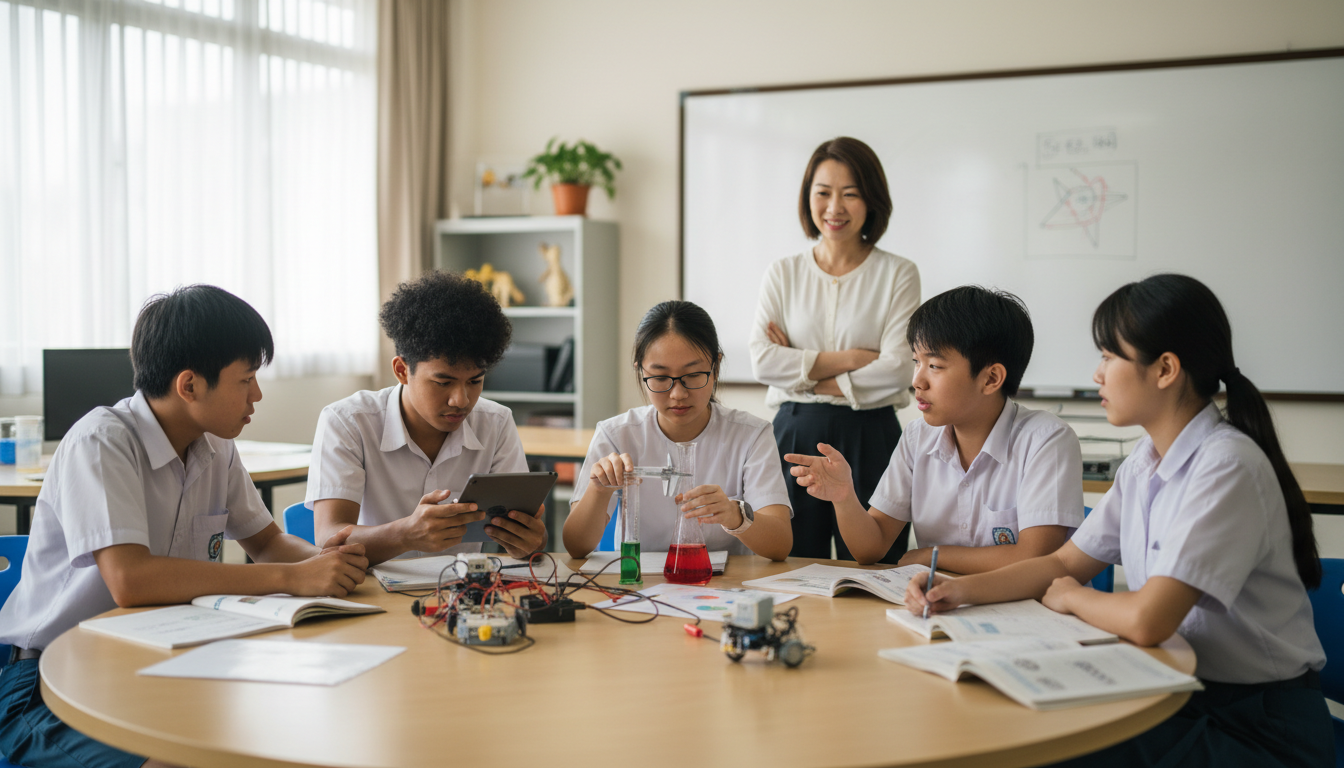
Secondary 1 Science small-group tuition for Clarke Quay families may help a pupil who knows facts but struggles to interpret unfamiliar scientific evidence. A well-managed group of three can provide targeted feedback, but cannot guarantee grades. This guide covers MOE G1/G2/G3, worked examples, benefits, consequences and progress checks.
Local Science around Clarke Quay: river systems, water-level graphs and reflections
The Clarke Quay area offers familiar prompts involving river systems, water-level graphs and reflections. These are hypothetical educational examples, not reports of local measurements or eduKate field classes. An observation may suggest a hypothesis but does not by itself establish its cause.
Local worked example 1: Water height and flow
A rising river-level graph does not directly measure water speed or establish rainfall as the sole cause.
The learner should identify what is directly observed, which quantity could be measured and what further evidence would support the explanation. A plausible mechanism is not automatically proven. If several conditions differ, the pupil should identify relevant confounders before claiming causation.
A changed fictional table or diagram can test the same reasoning in another context. One pupil describes evidence, another proposes a mechanism and the third challenges assumptions. Rotate roles and ask all three to answer an unfamiliar question independently.
For Clarke Quay families, the useful outcome is transfer beyond the local example. A copied answer immediately after the tutor’s explanation is weaker evidence than a correct delayed reattempt without hints. Safe diagrams and supplied data avoid risky field experiments.
Local worked example 2: Reflection from water
A smooth-water ray diagram is a model; ripples can change reflected directions.
The learner should identify what is directly observed, which quantity could be measured and what further evidence would support the explanation. A plausible mechanism is not automatically proven. If several conditions differ, the pupil should identify relevant confounders before claiming causation.
A changed fictional table or diagram can test the same reasoning in another context. One pupil describes evidence, another proposes a mechanism and the third challenges assumptions. Rotate roles and ask all three to answer an unfamiliar question independently.
For Clarke Quay families, the useful outcome is transfer beyond the local example. A copied answer immediately after the tutor’s explanation is weaker evidence than a correct delayed reattempt without hints. Safe diagrams and supplied data avoid risky field experiments.
Local worked example 3: A boat journey
A fictional boat travels 1,200 metres in 400 seconds, giving an average speed of 3 metres per second, not necessarily constant speed.
The learner should identify what is directly observed, which quantity could be measured and what further evidence would support the explanation. A plausible mechanism is not automatically proven. If several conditions differ, the pupil should identify relevant confounders before claiming causation.
A changed fictional table or diagram can test the same reasoning in another context. One pupil describes evidence, another proposes a mechanism and the third challenges assumptions. Rotate roles and ask all three to answer an unfamiliar question independently.
For Clarke Quay families, the useful outcome is transfer beyond the local example. A copied answer immediately after the tutor’s explanation is weaker evidence than a correct delayed reattempt without hints. Safe diagrams and supplied data avoid risky field experiments.
Local worked example 4: Water clarity
Clear-looking river water is not proof that it is safe to drink. Dissolved substances and microorganisms may be invisible.
The learner should identify what is directly observed, which quantity could be measured and what further evidence would support the explanation. A plausible mechanism is not automatically proven. If several conditions differ, the pupil should identify relevant confounders before claiming causation.
A changed fictional table or diagram can test the same reasoning in another context. One pupil describes evidence, another proposes a mechanism and the third challenges assumptions. Rotate roles and ask all three to answer an unfamiliar question independently.
For Clarke Quay families, the useful outcome is transfer beyond the local example. A copied answer immediately after the tutor’s explanation is weaker evidence than a correct delayed reattempt without hints. Safe diagrams and supplied data avoid risky field experiments.
Local worked example 5: A food web
Arrows represent energy transfer from food source to consumer. A simplified web cannot predict exact population changes.
The learner should identify what is directly observed, which quantity could be measured and what further evidence would support the explanation. A plausible mechanism is not automatically proven. If several conditions differ, the pupil should identify relevant confounders before claiming causation.
A changed fictional table or diagram can test the same reasoning in another context. One pupil describes evidence, another proposes a mechanism and the third challenges assumptions. Rotate roles and ask all three to answer an unfamiliar question independently.
For Clarke Quay families, the useful outcome is transfer beyond the local example. A copied answer immediately after the tutor’s explanation is weaker evidence than a correct delayed reattempt without hints. Safe diagrams and supplied data avoid risky field experiments.
Local worked example 6: Riverbank erosion
Flow, bank material, vegetation and time may affect erosion. One image cannot establish a measured rate.
The learner should identify what is directly observed, which quantity could be measured and what further evidence would support the explanation. A plausible mechanism is not automatically proven. If several conditions differ, the pupil should identify relevant confounders before claiming causation.
A changed fictional table or diagram can test the same reasoning in another context. One pupil describes evidence, another proposes a mechanism and the third challenges assumptions. Rotate roles and ask all three to answer an unfamiliar question independently.
For Clarke Quay families, the useful outcome is transfer beyond the local example. A copied answer immediately after the tutor’s explanation is weaker evidence than a correct delayed reattempt without hints. Safe diagrams and supplied data avoid risky field experiments.
What Secondary 1 Science demands
Lower-secondary Science asks pupils to interpret unfamiliar evidence, choose a suitable scientific idea and explain why the evidence supports a conclusion. Remembering a definition is not enough when a question changes its context. The tutor should find the first wrong reasoning step rather than assign more generic worksheets.
Parents should bring marked schoolwork and ask the child to reconstruct the original answer. A misread graph scale, an incorrect concept and an unsupported inference require different repairs. One disappointing assessment during a busy transition does not automatically establish the need for tuition.
The first year of secondary school brings new teachers, timetables, CCA and more independent study. Parents should weigh rest and school-based support before adding lessons. The aim is to solve a specific recurring problem rather than create a permanent dependency.
A tutor supporting a Clarke Quay pupil should connect this principle to actual marked schoolwork. Ask the learner to reconstruct the original reasoning, identify the first incorrect decision and apply the corrected idea to a changed problem. A polished copied answer does not demonstrate independent understanding.
Each of three pupils needs thinking time, specific feedback and suitable challenge. The tutor should gradually reduce hints, revisit the skill after a delay and align task depth with the actual subject level. Parents can compare independent answers rather than rely on worksheet counts.
The family should weigh fees, door-to-door travel, homework and sleep. If school feedback already enables independent correction, extra tuition may be unnecessary. If the group is poorly matched, another arrangement may be more effective.
G1 G2 G3 under Full Subject-Based Banding
Check the pupil’s actual Science subject level and current school topic. Under Full Subject-Based Banding, posting group does not necessarily determine every subject level. G1 includes laboratory measurements and context-based modules about machines, environment, body and health.
G2/G3 is organised around scientific endeavour, diversity, models, interactions and systems. These are not identical courses taught at three speeds. A tutor should adapt examples, vocabulary and task depth to the actual syllabus.
The SEC begins for graduating cohorts from 2027; it is not a national Secondary 1 examination. Teaching should establish present lower-secondary foundations rather than prematurely replace the school unit with graduating-level papers.
A tutor supporting a Clarke Quay pupil should connect this principle to actual marked schoolwork. Ask the learner to reconstruct the original reasoning, identify the first incorrect decision and apply the corrected idea to a changed problem. A polished copied answer does not demonstrate independent understanding.
Each of three pupils needs thinking time, specific feedback and suitable challenge. The tutor should gradually reduce hints, revisit the skill after a delay and align task depth with the actual subject level. Parents can compare independent answers rather than rely on worksheet counts.
The family should weigh fees, door-to-door travel, homework and sleep. If school feedback already enables independent correction, extra tuition may be unnecessary. If the group is poorly matched, another arrangement may be more effective.
Three pupils and diagnostic feedback
A group of three can give the tutor time to hear individual reasoning. One child may misread a scale, another select the wrong model and the third offer a cause unsupported by data. The first independent attempt reveals these differences before a teacher’s explanation.
Rotate discussion roles in describing evidence, proposing a mechanism and challenging assumptions. Every learner should eventually practise each role. The most confident child should not dominate, and quieter pupils need thinking time.
End with an unfamiliar independent question and reduce hints. If all three simply copy a model answer, the small class has not delivered its main advantage. Individual tutoring or school consultation may suit some pupils better.
A tutor supporting a Clarke Quay pupil should connect this principle to actual marked schoolwork. Ask the learner to reconstruct the original reasoning, identify the first incorrect decision and apply the corrected idea to a changed problem. A polished copied answer does not demonstrate independent understanding.
Each of three pupils needs thinking time, specific feedback and suitable challenge. The tutor should gradually reduce hints, revisit the skill after a delay and align task depth with the actual subject level. Parents can compare independent answers rather than rely on worksheet counts.
The family should weigh fees, door-to-door travel, homework and sleep. If school feedback already enables independent correction, extra tuition may be unnecessary. If the group is poorly matched, another arrangement may be more effective.
What research does and does not prove
The Education Endowment Foundation reviews small-group tuition involving two to five pupils and reports a positive average impact across varied studies. Its headline four-month additional-progress estimate is an aggregate, not a prediction for one Singapore Secondary 1 Science learner.
The evidence comes from different subjects and settings. Tutor quality, accurate diagnosis, suitable practice and feedback matter. No provider can guarantee an A1 because the group contains three pupils.
Parents should compare independent responses to changed questions after a delay. A child who now reads a new scale or identifies a confounder without hints has shown a meaningful skill change; a completed worksheet count is not equivalent.
A tutor supporting a Clarke Quay pupil should connect this principle to actual marked schoolwork. Ask the learner to reconstruct the original reasoning, identify the first incorrect decision and apply the corrected idea to a changed problem. A polished copied answer does not demonstrate independent understanding.
Each of three pupils needs thinking time, specific feedback and suitable challenge. The tutor should gradually reduce hints, revisit the skill after a delay and align task depth with the actual subject level. Parents can compare independent answers rather than rely on worksheet counts.
The family should weigh fees, door-to-door travel, homework and sleep. If school feedback already enables independent correction, extra tuition may be unnecessary. If the group is poorly matched, another arrangement may be more effective.
Observation and inference
An observation describes what is seen or measured. An inference proposes an explanation. A surface becoming dry is an observation; saying sunlight alone caused the change requires further evidence because airflow and drainage might contribute.
Ask pupils to classify statements and identify what extra measurement would support the proposed cause. A child who confidently states a mechanism without sufficient evidence needs to learn scientific caution.
A changed example should be solved independently. The aim is to make observation and inference useful habits in new questions rather than two memorised definitions.
A tutor supporting a Clarke Quay pupil should connect this principle to actual marked schoolwork. Ask the learner to reconstruct the original reasoning, identify the first incorrect decision and apply the corrected idea to a changed problem. A polished copied answer does not demonstrate independent understanding.
Each of three pupils needs thinking time, specific feedback and suitable challenge. The tutor should gradually reduce hints, revisit the skill after a delay and align task depth with the actual subject level. Parents can compare independent answers rather than rely on worksheet counts.
The family should weigh fees, door-to-door travel, homework and sleep. If school feedback already enables independent correction, extra tuition may be unnecessary. If the group is poorly matched, another arrangement may be more effective.
Fair testing
If two dishes of water lose different amounts but differ in both surface area and airflow, the result cannot isolate either factor. A fair comparison starts with a specific question and changes one selected condition.
The pupil should identify the independent variable, measured outcome and controls such as starting volume, container shape, temperature and measurement time. Saying ‘keep everything else the same’ is incomplete without naming relevant confounders.
Change the scenario to drying fabric and ask the learner to design a valid comparison without hints. A safe fictional dataset can teach the same reasoning as a supervised experiment.
A tutor supporting a Clarke Quay pupil should connect this principle to actual marked schoolwork. Ask the learner to reconstruct the original reasoning, identify the first incorrect decision and apply the corrected idea to a changed problem. A polished copied answer does not demonstrate independent understanding.
Each of three pupils needs thinking time, specific feedback and suitable challenge. The tutor should gradually reduce hints, revisit the skill after a delay and align task depth with the actual subject level. Parents can compare independent answers rather than rely on worksheet counts.
The family should weigh fees, door-to-door travel, homework and sleep. If school feedback already enables independent correction, extra tuition may be unnecessary. If the group is poorly matched, another arrangement may be more effective.
Measurement and units
A reading requires a quantity, unit and numerical scale. If two numbered marks differ by ten units across five equal intervals, each interval represents two units. The pupil should derive the increment rather than guess from the drawing.
A correct-looking number with the wrong unit is not a correct scientific measurement. Instrument resolution also limits how precisely a result can be stated.
Change the scale and ask for an independent reading after a delay. This distinguishes transferable method from memorisation of one diagram.
A tutor supporting a Clarke Quay pupil should connect this principle to actual marked schoolwork. Ask the learner to reconstruct the original reasoning, identify the first incorrect decision and apply the corrected idea to a changed problem. A polished copied answer does not demonstrate independent understanding.
Each of three pupils needs thinking time, specific feedback and suitable challenge. The tutor should gradually reduce hints, revisit the skill after a delay and align task depth with the actual subject level. Parents can compare independent answers rather than rely on worksheet counts.
The family should weigh fees, door-to-door travel, homework and sleep. If school feedback already enables independent correction, extra tuition may be unnecessary. If the group is poorly matched, another arrangement may be more effective.
Graphs and causal claims
A rising line can represent distance, temperature, water level or mass. Its meaning comes from the axes and units. A water-level graph does not directly measure flow speed, and a truncated axis can exaggerate a small numerical change.
The pupil should first describe the measured pattern. A cause may require additional data. An unusual reading should be recorded and considered rather than erased for a smooth curve.
A different graph with changed labels and scale is a better transfer check than rereading the original picture. The child should explain what can and cannot be concluded.
A tutor supporting a Clarke Quay pupil should connect this principle to actual marked schoolwork. Ask the learner to reconstruct the original reasoning, identify the first incorrect decision and apply the corrected idea to a changed problem. A polished copied answer does not demonstrate independent understanding.
Each of three pupils needs thinking time, specific feedback and suitable challenge. The tutor should gradually reduce hints, revisit the skill after a delay and align task depth with the actual subject level. Parents can compare independent answers rather than rely on worksheet counts.
The family should weigh fees, door-to-door travel, homework and sleep. If school feedback already enables independent correction, extra tuition may be unnecessary. If the group is poorly matched, another arrangement may be more effective.
Mixtures and separation
Sand suspended in water may be separated by suitable filtration, while dissolved salt passes through ordinary filter paper. The method depends on material properties and the component to be recovered.
Recovering a dissolved solid may involve evaporation or crystallisation under appropriate conditions. Recovering the solvent requires collecting it. A mixture may require more than one method.
Clear-looking water is not necessarily safe to drink because dissolved contaminants and microorganisms may remain. Never collect or consume unknown environmental water for tuition.
A tutor supporting a Clarke Quay pupil should connect this principle to actual marked schoolwork. Ask the learner to reconstruct the original reasoning, identify the first incorrect decision and apply the corrected idea to a changed problem. A polished copied answer does not demonstrate independent understanding.
Each of three pupils needs thinking time, specific feedback and suitable challenge. The tutor should gradually reduce hints, revisit the skill after a delay and align task depth with the actual subject level. Parents can compare independent answers rather than rely on worksheet counts.
The family should weigh fees, door-to-door travel, homework and sleep. If school feedback already enables independent correction, extra tuition may be unnecessary. If the group is poorly matched, another arrangement may be more effective.
Particle models
Particle diagrams illustrate selected features of materials and mixtures. Their dots, colours and spacing are not literal photographs of microscopic objects.
A learner should explain what the model helps show and what it omits. A changed representation tests whether the child understands a solution or suspension.
Scientific models are useful because they simplify. Students should not infer unsupported details from the illustration alone.
A tutor supporting a Clarke Quay pupil should connect this principle to actual marked schoolwork. Ask the learner to reconstruct the original reasoning, identify the first incorrect decision and apply the corrected idea to a changed problem. A polished copied answer does not demonstrate independent understanding.
Each of three pupils needs thinking time, specific feedback and suitable challenge. The tutor should gradually reduce hints, revisit the skill after a delay and align task depth with the actual subject level. Parents can compare independent answers rather than rely on worksheet counts.
The family should weigh fees, door-to-door travel, homework and sleep. If school feedback already enables independent correction, extra tuition may be unnecessary. If the group is poorly matched, another arrangement may be more effective.
Food webs and energy
Food-web arrows indicate energy transfer from food source to consumer. A simplified web omits many real species and feeding alternatives.
A decline in one fictional prey population may affect other organisms, but the diagram alone cannot establish exact numbers or timing.
Ask pupils to read a new web, make a qualified prediction and identify a limitation. The goal is cautious ecological reasoning.
A tutor supporting a Clarke Quay pupil should connect this principle to actual marked schoolwork. Ask the learner to reconstruct the original reasoning, identify the first incorrect decision and apply the corrected idea to a changed problem. A polished copied answer does not demonstrate independent understanding.
Each of three pupils needs thinking time, specific feedback and suitable challenge. The tutor should gradually reduce hints, revisit the skill after a delay and align task depth with the actual subject level. Parents can compare independent answers rather than rely on worksheet counts.
The family should weigh fees, door-to-door travel, homework and sleep. If school feedback already enables independent correction, extra tuition may be unnecessary. If the group is poorly matched, another arrangement may be more effective.
Biodiversity sampling
Species richness and total abundance are different measures. Many individuals of one species do not necessarily mean more species diversity.
Observation time, area, weather and identification method affect survey results. A short sighting is not a complete census.
Fictional tables can teach fair comparisons without collecting or disturbing wildlife. Students should state how sampling effort affects confidence.
A tutor supporting a Clarke Quay pupil should connect this principle to actual marked schoolwork. Ask the learner to reconstruct the original reasoning, identify the first incorrect decision and apply the corrected idea to a changed problem. A polished copied answer does not demonstrate independent understanding.
Each of three pupils needs thinking time, specific feedback and suitable challenge. The tutor should gradually reduce hints, revisit the skill after a delay and align task depth with the actual subject level. Parents can compare independent answers rather than rely on worksheet counts.
The family should weigh fees, door-to-door travel, homework and sleep. If school feedback already enables independent correction, extra tuition may be unnecessary. If the group is poorly matched, another arrangement may be more effective.
Heat and temperature
Metal and wood at similar measured temperatures can feel different because thermal conductivity affects heat transfer. Touch is not a calibrated thermometer.
Comparing cooling containers requires attention to starting temperatures, volumes, exposed areas and surroundings. Changing several factors prevents a clear causal claim.
Use safe classroom diagrams or fictional readings rather than handling hot objects. A changed problem tests independent reasoning.
A tutor supporting a Clarke Quay pupil should connect this principle to actual marked schoolwork. Ask the learner to reconstruct the original reasoning, identify the first incorrect decision and apply the corrected idea to a changed problem. A polished copied answer does not demonstrate independent understanding.
Each of three pupils needs thinking time, specific feedback and suitable challenge. The tutor should gradually reduce hints, revisit the skill after a delay and align task depth with the actual subject level. Parents can compare independent answers rather than rely on worksheet counts.
The family should weigh fees, door-to-door travel, homework and sleep. If school feedback already enables independent correction, extra tuition may be unnecessary. If the group is poorly matched, another arrangement may be more effective.
Electrical circuits
A simple lamp requires an appropriate complete conducting path. A closed switch cannot repair a disconnected wire elsewhere.
Circuit symbols represent relationships between components and omit physical details. Students should trace the whole schematic rather than memorise one switch rule.
Use safe low-voltage educational kits or diagrams, never household mains wiring. An unfamiliar circuit tests transfer.
A tutor supporting a Clarke Quay pupil should connect this principle to actual marked schoolwork. Ask the learner to reconstruct the original reasoning, identify the first incorrect decision and apply the corrected idea to a changed problem. A polished copied answer does not demonstrate independent understanding.
Each of three pupils needs thinking time, specific feedback and suitable challenge. The tutor should gradually reduce hints, revisit the skill after a delay and align task depth with the actual subject level. Parents can compare independent answers rather than rely on worksheet counts.
The family should weigh fees, door-to-door travel, homework and sleep. If school feedback already enables independent correction, extra tuition may be unnecessary. If the group is poorly matched, another arrangement may be more effective.
Cell structures
A plant-cell wall provides structural support while the membrane regulates movement across the boundary. These are different structures with different functions.
A textbook cell diagram simplifies proportions and appearance. It is not a literal picture of every cell.
Ask the pupil to interpret a changed diagram and explain a structure-function relationship at the appropriate subject level.
A tutor supporting a Clarke Quay pupil should connect this principle to actual marked schoolwork. Ask the learner to reconstruct the original reasoning, identify the first incorrect decision and apply the corrected idea to a changed problem. A polished copied answer does not demonstrate independent understanding.
Each of three pupils needs thinking time, specific feedback and suitable challenge. The tutor should gradually reduce hints, revisit the skill after a delay and align task depth with the actual subject level. Parents can compare independent answers rather than rely on worksheet counts.
The family should weigh fees, door-to-door travel, homework and sleep. If school feedback already enables independent correction, extra tuition may be unnecessary. If the group is poorly matched, another arrangement may be more effective.
Forces and motion
A moving object can slow while continuing to move. Friction can assist grip and braking, so it is not always undesirable.
Comparing stopping distances requires attention to starting speed, slope, surface and braking input. A diagram may omit information needed for exact predictions.
Safe diagrams and fictional data are preferable to risky tests on public paths. Ask which forces are relevant and which conclusions follow.
A tutor supporting a Clarke Quay pupil should connect this principle to actual marked schoolwork. Ask the learner to reconstruct the original reasoning, identify the first incorrect decision and apply the corrected idea to a changed problem. A polished copied answer does not demonstrate independent understanding.
Each of three pupils needs thinking time, specific feedback and suitable challenge. The tutor should gradually reduce hints, revisit the skill after a delay and align task depth with the actual subject level. Parents can compare independent answers rather than rely on worksheet counts.
The family should weigh fees, door-to-door travel, homework and sleep. If school feedback already enables independent correction, extra tuition may be unnecessary. If the group is poorly matched, another arrangement may be more effective.
Scientific writing
A strong Science answer identifies the relevant evidence, names an appropriate principle and explains the logical connection. Technical vocabulary cannot replace missing reasoning.
Compare a concise justified answer with a longer unsupported one. Students should recognise when the evidence is insufficient for a confident causal claim.
Remove sentence prompts and ask the learner to explain an unfamiliar situation independently. Clarity and accuracy matter more than length.
A tutor supporting a Clarke Quay pupil should connect this principle to actual marked schoolwork. Ask the learner to reconstruct the original reasoning, identify the first incorrect decision and apply the corrected idea to a changed problem. A polished copied answer does not demonstrate independent understanding.
Each of three pupils needs thinking time, specific feedback and suitable challenge. The tutor should gradually reduce hints, revisit the skill after a delay and align task depth with the actual subject level. Parents can compare independent answers rather than rely on worksheet counts.
The family should weigh fees, door-to-door travel, homework and sleep. If school feedback already enables independent correction, extra tuition may be unnecessary. If the group is poorly matched, another arrangement may be more effective.
A purposeful ninety-minute tutorial
Begin with brief no-notes retrieval and a diagnostic aligned with current schoolwork. Teach the missing concept through a diagram, safe demonstration or prepared dataset.
Rotate discussion roles and differentiate tasks. Finish with an unseen independent question, specific feedback and a short error note.
Recheck the concept after a delay. This is an illustrative three-pupil, 1.5-hour design, not confirmation of an estate-specific timetable.
A tutor supporting a Clarke Quay pupil should connect this principle to actual marked schoolwork. Ask the learner to reconstruct the original reasoning, identify the first incorrect decision and apply the corrected idea to a changed problem. A polished copied answer does not demonstrate independent understanding.
Each of three pupils needs thinking time, specific feedback and suitable challenge. The tutor should gradually reduce hints, revisit the skill after a delay and align task depth with the actual subject level. Parents can compare independent answers rather than rely on worksheet counts.
The family should weigh fees, door-to-door travel, homework and sleep. If school feedback already enables independent correction, extra tuition may be unnecessary. If the group is poorly matched, another arrangement may be more effective.
Four-week progress review
Week one establishes baseline errors. Week two repairs the concept with changed examples. Week three mixes topics so the pupil must select the principle.
Week four tests a comparable unfamiliar question after a delay. Report what the child can now do independently rather than worksheet counts.
Four weeks is a checkpoint, not a guarantee of complete improvement. If progress is weak, reconsider diagnosis, group match and fatigue.
A tutor supporting a Clarke Quay pupil should connect this principle to actual marked schoolwork. Ask the learner to reconstruct the original reasoning, identify the first incorrect decision and apply the corrected idea to a changed problem. A polished copied answer does not demonstrate independent understanding.
Each of three pupils needs thinking time, specific feedback and suitable challenge. The tutor should gradually reduce hints, revisit the skill after a delay and align task depth with the actual subject level. Parents can compare independent answers rather than rely on worksheet counts.
The family should weigh fees, door-to-door travel, homework and sleep. If school feedback already enables independent correction, extra tuition may be unnecessary. If the group is poorly matched, another arrangement may be more effective.
Twelve-week progression
Begin with diagnosis and foundational repair. Progress through retrieval, mixed-topic questions, graphs, units, scientific writing and unfamiliar models.
Finish with an independent review against the baseline. The sequence should match actual G-level and school coverage.
A tutor should be willing to recommend reduced tuition when the child becomes independent rather than extend lessons automatically.
A tutor supporting a Clarke Quay pupil should connect this principle to actual marked schoolwork. Ask the learner to reconstruct the original reasoning, identify the first incorrect decision and apply the corrected idea to a changed problem. A polished copied answer does not demonstrate independent understanding.
Each of three pupils needs thinking time, specific feedback and suitable challenge. The tutor should gradually reduce hints, revisit the skill after a delay and align task depth with the actual subject level. Parents can compare independent answers rather than rely on worksheet counts.
The family should weigh fees, door-to-door travel, homework and sleep. If school feedback already enables independent correction, extra tuition may be unnecessary. If the group is poorly matched, another arrangement may be more effective.
Benefits and consequences
Benefits may include closer diagnosis, targeted feedback and peer explanation. A respectful group can support confidence when every pupil participates.
Consequences include fees, travel, fatigue, peer pressure, mismatched readiness and dependence on hints.
School consultation, home practice or individual tuition may suit some pupils better. Choose the least burdensome effective intervention.
A tutor supporting a Clarke Quay pupil should connect this principle to actual marked schoolwork. Ask the learner to reconstruct the original reasoning, identify the first incorrect decision and apply the corrected idea to a changed problem. A polished copied answer does not demonstrate independent understanding.
Each of three pupils needs thinking time, specific feedback and suitable challenge. The tutor should gradually reduce hints, revisit the skill after a delay and align task depth with the actual subject level. Parents can compare independent answers rather than rely on worksheet counts.
The family should weigh fees, door-to-door travel, homework and sleep. If school feedback already enables independent correction, extra tuition may be unnecessary. If the group is poorly matched, another arrangement may be more effective.
Questions before enrolment
Ask what the first wrong reasoning step was, which G-level and school topic are taught and what each pupil does independently.
Ask how delayed retention is checked and how different readiness levels are managed. A responsible tutor should recommend changing format or stopping when appropriate.
Confirm the actual tutor, venue, group composition, fees, materials, timetable and replacement conditions. An estate name does not confirm a local vacancy.
A tutor supporting a Clarke Quay pupil should connect this principle to actual marked schoolwork. Ask the learner to reconstruct the original reasoning, identify the first incorrect decision and apply the corrected idea to a changed problem. A polished copied answer does not demonstrate independent understanding.
Each of three pupils needs thinking time, specific feedback and suitable challenge. The tutor should gradually reduce hints, revisit the skill after a delay and align task depth with the actual subject level. Parents can compare independent answers rather than rely on worksheet counts.
The family should weigh fees, door-to-door travel, homework and sleep. If school feedback already enables independent correction, extra tuition may be unnecessary. If the group is poorly matched, another arrangement may be more effective.
Next steps and official references
This is an information guide for Clarke Quay families and does not confirm a dedicated eduKate Science centre or available seat. Contact eduKate Singapore for actual arrangements. The immutable Clementi three-pupil tutorial reference explains the teaching format.
Official sources: MOE G1 Science, MOE G2/G3 Science, SEAB SEC and EEF evidence.