
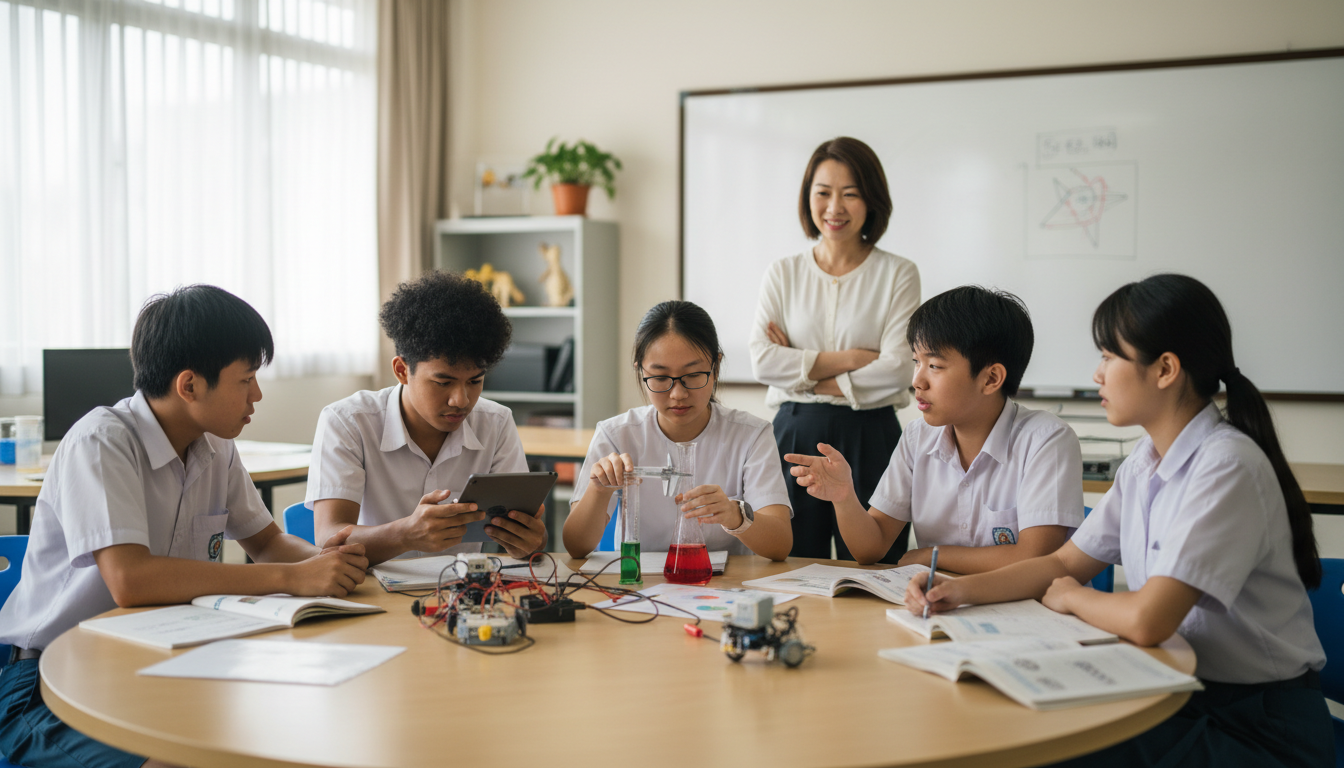
Secondary 1 Science small-group tuition for Lakeside families may help when a pupil knows facts but struggles with unfamiliar evidence. A well-managed group of three can offer targeted feedback, but cannot guarantee grades. This guide explains MOE G1/G2/G3, worked examples, benefits, consequences and progress checks.
Science in Lakeside: freshwater habitats, water quality and scientific sampling
The Lakeside area offers familiar prompts involving freshwater habitats, water quality and scientific sampling. An observation may suggest a scientific question but does not establish its cause. These are hypothetical classroom scenarios, not reports of local environmental measurements or eduKate field classes.
Local worked example 1: A freshwater food web
Energy arrows run from food source to consumer. A simplified web cannot establish exact population changes after one species declines.
Ask the learner to identify what is observed, what is inferred and which scientific quantity could be measured. A plausible explanation is not automatically proven. If conditions differ, the pupil should identify relevant confounders and what additional data would support a fair conclusion.
A fictional graph or diagram can test the same reasoning in a different setting. One pupil describes evidence, another proposes a mechanism and a third critiques an assumption. Rotate roles so each learner participates and then completes a changed question independently.
For Lakeside families, the outcome is transfer beyond this local example. A copied answer immediately after teaching is weaker evidence than a correct reattempt without hints after a delay. No unsafe outdoor experiment or collection of unknown water is required.
Local worked example 2: Water clarity
Clear-looking lake water is not necessarily safe to drink. Dissolved contaminants and microorganisms may be invisible.
Ask the learner to identify what is observed, what is inferred and which scientific quantity could be measured. A plausible explanation is not automatically proven. If conditions differ, the pupil should identify relevant confounders and what additional data would support a fair conclusion.
A fictional graph or diagram can test the same reasoning in a different setting. One pupil describes evidence, another proposes a mechanism and a third critiques an assumption. Rotate roles so each learner participates and then completes a changed question independently.
For Lakeside families, the outcome is transfer beyond this local example. A copied answer immediately after teaching is weaker evidence than a correct reattempt without hints after a delay. No unsafe outdoor experiment or collection of unknown water is required.
Local worked example 3: Water level
A chart of water height does not directly measure flow speed or identify rainfall as the only cause of change.
Ask the learner to identify what is observed, what is inferred and which scientific quantity could be measured. A plausible explanation is not automatically proven. If conditions differ, the pupil should identify relevant confounders and what additional data would support a fair conclusion.
A fictional graph or diagram can test the same reasoning in a different setting. One pupil describes evidence, another proposes a mechanism and a third critiques an assumption. Rotate roles so each learner participates and then completes a changed question independently.
For Lakeside families, the outcome is transfer beyond this local example. A copied answer immediately after teaching is weaker evidence than a correct reattempt without hints after a delay. No unsafe outdoor experiment or collection of unknown water is required.
Local worked example 4: Biodiversity survey
A ten-minute survey and an hour-long survey have different sampling effort. Their species counts cannot be compared uncritically.
Ask the learner to identify what is observed, what is inferred and which scientific quantity could be measured. A plausible explanation is not automatically proven. If conditions differ, the pupil should identify relevant confounders and what additional data would support a fair conclusion.
A fictional graph or diagram can test the same reasoning in a different setting. One pupil describes evidence, another proposes a mechanism and a third critiques an assumption. Rotate roles so each learner participates and then completes a changed question independently.
For Lakeside families, the outcome is transfer beyond this local example. A copied answer immediately after teaching is weaker evidence than a correct reattempt without hints after a delay. No unsafe outdoor experiment or collection of unknown water is required.
Local worked example 5: Dissolved salt
Ordinary filter paper does not separate dissolved salt from water. Recovering a dissolved solid requires a suitable different method.
Ask the learner to identify what is observed, what is inferred and which scientific quantity could be measured. A plausible explanation is not automatically proven. If conditions differ, the pupil should identify relevant confounders and what additional data would support a fair conclusion.
A fictional graph or diagram can test the same reasoning in a different setting. One pupil describes evidence, another proposes a mechanism and a third critiques an assumption. Rotate roles so each learner participates and then completes a changed question independently.
For Lakeside families, the outcome is transfer beyond this local example. A copied answer immediately after teaching is weaker evidence than a correct reattempt without hints after a delay. No unsafe outdoor experiment or collection of unknown water is required.
Local worked example 6: Evaporation
Surface area, temperature and airflow may influence evaporation. Comparing two natural water bodies does not isolate a factor.
Ask the learner to identify what is observed, what is inferred and which scientific quantity could be measured. A plausible explanation is not automatically proven. If conditions differ, the pupil should identify relevant confounders and what additional data would support a fair conclusion.
A fictional graph or diagram can test the same reasoning in a different setting. One pupil describes evidence, another proposes a mechanism and a third critiques an assumption. Rotate roles so each learner participates and then completes a changed question independently.
For Lakeside families, the outcome is transfer beyond this local example. A copied answer immediately after teaching is weaker evidence than a correct reattempt without hints after a delay. No unsafe outdoor experiment or collection of unknown water is required.
What Secondary 1 Science expects
Lower-secondary Science increasingly requires pupils to apply familiar ideas to unfamiliar situations. A learner may know the word evaporation but not distinguish it from drainage, or know a cell label but not its function. An effective tutor identifies the first mistaken reasoning step rather than assigning more pages indiscriminately.
A weak test result alone does not establish the need for tuition. Review marked schoolwork across several topics, ask the child to explain the original answer and check whether school feedback already enables independent correction. Secondary 1 also brings new teachers, timetables and CCA commitments, so rest matters.
A tutor supporting a Lakeside student should connect this principle to an actual marked school answer. Ask the child to reconstruct the original reasoning, identify the first mistaken decision and compare the corrected idea with a changed problem. A polished copied answer does not demonstrate independent understanding.
Each of three pupils needs thinking time and specific feedback. The tutor should gradually remove hints, revisit the skill after a delay and adjust difficulty to the student’s actual subject level. Parents can compare independent work and decide whether the additional fees, travel and time remain justified.
An effective check asks the learner to name the evidence, choose a suitable model and explain what the available information cannot establish. When the child can do this on unfamiliar questions, tuition should support increasing independence rather than dependence on the tutor’s opening prompts.
G1 G2 G3 and Full Subject-Based Banding
Confirm the actual Science subject level from school materials. Under Full Subject-Based Banding, posting group does not by itself determine every subject level. MOE G1 includes laboratory measurements and contextual modules about machines, environment, body and health. G2/G3 is organised around scientific endeavour, diversity, models, interactions and systems.
These are not identical courses taught at different speeds. The tutor should match vocabulary, examples and question depth to the actual course and current school unit. The SEC begins for graduating cohorts in 2027; it is not a national Secondary 1 examination.
A tutor supporting a Lakeside student should connect this principle to an actual marked school answer. Ask the child to reconstruct the original reasoning, identify the first mistaken decision and compare the corrected idea with a changed problem. A polished copied answer does not demonstrate independent understanding.
Each of three pupils needs thinking time and specific feedback. The tutor should gradually remove hints, revisit the skill after a delay and adjust difficulty to the student’s actual subject level. Parents can compare independent work and decide whether the additional fees, travel and time remain justified.
An effective check asks the learner to name the evidence, choose a suitable model and explain what the available information cannot establish. When the child can do this on unfamiliar questions, tuition should support increasing independence rather than dependence on the tutor’s opening prompts.
Why three pupils can help
A tutor can inspect three independent first attempts and identify distinct misconceptions. One child may misread a graph scale, another select the wrong concept and a third make an unsupported inference. The teaching response should address each error rather than simply give everyone a common answer.
Discussion roles can rotate: describe the evidence, propose a mechanism and challenge assumptions. Every pupil should eventually practise each role and solve a changed question without hints. A group of three is not automatically effective if the most confident child dominates.
A tutor supporting a Lakeside student should connect this principle to an actual marked school answer. Ask the child to reconstruct the original reasoning, identify the first mistaken decision and compare the corrected idea with a changed problem. A polished copied answer does not demonstrate independent understanding.
Each of three pupils needs thinking time and specific feedback. The tutor should gradually remove hints, revisit the skill after a delay and adjust difficulty to the student’s actual subject level. Parents can compare independent work and decide whether the additional fees, travel and time remain justified.
An effective check asks the learner to name the evidence, choose a suitable model and explain what the available information cannot establish. When the child can do this on unfamiliar questions, tuition should support increasing independence rather than dependence on the tutor’s opening prompts.
What tutoring research supports
The Education Endowment Foundation reviews small-group tuition involving two to five pupils and reports a positive average impact across varied studies. Its headline estimate of four months of additional progress is an aggregate, not a forecast for one Singapore Secondary 1 Science student.
Tutor quality, diagnostic precision, feedback and alignment with schoolwork matter. No responsible provider can guarantee an A1 because the group has three pupils. The best early indicator is whether the child solves a new comparable question independently after a delay.
A tutor supporting a Lakeside student should connect this principle to an actual marked school answer. Ask the child to reconstruct the original reasoning, identify the first mistaken decision and compare the corrected idea with a changed problem. A polished copied answer does not demonstrate independent understanding.
Each of three pupils needs thinking time and specific feedback. The tutor should gradually remove hints, revisit the skill after a delay and adjust difficulty to the student’s actual subject level. Parents can compare independent work and decide whether the additional fees, travel and time remain justified.
An effective check asks the learner to name the evidence, choose a suitable model and explain what the available information cannot establish. When the child can do this on unfamiliar questions, tuition should support increasing independence rather than dependence on the tutor’s opening prompts.
Observation versus inference
An observation reports what was directly seen or measured. An inference proposes an explanation. A puddle disappearing is an observation; claiming sunshine alone caused it is an inference that needs more evidence because drainage and airflow may also matter.
Give pupils paired statements and ask which are observations and which are interpretations. Then ask what measurement would test the explanation. An unfamiliar example checks whether the distinction has become a reasoning habit rather than a memorised definition.
A tutor supporting a Lakeside student should connect this principle to an actual marked school answer. Ask the child to reconstruct the original reasoning, identify the first mistaken decision and compare the corrected idea with a changed problem. A polished copied answer does not demonstrate independent understanding.
Each of three pupils needs thinking time and specific feedback. The tutor should gradually remove hints, revisit the skill after a delay and adjust difficulty to the student’s actual subject level. Parents can compare independent work and decide whether the additional fees, travel and time remain justified.
An effective check asks the learner to name the evidence, choose a suitable model and explain what the available information cannot establish. When the child can do this on unfamiliar questions, tuition should support increasing independence rather than dependence on the tutor’s opening prompts.
Fair testing and variables
Suppose two dishes lose different amounts of water, but one is wider and also exposed to a fan. The result cannot isolate airflow because surface area also differs. A fair test deliberately changes one selected factor and keeps relevant others comparable.
Students should name the independent variable, the measured outcome and specific controls such as starting volume, container dimensions and measurement time. Change the context to drying fabric and ask for a new fair design without hints.
A tutor supporting a Lakeside student should connect this principle to an actual marked school answer. Ask the child to reconstruct the original reasoning, identify the first mistaken decision and compare the corrected idea with a changed problem. A polished copied answer does not demonstrate independent understanding.
Each of three pupils needs thinking time and specific feedback. The tutor should gradually remove hints, revisit the skill after a delay and adjust difficulty to the student’s actual subject level. Parents can compare independent work and decide whether the additional fees, travel and time remain justified.
An effective check asks the learner to name the evidence, choose a suitable model and explain what the available information cannot establish. When the child can do this on unfamiliar questions, tuition should support increasing independence rather than dependence on the tutor’s opening prompts.
Reliable measurements
A measuring cylinder or thermometer must be read using its scale and unit. If numbered marks differ by ten units with five equal intervals, each interval represents two units. The child should derive the increment rather than guess from the appearance of the instrument.
A changed instrument diagram checks transfer. Measurement uncertainty and reading method may matter, and a plausible number with the wrong unit is not a correct scientific measurement. A tutor should correct the method rather than merely the final number.
A tutor supporting a Lakeside student should connect this principle to an actual marked school answer. Ask the child to reconstruct the original reasoning, identify the first mistaken decision and compare the corrected idea with a changed problem. A polished copied answer does not demonstrate independent understanding.
Each of three pupils needs thinking time and specific feedback. The tutor should gradually remove hints, revisit the skill after a delay and adjust difficulty to the student’s actual subject level. Parents can compare independent work and decide whether the additional fees, travel and time remain justified.
An effective check asks the learner to name the evidence, choose a suitable model and explain what the available information cannot establish. When the child can do this on unfamiliar questions, tuition should support increasing independence rather than dependence on the tutor’s opening prompts.
Graph interpretation
A rising line could represent temperature, water level, distance or mass. Its meaning depends on axis labels and units. A water-level graph does not directly measure flow speed. A truncated axis can make a small change look dramatic.
Students should describe the recorded pattern before proposing a cause. An anomalous point should be recorded and considered, not silently erased. A changed graph checks whether the pupil interprets data independently.
A tutor supporting a Lakeside student should connect this principle to an actual marked school answer. Ask the child to reconstruct the original reasoning, identify the first mistaken decision and compare the corrected idea with a changed problem. A polished copied answer does not demonstrate independent understanding.
Each of three pupils needs thinking time and specific feedback. The tutor should gradually remove hints, revisit the skill after a delay and adjust difficulty to the student’s actual subject level. Parents can compare independent work and decide whether the additional fees, travel and time remain justified.
An effective check asks the learner to name the evidence, choose a suitable model and explain what the available information cannot establish. When the child can do this on unfamiliar questions, tuition should support increasing independence rather than dependence on the tutor’s opening prompts.
Solutions and filtration
Sand suspended in water may be separated by suitable filtration, while dissolved salt passes through ordinary filter paper. The method depends on the material properties and which component must be recovered.
Recovering dissolved salt may involve evaporation or crystallisation under appropriate conditions. Recovering the solvent requires collecting it. Clear-looking filtered water is not necessarily safe to drink. Never consume unknown environmental water.
A tutor supporting a Lakeside student should connect this principle to an actual marked school answer. Ask the child to reconstruct the original reasoning, identify the first mistaken decision and compare the corrected idea with a changed problem. A polished copied answer does not demonstrate independent understanding.
Each of three pupils needs thinking time and specific feedback. The tutor should gradually remove hints, revisit the skill after a delay and adjust difficulty to the student’s actual subject level. Parents can compare independent work and decide whether the additional fees, travel and time remain justified.
An effective check asks the learner to name the evidence, choose a suitable model and explain what the available information cannot establish. When the child can do this on unfamiliar questions, tuition should support increasing independence rather than dependence on the tutor’s opening prompts.
Particle models
Particle diagrams can explain the distinction between a solution and suspended material, but they are models rather than literal photographs. Their colours, sizes and spacing are chosen to communicate selected ideas.
Ask what a diagram shows, what it omits and which claims it supports. A changed representation can reveal whether the pupil understands dissolved substances or merely recognises the original drawing.
A tutor supporting a Lakeside student should connect this principle to an actual marked school answer. Ask the child to reconstruct the original reasoning, identify the first mistaken decision and compare the corrected idea with a changed problem. A polished copied answer does not demonstrate independent understanding.
Each of three pupils needs thinking time and specific feedback. The tutor should gradually remove hints, revisit the skill after a delay and adjust difficulty to the student’s actual subject level. Parents can compare independent work and decide whether the additional fees, travel and time remain justified.
An effective check asks the learner to name the evidence, choose a suitable model and explain what the available information cannot establish. When the child can do this on unfamiliar questions, tuition should support increasing independence rather than dependence on the tutor’s opening prompts.
Food chains and food webs
Food-web arrows represent energy transfer from food source to consumer. A simplified web does not include every species or feeding relationship. A change in one fictional population cannot establish exact outcomes for every other organism.
Ask the child to interpret an arrow, predict a possible consequence cautiously and state a limitation of the model. A different unseen food web is a better transfer test than copying the first one.
A tutor supporting a Lakeside student should connect this principle to an actual marked school answer. Ask the child to reconstruct the original reasoning, identify the first mistaken decision and compare the corrected idea with a changed problem. A polished copied answer does not demonstrate independent understanding.
Each of three pupils needs thinking time and specific feedback. The tutor should gradually remove hints, revisit the skill after a delay and adjust difficulty to the student’s actual subject level. Parents can compare independent work and decide whether the additional fees, travel and time remain justified.
An effective check asks the learner to name the evidence, choose a suitable model and explain what the available information cannot establish. When the child can do this on unfamiliar questions, tuition should support increasing independence rather than dependence on the tutor’s opening prompts.
Biodiversity sampling
Species richness and total abundance are different measures. A short sighting is not a complete survey. Duration, area, weather and identification method can change what is recorded.
Provide fictional survey tables with unequal sampling effort. Ask whether the comparison is fair and how it could be improved without disturbing wildlife. The goal is evidence quality, not collecting organisms.
A tutor supporting a Lakeside student should connect this principle to an actual marked school answer. Ask the child to reconstruct the original reasoning, identify the first mistaken decision and compare the corrected idea with a changed problem. A polished copied answer does not demonstrate independent understanding.
Each of three pupils needs thinking time and specific feedback. The tutor should gradually remove hints, revisit the skill after a delay and adjust difficulty to the student’s actual subject level. Parents can compare independent work and decide whether the additional fees, travel and time remain justified.
An effective check asks the learner to name the evidence, choose a suitable model and explain what the available information cannot establish. When the child can do this on unfamiliar questions, tuition should support increasing independence rather than dependence on the tutor’s opening prompts.
Heat and temperature
Metal and wood can feel different at the same measured temperature because thermal conductivity affects heat transfer. Touch is not a calibrated thermometer. Pupils should distinguish sensation, temperature and thermal energy transfer.
Comparing cooling containers requires similar starting temperatures, volumes, exposed areas and surroundings. If multiple factors differ, the result cannot isolate material. Fictional readings avoid unsafe heating experiments.
A tutor supporting a Lakeside student should connect this principle to an actual marked school answer. Ask the child to reconstruct the original reasoning, identify the first mistaken decision and compare the corrected idea with a changed problem. A polished copied answer does not demonstrate independent understanding.
Each of three pupils needs thinking time and specific feedback. The tutor should gradually remove hints, revisit the skill after a delay and adjust difficulty to the student’s actual subject level. Parents can compare independent work and decide whether the additional fees, travel and time remain justified.
An effective check asks the learner to name the evidence, choose a suitable model and explain what the available information cannot establish. When the child can do this on unfamiliar questions, tuition should support increasing independence rather than dependence on the tutor’s opening prompts.
Electrical circuits
A lamp requires an appropriate complete conducting path. Closing a switch does not repair a disconnected wire elsewhere. The pupil should trace the whole schematic rather than rely on one memorised symbol.
Circuit diagrams are simplified representations of component relationships. Use safe low-voltage educational kits or diagrams, never household mains wiring. A changed arrangement checks independent understanding.
A tutor supporting a Lakeside student should connect this principle to an actual marked school answer. Ask the child to reconstruct the original reasoning, identify the first mistaken decision and compare the corrected idea with a changed problem. A polished copied answer does not demonstrate independent understanding.
Each of three pupils needs thinking time and specific feedback. The tutor should gradually remove hints, revisit the skill after a delay and adjust difficulty to the student’s actual subject level. Parents can compare independent work and decide whether the additional fees, travel and time remain justified.
An effective check asks the learner to name the evidence, choose a suitable model and explain what the available information cannot establish. When the child can do this on unfamiliar questions, tuition should support increasing independence rather than dependence on the tutor’s opening prompts.
Cells and structure-function
A plant cell wall provides structural support while the membrane regulates movement across the cell boundary. A textbook illustration simplifies proportions and appearance.
Students should link structure to function and explain what the model omits. A changed cell diagram at the appropriate G-level checks whether the learner understands rather than memorises labels.
A tutor supporting a Lakeside student should connect this principle to an actual marked school answer. Ask the child to reconstruct the original reasoning, identify the first mistaken decision and compare the corrected idea with a changed problem. A polished copied answer does not demonstrate independent understanding.
Each of three pupils needs thinking time and specific feedback. The tutor should gradually remove hints, revisit the skill after a delay and adjust difficulty to the student’s actual subject level. Parents can compare independent work and decide whether the additional fees, travel and time remain justified.
An effective check asks the learner to name the evidence, choose a suitable model and explain what the available information cannot establish. When the child can do this on unfamiliar questions, tuition should support increasing independence rather than dependence on the tutor’s opening prompts.
Forces and motion
A moving object can slow while continuing to move. Friction can help traction and braking, so it is not always undesirable. The exact outcome depends on the forces and stated conditions.
Comparing stopping distances requires attention to starting speed, slope, surface and braking input. Safe diagrams and fictional data are preferable to risky outdoor experiments.
A tutor supporting a Lakeside student should connect this principle to an actual marked school answer. Ask the child to reconstruct the original reasoning, identify the first mistaken decision and compare the corrected idea with a changed problem. A polished copied answer does not demonstrate independent understanding.
Each of three pupils needs thinking time and specific feedback. The tutor should gradually remove hints, revisit the skill after a delay and adjust difficulty to the student’s actual subject level. Parents can compare independent work and decide whether the additional fees, travel and time remain justified.
An effective check asks the learner to name the evidence, choose a suitable model and explain what the available information cannot establish. When the child can do this on unfamiliar questions, tuition should support increasing independence rather than dependence on the tutor’s opening prompts.
Scientific writing
A strong Science answer identifies the relevant evidence, names a suitable principle and explains the connection. Long sentences filled with technical words do not compensate for an unsupported causal claim.
Compare a concise justified explanation with a tempting incorrect one, then ask the pupil to write about a changed scenario without a sentence frame. Accurate language supports reasoning rather than replacing it.
A tutor supporting a Lakeside student should connect this principle to an actual marked school answer. Ask the child to reconstruct the original reasoning, identify the first mistaken decision and compare the corrected idea with a changed problem. A polished copied answer does not demonstrate independent understanding.
Each of three pupils needs thinking time and specific feedback. The tutor should gradually remove hints, revisit the skill after a delay and adjust difficulty to the student’s actual subject level. Parents can compare independent work and decide whether the additional fees, travel and time remain justified.
An effective check asks the learner to name the evidence, choose a suitable model and explain what the available information cannot establish. When the child can do this on unfamiliar questions, tuition should support increasing independence rather than dependence on the tutor’s opening prompts.
A purposeful ninety-minute tutorial
Begin with brief no-notes retrieval and a diagnostic aligned with the current school unit. Give a focused explanation using a safe demonstration, diagram or prepared dataset. Rotate group roles and adjust difficulty.
Finish with an unfamiliar independent question and a short error note. Recheck the idea after a delay. This is an illustrative approach consistent with eduKate’s three-pupil, 1.5-hour model, not a confirmed local timetable.
A tutor supporting a Lakeside student should connect this principle to an actual marked school answer. Ask the child to reconstruct the original reasoning, identify the first mistaken decision and compare the corrected idea with a changed problem. A polished copied answer does not demonstrate independent understanding.
Each of three pupils needs thinking time and specific feedback. The tutor should gradually remove hints, revisit the skill after a delay and adjust difficulty to the student’s actual subject level. Parents can compare independent work and decide whether the additional fees, travel and time remain justified.
An effective check asks the learner to name the evidence, choose a suitable model and explain what the available information cannot establish. When the child can do this on unfamiliar questions, tuition should support increasing independence rather than dependence on the tutor’s opening prompts.
Four-week checkpoint
Week one records baseline errors. Week two repairs the concept through changed examples. Week three mixes topics so the student must select the principle. Week four tests an unfamiliar comparable question after a delay.
A progress note should state what the child can now do independently, such as reading a new scale or identifying a confounder. A completed worksheet count is not a mastery measure. Four weeks is a decision point, not a guarantee.
A tutor supporting a Lakeside student should connect this principle to an actual marked school answer. Ask the child to reconstruct the original reasoning, identify the first mistaken decision and compare the corrected idea with a changed problem. A polished copied answer does not demonstrate independent understanding.
Each of three pupils needs thinking time and specific feedback. The tutor should gradually remove hints, revisit the skill after a delay and adjust difficulty to the student’s actual subject level. Parents can compare independent work and decide whether the additional fees, travel and time remain justified.
An effective check asks the learner to name the evidence, choose a suitable model and explain what the available information cannot establish. When the child can do this on unfamiliar questions, tuition should support increasing independence rather than dependence on the tutor’s opening prompts.
Twelve-week pathway
Start with diagnosis and foundational repair. Progress through retrieval, mixed-topic practice, accurate diagrams, units, scientific writing and unfamiliar models. End with an independent review against the baseline.
Adapt the sequence to actual G-level and school coverage. A responsible tutor should be willing to recommend less tuition as the child becomes more independent.
A tutor supporting a Lakeside student should connect this principle to an actual marked school answer. Ask the child to reconstruct the original reasoning, identify the first mistaken decision and compare the corrected idea with a changed problem. A polished copied answer does not demonstrate independent understanding.
Each of three pupils needs thinking time and specific feedback. The tutor should gradually remove hints, revisit the skill after a delay and adjust difficulty to the student’s actual subject level. Parents can compare independent work and decide whether the additional fees, travel and time remain justified.
An effective check asks the learner to name the evidence, choose a suitable model and explain what the available information cannot establish. When the child can do this on unfamiliar questions, tuition should support increasing independence rather than dependence on the tutor’s opening prompts.
Benefits and consequences
Benefits may include targeted feedback, peer explanation and early detection of misconceptions. Consequences include fees, travel, fatigue, peer pressure, mismatched readiness and dependence on hints.
School consultation, home practice or one-to-one support may be better for some learners. The best choice is the least burdensome intervention that solves a real problem and protects sleep.
A tutor supporting a Lakeside student should connect this principle to an actual marked school answer. Ask the child to reconstruct the original reasoning, identify the first mistaken decision and compare the corrected idea with a changed problem. A polished copied answer does not demonstrate independent understanding.
Each of three pupils needs thinking time and specific feedback. The tutor should gradually remove hints, revisit the skill after a delay and adjust difficulty to the student’s actual subject level. Parents can compare independent work and decide whether the additional fees, travel and time remain justified.
An effective check asks the learner to name the evidence, choose a suitable model and explain what the available information cannot establish. When the child can do this on unfamiliar questions, tuition should support increasing independence rather than dependence on the tutor’s opening prompts.
Parent questions
Ask what the first wrong reasoning step is, which G-level and topic are taught, what each pupil does independently and how delayed retention is checked.
Confirm the actual teacher, venue, fees, group composition, timetable and missed-lesson conditions. An estate-specific guide does not establish a dedicated local classroom or vacancy.
A tutor supporting a Lakeside student should connect this principle to an actual marked school answer. Ask the child to reconstruct the original reasoning, identify the first mistaken decision and compare the corrected idea with a changed problem. A polished copied answer does not demonstrate independent understanding.
Each of three pupils needs thinking time and specific feedback. The tutor should gradually remove hints, revisit the skill after a delay and adjust difficulty to the student’s actual subject level. Parents can compare independent work and decide whether the additional fees, travel and time remain justified.
An effective check asks the learner to name the evidence, choose a suitable model and explain what the available information cannot establish. When the child can do this on unfamiliar questions, tuition should support increasing independence rather than dependence on the tutor’s opening prompts.
Next steps and official references
This is an information guide for Lakeside families and does not confirm a dedicated eduKate Science centre or available seat in the estate. Contact eduKate Singapore to verify actual tutor, venue, fees and group composition. The immutable Clementi three-pupil tutorial reference explains the established approach.
Official sources: MOE G1 Science, MOE G2/G3 Science, SEAB SEC and EEF small-group evidence.