
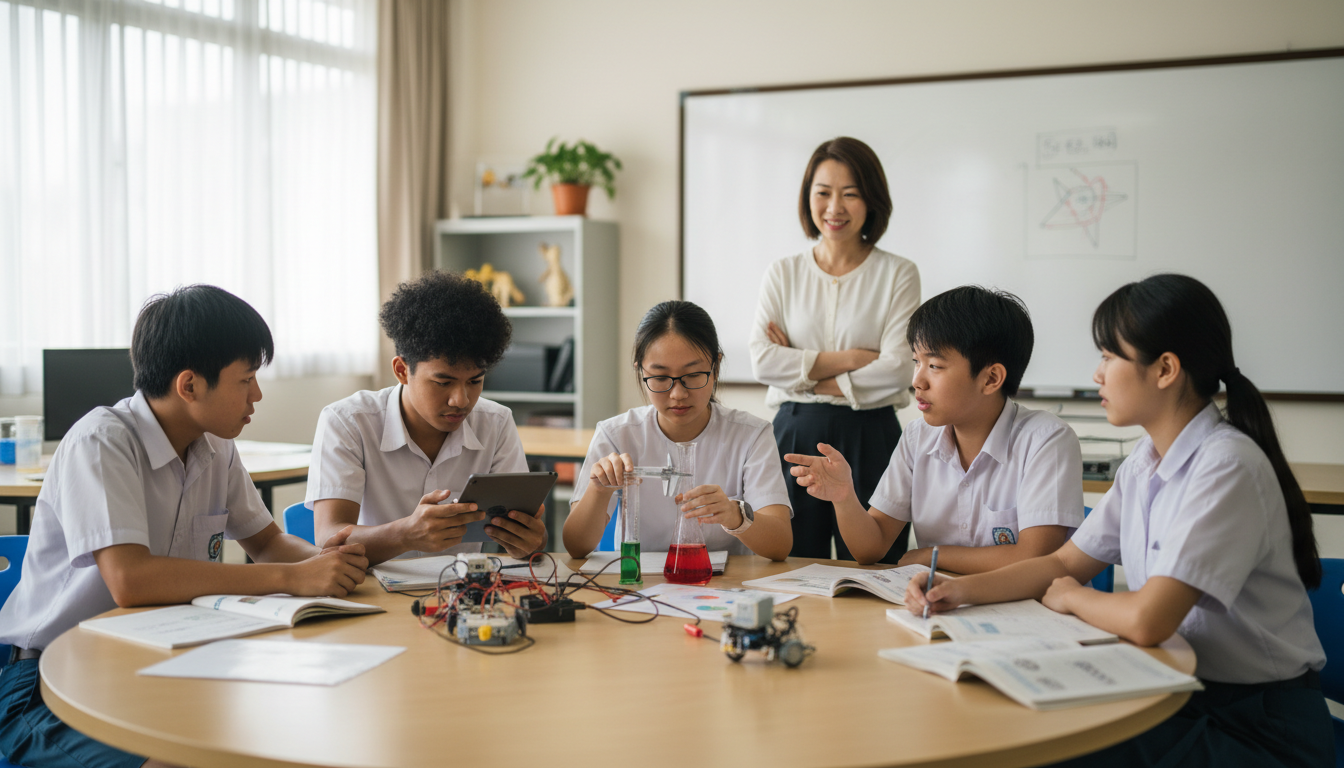
Secondary 3 Science small groups tuition for Lakeside families can help when a child remembers terms such as producer, consumer, habitat and food web but finds it difficult to interpret new ecological data or distinguish observations from unsupported environmental claims. A carefully matched tutorial of three students can give each learner time to interpret a diagram, justify the direction of energy transfer and evaluate an investigation, followed by independent practice with a changed example.
There are important consequences to weigh. Not every G1, G2 or G3 Science combination includes the same Ecology or Biology content, and a three-student group cannot compensate for teaching the wrong syllabus. Tuition adds travel, cost and extra assignments to the week. The best decision comes from a real school paper, clear subject matching and evidence that the tutor can correct a specific learning gap without making the pupil dependent on hints.
- Central learning theme: ecological models, energy flow, sampling, variation and scientifically valid conclusions.
- Three-pupil benefit: individual diagram explanations with questions from two peers.
- Course first: check the child’s actual Science subjects, G-level and examination year.
- Limitations: mismatched Biology coverage, passive copying, superficial environmental examples and the time cost of tuition.
- Review progress: use fresh unseen food-web or data questions at an appropriate syllabus level.
- Location: this is a guide for Lakeside readers, not a claim of a current eduKateSG venue or fieldwork programme there.
Why ecological examples need accurate Science rather than local assumptions
A place called Lakeside naturally suggests examples involving water, plants, energy, food chains and organisms. These contexts can help learners imagine the Science. However, a tutor should not assume that a named lake has a particular species composition or measured water quality without reliable observations. A useful example is clearly hypothetical, includes its measurements and teaches a principle that the child actually studies.
Secondary 3 pupils can sometimes recall ecological vocabulary while misunderstanding relationships. A learner may draw a food-chain arrow pointing in the direction of an animal’s movement rather than the direction of energy transfer. Another may think that all organisms at the same trophic level eat exactly the same food. A third may assume a sample of one square metre represents an entire habitat, even if the plot was chosen for convenience.
These errors reveal missing models and experimental reasoning. A tutor should ask the pupil to describe what the diagram represents, what the measurement covers and how strongly the data support a conclusion. Then give a different ecosystem or sampling method. If the child can apply the same reasoning without prompts, the lesson has taught more than a memorised environmental story.
MOE Full SBB and the first SEC cohort in 2027
Full Subject-Based Banding in Singapore enables subjects to be taken at G1, G2 and G3, with individual subjects potentially at different levels. A student’s initial Posting Group is not a permanent description of every subject. At upper secondary, there may be G1 Science, paired G2 or G3 Science, or separate G3 Physics, Chemistry and Biology, subject to school offerings and student allocation.
SEAB’s SEC overview confirms that the Singapore–Cambridge Secondary Education Certificate begins with the 2027 examination cohort, replacing the previous separate N(T), N(A) and O-Level certificates while recording the respective subject levels. A child in Secondary 3 during 2027 will normally sit the examination later; the syllabus for that actual candidate year should be used.
For 2027 school candidates, G1 lists Science K123; G2 lists Physics–Chemistry K223, Physics–Biology K224 and Chemistry–Biology K225; and G3 lists paired Science K326–K328 and separate Physics K323, Chemistry K324 and Biology K325. These are specific 2027 identifiers, not a guarantee about later-year examination codes.
A Lakeside parent should ask whether Ecology is in the child’s actual Science syllabus, and at what detail. If the pupil studies Physics–Chemistry without the relevant Biology content, a lengthy ecology lesson might be a poor fit. The tutor must inspect the school’s subject-option notice, scheme of work and marked paper before recommending a three-student group.
Food chains, food webs and the direction of energy transfer
In a food-chain diagram, arrows conventionally indicate the direction in which energy is transferred through feeding relationships, from an organism being eaten toward the consumer. A learner may instead draw arrows based on who is chasing whom or which animal appears strongest. The tutor should explain the meaning of the representation before checking arrow placement.
Food webs show multiple connected feeding relationships. A species can be part of several chains, and changes to one population can affect others through several pathways. But a web does not automatically prove that every population will increase or decrease by a fixed amount after a change. The strength and direction of the response depend on the particular ecological system and other relevant factors.
A three-student lesson can begin with a simple hypothetical web that includes a plant, grasshopper, frog and bird, then add a second food source. One learner traces energy transfer, another identifies a possible indirect effect and the third challenges an unsupported generalisation. After discussion, all three answer a new web individually.
Worked example: a four-step food chain
Consider a hypothetical food chain: grass → grasshopper → frog → snake. Grass is the producer and can capture light energy through photosynthesis, while the other organisms are consumers at successive feeding relationships. The arrows represent energy transferred from a food source to the organism feeding on it, rather than movement or a guarantee that each organism has only one food.
A pupil might say a snake is a producer because it is at the top of this chain. That is a misconception about trophic roles. Another may label the grasshopper the primary producer because it eats grass. A tutor should ask where energy enters the food chain and which organisms obtain energy by consuming others.
Now replace the snake with another predator and add a second prey species to the frog’s diet. The learner should reconstruct the web, check the direction of each arrow and avoid assuming that every organism belongs to only one feeding relationship. New situations reveal whether the original model has been understood.
Worked example: energy transfer and the limits of a pyramid
Imagine a simplified hypothetical transfer model in which a producer level has 10,000 arbitrary energy units available and a primary-consumer level has 1,000 units. The percentage transferred is 1,000 ÷ 10,000 × 100 = 10%. In this particular illustration the fraction is one tenth, but that is not a universal fixed law that every trophic transfer in every ecosystem is exactly ten per cent.
A pupil may memorise an approximate ten-per-cent rule and apply it even when the question provides different measured values. A tutor should emphasise that ratios should be calculated from the information supplied where the paper requires it. Energy transfers can occur through respiration, movement, heat and other routes, so not all energy in one trophic level becomes energy stored in organisms at the next.
A changed example gives 8,000 units at the first level and 1,600 at the next, representing 20% in the simplified dataset. The child should calculate the observed ratio rather than force the familiar ten-per-cent number onto it. This teaches interpreting evidence and the limits of a model simultaneously.
Worked example: biomass is not identical to population count
Suppose a hypothetical field survey reports 100 small insects and 10 large birds in the same region. The insects are more numerous, but the counts alone do not establish which group has the greater total biomass. Individual organism mass matters. A learner who assumes that a larger population count always means greater biomass is confusing two different measurements.
If each insect has an illustrative mass of 2 g, their total mass is 100 × 2 = 200 g. If each bird has an illustrative mass of 100 g, the birds’ combined mass is 10 × 100 = 1,000 g. The group with fewer individuals has greater total mass in this example. These hypothetical figures are a numerical teaching case, not an observation from any real Lakeside location.
The tutor can vary the individual masses or number of organisms. The learner must identify whether the question asks for count, total biomass or a ratio. The ability to choose the relevant quantity is more valuable than simply performing multiplication rapidly.
Worked Biology example: photosynthesis and limiting factors
A graph of photosynthesis rate against light intensity may initially rise as light increases and later level off. This is consistent with light no longer being the only limiting factor under those conditions. But the plateau alone need not prove exactly which other factor is responsible. Temperature, carbon dioxide availability and other conditions may matter depending on the experiment.
A pupil who writes that “more light always means more photosynthesis” is ignoring the plateau. A second learner may confidently name carbon dioxide as the sole limiting factor without the necessary evidence. The tutor should ask one child to describe the measured trend and another to distinguish an appropriate model from a claim about a specific unmeasured cause.
A changed graph might rise and then fall, or show a new carbon dioxide experiment instead of changing light. The pupil should read the new axes and use the relevant limiting-factor reasoning rather than copying the original answer. Such transfer practice should be restricted to the pupil’s actual Science course.
Worked investigation: fair sampling around a hypothetical lake
Imagine students wish to estimate the abundance of a particular plant across a large hypothetical habitat. They choose only a lush, accessible patch near a footpath and count plants in a one-square-metre plot. The count may be accurate for that selected plot, but it is not automatically representative of the whole habitat. Selection bias is different from an arithmetic error.
The tutor can ask what population or area the investigation seeks to describe, why the sample location was chosen and what a better sampling approach might involve. Depending on the subject, randomly selected quadrats or a suitable systematic sampling strategy can help provide broader information. Replicates may reveal variation, but they do not automatically repair a sampling process that excludes entire habitat types.
The independent task changes the layout and number of sample plots. The pupil should decide whether the samples fairly represent the region being studied and avoid generalising beyond the measured locations. This is a hypothetical classroom problem and not an invitation to conduct unsupervised fieldwork at an actual water body.
Worked calculation: abundance per square metre
Suppose a survey uses five equal one-square-metre quadrats and records plant counts of 6, 8, 5, 7 and 9. The total is 35 plants across 5 m² of sampled area, giving a mean recorded abundance of 7 plants per m². The mean describes those sampled plots. Extrapolating to a larger area would require a defensible sampling design and assumptions about representativeness.
A pupil may simply multiply 7 by the total habitat area to claim the exact number of plants. That would present an estimate as certainty. A good answer can calculate a possible estimated abundance while describing how the sampling method and variation affect confidence. The tutor should match the level of evaluation to the actual syllabus and question demands.
A changed task uses different-sized plots. The learner must account for sampled area before comparing densities, rather than compare raw counts from unequal areas. This is an example of how Scientific Mathematics requires meaningful units and a clearly defined denominator.
Worked investigation: comparing environmental conditions fairly
Suppose two hypothetical water samples are measured for a particular dissolved substance, but one was collected in the morning using one apparatus and the other at night using another. A difference in readings may be real, but time and measurement method both differ. The student should not automatically conclude that the sites have a fixed chemical difference without considering these factors.
A better designed comparison may standardise collection and measurement procedures, use comparable times where appropriate and record relevant conditions. Repeating across multiple dates can help understand variation. Each improvement should address a specific possible source of error rather than appear as a generic phrase in an evaluation answer.
This is an educational example, not a claim about the water quality of any named lake or canal. An honest article should never infer pollution, safety or ecological condition in a real location from fictional data. Teaching students to make that distinction is part of sound Science.
Worked Chemistry connection: concentration in two solutions
Solution A contains 4 g of dissolved substance in 0.20 L of solution, giving mass concentration 20 g/L. Solution B has 6 g in 0.40 L, giving 15 g/L. B contains more total dissolved mass, but A has a higher mass-per-volume concentration. A learner who compares the larger number alone is answering the wrong question.
The tutor should ask which quantity is measured, what the denominator means and why the units must be consistent. A changed question can give millilitres instead of litres, testing the conversion from 200 mL to 0.200 L. A correct result labelled with a mismatched unit is not a scientifically complete calculation.
This numerical example should be used only where the student’s syllabus covers the required concept. A Biology-only extension or a different G-level may require simpler qualitative interpretation. The tutor should not replace the actual subject with unrelated calculations merely because environmental context makes them convenient.
The food web does not establish a guaranteed population prediction
A pupil may see a predator disappear from a food web and assert that all prey will grow indefinitely. The web suggests possible effects, but population outcomes depend on food availability, disease, competing predators, reproduction and other interactions. The diagram alone may not establish the magnitude or permanence of a change.
A scientifically responsible answer distinguishes a plausible immediate effect from a universal prediction. If the examination gives an explicit simplified model and asks what happens when one link is removed, the pupil can reason within those assumptions. But when additional data contradict the simple prediction, the learner should use the evidence and recognise model limitations.
A three-pupil tutor can ask each learner to make a prediction, name its assumption and suggest a relevant observation that could test it. After the group discussion, a new food web is supplied for independent interpretation. The purpose is better reasoning rather than endless speculation.
How three students can learn ecological reasoning together
In a compatible group, the tutor can ask all three pupils to draw a food web or analyse a sampling table independently. One may reverse the arrow direction, another may confuse abundance with biomass and a third may make an unsupported causal inference. Their differences provide useful teaching information. Each child should receive feedback on their specific error before the next question.
The tutor should ensure the strongest pupil does not announce the correct diagram before everyone starts. Quiet first attempts make misconceptions visible. Structured discussion can then compare valid reasoning and explain why alternative interpretations fail. Finally, all three should attempt fresh data or a new food web independently.
A group containing a student whose Science combination excludes Ecology may not be suitable for a long Biology-focused lesson. Syllabus matching comes before any claim that groups of three are automatically better. Some conceptual inquiry skills can be shared, but the detailed subject requirements must still be met.
Research evidence for small-group tuition
The Education Endowment Foundation small-group tuition review defines a small group as two to five pupils. Across the included studies, the overall average is approximately four additional months of learning progress, with a smaller secondary-school subset averaging around two months. These averages concern varied subjects and schedules, not a guaranteed improvement in Singapore SEC Science grades.
The review identifies diagnostic targeting, well-prepared tutors and quality feedback as important factors. Some successful interventions meet more frequently than one weekly 90-minute class. Parents should therefore evaluate the actual lesson’s content and individual learning evidence instead of relying on the small-group label alone.
Benefits parents can check
- The student draws food-chain arrows in the correct energy-transfer direction.
- The tutor diagnoses confusion between abundance, biomass, concentration and rate.
- Each pupil justifies ecological predictions with appropriate assumptions.
- Unfamiliar sampling data are interpreted without making unsupported claims about a whole habitat.
- Peer questioning exposes alternative explanations respectfully.
- Earlier mistakes are retested after a delay.
- Independent changed questions show whether the model has transferred.
Consequences and costs of a poor match
Wrong Science combination: not every student studies the same Ecology or Biology content. A group should follow the actual subject allocation and depth, rather than assume environmental questions suit every learner.
Misleading local claims: hypothetical ecosystem exercises must not be presented as measured facts about Lakeside. Scientific tuition should distinguish a classroom model from verified environmental evidence.
Overgeneralisation: pupils can memorise food-web effects without understanding the assumptions. A tutor should challenge universal claims and test new diagrams rather than encourage stock paragraphs.
Practical limits: diagrams and printed data cannot fully replace supervised laboratory or field techniques where the course requires them. An educator should be accurate about the facilities and practical support provided.
Workload and costs: travel, tuition homework and fees add up, and some learners may feel intimidated by faster peers. Academic benefit must be balanced with school commitments and well-being.
When another form of support is better
A three-student class can suit pupils who need targeted feedback on subject-matched content and enjoy constructive peer discussion. One-to-one help can be better for major foundational gaps, unusual combinations or a markedly different pace. Larger classes can be appropriate for independent learners seeking structured syllabus revision.
School consultations and home study may be enough when the student understands the models but needs a more consistent way to practise new diagrams. A parent can ask the child to explain an original marked error, answer a changed food web and justify the result without notes. Avoid adding tuition if the child can already self-correct reliably.
An illustrative 90-minute ecology reasoning tutorial
- 10 minutes: retrieve earlier food-chain and data-reading concepts.
- 15 minutes: diagnose one wrong ecological or experimental interpretation from schoolwork.
- 20 minutes: rebuild the relevant model with a clear food web or sampling table.
- 15 minutes: compare three original responses with specific tutor feedback.
- 20 minutes: independently analyse unfamiliar food webs or sampling data.
- 10 minutes: record the correction and set brief delayed retrieval practice.
These timings are an instructional example, not a verified Lakeside class schedule. The teaching should be adjusted to the child’s actual Science syllabus and readiness. The crucial feature is the individual new question after explanation, not the amount of material covered in one evening.
A six-week checkpoint for independent ecological thinking
Week 1 establishes a baseline using a marked Science question and a fresh food web or dataset. Week 2 repairs the most serious model error. Week 3 revisits it after a delay with a changed diagram. Week 4 mixes it with percentage or density questions if relevant. Week 5 introduces a short independent set without chapter cues. Week 6 compares unfamiliar work at similar demand with the starting responses.
Look for correct energy-flow arrows, interpretation of measured quantities, reasonable sampling conclusions and fewer hints. A higher school test percentage on easier content is not sufficient evidence of mastery. Also consider the child’s overall timetable, interest in Science and ability to revise independently.
Six weeks is a decision checkpoint, not a promised grade-improvement date. The family may continue with a narrower target, move to a more compatible group or pause when the learner can apply the models reliably without tuition.
Lakeside travel and current class availability
Lakeside families should assess the journey from school, CCAs, transport connections and home-study commitments. A nearby class is helpful only when it covers the correct Science subjects and offers meaningful feedback. Count the complete weekly travel and additional practice time rather than only the nominal class duration.
This article is written for Lakeside families. It does not establish that eduKateSG currently runs a Secondary 3 Science classroom, fieldwork programme or three-pupil vacancy in Lakeside. Confirm the actual tutor, venue, subjects, fees and schedule directly.
Questions for parents before enrolling
- Which G-level, Science subjects and examination year apply to my child?
- Does the syllabus actually include the food-web or Ecology content discussed here?
- Can the tutor diagnose a real mistake in a marked sampling or data question?
- Will each pupil interpret a new diagram before seeing the group solution?
- What distinguishes hypothetical examples from actual collected field evidence?
- What is the confirmed teacher, teaching address, weekly workload, fee and missed-lesson policy?
- What evidence of independent progress would justify continuing tuition?
Frequently asked questions
Does every Secondary 3 pupil study Ecology?
No. The school’s actual Science combination and G-level determine the content. A Biology-focused tutorial may be inappropriate for a learner taking a combination without Biology.
Does the SEC start in 2027?
Yes. The first Singapore–Cambridge SEC examinations are in 2027. Later candidates should follow their own official examination-year syllabus.
Do food-chain arrows show the movement of animals?
No. In a standard food-chain diagram they show the direction of energy transfer through feeding relationships.
Does more population count always mean more biomass?
No. Biomass also depends on the mass of individual organisms, so raw counts and combined mass are different quantities.
Can a few sample plots prove the condition of an entire habitat?
Not automatically. The sample design, representativeness and variation need to be considered before generalising.
Does three-pupil tuition guarantee better results?
No. The small group allows closer feedback, but teaching quality and subject match determine whether it helps the child.
Can written work replace all field or laboratory practicals?
No. Written inquiry supports reasoning, but supervised techniques and safety require suitable facilities when relevant.
When can a family reduce tuition?
When the learner can interpret new diagrams, analyse data and self-correct without prompts, reducing or ending tuition may be appropriate.
Official sources and connected reading
Check SEAB’s SEC overview, the 2027 G1 list, the G2 paired Science list, the G3 Science list, MOE’s Full SBB explanation and EEF’s small-group review. Related eduKateSG guides include the Katong data and sampling guide, HarbourFront applied Science and Taman Jurong small-group subject matching.
Ask about a genuinely appropriate Science group
Bring the child’s school Science subject notice and a marked diagram or investigation question. Ask whether a suitable three-pupil class is available and how independent understanding will be assessed. Contact eduKate Singapore or enquire about Secondary 3 Science for Lakeside students. Confirm the actual tutor, subject, venue, fees and available places.