
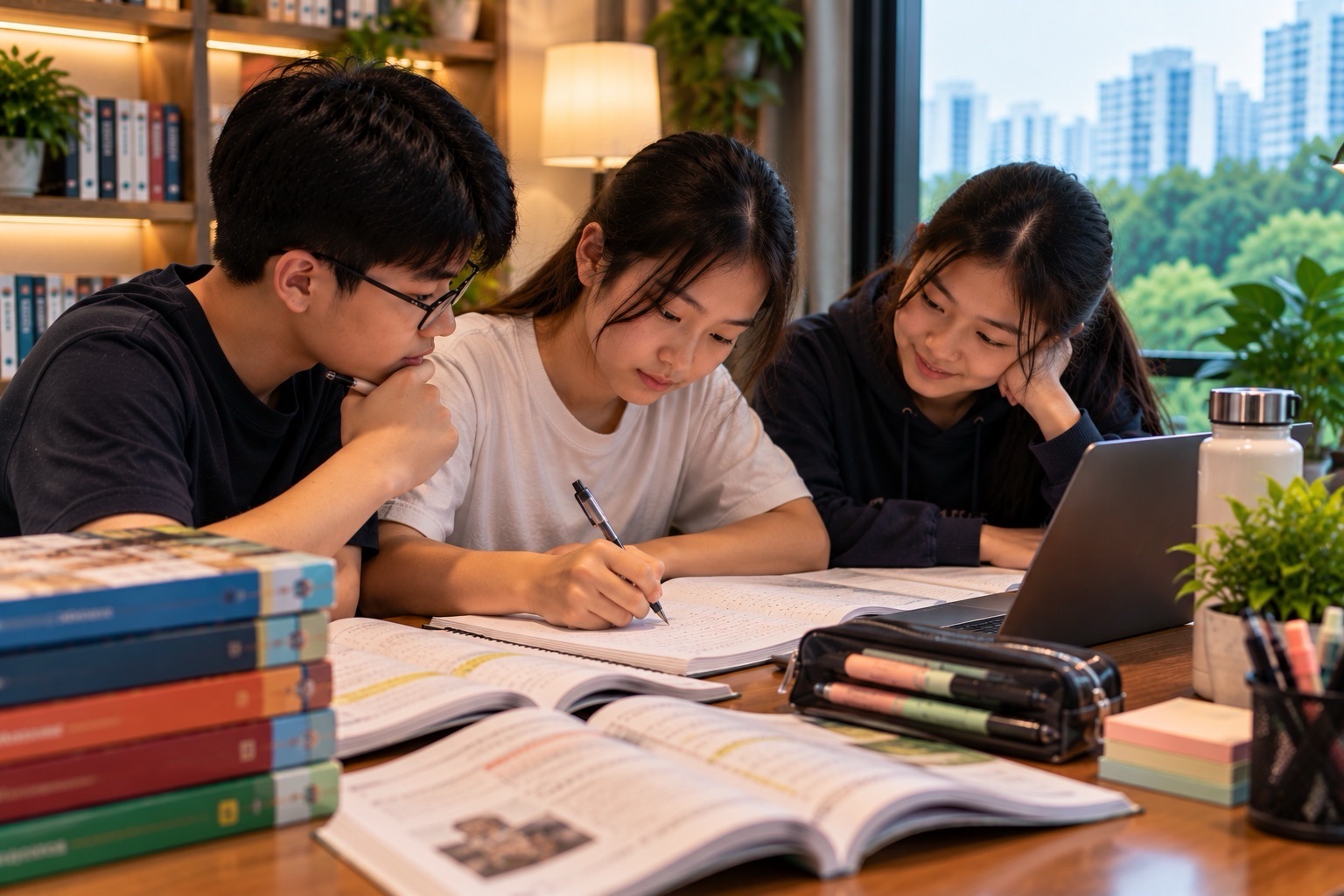
For a parent comparing Secondary 1 Science tuition around Jalan Bukit Merah, the decision between a weekday lesson and a weekend lesson should begin with what the child is finding difficult, not with a claim that one day is always more effective. A student may be able to repeat the words “evaporation” and “condensation” but still struggle to explain why a covered cup loses less water than an uncovered one, or why droplets appear on the outside of a cold container.
The Housing & Development Board describes Brickworks Estate and its ABC Brickworks market and food centre as part of the Jalan Bukit Merah neighbourhood. That familiar setting offers an approachable starting point for questions about water, heat and observations. Every cup, reading, minute and quantity below is a hypothetical classroom example. Nothing here reports a measurement from an actual stall, vendor or visitor.
This guide uses the learning model in eduKate’s Secondary 1 Mathematics Clementi reference: carefully taught principles, a small learning group where individual mistakes can be seen, guided practice and later independent checking. It does not promise that a particular Science group, venue, price or timetable is available. Families should contact eduKate for current arrangements.
Quick answer: the best Science tuition day depends on the next experiment
A weekday often works when a child is alert after school and needs to repair one fresh misconception before the next class. A weekend can work when a longer investigation, graph, explanation and correction cycle is required. For Secondary 1, the most useful evidence is whether the pupil can describe particles and changes of state, use a fair-test plan, and explain an unfamiliar result without copying yesterday’s answer.
Parent decision: choose the slot in which the student can concentrate, practise, and still complete school responsibilities. Test the choice over four weeks, not one unusually good or tiring lesson.
Weekday or weekend Science tuition near Jalan Bukit Merah?
A weekday lesson can sit close to the moment the school introduces a new practical skill. The tutor sees the erroneous claim while the student’s reasoning is still fresh: “The water vanished, therefore the mass was destroyed.” A well-timed correction can distinguish evaporation from loss of matter and then ask the learner to predict what happens in a closed system. This is a good reason for a weekday, provided travel, meals, homework and fatigue leave enough attention to think.
A weekend lesson provides different advantages. The learner might compare covered and uncovered containers, plot an illustrative mass-against-time graph, discuss uncontrolled conditions, make a second prediction and return to a previously missed question. That does not require spending Saturday or Sunday on endless worksheets. It requires enough mental room for an investigation followed by a correct independent explanation.
There is no scientific rule that weekends automatically generate better grades. Neither is every after-school lesson too exhausting. Families along Jalan Bukit Merah should estimate the actual journey and assess the child’s alertness. The tutor should demonstrate what happens with a changed question after teaching; the family should also protect rest, friendships and independent school study.
Ten chapters: matter, water and evidence for new Secondary 1 learners
1. The neighbourhood provides a context; the investigation must provide the evidence
A cup of drink or visible steam is easy to imagine around a food centre, but everyday impressions are not controlled scientific data. An observer might report that a surface “looked wet” or a container “felt colder.” Neither statement establishes a measured temperature, mass change or cause. A Secondary 1 student should learn to make observations precise before jumping to an explanation.
For a classroom model, describe two identical containers placed in a safe, controlled teaching setting. Both begin with the same measured water mass. One is covered; the other is uncovered. The goal is not to imitate a real business or make claims about serving practices. It is to isolate a scientific question. When a tutor asks what the learner can legitimately conclude from this description, the response must distinguish the conditions deliberately changed from those still uncertain.
The parent can ask the tutor to let the learner name three pieces of evidence that would be needed before saying one container loses water faster. If the student can do that without a prompt, the lesson has moved beyond memorising the term “evaporation.”
2. Water particles do not disappear when liquid water evaporates
Evaporation is the movement of particles from a liquid into the gas phase at the liquid surface. It can happen below boiling temperature. A frequent mistake is to treat “not visible” as “no longer present,” even though water vapour may be present in the surrounding air. If a cup loses liquid mass to the air, the matter has moved; it has not been created or destroyed.
A student might say that evaporation requires bubbles. The tutor should contrast evaporation with boiling. Boiling involves vapour bubbles forming within the liquid at its boiling point under the prevailing pressure; evaporation occurs at the surface over a wider temperature range. Then ask the student to describe a cold puddle gradually drying without being heated to boiling. The explanation should mention escaping particles, rather than merely stating that the sun “sucks up” water.
A strong Secondary 1 explanation uses a particle model while acknowledging that drawings are models, not magnified photographs. Drawing large gaps between gas particles helps conceptualise their freedom of movement; it should not encourage claims that the particles themselves enlarge during a change of state.
3. Condensation on the outside of a cold container has a different source
Droplets forming on the outer surface of a cold sealed bottle can lead to the false explanation that water leaked through the wall. The proper question is: what water particles were present before the droplets appeared? Water vapour in surrounding air may cool at the surface and condense into liquid water. The seal on the bottle does not need to fail.
A tutor can request a three-part explanation: identify the initial gas, describe the cooling condition, and name the liquid formed. An unfamiliar test might replace the bottle with a chilled metal surface. The learner must carry the same causal model into the new setting without depending on the exact object in the lesson notes.
This is a useful weekday diagnostic because the correction is focused and easy to retest. However, the learner should also be able to separate condensation from freezing, deposition, melting and evaporation. Similar-sounding changes are not interchangeable, and accurate scientific verbs matter when marks are awarded for an explanation.
4. Construct a fair comparison before worrying about the final graph
Suppose the research question is whether a lid changes the mass of liquid remaining in a container over forty minutes. The deliberately changed variable is the presence of a lid. The measured outcome is mass remaining, or equivalently mass lost, at agreed time points. Initial water mass, container geometry, exposure, measurement method and surrounding conditions should be kept comparable.
A common failure is to change the lid and the container size together. Even a beautifully drawn graph cannot rescue a comparison that changes multiple factors. The tutor should ask the learner which variable must be measured, which must be kept the same, and what repeat measurements could reveal about reliability.
If hot water or equipment is needed in a school practical, follow the school’s safety supervision and instructions. This article does not instruct children to conduct unsupervised hot-water experiments at home or in public. A desk-based data set is sufficient to learn experimental logic. Parents can observe whether their child can design the control before looking at the answer key.
5. Choosing the weekday means protecting the child’s attention
A family may prefer a short after-school lesson when a Science topic has just been taught and the student is still mentally fresh. That proximity matters only if the tutor can see the school exercise, identify the real misconception and teach a better mental model. Rewriting an entire chapter of notes after a long day can feel productive while leaving the underlying error untouched.
For example, a child might correctly identify evaporation in multiple-choice questions yet write “water particles become air particles.” A precise intervention distinguishes movement into air from transformation into a different substance. Then the student must explain the same idea with different surroundings and phrasing. This is narrow repair, not a second school lecture.
Parents should notice whether school homework is crowding out sleep or self-directed review. The best weekday slot is not necessarily the earliest available slot. It is one in which the child can still think, test a claim, accept correction and finish with a clear next action.
6. Choosing the weekend means making room for a full investigation
The weekend can be an opportunity to join concepts that schools often assess together: particle behaviour, variable control, measurements, tables, graphs and evaluation. An integrated task might begin with a question about evaporation, provide four timed readings, require a line graph, and ask why two trials produced slightly different results.
The longer window is valuable if the student works through the sequence rather than watching the tutor do it. One learner may need graph-scale help; another may need a clearer account of particle motion; a third may be tempted to treat one anomalous point as a universal law. In a three-student teaching model, each can receive a different correction while sharing the broad scientific question.
A weekend appointment that routinely collides with sports, family commitments or a child’s recovery time may not be sustainable. The right comparison is not “weekday versus weekend” as labels. It is the quality of attention, effective feedback and independent transfer the specific student can maintain.
7. Original worked example: calculate water loss without overclaiming
Imagine two identical containers, each holding a hypothetical 120 g of water at the start. After the same time, the uncovered model contains 108 g and the covered model 117 g. The uncovered model has lost 120 − 108 = 12 g. The covered model has lost 120 − 117 = 3 g. The difference in loss is 9 g.
Relative to each model’s initial 120 g, the uncovered loss is (12 / 120) × 100 = 10%, while the covered loss is (3 / 120) × 100 = 2.5%. The covered model has a 7.5 percentage-point smaller loss, but that is not the same phrase as “7.5 per cent less water.” Clear denominators prevent confusion.
These data are invented for teaching. They do not prove that every real lid reduces evaporation by the same percentage, or that an observed change is entirely due to evaporation. Spills, scale error or differing conditions may also affect results. A sensible conclusion is conditional: under the specified model conditions, the uncovered container showed the greater measured mass loss. The student should practise writing that restrained conclusion independently.
8. Tables, scales and units can alter the meaning of a result
A learner who calculates correctly can still misread a graph. If the vertical axis begins at 100 g rather than zero, visual differences may look strikingly large. A scale can be legitimate if labelled clearly; the reader must understand what the displayed height represents. Label both axes with quantities and units, plot points consistently, and do not turn two readings into a smooth physical law without justification.
Suppose an illustrative sequence gives 120, 117, 114, 111 and 108 g across equal ten-minute intervals. The change of 3 g per interval describes that invented sequence, not a universal evaporation rate. In the real world, the rate can depend on temperature, humidity, exposed surface area and airflow. A student should avoid extrapolating the line far outside the observed range.
Tutors should challenge vague phrases such as “the graph goes down because time goes up.” Better Science identifies what is being measured, the nature of the relationship, and what mechanism plausibly explains the pattern. This distinction becomes increasingly important from Secondary 1 onward.
9. Three pupils can reach the wrong answer for three different reasons
A small group earns its value when the teacher can inspect individual thinking, not merely when the attendance number is low. Imagine one learner calculates 120 − 108 incorrectly; a second knows the arithmetic but mixes up evaporation and condensation; a third gives the correct concept but writes an unsupported claim that a lid always prevents loss. They require three distinct responses.
The first pupil needs measured subtraction practice and unit checking. The second needs a particle explanation and a changed example. The third needs careful language about evidence, variables and limitations. Asking all three to copy a single model answer might improve the appearance of completed work without repairing any of those individual weaknesses.
Ask to see one before-and-after comparison from the tutor: an original student attempt, the reason for the error, the intervention and a later attempt with changed numbers. This is a more convincing indicator of educational value than a broad promise that every student receives personal attention.
10. Independent explanation after a delay is the real checkpoint
A student who can answer immediately after watching a worked solution may still be relying on short-term imitation. The better checkpoint occurs days later, when the exact picture, quantities and wording have changed. For example: why does a wet cloth dry in moving air, and what information would be needed to compare drying rates fairly?
A confident answer should identify evaporation and discuss variables that may influence it, without assuming a particular drying time. If the question instead presents condensation on a cool surface, the student must switch models correctly. This is the sort of flexible understanding that transfers to lower-secondary assessments and later Chemistry, Biology and Physics topics.
The family can ask the learner to teach the concept in sixty seconds, draw a particle diagram, or critique a deliberately wrong explanation. If the explanation collapses once the tutor’s notes are hidden, plan a narrower retrieval exercise rather than assigning more unrelated worksheets. Independence is a trained outcome, not a slogan.
How a possible 90-minute small-group Science tutorial might work
First ten minutes — independent retrieval. Each pupil receives a question distinguishing evaporation, boiling and condensation. The tutor records the actual mistake, not just the total mark. No model answer is shown beforehand.
Next fifteen minutes — particle-model reconstruction. Learners describe what changes and what is conserved. The teacher invites predictions before explanations and corrects unscientific phrases such as particles “turning into air.”
Next twenty minutes — measured evidence. The group receives the fictitious 120 g container data and identifies manipulated, responding and controlled variables. They calculate the two losses and defend the units. The tutor checks one student’s arithmetic while another explains the experiment.
Next fifteen minutes — individual variation. Each learner solves a changed version with different masses and conditions. The method should survive the new numbers.
Next fifteen minutes — graph or evaluation. Pupils either plot a short time series or identify why a proposed comparison is unfair. Their written explanations must name evidence and a limitation.
Next ten minutes — error audit. Students annotate one correction in their own words and explain why their first response failed.
Final five minutes — transfer plan. The tutor specifies one retrieval question for later in the week, and the family knows how progress will be checked. This is an illustrative structure based on the Clementi principle of close attention, not a promise of a current slot.
Four-week diagnostic plan for Secondary 1 families
Week one: establish the starting point. Gather one marked Science response and the actual school topic list. Sort weaknesses into vocabulary, concept model, variable control, numerical working and explanation. Do not infer a child’s ability from a single grade. Compare a short independent answer with the learner’s own account of where the difficulty occurred.
Week two: teach one mechanism well. Choose evaporation and condensation if those are being studied, or substitute the student’s current chapter. Use words, particle drawings and changed everyday contexts. Ask the child to predict before presenting the correct explanation. Keep homework small enough to be reviewed carefully.
Week three: connect concepts to data. Introduce a simple table or graph and check labels, measurement units, calculations and conclusions. Require the student to state one source of uncertainty. If the school has taught a different scientific topic, retain the same evidence-based structure without forcing an unrelated worksheet sequence.
Week four: retest independently. Use unseen question wording, allow no notes initially, and ask the child to explain a different container or environmental condition. Compare with week one and decide whether the current timetable still makes sense. Improvement should be observable in accuracy, clarity and independence, not only confidence reported immediately after the lesson.
Repair, stabilise or extend: three different routes
Repair is appropriate when the student cannot identify a liquid-to-gas change or confuses gas with air. Start with concrete examples, scientifically correct vocabulary and a simple particle sketch. Remove distractions until the foundational model is secure.
Stabilise fits the child who knows the idea but loses marks through diagrams, variable choice, graph reading or unsupported claims. Teach a short verification routine: identify quantity, check unit, cite evidence, consider limitations and re-read the question verb.
Extend suits the pupil who explains familiar cases correctly and is ready for less obvious scenarios. Compare open and closed systems, discuss when a model may fail, and ask how a result would change if humidity or surface area differed. Extension should deepen Science, not simply introduce material that belongs to an unrelated exam syllabus.
Parent questions about Secondary 1 Science tuition in Jalan Bukit Merah
Does a weekday lesson help more when my child has forgotten a topic from school?
It can, if the learner is still alert and the teacher uses the recent mistake to diagnose the exact conceptual gap. The benefit comes from timely explanation and retrieval, not from the weekday label itself. If the child is chronically tired, a weekend or different timing may be better.
Will a weekend lesson make a child too dependent on tutoring?
Any timetable can create dependence if the tutor supplies every answer. Ask for an unseen exit question, an independent home attempt and a delayed retest. The aim is to reduce the amount of prompting the child needs.
Is this an actual investigation at ABC Brickworks?
No. ABC Brickworks is a verifiable local place; the educational measurements and containers in this article are wholly hypothetical. They are not findings about hawker stalls, food, drinks, hygiene or products.
Does Secondary 1 Science follow the same syllabus as Secondary 4 GCE O-Level or SEC?
No. Secondary 1 pupils follow their school’s lower-secondary learning programme and subject level. MOE introduced Full Subject-Based Banding from the 2024 Secondary 1 cohort. SEAB’s 2027 SEC G1, G2 and G3 syllabuses are useful pathway references, but they are not a substitute for the child’s actual present Secondary 1 topic list. Do not turn a lower-secondary tutorial into premature final-year paper drilling.
Does small-group Science tuition mean every pupil has the same worksheet?
It should not. A purposeful small group can discuss one question while each pupil receives feedback on a different error. Ask the tutor to show how individual work is inspected, re-taught and retested, and verify current group size before enrolling.
How can parents decide after one month?
Compare the first unassisted answer with a later unseen one. Look for corrected scientific language, more coherent reasoning, fewer unit and graph mistakes, and a sensible workload. If no transfer appears, adjust the teaching diagnosis rather than automatically adding sessions.
Explore more verified eduKate Science routes
Use the Singapore Science Tuition by Area Index for geography-wide navigation. The Bukit Merah Secondary 1 weekday-or-weekend Science guide covers the broader town, while What Happens in Secondary 1 Bukit Merah Science Tuition explains the PSLE-to-secondary transition. The Queensway Secondary 1 Science comparison provides a different evidence example. These are adjacent routes, not proof of a physical centre in Jalan Bukit Merah.
Official sources and local verification
HDB: Brickworks Estate identifies the local estate and ABC Brickworks context. NEA: Hawker Management Overview identifies the Jalan Bukit Merah Block 6 market/food centre. MOE: Full Subject-Based Banding and the SEC transition explains the national timetable. For future final-year pathways, see SEAB 2027 G1, G2 and G3; select the relevant syllabus only when the student’s actual subject route calls for it.
Start with marked work rather than a timetable guess
Bring a recent school Science exercise, the actual learning topic, a description of the student’s weekday/weekend fatigue and a proposed learning goal. Ask what the tutor would teach first, what new response the child should produce, and how it will be checked a week later. Contact eduKate to verify current tutor, location, fees, group size, lesson duration and places.
Weekday versus weekend: Secondary 1 parent comparison
| Decision | Weekday lesson | Weekend lesson |
|---|---|---|
| Best when | A fresh evaporation or condensation misconception is still in view | A full fair-test design and simple mass graph need unhurried attention |
| What to practise | Correct the particle explanation; identify one variable and an appropriate control | Compare hypothetical covered/uncovered data; plot and evaluate measurements |
| Main risk | The pupil is too tired and copies scientific definitions without understanding | Extra lesson length becomes extra copying instead of investigation |
| Success check | Explain a changed cold-surface or water-loss example independently | Interpret new mass readings and justify one limitation without hints |
Neither column is a universal recommendation. The choice should match the student’s school evidence, alertness, travel and current subject requirements; confirm the actual available session rather than assuming one exists locally.
Continue the complete Jalan Bukit Merah Science series
Secondary 2 Science tuition: weekday or weekend · Secondary 3 Science tuition: weekday or weekend · Secondary 4 Science tuition: weekday or weekend. These are complementary level-specific guides; select your child’s current year and registered subject.