
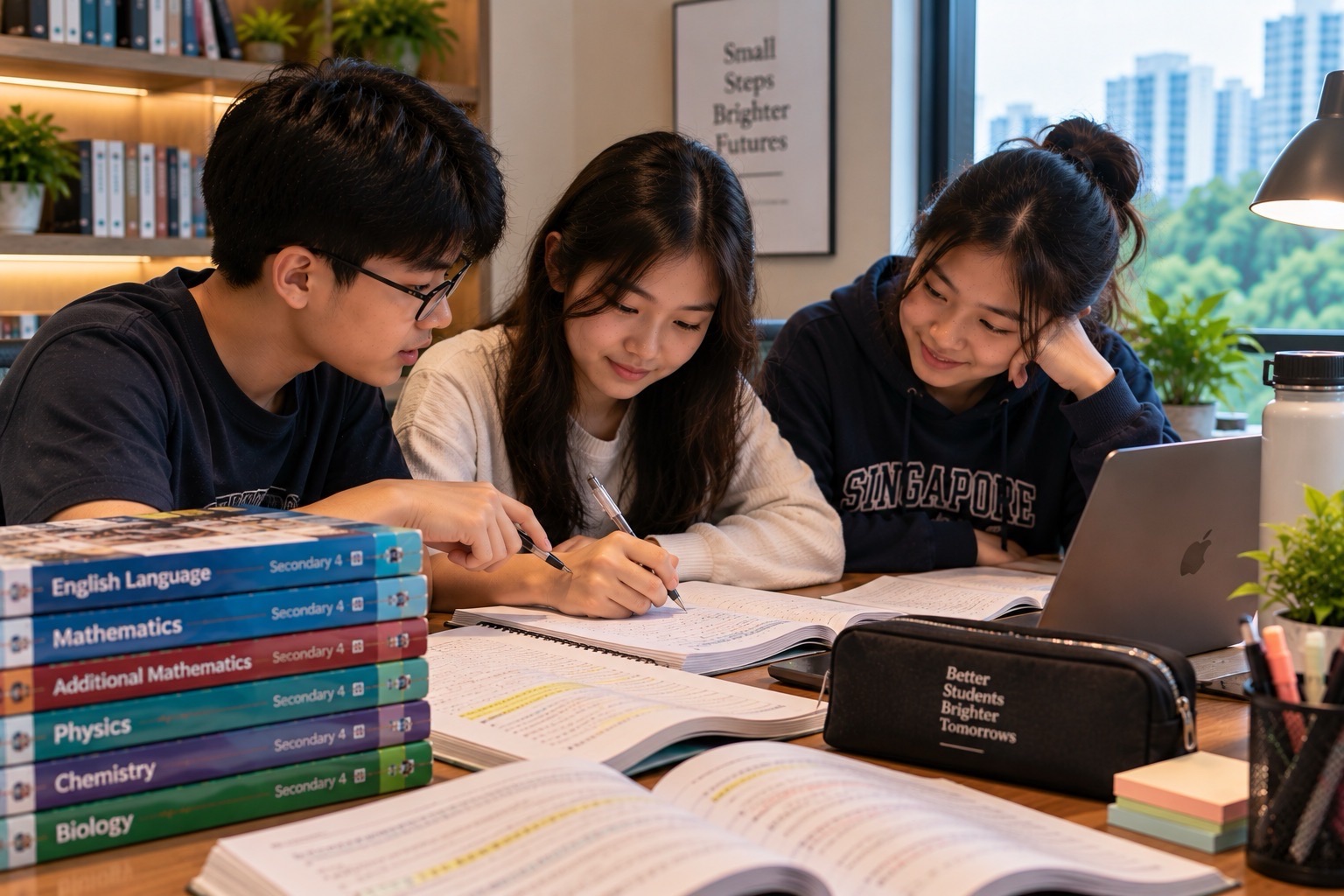
Did you know? A student can revise Mathematics for hours and still repeat the same errors in the next assessment. The difference is often not motivation. It is the absence of a system for identifying which step failed, repairing that exact skill, and testing whether it stays fixed when the notes are closed. For Secondary 2 G1 Mathematics in Bukit Timah, revision becomes more useful when it is specific, mixed and measurable.
Quick answer: diagnose, repair, retrieve and transfer
A practical revision cycle is Diagnose → Repair → Retrieve → Transfer. Start with a few genuine school questions to find the first wrong step; rebuild that prerequisite; ask the child to re-solve independently after a delay; then change the numbers or story to test whether understanding transfers. Repeat on a manageable schedule. This is more informative than counting pages completed or treating speed as a substitute for accuracy.
This is a parent-and-student guide for Secondary 2 G1 Mathematics learners in Bukit Timah. G1 is a subject level in Singapore’s Full Subject-Based Banding, not an overall label for a child’s ability. Every school sets its Secondary 2 topic order, weighting and assessment dates, so the teacher-issued scope always comes before an online checklist.
Find your revision answer quickly
- Ten-minute starting diagnostic
- Revision plan
- 36 original mini-clinics
- How to keep an error log
- Small-group tutorial example
- 2027 SEC versus current school tests
- Frequently asked questions
- Official sources
A ten-minute diagnostic that is actually useful
Choose four suitable school questions: one numbers or algebra question, one geometry or measurement question, one data or probability question, and one context problem. Do not select a topic the student has not yet been taught. Give the pupil a short, calm attempt without hints. For each error, record the first incorrect line and its likely cause. For example, if the pupil uses 360° where 180° is needed, the problem is selecting the correct angle property. If the setup is correct but 24÷6 becomes five, it is arithmetic.
Now take just one mistaken item, teach its prerequisite and give a changed-number version without looking at the first worked answer. Return to it another day. A student who can explain the reason and repeat it later has made more meaningful progress than a student who copied a correct answer immediately.
Build a revision plan around the child’s real error profile
Phase 1: sort mistakes by reason, not chapter name
Five helpful labels are concept (wrong mathematical property), representation (misread symbols, table, diagram or story), procedure (steps carried out incorrectly), arithmetic (calculation slip), and checking (failed to test an unreasonable result). One question can have several mistakes, but begin with the earliest one. The error note should be short enough for a pupil to understand without a lecture.
Phase 2: practise small units before full papers
For an unstable skill, use one explained example, one guided attempt and two independent changed-number attempts. A pupil who cannot yet distinguish an expression from an equation should not be pushed straight into a full timed test of equations. As accuracy stabilises, remove the scaffolding and mix the skill with earlier topics. This avoids merely memorising a worksheet pattern.
Phase 3: retrieve after a delay
On a later day, ask for the same mathematical idea with different numbers. Cover the model solution and let the pupil say why the first step is valid. If the learner needs the example in view, the method has not yet become independently available. Retention matters more than the appearance of a neat notebook.
Phase 4: only then add sensible time pressure
Timed work is useful for students who already choose the correct methods and need to improve pace and question selection. It is counterproductive when a child is still guessing whether the question wants perimeter or area. Short timed mixed sets should be reviewed for quality and not used to frighten the pupil into rushing.
A practical four-week framework
- Week 1: diagnose and repair. Work from marked school scripts and identify the two most persistent prerequisite gaps.
- Week 2: retrieve and explain. Revisit corrected ideas after a delay and give changed-number questions without notes.
- Week 3: interleave. Mix number, algebra, geometry and data work already taught at school, with clearly different instructions.
- Week 4: rehearse the school assessment. Use only the teacher-issued scope, realistic allotted time and mark allocation; analyse the first wrong line after each task.
Keep the schedule adaptable to homework, school commitments and fatigue. Five focused ten-minute sessions may be better than a single exhausting session. A revision plan should create information about learning, not become a second source of pressure.
36 original one-minute correction clinics
Each clinic shows how a revision mistake can be diagnosed and repaired. The exercises cover several K110-relevant mathematical strands but are original examples, not official past-paper questions or a promise of a specific Secondary 2 test syllabus. Use only the topics your child’s school has already covered.
1. Signed numbers: fix the direction first
Question or incorrect working. A student claims −4−9=+5.
Correct reasoning. Subtracting nine moves left from −4, so the correct result is −13.
Error diagnosis. The first wrong step was treating subtraction as taking the positive difference between four and nine.
Independent check. Check −13+9=−4; then try −6−3 without notes.
2. Fractions: choose the shared size of each part
Question or incorrect working. A pupil writes 2/3+1/6=3/9.
Correct reasoning. Convert 2/3 to 4/6 and add: 4/6+1/6=5/6.
Error diagnosis. The pupil added denominators as though thirds and sixths were already the same part size.
Independent check. Estimate the answer exceeds 2/3 and is less than one.
3. Decimals: align place values
Question or incorrect working. A pupil gives 0.3+0.07=0.10.
Correct reasoning. Write 0.30+0.07=0.37. The three tenths and seven hundredths occupy different columns.
Error diagnosis. Treating 3+7=10 as ten hundredths.
Independent check. Check 0.37−0.07=0.30.
4. Rounding: inspect the following digit
Question or incorrect working. Round 6.485 to two decimal places using the standard school half-up convention.
Correct reasoning. Keep two decimals 6.48 and inspect the next digit five; round the hundredths up to give 6.49.
Error diagnosis. Dropping the third decimal digit without applying the requested rounding rule.
Independent check. The result is within 0.005 of 6.485. For tie rules in specialist contexts, follow the question’s specified convention.
5. Division: predict the order of magnitude
Question or incorrect working. A student reports 120÷60=7200.
Correct reasoning. The operation is division: 2. Multiplication of 120 and 60 answers a different question.
Error diagnosis. Misreading the division symbol or choosing the wrong calculator operation.
Independent check. Check 2×60=120.
6. Ratio: the total number of parts matters
Question or incorrect working. Share forty tokens in ratio 2:3.
Correct reasoning. There are five ratio parts; one is 40/5=8. Shares are 16 and 24.
Error diagnosis. Using two-thirds of forty as the first share instead of two-fifths.
Independent check. 16+24=40 and 16:24 simplifies to 2:3.
7. Discounts: distinguish saving from payment
Question or incorrect working. An item listed at $75 has 20% off. What does the customer pay?
Correct reasoning. Saving is $15; payment is $60.
Error diagnosis. Stopping at $15 when the question asks for final payment.
Independent check. $15+$60=$75.
8. Reverse percent: identify the old base
Question or incorrect working. After a 10% discount an item is $45. What was the old price?
Correct reasoning. $45 is 90% of the original, so original is 45/0.9=$50.
Error diagnosis. Adding 10% of $45 and obtaining $49.50.
Independent check. Apply the discount to $50 and recover $45.
9. Time units: a quarter of an hour
Question or incorrect working. Convert 0.25 hours into minutes.
Correct reasoning. Multiply by sixty to obtain 15 minutes.
Error diagnosis. Reading 0.25 hours as twenty-five minutes.
Independent check. 15/60=0.25.
10. Average speed: convert minutes to hours
Question or incorrect working. A hypothetical vehicle covers 36 km in 45 minutes. Find average speed in km/h.
Correct reasoning. 45 minutes=0.75 h, so 36/0.75=48 km/h.
Error diagnosis. Using minutes as though they were hours.
Independent check. Check 48×0.75=36 km.
11. Algebra: combine only like terms
Question or incorrect working. Simplify 4x−2x+5.
Correct reasoning. Four x-units minus two x-units plus five yields 2x+5.
Error diagnosis. Adding the constant five to the coefficient of x.
Independent check. For x=2, original 8−4+5=9 and simplified 4+5=9.
12. Distribute a negative multiplier to every term
Question or incorrect working. Expand −3(x−2).
Correct reasoning. Multiply both terms: −3x+6.
Error diagnosis. Writing −3x−6 and losing the positive result of negative times negative.
Independent check. Set x=0: original +6, corrected expression +6.
13. Equations: preserve equality on both sides
Question or incorrect working. Solve 3x+7=22.
Correct reasoning. Subtract seven from both sides, then divide by three: x=5.
Error diagnosis. Adding seven when isolating 3x.
Independent check. Check 3×5+7=22.
14. Fractions in equations: keep the numerator together
Question or incorrect working. Solve (x+3)/4=5.
Correct reasoning. Multiply both sides by four: x+3=20; subtract three: x=17.
Error diagnosis. Multiplying x by four but leaving the numerator’s +3 untouched.
Independent check. (17+3)/4=5.
15. Substitution: bracket negative values
Question or incorrect working. Find y=2x+1 when x=−3.
Correct reasoning. y=2(−3)+1=−5.
Error diagnosis. Treating 2−3+1 as though 2x meant subtraction.
Independent check. Check 2×(−3)=−6 before adding one.
16. Sequence rules: n means position
Question or incorrect working. Find the eighth term of 2n+3.
Correct reasoning. Substitute n=8: 16+3=19.
Error diagnosis. Writing 2×3+8 because the pupil does not label the term position.
Independent check. The first term is five, the second seven; the constant difference is two.
17. Graphing: an output can be negative
Question or incorrect working. On y=−2x+4, find y when x=3.
Correct reasoning. y=−6+4=−2.
Error diagnosis. Ignoring the negative gradient and drawing a rising line.
Independent check. At x=2, y=0; moving one unit right drops y by two.
18. Intercept: zero the correct coordinate
Question or incorrect working. Where does y=3x−1 meet the y-axis?
Correct reasoning. On the y-axis x=0, so y=−1, at (0,−1).
Error diagnosis. Reporting (−1,0), which is an x-axis point instead.
Independent check. Check 3×0−1=−1.
19. Gradient: keep subtraction order consistent
Question or incorrect working. A line passes through (1,5) and (3,1). Find gradient.
Correct reasoning. Change in y=1−5=−4, change in x=3−1=2. Gradient is −2.
Error diagnosis. Dropping the negative sign or reversing one difference but not the other.
Independent check. The line goes down two units per one unit right.
20. Straight-line angles: a half turn
Question or incorrect working. Two adjacent angles form a straight line; one is 83°. Find the other.
Correct reasoning. Subtract from 180°: 97°.
Error diagnosis. Using 360° for a straight line instead of a full turn.
Independent check. 83+97=180.
21. Triangle angles: the sum is a check
Question or incorrect working. Two interior angles are 52° and 61°. Find the third.
Correct reasoning. 180−52−61=67°.
Error diagnosis. Subtracting the angles from each other.
Independent check. 52+61+67=180.
22. Perimeter: count edges
Question or incorrect working. A rectangle is 9 cm by 4 cm. Find its perimeter.
Correct reasoning. P=2(9+4)=26 cm.
Error diagnosis. Using 9×4 and reporting area instead.
Independent check. Count 9+4+9+4.
23. Area: use square units
Question or incorrect working. The same 9 cm by 4 cm rectangle has what area?
Correct reasoning. A=9×4=36 cm².
Error diagnosis. Reporting 36 cm with a linear unit.
Independent check. The answer counts 36 one-centimetre squares.
24. Triangles: perpendicular height is required
Question or incorrect working. A triangle has base 10 cm and perpendicular height 7 cm. Find area.
Correct reasoning. A=½×10×7=35 cm².
Error diagnosis. Forgetting the half factor or substituting a sloping side as height.
Independent check. Twice the triangle area is 70 cm².
25. Circle: distinguish area from circumference
Question or incorrect working. Find area of a circle with radius 3 cm in terms of π.
Correct reasoning. A=π×3²=9π cm².
Error diagnosis. Using 2π×3 gives circumference instead.
Independent check. Estimate area about 28.3 cm²; label square units.
26. Volume: three dimensions, not two
Question or incorrect working. Find volume of a 3 cm×4 cm×5 cm cuboid.
Correct reasoning. V=3×4×5=60 cm³.
Error diagnosis. Ignoring a dimension or reporting cm².
Independent check. Think of five layers of twelve small cubes.
27. Mean, median and mode describe different things
Question or incorrect working. For data 2,2,3,8,10, find mean, median and mode.
Correct reasoning. Sum is 25, so mean=5; middle value median=3; most frequent mode=2.
Error diagnosis. Assuming mean, median and mode are three names for one answer.
Independent check. Check the ordered list and count each occurrence.
28. Median: even list lengths have two middle values
Question or incorrect working. Find the median of 2,4,8,10.
Correct reasoning. The middle two values are 4 and 8; median=(4+8)/2=6.
Error diagnosis. Choosing only four or eight.
Independent check. Half the ordered observations lie on each side of the midpoint six.
29. Probability: list the complete sample space
Question or incorrect working. A fair six-sided die is rolled once. Find chance of an even face.
Correct reasoning. Even faces are 2,4,6: three favourable outcomes out of six equally likely outcomes. Probability=1/2.
Error diagnosis. Including zero or forgetting that die faces start at one.
Independent check. List all six faces before selecting the three even outcomes.
30. A bag’s contents determine the probability
Question or incorrect working. A bag has two red and five blue balls; one ball is drawn uniformly at random. P(red)?
Correct reasoning. Two of seven balls are red, so probability=2/7.
Error diagnosis. Using two-fifths, comparing the red count only against blue rather than the whole bag.
Independent check. P(blue)=5/7; the probabilities sum to one.
31. Read all rows before adding data
Question or incorrect working. A bar graph reports 4,7 and 5 objects in three categories. Find total.
Correct reasoning. Add the three labelled counts: 4+7+5=16.
Error diagnosis. Taking the highest bar seven as the total.
Independent check. Check that no bar was counted twice and all categories were included.
32. Pie-chart sectors describe parts of a full turn
Question or incorrect working. A sector represents one-quarter of a circle. Find its angle.
Correct reasoning. A quarter of 360° is 90°.
Error diagnosis. Using one-quarter of 180°, the half-turn amount.
Independent check. Four such sectors reconstruct a full 360°.
33. Simple interest: know what remains fixed
Question or incorrect working. A hypothetical $300 earns 4% simple interest each year for two years. Find total interest.
Correct reasoning. Per-year interest=300×0.04=$12; two years give $24.
Error diagnosis. Compounding despite the word ‘simple’.
Independent check. Check 300×0.04×2=$24; the illustration is not a product recommendation.
34. A budget story must honour event order
Question or incorrect working. A pupil starts with $100, spends $20 then $15. What remains?
Correct reasoning. 100−20−15=$65.
Error diagnosis. Subtracting only the second expense.
Independent check. Check remaining 65 plus both expenses equals 100.
35. A context may require rounding up
Question or incorrect working. A container holds nine whole books. How many containers are needed for 22 books?
Correct reasoning. 22/9≈2.44, but two containers hold only eighteen, so three containers are required.
Error diagnosis. Reporting 2.44 containers without interpreting the whole-object constraint.
Independent check. Three containers can hold up to 27 books.
36. A timeline may cross midnight
Question or incorrect working. A shift starts at 21:50 and ends at 00:10 the next day. How long is it?
Correct reasoning. 21:50 to midnight is 2 h 10 min; another ten minutes gives 2 h 20 min.
Error diagnosis. Subtracting 00:10 as if it were earlier on the same date.
Independent check. Check 21:50+2h20m=00:10 next day.
Keep an error log small enough to reuse
A useful log is four columns: question skill, first wrong line, correct reason and retest date/result. Avoid a long diary of copied solutions; the purpose is to make the missing step visible to the learner. A correct retest after a break can be marked ‘stable for now’, while repeated failure should send the child back to its prerequisite.
Example: the first wrong line is the wrong operation
A question asks for average speed, and the pupil multiplies distance by time. The repair is not simply ‘remember divide’. Write the units km and h, ask what ‘per hour’ means, then calculate distance/time. Check by multiplying the recovered speed by the elapsed time. Log ‘rate relationship and units’, not just ‘careless mistake’.
Example: the method is right but the sign is wrong
The student forms −3(x−2) correctly but expands it as −3x−6. Here the error occurs in distributing a negative multiplier. Let the pupil test x=0 in both expressions: the original gives +6, the false expansion −6. A counterexample makes the repair clear. Retest with −2(y−5) after a delay.
Example: the calculation is right but the answer is incomplete
A pupil correctly calculates 20% of $75 as $15, then writes $15 for a question asking what the customer pays. The fix is reading the requested quantity. Underline ‘price after discount’, draw original = saving + payment, then finish $75−$15=$60. Don’t treat this as a weak multiplication skill.
Example: a correct number has the wrong unit
The child calculates a triangle’s area as 35 but writes 35 cm. Ask them to describe the one-centimetre squares that cover the shape and relabel 35 cm². This is an error in mathematical communication and meaning. It should be corrected differently from a bad multiplication result.
How a three-pupil tutorial can monitor genuine improvement
The immutable eduKateSG Mathematics small-group programme describes three-pupil, 90-minute weekly tutorials near Sixth Avenue MRT. A teacher can use an error log to give each of three learners a different next step even if they are revising the same broad topic. The source is not altered by this guide and does not prove a particular Secondary 2 G1 slot is currently available.
- 10 minutes: recall two prior mistakes without notes.
- 20 minutes: teach or revisit the most important missing principle.
- 25 minutes: guide different pupils through targeted questions while inspecting their working.
- 15 minutes: transfer to a new context or changed number with no answer visible.
- 10 minutes: a short mixed, possibly lightly timed set when accuracy supports it.
- 10 minutes: pupil explains the correction and schedules an independent retest.
Parents can ask a tutor to show progress in terms of independent explanation and delayed success. An increasing worksheet count without improvement on changed questions is a reason to rethink the approach, not simply to assign more worksheets.
How the 2027 SEC differs from a 2026 Secondary 2 examination
The published 2027 Singapore-Cambridge SEC G1 Mathematics K110 syllabus has two 90-minute papers of 50 marks each, contributing 50% each, with Number and Algebra plus Geometry and Measurement in Paper 1, and Number and Algebra plus Statistics and Probability in Paper 2. Approved calculators may be used in both papers. The assessment objectives have approximate weightings of AO1 65% (standard techniques), AO2 30% (applications and contexts), and AO3 5% (reasoning and communication). These are official 2027 graduating-cohort specifications, not a description of the student’s school-based Secondary 2 assessment in 2026.
For current revision, do not imitate the national paper split unless the school has asked for it. Use the actual marked scripts, topics taught, expected working and question types in the school’s assessment. Later, when the pupil reaches their graduating year, recheck the official examination syllabus and requirements for that specific cohort.
Frequently asked questions
Should my child do a timed full paper every day?
Not if foundational methods remain unstable. Short, accurate practice with delayed retrieval often reveals more. Add realistic timed papers after the child understands how to choose and check methods.
How can I tell a careless error from a concept error?
Find the first wrong line. A pupil who knows the correct relationship but misadds numbers differs from one who never formed a valid equation. Ask for the reason, not just a corrected final answer.
Should revision repeat the same chapter for hours?
Early targeted repetition can help repair a gap, but once a method is secure, mix it with earlier topics so the child must choose the procedure independently.
Do G1 pupils need to show their working?
Clear mathematical steps are valuable in school assessment; the published 2027 K110 syllabus explicitly warns that omission of essential working results in lost marks. Follow the school’s marking expectations now.
Is Secondary 2 G1 exactly the same as the 2027 K110 examination?
No. K110 is a graduating examination syllabus for 2027. Secondary 2 school tests are separate, and a 2026 Secondary 2 pupil should use the eventual examination year’s official guidance.
How should I choose a Mathematics tutor in Bukit Timah?
Ask to see how individual errors are classified, how three pupils’ different needs are handled, and whether corrected skills are rechecked independently after a delay. Confirm actual venue, timing, fees and availability directly.
Continue with the most relevant learning guide
- Number foundations: fractions, decimals and negatives
- Algebra and linear equations
- Number patterns and sequences
- Geometry and mensuration
- Statistics and data interpretation
- Probability and single events
- How to read word problems
- Formula substitution, rearrangement and units
For local subject matching, see G1, G2 and G3 tuition guidance for Bukit Timah and the Bukit Timah tuition and enrichment overview.
Official references and reader notes
- SEAB: 2027 G1 syllabuses for school candidates
- SEAB: 2027 SEC G1 Mathematics K110, assessment objectives and paper scheme
- eduKateSG: unchanged Clementi three-pupil Mathematics tutorial reference
Reader note: This article gives original revision examples and a flexible study approach. It is not an official paper, an exam prediction, a guarantee of grades, a promise of subject-level changes or a verified class timetable. School assessment instructions and the learner’s own needs take precedence; confirm tuition arrangements directly.
Bring two marked school questions and one corrected reattempt when contacting eduKate Singapore. A practical tutorial conversation should begin with the first error and end with a plan to check learning again without notes.