
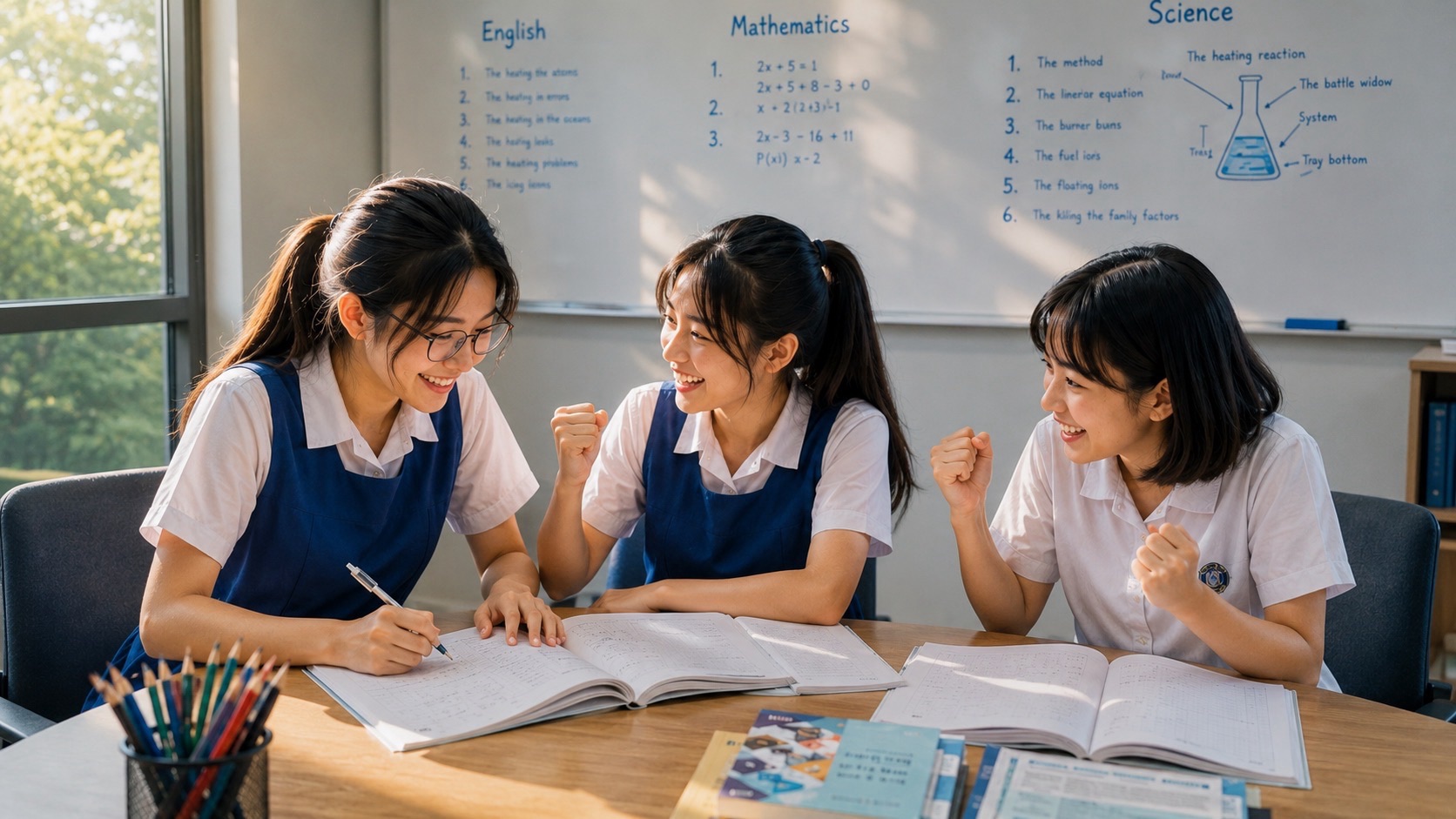
Stronger algebra. More dependable results. A carefully prepared route into upper-secondary Mathematics.
At eduKateSG, we provide premium 3-pax Secondary 2 Mathematics tutorials for students travelling from Bukit Batok to our Bukit Timah centre near Sixth Avenue MRT.
Secondary 2 is sometimes treated as a comfortable middle year.
It should not be.
This is the year when the Mathematics introduced in Secondary 1 must become stable enough to support the heavier demands of Secondary 3. Algebra grows more layered. Geometry requires clearer reasoning. Graphs, equations, ratios and word problems begin to connect across longer questions.
A student may still be passing while important weaknesses are quietly accumulating underneath.
Our Secondary 2 Mathematics tutorials are designed to find these weaknesses early, improve present school performance and prepare the student to enter upper secondary with a stronger mathematical foundation.
Students receive:
- close guidance in a maximum 3-pax class;
- first-principles explanations;
- targeted algebra and accuracy repair;
- structured school-assessment preparation;
- retrieval and mixed-topic practice;
- careful correction of recurring errors;
- guided development of independent working; and
- preparation for Secondary 3 Mathematics and, where appropriate, future Additional Mathematics.
Lessons are conducted weekly for 1.5 hours, with curated materials, focused continuation work and support around important school assessment periods.
The Core Aim of eduKateSG’s Tutor in Class for Secondary 2 Mathematics Tuition for Bukit Batok
The core aim of an eduKateSG tutor is not simply to help a Secondary 2 student complete more Mathematics questions.
It is to build a student who can understand what a question is asking, recognise the mathematical structure beneath it, select an appropriate method and carry the solution through accurately.
This distinction matters in Secondary 2.
At this level, Mathematics begins to move beyond the more direct calculations students may have been comfortable with in Primary School and Secondary 1. Algebra becomes more demanding. Geometry requires stronger reasoning. Graphs, equations, ratios and word problems begin to connect. Students are also expected to explain their thinking more clearly and work with fewer prompts from the teacher.
A student may still pass by memorising familiar procedures. However, this approach becomes increasingly fragile as questions become less predictable.
For students attending Secondary 2 Mathematics Tuition for Bukit Batok, our tutor’s work in class is therefore centred on one larger objective:
To develop a stable, connected and independent mathematical mind before the demands of Secondary 3 arrive.
Secondary 2 Is a Year of Mathematical Consolidation
Secondary 2 is sometimes treated as a quiet year between the Secondary 1 transition and the Secondary 3 subject demands.
In reality, it is one of the most important years for building mathematical readiness.
The concepts learned during Secondary 2 often become the working tools required for later Mathematics. If these tools are weak, students may struggle when they encounter more advanced algebra, coordinate geometry, trigonometry, graphs, statistics and Additional Mathematics.
A student who enters Secondary 3 with unstable algebra may find that almost every new topic feels difficult. The problem is not always the new topic itself. The student may be using too much mental effort to manage basic manipulation, substitution, expansion or factorisation.
The eduKateSG tutor therefore uses Secondary 2 to strengthen the underlying system.
We want students to leave the year with:
- reliable foundational knowledge;
- accurate mathematical procedures;
- stronger interpretation of questions;
- organised written workings;
- better awareness of mistakes;
- confidence when facing unfamiliar problems; and
- sufficient readiness for the pace of Secondary 3.
The purpose is not to rush through the syllabus. It is to make the syllabus usable.
The First Aim: Make Mathematics Understandable
Students often say that they do not understand Mathematics when they actually mean one of several different things.
They may not understand the mathematical language used in the question. They may recognise the topic but not know which method to use. They may understand the method during the lesson but forget it when working independently. They may also know the correct steps but make repeated algebraic or numerical errors.
An eduKateSG tutor does not treat all these difficulties as the same problem.
The tutor observes how the student approaches each question and identifies where the thinking begins to break down.
For example, a student struggling with an algebraic word problem may not have an algebra problem alone. The difficulty may begin earlier:
- The student does not identify the unknown quantity.
- The student cannot translate the sentence into an expression.
- The student forms the equation incorrectly.
- The student solves the equation accurately but does not answer the original question.
- The student reaches the correct value but omits the unit or final statement.
Each point requires a different form of correction.
Our tutor’s aim is to make this thinking visible. Once the student can see where the process changes from language to representation, from representation to equation and from equation to solution, the question becomes less mysterious.
Mathematics begins to feel organised rather than intimidating.
Teaching From the Beginning, Not Merely From the Mistake
When a student answers a question incorrectly, it is tempting to correct only that question.
However, a single wrong answer may be the final sign of a much earlier misunderstanding.
At eduKateSG, the tutor may return to the beginning of the concept when necessary. This does not mean repeating everything slowly without purpose. It means rebuilding the exact piece of knowledge the student needs.
For instance, a student who cannot solve a pair of linear equations may need more than another explanation of elimination. The tutor may first check whether the student can:
- collect like terms;
- manage positive and negative signs;
- multiply an equation correctly;
- substitute a value into an expression;
- maintain equality on both sides; and
- present the working in a logical sequence.
When these component skills become stable, the larger method becomes much easier.
This fundamentals-first approach protects the student from developing a collection of memorised steps with no understanding of how they fit together.
Building Connections Between Topics
Secondary Mathematics is not a shelf of completely separate chapters.
The topics form a connected system.
Algebra supports graphs. Ratio supports scale and similarity. Equations appear in geometry and word problems. Coordinates connect numerical relationships with visual representations. Percentage, rate and proportion appear across practical applications.
One of the tutor’s central aims is to help students notice these connections.
A student who sees every chapter as an isolated topic has to memorise many separate rules. A student who understands the connections can reuse a smaller number of powerful ideas.
For example, the concept of balance in an equation is not only useful when solving for an unknown. It supports substitution, formula manipulation and later algebraic reasoning. Understanding gradient is not only about drawing a straight-line graph. It prepares the student to interpret rates of change and compare relationships.
In class, the tutor may deliberately connect a current topic to an earlier one. This strengthens memory while showing the student that Mathematics has an internal structure.
The goal is not merely to remember more.
It is to organise knowledge better.
Teaching Students to Read Mathematics Properly
Many Secondary 2 Mathematics errors begin before the calculation starts.
Students may overlook a condition, misread a scale, confuse a radius with a diameter or answer a different question from the one asked.
The eduKateSG tutor therefore teaches students to read mathematical questions actively.
Students learn to notice:
- what information has been given;
- what must be found;
- which conditions limit the answer;
- whether a diagram is drawn to scale;
- which units are being used;
- what form the final answer should take; and
- whether estimation or exact calculation is required.
This is especially important for word problems and multi-step questions.
A strong student does not immediately calculate simply because numbers are present. The student first builds a clear representation of the problem.
The tutor may ask:
“What does this value represent?”
“Which quantity is changing?”
“What remains constant?”
“Why is this equation suitable?”
“What would the answer mean in the original situation?”
These questions guide the student towards deliberate reasoning rather than impulsive calculation.
Developing Accurate and Efficient Workings
Correct Mathematics is not only about obtaining the correct final answer.
The quality of the working matters.
Disorganised working increases the chance of sign errors, missing steps and accidental substitutions. It also makes it difficult for the student to locate the source of an error.
In class, the eduKateSG tutor helps students develop disciplined presentation habits.
This includes:
- writing one logical transformation at a time;
- aligning equations clearly;
- showing substitutions;
- using mathematical symbols correctly;
- labelling diagrams;
- retaining sufficient working for method marks;
- including units where required; and
- stating the final answer clearly.
The aim is not to make every page look decorative. It is to make the student’s reasoning easy to follow.
Good presentation also improves self-checking. When the steps are visible, the student can examine the path rather than simply wondering why the final answer is wrong.
Over time, neat and purposeful working becomes part of mathematical accuracy.
Correcting Errors Without Damaging Confidence
Secondary 2 students are old enough to notice when they are struggling, but they may not yet know how to interpret that struggle.
Some begin to believe that they are “not good at Mathematics.” Others avoid asking questions because they are embarrassed. A few rush through their work to escape the discomfort of uncertainty.
The tutor’s role is to correct errors firmly without allowing the student to confuse a mistake with an identity.
A wrong answer is treated as useful information.
It tells the tutor whether the student has misunderstood the concept, selected an unsuitable method, forgotten a procedure or made a careless execution error.
These categories matter because they lead to different solutions.
A conceptual misunderstanding requires reteaching.
A weak procedure requires structured practice.
A careless error requires better checking habits.
A slow response may require greater familiarity and retrieval practice.
When students learn to classify their errors, they become less emotional and more analytical. Instead of saying, “I cannot do Mathematics,” they begin to say, “I expanded the bracket incorrectly,” or “I did not translate the ratio into the correct quantities.”
That change in language is important.
The problem becomes specific, and specific problems can be corrected.
Creating a Classroom Where Students Must Think
A small class should not become a smaller version of a lecture hall.
The advantage of small-group Secondary 2 Mathematics tuition is that the tutor can observe each student’s thinking closely and require active participation.
At eduKateSG, students may be asked to explain a method, compare two possible solutions, identify an error or justify why an answer is reasonable.
The tutor does not always provide the next step immediately.
Sometimes a carefully chosen prompt is more valuable than a complete demonstration.
For example:
“What information have you not used yet?”
“Can the expression be simplified first?”
“Is there another way to represent this?”
“Does your answer fit the diagram?”
“What would happen if the value were negative?”
These prompts encourage students to stay inside the problem for longer.
The tutor remains available, but the student is not trained to become dependent on immediate rescue.
This balance is essential. Students need sufficient support to progress, but also sufficient responsibility to develop independence.
Teaching Ahead With Purpose
Where appropriate, eduKateSG teaches ahead of the school schedule.
The purpose is not simply to finish the syllabus earlier.
Teaching ahead gives students a first encounter with the concept in a quieter and more guided setting. When the topic later appears in school, the student is not meeting it as a complete stranger.
This familiarity can reduce cognitive pressure.
The student can listen more carefully, ask better questions and use the school lesson as reinforcement rather than emergency first exposure.
However, teaching ahead only works when the current foundations are secure. Moving forward with unresolved weaknesses can create the appearance of progress without the substance.
The tutor therefore balances three responsibilities:
- repairing earlier gaps;
- supporting current school demands; and
- preparing students for upcoming concepts.
The exact balance may differ from student to student.
Preparing for Secondary 3 Before Secondary 3 Begins
The move into Secondary 3 can be substantial.
Students may face a faster pace, more complex questions and the possible introduction of Additional Mathematics. Even those taking only Elementary Mathematics will encounter greater depth and integration.
The core aim of Secondary 2 tuition is therefore not limited to performing well in the next class test.
The tutor is preparing the student for what comes after.
By the end of Secondary 2, students should be increasingly able to:
- manipulate algebraic expressions confidently;
- solve equations with fewer prompts;
- interpret graphs and geometrical information;
- manage multi-step questions;
- connect concepts across chapters;
- explain why a method works;
- identify unreasonable answers; and
- learn from corrections independently.
These abilities form the bridge into upper-secondary Mathematics.
A student does not need to be perfect before entering Secondary 3. However, the basic tools should be dependable enough that new learning can be placed on top of them.
Supporting Different Starting Points
Not every Secondary 2 student enters tuition for the same reason.
One student may be struggling to pass. Another may be scoring comfortably but losing marks through inconsistent working. A third may be preparing for Additional Mathematics and wants a stronger algebraic foundation.
The tutor’s core aim remains the same, but the immediate priorities differ.
For a Student Who Is Struggling
The tutor first restores access to the subject.
This may involve rebuilding essential number skills, algebra, fractions, ratios or equation-solving. Questions are sequenced carefully so the student can experience genuine progress without avoiding difficulty.
The aim is to replace confusion with structure.
For a Student Who Is Inconsistent
The tutor examines where marks are being lost.
The issue may involve careless signs, weak interpretation, incomplete working or insufficient checking. Practice is then designed to improve stability rather than simply increase volume.
The aim is to make correct performance repeatable.
For a Student Already Performing Strongly
The tutor increases depth.
The student may work on unfamiliar applications, alternative solution methods, more demanding reasoning and questions that combine several concepts.
The aim is to move beyond familiarity towards flexibility.
In all three cases, the class remains purposeful. Students are not given identical work merely because they are in the same academic level.
The Importance of Checking and Reflection
Many students believe checking means repeating the same calculation quickly.
Effective checking is more thoughtful.
The tutor teaches students to examine an answer from several directions:
- Is the sign reasonable?
- Is the value too large or too small?
- Does the answer satisfy the original equation?
- Are the units correct?
- Has every part of the question been answered?
- Can the result be estimated?
- Does the graph or diagram support the conclusion?
Students may also be asked to review corrected work and explain the source of the original error.
This reflection turns correction into learning.
Without reflection, a student may copy the correct solution and repeat the same mistake later. With reflection, the student begins to build a personal error-awareness system.
Confidence as a Result of Competence
Confidence in Mathematics should not be built through praise alone.
It should be supported by evidence.
A student becomes genuinely confident when the student can solve a question that was previously difficult, explain a method clearly and recover from an error without panic.
The eduKateSG tutor therefore builds confidence through competence.
Lessons are designed so students can see the relationship between careful learning and improved performance. Progress may first appear in small ways:
- fewer sign errors;
- faster recall of algebraic rules;
- more complete working;
- greater willingness to attempt difficult questions;
- clearer explanations; or
- improved accuracy across mixed topics.
These changes are important even before they appear fully in examination marks.
They show that the internal mathematical system is becoming stronger.
The Tutor Is Building a Learner, Not Only a Score
Examination results matter. They provide opportunities, affect subject choices and give families a clear indication of current performance.
However, the tutor’s work cannot stop at score improvement.
A student who depends on memorised question types may improve temporarily but remain vulnerable when the paper changes. A student who learns to analyse, represent, calculate, verify and reflect has a more durable advantage.
The wider aim is to develop a learner who can:
- approach unfamiliar questions calmly;
- break complex tasks into manageable parts;
- use previous knowledge in new situations;
- ask precise questions;
- recognise and repair mistakes; and
- continue learning with increasing independence.
These habits are valuable within Mathematics, but they also extend beyond it.
What Parents May Notice Over Time
Meaningful progress does not always appear as an immediate jump in marks.
Parents may first notice that their child:
- starts homework with less resistance;
- explains what a question is asking;
- shows more organised workings;
- asks more specific questions;
- makes fewer repeated mistakes;
- completes familiar questions more efficiently;
- checks answers without being reminded; or
- becomes less anxious before Mathematics lessons.
These are signs that the student is gaining control over the subject.
Marks usually become more stable when understanding, procedure, accuracy and confidence begin to support one another.
The Core Aim in One Sentence
The core aim of eduKateSG’s tutor in class for Secondary 2 Mathematics Tuition for Bukit Batok is to help every student build a reliable mathematical system that can understand, connect, apply and verify knowledge independently.
This requires more than covering chapters.
It requires the tutor to observe closely, explain precisely, correct intelligently and challenge each student at the appropriate level.
By the end of the process, we want the student to possess more than a completed worksheet or a collection of formulas.
We want the student to know how to enter a problem, remain composed inside it and find a clear way through.
That is the foundation on which stronger Secondary 3 Mathematics, Additional Mathematics and later examination performance can be built.
Why Secondary 2 Mathematics Matters More Than It Appears
Secondary 1 introduces students to the language of secondary Mathematics.
Secondary 2 asks them to use that language with control.
By this stage, students must often manage several processes at once:
- recall an earlier rule;
- recognise the question structure;
- choose an appropriate method;
- organise several lines of working;
- maintain signs and algebraic relationships;
- calculate accurately;
- interpret the result; and
- present a complete solution.
The individual ideas may not appear especially advanced.
The difficulty comes from making several ordinary ideas work together without allowing one part to break.
A student may understand expansion during an algebra lesson but lose a negative sign when the same skill appears inside an equation.
Another may know the formula for the area of a triangle but select the wrong height from a complicated diagram.
A third may solve simultaneous equations during guided practice but be unable to recognise them inside a word problem.
Secondary 2 begins to reveal whether the student’s Mathematics can travel.
A method is not yet stable simply because the student can perform it immediately after watching an example.
Knowledge becomes dependable when the student can retrieve and use it:
- several weeks later;
- alongside other topics;
- inside an unfamiliar question;
- without being told which method to choose;
- without continuous tutor prompting; and
- under assessment conditions.
This is the deeper work of Secondary 2 Mathematics.
The student is not merely learning more chapters.
The student is learning to hold a connected mathematical system together.
The Bridge Between Lower and Upper Secondary Mathematics
Secondary 2 sits between two distinct stages.
Secondary 1 is largely an entry and adaptation year. Students become familiar with variables, formal notation, negative values, equations and a more structured style of mathematical working.
Secondary 3 brings a different level of academic load.
There are more topics to retain, more complex relationships to manage and greater expectations of independent problem solving. Other subjects also become heavier. Some students begin Additional Mathematics, while Mathematics itself moves towards upper-secondary examination requirements.
Secondary 2 must therefore perform two jobs.
It must improve the student’s current school performance while preparing the mathematical system required for what comes next.
That preparation includes:
- fluent algebraic manipulation;
- confident equation solving;
- stable number control;
- accurate handling of fractions and negative values;
- reliable use of indices;
- clearer graph interpretation;
- stronger geometric reasoning;
- better translation of worded information;
- mixed-topic recognition; and
- disciplined mathematical presentation.
A student who enters Secondary 3 with these systems working can concentrate on learning new concepts.
A student who enters Secondary 3 with unstable algebra must learn new concepts while simultaneously repairing older weaknesses.
That creates unnecessary pressure.
The new lesson is no longer the only task. Every question may also reopen an unfinished problem from Secondary 1 or Secondary 2.
A carefully taught Secondary 2 year reduces this accumulated load.
Secondary 2 Mathematics Under Full Subject-Based Banding
Under Full Subject-Based Banding, Mathematics may be studied at G1, G2 or G3 subject level according to the student’s readiness, strengths and school arrangements. The older stream-based structure has been progressively replaced for students entering Secondary 1 from 2024.
This means that a present-day Secondary 2 Mathematics programme should not be built around old stream labels alone.
The tutor must consider:
- the student’s current Mathematics subject level;
- the school’s sequence of topics;
- the pace and depth of school instruction;
- the student’s present results;
- the foundations carried forward from Secondary 1;
- the possibility of taking subjects at different levels;
- intended upper-secondary subject choices; and
- the student’s longer-term Mathematics route.
A student who is performing well at G3 but losing marks through poor execution needs a different programme from a student who is still unstable with fractions, negative numbers and basic algebra.
Similarly, a student who is ready for greater depth should not be held indefinitely inside routine worksheets merely because the work is labelled “Secondary 2”.
The class must meet the student at the correct point.
At eduKateSG, the programme is adjusted to the learner rather than delivered as one generic stack of worksheets for every Secondary 2 student.
Who Our Secondary 2 Mathematics Tutorials Are For
Secondary 2 students do not all require tuition for the same reason.
Some need repair.
Some need consistency.
Some are preparing for a more demanding upper-secondary route.
Students whose Secondary 1 gaps are beginning to show
These students may struggle with:
- negative numbers;
- fractions;
- algebraic simplification;
- expansion;
- factorisation;
- equations;
- ratio and percentage;
- graph interpretation; or
- complete mathematical working.
They may have progressed into Secondary 2 without fully controlling the previous year’s foundation.
During straightforward lessons, the student may still appear to cope. The weakness becomes more visible when questions become longer or combine several earlier skills.
We identify the first unstable layer and rebuild from there.
The objective is not to send the student backwards through an entire syllabus.
It is to restore the exact foundation that is preventing access to current work.
Students who are passing but inconsistent
These students may produce one strong result followed by an unexpected decline.
They often perform well when:
- the paper resembles recent worksheets;
- the chapter has just been taught;
- the question structure is familiar;
- the student is given a starting cue; or
- the paper is short and comfortably paced.
Results may fall when:
- the wording changes;
- several topics are mixed;
- unfamiliar values are introduced;
- the paper becomes longer;
- time becomes tight; or
- a familiar method appears in an unfamiliar form.
The priority is to turn temporary chapter comfort into stable mathematical performance.
Students preparing for a stronger Secondary 3 route
These students may already be coping comfortably.
They require:
- greater algebraic fluency;
- stronger non-routine problem solving;
- more demanding mixed-topic work;
- cleaner mathematical explanation;
- better assessment discipline;
- increased independent control; and
- a deliberate runway towards Secondary 3.
The objective is not uncontrolled acceleration.
It is greater depth, flexibility and reliability.
Students considering Additional Mathematics
Secondary 2 is not the year to rush mechanically through Additional Mathematics chapters.
It is the year to build the system that will make Additional Mathematics manageable later.
That system includes:
- accurate arithmetic;
- confident algebraic manipulation;
- strong expansion and factorisation;
- reliable equation solving;
- secure indices;
- graph awareness;
- disciplined mathematical working;
- sustained concentration; and
- the willingness to work through unfamiliar structures.
A student does not prepare well for Additional Mathematics by memorising isolated advanced procedures early.
The student prepares by making ordinary Mathematics dependable.
When to Start Small Groups Secondary 2 Mathematics Tuition for Bukit Batok?
Secondary 2 is often treated as a continuation year.
It is more accurately understood as a preparation year.
The Mathematics taught in Secondary 2 strengthens the algebraic, geometric and problem-solving foundations students will need when they move into upper secondary school. Topics become more connected, questions require more interpretation, and weaknesses that were manageable in Secondary 1 can begin to affect several chapters at once.
For families in Bukit Batok, the best time to begin small groups Secondary 2 Mathematics tuition depends on the student’s present understanding—not simply the month shown on the calendar.
Some students benefit from beginning before Secondary 2 starts. Others are comfortable starting in January. A student who is already performing steadily may only need support later, when the work becomes more demanding.
The important decision is to begin before uncertainty becomes a long-standing learning pattern.
The Best Starting Point: November or December Before Secondary 2
For students who found Secondary 1 Mathematics difficult, the November and December holidays are usually the most comfortable time to begin.
This period provides space to repair earlier weaknesses without competing with school homework, tests and co-curricular commitments.
A well-planned holiday programme can revisit important Secondary 1 foundations such as:
- algebraic expressions and manipulation;
- equations and inequalities;
- ratio, rate and percentage;
- coordinates and graphs;
- geometrical reasoning;
- mathematical vocabulary;
- clear presentation of working; and
- checking methods and answer accuracy.
The aim is not to rush through the entire Secondary 2 syllabus.
It is to make sure the student enters the new school year with a stable mathematical base.
Once these foundations are secure, the tutor can introduce selected Secondary 2 concepts ahead of school. When the student later encounters the topic in class, it feels familiar rather than completely new.
This early familiarity can reduce anxiety and allow the student to listen more carefully during school lessons.
Starting in January: Ideal for Students Who Want a Structured Year
January is a strong starting point for students who completed Secondary 1 reasonably well but want more consistent guidance in Secondary 2.
Beginning at the start of the academic year allows the tutor to build a proper weekly rhythm.
The student can:
- learn important concepts before or alongside school;
- clarify misconceptions while the chapter is still being taught;
- practise questions progressively;
- receive corrections before errors become habitual;
- revise earlier topics throughout the year; and
- prepare for assessments without last-minute cramming.
In a small group of up to three students, the tutor can observe how each student thinks.
This is important because two students may obtain the same wrong answer for very different reasons. One may not understand the concept. Another may understand it but make an algebraic error. A third may misread the question.
These students should not receive identical explanations.
Starting in January gives the tutor enough time to identify these differences and develop each student carefully.
Starting After the First School Assessment
Some families prefer to observe the first few weeks of Secondary 2 before deciding whether tuition is necessary.
This can be sensible when the student has previously been independent and academically stable.
However, the decision should not be based only on the final mark.
Parents should also look at how the mark was obtained.
A student may still score reasonably well while showing early warning signs such as:
- taking unusually long to complete homework;
- relying heavily on answer keys;
- memorising procedures without understanding them;
- forgetting methods soon after a test;
- avoiding unfamiliar questions;
- leaving multi-step questions incomplete;
- making repeated sign or transposition errors; or
- becoming increasingly anxious before Mathematics lessons.
These signs suggest that the student may be maintaining the result through effort alone, without a sufficiently secure structure underneath.
Beginning tuition after the first assessment can still provide enough time to correct the problem, especially when the weaknesses are identified accurately.
The tutor should review the paper, classify the errors and determine whether the difficulty comes from knowledge, application, speed, interpretation or careless execution.
Starting After a Weak Result
A disappointing result does not always mean that the student lacks mathematical ability.
It may indicate that the student has reached a point where the previous learning method is no longer sufficient.
Secondary Mathematics becomes increasingly cumulative. A weakness in algebra can affect graphs, equations, geometry and later upper-secondary topics. A weakness in mathematical language can affect almost every word problem.
When a student begins tuition after a weak result, the first priority should not be to complete more worksheets.
The tutor should first determine:
- what the student understands;
- where the reasoning becomes uncertain;
- which foundational skills are missing;
- whether the student can explain the method independently; and
- whether the student can apply the idea to an unfamiliar question.
Once this is clear, the learning sequence can be rebuilt properly.
Students often improve more steadily when they are taught from the beginning of the concept rather than being repeatedly drilled on the final exam format.
Starting in March or April
March or April can still be a productive starting period.
By then, the student and parents usually have a clearer view of the school’s pace, the complexity of the work and the student’s ability to cope independently.
This is a suitable time to begin when:
- homework is becoming more difficult;
- earlier chapters have not been fully retained;
- school explanations feel too fast;
- the student is losing confidence;
- test results are beginning to fluctuate; or
- the student requires a more organised revision system.
At this stage, the programme should balance three responsibilities:
- repairing earlier gaps;
- keeping pace with current school chapters; and
- preparing the student for upcoming assessments.
A small-group format is particularly useful here because the tutor can adjust the lesson without turning it into a lecture for a large class.
One student may need more algebraic reinforcement, while another may be ready for challenging application questions. Both can work within the same lesson while receiving different levels of guidance.
Starting During the June Holidays
The June holidays offer another important entry point.
For students who have struggled during the first half of Secondary 2, this period provides a chance to pause, review and reset.
A useful June programme should begin with the student’s school materials and assessment papers.
The tutor can identify:
- recurring conceptual gaps;
- chapters that were only partially understood;
- marks lost through presentation;
- slow or inefficient methods;
- careless patterns;
- difficulty translating words into equations; and
- topics that need to be relearned from first principles.
The holidays should then be used to consolidate the first half of the year while introducing selected topics for the next term.
This prevents the student from returning to school with the same unresolved problems.
Starting in June is especially valuable when the student is approaching the end of Secondary 2 without a dependable Mathematics foundation. The second half of the year should not be spent merely surviving the next test. It should also prepare the student for the greater independence expected in Secondary 3.
Starting in Term 3
Term 3 is later, but it is not necessarily too late.
Students can still make meaningful progress when the support is focused and the learning plan is realistic.
At this point, the tutor should avoid trying to reteach every chapter at equal depth. Instead, the programme should prioritise the knowledge that has the greatest effect on future learning.
This often includes:
- algebraic fluency;
- equation solving;
- graph interpretation;
- geometrical reasoning;
- ratio and proportional thinking;
- problem representation;
- clear mathematical communication; and
- disciplined checking.
The student will also need help managing current schoolwork and preparing for year-end assessments.
Starting in Term 3 therefore requires careful sequencing. The tutor must decide what should be repaired immediately, what can be strengthened gradually, and what the student must know before entering Secondary 3.
Should a Strong Student Start Early?
Tuition is not only for students who are failing.
A strong student may benefit from beginning early when the purpose is appropriate.
For example, the student may want to:
- deepen conceptual understanding;
- improve performance on unfamiliar questions;
- develop greater speed and precision;
- prepare for more advanced upper-secondary Mathematics;
- strengthen reasoning rather than memorisation;
- learn to present solutions more elegantly; or
- build confidence before taking on a heavier academic workload.
However, strong students should not be given endless repetitive exercises simply because they can complete them.
Their lessons should involve greater mathematical depth.
They should be asked to compare methods, justify conclusions, identify hidden assumptions and solve questions that require flexible thinking.
The goal is not merely to move faster.
It is to build a student who can think independently when the question no longer resembles the examples in the textbook.
When Tuition May Not Be Necessary Yet
Not every Secondary 2 student needs tuition immediately.
A student may be able to continue independently when the student:
- understands school lessons clearly;
- completes work without excessive help;
- remembers previously learned methods;
- explains the reasoning behind an answer;
- responds calmly to unfamiliar questions;
- learns from corrections;
- maintains consistent results; and
- has enough time to rest and manage other responsibilities.
In this situation, parents may simply continue observing the student’s progress.
Tuition should have a clear purpose. It should not be added automatically because other students are attending lessons.
A consultation can help determine whether the student requires regular tuition, a short period of consolidation or no additional support at present.
Why Secondary 2 Mathematics Should Not Be Left Too Late
Secondary 2 is the final full year before upper-secondary Mathematics becomes more specialised and demanding.
Students who enter Secondary 3 with weak algebra, poor working habits or fragile confidence often find that new topics arrive faster than old gaps can be repaired.
They are then asked to manage two tasks at the same time:
- learn the new syllabus; and
- reconstruct the foundations that should already be available.
This creates unnecessary pressure.
Starting earlier allows the student to build those foundations under calmer conditions.
There is more time to ask questions, make mistakes, revisit methods and develop proper mathematical habits.
The value of starting early is not simply that more chapters can be completed.
It is that learning can proceed at a thoughtful pace.
Why Small Groups Work Well for Secondary 2 Mathematics
Secondary 2 students need enough independence to think, but enough access to the tutor to prevent confusion from continuing unnoticed.
A three-student small group provides this balance.
Students can attempt questions individually, compare approaches and hear explanations given from different perspectives. At the same time, the tutor can inspect each student’s working and respond directly.
This creates several advantages:
Immediate Correction
Errors can be corrected while the student still remembers the reasoning that produced them.
Personalised Questioning
The tutor can ask different questions according to each student’s level of understanding.
Active Participation
Students cannot disappear quietly into a large classroom. They are expected to explain, attempt and respond.
Healthy Academic Pace
Students benefit from working beside peers without being rushed through material they do not understand.
Better Observation
The tutor can notice whether a student is guessing, memorising, hesitating or applying a genuine mathematical structure.
This close observation is particularly valuable in Secondary 2, when small weaknesses can still be corrected before they become upper-secondary difficulties.
What a Good Starting Programme Should Include
A strong Secondary 2 Mathematics programme should not begin with assumptions.
It should begin by understanding the student.
At eduKateSG, the early lessons are used to establish the student’s present foundation, learning habits and confidence.
The programme can then be structured around four stages.
Stage 1: Rebuild
Missing foundations are retaught clearly and patiently.
Stage 2: Stabilise
The student practises until the method can be used accurately without constant prompting.
Stage 3: Extend
Questions become less familiar and require greater interpretation, connection and flexibility.
Stage 4: Perform
The student learns to manage time, present solutions clearly, check work and respond calmly during assessments.
These stages may overlap. A student can be extending one topic while still rebuilding another.
The important point is that progress should be deliberate rather than accidental.
The Right Time Is Before Confidence Falls Too Far
Parents sometimes wait until the student openly says, “I cannot do Mathematics.”
By then, the difficulty may already include more than academic gaps.
The student may have developed avoidance, embarrassment or a belief that mathematical ability is fixed.
It is better to intervene when the first repeated signs appear:
- increasing reluctance to begin work;
- growing dependence on help;
- repeated misunderstanding of similar questions;
- unstable test performance;
- slow completion;
- excessive careless mistakes; or
- loss of confidence despite substantial effort.
Early support is quieter and easier.
The student does not need to recover from a crisis. The tutor can simply strengthen the system while the student is still willing to engage.
A Practical Starting Guide for Parents
For most Bukit Batok families, the following guide is useful:
- Begin in November or December when Secondary 1 foundations are weak.
- Begin in January when the student needs consistent structure throughout Secondary 2.
- Begin after the first assessment when results or working habits reveal emerging gaps.
- Begin in March or April when the school pace is becoming difficult to manage.
- Begin during the June holidays when the first half of the year requires consolidation.
- Begin in Term 3 when urgent preparation for Secondary 3 is needed.
- Continue monitoring without tuition when the student is independent, accurate and genuinely understands the work.
There is no single compulsory month.
The best time is the point at which support can still create steady improvement without placing the student under unnecessary pressure.
Preparing Calmly for Secondary 3
The deeper purpose of Secondary 2 Mathematics tuition is not simply to improve one examination result.
It is to help the student arrive in Secondary 3 with:
- secure foundations;
- organised working;
- stronger mathematical language;
- confidence with algebra;
- better problem interpretation;
- more independent study habits; and
- the resilience to attempt unfamiliar questions.
These qualities make the next stage of Mathematics more manageable.
A student who understands how ideas connect will adapt more easily than one who has memorised isolated procedures.
The eduKateSG Approach in Bukit Timah
eduKateSG conducts Secondary Mathematics lessons in small groups of up to three students.
Lessons are designed around close observation, clear explanations and carefully sequenced practice. Students are taught from the foundations, guided ahead where appropriate, and given time to understand why a method works.
The aim is not to create dependence on tuition.
It is to develop a student who can eventually approach Mathematics with greater clarity, independence and control.
For a Secondary 2 student in Bukit Batok, the right starting time is therefore not determined only by age, term or examination date.
It is determined by readiness.
When the foundations are uncertain, begin early enough to rebuild them properly. When the student is stable, continue observing. When the signs of difficulty become consistent, act before the gap grows wider.
Secondary 2 offers a valuable window.
Used well, it gives the student time to strengthen the past, manage the present and enter upper secondary school prepared for what comes next.
What Students Learn in Secondary 2 Mathematics
The exact sequence of topics differs across schools and subject levels.
Our tutorials coordinate with the student’s school programme while strengthening the underlying mathematical connections that must remain available throughout the year.
Number Structure and Numerical Control
Students may work with:
- directed numbers;
- rational and irrational numbers;
- standard form;
- approximation and estimation;
- percentage applications;
- rates and proportion;
- indices;
- squares, cubes and roots; and
- numerical problem solving.
These ideas do not remain safely inside a “numbers” chapter.
They reappear inside algebra, geometry, graphs, mensuration and applied questions.
A student who loses control of negative values during arithmetic will usually face the same difficulty when negative values appear inside expansion, substitution or equations.
Numerical accuracy therefore remains part of the algebra programme.
Algebraic Manipulation
Students develop greater control over:
- simplifying expressions;
- collecting like terms;
- expanding brackets;
- factorisation;
- substitution;
- formula manipulation;
- algebraic fractions where applicable;
- linear equations;
- inequalities; and
- forming expressions from written information.
At Secondary 2, algebra should begin to feel like an organised system rather than a collection of unrelated tricks.
Students learn what each operation changes, what must remain equivalent and why a particular transformation is valid.
For example, factorisation is not taught merely as “putting something outside the bracket”.
It is understood as reversing expansion and identifying a common mathematical structure.
That understanding becomes important when the numbers, signs or expressions become less familiar.
Equations and Simultaneous Relationships
Depending on the student’s subject level and school sequence, questions may involve:
- equations containing brackets;
- equations containing fractions;
- unknowns on both sides;
- simultaneous linear equations;
- graphical representations of relationships; and
- equations formed from word problems.
The main difficulty is not always solving the final equation.
Frequently, the harder task is forming the correct mathematical relationship from the information given.
A student may calculate well but still struggle to decide:
- what the variable represents;
- which two quantities are related;
- whether the relationship is additive or multiplicative;
- which equation should be formed first; or
- whether the final answer matches the original question.
We therefore teach equation solving together with mathematical interpretation.
Graphs and Coordinate Geometry
Students may learn to:
- plot coordinates accurately;
- read horizontal and vertical scales;
- recognise linear relationships;
- understand gradient;
- identify intercepts;
- compare graphical patterns;
- form relationships from data; and
- extract information from graphs.
A graph is not merely a set of points joined by a line.
It is a visual account of how one quantity changes in relation to another.
Students are taught to ask:
- What does each axis represent?
- What does the scale show?
- What is changing?
- How quickly is it changing?
- What does an intercept mean in this context?
- Is the relationship increasing, decreasing or constant?
- Does the graph support the conclusion being made?
Plotting is only the beginning.
The student must understand what the graph is saying.
Geometry and Mensuration
Secondary 2 geometry may include:
- angle relationships;
- properties of polygons;
- congruence;
- similarity;
- scale relationships;
- Pythagoras’ theorem;
- perimeter and area;
- surface area and volume;
- geometric construction; and
- reasoning from diagrams.
Students must learn to separate what a diagram appears to show from what the mathematical information actually proves.
A line that looks perpendicular may not have been stated to be perpendicular.
Two lengths that appear equal may not be equal.
A diagram may not be drawn to scale.
Good geometry therefore requires more than selecting a formula.
Students must read markings, identify known relationships, label information and build a valid chain of reasoning.
Statistics and Probability
Students may work with:
- data representation;
- averages;
- frequency tables;
- statistical graphs;
- comparison of data sets;
- simple probability;
- combined outcomes; and
- interpretation of results.
The objective is not only to perform a calculation.
Students should understand what the result means.
An average without context is incomplete.
A probability without a clear sample space may be misleading.
A graph without careful attention to its scale can produce the wrong conclusion.
Mathematics must return to interpretation.
Why Algebra Receives Particular Attention
In Secondary 2, algebra stops being merely one chapter.
It becomes the internal operating language of the subject.
Algebra appears inside:
- equations;
- formulae;
- geometry;
- graphs;
- ratio;
- rates;
- percentage;
- statistics;
- Science calculations;
- upper-secondary Mathematics; and
- future Additional Mathematics.
A student may appear to have several separate topic weaknesses when the deeper problem is one unstable algebra system.
For example:
- graph questions fail because substitution is inaccurate;
- geometry questions fail because formulas cannot be rearranged;
- percentage questions fail because relationships cannot be expressed;
- simultaneous equations fail because negative signs are poorly controlled;
- mensuration questions fail because brackets are handled incorrectly; and
- word problems fail because written information cannot be translated into variables.
We therefore do not treat algebra as a chapter to complete and leave behind.
It is revisited throughout the year.
The objective is for the student to read an algebraic expression calmly, understand its structure and perform valid operations without guessing.
Algebra must become a carrier
A strong foundation carries later learning forward.
A weak foundation interrupts every new topic.
Consider a student learning a new geometry concept that requires rearranging a formula.
If the student’s algebra is secure, attention remains on the new geometry.
If algebra is insecure, the student must manage two problems at once:
- understand the new geometry; and
- fight with the equation used to calculate the answer.
The same difficulty appears in graphs, Science formulas, trigonometry and Additional Mathematics.
Strengthening algebra reduces this internal congestion.
It allows new learning to travel through a clearer system.
Our First-Principles Teaching Method
Students should not be expected to accept a mathematical rule simply because it has been written on the board.
We begin by making the structure visible.
1. Understand Before Accelerating
A student may be able to copy a procedure without knowing why it works.
During guided practice, this can create the appearance of progress.
The weakness appears later when:
- the numbers change;
- the question is reversed;
- a negative value is introduced;
- an additional bracket appears;
- a fraction is included;
- the unknown is placed elsewhere; or
- the question is presented in words.
At eduKateSG, students learn why an operation is valid before they are expected to perform it quickly.
Clarity comes first.
Speed is built afterwards.
2. Diagnose the Exact Failure Point
We avoid broad descriptions such as “weak in Mathematics” or “careless with algebra” whenever possible.
A student who is struggling with simultaneous equations may actually have difficulty with:
- subtracting negative values;
- expanding brackets;
- multiplying an entire equation;
- aligning like terms;
- recognising equivalent expressions;
- deciding between elimination and substitution; or
- organising several steps without losing information.
Assigning another large set of simultaneous-equation questions may simply reproduce the same failure.
More work is not always the same as better correction.
We diagnose before prescribing practice.
3. Rebuild From the First Unstable Layer
When an earlier skill is preventing current progress, we return to it.
This is not moving backwards.
It is restoring the floor beneath the present topic.
A student who repeatedly fails algebraic fractions may first need to stabilise ordinary fraction operations.
A student who struggles with factorisation may need a clearer understanding of expansion and common factors.
A student who cannot rearrange a formula may need stronger equation balance and inverse-operation control.
Once the missing connection is repaired, the current topic often becomes significantly more manageable.
4. Use the Fencing Method
A mathematical idea is first secured within a clear and manageable boundary.
For an equation, the first fence may contain:
- whole numbers;
- one variable;
- one operation;
- positive values; and
- no brackets.
Once that structure is secure, complexity is added carefully:
- negative coefficients;
- more terms;
- brackets;
- fractions;
- unknowns on both sides;
- written applications; and
- mixed-topic questions.
Each new condition is introduced deliberately.
The student can see what changed, what remained the same and which earlier principle still applies.
Complexity grows without confusion becoming uncontrolled.
5. Move From Visible Relationships to Abstract Notation
Where useful, students move through a Concrete–Representational–Abstract progression.
A concept may begin with:
- a familiar quantity or physical relationship;
- a diagram, table, number line or graph; and
- formal symbols and algebraic notation.
This is particularly useful when a student can perform a memorised operation but cannot explain its meaning.
The representation gives the student something visible to reason from before the idea is compressed into symbols.
6. Ask Students to Think Aloud
Students are regularly asked:
- What information is given?
- What must be found?
- Which relationship connects the quantities?
- Why is this method suitable?
- What does this line of working accomplish?
- Does the answer make sense?
- How could the answer be checked?
Explanation reveals understanding.
A student who can describe the route is more likely to reproduce it independently.
A student who cannot explain the route may still be relying on imitation.
7. Reduce Help Deliberately
Tutor support is useful, but permanent dependence is not the objective.
During guided practice, prompts may include:
- identifying the first step;
- drawing attention to a sign;
- asking the student to label a diagram;
- recalling an earlier relationship; or
- narrowing the choice of methods.
As control improves, these prompts are gradually removed.
The student must eventually begin, continue and verify the solution independently.
We know the teaching is becoming secure when the student succeeds with less help.
Retrieval, Interleaving and Mixed-Topic Control
School Mathematics is usually introduced chapter by chapter.
Assessments do not always preserve those chapter boundaries.
A paper may move from algebra to geometry, then percentage, graphs, statistics and equations. A more complex question may contain several of these ideas at once.
The question does not announce which method should be used.
The student must recognise it.
This is why our practice does not remain permanently chapter-based.
Retrieval practice
Students recall earlier knowledge after time has passed.
This reveals whether the method has been retained or was only temporarily familiar.
A topic that disappears immediately after its worksheet is completed has not yet become usable knowledge.
Interleaved practice
Different question types are placed within the same set.
The student must identify the structure before choosing a method.
This is more demanding than repeating twenty questions that all require the same procedure, but it develops the flexibility required in actual assessments.
Spaced review
Important ideas return across several weeks.
They are not taught once and assumed to remain permanently available.
Algebra, fractions, equations, graphs and geometric reasoning are revisited so that the connections become stronger.
Cumulative micro-tests
Short assessments help us check whether older skills remain available while new content is being learned.
A micro-test may contain:
- one recent concept;
- one earlier algebra skill;
- one numerical question;
- one graph or geometry application; and
- one question based on a previous error pattern.
This allows the tutor to see whether the student’s mathematical system is remaining connected.
A Typical 90-Minute Secondary 2 Mathematics Tutorial
Each lesson is responsive to the students, but the underlying rhythm remains deliberate.
1. Retrieval Warm-Up
Students begin with several short questions drawn from previous learning.
This reactivates useful knowledge and reveals early signs of forgetting.
The warm-up may also prepare a foundation needed for the day’s topic.
2. Concept Instruction
The tutor introduces or revisits the central mathematical idea.
Definitions, relationships and common misconceptions are made explicit.
The explanation focuses on why the method works, not only the sequence of steps.
3. Guided Practice
Students begin solving questions with the tutor nearby.
The tutor observes:
- how the question is read;
- which information is selected;
- how the first step is chosen;
- how the working is organised;
- where hesitation begins;
- whether notation is used correctly; and
- which errors repeat.
The wrong answer is only the visible end of the problem.
The tutor must identify the incorrect mental move that produced it.
4. Independent Application
Support is gradually removed.
Students attempt selected questions without step-by-step prompting.
This shows whether the idea can be executed independently.
A student who succeeds only while the tutor is providing continuous cues has not yet secured the method.
5. Mixed or Timed Practice
The new concept may be combined with earlier topics or placed inside a short timed set.
This checks whether the student can recognise and apply the method under a more realistic cognitive load.
Timing is introduced carefully.
The objective is speed with control, not hurried work.
6. Error Analysis
Mistakes are examined rather than simply marked wrong.
Students identify whether the failure came from:
- misunderstanding;
- weak recall;
- incorrect reading;
- arithmetic;
- algebra;
- notation;
- copying;
- method selection;
- incomplete presentation; or
- time pressure.
The correction is then matched to the actual error.
7. Focused Continuation Work
Home practice is selected according to the student’s next requirement.
It may reinforce:
- the day’s concept;
- a recurring error;
- an earlier foundation;
- mixed-topic recognition; or
- preparation for an upcoming school assessment.
The work is purposeful and contained.
We do not measure educational quality by the thickness of the worksheet.
Why Three Students Work Well for Secondary 2 Mathematics
Secondary 2 students are old enough to hide confusion effectively.
They may copy from the board, remain quiet and appear attentive while understanding only part of the lesson.
In a large class, this can continue for some time.
A maximum 3-pax tutorial makes it much harder for confusion to remain invisible.
Each student participates.
The tutor can see:
- how the student begins;
- whether the question has been interpreted correctly;
- which method is selected;
- where the student pauses;
- whether working is organised clearly;
- how corrections are received; and
- whether the same mistake returns.
Immediate feedback
A sign error can be corrected before it is repeated across an entire page.
A misunderstanding about gradient can be addressed before it becomes embedded inside several graph questions.
More precise pacing
One student may require a brief repair of fraction operations.
Another may be ready for a more demanding application of the same algebraic idea.
A small class allows these adjustments to happen naturally.
Frequent explanation
Each student has opportunities to describe a method, justify a step and defend a mathematical choice.
This makes hidden misunderstandings easier to detect.
Productive peer learning
Students can compare approaches and notice that the same problem may sometimes be solved through different valid routes.
They hear another student’s reasoning without being lost inside the noise of a large class.
Calm accountability
There is nowhere to disappear, but the setting remains supportive.
Students are seen without being placed under the social pressure of speaking before a large classroom.
The class is small by design.
It keeps teaching personal while retaining the useful momentum of learning with peers.
When to Start Small Groups Secondary 2 Mathematics Tuition for Bukit Batok?
For most students, the best time to start Secondary 2 Mathematics tuition is before Mathematics begins to feel difficult.
Secondary 2 is often mistaken for a quiet year between the transition into secondary school and the demands of upper secondary. In reality, it is an important consolidation year. Students are expected to become more comfortable with algebra, graphs, geometry, ratio, percentages, statistics and multi-step problem-solving while working with greater speed and independence.
For Bukit Batok families, the strongest starting points are usually the Secondary 1 year-end holidays or the beginning of Secondary 2. These periods give the tutor enough time to strengthen foundations, introduce the new year’s work carefully and prevent small weaknesses from becoming larger problems.
However, there is no single compulsory starting month. The right time depends on the student’s foundation, school pace, confidence and ability to complete unfamiliar questions without excessive guidance.
The aim is not to begin tuition as early as possible.
The aim is to begin while there is still enough time to teach properly.
The Best General Starting Point: Before Secondary 2 Begins
The Secondary 1 year-end holidays provide one of the most useful entry points for Small Groups Secondary 2 Mathematics Tuition.
At this stage, the tutor can review the student’s Secondary 1 foundation without the pressure of an immediate school examination. Topics such as negative numbers, fractions, algebraic manipulation, equations, ratio, percentages, geometry and data handling can be checked carefully.
This matters because Secondary 2 Mathematics does not replace Secondary 1 Mathematics. It builds upon it.
A student who is uncertain when simplifying algebraic expressions may struggle when equations become more complex. A student who does not understand ratio properly may later find speed, scale and proportional reasoning difficult. A student who relies on memorised steps may become confused when familiar concepts appear inside unfamiliar questions.
Beginning during the year-end holidays allows these weaknesses to be repaired calmly.
It also gives the tutor an opportunity to introduce selected Secondary 2 concepts before school begins. The purpose is not to rush through the syllabus. It is to give the student a clear first encounter, so that school lessons feel more familiar and manageable.
Starting in January or February
The beginning of Secondary 2 is another excellent time to start.
During the first few weeks, students are still settling into the new academic year. The workload has not yet reached its peak, and there is usually sufficient time to establish a stable weekly learning routine.
Starting in January or February allows the tutor to work alongside the school syllabus while teaching slightly ahead where appropriate.
The student can:
- understand a topic before it becomes urgent;
- ask questions while the lesson is still fresh;
- correct misconceptions before practising them repeatedly;
- complete schoolwork with greater independence;
- prepare for weighted assessments without last-minute cramming.
This is particularly useful for students who passed Secondary 1 Mathematics but did not feel fully secure.
A passing grade does not always mean that the foundation is strong. Some students obtain reasonable marks through repeated practice, familiar question formats or careful memorisation. When the questions become less predictable, the underlying gaps begin to show.
An early Secondary 2 start gives the tutor time to move the student from recognition to understanding.
Starting After the First Weighted Assessment
Some families prefer to wait for the first Secondary 2 assessment before deciding whether tuition is necessary.
This can be reasonable, provided the results are interpreted carefully.
A first assessment does not only provide a mark. It can reveal how the student is currently learning.
For example, the paper may show that the student:
- understands concepts but makes frequent careless mistakes;
- completes routine questions but struggles with unfamiliar applications;
- loses marks because algebraic working is unclear;
- knows the method but cannot finish within the allocated time;
- avoids difficult questions rather than attempting them;
- depends too heavily on calculators or memorised procedures.
Starting after the first assessment, usually around March or April, still provides a useful amount of time.
The tutor can review the paper, identify recurring error patterns and build a more targeted programme. There is usually enough of the school year remaining to strengthen foundations before the mid-year or end-of-year examinations.
The important point is not to respond only to the final score.
A student who scores well but shows weak working habits may still need support. Conversely, a student with a modest score may understand the concepts but require better accuracy, time management and question interpretation.
The tutor should examine how the marks were gained or lost.
Starting During the June Holidays
The June holidays are often the clearest intervention point for a student whose difficulties have become more visible during Semester One.
By this stage, parents usually have several sources of information:
- school assessment results;
- homework performance;
- teacher feedback;
- the student’s own confidence;
- the amount of help required at home;
- recurring topics that remain unstable.
Starting in June allows the first half of the year to be reviewed before the student proceeds into the later Secondary 2 syllabus.
A carefully planned holiday programme can help the student repair earlier topics, organise accumulated knowledge and prepare for the next term.
However, the June holidays should not be used merely to complete a large volume of worksheets.
When a student is already struggling, more questions alone may reinforce the same mistakes.
The tutor should first determine what is causing the difficulty. It may be a missing prerequisite, weak algebraic fluency, poor mathematical language, inaccurate working, limited confidence or difficulty connecting several concepts within one problem.
Once the cause is identified, practice becomes more purposeful.
June is still a good time to start, but the programme may need to balance foundation repair with the continuing school syllabus.
Starting in Term Three
Starting in Term Three is later, but it is not too late.
At this stage, the tutor must usually work with greater precision. There may not be enough time to rebuild every topic from the beginning before the end-of-year examinations, so priorities must be established.
The first objective is to stabilise the topics that support the greatest number of other areas.
Algebra is often one of these priorities. A student who cannot manipulate expressions accurately may struggle across equations, graphs, formulae and application questions. Strengthening algebra can therefore improve performance in several parts of the syllabus at once.
The tutor may also need to separate the work into three layers:
- Essential concepts the student must understand.
- Common question types the student must complete reliably.
- Higher-order applications to develop once the foundation is stable.
This prevents the student from being overwhelmed.
A late start should not become a frantic attempt to cover everything immediately. The programme should create order, restore control and secure the most important marks first.
Starting After the Secondary 2 End-of-Year Examination
Some students begin tuition only after completing Secondary 2.
This can still be valuable because the transition into Secondary 3 introduces a new level of mathematical demand. Depending on the student’s school pathway and subject combination, Mathematics may become faster, more specialised and more examination-driven.
The post-examination period can be used to conduct a full Secondary 2 review before upper secondary begins.
This is especially important when the student has technically passed but remains uncertain in areas such as:
- algebraic manipulation;
- linear equations;
- graphs;
- geometry;
- ratio and proportion;
- percentages and rates;
- statistics;
- multi-step word problems.
A weak Secondary 2 foundation does not remain contained within Secondary 2. It follows the student into the next stage.
Beginning tuition after the final examination therefore becomes a bridging decision. The tutor is not merely revising an old syllabus. The tutor is preparing the student to enter Secondary 3 with a more dependable mathematical base.
Signs That a Student Should Start Earlier
Parents do not always need to wait for a failing grade.
Mathematical difficulty often appears in smaller behaviours before it appears clearly in the report book.
A Secondary 2 student may benefit from starting tuition when the student:
- takes unusually long to complete routine homework;
- frequently says that school explanations move too quickly;
- can follow examples but cannot begin questions independently;
- forgets methods shortly after learning them;
- avoids showing working;
- makes repeated sign, fraction or algebra errors;
- becomes anxious when a question looks unfamiliar;
- depends heavily on parents, friends or online solutions;
- performs well in practice but poorly under timed conditions;
- has marks that vary sharply between assessments.
These signs suggest that the student’s mathematical system is not yet stable.
Starting earlier allows the tutor to address the cause before the student begins to associate Mathematics with repeated failure.
When Early Tuition May Not Be Necessary
Not every Secondary 2 student needs tuition.
A student may be progressing well without additional support if the student can:
- understand school lessons independently;
- complete homework with reasonable accuracy;
- explain why a method works;
- correct mistakes after receiving feedback;
- retain earlier topics;
- manage unfamiliar questions calmly;
- maintain consistent assessment performance;
- seek help appropriately when needed.
Tuition should have a clear educational purpose.
It should not simply add more work to an already capable student’s week. For a student who is learning confidently and independently, time may be better spent on rest, reading, sport, family activities or other areas of development.
The decision should be based on the quality of the student’s learning, not only on comparison with classmates.
Why Secondary 2 Is an Important Year to Stabilise Mathematics
Secondary 2 is where many mathematical habits become visible.
In Secondary 1, students are still adapting to a new school, new teachers, new expectations and a more independent learning environment. Some weaknesses can remain hidden because the early topics appear manageable.
By Secondary 2, questions begin to require more connection.
Students may need to translate words into algebra, interpret a graph, apply a geometrical property and organise several lines of working within the same problem.
The challenge is no longer only whether the student has seen the topic before.
The challenge is whether the student can select and use the correct knowledge independently.
This is why Secondary 2 should not be treated merely as another year of content coverage. It is a year for developing controlled mathematical thinking before upper secondary begins.
What the First Months of Tuition Should Achieve
A strong Secondary 2 tuition programme should not begin by rushing into the most difficult questions.
The tutor should first establish what the student knows, what the student only partially understands and where errors repeatedly occur.
The early phase should help the student:
- stabilise essential Secondary 1 knowledge;
- understand current Secondary 2 concepts;
- improve algebraic fluency;
- present working clearly;
- distinguish conceptual errors from careless mistakes;
- develop a reliable checking process;
- connect topics instead of memorising them separately;
- attempt unfamiliar questions with greater confidence.
At eduKateSG, we teach from the beginning of a concept and build towards its more advanced applications.
Students should understand what they are doing before they are asked to perform quickly.
Once the foundation is stable, speed and examination technique become much easier to develop.
Why Small Groups Can Be Particularly Useful
In a large class, a student may appear to understand simply because the lesson continues before confusion becomes visible.
In a small group, the tutor can observe how the student begins a question, organises the working and responds when the first method does not succeed.
This makes correction more precise.
eduKateSG’s Small Groups Secondary 2 Mathematics Tuition is kept to a maximum of three students. This allows students to receive close guidance while still learning to think and work independently.
The group setting also gives students an opportunity to hear different approaches.
One student may solve a problem algebraically. Another may notice a visual relationship. A third may ask the question that the others were hesitant to raise.
These interactions can deepen understanding, provided the group remains small enough for the tutor to monitor every student.
The aim is not to create dependency on the tutor.
The tutor models the process, guides the student through uncertainty and gradually reduces support as the student becomes more capable.
Starting Early Does Not Mean Rushing Ahead
Some parents worry that starting tuition early will place unnecessary pressure on the child.
That depends on how the tuition is conducted.
Starting early should create more space, not more urgency.
When there is sufficient time, difficult ideas can be introduced gradually. The tutor can revisit earlier concepts, explain alternative methods and allow the student to practise until the work becomes secure.
A late intervention often feels more pressured because foundation repair, current schoolwork and examination preparation must all happen together.
Early tuition is most beneficial when it reduces confusion and gives the student a calmer relationship with Mathematics.
It should not become a race to complete the entire syllabus.
A Practical Starting Guide for Bukit Batok Families
The Secondary 1 year-end holidays are suitable when the student has known foundation gaps or would benefit from a gentle introduction to Secondary 2.
January or February is suitable when the family wants consistent support from the beginning of the school year.
March or April is suitable when the first assessment reveals unstable understanding, poor accuracy or difficulty applying concepts.
The June holidays are suitable when Semester One results show that structured intervention is needed.
Term Three is suitable when the student requires focused support before the end-of-year examinations.
The post-Secondary 2 examination period is suitable when the priority is to strengthen the foundation before Secondary 3.
The best starting point is the point at which tuition can still improve how the student learns, rather than merely helping the student survive the next examination.
The Core Aim
The purpose of Small Groups Secondary 2 Mathematics Tuition is not simply to increase the number of completed questions.
It is to help the student build a mathematical system that remains dependable when the questions change.
The student should learn to:
- identify what a problem is asking;
- retrieve the relevant concept;
- select an appropriate method;
- organise the working clearly;
- verify whether the answer is reasonable;
- learn from mistakes without losing confidence.
These abilities require time to develop.
That is why the most suitable time to begin is usually before Mathematics becomes an emergency.
Conclusion
For most Bukit Batok students, the Secondary 1 year-end holidays or the beginning of Secondary 2 provide the strongest starting window for Small Groups Mathematics Tuition.
This gives the tutor time to repair earlier weaknesses, teach new concepts carefully and develop the student’s independence before upper secondary.
Students who begin after the first assessment or during the June holidays can still make meaningful progress. Even a Term Three or post-examination start can be valuable when the programme is properly prioritised.
The decision should not be based only on whether the student has failed.
It should be based on whether the student’s understanding, accuracy, confidence and working habits are strong enough for the next stage.
The right time to start is when there is still room to teach calmly, correct precisely and build Mathematics into a subject the student can manage with clarity.
Frequently Asked Questions
Should my child start Secondary 2 Mathematics tuition during the year-end holidays?
The year-end holidays are an excellent starting point when the student has weaknesses from Secondary 1 or would benefit from learning selected Secondary 2 concepts before school begins. The programme should combine foundation review with measured preparation rather than rushing through the syllabus.
Is January too early to begin tuition?
January is not too early when tuition has a clear purpose. Beginning at the start of the year allows the student to establish good habits, understand lessons before gaps accumulate and prepare for assessments without last-minute pressure.
Should we wait for the first poor result?
It is not necessary to wait for failure. Difficulty may already be visible through slow homework completion, repeated algebra errors, weak retention, dependence on help or anxiety when questions are unfamiliar.
Can a student still improve after starting in June?
Yes. June remains a useful intervention point because there is time to review Semester One, repair important foundations and prepare for the remaining school year. The tutor must identify the causes of difficulty rather than simply assigning more practice.
Is Term Three too late?
Term Three is later, but it is not too late. The programme should prioritise high-impact foundations, common assessment requirements and reliable working habits. The immediate goal is to restore control before expanding into more advanced questions.
Does a student with good marks still need tuition?
Not necessarily. Strong marks accompanied by genuine understanding, consistent working and independence may indicate that tuition is unnecessary. However, good marks achieved through memorisation or extensive assistance may hide weaknesses that should be examined more carefully.
Why choose a maximum three-student group?
A maximum three-student group allows the tutor to observe each student closely, correct misconceptions promptly and provide individual guidance. Students also benefit from discussion and alternative approaches without disappearing inside a large class.
What should parents look for after tuition begins?
Parents should look beyond immediate marks. Useful progress may first appear as clearer working, faster homework completion, fewer repeated mistakes, better questions, improved confidence and greater independence. These changes form the foundation for more stable examination results.
Three Secondary 2 Learning Pathways
Every student begins from a different point.
Our tutorials generally follow one of three broad pathways, with movement between them as the student develops.
Bridging and Repair
This pathway is for students carrying significant gaps from Secondary 1 or Primary Mathematics.
The programme may prioritise:
- number control;
- fractions;
- negative values;
- basic algebra;
- expansion;
- equations;
- ratio;
- percentage; and
- correct mathematical writing.
The first objective is to restore access to the current Secondary 2 syllabus.
The student should no longer feel that every new chapter is arriving through a locked door.
Core Consolidation
This pathway is for students who are passing but not yet dependable.
The programme focuses on:
- retention;
- mixed-topic recognition;
- reduction of repeated errors;
- clearer working;
- school-assessment preparation;
- speed with control;
- independent practice; and
- more stable results.
The objective is to replace fluctuating performance with a reliable mathematical system.
Upper-Secondary Readiness
This pathway is for students who are secure and ready for greater depth.
The programme may include:
- more complex algebra;
- unfamiliar applications;
- multiple solution methods;
- stronger explanation;
- higher-load mixed sets;
- carefully selected pre-teaching; and
- preparation for Secondary 3 demands.
The objective is depth rather than uncontrolled acceleration.
The student should become increasingly capable of meeting an unfamiliar question with a plan.
Careless Mistakes Are Usually Not One Problem
Parents often say that a child understands Mathematics but is careless.
Sometimes that description is accurate.
More often, several different error types have been placed inside one convenient label.
Reading errors
The student overlooks a condition, misreads a value or answers a different question from the one asked.
Sign errors
A negative sign is lost during expansion, substitution, rearrangement or calculation.
Arithmetic errors
The method is correct, but the underlying calculation fails.
Copying errors
A number, exponent, operation or symbol changes between lines.
Structural errors
An operation is applied to one term when it should apply to an entire expression.
For example, a multiplier may be distributed across only the first term inside a bracket.
Method-selection errors
The student uses a familiar procedure for a question with a different mathematical structure.
Presentation errors
The working is compressed or disorganised, making it difficult for the student to see where the reasoning changed direction.
Time-pressure errors
The student works faster than the level at which accuracy can be maintained.
Each error requires a different correction.
Telling every student to “be more careful” does not address the underlying cause.
We identify the category, install a suitable checking behaviour and test whether the correction holds in a related question.
Our Error-Correction Cycle
A mistake becomes educationally useful when it changes future behaviour.
Our correction process asks the student to:
- locate the first incorrect line;
- identify the type of error;
- explain why the error occurred;
- solve the question correctly;
- state the check that could have caught it; and
- apply the correction to a related question.
This converts a wrong answer into a reusable lesson.
Over time, students begin to recognise their own patterns.
One student may learn to check every negative sign after expansion.
Another may draw and label a diagram before choosing a mensuration formula.
Another may estimate an answer before completing a percentage calculation.
Another may separate each equation-solving operation onto a new line.
The correction becomes personal because the error pattern is personal.
This is significantly more useful than copying a model answer without identifying why the original attempt failed.
Preparing for Secondary 3 Mathematics
Secondary 3 is not simply Secondary 2 with larger numbers.
The curriculum becomes more demanding because:
- the number of connected topics increases;
- algebra becomes more deeply embedded;
- multi-step questions become more common;
- assessment expectations rise;
- independent study becomes more important;
- other academic subjects also become heavier; and
- some students begin Additional Mathematics.
Preparation should therefore begin before the first Secondary 3 lesson.
By the end of Secondary 2, we want students to be able to:
- manipulate algebra without excessive hesitation;
- expand and factorise accurately;
- solve equations cleanly;
- manage negative values;
- interpret graphs;
- use and rearrange formulas;
- reason from geometric information;
- translate worded relationships;
- retrieve earlier topics;
- present working clearly;
- work with decreasing assistance; and
- complete a mixed set without losing control when the topic changes.
These abilities create space for new learning.
Without them, every new upper-secondary topic must compete with unfinished repair work.
Secondary 2 is therefore not merely a year to pass.
It is a year to prepare the mathematical runway.
Preparing for Additional Mathematics Without Rushing It
The 2027 G3 Singapore-Cambridge Secondary Education Certificate syllabus listings include Mathematics and Additional Mathematics as separate examination subjects.
However, good early preparation does not require a Secondary 2 student to race through calculus or advanced trigonometry before the foundation is ready.
A stronger preparation sequence is:
- stabilise arithmetic;
- build fluent algebra;
- strengthen expansion and factorisation;
- improve equation control;
- secure indices;
- understand graphs and relationships;
- maintain clean mathematical working; and
- develop the stamina to solve unfamiliar problems.
Additional Mathematics amplifies algebra.
When the algebra floor is weak, the new subject feels disproportionately difficult.
When the algebra floor is strong, the student can concentrate on the new concept instead of fighting the notation surrounding it.
This is why readiness matters more than premature coverage.
The objective is not for the student to say, “I have already seen this chapter.”
The objective is for the student to possess the mathematical control required to learn it well.
Teaching Ahead Without Creating Fragile Learning
We teach ahead of school when it benefits the student.
Pre-teaching gives the student a calm first encounter with a topic.
When the same topic later appears in school:
- the terminology is familiar;
- the notation has already been seen;
- the student can follow explanations more easily;
- classroom practice becomes reinforcement; and
- confidence begins with recognition rather than surprise.
However, teaching ahead must not become syllabus racing.
A student who has “covered” Secondary 3 material but cannot reliably solve Secondary 2 equations is not genuinely ahead.
The new content is resting on an unstable platform.
Our approach is to pre-teach selectively while continuing to protect the foundations underneath.
Ahead should mean better prepared.
It should not simply mean further along in the textbook.
What Meaningful Progress Looks Like
A school result matters, but it is not the only early sign of improvement.
Parents may first notice that the student:
- starts homework with less resistance;
- requires fewer prompts;
- explains methods more clearly;
- produces cleaner working;
- retains older topics for longer;
- notices unreasonable answers;
- asks more precise questions;
- makes fewer repeated sign errors;
- responds more calmly to unfamiliar questions;
- works with better control under time pressure; and
- begins correcting mistakes independently.
These are not small changes.
They show that the student is moving from dependence towards mathematical control.
Marks become more sustainable when several systems begin working together:
- understanding;
- recall;
- accuracy;
- method selection;
- presentation;
- time management; and
- independent verification.
Responsible tuition does not promise an instant grade after one or two lessons.
The rate of improvement depends on:
- the student’s starting point;
- the size of existing gaps;
- attendance;
- school demands;
- practice between lessons;
- willingness to correct old habits; and
- the time available before an assessment.
Our role is to make the improvement process visible, structured and teachable.
When Should a Bukit Batok Student Start Secondary 2 Mathematics Tuition?
Parents do not need to wait for a serious failure.
Support may be appropriate when:
- Secondary 1 foundations remain uncertain;
- algebra causes visible frustration;
- school results fluctuate significantly;
- homework cannot be completed independently;
- the same mistakes return after correction;
- earlier topics are quickly forgotten;
- the student depends heavily on worked examples;
- mixed-topic papers cause a sharp decline;
- the school pace feels increasingly fast;
- confidence has begun to fall;
- working is incomplete or difficult to follow;
- the student is preparing for a stronger upper-secondary route; or
- Additional Mathematics is being considered.
The best time to intervene is usually when a repeated pattern first becomes visible.
At this stage, the repair is smaller.
The student still has time to consolidate before the demands of Secondary 3 arrive.
Early support is often quieter than emergency repair.
There are fewer layers of misunderstanding to dismantle, and confidence may still be protected before Mathematics becomes associated with repeated failure.
Convenient Access From Bukit Batok to Sixth Avenue
eduKateSG’s Bukit Timah centre is located at 8 Fourth Avenue, near Sixth Avenue MRT.
Bukit Batok families have several practical public-transport routes towards the centre. Bus service 852 links Bukit Batok Interchange with the Sixth Avenue area, while a rail journey can be made through Choa Chu Kang and Bukit Panjang before continuing on the Downtown Line to Sixth Avenue. Actual journey conditions and waiting times may vary.
For some families, travelling a little beyond the immediate neighbourhood creates a useful separation between school, home and tuition.
The student enters a calm learning environment with one clear purpose.
There is no large-class anonymity and less opportunity for confusion to remain hidden.
For parents choosing between the nearest available class and a more closely matched tutorial, the more important question is often not distance alone.
It is whether the tutor can see how the student thinks.
Location: eduKateSG, 8 Fourth Avenue, Singapore 268674
Nearest MRT: Sixth Avenue MRT, Downtown Line
Class format: Maximum three students
Lesson duration: 1.5 hours weekly
Attendance: By consultation and suitable class placement
Secondary 2 Mathematics Class Details
Level: Secondary 2 Mathematics
Subject levels: G1, G2 and G3 Mathematics, according to the student’s school programme, present readiness and learning requirements
Format: Premium 3-pax small-group tutorials
Duration: 1.5 hours weekly
Programme elements:
- school-topic support;
- foundation repair;
- algebra consolidation;
- first-principles instruction;
- guided and independent practice;
- retrieval and mixed-topic work;
- error analysis;
- timed micro-tests;
- school-assessment preparation;
- carefully paced pre-teaching; and
- Secondary 3 readiness.
Materials may include:
- curated lesson notes;
- topic practice;
- mixed revision sets;
- school-assessment-style questions;
- correction exercises;
- diagnostic questions;
- cumulative micro-tests; and
- focused home practice.
Additional preparation may be arranged around significant school assessment periods, subject to class scheduling.
How Placement Works
1. Parent–Student Consultation
We discuss:
- present Mathematics results;
- school and subject level;
- recurring concerns;
- learning habits;
- confidence;
- upcoming assessments;
- current topic coverage; and
- intended upper-secondary route.
The purpose is to understand the student before recommending the programme.
2. Academic Review
Recent school papers and assignments help us identify:
- conceptual gaps;
- algebra weaknesses;
- recurring error patterns;
- topic-specific difficulties;
- timing problems;
- presentation issues;
- dependence on familiar examples; and
- the level of independent control.
A final score gives useful information, but it does not explain the whole student.
Two students may both score 60%.
One may understand most concepts but lose marks through poor time management and incomplete working.
The other may have substantial algebra gaps that prevent access to later questions.
Their programmes should not be identical.
The working reveals what the final mark cannot.
3. Suitable 3-Pax Placement
Students are placed according to:
- school level;
- subject level;
- present readiness;
- learning pace;
- timetable; and
- compatibility with the existing class.
A small group works best when the students can learn productively together while still receiving individual attention.
4. Initial Learning Priorities
The tutor determines whether the first stage should emphasise:
- foundation repair;
- current-topic consolidation;
- school-assessment support;
- improvement of accuracy;
- extension; or
- preparation for Secondary 3.
Limited trial lessons may occasionally be possible when the 3-pax class configuration permits.
The usual first step is a parent–student consultation because the placement must remain carefully matched.
What Parents Can Bring to the Consultation
Useful materials include:
- recent weighted-assessment papers;
- marked class tests;
- school worksheets;
- the current Mathematics textbook;
- the school’s topic schedule;
- teacher comments;
- examples of incomplete homework; and
- questions the student repeatedly finds difficult.
We are not only looking at the score.
We are looking for patterns.
A marked paper may reveal:
- concepts that were never understood;
- methods that were learned but forgotten;
- good understanding weakened by poor presentation;
- repeated sign or copying errors;
- slow working;
- incorrect method selection;
- incomplete interpretation; or
- a sharp decline when familiar questions become mixed.
These patterns help us decide whether the student requires repair, consolidation or extension.
Frequently Asked Questions
Why is Secondary 2 considered a bridge year?
Secondary 2 is the final full year in which lower-secondary foundations can be consolidated before the heavier Secondary 3 curriculum begins.
Students need stable algebra, number control, graph interpretation, geometric reasoning and independent problem-solving habits before upper-secondary demands increase.
My child passed Secondary 1 Mathematics. Why is Secondary 2 becoming difficult?
Passing Secondary 1 does not necessarily mean every foundation is secure.
Some students rely on recent examples, familiar worksheets or repeated question patterns.
Secondary 2 introduces more connected work and places greater load on algebra, retention, method selection and multi-step execution.
A weakness that remained quiet inside an individual chapter may become visible when topics begin working together.
Is Secondary 2 Mathematics tuition only about preparing for Secondary 3?
No.
The immediate objective is to improve the student’s present understanding and school performance.
Secondary 3 readiness grows from the same work:
- stronger algebra;
- better retention;
- cleaner methods;
- fewer repeated errors; and
- more dependable independent execution.
Do you support G1, G2 and G3 Mathematics?
Yes.
Teaching depth, pace and materials are adjusted according to the student’s subject level, school programme and present readiness.
Do you teach E-Math in Secondary 2?
At Secondary 2, students are still building the lower-secondary Mathematics foundation.
The familiar term Elementary Mathematics, or E-Math, is commonly associated with the upper-secondary examination route.
Our Secondary 2 programme builds the number, algebra, equation, graph, geometry and problem-solving systems required for later Mathematics.
Do you prepare students for Additional Mathematics?
We prepare the foundations needed for Additional Mathematics.
These include:
- fluent algebra;
- equation control;
- expansion and factorisation;
- indices;
- graph understanding;
- accurate working; and
- the ability to manage unfamiliar mathematical structures.
We do not rush students into advanced chapters while their present Mathematics remains unstable.
How do you help students who keep forgetting earlier topics?
Earlier concepts return through:
- retrieval practice;
- spaced review;
- mixed-topic sets;
- cumulative micro-tests; and
- deliberate links between old and new learning.
Students must retrieve a method after time has passed, not only repeat it immediately after the lesson.
How do you reduce careless mistakes?
We classify the mistake before correcting it.
A reading error, sign error, arithmetic error, copying error and time-management error require different responses.
Students learn a checking routine matched to their recurring error pattern.
My child understands during tuition but performs poorly during tests. Why?
Understanding during a guided lesson is only one stage.
The student may still need to develop:
- independent retrieval;
- method recognition;
- speed with control;
- mixed-topic flexibility;
- working discipline;
- assessment stamina; and
- accuracy under pressure.
We therefore test whether the learning can survive after tutor prompts are removed.
Do you follow the school’s topic sequence?
We coordinate with school topics and upcoming assessments.
However, we may also revisit an earlier foundation when it is preventing the student from understanding the current chapter.
The objective is to support the school programme without placing new material on top of an unstable base.
Do you teach ahead of school?
Yes, when the student is ready.
Pre-teaching is used to create familiarity, confidence and a calmer school-learning experience.
It is not used merely to race through the syllabus.
Can a student join halfway through Secondary 2?
Yes, subject to a suitable class placement.
We first identify the student’s present level, school sequence and the amount of bridging required.
How quickly should results improve?
Some students demonstrate clearer working, stronger confidence and improved accuracy after several lesson cycles.
Larger conceptual gaps require more time.
Progress depends on the starting point, attendance, practice, assessment proximity and the student’s willingness to replace old habits.
Is a 3-pax class suitable for a quiet student?
Yes.
A small group provides frequent opportunities to respond without requiring the student to speak before a large class.
The tutor can notice hesitation, ask a carefully directed question and bring the student into the discussion without unnecessary social pressure.
Why travel from Bukit Batok instead of choosing a larger class nearby?
A nearby large class may be sufficient for a student who requires only general revision.
A 3-pax tutorial is more suitable when the student needs:
- close inspection of working;
- customised pacing;
- frequent questioning;
- individual error correction;
- foundation repair; or
- a carefully prepared route into Secondary 3.
The relevant question is not simply which centre is nearest.
It is which learning environment can identify and correct the student’s actual mathematical problem.
Secondary 2 Mathematics Tutor for Bukit Batok Families
Secondary 2 is the year to make Mathematics dependable.
Not temporarily familiar.
Not correct only when the worksheet follows the classroom example.
Not stable only while the tutor is sitting beside the student.
Dependable Mathematics means the student can:
- recognise the structure of a question;
- select an appropriate method;
- execute the steps accurately;
- retain earlier learning;
- notice when an answer is unreasonable;
- correct recurring mistakes;
- explain the route taken; and
- continue working when the question looks unfamiliar.
At eduKateSG, our premium 3-pax Secondary 2 Mathematics tutorials give the tutor enough space to see how each student thinks.
For students carrying gaps, we repair the missing structure.
For students whose results fluctuate, we build consistency.
For students preparing for upper secondary, we deepen algebra, reasoning and independent control.
The objective is not simply to complete Secondary 2.
It is to leave Secondary 2 ready.
Why Choose eduKateSG’s Small Groups Secondary 2 Mathematics Tutor for Bukit Batok?
Secondary 2 Mathematics is an important turning point.
The subject may still look familiar—algebra, graphs, geometry, ratios and equations—but the level of thinking has changed. Questions become less direct, several ideas may appear in the same problem, and students are increasingly expected to decide for themselves which method to use.
For Bukit Batok families, eduKateSG’s Small Groups Secondary 2 Mathematics Tuition provides a carefully structured environment where students can strengthen their foundations, develop greater mathematical independence and prepare properly for the demands of Secondary 3.
With a maximum of three students in each class, lessons remain personal, focused and responsive. The tutor can observe how every student thinks, identify small gaps before they become larger problems and adjust the lesson according to what each learner genuinely needs.
The aim is not simply to complete more worksheets.
It is to help students understand Mathematics well enough to work accurately, explain their reasoning and approach unfamiliar questions with confidence.
Secondary 2 Mathematics Is More Than a Continuation of Secondary 1
Secondary 1 introduces students to a faster and more abstract form of Mathematics. Secondary 2 builds on that foundation and begins connecting the topics more closely.
A student may now need to:
- rearrange an equation before solving it;
- interpret information from a graph;
- connect algebra with geometry;
- recognise patterns and form expressions;
- choose the correct theorem or formula;
- translate a written situation into mathematical form;
- explain why an answer is reasonable.
This is where students who have relied mainly on memorised procedures may begin to struggle.
They may know how to follow a familiar example, but become uncertain when the wording changes. They may understand each individual topic separately, yet find it difficult when two or three concepts appear together.
A good Secondary 2 Mathematics Tutor therefore does more than demonstrate solutions. The tutor helps the student understand the structure beneath the question.
Once that structure becomes visible, Mathematics feels less like a collection of isolated tricks and more like a connected system.
Why Small Groups Work Especially Well at Secondary 2
Secondary 2 students need sufficient explanation, but they also need opportunities to think independently.
In a large class, it is easy for a quiet student to appear comfortable even when important ideas remain unclear. A student may copy the working, nod at the explanation and leave without being able to reproduce the method alone.
In eduKateSG’s three-student small groups, there is far less room for hidden confusion.
The tutor can ask each student to:
- explain the first step;
- identify the relevant concept;
- compare two possible methods;
- locate an error;
- justify an answer;
- solve a similar question without assistance.
This allows the tutor to see whether the student has genuinely understood the lesson.
Small groups also create a useful balance. Students receive personal attention without losing the benefits of learning alongside others. They can listen to different approaches, observe common mistakes and learn to communicate mathematical ideas clearly.
One student’s question may reveal a misconception that another student had not yet recognised. A different solution method may show the class that there is more than one sensible way to approach a problem.
The group remains small enough for individual teaching, yet active enough to encourage discussion, comparison and mathematical maturity.
Personal Attention Without Creating Dependence
Personalised tuition should not mean that the tutor completes every difficult step for the student.
At eduKateSG, support is carefully adjusted.
When a student is new to a concept, the tutor may provide more modelling and guidance. As understanding improves, that support is gradually reduced. The student is then expected to retrieve the method, make decisions and complete increasingly demanding questions independently.
This progression matters.
A student who receives too little support may feel lost. A student who receives too much support may appear successful during tuition but remain unable to perform during a school assessment.
The tutor’s role is to find the right level of challenge.
Students are guided enough to make progress, but not so much that the thinking is removed from them.
Over time, they learn to begin questions more confidently, persist when the route is not immediately obvious and check their own reasoning before asking for help.
Building the Foundations Before Chasing Difficult Questions
Many Secondary 2 difficulties can be traced to earlier weaknesses.
A student may struggle with algebraic fractions because basic fraction work is unstable. Another may find linear graphs difficult because substitution and negative numbers are not secure. Geometry may feel confusing because the student cannot distinguish between a property, a theorem and an assumption based on appearance.
When these foundations are weak, simply assigning harder examination questions rarely solves the problem.
eduKateSG’s approach is to locate the precise point where understanding begins to break down.
The tutor may revisit:
- arithmetic fluency;
- fractions, decimals and percentages;
- negative numbers;
- algebraic manipulation;
- substitution;
- solving equations;
- ratio and proportion;
- units and measurement;
- angle properties;
- interpretation of graphs.
This is not about returning unnecessarily to easy work. It is about repairing the part of the mathematical structure that is preventing the student from moving forward.
Once the foundation is secure, more advanced work becomes considerably easier.
Teaching Students to See the Question Properly
A common Secondary 2 problem is not that students know nothing. It is that they do not recognise what the question is asking them to use.
They may read too quickly, select numbers without understanding their role or begin calculating before deciding on a method.
A strong Mathematics Tutor teaches students to pause and examine the question.
Students learn to ask:
- What information has been given?
- What am I required to find?
- Which topic does this resemble?
- Is there a relationship I can express algebraically?
- Would a diagram, table or graph make the information clearer?
- What conditions must my answer satisfy?
- How can I check whether the result is sensible?
These habits reduce impulsive mistakes and make unfamiliar questions more manageable.
Instead of reacting to the surface wording, students begin identifying the underlying mathematical structure.
This is one of the most valuable shifts that can take place during Secondary 2.
Clear Working Is Part of Mathematical Thinking
Many students treat working as something written only to collect method marks.
In reality, clear working helps the student think.
When each step is organised properly, the student is more likely to notice:
- a sign error;
- an incorrect substitution;
- a missing unit;
- an unreasonable value;
- an unsupported conclusion;
- a step that does not logically follow from the previous one.
At eduKateSG, students are taught to present solutions in a way that another person can follow.
This includes using appropriate mathematical notation, showing essential intermediate steps, labelling diagrams correctly and writing concluding statements where required.
Good presentation is not merely cosmetic. It reduces cognitive load and makes self-correction possible.
A well-organised solution allows the student to see the path taken. A disorganised page often hides both the method and the mistake.
Error Analysis Instead of Repeated Correction
When a student makes an error, the quickest response is to show the correct solution.
The more useful response is to determine why the error occurred.
Was the concept misunderstood?
Was the method remembered incorrectly?
Did the student misread the question?
Was the calculation careless?
Was an earlier step omitted?
Did the student know the concept but fail to recognise when to apply it?
Different errors require different solutions.
eduKateSG’s small-group structure allows the tutor to examine these mistakes closely. The student is encouraged to identify the point where the reasoning changed direction and explain what should have happened instead.
This develops stronger self-monitoring.
The long-term goal is not for the tutor to become increasingly skilled at correcting the student. It is for the student to become increasingly skilled at detecting and correcting their own work.
Preparing for the Secondary 3 Mathematics Transition
Secondary 3 is often where the pace and depth of Mathematics increase significantly.
Students may enter more demanding subject pathways, encounter denser algebraic content and face questions that require longer chains of reasoning. For those taking Additional Mathematics later, algebraic fluency becomes especially important.
Secondary 2 is therefore the right time to stabilise the underlying system.
Before moving into Secondary 3, students should ideally be comfortable with:
- manipulating algebraic expressions;
- solving equations accurately;
- interpreting and constructing graphs;
- applying geometrical properties;
- working with ratio, rate and proportion;
- translating written information into mathematical statements;
- presenting multi-step solutions clearly;
- checking answers independently.
A student does not need to be perfect before Secondary 3.
However, persistent foundational weaknesses should not be carried forward without attention. The greater the mathematical load becomes, the more costly those weaknesses are.
A well-structured Secondary 2 programme gives students the time to repair, consolidate and extend before the next major academic transition.
Teaching Ahead Without Rushing
eduKateSG teaches ahead of the school schedule where appropriate.
This does not mean moving quickly through topics simply to say that they have been completed. Teaching ahead is useful only when students have enough time to understand, practise and revisit the material.
When a topic is introduced before it appears in school, the student gains a first layer of familiarity.
Later, when the school teacher presents the same concept, the lesson is no longer completely new. The student can listen more carefully, recognise the structure and ask better questions.
This creates a valuable learning cycle:
- the concept is introduced during tuition;
- the student practises it with guidance;
- the topic is reinforced in school;
- misunderstandings become easier to identify;
- the student returns to more advanced applications;
- the concept is reviewed through mixed practice.
The purpose of teaching ahead is not acceleration for its own sake.
It is to create familiarity, confidence and sufficient time for learning to settle.
From Topic Practice to Mixed Mathematical Thinking
Students often perform well when a worksheet clearly states the topic being tested.
For example, if the page is labelled “Simultaneous Equations,” the student already knows which method to use.
Examinations are different.
Questions do not always announce the required technique. Topics may be mixed, and the student must identify the correct approach independently.
eduKateSG therefore moves students gradually from focused practice to mixed practice.
At the beginning of a topic, questions may be arranged in a clear progression. This helps students understand the method and build accuracy.
Later, the practice becomes less predictable. Students may need to distinguish between algebraic methods, graphical methods, ratio reasoning or geometric relationships.
This interleaving develops flexibility.
Students learn not only how to execute a method, but also when and why to use it.
Supporting Both Struggling and Stronger Students
Small groups allow lessons to remain appropriately challenging for different learners.
A student who is struggling may need:
- slower explanation;
- carefully selected foundational questions;
- more visual representation;
- repeated retrieval of key steps;
- guided correction;
- shorter stages of difficulty.
A stronger student may need:
- less routine repetition;
- unfamiliar question structures;
- comparison of alternative methods;
- deeper explanation;
- higher-order applications;
- questions requiring greater precision.
Because there are only three students, the tutor can vary the level of support and the type of questioning without separating the class entirely.
The students may study the same broad topic while working at different depths.
This helps each learner progress from their present position rather than being forced into a pace that is either overwhelming or unproductive.
Confidence Built Through Competence
Many students say that they are “not good at Mathematics.”
Often, this belief develops after repeated experiences of confusion, unfinished work or disappointing results.
Confidence cannot be restored through encouragement alone.
It grows when the student begins to understand what was previously unclear, completes questions that once seemed difficult and sees that improvement follows from a reliable process.
eduKateSG builds confidence through competence.
The student is shown that Mathematics can be approached step by step:
- understand the concept;
- identify the structure;
- choose a method;
- show the reasoning;
- check the result;
- learn from the error.
As these habits become more stable, anxiety usually decreases.
The student no longer depends entirely on recognising a familiar example. There is a framework for approaching the unfamiliar.
That is a more durable form of confidence.
A Calm and Focused Learning Environment
Secondary school students often carry a full academic schedule.
Tuition should not add unnecessary noise.
A well-run lesson should feel purposeful, calm and intellectually active. Students should know what they are learning, why it matters and what they are expected to improve.
With only three students, the tutor can maintain a focused pace without turning the lesson into a lecture.
There is time to listen, question, practise, correct and reflect.
The environment is structured, but not impersonal. Students are expected to participate, yet they are also given enough space to think.
This is particularly valuable for quieter students who may not ask questions in a larger classroom. In a small group, the tutor can notice hesitation before it becomes silence and invite the student into the discussion naturally.
What Parents May Notice Over Time
Progress in Mathematics is not always reflected immediately in a dramatic score increase.
Some of the earliest improvements may appear in the student’s behaviour.
Parents may notice that the student:
- begins homework with less resistance;
- asks more specific questions;
- shows clearer working;
- makes fewer repeated mistakes;
- spends less time staring at unfamiliar questions;
- checks answers more carefully;
- explains methods with greater clarity;
- becomes less dependent on answer keys;
- recovers more calmly after making an error.
These changes are important because they show that the student’s learning process is becoming more reliable.
Marks usually improve more sustainably when the underlying habits improve first.
Why Bukit Batok Families Choose eduKateSG’s Small Groups
Families looking for a Secondary 2 Mathematics Tutor in Bukit Batok may find many different formats available.
The right choice depends on what the student needs.
eduKateSG’s small-group format is particularly suitable for families who value:
- close academic observation;
- individualised explanation;
- strong foundational teaching;
- lessons taught ahead of school where appropriate;
- active student participation;
- clear mathematical working;
- gradual development of independence;
- preparation for Secondary 3;
- a maximum of three students in each class.
The programme is designed for parents who want more than temporary completion of homework.
It is for students who need Mathematics to become clearer, more connected and more manageable.
The Aim Is a Student Who Can Think Without the Tutor
The final measure of good tuition is not how much the tutor can explain.
It is how much the student can eventually do without explanation.
A successful Secondary 2 Mathematics programme should help the student become increasingly capable of:
- understanding new concepts;
- retrieving earlier knowledge;
- selecting suitable methods;
- presenting logical solutions;
- recognising errors;
- adapting to unfamiliar questions;
- working with greater independence.
This takes time and careful instruction.
Small-group tuition makes that process visible. The tutor can see not only whether the student obtained the correct answer, but also how the answer was produced.
That is where meaningful teaching takes place.
A Stronger Secondary 2 Year Creates a Better Secondary 3 Beginning
Secondary 2 is not merely a year to get through before subject selection or Secondary 3.
It is a valuable period for consolidation, correction and intellectual growth.
Students who use this year well can enter the next stage with stronger algebra, clearer working habits and a more mature approach to problem-solving.
For Bukit Batok families, eduKateSG’s Small Groups Secondary 2 Mathematics Tuition offers a thoughtful way to build that readiness.
With a maximum of three students, lessons remain attentive and precise. Concepts are taught from their foundations, school learning is anticipated where useful, and students are gradually guided towards greater independence.
The result is not simply a student who has completed more Mathematics.
It is a student who understands more, notices more and knows what to do when the next question is not immediately familiar.
Arrange a Parent–Student Consultation
Speak with eduKateSG about your child’s:
- school and Mathematics subject level;
- present results;
- recurring learning gaps;
- assessment performance;
- confidence;
- current topic sequence; and
- intended upper-secondary route.
eduKateSG
8 Fourth Avenue
Singapore 268674
Near Sixth Avenue MRT
Premium 3-pax small-group tuition
By appointment
Properly taught kids shine a bright light into the future.