
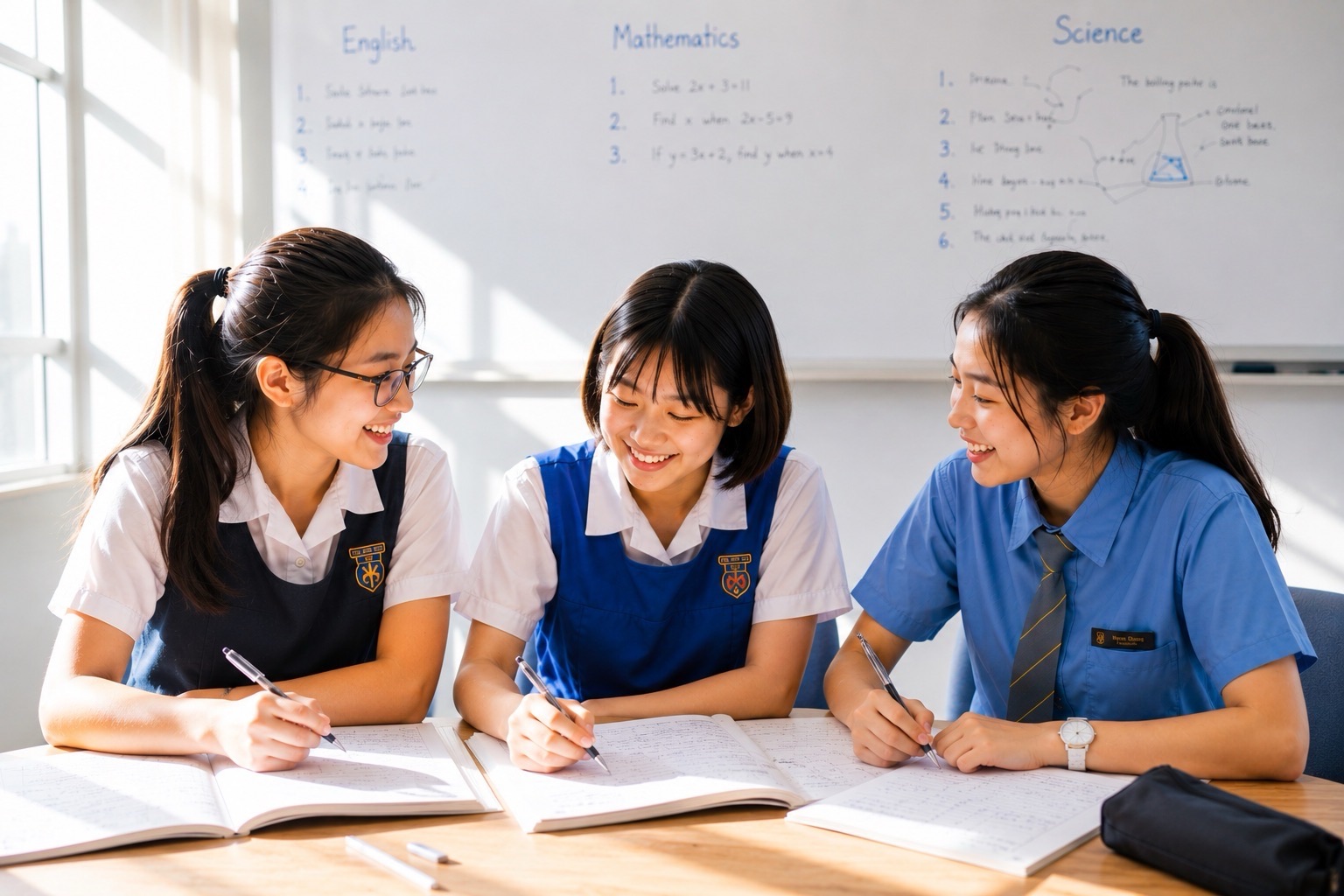
Secondary 4 Additional Mathematics tutor for Bukit Batok students. Premium 3-pax tutorials near Sixth Avenue MRT, with full-syllabus consolidation, calculus support, examination practice and close correction.
A strong Secondary 4 Additional Mathematics year requires more than completing the remaining chapters.
At eduKateSG, we provide premium 3-pax Secondary 4 Additional Mathematics tutorials for students travelling from Bukit Batok to our Bukit Timah location near Sixth Avenue MRT. Each 1.5-hour lesson combines clear explanation, carefully selected practice, close inspection of workings and structured preparation for school examinations and the O-Level Additional Mathematics papers. (EduKate)
The purpose is not simply to give students more A-Math questions.
It is to help them bring the entire subject under control.
Immediate Parent Concerns in Secondary 4 Additional Mathematics—and How an eduKateSG Tutor Can Help
Secondary 4 often changes the way parents look at Additional Mathematics.
In Secondary 3, there may still seem to be time. A weak chapter can be revisited later. An inconsistent test result may appear temporary. Parents may assume that greater maturity, more practice or the school revision programme will eventually resolve the problem.
By Secondary 4, that sense of available time becomes much smaller.
New topics must still be completed. Earlier chapters must be remembered. School assessments become more demanding. Preliminary examinations approach quickly, while the student is also managing English, Mathematics, Sciences, Humanities and other subjects.
For many parents, the immediate concern is no longer simply:
“Does my child understand A-Math?”
It becomes:
“Can my child bring the whole subject together in time?”
That is an important distinction.
A student may understand individual lessons and still struggle to complete a mixed paper. Another may remember the formulas but not know when to use them. A capable student may lose marks repeatedly through algebra, signs, incomplete solutions or poor time control.
At eduKateSG, the tutor’s first responsibility is to identify the actual source of instability. We do not assume that every disappointing result has the same cause.
“My Child Is Falling Behind the School’s Pace”
This is one of the most urgent concerns in Secondary 4.
The school must continue moving through the syllabus, even when a student has not fully understood an earlier topic. Once the student falls behind, each new lesson may depend on knowledge that is already uncertain.
For example:
- differentiation may expose weak algebra and indices;
- logarithmic differentiation may reveal incomplete logarithm laws;
- integration may be affected by poor manipulation of powers;
- trigonometric equations may depend on weak graph and quadrant understanding;
- coordinate geometry may require simultaneous equations and careful substitution.
The difficulty can therefore accumulate.
An eduKateSG tutor helps by finding the earliest unstable skill that is still affecting current work. The tutor repairs that skill while keeping the student connected to the school’s present topic.
This is more efficient than restarting the entire syllabus and more responsible than ignoring the foundation.
The aim is to help the student re-enter the school’s learning sequence with enough control to follow lessons, complete assignments and prepare for the next assessment.
“My Child Understands During Tuition but Cannot Do the Questions Alone”
This usually means the student can follow a demonstrated method but has not yet developed independent retrieval.
When the tutor or teacher is explaining, the topic is already identified. The correct formula is visible. The steps appear in a logical sequence.
During an examination, none of this guidance is present.
The student must independently decide:
- what the question is testing;
- which information matters;
- which topic or combination of topics is active;
- how to begin;
- what formula or identity is suitable;
- what order the steps should follow; and
- how to check the final result.
At eduKateSG, guided work is gradually reduced.
The tutor may first demonstrate the structure, then complete one question together with the student. The student then attempts a similar question with limited prompts before moving to a mixed question independently.
This progression matters.
A student should not leave a lesson merely feeling that the explanation was clear. The student should leave having demonstrated that the method can be retrieved and used without continuous assistance.
“My Child Keeps Saying the Mistakes Are Careless”
Parents often hear:
“I knew how to do it.”
“I just copied the number wrongly.”
“I forgot the negative sign.”
“I pressed the calculator incorrectly.”
Careless mistakes do occur, but repeated carelessness usually has a pattern.
It may come from:
- rushing because the student is working too slowly;
- weak algebraic habits;
- overcrowded working;
- poor bracket control;
- uncertainty about the method;
- premature calculator use;
- incomplete checking;
- anxiety under timed conditions; or
- trying to hold too many steps mentally.
An eduKateSG tutor does not simply tell the student to “be more careful”.
The tutor identifies where the mistake enters the solution.
If negative signs are repeatedly lost during substitution, the student may need a clearer substitution format. If brackets are being expanded incorrectly, the algebraic process must be repaired. If the student rounds too early, exact-value discipline must be established. If the final part of long questions is often missed, the student may need a completion checklist.
The correction must match the error.
Once students understand their own error pattern, they become better able to prevent it.
“My Child Is Passing, but the Marks Are Not Stable”
An unstable pass can be worrying because it is difficult to know which result represents the student’s true level.
A student may score reasonably well in a topical test, then perform much more poorly in a mixed paper. This often happens because topical practice tells the student which method to use, while an examination requires recognition and selection.
Other students may perform well when there is enough time but lose control during timed assessments.
At eduKateSG, the tutor looks beyond the overall percentage.
The paper is examined for patterns:
- Were marks lost mainly in algebra?
- Were questions left blank?
- Did the student begin with the wrong method?
- Were earlier topics forgotten?
- Was there enough working for method marks?
- Did time run out?
- Were the difficult questions attempted too early?
- Did the student lose marks across many small errors or a few large conceptual gaps?
Once the pattern is visible, the revision plan becomes more precise.
For some students, the immediate need is foundation repair. For others, it is mixed-topic retrieval, paper strategy, speed, checking or answer presentation.
“My Child Has Started Saying A-Math Is Impossible”
This statement should not be dismissed too quickly.
It may be an emotional response to repeated failure, but it may also describe the student’s genuine experience of the subject.
When too many steps are unstable, even a standard question can feel unpredictable. The student may not know where to begin, how to continue or whether any answer is reliable.
Repeatedly facing this uncertainty can lead to avoidance.
The student may:
- delay homework;
- copy answers;
- stop asking questions;
- leave difficult sections blank;
- depend heavily on notes;
- become defensive when A-Math is discussed; or
- consider giving up on the subject.
An eduKateSG tutor helps by making the subject smaller and more manageable again.
A difficult chapter is divided into clear components. The student first learns the simplest valid structure, then adds one variation at a time. Early questions are selected carefully so that understanding can be demonstrated, not merely explained.
Confidence is not built through praise alone.
It is built when the student experiences a repeatable process:
“I can recognise this.”
“I know how to begin.”
“I can complete the steps.”
“I can check whether the answer makes sense.”
As this control grows, the emotional resistance often begins to reduce.
“Should My Child Drop Additional Mathematics?”
For some families, this becomes an immediate Secondary 4 discussion.
The decision should not be made from panic after one poor paper. It should also not be delayed without examining the student’s actual position.
Important questions include:
- How large are the foundational gaps?
- How much of the syllabus remains unfamiliar?
- Is the student completing work independently?
- Does the student need A-Math for intended post-secondary pathways?
- Is the difficulty concentrated in a few topics or spread across the subject?
- How much time remains before the examinations?
- Is the subject affecting the student’s performance in other areas?
- Is there evidence that structured support is producing improvement?
An eduKateSG tutor can help the family assess the situation more clearly.
The purpose is not to pressure every student to continue regardless of circumstances. It is to establish whether the subject can be repaired within the available time and what that repair would realistically require.
Where continuation is appropriate, the tutor identifies the highest-impact priorities.
Where the gaps are substantial, the plan must be honest, focused and carefully paced.
“There Is Not Much Time Left—Can Tuition Still Help?”
Later support can still be useful, but the strategy changes.
At the beginning of Secondary 4, there may be time to rebuild broadly, teach ahead, revisit older chapters and develop examination habits gradually.
Closer to the preliminary examinations or O-Levels, the tutor must be more selective.
The focus may shift towards:
- high-frequency algebraic weaknesses;
- standard methods that should become dependable;
- major calculus procedures;
- trigonometric equations and identities;
- common mixed-topic structures;
- question selection;
- time allocation;
- preservation of method marks;
- correction of repeated errors; and
- full-paper execution.
The tutor cannot create additional months, but the remaining time can be used more intelligently.
A clear plan is often more valuable than frantic revision.
“My Child Is Doing Many Papers but the Results Are Not Improving”
Completing more papers does not automatically produce better performance.
A student may repeatedly practise the same mistakes, check the final answer and move on without understanding why the solution failed.
At eduKateSG, paper practice is followed by error conversion.
Each important mistake should lead to an action.
For example:
- a forgotten identity becomes a retrieval item;
- a weak algebraic step becomes targeted practice;
- a method-selection error becomes a comparison exercise;
- a time-management failure becomes a timed section;
- an incomplete solution becomes a presentation checklist;
- a misunderstood concept returns to guided instruction.
The paper is not merely marked.
It is used to improve the student’s mathematical system.
This is where close tutoring becomes especially valuable. The tutor can distinguish between a student who does not understand, a student who has forgotten, a student who chose poorly and a student who knew the method but could not execute it reliably.
What Parents Should Look for Immediately
Parents do not need to diagnose every mathematical weakness themselves.
However, the following signs deserve attention:
- schoolwork regularly takes much longer than expected;
- the student cannot explain the first step of a question;
- earlier topics are repeatedly forgotten;
- answers depend heavily on notes or worked solutions;
- the student leaves several questions blank;
- test marks vary widely;
- the same algebraic mistakes keep returning;
- calculus is being learnt without stable algebra;
- the student cannot finish papers;
- anxiety appears before every A-Math assessment; or
- the student has stopped believing improvement is possible.
These signs do not mean the situation is beyond repair.
They indicate that the student may need a clearer diagnosis and a more structured learning environment.
How the eduKateSG Tutor Responds
Our 3-pax Secondary 4 Additional Mathematics tutorials allow the tutor to respond closely to each student.
The tutor can:
- inspect complete workings rather than only final answers;
- identify the first unstable step;
- revisit the necessary prerequisite without losing sight of current schoolwork;
- adjust the difficulty and pacing of questions;
- ask the student to explain the chosen method;
- reduce prompts until the student can work independently;
- track repeated errors across lessons;
- prepare for upcoming school assessments;
- introduce mixed-topic and timed work at the appropriate stage; and
- help the student build a realistic revision route towards the examinations.
The immediate objective is clarity.
Parents should understand what is going wrong.
Students should understand what they are working on.
The tutor should know what improvement needs to appear next.
Secondary 4 A-Math can feel urgent, but urgency should not produce disorder.
The strongest response is a calm, accurate plan: repair what is blocking progress, stabilise the essential methods, reconnect the topics and train the student to execute under examination conditions.
That is how an eduKateSG tutor helps turn parental concern into a practical course of action.
By Secondary 4, students must retrieve knowledge from Secondary 3, complete the remaining syllabus, connect topics, recognise unfamiliar question structures and execute full solutions under time pressure. A small algebra mistake can affect an entire calculus question. A weak understanding of functions can create difficulty in logarithms, trigonometry, graphs and differentiation.
Our Secondary 4 Additional Mathematics tutorials are suitable for students who need to:
- repair unresolved Secondary 3 A-Math gaps;
- understand calculus more clearly;
- strengthen algebraic manipulation;
- improve trigonometric identities and equations;
- complete the syllabus without rushing;
- prepare for weighted assessments and preliminary examinations;
- improve speed without losing accuracy;
- learn how to approach mixed-topic questions;
- convert existing understanding into stronger examination marks; or
- work towards a dependable O-Level Additional Mathematics result.
Class size is limited to three students.
Lessons are conducted weekly for 1.5 hours, with teaching materials, guided corrections, focused continuation practice and additional examination preparation where class arrangements permit. (EduKate)
Secondary 4 Additional Mathematics Tutor Bukit Batok | 3-Pax A-Math Tutorials
Secondary 4 Additional Mathematics tutor for Bukit Batok students. Premium 3-pax tutorials near Sixth Avenue MRT, with full-syllabus consolidation, calculus support, examination practice and close correction.
A strong Secondary 4 Additional Mathematics year requires more than completing the remaining chapters.
At eduKateSG, we provide premium 3-pax Secondary 4 Additional Mathematics tutorials for students travelling from Bukit Batok to our Bukit Timah location near Sixth Avenue MRT. Each 1.5-hour lesson combines clear explanation, carefully selected practice, close inspection of workings and structured preparation for school examinations and the O-Level Additional Mathematics papers. (EduKate)
The purpose is not simply to give students more A-Math questions.
It is to help them bring the entire subject under control.
By Secondary 4, students must retrieve knowledge from Secondary 3, complete the remaining syllabus, connect topics, recognise unfamiliar question structures and execute full solutions under time pressure. A small algebra mistake can affect an entire calculus question. A weak understanding of functions can create difficulty in logarithms, trigonometry, graphs and differentiation.
Our Secondary 4 Additional Mathematics tutorials are suitable for students who need to:
- repair unresolved Secondary 3 A-Math gaps;
- understand calculus more clearly;
- strengthen algebraic manipulation;
- improve trigonometric identities and equations;
- complete the syllabus without rushing;
- prepare for weighted assessments and preliminary examinations;
- improve speed without losing accuracy;
- learn how to approach mixed-topic questions;
- convert existing understanding into stronger examination marks; or
- work towards a dependable O-Level Additional Mathematics result.
Class size is limited to three students.
Lessons are conducted weekly for 1.5 hours, with teaching materials, guided corrections, focused continuation practice and additional examination preparation where class arrangements permit. (EduKate)
Secondary 4 Is Where A-Math Becomes an Examination Subject
Secondary 3 is usually where students first encounter the weight of Additional Mathematics.
The algebra becomes more demanding. Functions become more abstract. Familiar E-Math methods no longer carry every question. Students must learn new symbolic structures and maintain accuracy across longer solutions.
Secondary 4 introduces another change.
The student is no longer studying one chapter at a time inside a relatively protected learning sequence.
The student must now manage:
- unfinished Secondary 4 content;
- forgotten Secondary 3 topics;
- increasingly mixed school papers;
- more demanding application questions;
- tighter completion times;
- repeated school assessments;
- preliminary examinations;
- revision for several other subjects; and
- the approaching national examination.
This is why a student who appeared comfortable in Secondary 3 may become less stable in Secondary 4.
The difficulty is not always caused by one new topic.
It may be caused by the entire subject becoming active at the same time.
Quadratics may appear inside coordinate geometry.
Trigonometry may be required before differentiation can begin.
Differentiation may depend on correct use of indices, logarithms, products, quotients or the chain rule.
Integration may require the student to recognise an expression before applying the correct reverse process.
A Secondary 4 Additional Mathematics tutor must therefore do more than teach chapters.
The tutor must help the student organise the subject as one connected mathematical system.
The Hidden Secondary 4 A-Math Problem: Knowing a Method Is Not the Same as Controlling a Route
Consider a student who has learnt differentiation.
The student may remember that:
[
\frac{d}{dx}(x^n)=nx^{n-1}
]
This is useful knowledge.
However, an examination question may require the student to:
- simplify an expression;
- recognise that it is a composite function;
- apply the chain rule;
- substitute a particular value;
- determine a gradient;
- form the equation of a tangent or normal; and
- present the answer in the required form.
The differentiation rule is only one part of the route.
The student must also know:
- where the route begins;
- what must be simplified first;
- which rule is appropriate;
- how one line connects to the next;
- which restrictions or conditions matter;
- whether an exact answer is required;
- how to detect an unreasonable result; and
- how much time the solution should take.
This is the central Secondary 4 problem.
Students may possess individual pieces of knowledge without being able to assemble them quickly and safely.
They may say:
“I know this topic, but I did not know the question was testing it.”
“I understood after seeing the answer.”
“I used the correct formula but still obtained the wrong result.”
“I could do it at home, but I could not finish during the test.”
“I got stuck at the beginning and lost the whole question.”
These are not identical problems.
They may indicate weakness in:
- question recognition;
- algebraic preparation;
- method selection;
- symbolic accuracy;
- memory retrieval;
- route planning;
- working presentation;
- checking discipline;
- examination timing; or
- confidence under pressure.
At eduKateSG, we separate these problems.
A student should not be given another pile of worksheets until the tutor understands why the existing work is not converting into marks.
Why Bukit Batok Parents Choose 3-Pax Additional Mathematics Tutorials
A class of three creates a particular kind of A-Math environment.
There are enough students for discussion, comparison and useful peer momentum. At the same time, the class remains small enough for the tutor to inspect how each student is thinking.
This matters because the final answer reveals only the end of the mathematical process.
The tutor must find the precise line where the solution became unstable.
A student may:
- expand a bracket incorrectly;
- lose a negative sign;
- apply an index law in the wrong direction;
- cancel terms that cannot be cancelled;
- confuse an equation with an identity;
- use degrees when the question requires radians;
- omit part of a trigonometric solution;
- differentiate the outer function but not the inner function;
- forget the constant of integration;
- choose incorrect limits;
- substitute before simplifying;
- round too early;
- use the calculator without preserving exact values;
- find a stationary point but fail to classify it;
- obtain the correct method but present insufficient working; or
- spend too long on one difficult question.
In a large class, the tutor may see only whether the answer is right or wrong.
In a 3-pax tutorial, the tutor can pause at the exact line, question the student and correct the reasoning before the error becomes habitual.
The advantages of three students
- Immediate feedback during difficult practice
- Close checking of complete workings
- Frequent opportunities to explain methods
- Less room to remain silent when confused
- Pacing adjusted more carefully to the group
- Questions selected according to individual weaknesses
- Easier identification of repeated error patterns
- Calm peer momentum without large-class noise
- More targeted preparation before school assessments
- Greater accountability during independent practice
The class is intentionally small.
It protects the personal attention needed for A-Math while preserving the useful energy of learning alongside capable peers.
The Current O-Level Additional Mathematics Examination
For 2026 school candidates, SEAB lists Additional Mathematics as syllabus 4049.
The syllabus is organised into three principal strands:
- Algebra;
- Geometry and Trigonometry; and
- Calculus.
It assumes knowledge of O-Level Mathematics and places substantial emphasis on mathematical problem-solving, connections between topics, reasoning and communication. (SEAB)
The examination consists of two papers:
- Paper 1: 2 hours 15 minutes, 90 marks and 50% of the final result;
- Paper 2: 2 hours 15 minutes, 90 marks and 50% of the final result.
Students must answer all questions in both papers. The syllabus also states that omission of essential working can result in lost marks.
This creates several important implications.
There is no safe paper
Both papers carry equal weight.
A student cannot depend on one paper to compensate indefinitely for poor control in the other.
Every question matters
As all questions must be attempted, students need a strategy for:
- beginning efficiently;
- moving through routine sections accurately;
- recognising longer questions;
- protecting time;
- returning to incomplete work; and
- avoiding blank sections.
Working is part of the answer
A-Math is not assessed only by the number shown at the end.
Students must display enough mathematical structure for method marks and communication to remain visible.
Problem-solving carries significant weight
The current assessment objectives place approximately 50% of the weighting on solving problems in varied contexts, including choosing appropriate concepts, translating information and making connections across topics. (Isomer User Content)
A student who can repeat standard exercises but cannot identify the mathematics inside a mixed question remains vulnerable.
What We Teach in Secondary 4 Additional Mathematics Tutorials
Schools may complete topics in different sequences.
Our tutorials coordinate with the student’s school programme while ensuring that the full A-Math structure remains coherent.
Algebraic Control
Algebra is not merely one section of the syllabus.
It is the operating language through which much of Additional Mathematics is expressed.
Students strengthen their control over:
- algebraic expansion;
- factorisation;
- algebraic fractions;
- indices;
- surds;
- equations and inequalities;
- completing the square;
- discriminants;
- simultaneous equations;
- polynomial division;
- the remainder theorem;
- the factor theorem;
- cubic equations;
- partial fractions;
- binomial expansion;
- exponential functions;
- logarithmic functions; and
- transformation between mathematical forms.
The current syllabus includes quadratic functions, equations and inequalities, surds, polynomials, partial fractions, binomial expansions, exponential functions and logarithmic functions.
Students are not taught these as disconnected procedures.
They learn to ask:
- What kind of expression is this?
- What structure is hidden inside it?
- Should I expand, factorise, substitute or transform?
- Which form will make the next step easier?
- What restrictions apply?
- Can the answer be checked another way?
The goal is controlled symbolic movement.
A-Math becomes more manageable when the student can move an expression from one useful form to another without damaging its meaning.
Quadratic Functions, Equations and Inequalities
Students work with:
- completing the square;
- maximum and minimum values;
- discriminants;
- conditions for real or equal roots;
- intersections between lines and curves;
- tangent conditions;
- simultaneous equations;
- quadratic inequalities; and
- mathematical modelling with quadratic functions.
A common weakness is learning each method separately.
For example, the student may know the discriminant formula but fail to recognise that the words “touches the curve” indicate an equal-root condition.
We connect the language, graph and algebra.
The student learns that:
- roots correspond to intersections;
- equal roots correspond to tangency;
- the discriminant describes possible intersections;
- completing the square reveals turning-point structure; and
- inequalities describe intervals rather than isolated values.
Once the representations are connected, the methods become easier to retrieve.
Polynomials and Partial Fractions
Students strengthen:
- multiplication and division of polynomials;
- the remainder theorem;
- the factor theorem;
- factorisation of cubic expressions;
- solving cubic equations;
- standard cubic identities; and
- decomposition into partial fractions.
These questions are often lost through small algebraic errors.
We therefore teach students to maintain a clean line-by-line structure, verify factors and check whether the reconstructed expression matches the original.
Partial fractions also prepares a useful way of thinking.
A complicated expression can sometimes be decomposed into simpler components.
The student is not merely memorising a template.
The student is learning how mathematical structure can be reorganised to make a problem more workable.
Exponential and Logarithmic Functions
Students learn to work confidently with:
- exponential expressions;
- logarithmic expressions;
- laws of logarithms;
- natural logarithms;
- change of base;
- exponential equations;
- logarithmic equations;
- graphs of exponential and logarithmic functions; and
- applications involving growth and decay.
Weakness in logarithms is frequently an algebra problem in disguise.
A student may remember the laws but apply them without checking whether the expression is a product, quotient, power or sum.
We slow the symbolic reading down before rebuilding speed.
Students also learn that:
[
y=a^x
]
and
[
x=\log_a y
]
describe the same relationship from different directions.
This allows logarithms to become meaningful rather than appearing as a collection of arbitrary laws.
Trigonometric Functions, Identities and Equations
Secondary 4 trigonometry requires significantly more than applying sine, cosine and tangent to a triangle.
Students must work with:
- six trigonometric functions;
- angles of any magnitude;
- degrees and radians;
- exact values;
- principal values;
- trigonometric graphs;
- amplitude;
- periodicity;
- symmetry;
- compound-angle formulae;
- double-angle formulae;
- trigonometric identities;
- (R)-formula transformations;
- trigonometric equations;
- specified intervals; and
- mathematical models.
These areas are included in the current Additional Mathematics syllabus.
The difficult part is often route selection.
A student facing a trigonometric expression may have several identities available. The question is not whether the student has memorised them.
The question is:
Which identity changes the expression in the direction required?
We teach students to inspect:
- the target form;
- the functions present;
- the angles present;
- whether squares appear;
- whether a double angle is hidden;
- whether everything should be converted into sine and cosine;
- whether factorisation is possible; and
- whether restrictions must be stated.
Trigonometric proofs
For identity proofs, students learn not to manipulate both sides randomly.
Instead, they usually begin with the more complicated side and move it deliberately towards the simpler side.
Each line must remain equivalent to the previous one.
The objective is not merely to reach the answer.
It is to create a valid mathematical argument.
Trigonometric equations
Students practise:
- identifying the basic angle;
- locating valid quadrants;
- handling positive and negative values;
- working within the stated interval;
- converting between radians and degrees when required;
- checking for repeated or excluded solutions; and
- presenting the complete solution set.
Missing one valid solution is not a “small careless mistake”.
It usually reveals an incomplete solving system.
We therefore train a repeatable procedure that remains reliable under examination pressure.
Coordinate Geometry and Proof
Students may also require support with:
- parallel and perpendicular gradients;
- midpoints;
- areas of rectilinear figures;
- equations of circles;
- centres and radii;
- line-and-circle relationships;
- transformations into linear form; and
- plane-geometry proofs.
Coordinate geometry questions often combine several topics.
A student may need to identify a centre, form a radius, use a gradient condition, solve simultaneous equations and interpret the resulting coordinates.
The challenge is not necessarily one difficult calculation.
It is keeping the route organised across several linked steps.
For transformation to linear form, students learn to understand what each transformed variable represents instead of copying a memorised table.
For proofs, students learn to state the property being used and connect each conclusion logically to the next.
Differentiation
Calculus is often where Secondary 4 A-Math begins to feel visibly advanced.
The current syllabus includes differentiation as gradient and rate of change, product and quotient rules, the chain rule, increasing and decreasing functions, stationary points, second derivatives, tangents, normals, connected rates of change and optimisation.
Students develop control over:
- standard derivatives;
- rational powers;
- trigonometric functions;
- exponential functions;
- logarithmic functions;
- products;
- quotients;
- composite functions;
- first and second derivatives;
- gradients;
- tangents and normals;
- stationary points;
- maximum and minimum problems;
- rates of change; and
- motion.
Differentiation must begin with function recognition
Before differentiating, the student should be able to see whether the function is:
- a sum;
- a product;
- a quotient;
- a composite function;
- an exponential function;
- a logarithmic function; or
- a trigonometric function.
Many errors occur because the student begins differentiating before reading the structure.
We teach students to identify the architecture first.
Chain rule control
Students frequently understand the chain rule in simple examples but lose it when the inner function is less obvious.
We make the layers visible.
The student identifies:
- the outer function;
- the inner function;
- the derivative of the outer layer;
- the derivative of the inner layer; and
- how the two parts combine.
Once the structure is stable, increasingly complex variations can be introduced.
Stationary points
Finding (\frac{dy}{dx}=0) is only the beginning.
Students may also need to:
- solve for the relevant coordinate;
- substitute back into the original function;
- determine the nature of the stationary point;
- use a second-derivative test;
- distinguish a maximum, minimum or stationary point of inflexion; and
- interpret the result within a context.
The complete route is taught, not only the first equation.
Tangents and normals
Students learn to connect:
- the derivative;
- the gradient at a point;
- the perpendicular-gradient relationship;
- the coordinates of the point; and
- the equation of a straight line.
This is a good example of how E-Math and A-Math knowledge must cooperate.
The calculus produces the gradient.
Coordinate geometry completes the answer.
Integration
Integration is taught as more than “reverse differentiation”.
Students develop control over:
- standard integrals;
- algebraic powers;
- trigonometric functions;
- exponential functions;
- composite linear expressions;
- constants of integration;
- definite integrals;
- areas under curves;
- regions below the (x)-axis;
- displacement;
- velocity; and
- acceleration.
The current syllabus assesses integration, definite integrals, areas bounded by curves and lines, regions below the (x)-axis and straight-line motion applications.
The constant of integration
The (+c) is not treated as a decorative symbol.
Students learn why differentiation removes an additive constant and why indefinite integration therefore represents a family of possible functions.
Understanding this reduces omission.
Definite integrals and area
Students must distinguish between:
- the value of an integral;
- signed area;
- geometric area;
- regions above the axis;
- regions below the axis; and
- the correct limits.
A negative definite integral does not mean the physical area is negative.
The student must interpret the graph and the question.
Kinematics
For motion in a straight line, students learn the relationships between:
- displacement;
- velocity;
- acceleration;
- differentiation; and
- integration.
They must also interpret signs, turning points and intervals carefully.
A negative velocity, for example, describes direction rather than a failure of calculation.
Our First-Principles Teaching Method
A strong Secondary 4 A-Math programme should not consist only of demonstrations followed by many similar questions.
Students need a structure that keeps knowledge usable after the lesson and under examination conditions.
1. Diagnose the exact weakness
We avoid broad descriptions such as:
“My child is weak in A-Math.”
A student described as weak in A-Math may actually be struggling with:
- basic algebraic manipulation;
- negative signs;
- fractions;
- index laws;
- function notation;
- graph interpretation;
- trigonometric recall;
- radians;
- chain-rule recognition;
- exact-value control;
- working memory;
- method selection;
- time management; or
- confidence after repeated poor results.
The correction depends on the cause.
We inspect school papers, marked assignments and the way the student begins a question.
2. Rebuild from the first unstable point
When an earlier skill is blocking the current topic, we return to it.
This is not abandoning Secondary 4 work.
It is removing the obstruction that makes Secondary 4 work unnecessarily difficult.
A student struggling with differentiation of logarithmic functions may first need stronger logarithm laws.
A student losing marks in integration may need better index control.
A student struggling with trigonometric identities may need clearer understanding of algebraic fractions and factorisation.
We repair the earliest useful point and reconnect it immediately to the current syllabus.
3. Use the Fencing Method
We establish a clear boundary before adding variation.
For differentiation, a student may begin with:
- one standard function;
- one clear operation;
- whole-number powers; and
- no hidden composite structure.
Once the method is secure, we introduce:
- negative powers;
- fractional powers;
- products;
- quotients;
- composite functions;
- trigonometric functions;
- exponentials;
- logarithms; and
- mixed applications.
Each new condition is introduced deliberately.
The student learns what changed, why the original route is no longer sufficient and which additional rule is required.
4. Connect representations
A concept may appear as:
- an equation;
- an expression;
- a graph;
- a table;
- a diagram;
- a written situation; or
- a rate of change.
We help students move between these representations.
For example, a quadratic can be understood through:
- its algebraic form;
- its roots;
- its discriminant;
- its turning point;
- its completed-square form; and
- its graph.
These are not separate facts.
They are different views of the same mathematical object.
5. Ask students to think aloud
Students are asked to explain:
- what the question is asking;
- what topic appears to be active;
- what information is available;
- which relationship matters;
- why a method is suitable;
- what each line of working achieves;
- what restrictions apply; and
- whether the final result is reasonable.
Explanation exposes understanding.
It also reveals confusion before that confusion becomes a repeated written habit.
6. Retrieve and interleave
Earlier topics are revisited after the original lesson.
Questions are mixed so that students must identify the method independently.
This is important because an examination paper does not announce:
“This is a chain-rule question.”
“This is a discriminant question.”
“This is a logarithm-law question.”
The student must recognise the structure.
Interleaving develops this recognition.
7. Build examination discipline
Students practise:
- writing one useful transformation per line;
- using equal signs correctly;
- preserving exact values;
- stating restrictions;
- showing essential working;
- maintaining readable notation;
- checking calculator mode;
- labelling diagrams;
- avoiding premature rounding;
- allocating time; and
- verifying final answers.
These are not cosmetic habits.
They protect marks.
What Happens During a 90-Minute Lesson
Every lesson is adjusted to the students, but a typical tutorial follows a stable rhythm.
Warm-up retrieval
Students begin with a short set drawn from earlier learning.
This allows the tutor to check retention and reactivate knowledge required for the day’s work.
A calculus lesson may therefore begin with algebra, indices or logarithms if those skills are about to be used.
Concept instruction
The tutor introduces or revisits the central mathematical idea.
Explanations focus on:
- meaning;
- structure;
- notation;
- method conditions;
- connections to earlier topics; and
- common misconceptions.
Guided practice
Students attempt selected questions with the tutor nearby.
The tutor observes how the student begins, which route is selected and where uncertainty appears.
Prompts are reduced as control improves.
Independent application
Students complete questions without step-by-step guidance.
This reveals whether the student can reproduce the method independently rather than merely follow an explanation.
Mixed or timed practice
Older topics may be combined with the current topic.
Short timed sets may be introduced to improve retrieval speed, route selection and completion discipline.
Error review
Mistakes are classified.
The student learns whether the error came from:
- conceptual misunderstanding;
- weak recall;
- incorrect algebra;
- wrong method selection;
- sign control;
- calculator use;
- incomplete working;
- interpretation;
- time pressure; or
- rushing.
Focused continuation work
Home practice is purposeful.
The objective is to reinforce the lesson and revisit important weaknesses, not to produce an indiscriminate stack of worksheets.
Three Secondary 4 A-Math Student Pathways
Not every student enters tuition for the same reason.
The Repair Pathway
This student may be:
- failing or close to failing;
- unable to complete school homework independently;
- carrying major Secondary 3 gaps;
- confused by calculus;
- weak in algebra;
- dependent on worked answers;
- avoiding difficult questions; or
- considering whether to give up on the subject.
The immediate priority is to stop further drift.
We identify the earliest weaknesses that are still affecting the syllabus, repair them and reconnect the student to current school work.
The plan must be realistic.
When the examination is close, not every weakness carries equal urgency. We prioritise the knowledge that unlocks the largest useful part of the subject.
The Stabilisation Pathway
This student is passing, but performance is inconsistent.
The student may:
- score well on familiar topical work;
- drop sharply in mixed papers;
- lose marks through signs and algebra;
- forget earlier chapters;
- leave long questions incomplete;
- struggle under time pressure; or
- understand lessons without converting that understanding reliably into marks.
The priority is dependable performance.
The student needs stronger retrieval, cleaner working, better question recognition and controlled examination pacing.
The Extension Pathway
This student is coping well and wants stronger distinction-level control.
The work may include:
- less routine applications;
- deeper mixed-topic questions;
- alternative solution routes;
- sharper algebraic efficiency;
- stronger mathematical communication;
- more demanding timed sets;
- full-paper strategy;
- error reduction; and
- preparation for future quantitative study.
The priority is not simply to complete more papers.
It is to improve the quality, speed and reliability of mathematical decisions.
Why Algebra Receives Special Attention in Secondary 4
A student may describe the problem as calculus.
The actual weakness may still be algebra.
Consider differentiation involving:
[
y=\frac{(2x+1)^3}{x^2}
]
Before or during differentiation, the student must control:
- powers;
- brackets;
- quotient structure;
- negative indices if rewriting;
- the chain rule;
- simplification; and
- line-by-line notation.
A small algebraic error can make the entire solution appear to be a calculus failure.
The same applies to:
- logarithmic equations;
- trigonometric identities;
- coordinate geometry;
- partial fractions;
- stationary-point questions;
- integration; and
- kinematics.
This is why we do not treat algebra as “old Secondary 3 work” that should automatically be left behind.
Algebra is inspected throughout Secondary 4.
Where it is weak, we repair it.
Where it is slow, we improve fluency.
Where it is accurate but inefficient, we teach better transformations.
How We Reduce Careless Mistakes
“Careless” is often too broad a diagnosis.
Different mistakes require different corrections.
Reading Errors
The student may overlook words such as:
- exact;
- hence;
- show that;
- maximum;
- minimum;
- normal;
- stationary;
- positive;
- distinct;
- given interval;
- increasing;
- decreasing; or
- correct to three significant figures.
Correction requires deliberate reading and annotation.
Sign Errors
The student may lose control when:
- negative values are substituted;
- brackets are expanded;
- terms cross several lines;
- velocities change direction;
- regions lie below the axis; or
- trigonometric functions change sign by quadrant.
Correction requires slower symbolic handling and targeted checking before speed is rebuilt.
Algebra Errors
The student may:
- cancel across addition;
- apply an index law incorrectly;
- omit a factor;
- expand only part of a bracket;
- divide inconsistently;
- rationalise incorrectly; or
- change an exponent while copying.
Correction requires concept repair and cleaner working structure.
Method Errors
The student may know several formulas but choose the wrong one.
Correction requires stronger recognition of mathematical structure, not merely more formula memorisation.
Calculator Errors
The student may:
- use the wrong angle mode;
- enter brackets incorrectly;
- round too early;
- copy a value inaccurately;
- trust an approximate result when an exact form is required; or
- fail to distinguish calculator evidence from mathematical proof.
Correction requires calculator discipline alongside handwritten reasoning.
Presentation Errors
The student may omit:
- essential transformations;
- coordinates;
- units;
- limits;
- the constant of integration;
- restrictions;
- complete trigonometric solutions; or
- the conclusion required by a proof.
Correction requires an answer-completion checklist appropriate to the topic.
Time-Pressure Errors
The student may spend too long trying to rescue one question and leave easier marks untouched.
Correction requires timed micro-sets, section control and a planned return strategy.
We track error patterns instead of treating every wrong answer as an isolated incident.
Once the pattern becomes visible, the correction becomes more precise.
Full-Syllabus Revision Without Drowning the Student
Secondary 4 revision can become inefficient very quickly.
A student may attempt to revise by:
- rereading every note;
- restarting every textbook chapter;
- completing paper after paper without analysis;
- copying worked solutions;
- highlighting formulas;
- watching many explanations without practising; or
- concentrating only on preferred topics.
This creates activity, but not necessarily readiness.
A stronger revision system separates the work into layers.
Layer 1: Foundation repair
We identify essential weaknesses that are still damaging several topics.
Examples include:
- algebraic fractions;
- indices;
- surds;
- factorisation;
- logarithm laws;
- radian control; and
- basic trigonometric identities.
Layer 2: Topic consolidation
The student revises the principal methods within each topic and completes carefully selected variations.
Layer 3: Connection training
Questions begin combining topics.
The student learns to recognise when one chapter is operating inside another.
Layer 4: Mixed-paper practice
The chapter label disappears.
The student must identify the method, organise the route and maintain accuracy.
Layer 5: Timed execution
The student completes larger sections or full papers under realistic timing.
Layer 6: Error conversion
Every serious mistake is reviewed and converted into a future checking instruction, retrieval item or repair task.
This prevents revision from becoming a repeated performance of the same weaknesses.
Examination Practice Without Premature Paper Drilling
Past-year and school papers are valuable.
However, full-paper practice is most useful when the student has enough knowledge to learn from it.
Giving a severely unstable student repeated full papers may produce:
- large numbers of blanks;
- repeated guessing;
- answer-key dependence;
- growing discouragement;
- poor-quality corrections; and
- very little actual repair.
We therefore match the size of the task to the student’s current readiness.
A student may begin with:
- one method;
- one variation;
- one connected pair of topics;
- a short mixed set;
- a timed section;
- half a paper; and
- eventually a complete paper.
Paper practice should reveal and strengthen the system.
It should not merely measure the same failure repeatedly.
Teaching Ahead Without Rushing
At the beginning of Secondary 4, some schools may still be introducing substantial new content.
Where the student’s foundation is ready, we may introduce a topic slightly before it appears in school.
The purpose is not to race through the syllabus.
It is to give the student a calm first encounter.
When the topic later appears in school:
- the notation is familiar;
- the central idea is recognisable;
- the student can follow the lesson more easily;
- school practice becomes consolidation; and
- questions can be asked with greater precision.
As the year progresses, teaching ahead gradually becomes syllabus completion and revision planning.
The objective is to create enough runway for:
- mixed-topic practice;
- preliminary-examination preparation;
- correction cycles;
- timed papers; and
- final refinement.
Coverage matters.
However, unstable coverage is not readiness.
We move ahead while continuing to protect the foundations beneath it.
What Progress Should Look Like
Progress is not limited to one test score.
Parents may first notice that the student:
- begins A-Math work with less resistance;
- identifies the likely topic more quickly;
- uses fewer unnecessary steps;
- writes more organised solutions;
- checks signs and restrictions;
- remembers earlier methods more reliably;
- asks more precise questions;
- completes routine work faster;
- recovers more calmly after getting stuck;
- leaves fewer questions blank;
- makes fewer repeated errors; and
- produces more stable school results.
Marks tend to improve when several parts begin working together:
- understanding;
- retrieval;
- algebra;
- method selection;
- accuracy;
- timing;
- communication; and
- checking.
Responsible tuition does not promise an immediate grade change after one or two lessons.
The rate of improvement depends on:
- the student’s starting point;
- the size of existing gaps;
- attendance;
- independent practice;
- school workload;
- willingness to correct old habits;
- emotional response to the subject; and
- time remaining before the next assessment.
Our role is to make the improvement process visible, structured and teachable.
When Should a Bukit Batok Student Begin Secondary 4 A-Math Tuition?
Support may be useful when a student:
- entered Secondary 4 with an unstable Secondary 3 foundation;
- cannot manipulate algebra reliably;
- finds differentiation or integration confusing;
- understands topical exercises but struggles with mixed papers;
- repeatedly forgets trigonometric identities;
- depends heavily on notes or answer keys;
- loses marks through incomplete solutions;
- performs well during practice but poorly during tests;
- cannot finish school papers;
- has begun avoiding A-Math;
- is considering dropping the subject;
- wants to move from a pass to a stronger grade;
- wants a more dependable distinction; or
- needs a structured plan before the preliminary examinations.
Parents do not need to wait for a major failure.
Earlier support usually allows more time for genuine rebuilding.
However, students can still benefit when joining later in the year.
The plan simply becomes more selective.
With limited time, the tutor must distinguish between:
- foundational repairs that unlock many marks;
- topics that can be stabilised quickly;
- examination habits that can improve immediately; and
- lower-priority weaknesses that should not consume the remaining runway.
The later the starting point, the more precise the plan must become.
Convenient Access from Bukit Batok to Sixth Avenue
eduKateSG’s Bukit Timah location is at 8 Fourth Avenue, near Sixth Avenue MRT on the Downtown Line.
For families using public transport, Bus Service 77 begins at Bukit Batok Interchange and travels through Toh Tuck, Bukit Timah and the Sixth Avenue area before continuing towards the city. (Land Transport Guru)
Families may also use combinations of the North–South, East–West, Circle and Downtown Lines depending on their starting point within Bukit Batok.
For some students, travelling a short distance away from the immediate school-and-home environment creates a useful separation.
The student enters a calm tutorial setting, completes a clearly defined piece of mathematical work and returns home with the next step already organised.
Location: eduKateSG, 8 Fourth Avenue, Singapore 268674
Nearest MRT: Sixth Avenue MRT, Downtown Line
Attendance: By appointment (EduKate)
Class Details
Format: Premium 3-pax small-group tutorials
Level: Secondary 4 Additional Mathematics
Examination support: Singapore-Cambridge O-Level Additional Mathematics, according to the student’s examination year and school programme
Duration: 1.5 hours weekly
Teaching approach:
- first-principles explanation;
- Secondary 3 foundation repair;
- full-syllabus consolidation;
- guided and independent practice;
- retrieval and interleaving;
- algebraic fluency;
- error analysis;
- school-assessment alignment;
- preliminary-examination preparation;
- timed practice; and
- full-paper conditioning.
Materials may include:
- curated lesson notes;
- topical practice;
- mixed revision;
- assessment-style questions;
- school-paper analysis;
- micro-tests;
- timed sections;
- full examination papers; and
- focused continuation work.
Additional preparation may be arranged around important school assessments, subject to the needs and organisation of the class.
Limited trial lessons may occasionally be possible when the 3-pax class configuration permits.
The usual first step is a parent–student consultation.
What Parents Can Bring to the Consultation
Useful materials include:
- recent school examination papers;
- weighted-assessment papers;
- marked assignments;
- topical worksheets;
- the school’s current topic schedule;
- the student’s textbook;
- teacher comments;
- revision materials already being used; and
- examples of questions the student repeatedly finds difficult.
We are not looking only at the final score.
We are looking for patterns.
A score of 55% may belong to:
- a student with serious conceptual gaps;
- a student who understands but works too slowly;
- a student losing many marks through algebra;
- a student leaving questions blank;
- a student who performs poorly only under test conditions; or
- a capable student with weak checking discipline.
Those students require different plans.
The consultation helps us determine whether the student needs:
- repair;
- stabilisation;
- examination conversion; or
- extension.
Frequently Asked Questions
Is Secondary 4 Additional Mathematics tuition mainly about calculus?
No.
Differentiation and integration are important, but Secondary 4 success also depends on algebra, quadratics, polynomials, logarithms, trigonometry, coordinate geometry and knowledge carried forward from O-Level Mathematics.
Calculus frequently exposes earlier algebraic weakness. A strong programme therefore teaches calculus while repairing the foundations required to use it.
My child did reasonably well in Secondary 3. Is tuition necessary?
Not automatically.
A student who is learning confidently, retaining earlier topics, completing work independently and performing consistently may not require additional tuition.
Support becomes useful when the full Secondary 4 load exposes instability, school pace becomes difficult or the student wants more structured examination preparation.
My child is already failing. Is it too late?
Not necessarily.
The available plan depends on how much time remains and why the student is failing.
We first identify the highest-impact weaknesses. Some students improve significantly after repairing algebra and learning a more controlled approach to standard questions. Larger gaps require more time and consistent practice.
A realistic plan is more useful than an exaggerated promise.
Will you restart the entire Secondary 3 syllabus?
Usually not.
We return to the Secondary 3 topics that are affecting current performance.
For example, we may revisit logarithms because they are blocking differentiation, or factorisation because it is affecting several algebra and calculus questions.
The purpose is targeted repair rather than indiscriminate repetition.
Do you follow the school’s topic order?
We consider the school sequence, upcoming assessments and preliminary-examination timetable.
However, an earlier weakness may need to be repaired before the current chapter can become stable.
Do you teach ahead of school?
Yes, when the student’s foundation and the time of year make it appropriate.
Early pre-teaching gives students a supported first encounter. Later in Secondary 4, the emphasis shifts towards syllabus completion, revision, mixed questions and examination preparation.
How do you help students who make careless mistakes?
We separate errors into categories such as:
- reading;
- concept;
- recall;
- algebra;
- signs;
- calculator use;
- notation;
- presentation;
- method selection; and
- time management.
The correction is matched to the actual error pattern.
How quickly should improvement appear?
Some students show clearer working, better confidence and fewer repeated mistakes within several lesson cycles.
Larger conceptual gaps require more time.
Progress depends on the starting point, attendance, practice and proximity of assessments.
Can a student join after the June holidays?
Yes, subject to a suitable 3-pax placement.
The programme will need to prioritise carefully. There may be less time for broad rebuilding, so lessons focus on the weaknesses and examination behaviours with the greatest impact.
Can a student join after the preliminary examinations?
Yes, where a suitable class placement is available.
At that stage, the preliminary paper becomes useful diagnostic evidence. We identify recurring losses, repair high-value weaknesses and sharpen paper execution.
The programme is necessarily more compressed, but there may still be meaningful improvements available.
Do you only help students who are failing?
No.
Students may join to:
- repair;
- stabilise;
- improve examination consistency;
- work towards an A grade;
- reduce unnecessary mark loss; or
- deepen mathematical control.
Why not choose a larger A-Math class closer to Bukit Batok?
A larger class may be sufficient for a student who only needs general revision and is already highly independent.
A 3-pax tutorial is more suitable when the student requires:
- close inspection of workings;
- frequent questioning;
- individual pacing;
- targeted repair;
- detailed error analysis; or
- careful examination conversion.
Helpful Reading for Bukit Batok Parents
- Mathematics Tuition Bukit Batok: Primary and Secondary Mathematics support (EduKate)
- Secondary Mathematics Tuition Bukit Batok: 3-pax small groups (EduKate)
- What Happens in Secondary 4 Additional Mathematics Tuition? (EduKate)
- How to Get A1 for Secondary 4 Additional Mathematics (EduKate)
- The eduKate Mathematics Learning System (EduKate)
- SEAB 2026 O-Level Additional Mathematics syllabus and assessment information (SEAB)
Secondary 4 Additional Mathematics Tutor for Bukit Batok Families
Secondary 4 is where the many parts of Additional Mathematics must begin operating as one system.
Algebra becomes the movement between forms.
Functions become mathematical objects that can be transformed and analysed.
Trigonometry becomes a language of identities, graphs and periodic relationships.
Differentiation becomes a way to describe gradient, change and optimisation.
Integration becomes a way to reconstruct functions, measure regions and understand motion.
Examination working becomes part of mathematical communication.
A carefully taught student does more than remember formulas.
The student begins to recognise which idea is active, why a particular route is suitable and how to carry that route safely to its conclusion.
At eduKateSG, our 3-pax Secondary 4 Additional Mathematics tutorials provide the time, attention and structure required for this work.
For students who are behind, we rebuild.
For students who are passing but unstable, we consolidate.
For students who know the content but cannot convert it under pressure, we sharpen examination execution.
For students who are ready, we extend.
The objective is not simply a student who has completed the A-Math syllabus.
It is a student who can enter the examination with stronger algebra, clearer route selection, controlled working and the confidence to continue even when a question is unfamiliar.
Arrange a Parent–Student Consultation
Speak with us about your child’s school programme, current results, learning gaps, preliminary examinations and O-Level preparation.
eduKateSG
8 Fourth Avenue
Singapore 268674
Near Sixth Avenue MRT
Premium 3-pax small-group tuition
By appointment (EduKate)
Properly taught kids shine a bright light into the future.
Secondary 4 Is Where A-Math Becomes an Examination Subject
Secondary 3 is usually where students first encounter the weight of Additional Mathematics.
The algebra becomes more demanding. Functions become more abstract. Familiar E-Math methods no longer carry every question. Students must learn new symbolic structures and maintain accuracy across longer solutions.
Secondary 4 introduces another change.
The student is no longer studying one chapter at a time inside a relatively protected learning sequence.
The student must now manage:
- unfinished Secondary 4 content;
- forgotten Secondary 3 topics;
- increasingly mixed school papers;
- more demanding application questions;
- tighter completion times;
- repeated school assessments;
- preliminary examinations;
- revision for several other subjects; and
- the approaching national examination.
This is why a student who appeared comfortable in Secondary 3 may become less stable in Secondary 4.
The difficulty is not always caused by one new topic.
It may be caused by the entire subject becoming active at the same time.
Quadratics may appear inside coordinate geometry.
Trigonometry may be required before differentiation can begin.
Differentiation may depend on correct use of indices, logarithms, products, quotients or the chain rule.
Integration may require the student to recognise an expression before applying the correct reverse process.
A Secondary 4 Additional Mathematics tutor must therefore do more than teach chapters.
The tutor must help the student organise the subject as one connected mathematical system.
The Hidden Secondary 4 A-Math Problem: Knowing a Method Is Not the Same as Controlling a Route
Consider a student who has learnt differentiation.
The student may remember that:
[
\frac{d}{dx}(x^n)=nx^{n-1}
]
This is useful knowledge.
However, an examination question may require the student to:
- simplify an expression;
- recognise that it is a composite function;
- apply the chain rule;
- substitute a particular value;
- determine a gradient;
- form the equation of a tangent or normal; and
- present the answer in the required form.
The differentiation rule is only one part of the route.
The student must also know:
- where the route begins;
- what must be simplified first;
- which rule is appropriate;
- how one line connects to the next;
- which restrictions or conditions matter;
- whether an exact answer is required;
- how to detect an unreasonable result; and
- how much time the solution should take.
This is the central Secondary 4 problem.
Students may possess individual pieces of knowledge without being able to assemble them quickly and safely.
They may say:
“I know this topic, but I did not know the question was testing it.”
“I understood after seeing the answer.”
“I used the correct formula but still obtained the wrong result.”
“I could do it at home, but I could not finish during the test.”
“I got stuck at the beginning and lost the whole question.”
These are not identical problems.
They may indicate weakness in:
- question recognition;
- algebraic preparation;
- method selection;
- symbolic accuracy;
- memory retrieval;
- route planning;
- working presentation;
- checking discipline;
- examination timing; or
- confidence under pressure.
At eduKateSG, we separate these problems.
A student should not be given another pile of worksheets until the tutor understands why the existing work is not converting into marks.
Secondary 4 Additional Mathematics Tutor Bukit Batok | 3-Pax A-Math Tutorials
Secondary 4 Additional Mathematics tutor for Bukit Batok students. Premium 3-pax tutorials near Sixth Avenue MRT, with full-syllabus consolidation, calculus support, examination practice and close correction.
A strong Secondary 4 Additional Mathematics year requires more than completing the remaining chapters.
At eduKateSG, we provide premium 3-pax Secondary 4 Additional Mathematics tutorials for students travelling from Bukit Batok to our Bukit Timah location near Sixth Avenue MRT. Each 1.5-hour lesson combines clear explanation, carefully selected practice, close inspection of workings and structured preparation for school examinations and the O-Level Additional Mathematics papers. (EduKate)
The purpose is not simply to give students more A-Math questions.
It is to help them bring the entire subject under control.
By Secondary 4, students must retrieve knowledge from Secondary 3, complete the remaining syllabus, connect topics, recognise unfamiliar question structures and execute full solutions under time pressure. A small algebra mistake can affect an entire calculus question. A weak understanding of functions can create difficulty in logarithms, trigonometry, graphs and differentiation.
Our Secondary 4 Additional Mathematics tutorials are suitable for students who need to:
- repair unresolved Secondary 3 A-Math gaps;
- understand calculus more clearly;
- strengthen algebraic manipulation;
- improve trigonometric identities and equations;
- complete the syllabus without rushing;
- prepare for weighted assessments and preliminary examinations;
- improve speed without losing accuracy;
- learn how to approach mixed-topic questions;
- convert existing understanding into stronger examination marks; or
- work towards a dependable O-Level Additional Mathematics result.
Class size is limited to three students.
Lessons are conducted weekly for 1.5 hours, with teaching materials, guided corrections, focused continuation practice and additional examination preparation where class arrangements permit. (EduKate)
Secondary 4 Is Where A-Math Becomes an Examination Subject
Secondary 3 is usually where students first encounter the weight of Additional Mathematics.
The algebra becomes more demanding. Functions become more abstract. Familiar E-Math methods no longer carry every question. Students must learn new symbolic structures and maintain accuracy across longer solutions.
Secondary 4 introduces another change.
The student is no longer studying one chapter at a time inside a relatively protected learning sequence.
The student must now manage:
- unfinished Secondary 4 content;
- forgotten Secondary 3 topics;
- increasingly mixed school papers;
- more demanding application questions;
- tighter completion times;
- repeated school assessments;
- preliminary examinations;
- revision for several other subjects; and
- the approaching national examination.
This is why a student who appeared comfortable in Secondary 3 may become less stable in Secondary 4.
The difficulty is not always caused by one new topic.
It may be caused by the entire subject becoming active at the same time.
Quadratics may appear inside coordinate geometry.
Trigonometry may be required before differentiation can begin.
Differentiation may depend on correct use of indices, logarithms, products, quotients or the chain rule.
Integration may require the student to recognise an expression before applying the correct reverse process.
A Secondary 4 Additional Mathematics tutor must therefore do more than teach chapters.
The tutor must help the student organise the subject as one connected mathematical system.
The Hidden Secondary 4 A-Math Problem: Knowing a Method Is Not the Same as Controlling a Route
Consider a student who has learnt differentiation.
The student may remember that:
[
\frac{d}{dx}(x^n)=nx^{n-1}
]
This is useful knowledge.
However, an examination question may require the student to:
- simplify an expression;
- recognise that it is a composite function;
- apply the chain rule;
- substitute a particular value;
- determine a gradient;
- form the equation of a tangent or normal; and
- present the answer in the required form.
The differentiation rule is only one part of the route.
The student must also know:
- where the route begins;
- what must be simplified first;
- which rule is appropriate;
- how one line connects to the next;
- which restrictions or conditions matter;
- whether an exact answer is required;
- how to detect an unreasonable result; and
- how much time the solution should take.
This is the central Secondary 4 problem.
Students may possess individual pieces of knowledge without being able to assemble them quickly and safely.
They may say:
“I know this topic, but I did not know the question was testing it.”
“I understood after seeing the answer.”
“I used the correct formula but still obtained the wrong result.”
“I could do it at home, but I could not finish during the test.”
“I got stuck at the beginning and lost the whole question.”
These are not identical problems.
They may indicate weakness in:
- question recognition;
- algebraic preparation;
- method selection;
- symbolic accuracy;
- memory retrieval;
- route planning;
- working presentation;
- checking discipline;
- examination timing; or
- confidence under pressure.
At eduKateSG, we separate these problems.
A student should not be given another pile of worksheets until the tutor understands why the existing work is not converting into marks.
Why Bukit Batok Parents Choose 3-Pax Additional Mathematics Tutorials
A class of three creates a particular kind of A-Math environment.
There are enough students for discussion, comparison and useful peer momentum. At the same time, the class remains small enough for the tutor to inspect how each student is thinking.
This matters because the final answer reveals only the end of the mathematical process.
The tutor must find the precise line where the solution became unstable.
A student may:
- expand a bracket incorrectly;
- lose a negative sign;
- apply an index law in the wrong direction;
- cancel terms that cannot be cancelled;
- confuse an equation with an identity;
- use degrees when the question requires radians;
- omit part of a trigonometric solution;
- differentiate the outer function but not the inner function;
- forget the constant of integration;
- choose incorrect limits;
- substitute before simplifying;
- round too early;
- use the calculator without preserving exact values;
- find a stationary point but fail to classify it;
- obtain the correct method but present insufficient working; or
- spend too long on one difficult question.
In a large class, the tutor may see only whether the answer is right or wrong.
In a 3-pax tutorial, the tutor can pause at the exact line, question the student and correct the reasoning before the error becomes habitual.
The advantages of three students
- Immediate feedback during difficult practice
- Close checking of complete workings
- Frequent opportunities to explain methods
- Less room to remain silent when confused
- Pacing adjusted more carefully to the group
- Questions selected according to individual weaknesses
- Easier identification of repeated error patterns
- Calm peer momentum without large-class noise
- More targeted preparation before school assessments
- Greater accountability during independent practice
The class is intentionally small.
It protects the personal attention needed for A-Math while preserving the useful energy of learning alongside capable peers.
The Current O-Level Additional Mathematics Examination
For 2026 school candidates, SEAB lists Additional Mathematics as syllabus 4049.
The syllabus is organised into three principal strands:
- Algebra;
- Geometry and Trigonometry; and
- Calculus.
It assumes knowledge of O-Level Mathematics and places substantial emphasis on mathematical problem-solving, connections between topics, reasoning and communication. (SEAB)
The examination consists of two papers:
- Paper 1: 2 hours 15 minutes, 90 marks and 50% of the final result;
- Paper 2: 2 hours 15 minutes, 90 marks and 50% of the final result.
Students must answer all questions in both papers. The syllabus also states that omission of essential working can result in lost marks.
This creates several important implications.
There is no safe paper
Both papers carry equal weight.
A student cannot depend on one paper to compensate indefinitely for poor control in the other.
Every question matters
As all questions must be attempted, students need a strategy for:
- beginning efficiently;
- moving through routine sections accurately;
- recognising longer questions;
- protecting time;
- returning to incomplete work; and
- avoiding blank sections.
Working is part of the answer
A-Math is not assessed only by the number shown at the end.
Students must display enough mathematical structure for method marks and communication to remain visible.
Problem-solving carries significant weight
The current assessment objectives place approximately 50% of the weighting on solving problems in varied contexts, including choosing appropriate concepts, translating information and making connections across topics. (Isomer User Content)
A student who can repeat standard exercises but cannot identify the mathematics inside a mixed question remains vulnerable.
What We Teach in Secondary 4 Additional Mathematics Tutorials
Schools may complete topics in different sequences.
Our tutorials coordinate with the student’s school programme while ensuring that the full A-Math structure remains coherent.
Algebraic Control
Algebra is not merely one section of the syllabus.
It is the operating language through which much of Additional Mathematics is expressed.
Students strengthen their control over:
- algebraic expansion;
- factorisation;
- algebraic fractions;
- indices;
- surds;
- equations and inequalities;
- completing the square;
- discriminants;
- simultaneous equations;
- polynomial division;
- the remainder theorem;
- the factor theorem;
- cubic equations;
- partial fractions;
- binomial expansion;
- exponential functions;
- logarithmic functions; and
- transformation between mathematical forms.
The current syllabus includes quadratic functions, equations and inequalities, surds, polynomials, partial fractions, binomial expansions, exponential functions and logarithmic functions.
Students are not taught these as disconnected procedures.
They learn to ask:
- What kind of expression is this?
- What structure is hidden inside it?
- Should I expand, factorise, substitute or transform?
- Which form will make the next step easier?
- What restrictions apply?
- Can the answer be checked another way?
The goal is controlled symbolic movement.
A-Math becomes more manageable when the student can move an expression from one useful form to another without damaging its meaning.
Quadratic Functions, Equations and Inequalities
Students work with:
- completing the square;
- maximum and minimum values;
- discriminants;
- conditions for real or equal roots;
- intersections between lines and curves;
- tangent conditions;
- simultaneous equations;
- quadratic inequalities; and
- mathematical modelling with quadratic functions.
A common weakness is learning each method separately.
For example, the student may know the discriminant formula but fail to recognise that the words “touches the curve” indicate an equal-root condition.
We connect the language, graph and algebra.
The student learns that:
- roots correspond to intersections;
- equal roots correspond to tangency;
- the discriminant describes possible intersections;
- completing the square reveals turning-point structure; and
- inequalities describe intervals rather than isolated values.
Once the representations are connected, the methods become easier to retrieve.
Polynomials and Partial Fractions
Students strengthen:
- multiplication and division of polynomials;
- the remainder theorem;
- the factor theorem;
- factorisation of cubic expressions;
- solving cubic equations;
- standard cubic identities; and
- decomposition into partial fractions.
These questions are often lost through small algebraic errors.
We therefore teach students to maintain a clean line-by-line structure, verify factors and check whether the reconstructed expression matches the original.
Partial fractions also prepares a useful way of thinking.
A complicated expression can sometimes be decomposed into simpler components.
The student is not merely memorising a template.
The student is learning how mathematical structure can be reorganised to make a problem more workable.
Exponential and Logarithmic Functions
Students learn to work confidently with:
- exponential expressions;
- logarithmic expressions;
- laws of logarithms;
- natural logarithms;
- change of base;
- exponential equations;
- logarithmic equations;
- graphs of exponential and logarithmic functions; and
- applications involving growth and decay.
Weakness in logarithms is frequently an algebra problem in disguise.
A student may remember the laws but apply them without checking whether the expression is a product, quotient, power or sum.
We slow the symbolic reading down before rebuilding speed.
Students also learn that:
[
y=a^x
]
and
[
x=\log_a y
]
describe the same relationship from different directions.
This allows logarithms to become meaningful rather than appearing as a collection of arbitrary laws.
Trigonometric Functions, Identities and Equations
Secondary 4 trigonometry requires significantly more than applying sine, cosine and tangent to a triangle.
Students must work with:
- six trigonometric functions;
- angles of any magnitude;
- degrees and radians;
- exact values;
- principal values;
- trigonometric graphs;
- amplitude;
- periodicity;
- symmetry;
- compound-angle formulae;
- double-angle formulae;
- trigonometric identities;
- (R)-formula transformations;
- trigonometric equations;
- specified intervals; and
- mathematical models.
These areas are included in the current Additional Mathematics syllabus.
The difficult part is often route selection.
A student facing a trigonometric expression may have several identities available. The question is not whether the student has memorised them.
The question is:
Which identity changes the expression in the direction required?
We teach students to inspect:
- the target form;
- the functions present;
- the angles present;
- whether squares appear;
- whether a double angle is hidden;
- whether everything should be converted into sine and cosine;
- whether factorisation is possible; and
- whether restrictions must be stated.
Trigonometric proofs
For identity proofs, students learn not to manipulate both sides randomly.
Instead, they usually begin with the more complicated side and move it deliberately towards the simpler side.
Each line must remain equivalent to the previous one.
The objective is not merely to reach the answer.
It is to create a valid mathematical argument.
Trigonometric equations
Students practise:
- identifying the basic angle;
- locating valid quadrants;
- handling positive and negative values;
- working within the stated interval;
- converting between radians and degrees when required;
- checking for repeated or excluded solutions; and
- presenting the complete solution set.
Missing one valid solution is not a “small careless mistake”.
It usually reveals an incomplete solving system.
We therefore train a repeatable procedure that remains reliable under examination pressure.
Coordinate Geometry and Proof
Students may also require support with:
- parallel and perpendicular gradients;
- midpoints;
- areas of rectilinear figures;
- equations of circles;
- centres and radii;
- line-and-circle relationships;
- transformations into linear form; and
- plane-geometry proofs.
Coordinate geometry questions often combine several topics.
A student may need to identify a centre, form a radius, use a gradient condition, solve simultaneous equations and interpret the resulting coordinates.
The challenge is not necessarily one difficult calculation.
It is keeping the route organised across several linked steps.
For transformation to linear form, students learn to understand what each transformed variable represents instead of copying a memorised table.
For proofs, students learn to state the property being used and connect each conclusion logically to the next.
Differentiation
Calculus is often where Secondary 4 A-Math begins to feel visibly advanced.
The current syllabus includes differentiation as gradient and rate of change, product and quotient rules, the chain rule, increasing and decreasing functions, stationary points, second derivatives, tangents, normals, connected rates of change and optimisation.
Students develop control over:
- standard derivatives;
- rational powers;
- trigonometric functions;
- exponential functions;
- logarithmic functions;
- products;
- quotients;
- composite functions;
- first and second derivatives;
- gradients;
- tangents and normals;
- stationary points;
- maximum and minimum problems;
- rates of change; and
- motion.
Differentiation must begin with function recognition
Before differentiating, the student should be able to see whether the function is:
- a sum;
- a product;
- a quotient;
- a composite function;
- an exponential function;
- a logarithmic function; or
- a trigonometric function.
Many errors occur because the student begins differentiating before reading the structure.
We teach students to identify the architecture first.
Chain rule control
Students frequently understand the chain rule in simple examples but lose it when the inner function is less obvious.
We make the layers visible.
The student identifies:
- the outer function;
- the inner function;
- the derivative of the outer layer;
- the derivative of the inner layer; and
- how the two parts combine.
Once the structure is stable, increasingly complex variations can be introduced.
Stationary points
Finding (\frac{dy}{dx}=0) is only the beginning.
Students may also need to:
- solve for the relevant coordinate;
- substitute back into the original function;
- determine the nature of the stationary point;
- use a second-derivative test;
- distinguish a maximum, minimum or stationary point of inflexion; and
- interpret the result within a context.
The complete route is taught, not only the first equation.
Tangents and normals
Students learn to connect:
- the derivative;
- the gradient at a point;
- the perpendicular-gradient relationship;
- the coordinates of the point; and
- the equation of a straight line.
This is a good example of how E-Math and A-Math knowledge must cooperate.
The calculus produces the gradient.
Coordinate geometry completes the answer.
Integration
Integration is taught as more than “reverse differentiation”.
Students develop control over:
- standard integrals;
- algebraic powers;
- trigonometric functions;
- exponential functions;
- composite linear expressions;
- constants of integration;
- definite integrals;
- areas under curves;
- regions below the (x)-axis;
- displacement;
- velocity; and
- acceleration.
The current syllabus assesses integration, definite integrals, areas bounded by curves and lines, regions below the (x)-axis and straight-line motion applications.
The constant of integration
The (+c) is not treated as a decorative symbol.
Students learn why differentiation removes an additive constant and why indefinite integration therefore represents a family of possible functions.
Understanding this reduces omission.
Definite integrals and area
Students must distinguish between:
- the value of an integral;
- signed area;
- geometric area;
- regions above the axis;
- regions below the axis; and
- the correct limits.
A negative definite integral does not mean the physical area is negative.
The student must interpret the graph and the question.
Kinematics
For motion in a straight line, students learn the relationships between:
- displacement;
- velocity;
- acceleration;
- differentiation; and
- integration.
They must also interpret signs, turning points and intervals carefully.
A negative velocity, for example, describes direction rather than a failure of calculation.
Our First-Principles Teaching Method
A strong Secondary 4 A-Math programme should not consist only of demonstrations followed by many similar questions.
Students need a structure that keeps knowledge usable after the lesson and under examination conditions.
1. Diagnose the exact weakness
We avoid broad descriptions such as:
“My child is weak in A-Math.”
A student described as weak in A-Math may actually be struggling with:
- basic algebraic manipulation;
- negative signs;
- fractions;
- index laws;
- function notation;
- graph interpretation;
- trigonometric recall;
- radians;
- chain-rule recognition;
- exact-value control;
- working memory;
- method selection;
- time management; or
- confidence after repeated poor results.
The correction depends on the cause.
We inspect school papers, marked assignments and the way the student begins a question.
2. Rebuild from the first unstable point
When an earlier skill is blocking the current topic, we return to it.
This is not abandoning Secondary 4 work.
It is removing the obstruction that makes Secondary 4 work unnecessarily difficult.
A student struggling with differentiation of logarithmic functions may first need stronger logarithm laws.
A student losing marks in integration may need better index control.
A student struggling with trigonometric identities may need clearer understanding of algebraic fractions and factorisation.
We repair the earliest useful point and reconnect it immediately to the current syllabus.
3. Use the Fencing Method
We establish a clear boundary before adding variation.
For differentiation, a student may begin with:
- one standard function;
- one clear operation;
- whole-number powers; and
- no hidden composite structure.
Once the method is secure, we introduce:
- negative powers;
- fractional powers;
- products;
- quotients;
- composite functions;
- trigonometric functions;
- exponentials;
- logarithms; and
- mixed applications.
Each new condition is introduced deliberately.
The student learns what changed, why the original route is no longer sufficient and which additional rule is required.
4. Connect representations
A concept may appear as:
- an equation;
- an expression;
- a graph;
- a table;
- a diagram;
- a written situation; or
- a rate of change.
We help students move between these representations.
For example, a quadratic can be understood through:
- its algebraic form;
- its roots;
- its discriminant;
- its turning point;
- its completed-square form; and
- its graph.
These are not separate facts.
They are different views of the same mathematical object.
5. Ask students to think aloud
Students are asked to explain:
- what the question is asking;
- what topic appears to be active;
- what information is available;
- which relationship matters;
- why a method is suitable;
- what each line of working achieves;
- what restrictions apply; and
- whether the final result is reasonable.
Explanation exposes understanding.
It also reveals confusion before that confusion becomes a repeated written habit.
6. Retrieve and interleave
Earlier topics are revisited after the original lesson.
Questions are mixed so that students must identify the method independently.
This is important because an examination paper does not announce:
“This is a chain-rule question.”
“This is a discriminant question.”
“This is a logarithm-law question.”
The student must recognise the structure.
Interleaving develops this recognition.
7. Build examination discipline
Students practise:
- writing one useful transformation per line;
- using equal signs correctly;
- preserving exact values;
- stating restrictions;
- showing essential working;
- maintaining readable notation;
- checking calculator mode;
- labelling diagrams;
- avoiding premature rounding;
- allocating time; and
- verifying final answers.
These are not cosmetic habits.
They protect marks.
What Happens During a 90-Minute Lesson
Every lesson is adjusted to the students, but a typical tutorial follows a stable rhythm.
Warm-up retrieval
Students begin with a short set drawn from earlier learning.
This allows the tutor to check retention and reactivate knowledge required for the day’s work.
A calculus lesson may therefore begin with algebra, indices or logarithms if those skills are about to be used.
Concept instruction
The tutor introduces or revisits the central mathematical idea.
Explanations focus on:
- meaning;
- structure;
- notation;
- method conditions;
- connections to earlier topics; and
- common misconceptions.
Guided practice
Students attempt selected questions with the tutor nearby.
The tutor observes how the student begins, which route is selected and where uncertainty appears.
Prompts are reduced as control improves.
Independent application
Students complete questions without step-by-step guidance.
This reveals whether the student can reproduce the method independently rather than merely follow an explanation.
Mixed or timed practice
Older topics may be combined with the current topic.
Short timed sets may be introduced to improve retrieval speed, route selection and completion discipline.
Error review
Mistakes are classified.
The student learns whether the error came from:
- conceptual misunderstanding;
- weak recall;
- incorrect algebra;
- wrong method selection;
- sign control;
- calculator use;
- incomplete working;
- interpretation;
- time pressure; or
- rushing.
Focused continuation work
Home practice is purposeful.
The objective is to reinforce the lesson and revisit important weaknesses, not to produce an indiscriminate stack of worksheets.
Three Secondary 4 A-Math Student Pathways
Not every student enters tuition for the same reason.
The Repair Pathway
This student may be:
- failing or close to failing;
- unable to complete school homework independently;
- carrying major Secondary 3 gaps;
- confused by calculus;
- weak in algebra;
- dependent on worked answers;
- avoiding difficult questions; or
- considering whether to give up on the subject.
The immediate priority is to stop further drift.
We identify the earliest weaknesses that are still affecting the syllabus, repair them and reconnect the student to current school work.
The plan must be realistic.
When the examination is close, not every weakness carries equal urgency. We prioritise the knowledge that unlocks the largest useful part of the subject.
The Stabilisation Pathway
This student is passing, but performance is inconsistent.
The student may:
- score well on familiar topical work;
- drop sharply in mixed papers;
- lose marks through signs and algebra;
- forget earlier chapters;
- leave long questions incomplete;
- struggle under time pressure; or
- understand lessons without converting that understanding reliably into marks.
The priority is dependable performance.
The student needs stronger retrieval, cleaner working, better question recognition and controlled examination pacing.
The Extension Pathway
This student is coping well and wants stronger distinction-level control.
The work may include:
- less routine applications;
- deeper mixed-topic questions;
- alternative solution routes;
- sharper algebraic efficiency;
- stronger mathematical communication;
- more demanding timed sets;
- full-paper strategy;
- error reduction; and
- preparation for future quantitative study.
The priority is not simply to complete more papers.
It is to improve the quality, speed and reliability of mathematical decisions.
Why Algebra Receives Special Attention in Secondary 4
A student may describe the problem as calculus.
The actual weakness may still be algebra.
Consider differentiation involving:
[
y=\frac{(2x+1)^3}{x^2}
]
Before or during differentiation, the student must control:
- powers;
- brackets;
- quotient structure;
- negative indices if rewriting;
- the chain rule;
- simplification; and
- line-by-line notation.
A small algebraic error can make the entire solution appear to be a calculus failure.
The same applies to:
- logarithmic equations;
- trigonometric identities;
- coordinate geometry;
- partial fractions;
- stationary-point questions;
- integration; and
- kinematics.
This is why we do not treat algebra as “old Secondary 3 work” that should automatically be left behind.
Algebra is inspected throughout Secondary 4.
Where it is weak, we repair it.
Where it is slow, we improve fluency.
Where it is accurate but inefficient, we teach better transformations.
How We Reduce Careless Mistakes
“Careless” is often too broad a diagnosis.
Different mistakes require different corrections.
Reading Errors
The student may overlook words such as:
- exact;
- hence;
- show that;
- maximum;
- minimum;
- normal;
- stationary;
- positive;
- distinct;
- given interval;
- increasing;
- decreasing; or
- correct to three significant figures.
Correction requires deliberate reading and annotation.
Sign Errors
The student may lose control when:
- negative values are substituted;
- brackets are expanded;
- terms cross several lines;
- velocities change direction;
- regions lie below the axis; or
- trigonometric functions change sign by quadrant.
Correction requires slower symbolic handling and targeted checking before speed is rebuilt.
Algebra Errors
The student may:
- cancel across addition;
- apply an index law incorrectly;
- omit a factor;
- expand only part of a bracket;
- divide inconsistently;
- rationalise incorrectly; or
- change an exponent while copying.
Correction requires concept repair and cleaner working structure.
Method Errors
The student may know several formulas but choose the wrong one.
Correction requires stronger recognition of mathematical structure, not merely more formula memorisation.
Calculator Errors
The student may:
- use the wrong angle mode;
- enter brackets incorrectly;
- round too early;
- copy a value inaccurately;
- trust an approximate result when an exact form is required; or
- fail to distinguish calculator evidence from mathematical proof.
Correction requires calculator discipline alongside handwritten reasoning.
Presentation Errors
The student may omit:
- essential transformations;
- coordinates;
- units;
- limits;
- the constant of integration;
- restrictions;
- complete trigonometric solutions; or
- the conclusion required by a proof.
Correction requires an answer-completion checklist appropriate to the topic.
Time-Pressure Errors
The student may spend too long trying to rescue one question and leave easier marks untouched.
Correction requires timed micro-sets, section control and a planned return strategy.
We track error patterns instead of treating every wrong answer as an isolated incident.
Once the pattern becomes visible, the correction becomes more precise.
Full-Syllabus Revision Without Drowning the Student
Secondary 4 revision can become inefficient very quickly.
A student may attempt to revise by:
- rereading every note;
- restarting every textbook chapter;
- completing paper after paper without analysis;
- copying worked solutions;
- highlighting formulas;
- watching many explanations without practising; or
- concentrating only on preferred topics.
This creates activity, but not necessarily readiness.
A stronger revision system separates the work into layers.
Layer 1: Foundation repair
We identify essential weaknesses that are still damaging several topics.
Examples include:
- algebraic fractions;
- indices;
- surds;
- factorisation;
- logarithm laws;
- radian control; and
- basic trigonometric identities.
Layer 2: Topic consolidation
The student revises the principal methods within each topic and completes carefully selected variations.
Layer 3: Connection training
Questions begin combining topics.
The student learns to recognise when one chapter is operating inside another.
Layer 4: Mixed-paper practice
The chapter label disappears.
The student must identify the method, organise the route and maintain accuracy.
Layer 5: Timed execution
The student completes larger sections or full papers under realistic timing.
Layer 6: Error conversion
Every serious mistake is reviewed and converted into a future checking instruction, retrieval item or repair task.
This prevents revision from becoming a repeated performance of the same weaknesses.
Why Choose a Small Groups Secondary 4 Additional Mathematics Tutor for Bukit Batok?
Secondary 4 Additional Mathematics is not simply another school subject to complete. It is the final stage of a mathematical journey that has been building since Secondary 3, and it is the year when every concept must become accurate, connected and usable under examination conditions.
For students in Bukit Batok, choosing a small groups Secondary 4 Additional Mathematics tutor can provide the structure needed to turn knowledge into dependable performance.
At eduKateSG, our classes are kept to a maximum of three students. This allows the tutor to teach at a high level while still paying close attention to how each student thinks, calculates and responds when a question becomes unfamiliar.
The aim is not merely to complete more worksheets.
The aim is to help the student enter the examination knowing what to do, why it works and how to recover when the first approach does not succeed.
Secondary 4 Is the Year Everything Must Come Together
In Secondary 3, students are introduced to the language and methods of Additional Mathematics. They learn algebraic manipulation, equations, functions, logarithms, trigonometry, coordinate geometry, differentiation and other important foundations.
In Secondary 4, these ideas no longer remain separate.
A single examination question may require the student to:
- recognise the underlying topic;
- recall an earlier formula;
- manipulate an expression accurately;
- choose an efficient method;
- connect two or more concepts;
- present the working clearly; and
- check whether the final answer is mathematically reasonable.
This is why some students understand individual chapters but still struggle in examinations.
They may know differentiation when the chapter title tells them to differentiate. They may know trigonometric identities when the worksheet is labelled accordingly. However, an examination does not always reveal the method so clearly.
The student must identify the mathematical structure independently.
A strong Secondary 4 Additional Mathematics tutor therefore does more than explain content. The tutor teaches the student how to read the question, classify the problem, select the method and move through the solution without unnecessary confusion.
Small Groups Allow the Tutor to See the Student’s Actual Thinking
A completed answer does not always reveal where the student struggled.
Two students can arrive at the same incorrect answer for entirely different reasons.
One may have misunderstood the concept. Another may have selected the correct method but made an algebraic error. A third may know the mathematics but panic when the question appears unfamiliar.
These differences matter.
In a large class, the tutor may only have time to present the standard solution. The student sees what should have been done, copies the working and assumes the problem has been resolved.
In a small group of three students, the tutor can examine the process more carefully.
The tutor can ask:
- Why did you choose this equation?
- What does this symbol represent?
- Which earlier result are you using?
- Where did the negative sign change?
- Is there another method?
- How can you verify the answer?
These questions make the student’s thinking visible.
Once the tutor can see how the student thinks, the lesson can address the real weakness rather than treating every mistake as a lack of practice.
Additional Mathematics Requires Immediate Correction
Small misunderstandings in Additional Mathematics rarely remain small.
A student who is uncertain about indices may later struggle with logarithms. Weak algebraic manipulation can affect functions, trigonometry, calculus and coordinate geometry. An incomplete understanding of gradients can create difficulty when differentiation is introduced.
The subject is cumulative.
This means errors should be corrected while they are still manageable.
In a small groups Secondary 4 Additional Mathematics class, the tutor can intervene immediately when the student:
- skips a necessary step;
- applies a formula outside its conditions;
- confuses similar methods;
- loses accuracy during manipulation;
- uses the calculator without interpreting the result;
- writes an answer without sufficient working; or
- repeats an inefficient solution pattern.
Immediate correction prevents the mistake from becoming part of the student’s normal working habit.
This is especially important in Secondary 4 because there is limited value in completing many questions incorrectly. Repetition strengthens whatever is being repeated, including poor habits.
Good practice must therefore be accurate practice.
We Rebuild Weak Foundations Without Slowing the Entire Class
Many Secondary 4 students carry gaps from Secondary 3.
Some may have forgotten earlier topics. Others may have memorised procedures without understanding the reasoning beneath them. A student may appear comfortable during familiar exercises but become uncertain when the question is rearranged.
These gaps do not mean the student is incapable of Additional Mathematics.
They usually mean that part of the mathematical structure was never made stable.
At eduKateSG, we teach from first principles when necessary. We return to the earliest point where the student’s understanding became uncertain and rebuild from there.
This may involve:
- revisiting essential algebra;
- clarifying the meaning of functions;
- strengthening equation-solving techniques;
- reconnecting graphs to their algebraic forms;
- explaining why differentiation rules work;
- rebuilding trigonometric relationships; or
- showing how topics connect across the syllabus.
Because the group is small, this support can be given without turning every lesson into a general revision lecture.
One student may receive a short correction on algebra while another works through a more advanced extension. The tutor can adjust the depth, speed and questioning while keeping the group moving together.
A Small Group Preserves Both Personal Attention and Academic Energy
One-to-one tuition offers individual attention, but it can sometimes become too dependent on the tutor.
The student may wait for reassurance after every step. The tutor may unknowingly provide too many prompts. Over time, the student becomes comfortable solving questions only when someone is sitting beside them.
A well-managed small group creates a different learning environment.
The student still receives close guidance, but also sees how other students approach the same problem. One student may identify a shortcut. Another may notice a hidden condition. A third may make a common mistake that becomes a useful lesson for everyone.
This creates productive academic energy.
Students learn that a problem may have more than one possible entry point. They become more willing to explain their reasoning and defend their method. They also become aware that confusion is not a private failure. It is part of the learning process.
The tutor remains present, but the students are expected to think.
That balance is particularly valuable in Secondary 4, when independence must gradually replace constant support.
The Tutor Can Calibrate the Level More Precisely
Secondary 4 Additional Mathematics students are rarely at exactly the same stage.
One student may be aiming to secure a pass. Another may be moving from a B to an A. A stronger student may understand the syllabus but lose marks through presentation, speed or careless errors.
A maximum group size of three allows the tutor to preserve a common lesson while adjusting the demands placed on each learner.
For example, during the same topic:
- one student may strengthen the basic method;
- another may work on mixed applications;
- a third may be challenged with unfamiliar or multi-stage questions.
The lesson remains coherent, but the work is calibrated.
This prevents weaker students from becoming overwhelmed and stronger students from remaining comfortable.
Both problems matter.
A student who is consistently overwhelmed may stop attempting difficult questions. A student who is consistently under-challenged may develop the false impression that preparation is complete.
Good tuition keeps the student working slightly beyond the current level while providing enough support for genuine progress.
We Teach Ahead Where Possible
Secondary 4 moves quickly.
Schools must complete the remaining syllabus, conduct revision, prepare students for preliminary examinations and manage the transition towards the national examination period.
When students encounter a topic for the first time only during a fast school lesson, they may spend more energy trying to follow the explanation than thinking about the mathematics itself.
Teaching ahead changes the experience.
When the student later meets the topic in school, the ideas are no longer completely unfamiliar. The student can listen with greater confidence, ask better questions and use the school lesson as reinforcement.
This creates a stronger learning cycle:
- The topic is introduced clearly during tuition.
- The student practises the essential method.
- The school lesson provides a second exposure.
- Tuition strengthens applications and corrects weaknesses.
- Revision later becomes retrieval rather than relearning.
Teaching ahead does not mean rushing through the syllabus.
It means creating enough familiarity for school learning to become more effective.
Examination Technique Must Be Built Into the Mathematics
Additional Mathematics examinations do not only test whether the student knows the content.
They also test whether the student can use that content accurately within a limited amount of time.
A student may lose marks because of:
- incomplete working;
- poor time allocation;
- choosing a long method unnecessarily;
- failing to identify the required form of the answer;
- calculator errors;
- inaccurate graph interpretation;
- missing units or conditions;
- abandoning a question too early; or
- spending too long trying to recover one difficult mark.
These are not minor details.
They are part of examination competence.
In a small group, the tutor can watch how each student approaches timed work. Some students begin too quickly and make avoidable errors. Others spend too long checking simple questions. Some refuse to move on until a difficult question is solved.
The tutor can then teach a more disciplined process.
This includes:
- reading the instruction precisely;
- identifying the likely topic;
- estimating the number of stages required;
- writing enough working to protect method marks;
- checking signs and substitutions;
- recognising when to move forward;
- returning strategically to incomplete questions; and
- verifying the final answer efficiently.
Examination technique should not be introduced only shortly before the examination. It should be developed throughout the year until it becomes part of the student’s normal mathematical behaviour.
Past-Year Questions Become More Useful After the Foundations Are Stable
Past-year papers are valuable, but timing matters.
When a student begins examination papers before the core methods are secure, the paper can become an exercise in guessing, copying corrections and accumulating unfinished questions.
The student may appear busy without becoming significantly stronger.
At eduKateSG, examination practice is introduced with purpose.
We first establish whether the student can perform the necessary mathematics. We then use mixed questions and papers to train recognition, application, accuracy and timing.
After each paper, the focus is not only the score.
We examine the pattern behind the score.
Did the student lose marks mainly through:
- conceptual gaps;
- algebraic errors;
- incomplete working;
- misreading;
- weak topic recognition;
- calculator use;
- poor timing; or
- lack of confidence?
The next lesson can then target the pattern rather than simply assigning another paper.
This makes examination practice diagnostic and developmental, not merely repetitive.
Students Learn How to Recover From Difficult Questions
Many students believe strong mathematics performance means knowing how to solve every question immediately.
That is not realistic.
Even well-prepared students encounter questions that appear unusual.
The important difference is what happens next.
An unprepared student may panic, assume the question is impossible and stop. A trained student begins looking for structure.
The student may ask:
- What information has been given?
- What is the question asking me to find?
- Which topic does this resemble?
- Can I represent the information algebraically?
- Is there an earlier part I can use?
- Can I work backwards from the required result?
- What can I calculate even if I cannot complete the whole question?
This recovery process can be taught.
In a small group, the tutor can pause at the moment of difficulty and guide students through the decision-making process without immediately revealing the answer.
Over time, students learn that unfamiliarity does not mean impossibility.
It simply means the problem must be opened carefully.
Confidence Should Come From Competence
Secondary 4 students often say they lack confidence in Additional Mathematics.
Encouragement helps, but lasting confidence does not come from repeated reassurance alone.
It comes from competence.
A student becomes more confident when they can:
- recognise familiar structures;
- complete the algebra accurately;
- explain why a method works;
- solve questions without immediate help;
- recover from mistakes;
- manage time under pressure; and
- see measurable improvement across several assessments.
This is the kind of confidence we aim to develop.
It is quiet, practical and evidence-based.
The student does not need to believe every paper will be easy. The student needs to know that there is a dependable process for handling what appears.
The Final Year Requires Better Prioritisation
Not every Secondary 4 student needs the same revision plan.
A student with weak foundations may need to rebuild high-impact topics first. A student already performing well may need more mixed application, speed training and refinement. Another student may require urgent correction of a small number of recurring mistakes.
A small groups tutor can prioritise more intelligently because the student is known personally.
The tutor can identify:
- which topics are costing the most marks;
- which weaknesses affect several chapters;
- which mistakes can be corrected quickly;
- which concepts require deeper rebuilding;
- which examination habits are reducing performance; and
- where the student should focus during independent study.
This prevents revision from becoming a random movement through the textbook.
The student receives a clearer sequence:
- Stabilise the most important foundations.
- Repair high-frequency errors.
- strengthen mixed-topic recognition.
- practise under controlled timing.
- review performance patterns.
- refine accuracy and examination decisions.
The result is a more deliberate path towards the examination.
Why Parents Choose a Three-Student Class
Parents often look for tuition because they want more attention than the student receives in school.
However, attention alone is not enough.
The tutor must be able to use that attention productively.
A three-student class gives the tutor enough visibility to notice small but important details:
- whether the student is following or merely copying;
- whether the student can explain the method independently;
- whether the student is avoiding a particular topic;
- whether working has become careless;
- whether confidence is improving;
- whether homework reflects genuine understanding; and
- whether progress is translating into examination performance.
It also gives students space to participate.
They cannot disappear quietly at the back of a large room. They are expected to answer, attempt, explain and correct.
This accountability is gentle but consistent.
Over time, it helps students become more attentive and responsible for their own learning.
What a Strong Secondary 4 Additional Mathematics Programme Should Provide
A thoughtful programme should provide more than weekly question practice.
It should include:
Clear Conceptual Teaching
Students should understand the mathematical relationships beneath the procedures, not only memorise a sequence of steps.
Strong Algebraic Foundations
Algebra is the working language of Additional Mathematics. Weak manipulation must be identified and corrected early.
Connected Learning
Students should see how functions, graphs, equations, trigonometry and calculus relate to one another.
Graduated Difficulty
Questions should move from essential understanding to standard applications and then to unfamiliar or multi-stage problems.
Active Correction
Mistakes should be examined carefully so the student understands why they occurred and how to prevent them.
Timed Practice
Students should gradually learn to work accurately within examination conditions.
Independent Thinking
The tutor should reduce support over time so the student can begin, continue and complete questions without constant prompting.
Personal Calibration
The lesson should remain responsive to the student’s present level, school progress and examination needs.
These elements work particularly well in a small group because the tutor can observe whether each part of the programme is actually helping the individual student.
When Should a Secondary 4 Student Begin?
The best time to begin is before the student reaches a crisis point.
Early support allows more time to rebuild foundations, complete the syllabus carefully and strengthen examination habits gradually.
However, students who begin later can still make meaningful progress when priorities are chosen carefully.
The starting plan should depend on the student’s current condition.
A student who is struggling across many topics may need systematic rebuilding. A student who is close to the desired grade may need targeted refinement. A student preparing for preliminary examinations may require a concentrated combination of revision, timed work and error analysis.
The essential point is to begin with an honest assessment.
The tutor should determine not only what the student has completed, but what the student can actually use without assistance.
Choosing the Right Secondary 4 Additional Mathematics Tutor in Bukit Batok
Parents should look beyond the number of worksheets, the speed of syllabus completion or the promise of quick improvement.
A suitable tutor should be able to:
- explain difficult concepts clearly;
- identify the reason behind errors;
- teach from first principles when necessary;
- challenge stronger students appropriately;
- build independence rather than dependence;
- connect classroom teaching to examination performance;
- monitor progress over time; and
- create a calm environment where students are expected to think.
The student should leave lessons with greater clarity, not merely more completed pages.
There should be a visible difference in how the student approaches mathematics: more orderly working, better topic recognition, fewer repeated mistakes and a stronger ability to continue when a question becomes difficult.
A Calm, Serious Place to Prepare
Secondary 4 Additional Mathematics can feel intense because the examination is approaching and the subject demands precision.
The learning environment should not add unnecessary pressure.
Students perform best when expectations are high but the teaching remains calm.
At eduKateSG, the small-group structure allows us to maintain that balance. Students receive careful attention, meaningful challenge and enough space to think. Errors are corrected without embarrassment. Difficult topics are rebuilt without judgement. Stronger performance is developed through consistent, deliberate work.
The purpose is not to make every question feel easy.
The purpose is to make the student more capable.
The eduKateSG Approach
Our Secondary 4 Additional Mathematics tuition is built around a clear progression:
- understand the mathematics;
- stabilise the foundations;
- connect the topics;
- practise with increasing complexity;
- correct recurring errors;
- develop examination discipline; and
- perform independently.
With a maximum of three students in each class, the tutor can remain close to the learning process.
We can see when the student hesitates, when the working becomes uncertain and when a difficult concept begins to make sense.
That visibility allows teaching to be precise.
For families looking for a small groups Secondary 4 Additional Mathematics tutor for Bukit Batok, the central advantage is not simply a smaller class.
It is the quality of attention that becomes possible within it.
The student is known.
The mistakes are understood.
The lessons are calibrated.
The progress is built carefully.
And as the examination approaches, the student carries more than a collection of memorised methods. The student develops a connected mathematical system that can be used with accuracy, confidence and independence when it matters most.
Examination Practice Without Premature Paper Drilling
Past-year and school papers are valuable.
However, full-paper practice is most useful when the student has enough knowledge to learn from it.
Giving a severely unstable student repeated full papers may produce:
- large numbers of blanks;
- repeated guessing;
- answer-key dependence;
- growing discouragement;
- poor-quality corrections; and
- very little actual repair.
We therefore match the size of the task to the student’s current readiness.
A student may begin with:
- one method;
- one variation;
- one connected pair of topics;
- a short mixed set;
- a timed section;
- half a paper; and
- eventually a complete paper.
Paper practice should reveal and strengthen the system.
It should not merely measure the same failure repeatedly.
Teaching Ahead Without Rushing
At the beginning of Secondary 4, some schools may still be introducing substantial new content.
Where the student’s foundation is ready, we may introduce a topic slightly before it appears in school.
The purpose is not to race through the syllabus.
It is to give the student a calm first encounter.
When the topic later appears in school:
- the notation is familiar;
- the central idea is recognisable;
- the student can follow the lesson more easily;
- school practice becomes consolidation; and
- questions can be asked with greater precision.
As the year progresses, teaching ahead gradually becomes syllabus completion and revision planning.
The objective is to create enough runway for:
- mixed-topic practice;
- preliminary-examination preparation;
- correction cycles;
- timed papers; and
- final refinement.
Coverage matters.
However, unstable coverage is not readiness.
We move ahead while continuing to protect the foundations beneath it.
What Progress Should Look Like
Progress is not limited to one test score.
Parents may first notice that the student:
- begins A-Math work with less resistance;
- identifies the likely topic more quickly;
- uses fewer unnecessary steps;
- writes more organised solutions;
- checks signs and restrictions;
- remembers earlier methods more reliably;
- asks more precise questions;
- completes routine work faster;
- recovers more calmly after getting stuck;
- leaves fewer questions blank;
- makes fewer repeated errors; and
- produces more stable school results.
Marks tend to improve when several parts begin working together:
- understanding;
- retrieval;
- algebra;
- method selection;
- accuracy;
- timing;
- communication; and
- checking.
Responsible tuition does not promise an immediate grade change after one or two lessons.
The rate of improvement depends on:
- the student’s starting point;
- the size of existing gaps;
- attendance;
- independent practice;
- school workload;
- willingness to correct old habits;
- emotional response to the subject; and
- time remaining before the next assessment.
Our role is to make the improvement process visible, structured and teachable.
When Should a Bukit Batok Student Begin Secondary 4 A-Math Tuition?
Support may be useful when a student:
- entered Secondary 4 with an unstable Secondary 3 foundation;
- cannot manipulate algebra reliably;
- finds differentiation or integration confusing;
- understands topical exercises but struggles with mixed papers;
- repeatedly forgets trigonometric identities;
- depends heavily on notes or answer keys;
- loses marks through incomplete solutions;
- performs well during practice but poorly during tests;
- cannot finish school papers;
- has begun avoiding A-Math;
- is considering dropping the subject;
- wants to move from a pass to a stronger grade;
- wants a more dependable distinction; or
- needs a structured plan before the preliminary examinations.
Parents do not need to wait for a major failure.
Earlier support usually allows more time for genuine rebuilding.
However, students can still benefit when joining later in the year.
The plan simply becomes more selective.
With limited time, the tutor must distinguish between:
- foundational repairs that unlock many marks;
- topics that can be stabilised quickly;
- examination habits that can improve immediately; and
- lower-priority weaknesses that should not consume the remaining runway.
The later the starting point, the more precise the plan must become.
Convenient Access from Bukit Batok to Sixth Avenue
eduKateSG’s Bukit Timah location is at 8 Fourth Avenue, near Sixth Avenue MRT on the Downtown Line.
For families using public transport, Bus Service 77 begins at Bukit Batok Interchange and travels through Toh Tuck, Bukit Timah and the Sixth Avenue area before continuing towards the city. (Land Transport Guru)
Families may also use combinations of the North–South, East–West, Circle and Downtown Lines depending on their starting point within Bukit Batok.
For some students, travelling a short distance away from the immediate school-and-home environment creates a useful separation.
The student enters a calm tutorial setting, completes a clearly defined piece of mathematical work and returns home with the next step already organised.
Location: eduKateSG, 8 Fourth Avenue, Singapore 268674
Nearest MRT: Sixth Avenue MRT, Downtown Line
Attendance: By appointment (EduKate)
Class Details
Format: Premium 3-pax small-group tutorials
Level: Secondary 4 Additional Mathematics
Examination support: Singapore-Cambridge O-Level Additional Mathematics, according to the student’s examination year and school programme
Duration: 1.5 hours weekly
Teaching approach:
- first-principles explanation;
- Secondary 3 foundation repair;
- full-syllabus consolidation;
- guided and independent practice;
- retrieval and interleaving;
- algebraic fluency;
- error analysis;
- school-assessment alignment;
- preliminary-examination preparation;
- timed practice; and
- full-paper conditioning.
Materials may include:
- curated lesson notes;
- topical practice;
- mixed revision;
- assessment-style questions;
- school-paper analysis;
- micro-tests;
- timed sections;
- full examination papers; and
- focused continuation work.
Additional preparation may be arranged around important school assessments, subject to the needs and organisation of the class.
Limited trial lessons may occasionally be possible when the 3-pax class configuration permits.
The usual first step is a parent–student consultation.
What Parents Can Bring to the Consultation
Useful materials include:
- recent school examination papers;
- weighted-assessment papers;
- marked assignments;
- topical worksheets;
- the school’s current topic schedule;
- the student’s textbook;
- teacher comments;
- revision materials already being used; and
- examples of questions the student repeatedly finds difficult.
We are not looking only at the final score.
We are looking for patterns.
A score of 55% may belong to:
- a student with serious conceptual gaps;
- a student who understands but works too slowly;
- a student losing many marks through algebra;
- a student leaving questions blank;
- a student who performs poorly only under test conditions; or
- a capable student with weak checking discipline.
Those students require different plans.
The consultation helps us determine whether the student needs:
- repair;
- stabilisation;
- examination conversion; or
- extension.
Frequently Asked Questions
Is Secondary 4 Additional Mathematics tuition mainly about calculus?
No.
Differentiation and integration are important, but Secondary 4 success also depends on algebra, quadratics, polynomials, logarithms, trigonometry, coordinate geometry and knowledge carried forward from O-Level Mathematics.
Calculus frequently exposes earlier algebraic weakness. A strong programme therefore teaches calculus while repairing the foundations required to use it.
My child did reasonably well in Secondary 3. Is tuition necessary?
Not automatically.
A student who is learning confidently, retaining earlier topics, completing work independently and performing consistently may not require additional tuition.
Support becomes useful when the full Secondary 4 load exposes instability, school pace becomes difficult or the student wants more structured examination preparation.
My child is already failing. Is it too late?
Not necessarily.
The available plan depends on how much time remains and why the student is failing.
We first identify the highest-impact weaknesses. Some students improve significantly after repairing algebra and learning a more controlled approach to standard questions. Larger gaps require more time and consistent practice.
A realistic plan is more useful than an exaggerated promise.
Will you restart the entire Secondary 3 syllabus?
Usually not.
We return to the Secondary 3 topics that are affecting current performance.
For example, we may revisit logarithms because they are blocking differentiation, or factorisation because it is affecting several algebra and calculus questions.
The purpose is targeted repair rather than indiscriminate repetition.
Do you follow the school’s topic order?
We consider the school sequence, upcoming assessments and preliminary-examination timetable.
However, an earlier weakness may need to be repaired before the current chapter can become stable.
Do you teach ahead of school?
Yes, when the student’s foundation and the time of year make it appropriate.
Early pre-teaching gives students a supported first encounter. Later in Secondary 4, the emphasis shifts towards syllabus completion, revision, mixed questions and examination preparation.
How do you help students who make careless mistakes?
We separate errors into categories such as:
- reading;
- concept;
- recall;
- algebra;
- signs;
- calculator use;
- notation;
- presentation;
- method selection; and
- time management.
The correction is matched to the actual error pattern.
How quickly should improvement appear?
Some students show clearer working, better confidence and fewer repeated mistakes within several lesson cycles.
Larger conceptual gaps require more time.
Progress depends on the starting point, attendance, practice and proximity of assessments.
Can a student join after the June holidays?
Yes, subject to a suitable 3-pax placement.
The programme will need to prioritise carefully. There may be less time for broad rebuilding, so lessons focus on the weaknesses and examination behaviours with the greatest impact.
Can a student join after the preliminary examinations?
Yes, where a suitable class placement is available.
At that stage, the preliminary paper becomes useful diagnostic evidence. We identify recurring losses, repair high-value weaknesses and sharpen paper execution.
The programme is necessarily more compressed, but there may still be meaningful improvements available.
Do you only help students who are failing?
No.
Students may join to:
- repair;
- stabilise;
- improve examination consistency;
- work towards an A grade;
- reduce unnecessary mark loss; or
- deepen mathematical control.
Why not choose a larger A-Math class closer to Bukit Batok?
A larger class may be sufficient for a student who only needs general revision and is already highly independent.
A 3-pax tutorial is more suitable when the student requires:
- close inspection of workings;
- frequent questioning;
- individual pacing;
- targeted repair;
- detailed error analysis; or
- careful examination conversion.
Helpful Reading for Bukit Batok Parents
- Mathematics Tuition Bukit Batok: Primary and Secondary Mathematics support (EduKate)
- Secondary Mathematics Tuition Bukit Batok: 3-pax small groups (EduKate)
- What Happens in Secondary 4 Additional Mathematics Tuition? (EduKate)
- How to Get A1 for Secondary 4 Additional Mathematics (EduKate)
- The eduKate Mathematics Learning System (EduKate)
- SEAB 2026 O-Level Additional Mathematics syllabus and assessment information (SEAB)
Secondary 4 Additional Mathematics Tutor for Bukit Batok Families
Secondary 4 is where the many parts of Additional Mathematics must begin operating as one system.
Algebra becomes the movement between forms.
Functions become mathematical objects that can be transformed and analysed.
Trigonometry becomes a language of identities, graphs and periodic relationships.
Differentiation becomes a way to describe gradient, change and optimisation.
Integration becomes a way to reconstruct functions, measure regions and understand motion.
Examination working becomes part of mathematical communication.
A carefully taught student does more than remember formulas.
The student begins to recognise which idea is active, why a particular route is suitable and how to carry that route safely to its conclusion.
At eduKateSG, our 3-pax Secondary 4 Additional Mathematics tutorials provide the time, attention and structure required for this work.
For students who are behind, we rebuild.
For students who are passing but unstable, we consolidate.
For students who know the content but cannot convert it under pressure, we sharpen examination execution.
For students who are ready, we extend.
The objective is not simply a student who has completed the A-Math syllabus.
It is a student who can enter the examination with stronger algebra, clearer route selection, controlled working and the confidence to continue even when a question is unfamiliar.
Arrange a Parent–Student Consultation
Speak with us about your child’s school programme, current results, learning gaps, preliminary examinations and O-Level preparation.
eduKateSG
8 Fourth Avenue
Singapore 268674
Near Sixth Avenue MRT
Premium 3-pax small-group tuition
By appointment (EduKate)
Properly taught kids shine a bright light into the future.
Why Bukit Batok Parents Choose 3-Pax Additional Mathematics Tutorials
A class of three creates a particular kind of A-Math environment.
There are enough students for discussion, comparison and useful peer momentum. At the same time, the class remains small enough for the tutor to inspect how each student is thinking.
This matters because the final answer reveals only the end of the mathematical process.
The tutor must find the precise line where the solution became unstable.
A student may:
- expand a bracket incorrectly;
- lose a negative sign;
- apply an index law in the wrong direction;
- cancel terms that cannot be cancelled;
- confuse an equation with an identity;
- use degrees when the question requires radians;
- omit part of a trigonometric solution;
- differentiate the outer function but not the inner function;
- forget the constant of integration;
- choose incorrect limits;
- substitute before simplifying;
- round too early;
- use the calculator without preserving exact values;
- find a stationary point but fail to classify it;
- obtain the correct method but present insufficient working; or
- spend too long on one difficult question.
In a large class, the tutor may see only whether the answer is right or wrong.
In a 3-pax tutorial, the tutor can pause at the exact line, question the student and correct the reasoning before the error becomes habitual.
The advantages of three students
- Immediate feedback during difficult practice
- Close checking of complete workings
- Frequent opportunities to explain methods
- Less room to remain silent when confused
- Pacing adjusted more carefully to the group
- Questions selected according to individual weaknesses
- Easier identification of repeated error patterns
- Calm peer momentum without large-class noise
- More targeted preparation before school assessments
- Greater accountability during independent practice
The class is intentionally small.
It protects the personal attention needed for A-Math while preserving the useful energy of learning alongside capable peers.
The Current O-Level Additional Mathematics Examination
For 2026 school candidates, SEAB lists Additional Mathematics as syllabus 4049.
The syllabus is organised into three principal strands:
- Algebra;
- Geometry and Trigonometry; and
- Calculus.
It assumes knowledge of O-Level Mathematics and places substantial emphasis on mathematical problem-solving, connections between topics, reasoning and communication. (SEAB)
The examination consists of two papers:
- Paper 1: 2 hours 15 minutes, 90 marks and 50% of the final result;
- Paper 2: 2 hours 15 minutes, 90 marks and 50% of the final result.
Students must answer all questions in both papers. The syllabus also states that omission of essential working can result in lost marks.
This creates several important implications.
There is no safe paper
Both papers carry equal weight.
A student cannot depend on one paper to compensate indefinitely for poor control in the other.
Every question matters
As all questions must be attempted, students need a strategy for:
- beginning efficiently;
- moving through routine sections accurately;
- recognising longer questions;
- protecting time;
- returning to incomplete work; and
- avoiding blank sections.
Working is part of the answer
A-Math is not assessed only by the number shown at the end.
Students must display enough mathematical structure for method marks and communication to remain visible.
Problem-solving carries significant weight
The current assessment objectives place approximately 50% of the weighting on solving problems in varied contexts, including choosing appropriate concepts, translating information and making connections across topics. (Isomer User Content)
A student who can repeat standard exercises but cannot identify the mathematics inside a mixed question remains vulnerable.
What We Teach in Secondary 4 Additional Mathematics Tutorials
Schools may complete topics in different sequences.
Our tutorials coordinate with the student’s school programme while ensuring that the full A-Math structure remains coherent.
Algebraic Control
Algebra is not merely one section of the syllabus.
It is the operating language through which much of Additional Mathematics is expressed.
Students strengthen their control over:
- algebraic expansion;
- factorisation;
- algebraic fractions;
- indices;
- surds;
- equations and inequalities;
- completing the square;
- discriminants;
- simultaneous equations;
- polynomial division;
- the remainder theorem;
- the factor theorem;
- cubic equations;
- partial fractions;
- binomial expansion;
- exponential functions;
- logarithmic functions; and
- transformation between mathematical forms.
The current syllabus includes quadratic functions, equations and inequalities, surds, polynomials, partial fractions, binomial expansions, exponential functions and logarithmic functions.
Students are not taught these as disconnected procedures.
They learn to ask:
- What kind of expression is this?
- What structure is hidden inside it?
- Should I expand, factorise, substitute or transform?
- Which form will make the next step easier?
- What restrictions apply?
- Can the answer be checked another way?
The goal is controlled symbolic movement.
A-Math becomes more manageable when the student can move an expression from one useful form to another without damaging its meaning.
Quadratic Functions, Equations and Inequalities
Students work with:
- completing the square;
- maximum and minimum values;
- discriminants;
- conditions for real or equal roots;
- intersections between lines and curves;
- tangent conditions;
- simultaneous equations;
- quadratic inequalities; and
- mathematical modelling with quadratic functions.
A common weakness is learning each method separately.
For example, the student may know the discriminant formula but fail to recognise that the words “touches the curve” indicate an equal-root condition.
We connect the language, graph and algebra.
The student learns that:
- roots correspond to intersections;
- equal roots correspond to tangency;
- the discriminant describes possible intersections;
- completing the square reveals turning-point structure; and
- inequalities describe intervals rather than isolated values.
Once the representations are connected, the methods become easier to retrieve.
Polynomials and Partial Fractions
Students strengthen:
- multiplication and division of polynomials;
- the remainder theorem;
- the factor theorem;
- factorisation of cubic expressions;
- solving cubic equations;
- standard cubic identities; and
- decomposition into partial fractions.
These questions are often lost through small algebraic errors.
We therefore teach students to maintain a clean line-by-line structure, verify factors and check whether the reconstructed expression matches the original.
Partial fractions also prepares a useful way of thinking.
A complicated expression can sometimes be decomposed into simpler components.
The student is not merely memorising a template.
The student is learning how mathematical structure can be reorganised to make a problem more workable.
Exponential and Logarithmic Functions
Students learn to work confidently with:
- exponential expressions;
- logarithmic expressions;
- laws of logarithms;
- natural logarithms;
- change of base;
- exponential equations;
- logarithmic equations;
- graphs of exponential and logarithmic functions; and
- applications involving growth and decay.
Weakness in logarithms is frequently an algebra problem in disguise.
A student may remember the laws but apply them without checking whether the expression is a product, quotient, power or sum.
We slow the symbolic reading down before rebuilding speed.
Students also learn that:
[
y=a^x
]
and
[
x=\log_a y
]
describe the same relationship from different directions.
This allows logarithms to become meaningful rather than appearing as a collection of arbitrary laws.
Trigonometric Functions, Identities and Equations
Secondary 4 trigonometry requires significantly more than applying sine, cosine and tangent to a triangle.
Students must work with:
- six trigonometric functions;
- angles of any magnitude;
- degrees and radians;
- exact values;
- principal values;
- trigonometric graphs;
- amplitude;
- periodicity;
- symmetry;
- compound-angle formulae;
- double-angle formulae;
- trigonometric identities;
- (R)-formula transformations;
- trigonometric equations;
- specified intervals; and
- mathematical models.
These areas are included in the current Additional Mathematics syllabus.
The difficult part is often route selection.
A student facing a trigonometric expression may have several identities available. The question is not whether the student has memorised them.
The question is:
Which identity changes the expression in the direction required?
We teach students to inspect:
- the target form;
- the functions present;
- the angles present;
- whether squares appear;
- whether a double angle is hidden;
- whether everything should be converted into sine and cosine;
- whether factorisation is possible; and
- whether restrictions must be stated.
Trigonometric proofs
For identity proofs, students learn not to manipulate both sides randomly.
Instead, they usually begin with the more complicated side and move it deliberately towards the simpler side.
Each line must remain equivalent to the previous one.
The objective is not merely to reach the answer.
It is to create a valid mathematical argument.
Trigonometric equations
Students practise:
- identifying the basic angle;
- locating valid quadrants;
- handling positive and negative values;
- working within the stated interval;
- converting between radians and degrees when required;
- checking for repeated or excluded solutions; and
- presenting the complete solution set.
Missing one valid solution is not a “small careless mistake”.
It usually reveals an incomplete solving system.
We therefore train a repeatable procedure that remains reliable under examination pressure.
Coordinate Geometry and Proof
Students may also require support with:
- parallel and perpendicular gradients;
- midpoints;
- areas of rectilinear figures;
- equations of circles;
- centres and radii;
- line-and-circle relationships;
- transformations into linear form; and
- plane-geometry proofs.
Coordinate geometry questions often combine several topics.
A student may need to identify a centre, form a radius, use a gradient condition, solve simultaneous equations and interpret the resulting coordinates.
The challenge is not necessarily one difficult calculation.
It is keeping the route organised across several linked steps.
For transformation to linear form, students learn to understand what each transformed variable represents instead of copying a memorised table.
For proofs, students learn to state the property being used and connect each conclusion logically to the next.
Differentiation
Calculus is often where Secondary 4 A-Math begins to feel visibly advanced.
The current syllabus includes differentiation as gradient and rate of change, product and quotient rules, the chain rule, increasing and decreasing functions, stationary points, second derivatives, tangents, normals, connected rates of change and optimisation.
Students develop control over:
- standard derivatives;
- rational powers;
- trigonometric functions;
- exponential functions;
- logarithmic functions;
- products;
- quotients;
- composite functions;
- first and second derivatives;
- gradients;
- tangents and normals;
- stationary points;
- maximum and minimum problems;
- rates of change; and
- motion.
Differentiation must begin with function recognition
Before differentiating, the student should be able to see whether the function is:
- a sum;
- a product;
- a quotient;
- a composite function;
- an exponential function;
- a logarithmic function; or
- a trigonometric function.
Many errors occur because the student begins differentiating before reading the structure.
We teach students to identify the architecture first.
Chain rule control
Students frequently understand the chain rule in simple examples but lose it when the inner function is less obvious.
We make the layers visible.
The student identifies:
- the outer function;
- the inner function;
- the derivative of the outer layer;
- the derivative of the inner layer; and
- how the two parts combine.
Once the structure is stable, increasingly complex variations can be introduced.
Stationary points
Finding (\frac{dy}{dx}=0) is only the beginning.
Students may also need to:
- solve for the relevant coordinate;
- substitute back into the original function;
- determine the nature of the stationary point;
- use a second-derivative test;
- distinguish a maximum, minimum or stationary point of inflexion; and
- interpret the result within a context.
The complete route is taught, not only the first equation.
Tangents and normals
Students learn to connect:
- the derivative;
- the gradient at a point;
- the perpendicular-gradient relationship;
- the coordinates of the point; and
- the equation of a straight line.
This is a good example of how E-Math and A-Math knowledge must cooperate.
The calculus produces the gradient.
Coordinate geometry completes the answer.
Integration
Integration is taught as more than “reverse differentiation”.
Students develop control over:
- standard integrals;
- algebraic powers;
- trigonometric functions;
- exponential functions;
- composite linear expressions;
- constants of integration;
- definite integrals;
- areas under curves;
- regions below the (x)-axis;
- displacement;
- velocity; and
- acceleration.
The current syllabus assesses integration, definite integrals, areas bounded by curves and lines, regions below the (x)-axis and straight-line motion applications.
The constant of integration
The (+c) is not treated as a decorative symbol.
Students learn why differentiation removes an additive constant and why indefinite integration therefore represents a family of possible functions.
Understanding this reduces omission.
Definite integrals and area
Students must distinguish between:
- the value of an integral;
- signed area;
- geometric area;
- regions above the axis;
- regions below the axis; and
- the correct limits.
A negative definite integral does not mean the physical area is negative.
The student must interpret the graph and the question.
Kinematics
For motion in a straight line, students learn the relationships between:
- displacement;
- velocity;
- acceleration;
- differentiation; and
- integration.
They must also interpret signs, turning points and intervals carefully.
A negative velocity, for example, describes direction rather than a failure of calculation.
Our First-Principles Teaching Method
A strong Secondary 4 A-Math programme should not consist only of demonstrations followed by many similar questions.
Students need a structure that keeps knowledge usable after the lesson and under examination conditions.
1. Diagnose the exact weakness
We avoid broad descriptions such as:
“My child is weak in A-Math.”
A student described as weak in A-Math may actually be struggling with:
- basic algebraic manipulation;
- negative signs;
- fractions;
- index laws;
- function notation;
- graph interpretation;
- trigonometric recall;
- radians;
- chain-rule recognition;
- exact-value control;
- working memory;
- method selection;
- time management; or
- confidence after repeated poor results.
The correction depends on the cause.
We inspect school papers, marked assignments and the way the student begins a question.
2. Rebuild from the first unstable point
When an earlier skill is blocking the current topic, we return to it.
This is not abandoning Secondary 4 work.
It is removing the obstruction that makes Secondary 4 work unnecessarily difficult.
A student struggling with differentiation of logarithmic functions may first need stronger logarithm laws.
A student losing marks in integration may need better index control.
A student struggling with trigonometric identities may need clearer understanding of algebraic fractions and factorisation.
We repair the earliest useful point and reconnect it immediately to the current syllabus.
3. Use the Fencing Method
We establish a clear boundary before adding variation.
For differentiation, a student may begin with:
- one standard function;
- one clear operation;
- whole-number powers; and
- no hidden composite structure.
Once the method is secure, we introduce:
- negative powers;
- fractional powers;
- products;
- quotients;
- composite functions;
- trigonometric functions;
- exponentials;
- logarithms; and
- mixed applications.
Each new condition is introduced deliberately.
The student learns what changed, why the original route is no longer sufficient and which additional rule is required.
4. Connect representations
A concept may appear as:
- an equation;
- an expression;
- a graph;
- a table;
- a diagram;
- a written situation; or
- a rate of change.
We help students move between these representations.
For example, a quadratic can be understood through:
- its algebraic form;
- its roots;
- its discriminant;
- its turning point;
- its completed-square form; and
- its graph.
These are not separate facts.
They are different views of the same mathematical object.
5. Ask students to think aloud
Students are asked to explain:
- what the question is asking;
- what topic appears to be active;
- what information is available;
- which relationship matters;
- why a method is suitable;
- what each line of working achieves;
- what restrictions apply; and
- whether the final result is reasonable.
Explanation exposes understanding.
It also reveals confusion before that confusion becomes a repeated written habit.
6. Retrieve and interleave
Earlier topics are revisited after the original lesson.
Questions are mixed so that students must identify the method independently.
This is important because an examination paper does not announce:
“This is a chain-rule question.”
“This is a discriminant question.”
“This is a logarithm-law question.”
The student must recognise the structure.
Interleaving develops this recognition.
7. Build examination discipline
Students practise:
- writing one useful transformation per line;
- using equal signs correctly;
- preserving exact values;
- stating restrictions;
- showing essential working;
- maintaining readable notation;
- checking calculator mode;
- labelling diagrams;
- avoiding premature rounding;
- allocating time; and
- verifying final answers.
These are not cosmetic habits.
They protect marks.
What Happens During a 90-Minute Lesson
Every lesson is adjusted to the students, but a typical tutorial follows a stable rhythm.
Warm-up retrieval
Students begin with a short set drawn from earlier learning.
This allows the tutor to check retention and reactivate knowledge required for the day’s work.
A calculus lesson may therefore begin with algebra, indices or logarithms if those skills are about to be used.
Concept instruction
The tutor introduces or revisits the central mathematical idea.
Explanations focus on:
- meaning;
- structure;
- notation;
- method conditions;
- connections to earlier topics; and
- common misconceptions.
Guided practice
Students attempt selected questions with the tutor nearby.
The tutor observes how the student begins, which route is selected and where uncertainty appears.
Prompts are reduced as control improves.
Independent application
Students complete questions without step-by-step guidance.
This reveals whether the student can reproduce the method independently rather than merely follow an explanation.
Mixed or timed practice
Older topics may be combined with the current topic.
Short timed sets may be introduced to improve retrieval speed, route selection and completion discipline.
Error review
Mistakes are classified.
The student learns whether the error came from:
- conceptual misunderstanding;
- weak recall;
- incorrect algebra;
- wrong method selection;
- sign control;
- calculator use;
- incomplete working;
- interpretation;
- time pressure; or
- rushing.
Focused continuation work
Home practice is purposeful.
The objective is to reinforce the lesson and revisit important weaknesses, not to produce an indiscriminate stack of worksheets.
Three Secondary 4 A-Math Student Pathways
Not every student enters tuition for the same reason.
The Repair Pathway
This student may be:
- failing or close to failing;
- unable to complete school homework independently;
- carrying major Secondary 3 gaps;
- confused by calculus;
- weak in algebra;
- dependent on worked answers;
- avoiding difficult questions; or
- considering whether to give up on the subject.
The immediate priority is to stop further drift.
We identify the earliest weaknesses that are still affecting the syllabus, repair them and reconnect the student to current school work.
The plan must be realistic.
When the examination is close, not every weakness carries equal urgency. We prioritise the knowledge that unlocks the largest useful part of the subject.
The Stabilisation Pathway
This student is passing, but performance is inconsistent.
The student may:
- score well on familiar topical work;
- drop sharply in mixed papers;
- lose marks through signs and algebra;
- forget earlier chapters;
- leave long questions incomplete;
- struggle under time pressure; or
- understand lessons without converting that understanding reliably into marks.
The priority is dependable performance.
The student needs stronger retrieval, cleaner working, better question recognition and controlled examination pacing.
The Extension Pathway
This student is coping well and wants stronger distinction-level control.
The work may include:
- less routine applications;
- deeper mixed-topic questions;
- alternative solution routes;
- sharper algebraic efficiency;
- stronger mathematical communication;
- more demanding timed sets;
- full-paper strategy;
- error reduction; and
- preparation for future quantitative study.
The priority is not simply to complete more papers.
It is to improve the quality, speed and reliability of mathematical decisions.
Why Algebra Receives Special Attention in Secondary 4
A student may describe the problem as calculus.
The actual weakness may still be algebra.
Consider differentiation involving:
[
y=\frac{(2x+1)^3}{x^2}
]
Before or during differentiation, the student must control:
- powers;
- brackets;
- quotient structure;
- negative indices if rewriting;
- the chain rule;
- simplification; and
- line-by-line notation.
A small algebraic error can make the entire solution appear to be a calculus failure.
The same applies to:
- logarithmic equations;
- trigonometric identities;
- coordinate geometry;
- partial fractions;
- stationary-point questions;
- integration; and
- kinematics.
This is why we do not treat algebra as “old Secondary 3 work” that should automatically be left behind.
Algebra is inspected throughout Secondary 4.
Where it is weak, we repair it.
Where it is slow, we improve fluency.
Where it is accurate but inefficient, we teach better transformations.
How We Reduce Careless Mistakes
“Careless” is often too broad a diagnosis.
Different mistakes require different corrections.
Reading Errors
The student may overlook words such as:
- exact;
- hence;
- show that;
- maximum;
- minimum;
- normal;
- stationary;
- positive;
- distinct;
- given interval;
- increasing;
- decreasing; or
- correct to three significant figures.
Correction requires deliberate reading and annotation.
Sign Errors
The student may lose control when:
- negative values are substituted;
- brackets are expanded;
- terms cross several lines;
- velocities change direction;
- regions lie below the axis; or
- trigonometric functions change sign by quadrant.
Correction requires slower symbolic handling and targeted checking before speed is rebuilt.
Algebra Errors
The student may:
- cancel across addition;
- apply an index law incorrectly;
- omit a factor;
- expand only part of a bracket;
- divide inconsistently;
- rationalise incorrectly; or
- change an exponent while copying.
Correction requires concept repair and cleaner working structure.
Method Errors
The student may know several formulas but choose the wrong one.
Correction requires stronger recognition of mathematical structure, not merely more formula memorisation.
Calculator Errors
The student may:
- use the wrong angle mode;
- enter brackets incorrectly;
- round too early;
- copy a value inaccurately;
- trust an approximate result when an exact form is required; or
- fail to distinguish calculator evidence from mathematical proof.
Correction requires calculator discipline alongside handwritten reasoning.
Presentation Errors
The student may omit:
- essential transformations;
- coordinates;
- units;
- limits;
- the constant of integration;
- restrictions;
- complete trigonometric solutions; or
- the conclusion required by a proof.
Correction requires an answer-completion checklist appropriate to the topic.
Time-Pressure Errors
The student may spend too long trying to rescue one question and leave easier marks untouched.
Correction requires timed micro-sets, section control and a planned return strategy.
We track error patterns instead of treating every wrong answer as an isolated incident.
Once the pattern becomes visible, the correction becomes more precise.
Full-Syllabus Revision Without Drowning the Student
Secondary 4 revision can become inefficient very quickly.
A student may attempt to revise by:
- rereading every note;
- restarting every textbook chapter;
- completing paper after paper without analysis;
- copying worked solutions;
- highlighting formulas;
- watching many explanations without practising; or
- concentrating only on preferred topics.
This creates activity, but not necessarily readiness.
A stronger revision system separates the work into layers.
Layer 1: Foundation repair
We identify essential weaknesses that are still damaging several topics.
Examples include:
- algebraic fractions;
- indices;
- surds;
- factorisation;
- logarithm laws;
- radian control; and
- basic trigonometric identities.
Layer 2: Topic consolidation
The student revises the principal methods within each topic and completes carefully selected variations.
Layer 3: Connection training
Questions begin combining topics.
The student learns to recognise when one chapter is operating inside another.
Layer 4: Mixed-paper practice
The chapter label disappears.
The student must identify the method, organise the route and maintain accuracy.
Layer 5: Timed execution
The student completes larger sections or full papers under realistic timing.
Layer 6: Error conversion
Every serious mistake is reviewed and converted into a future checking instruction, retrieval item or repair task.
This prevents revision from becoming a repeated performance of the same weaknesses.
Examination Practice Without Premature Paper Drilling
Past-year and school papers are valuable.
However, full-paper practice is most useful when the student has enough knowledge to learn from it.
Giving a severely unstable student repeated full papers may produce:
- large numbers of blanks;
- repeated guessing;
- answer-key dependence;
- growing discouragement;
- poor-quality corrections; and
- very little actual repair.
We therefore match the size of the task to the student’s current readiness.
A student may begin with:
- one method;
- one variation;
- one connected pair of topics;
- a short mixed set;
- a timed section;
- half a paper; and
- eventually a complete paper.
Paper practice should reveal and strengthen the system.
It should not merely measure the same failure repeatedly.
Teaching Ahead Without Rushing
At the beginning of Secondary 4, some schools may still be introducing substantial new content.
Where the student’s foundation is ready, we may introduce a topic slightly before it appears in school.
The purpose is not to race through the syllabus.
It is to give the student a calm first encounter.
When the topic later appears in school:
- the notation is familiar;
- the central idea is recognisable;
- the student can follow the lesson more easily;
- school practice becomes consolidation; and
- questions can be asked with greater precision.
As the year progresses, teaching ahead gradually becomes syllabus completion and revision planning.
The objective is to create enough runway for:
- mixed-topic practice;
- preliminary-examination preparation;
- correction cycles;
- timed papers; and
- final refinement.
Coverage matters.
However, unstable coverage is not readiness.
We move ahead while continuing to protect the foundations beneath it.
What Progress Should Look Like
Progress is not limited to one test score.
Parents may first notice that the student:
- begins A-Math work with less resistance;
- identifies the likely topic more quickly;
- uses fewer unnecessary steps;
- writes more organised solutions;
- checks signs and restrictions;
- remembers earlier methods more reliably;
- asks more precise questions;
- completes routine work faster;
- recovers more calmly after getting stuck;
- leaves fewer questions blank;
- makes fewer repeated errors; and
- produces more stable school results.
Marks tend to improve when several parts begin working together:
- understanding;
- retrieval;
- algebra;
- method selection;
- accuracy;
- timing;
- communication; and
- checking.
Responsible tuition does not promise an immediate grade change after one or two lessons.
The rate of improvement depends on:
- the student’s starting point;
- the size of existing gaps;
- attendance;
- independent practice;
- school workload;
- willingness to correct old habits;
- emotional response to the subject; and
- time remaining before the next assessment.
Our role is to make the improvement process visible, structured and teachable.
When Should a Bukit Batok Student Begin Secondary 4 A-Math Tuition?
Support may be useful when a student:
- entered Secondary 4 with an unstable Secondary 3 foundation;
- cannot manipulate algebra reliably;
- finds differentiation or integration confusing;
- understands topical exercises but struggles with mixed papers;
- repeatedly forgets trigonometric identities;
- depends heavily on notes or answer keys;
- loses marks through incomplete solutions;
- performs well during practice but poorly during tests;
- cannot finish school papers;
- has begun avoiding A-Math;
- is considering dropping the subject;
- wants to move from a pass to a stronger grade;
- wants a more dependable distinction; or
- needs a structured plan before the preliminary examinations.
Parents do not need to wait for a major failure.
Earlier support usually allows more time for genuine rebuilding.
However, students can still benefit when joining later in the year.
The plan simply becomes more selective.
With limited time, the tutor must distinguish between:
- foundational repairs that unlock many marks;
- topics that can be stabilised quickly;
- examination habits that can improve immediately; and
- lower-priority weaknesses that should not consume the remaining runway.
The later the starting point, the more precise the plan must become.
Convenient Access from Bukit Batok to Sixth Avenue
eduKateSG’s Bukit Timah location is at 8 Fourth Avenue, near Sixth Avenue MRT on the Downtown Line.
For families using public transport, Bus Service 77 begins at Bukit Batok Interchange and travels through Toh Tuck, Bukit Timah and the Sixth Avenue area before continuing towards the city. (Land Transport Guru)
Families may also use combinations of the North–South, East–West, Circle and Downtown Lines depending on their starting point within Bukit Batok.
For some students, travelling a short distance away from the immediate school-and-home environment creates a useful separation.
The student enters a calm tutorial setting, completes a clearly defined piece of mathematical work and returns home with the next step already organised.
Location: eduKateSG, 8 Fourth Avenue, Singapore 268674
Nearest MRT: Sixth Avenue MRT, Downtown Line
Attendance: By appointment (EduKate)
Class Details
Format: Premium 3-pax small-group tutorials
Level: Secondary 4 Additional Mathematics
Examination support: Singapore-Cambridge O-Level Additional Mathematics, according to the student’s examination year and school programme
Duration: 1.5 hours weekly
Teaching approach:
- first-principles explanation;
- Secondary 3 foundation repair;
- full-syllabus consolidation;
- guided and independent practice;
- retrieval and interleaving;
- algebraic fluency;
- error analysis;
- school-assessment alignment;
- preliminary-examination preparation;
- timed practice; and
- full-paper conditioning.
Materials may include:
- curated lesson notes;
- topical practice;
- mixed revision;
- assessment-style questions;
- school-paper analysis;
- micro-tests;
- timed sections;
- full examination papers; and
- focused continuation work.
Additional preparation may be arranged around important school assessments, subject to the needs and organisation of the class.
Limited trial lessons may occasionally be possible when the 3-pax class configuration permits.
The usual first step is a parent–student consultation.
What Parents Can Bring to the Consultation
Useful materials include:
- recent school examination papers;
- weighted-assessment papers;
- marked assignments;
- topical worksheets;
- the school’s current topic schedule;
- the student’s textbook;
- teacher comments;
- revision materials already being used; and
- examples of questions the student repeatedly finds difficult.
We are not looking only at the final score.
We are looking for patterns.
A score of 55% may belong to:
- a student with serious conceptual gaps;
- a student who understands but works too slowly;
- a student losing many marks through algebra;
- a student leaving questions blank;
- a student who performs poorly only under test conditions; or
- a capable student with weak checking discipline.
Those students require different plans.
The consultation helps us determine whether the student needs:
- repair;
- stabilisation;
- examination conversion; or
- extension.
Frequently Asked Questions
Is Secondary 4 Additional Mathematics tuition mainly about calculus?
No.
Differentiation and integration are important, but Secondary 4 success also depends on algebra, quadratics, polynomials, logarithms, trigonometry, coordinate geometry and knowledge carried forward from O-Level Mathematics.
Calculus frequently exposes earlier algebraic weakness. A strong programme therefore teaches calculus while repairing the foundations required to use it.
My child did reasonably well in Secondary 3. Is tuition necessary?
Not automatically.
A student who is learning confidently, retaining earlier topics, completing work independently and performing consistently may not require additional tuition.
Support becomes useful when the full Secondary 4 load exposes instability, school pace becomes difficult or the student wants more structured examination preparation.
My child is already failing. Is it too late?
Not necessarily.
The available plan depends on how much time remains and why the student is failing.
We first identify the highest-impact weaknesses. Some students improve significantly after repairing algebra and learning a more controlled approach to standard questions. Larger gaps require more time and consistent practice.
A realistic plan is more useful than an exaggerated promise.
Will you restart the entire Secondary 3 syllabus?
Usually not.
We return to the Secondary 3 topics that are affecting current performance.
For example, we may revisit logarithms because they are blocking differentiation, or factorisation because it is affecting several algebra and calculus questions.
The purpose is targeted repair rather than indiscriminate repetition.
Do you follow the school’s topic order?
We consider the school sequence, upcoming assessments and preliminary-examination timetable.
However, an earlier weakness may need to be repaired before the current chapter can become stable.
Do you teach ahead of school?
Yes, when the student’s foundation and the time of year make it appropriate.
Early pre-teaching gives students a supported first encounter. Later in Secondary 4, the emphasis shifts towards syllabus completion, revision, mixed questions and examination preparation.
How do you help students who make careless mistakes?
We separate errors into categories such as:
- reading;
- concept;
- recall;
- algebra;
- signs;
- calculator use;
- notation;
- presentation;
- method selection; and
- time management.
The correction is matched to the actual error pattern.
How quickly should improvement appear?
Some students show clearer working, better confidence and fewer repeated mistakes within several lesson cycles.
Larger conceptual gaps require more time.
Progress depends on the starting point, attendance, practice and proximity of assessments.
Can a student join after the June holidays?
Yes, subject to a suitable 3-pax placement.
The programme will need to prioritise carefully. There may be less time for broad rebuilding, so lessons focus on the weaknesses and examination behaviours with the greatest impact.
Can a student join after the preliminary examinations?
Yes, where a suitable class placement is available.
At that stage, the preliminary paper becomes useful diagnostic evidence. We identify recurring losses, repair high-value weaknesses and sharpen paper execution.
The programme is necessarily more compressed, but there may still be meaningful improvements available.
Do you only help students who are failing?
No.
Students may join to:
- repair;
- stabilise;
- improve examination consistency;
- work towards an A grade;
- reduce unnecessary mark loss; or
- deepen mathematical control.
Why not choose a larger A-Math class closer to Bukit Batok?
A larger class may be sufficient for a student who only needs general revision and is already highly independent.
A 3-pax tutorial is more suitable when the student requires:
- close inspection of workings;
- frequent questioning;
- individual pacing;
- targeted repair;
- detailed error analysis; or
- careful examination conversion.
Helpful Reading for Bukit Batok Parents
- Mathematics Tuition Bukit Batok: Primary and Secondary Mathematics support (EduKate)
- Secondary Mathematics Tuition Bukit Batok: 3-pax small groups (EduKate)
- What Happens in Secondary 4 Additional Mathematics Tuition? (EduKate)
- How to Get A1 for Secondary 4 Additional Mathematics (EduKate)
- The eduKate Mathematics Learning System (EduKate)
- SEAB 2026 O-Level Additional Mathematics syllabus and assessment information (SEAB)
Secondary 4 Additional Mathematics Tutor for Bukit Batok Families
Secondary 4 is where the many parts of Additional Mathematics must begin operating as one system.
Algebra becomes the movement between forms.
Functions become mathematical objects that can be transformed and analysed.
Trigonometry becomes a language of identities, graphs and periodic relationships.
Differentiation becomes a way to describe gradient, change and optimisation.
Integration becomes a way to reconstruct functions, measure regions and understand motion.
Examination working becomes part of mathematical communication.
A carefully taught student does more than remember formulas.
The student begins to recognise which idea is active, why a particular route is suitable and how to carry that route safely to its conclusion.
At eduKateSG, our 3-pax Secondary 4 Additional Mathematics tutorials provide the time, attention and structure required for this work.
For students who are behind, we rebuild.
For students who are passing but unstable, we consolidate.
For students who know the content but cannot convert it under pressure, we sharpen examination execution.
For students who are ready, we extend.
The objective is not simply a student who has completed the A-Math syllabus.
It is a student who can enter the examination with stronger algebra, clearer route selection, controlled working and the confidence to continue even when a question is unfamiliar.
Arrange a Parent–Student Consultation
Speak with us about your child’s school programme, current results, learning gaps, preliminary examinations and O-Level preparation.
eduKateSG
8 Fourth Avenue
Singapore 268674
Near Sixth Avenue MRT
Premium 3-pax small-group tuition
By appointment (EduKate)
Properly taught kids shine a bright light into the future.