
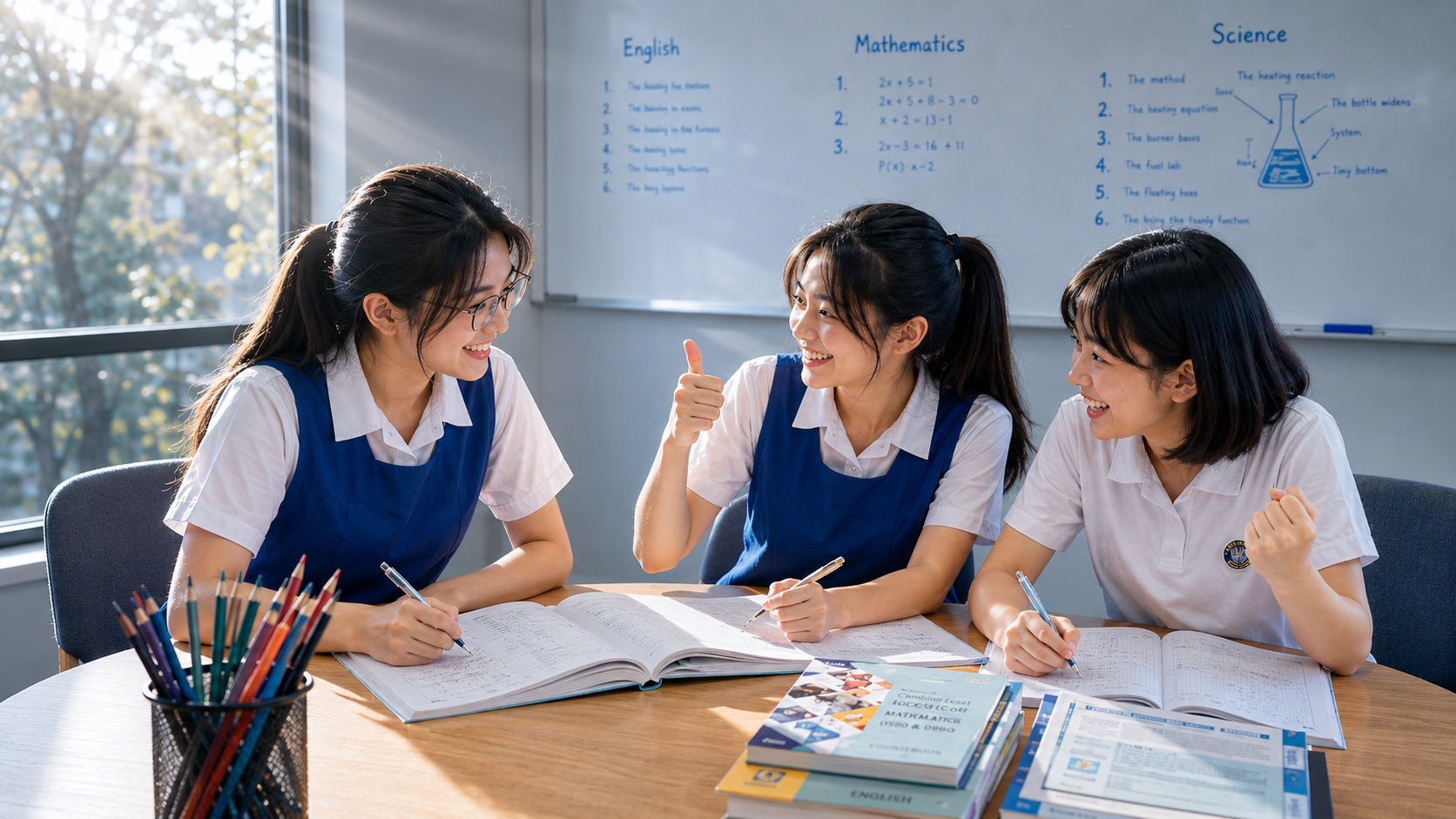
Secondary 2 Mathematics tutor for Clementi students. Premium 3-pax tutorials near Sixth Avenue MRT, strengthening algebra, accuracy and readiness for Secondary 3.
Stronger algebra. More dependable results. A carefully prepared route into upper-secondary Mathematics.
At eduKateSG, we provide premium 3-pax Secondary 2 Mathematics tutorials for students travelling from Clementi to our centre near Sixth Avenue MRT.
Secondary 2 is often treated as an ordinary middle year.
It is not.
This is the year when the Mathematics learned in Secondary 1 must become stable enough to carry a student into the heavier demands of Secondary 3. Algebra becomes more layered. Questions require longer chains of reasoning. Geometry becomes more formal. Graphs, equations and word problems begin to connect.
A student may still be passing while important weaknesses are quietly accumulating underneath.
Our Secondary 2 Mathematics tutorials are designed to find those weaknesses early, strengthen the student’s present school performance and prepare a safer transition into upper-secondary Mathematics.
Students receive:
- close guidance in a maximum 3-pax class;
- first-principles explanations;
- targeted algebra and accuracy repair;
- structured school-test preparation;
- mixed-topic retrieval practice;
- careful correction of recurring mistakes; and
- preparation for Secondary 3 Mathematics and, where appropriate, Additional Mathematics.
Lessons are conducted weekly for 1.5 hours.
Arrange a parent–student consultation with eduKate Singapore
Chat with eduKateSG on WhatsApp
Why Secondary 2 Mathematics Matters More Than It Appears
Secondary 1 introduces students to the language of secondary Mathematics.
Secondary 2 asks them to use that language with greater control.
By this stage, a student is expected to manage several mathematical processes at the same time:
- recall an earlier rule;
- identify the correct method;
- organise several steps;
- maintain signs and algebraic structure;
- calculate accurately;
- interpret the answer; and
- present the solution clearly.
The question may not be difficult because of one advanced idea.
It may be difficult because several ordinary ideas must work together without breaking.
This is why some students begin to experience unexpected instability in Secondary 2. They may understand each chapter during class but struggle when topics are mixed. They may complete homework successfully but lose control during timed assessments.
Secondary 2 exposes whether the student’s Mathematics can travel.
A method that only works immediately after a teacher demonstrates it is not yet stable knowledge.
A student is becoming ready for upper secondary when the method can still be recognised and executed:
- several weeks later;
- inside an unfamiliar question;
- alongside other topics;
- without step-by-step prompting; and
- under assessment conditions.
The Bridge Between Lower and Upper Secondary Mathematics
Secondary 2 sits between two distinct stages.
Secondary 1 is largely an entry and adaptation year.
Secondary 3 is where the academic load increases sharply. Students encounter more demanding Mathematics, more substantial Science content and, depending on their subject route, Additional Mathematics.
Secondary 2 must therefore perform two jobs.
It must strengthen current school performance while preparing the student for what comes next.
That preparation includes:
- fluent algebraic manipulation;
- confident equation solving;
- strong number control;
- accurate handling of fractions and negative values;
- clearer graph interpretation;
- stable geometry reasoning;
- the ability to connect topics; and
- disciplined written presentation.
A student who enters Secondary 3 with these systems working can concentrate on learning new concepts.
A student who enters Secondary 3 with unstable algebra must learn new concepts while simultaneously repairing old ones.
That creates a much heavier learning load.
For a deeper explanation of this transition, read Why Secondary 2 Mathematics Is a Bridge Year Before Upper Secondary.
Secondary 2 Mathematics Under Full Subject-Based Banding
Under Full Subject-Based Banding, secondary students may take subjects at G1, G2 or G3 levels according to their readiness and strengths. The former Express, Normal (Academic) and Normal (Technical) streams have been progressively replaced for cohorts entering Secondary 1 from 2024.
From 2027, the previous N(T), N(A) and O-Level certificates are combined under the Singapore-Cambridge Secondary Education Certificate, or SEC. Students sit their subjects at the respective G1, G2 or G3 subject levels, and their certificate reflects the subjects and levels taken.
This means a present-day Secondary 2 Mathematics programme should not rely on old stream labels alone.
The tutor must consider:
- the student’s Mathematics subject level;
- the school’s topic sequence;
- the pace and depth of school instruction;
- the student’s present performance;
- whether the student may be ready for a different subject level;
- the intended upper-secondary subject combination; and
- the student’s longer-term Mathematics route.
Our lessons are adjusted to the actual student rather than built around a generic Secondary 2 worksheet pack.
Who Our Secondary 2 Mathematics Tutorials Are For
The programme supports several types of learners.
Students whose Secondary 1 gaps are beginning to show
These students may struggle with:
- negative numbers;
- fractions;
- algebraic simplification;
- expansion;
- equations;
- ratio and percentage;
- graph reading; or
- writing complete solutions.
The student may have progressed into Secondary 2 without fully controlling the previous year’s foundation.
We identify the first unstable layer and rebuild from there.
Students who are passing but inconsistent
These students often produce results that move sharply between assessments.
They may score well when the paper resembles recent practice but struggle when:
- question wording changes;
- several topics are combined;
- unfamiliar values are used;
- the paper is longer;
- time becomes tight; or
- a familiar method appears in a less familiar form.
The objective is to turn temporary chapter comfort into stable mathematical performance.
Students preparing for a stronger Secondary 3 route
These students may already be coping well.
They require:
- greater algebraic fluency;
- stronger non-routine problem solving;
- cleaner explanation;
- more demanding mixed-topic work;
- better assessment discipline; and
- a deliberate runway towards upper-secondary Mathematics.
Students considering Additional Mathematics
Secondary 2 is not the time to rush mechanically into the Additional Mathematics syllabus.
It is the time to build the system that will allow Additional Mathematics to become manageable.
That system includes:
- accurate algebra;
- confident manipulation of expressions;
- strong indices and equation skills;
- graph awareness;
- procedural discipline;
- mathematical stamina; and
- willingness to work through unfamiliar structures.
A student does not prepare for A-Math by memorising A-Math chapters early.
The student prepares by making ordinary Mathematics dependable.
What Students Learn in Secondary 2 Mathematics
The exact topic sequence differs across schools and subject levels. We coordinate teaching with the student’s current school programme while strengthening the underlying mathematical connections.
Number structure and numerical control
Students may work with:
- directed numbers;
- rational and irrational numbers;
- standard form;
- approximation and estimation;
- percentage applications;
- rates and proportion;
- indices;
- squares, cubes and roots; and
- numerical problem solving.
These skills must remain accurate when they appear inside algebra, geometry and applied questions.
Algebraic manipulation
Students develop greater control over:
- simplifying expressions;
- expanding brackets;
- factorisation;
- substitution;
- algebraic fractions where applicable;
- formula manipulation;
- linear equations;
- inequalities; and
- forming algebraic expressions from written information.
At Secondary 2, algebra should begin to feel like an organised system rather than a collection of isolated tricks.
Equations and simultaneous relationships
Depending on subject level and school sequence, students may encounter questions involving:
- equations with brackets;
- equations with fractions;
- unknowns on both sides;
- simultaneous linear equations;
- graphical representations of relationships; and
- equations formed from word problems.
The central difficulty is often not solving the final equation.
It is translating the original situation into the correct mathematical relationship.
Graphs and coordinate geometry
Students may learn to:
- plot coordinates accurately;
- interpret horizontal and vertical scales;
- recognise linear relationships;
- understand gradient;
- identify intercepts;
- compare graphical patterns;
- form relationships from data; and
- extract information from graphs.
Students are taught to read graphs as mathematical stories.
A graph shows how one quantity changes in relation to another. Plotting is only the beginning.
Geometry and mensuration
Secondary 2 geometry may involve:
- angle relationships;
- polygons;
- congruence;
- similarity;
- scale relationships;
- Pythagoras’ theorem;
- perimeter and area;
- surface area and volume;
- geometric construction; and
- reasoning from diagrams.
Students must learn to separate what a diagram appears to show from what the given mathematical information proves.
Statistics and probability
Students may work with:
- data representation;
- averages;
- frequency tables;
- statistical graphs;
- comparison of data sets;
- simple probability;
- combined outcomes; and
- interpretation of results.
The objective is not only to perform a calculation.
Students should understand what the resulting value tells them about the data or event.
Why Algebra Receives Particular Attention
In Secondary 2, algebra stops being only one chapter.
It becomes the internal operating language of the subject.
Algebra appears inside:
- equations;
- geometry formulae;
- graphs;
- ratio;
- rates;
- percentage;
- statistics;
- Science calculations;
- upper-secondary Mathematics; and
- Additional Mathematics.
A student may appear to have several separate topic weaknesses when the deeper difficulty is one unstable algebra system.
For example:
- graph questions fail because substitution is inaccurate;
- geometry questions fail because formulas cannot be rearranged;
- percentage questions fail because relationships cannot be expressed;
- simultaneous equations fail because negative signs are poorly controlled; and
- word problems fail because written information cannot be translated into variables.
We therefore do not treat algebra as a chapter to finish and leave behind.
It is revisited throughout the year until students can use it with confidence.
Our First-Principles Teaching Method
Students are not expected to accept rules merely because the tutor has written them on the board.
We begin by making the structure visible.
Understand before accelerating
A student may be able to copy a procedure without understanding why it works.
That can create the appearance of progress during guided practice.
The weakness appears later when:
- the numbers change;
- the question is reversed;
- an extra bracket is added;
- a fraction appears;
- the unknown moves to another position; or
- the problem is presented in words.
At eduKateSG, students learn the reason behind the operation before being asked to perform it at speed.
Rebuild from the first unstable layer
Suppose a student repeatedly fails simultaneous equations.
The immediate temptation is to assign more simultaneous-equation worksheets.
However, the actual weakness may be:
- subtraction involving negative values;
- expansion of brackets;
- equivalent transformations;
- multiplication of an entire equation;
- poor alignment of terms; or
- difficulty deciding between elimination and substitution.
More questions will not repair the student until the true failure point is found.
We diagnose before prescribing practice.
Use the Fencing Method
A mathematical idea is first secured within a simple boundary.
For equations, the first fence might contain:
- whole numbers;
- one variable;
- one operation; and
- no brackets.
Once the student controls that environment, complexity is added carefully:
- negative coefficients;
- multiple terms;
- brackets;
- fractions;
- unknowns on both sides;
- written applications; and
- mixed-topic questions.
The student sees exactly what changed and which earlier principle still applies.
Complexity grows without confusion becoming uncontrolled.
Move from visible representations to abstraction
Where helpful, students move through a Concrete–Representational–Abstract sequence.
A concept may begin with:
- a familiar quantity or physical relationship;
- a diagram, table, number line or graph; and
- formal mathematical notation.
This is especially useful when a student has memorised an operation but has lost its meaning.
Think aloud
Students are regularly asked:
- What is given?
- What must be found?
- Which relationship connects them?
- Why did you choose this method?
- What does this line of working accomplish?
- Does the answer make sense?
- How can the answer be checked?
A student who can explain the route is more likely to reproduce it independently.
A student who cannot explain the route may still be depending on imitation.
Retrieval, Interleaving and Mixed-Topic Control
School Mathematics is usually introduced by chapter.
Assessments do not always preserve those chapter boundaries.
A student may meet algebra, geometry and percentage within the same paper. The question does not announce which method should be used.
The student must identify it.
This is why our practice does not remain permanently chapter-based.
Retrieval practice
Students are asked to recall earlier knowledge after time has passed.
This reveals whether learning has been retained or was only temporarily familiar.
Interleaved practice
Different topics are mixed within a short set.
The student must first recognise the problem structure before selecting a method.
Spaced review
Important ideas return across several weeks rather than disappearing after one worksheet has been completed.
Cumulative micro-tests
Short assessments allow us to check whether earlier skills remain available while new content is being learned.
This is how Mathematics begins to become a connected system.
A Typical 90-Minute Secondary 2 Mathematics Tutorial
Each lesson is responsive to the students, but the underlying flow remains deliberate.
1. Retrieval warm-up
Students begin with several short questions drawn from previous topics.
This reactivates prior knowledge and allows the tutor to detect early signs of forgetting.
2. Concept instruction
The tutor explains the central idea for the lesson.
Definitions, relationships and misconceptions are made explicit.
3. Guided practice
Students begin solving with support.
The tutor observes:
- how the question is read;
- which method is selected;
- how working is organised;
- where hesitation begins; and
- which errors repeat.
4. Independent practice
Support is gradually removed.
The student must demonstrate that the method can be executed without continuous prompting.
5. Mixed or timed application
The new concept is combined with earlier content or placed inside a short timed set.
This checks whether the student can recognise and use the method under a more realistic load.
6. Error analysis
Mistakes are examined rather than simply marked wrong.
Students identify whether the failure came from:
- concept;
- recall;
- reading;
- arithmetic;
- algebra;
- notation;
- method selection;
- incomplete working; or
- time pressure.
7. Focused continuation work
Home practice is selected according to the student’s next requirement.
The work is purposeful and contained.
The intention is not to measure effort by the thickness of the worksheet.
Why Three Students Work Well for Secondary 2 Mathematics
Secondary 2 students are old enough to hide confusion effectively.
They may copy from the board, remain quiet and appear attentive while understanding only part of the lesson.
A maximum 3-pax class makes that much harder.
Each student must participate.
The tutor can see:
- how the student starts;
- whether the correct method is selected;
- when the student pauses;
- whether notation is being used correctly;
- how corrections are received; and
- whether the same error returns.
Immediate feedback
A sign error can be corrected before it is repeated across an entire page.
Customised pacing
One student may require a brief review of fractions while another needs a more demanding extension question.
A small class allows these adjustments to happen naturally.
Frequent explanation
Each student has opportunities to describe a method and defend a choice.
Productive peer learning
Students can compare approaches and notice that the same question may sometimes be solved through different valid routes.
Calm accountability
There is nowhere to disappear, but the setting remains supportive.
The student is seen without being placed under the social pressure of a large classroom.
Three Secondary 2 Learning Pathways
Bridging and repair
For students carrying significant gaps from Secondary 1 or Primary Mathematics.
The programme may prioritise:
- number control;
- fractions;
- negative values;
- basic algebra;
- equations;
- ratio;
- percentage; and
- correct mathematical writing.
The objective is to restore access to the current syllabus.
Core consolidation
For students who are passing but not yet dependable.
The programme focuses on:
- retention;
- mixed-topic recognition;
- reduction of repeated mistakes;
- clearer workings;
- school-test preparation;
- speed with control; and
- stable independent practice.
The objective is to replace fluctuating performance with a reliable Mathematics system.
Upper-secondary readiness
For students who are secure and ready for greater depth.
The programme may include:
- more complex algebra;
- unfamiliar applications;
- multiple methods;
- stronger explanation;
- higher-load mixed sets;
- pre-teaching of selected concepts; and
- preparation for the demands of Secondary 3.
The objective is depth, not uncontrolled acceleration.
Careless Mistakes Are Usually Not One Problem
Parents often say that a child “understands everything but is careless”.
Sometimes that is accurate.
More often, several different error types have been placed inside one convenient label.
Reading error
The student overlooks a condition or misreads what must be found.
Sign error
The student loses a negative sign during expansion, substitution or rearrangement.
Arithmetic error
The mathematical method is correct, but the calculation fails.
Copying error
A number, exponent or symbol changes between lines.
Structural error
The student performs an operation on one term instead of the entire expression.
Method-selection error
A familiar procedure is used for a question with a different structure.
Presentation error
Unclear working makes it difficult for the student to see where the reasoning changed.
Time-pressure error
The student accelerates beyond the level at which accuracy can be maintained.
Each error requires a different correction.
Telling all these students to “be more careful” is unlikely to solve the underlying problem.
We identify the category, install a suitable checking behaviour and test whether the correction holds.
Our Error-Correction Cycle
A mistake becomes useful when it changes future behaviour.
Our correction process asks the student to:
- locate the first incorrect line;
- identify the type of error;
- explain why it happened;
- solve the question correctly;
- state the check that could have caught it; and
- apply the correction to a related question.
This converts a wrong answer into a reusable lesson.
Over time, students begin to recognise their own patterns.
One student may learn to check signs after every expansion.
Another may draw a labelled diagram before using a geometry formula.
Another may estimate the answer before performing a percentage calculation.
The correction becomes personal because the error pattern is personal.
Preparing for Secondary 3 Mathematics
Secondary 3 is not simply Secondary 2 with more difficult numbers.
The curriculum becomes more demanding because:
- the number of connected topics increases;
- algebra becomes more heavily embedded;
- multi-step questions become more common;
- assessment expectations rise;
- other subjects also become heavier; and
- students may begin Additional Mathematics.
The preparation for Secondary 3 should therefore begin before the first Secondary 3 lesson.
By the end of Secondary 2, we want students to be able to:
- manipulate algebra without excessive hesitation;
- solve equations cleanly;
- manage negative values accurately;
- interpret graphs;
- use formulas confidently;
- reason from geometric information;
- translate worded relationships;
- retain earlier topics;
- work independently; and
- complete a mixed set without collapsing when the chapter changes.
These abilities create space for new learning.
Without them, every new topic competes with unfinished repair work.
Preparing for Additional Mathematics Without Rushing It
Some students will later take Additional Mathematics at the G2 or G3 level, depending on their school offering and subject route. The 2027 SEC subject listings include Mathematics and Additional Mathematics among the available examination subjects at the relevant levels.
However, early preparation should not consist of racing through calculus or trigonometric identities before the student is ready.
A stronger preparation sequence is:
- stabilise arithmetic;
- build fluent algebra;
- strengthen expansion and factorisation;
- improve equation control;
- understand graphs and relationships;
- maintain clean mathematical working; and
- develop the stamina to solve unfamiliar problems.
Additional Mathematics amplifies algebra.
If the algebra floor is weak, the new subject feels disproportionately difficult.
If the algebra floor is strong, the student can focus on the new mathematical idea instead of fighting the notation surrounding it.
Read How Secondary 2 Mathematics Tuition Prepares Students for Additional Mathematics.
Teaching Ahead Without Creating Fragile Learning
We teach ahead of school where it benefits the student.
Pre-teaching gives the child a calm first encounter with a topic.
When the topic later appears in school:
- the vocabulary is familiar;
- the notation has already been seen;
- the student can follow explanations more easily;
- school practice becomes reinforcement; and
- confidence comes from recognition.
However, teaching ahead must not become syllabus racing.
A student who has “covered” Secondary 3 content but cannot reliably solve Secondary 2 equations is not genuinely ahead.
The new content is resting on an unstable platform.
Our approach is to pre-teach selectively while continuing to protect the foundations underneath.
What Meaningful Progress Looks Like
A test score is important, but it is not the only early sign of improvement.
Parents may notice that the student:
- starts homework with less avoidance;
- requires fewer prompts;
- explains methods more clearly;
- produces neater working;
- retains older topics for longer;
- notices unreasonable answers;
- asks more precise questions;
- makes fewer repeated sign mistakes;
- works more calmly under time pressure; and
- responds to unfamiliar questions with a plan.
These are not small changes.
They show that the student is moving from dependence towards mathematical control.
Marks become more sustainable when understanding, recall, accuracy, method selection and exam execution begin working together.
When Should a Clementi Student Start Secondary 2 Mathematics Tuition?
Parents do not need to wait for failure.
Support may be appropriate when:
- Secondary 1 foundations remain uncertain;
- algebra causes visible frustration;
- results fluctuate significantly;
- the child cannot complete homework independently;
- mistakes repeat after correction;
- older topics are quickly forgotten;
- the child depends on worked examples;
- mixed-topic papers cause a sharp drop;
- school pace feels increasingly fast;
- confidence has started to fall;
- the child is preparing for a stronger upper-secondary route; or
- Additional Mathematics is being considered.
The best time to intervene is usually when a repeated pattern first becomes visible.
At that point, the repair is smaller and the student still has time to consolidate before Secondary 3.
Read When to Start Secondary 2 Mathematics Tuition.
Convenient Access from Clementi to Sixth Avenue MRT
eduKateSG conducts small-group Mathematics tuition near Sixth Avenue MRT, with the location positioned for families travelling from Clementi, Holland, Bukit Timah and nearby western districts.
Students travelling by train can take the East–West Line from Clementi to Buona Vista, transfer to the Circle Line for Botanic Gardens and continue on the Downtown Line to Sixth Avenue.
The route is predictable and largely sheltered.
For families who value a suitable tutor over the nearest large classroom, the journey provides access to a quieter 3-pax learning environment without travelling into the city centre.
Location: eduKateSG, near Sixth Avenue MRT
Class format: Maximum 3 students
Lesson duration: 1.5 hours weekly
Attendance: By consultation and suitable class placement
Class Details
Level: Secondary 2 Mathematics
Subject levels: G1, G2 and G3 Mathematics, according to the student’s school route and learning needs
Format: Premium 3-pax small-group tutorials
Duration: 1.5 hours weekly
Programme elements:
- school-topic support;
- foundation repair;
- algebra consolidation;
- first-principles instruction;
- guided and independent practice;
- mixed-topic retrieval;
- error analysis;
- timed micro-tests;
- assessment preparation; and
- Secondary 3 readiness.
Materials may include:
- curated lesson notes;
- topic drills;
- mixed revision sets;
- school-assessment-style questions;
- correction exercises;
- diagnostic questions; and
- focused home practice.
Additional preparation may be arranged around significant school assessments, subject to class scheduling.
How Placement Works
1. Parent–student consultation
We discuss:
- present results;
- school and subject level;
- recurring concerns;
- learning habits;
- confidence;
- upcoming assessments; and
- intended upper-secondary route.
2. Academic review
Recent school papers and assignments help us identify:
- concept gaps;
- algebra weaknesses;
- careless-error patterns;
- topic-specific difficulties;
- timing problems; and
- presentation issues.
3. Suitable 3-pax placement
Students are placed according to:
- level;
- pace;
- present readiness;
- timetable; and
- compatibility with the existing class.
4. Initial learning priorities
The tutor determines whether the first stage should emphasise:
- repair;
- consolidation;
- school-test support;
- extension; or
- preparation for Secondary 3.
Limited trial lessons may occasionally be possible when the 3-pax class configuration permits. The usual first step is a consultation because the class must remain appropriately matched.
What Parents Can Bring to the Consultation
Useful materials include:
- recent weighted assessment papers;
- marked class tests;
- school worksheets;
- the current textbook;
- the school’s topic schedule;
- teacher comments;
- examples of incomplete homework; and
- questions the child repeatedly finds difficult.
A score alone does not explain the student.
Two students may both score 60%, but one may have strong understanding with poor time management while the other has substantial algebra gaps.
Their programmes should not be identical.
The working reveals what the final mark cannot.
Frequently Asked Questions
Why is Secondary 2 considered a bridge year?
Secondary 2 is the final full year in which lower-secondary foundations can be consolidated before the heavier Secondary 3 curriculum begins. Students need stable algebra, number control, geometry reasoning and independent problem-solving habits before upper-secondary demands increase.
My child passed Secondary 1 Mathematics. Why is Secondary 2 becoming difficult?
Passing Secondary 1 does not always mean every foundation is secure.
Some students rely on recent examples, familiar worksheets or repeated question patterns. Secondary 2 introduces more connected questions and places greater load on algebra, retention and method selection.
Is Secondary 2 Mathematics only about preparing for Secondary 3?
No.
The first objective is to improve the student’s present understanding and school performance.
Secondary 3 readiness is built through the same work: stronger algebra, cleaner methods, better retention and more dependable execution.
Do you support G1, G2 and G3 Mathematics?
Yes.
The teaching depth, pace and materials are adjusted to the student’s subject level, school programme and present readiness.
Do you teach E-Math in Secondary 2?
At Secondary 2, students are still building the lower-secondary Mathematics foundation.
The familiar term E-Math is generally associated with the upper-secondary examination route. Our Secondary 2 programme prepares the number, algebra, geometry, graph and problem-solving systems required for later Mathematics.
Do you prepare students for Additional Mathematics?
We prepare the foundations needed for Additional Mathematics.
This includes fluent algebra, equation control, factorisation, graph understanding, accurate working and the ability to manage unfamiliar mathematical structures.
We do not rush students into advanced chapters while their current Mathematics remains unstable.
How do you help a student who keeps forgetting earlier topics?
Earlier concepts are returned through retrieval practice, spaced review, mixed-topic sets and cumulative micro-tests.
Students need to retrieve a method after time has passed, not only repeat it immediately after the lesson.
How do you reduce careless mistakes?
We classify the mistake before correcting it.
A sign error, reading error, arithmetic error and timing error require different responses. Students learn a checking routine matched to their recurring pattern.
My child understands during tuition but performs poorly in tests. Why?
Understanding during a guided lesson is only one stage.
The student may still need to develop:
- independent retrieval;
- method recognition;
- speed;
- mixed-topic flexibility;
- working discipline;
- assessment stamina; and
- control under pressure.
We test whether the learning can survive without immediate tutor prompts.
Do you follow the school’s topic sequence?
We coordinate with school topics and upcoming assessments.
However, we may also revisit an earlier foundation if it is preventing the student from understanding the current chapter.
Do you teach ahead?
Yes, when the student is ready.
Pre-teaching is used to create familiarity and confidence, not to race through the syllabus.
Can a student join halfway through Secondary 2?
Yes, subject to a suitable class placement.
We first identify the student’s present level and the amount of bridging required.
How quickly will results improve?
Some students show stronger confidence, clearer workings and improved accuracy within several lesson cycles.
Larger foundation gaps require more time. Progress depends on attendance, present readiness, practice between lessons and how close the student is to an assessment.
Is a 3-pax class suitable for a quiet student?
Yes.
A small group gives the student frequent opportunities to respond without the pressure of speaking before a large class. The tutor can also notice hesitation and invite the student into the discussion carefully.
Why travel from Clementi instead of joining a larger class nearby?
A nearby large class may be sufficient for general revision.
A 3-pax tutorial is more suitable when the student needs close checking of workings, customised pacing, frequent explanation and targeted repair.
Helpful Reading for Clementi Parents
- Secondary Mathematics Tuition Clementi — 3-Pax Small Groups
- Secondary 2 Mathematics Tuition Hub
- What Happens in Secondary 2 Mathematics Tuition?
- Why Secondary 2 Mathematics Is a Bridge Year
- How to Improve in Secondary 2 Mathematics
- When to Start Secondary 2 Mathematics Tuition
- Secondary 2 Mathematics Master Index
- Secondary 2 Math Tutor in Bukit Timah
- MOE Secondary Curriculum and Syllabuses
- SEAB Singapore-Cambridge Secondary Education Certificate
Secondary 2 Mathematics Tutor for Clementi Families
Secondary 2 is the year to make Mathematics dependable.
Not temporarily familiar.
Not correct only when the worksheet follows the classroom example.
Not stable only when the tutor is sitting beside the student.
Dependable Mathematics means the student can:
- recognise the structure;
- choose an appropriate method;
- execute the steps accurately;
- notice when an answer is unreasonable;
- correct mistakes;
- retain earlier learning; and
- continue working when the question looks unfamiliar.
At eduKateSG, our premium 3-pax Secondary 2 Mathematics tutorials give the tutor enough space to see how each student thinks.
For students who have gaps, we repair the missing structure.
For students whose marks fluctuate, we build consistency.
For students preparing for upper secondary, we deepen algebra, reasoning and independent control.
The aim is not simply to complete Secondary 2.
It is to leave Secondary 2 ready.
Arrange a Parent–Student Consultation
Speak with eduKateSG about your child’s:
- present Mathematics level;
- school performance;
- recurring mistakes;
- assessment timetable;
- Secondary 3 readiness; and
- suitable 3-pax class placement.
Chat with eduKateSG on WhatsApp
eduKateSG
Near Sixth Avenue MRT
Premium 3-pax Secondary Mathematics tutorials
1.5-hour weekly lessons
By consultation and suitable class placement
Properly taught kids shine a bright light into the future.