
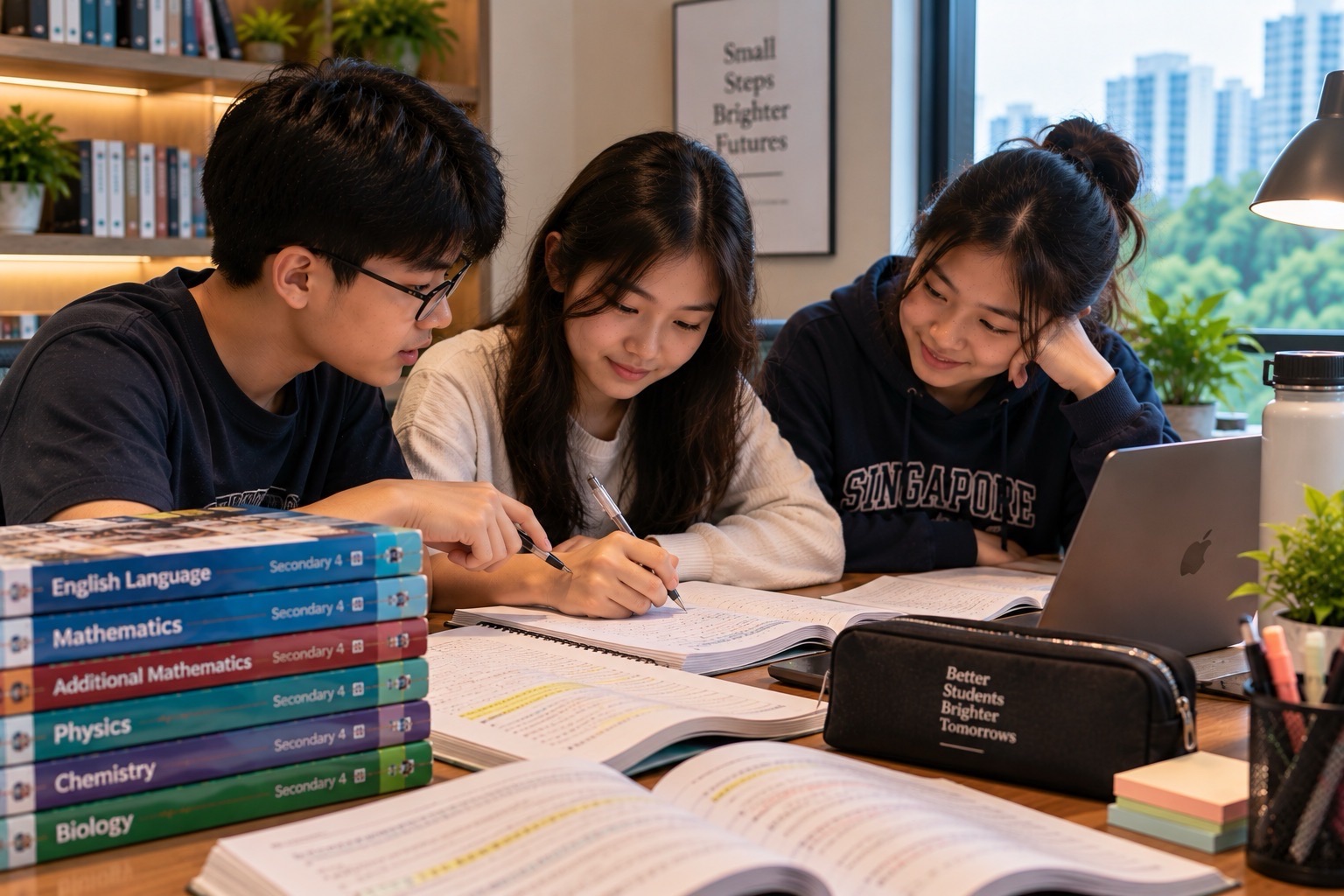
EDUKATE · ONE-NORTH · SECONDARY 2 PHYSICAL SCIENCE · G1/G2/G3 · PREMIUM THREE-PAX TUTORIALS
Secondary 2 Physics Tuition | one-north Weekday or Weekend Parent Dilemma
Secondary 2 Physics tuition near one-north should help children explain diagrams and physical systems independently. Choose weekdays if the pupil can repair a fresh school mistake while alert, or weekends if deliberate safe investigations and changed questions fit better. Judge the result by a later independent task, not the number of completed worksheets.
In Singapore, Secondary 2 Physics-related topics normally sit within G1, G2 or G3 lower-secondary Science, not a separate Pure Physics examination paper. This guide covers light, electricity, sound, heat, measurement and scientific reasoning at appropriate levels, with explicitly labelled extensions rather than claims that every school teaches identical material.
NParks describes one-north Park as connecting Biopolis, Fusionopolis, Mediapolis and Rochester. These are local contexts, not a claim that eduKate operates inside a research building. The established premium three-student tuition reference is 8 Fourth Avenue near Sixth Avenue MRT; confirm actual venue, programme and vacancies.
| Parent question | Weekday | Weekend |
|---|---|---|
| Potential strength | New school diagram errors still remembered | More time for safe experiments and careful explanation |
| Main risk | School fatigue, CCA and travel | Overlong enrichment and delayed school corrections |
| Proof afterward | Unseen diagram solved without hints | Unseen diagram solved without hints |

A complete parent and student Physics-related Science guide
- Secondary 2 asks for explanations across connected systems
- Secondary 2 physical science remains lower-secondary Science
- one-north’s park is a green corridor, not a single destination
- A research district can prompt honest questions about electricity
- Why weekday tuition may fix a diagram error sooner
- Why a weekend lesson can improve experimental reasoning
- Count the whole journey from school or home
- A scientific model should explain what each line represents
- Start reflection with the normal rather than an angle formula
- Original reflection example: two references for one ray
- Why shadows require clearly defined positions
- A circuit with an open switch must be read by its connections
- Series versus parallel requires tracing branches
- A current-junction calculation should obey conservation
- Current, potential difference and resistance are not the same quantity
- Original optional resistor example: a simple parallel pair
- Electrical energy should not be confused with electrical power
- Heat transfer begins with a system and an observation
- Original cooling example: the graph gives a rate, not a cause
- Sound needs a medium: physical model before calculation
- Original echo example: sound makes a round trip
- Experimental control matters more than tidy-looking readings
- Graph interpretation starts with units and scale
- The Fencing Method teaches one relationship before adding branches
- Repair, Stabilisation and Extension are separate responses
- The Four Contact Points around a learner
- A possible ninety-minute premium three-pupil lesson
- A four-week plan prioritises transfer instead of volume
- Secondary 2 should prepare choices without locking them in
- A consultation should clarify scope and venue
Secondary 2 asks for explanations across connected systems
A Secondary 2 Science student may recognise a circuit symbol, mirror or cooling graph yet struggle when the same concept appears in an unfamiliar setting. The challenge is often connecting the scientific representation to what happens physically, rather than simply remembering one more definition. A good Physics-related tutorial should inspect that connection before assigning work.
For parents travelling through one-north, the first question is not whether the timetable contains a vacant Wednesday or Saturday. Ask where the student’s first incorrect decision occurred in real schoolwork. A diagram may have been misread, a unit confused or a plausible inference presented as an observation.
The lesson should repair that specific error, demonstrate the relevant model and require a different question solved without prompts. After a short delay, test again. This gives the family a meaningful measure of learning. A pile of completed questions is not enough when the pupil still waits for the tutor to choose the method.
Secondary 2 physical science remains lower-secondary Science
Under Full Subject-Based Banding, a pupil may take lower-secondary Science at G1, G2 or G3. MOE’s G1 curriculum and G2/G3 lower-secondary syllabus are distinct, and the school’s subject sequence determines which ideas are appropriate for immediate assessment. Secondary 2 is not automatically a standalone Pure Physics examination course.
A tutor should check whether electricity, light, heat, sound or experimental design is actually being taught in the present unit. Some examples in this guide are deliberate extensions: they may strengthen physical reasoning without being compulsory calculations for every level at the same time.
Parents should bring the exact school topic and a marked response. Ask the tutor to explain the relationship between the selected exercise and the stated subject-level learning outcomes. The aim is not to impress families with an advanced workbook. It is to make the child’s real school Science more understandable and transferable.
one-north’s park is a green corridor, not a single destination
NParks describes one-north Park as a connected green corridor with sections at Biopolis, Fusionopolis, Mediapolis and Rochester. It connects people between important district developments, but individual sections differ in their access routes. The park and the wider precinct therefore make useful reference points for families and scientific observation.
These features do not establish a tuition classroom inside one-north, nor do they tell parents precisely how long a journey from school will take. A weekday pupil might arrive from an entirely different part of Singapore after CCA; a weekend trip may begin near home or another family activity.
The established eduKate premium three-pupil tutorial reference remains at 8 Fourth Avenue near Sixth Avenue MRT. Confirm the actual programme, room, class size, fee and availability directly. one-north in this article identifies a family search and commuting area, not a new teaching branch.
A research district can prompt honest questions about electricity
The buildings and laboratories around one-north may invite a child to ask how lighting, electronic equipment or environmental systems work. Curiosity is useful, but seeing a large building does not reveal its circuit arrangement, actual electricity consumption or daily energy bill. Those quantities require technical information or direct measurements.
A tutor can convert that curiosity into a fictional classroom model: draw a safe low-voltage circuit with a cell, lamp and switch. Ask the learner to identify the path, predict whether the lamp lights and explain what changes when the switch opens. The model need not pretend to describe any actual laboratory wiring.
This habit separates an observed setting from a justified calculation. Scientific learning becomes more engaging without inventing claims about a specific company or building. A child who requests the missing measurements is reasoning more accurately than one who guesses impressive-looking numbers.
Why weekday tuition may fix a diagram error sooner
A student who recently misread a reflection diagram may still remember why they measured an angle from the mirror rather than its normal. A weekday lesson can reconstruct that decision while the original school explanation is fresh. The tutor can then redraw the mirror at a different orientation to see whether the correction really transfers.
The limitation is mental energy. School, homework, CCA and travel may leave the learner barely able to read the question. A perfect answer obtained while the tutor provides every first step is weak evidence. Parents should consider meals, journey length and attention before treating prompt feedback as a universal advantage.
Keep an unseen angle or circuit question for the following day. The pupil must explain it without the original solution in view. This delayed independent result is a better indicator of a useful weekday than the amount of work completed during tuition.
Why a weekend lesson can improve experimental reasoning
A weekend class may provide room for a small investigation: measure, predict, observe, repeat and discuss why readings differ. The learner can test a safe circuit model or use ray diagrams to compare reflections without being rushed into another activity immediately afterward.
But a long weekend is not automatically a good one. Overlapping enrichment programmes can remove the recovery a Secondary 2 student needs. A tutor who fills the extra time with repetitive questions may also create false confidence because the child sees the same form over and over.
Ask how the lesson will end. A useful exit task changes one meaningful condition and requires the pupil to begin alone. An additional short home retrieval several days later checks whether the learning survives outside the classroom. The best weekend class has a clear scientific purpose and a sustainable family cost.
Count the whole journey from school or home
NParks lists one-north and Buona Vista MRT access near different one-north Park sections. The proximity of a park section to one station does not determine travel from the child’s school to the actual teaching room. A Tuesday journey beginning after CCA can be entirely different from a Saturday trip from home.
Make a real plan: identify the school dismissal time, CCA, expected meal, journey to 8 Fourth Avenue if that is the confirmed class venue, lesson duration and return home. Avoid treating a map’s straight-line distance as the student’s actual commuting time.
Parents can then compare alertness and the quality of independent work for the available slots. The best timetable supports accurate model selection after tuition without damaging the next school day. This is a reasoned practical decision, not a vote on whether weekends are naturally more academic.
A scientific model should explain what each line represents
An electrical diagram is not a photograph of wires laid out exactly as they appear in a real room. A circuit symbol represents a component, and a connecting line represents an electrical connection in the simplified model. A student should be able to explain what the symbols mean before using any circuit rule.
Similarly, a drawn light ray represents a direction of propagation rather than a literal visible string. A cooling graph records a relationship between measured variables rather than a physical path travelled through space. These distinctions help learners avoid treating all diagrams as pictures.
A strong tutorial asks the pupil to translate between words, an illustration, a symbol diagram and a short explanation. When the student can do this with a changed representation, they are less likely to depend on the familiar layout of one worksheet.
Start reflection with the normal rather than an angle formula
For reflection from a plane mirror, the normal is drawn perpendicular to the surface at the point of incidence. The angle of incidence and angle of reflection are measured relative to that normal. A pupil who measures from the mirror surface may produce an apparently reasonable but incorrect answer.
Draw the surface, identify the point where the ray meets it, then draw the normal and label the incoming direction. Only then state the relationship between incidence and reflection angles. The model can be tested by rotating the mirror drawing while keeping the rule unchanged.
If the school has not covered formal reflection yet, treat this as an extension rather than an assumed Secondary 2 requirement. The lasting scientific habit is respecting how a diagram defines its quantities. Correct definitions make later calculations straightforward.
Original reflection example: two references for one ray
An illustrative light ray strikes a plane mirror at an angle of 27° to the normal. The angle of reflection is also 27° to the normal. Since the normal is perpendicular to the mirror, the angle between the reflected ray and the mirror surface is 90° – 27° = 63°.
Now change the wording: the incident ray is 35° to the mirror surface. Its incidence angle is 90° – 35° = 55° to the normal. The reflected ray is therefore 55° to the normal, or 35° to the surface. The two forms describe the same geometric relationship using different reference lines.
Ask the pupil to draw the ray diagram before calculating. A student who still uses 35° as the incidence angle has probably memorised an angle without understanding its reference. A changed orientation of the page offers a useful transfer check.
Why shadows require clearly defined positions
A shadow can change with the positions and dimensions of a light source, object and screen. Students sometimes memorise that moving an object makes a shadow larger, without specifying which way the object is moved or what remains fixed.
A safe classroom model can keep the light and screen positions fixed while adjusting the object’s location along a defined path. The pupil predicts a change before making it, records observations and explains the geometry. If multiple objects or distances move at once, several explanations may fit the result.
The park landscape near one-north offers everyday shadows, but a photograph does not provide exact solar angles, distances or shadow lengths. A scientific answer should use supplied measurements, a defined model or a careful observation rather than inventing numbers attached to a familiar site.
A circuit with an open switch must be read by its connections
In a simple classroom circuit, a switch interrupts or completes a conducting path. It does not create energy or mysteriously store all the charge when open. Ask the student to trace a complete path from the source through the intended components and back before predicting whether the lamp lights.
Draw the same physical connections in a different shape. A learner who changes their prediction solely because the diagram is rearranged has been relying on appearance. The electrical paths, not the artistic outline, determine the simplified circuit behaviour.
Use only school-approved low-voltage equipment when practical work is appropriate. Household mains electricity is dangerous and not suitable for informal student experimentation. An accurate circuit diagram and a supervised kit are enough to develop the target reasoning.
Series versus parallel requires tracing branches
Series components share a single conducting path in the suitable simple model. Parallel branches provide different current paths connected across the same pair of nodes. A student who memorises ‘series is straight and parallel is side by side’ may fail on a circuit drawn with unusual bends.
Have the learner mark the junctions and trace the paths. A switch that interrupts one parallel branch does not necessarily interrupt another complete branch. Conversely, opening the only shared supply path can affect all branches.
Avoid unqualified claims that a certain arrangement always produces a brighter bulb. Real brightness depends on component properties and the circuit conditions. At Secondary 2, the priority is selecting the correct network model and explaining what the diagram actually establishes. Numerical extensions should follow the school’s subject-level teaching sequence.
A current-junction calculation should obey conservation
Imagine an ideal steady circuit with 0.75 A reaching a junction and dividing into two branches. If one branch carries 0.28 A, the other branch must carry 0.75 – 0.28 = 0.47 A. The numerical subtraction represents a physical accounting of current under the stated model.
Ask the pupil to draw directional arrows. If the diagram is flipped on the page, the same conservation relationship must apply when the current directions remain equivalent. Merely reading numbers from left to right is not a reliable method.
For a changed question, let three branches carry 0.15 A, 0.25 A and an unknown amount from a total 0.90 A. The missing branch current is 0.50 A. This is an extension wherever appropriate; not every G1/G2/G3 learner will be assessed on the identical calculation at the same point.
Current, potential difference and resistance are not the same quantity
Current is measured in amperes; potential difference in volts; resistance in ohms. A pupil who labels all three as the amount of ‘electricity’ may struggle with diagrams even when they remember the instrument symbols. The tutor should teach the distinct questions that these quantities answer.
An ammeter is connected appropriately to measure current in the relevant path, while a voltmeter measures potential difference across the relevant component or pair of points. Whether a reading makes sense depends on the circuit and connection arrangement.
An explanation should identify the requested physical quantity before selecting a measurement or calculation. Rushing to an Ohm’s law formula without recognising the model’s assumptions or the child’s actual syllabus is often unhelpful. Build a clear concept first; extend the mathematics only when the learner is ready.
Original optional resistor example: a simple parallel pair
Consider two ideal fixed resistors of 6.0 Ω and 3.0 Ω connected in parallel across an ideal 6.0 V source. Each branch has 6.0 V across it in this model. Current through the 6.0 Ω resistor is 6.0/6.0 = 1.0 A; through the 3.0 Ω resistor it is 6.0/3.0 = 2.0 A. Total current is 3.0 A.
The equivalent resistance is therefore 6.0/3.0 = 2.0 Ω, consistent with the parallel-resistance formula. The answer’s significance is that adding another branch provides more total current path and lowers the equivalent resistance under the stated ideal conditions.
This example is a deliberately labelled extension, not a claim that every Secondary 2 lower-secondary Science assessment includes parallel-resistance calculations. The transferable habit is identifying shared nodes, compatible units and a sensible conservation check.
Electrical energy should not be confused with electrical power
Power describes a rate of energy transfer. Energy describes the quantity transferred. An imaginary low-voltage device operating steadily at 12 W for 20 s transfers 12 × 20 = 240 J. If it runs for 40 s at the same power, it transfers 480 J, although its power rating remains 12 W.
A learner who states ‘240 watts of energy’ has mixed a rate with a total. Ask the student which quantity the question gives and how the time interval affects the result. The units W and J are meaningful parts of the explanation.
No conclusion about the actual power consumption of Biopolis laboratories or Fusionopolis buildings follows from this classroom example. Real facilities require real meter readings or technical specifications. A credible Science answer should never treat a recognisable place as a substitute for data.
Heat transfer begins with a system and an observation
A metal spoon placed in warm water can gain thermal energy through interaction with the water, but a scientifically complete account names the objects and what change is observed. Saying only ‘heat goes up’ provides neither a defined system nor a clear mechanism.
A school experiment may compare different container materials or insulation. To interpret the result, the pupil should inspect water volume, starting temperature, timing and surrounding conditions. If several factors vary, any temperature difference may have competing explanations.
Conduction, convection and radiation have distinct meanings. A good tutor introduces the relevant mechanism at a depth appropriate to the child’s actual Science level, avoiding both vague slogans and unrelated advanced formulas. The learner should connect the mechanism to the evidence instead of listing all known thermal terms automatically.
Original cooling example: the graph gives a rate, not a cause
An invented experiment records water at 70 °C and then 58 °C after six minutes. Temperature change is -12 °C and the average rate is -2 °C per minute. A second sample starting at 70 °C and ending at 64 °C over the same interval changes at -1 °C per minute.
These results show that the first sample had a greater average rate of temperature decrease in magnitude during the measured interval. They do not, by themselves, establish which heat-transfer mechanism caused the difference. That interpretation would need a defined setup and additional information.
The pupil should first describe the measured trend, then suggest a plausible cause supported by the experimental conditions. A curve does not explain itself. This division between observation and inference is central to reliable data-based Science answers.
Sound needs a medium: physical model before calculation
A vibrating source can create a sound disturbance that propagates through a material medium. A student may confuse a moving wave pattern with a continuous journey of each particle from source to listener. Ask how a disturbance can pass along a medium while individual parts mainly oscillate about their positions.
A ruler vibrating at a desk under safe supervision can be a useful classroom demonstration. The pupil should identify what vibrates and what receives the sound, then consider what a simplified model can and cannot explain.
Sound cannot travel through a perfect vacuum as a mechanical wave. Avoid treating film sound effects in outer space as scientific evidence. This is a conceptual lesson that may precede formal wave equations; the order and depth must reflect the school’s syllabus.
Original echo example: sound makes a round trip
An illustrative echo is heard 1.2 s after a sound pulse in an idealised still-air problem. If a question supplies sound speed 340 m/s, the sound travels a total path of 340 × 1.2 = 408 m. Since the echo goes to a reflecting surface and returns, the one-way distance is 408/2 = 204 m.
The factor of two is the important physical step. A pupil who reports 408 m as the reflector’s distance has calculated the whole travelled path but answered the one-way question incorrectly. Drawing outgoing and returning arrows makes the reasoning visible.
This is a hypothetical extension, not a measurement of echoes from one-north buildings. It should not be assigned indiscriminately to children who have not yet covered the relevant sound model. Its value is showing how a simple diagram prevents a plausible numerical error.
Experimental control matters more than tidy-looking readings
Suppose students compare how far a toy vehicle moves on different table surfaces. If they also change the toy, release height or starting push, a difference in travel distance cannot be confidently attributed to surface type alone. A fair test controls plausible competing influences.
The learner should justify each chosen control: what alternative explanation would it eliminate? This goes beyond copying the words ‘independent’, ‘dependent’ and ‘controlled variable’ into worksheet boxes.
Real trials may produce slightly different readings. Record them, repeat where appropriate and discuss limitations without manufacturing a perfectly smooth data table. A scientifically honest investigation may support a conclusion with uncertainty; it should not pretend that every instrument and human action was error-free.
Graph interpretation starts with units and scale
A line that looks steep may represent a large rate of change, but only when the axes, quantity definitions and scale are known. A graph of temperature against time and one of distance against time can look similar while describing entirely different physical systems.
Before calculating, have the pupil say what one horizontal division and one vertical division mean. Then choose two valid plotted points and explain the units of a gradient. Drawing an attractive line is not a substitute for reading the measurements accurately.
Where points scatter, do not invent exact relations merely because a textbook diagram looked straight. A suitable best-fit interpretation depends on the task. Scientific graphs are arguments from data, and pupils should know how strongly the data support their stated trend.
The Fencing Method teaches one relationship before adding branches
In eduKate’s Fencing Method, the tutor begins with a clearly bounded model and introduces complexity deliberately. For electricity, start with a single safe cell-lamp-switch circuit. Ask whether the conducting path is complete. Then add one independent branch and check whether the pupil can trace both paths.
Only after the basic network is secure should the tutor introduce a different diagram layout, measurements or numerical relationships. In reflection, begin with a normal and a known incidence angle, then rotate the surface or change the angle reference.
If the student fails after a new condition is added, the tutor can identify the specific extra demand. This is more useful than announcing that the entire topic needs to be retaught. The aim is eventual success on unfamiliar problems, reached through controlled, visible changes.
Repair, Stabilisation and Extension are separate responses
Repair is necessary when a core concept is missing. A pupil measuring an incidence angle from the mirror surface needs to relearn the definition of the normal. A pupil who believes an open switch produces current needs to return to the conducting-path model.
Stabilisation is for knowledge that seems secure immediately after teaching but disappears later. Use short retrieval after several days, diagrams redrawn in unfamiliar orientations and mixed questions requiring independent selection. Extension suits students already solving changed problems reliably: compare more complicated networks, explain experimental limitations or evaluate competing models.
These are responses to a specific skill, not permanent labels assigned to children. One pupil may need repair in ray diagrams and extension in experimental design during the same week. A tutor should explain the diagnosis and adapt when the next independent answer does not improve.
The Four Contact Points around a learner
School, Parents, Tutor, and Friends and Peers are eduKate’s Four Contact Points. School provides the formal Science syllabus, topic sequence, experiments and marked responses. Parents protect a reasonable weekly routine with meals, sleep and travel. The tutor identifies the earliest misconception and checks understanding on altered tasks. Friends and peers influence habits, effort and whether thoughtful explanation feels normal.
These roles should reinforce rather than compete with one another. A tutor should not disregard a student’s actual school course in favour of unrelated advanced equations. A parent should not schedule tuition during every recovery period. Friends can offer alternative reasoning without giving the answer to copy.
A clear shared target might be ‘trace the current paths independently in a changed circuit this week’. Small, observable goals provide better coordination than vague pressure to become good at Physics quickly.
A possible ninety-minute premium three-pupil lesson
The established eduKate reference describes a maximum of three pupils for a usual ninety-minute weekly tutorial. One possible Secondary 2 structure uses ten minutes for independent retrieval and fifteen minutes for investigating a marked school misconception. Twenty minutes can then explain a model with a diagram or safe equipment.
The next twenty minutes can involve separate changed questions; ten minutes can be used for moderated comparison; and fifteen minutes can cover an unseen exit question, an error note and focused continuation practice. This adds to ninety minutes but is illustrative, not an assertion that a specific present class is available.
The tutor should examine each child’s first attempt. One may need a clearer angle reference, another may misunderstand circuit paths and a third may need stronger units. Peer conversation is valuable when it reveals different explanations, not when one confident student supplies every answer.
A four-week plan prioritises transfer instead of volume
Week 1: check the exact Science level and school topics, collect two recently missed questions and establish a short independent baseline. Week 2: teach the first unstable concept, whether reflection, circuits or thermal reasoning, and test a changed example.
Week 3: revisit it after a delay and mix it with an earlier stable topic, so the learner cannot rely on a heading that announces the formula. Week 4: use a small unseen assessment and evaluate the child’s alertness, homework load and schedule.
Ask what has improved in the first independent decision, not how many sheets were finished. A sensible tutoring plan can be revised when the evidence is poor. A four-week process is a diagnostic framework, not a guarantee that every pupil’s school marks will rise by a specified amount.
Secondary 2 should prepare choices without locking them in
Upper-secondary subject combinations depend on the school, the learner’s subject-level progression and their evolving interests. The later 2027 SEC system distinguishes separate G3 Physics from G3 Combined Science and G2 Science routes involving Physics. These routes are relevant for future planning but do not mean every Secondary 2 child is currently in a Pure Physics examination course.
The most useful preparation is portable reasoning: identifying quantities, reading graphs, understanding circuits and designing fair comparisons. A pupil who can explain a changed model independently is better prepared for later decisions than one who merely recognises future syllabus codes.
Parents should discuss actual subject choices with the school when appropriate. The tutor’s job now is to strengthen current Science and curiosity rather than turn a young student’s interest into a premature examination commitment.
A consultation should clarify scope and venue
Bring the student’s school Science level, marked work, a topic list and two realistic class windows. Ask the tutor to show the first wrong step they would repair and how an unfamiliar follow-up question would test the correction. Also ask whether a broader Science programme would fit better than Physics-focused support.
Confirm today’s teaching address, subject availability, tutor, fee, maximum group size and transport arrangements. The established three-pupil reference is at 8 Fourth Avenue near Sixth Avenue MRT, not an announced classroom within one-north’s research precincts.
Choose the lesson where the child can reason clearly, retrieve the learning after a delay and still manage ordinary school responsibilities. That is a better investment than simply filling an empty weekday or weekend slot.
Questions parents ask
Is Secondary 2 Physics a separate examination subject?
Usually the physical-science work forms part of lower-secondary G1/G2/G3 Science. Check the school’s current level, topic and syllabus.
Are all one-north Park sections equally near the same MRT?
No. NParks identifies different one-north Park sections with access near one-north or Buona Vista MRT. Use the family’s actual journey.
Is an eduKate classroom available at Fusionopolis?
This guide does not claim one. The established three-pupil teaching reference is at 8 Fourth Avenue near Sixth Avenue MRT; verify programme vacancies.
Must every Secondary 2 pupil solve parallel-resistance equations?
No. Numerical examples may be extensions and should match the child’s actual school course and taught sequence.
Why are angles measured from the normal in reflection?
The incidence and reflection angles are formally defined relative to the line perpendicular to the mirror at the point of incidence.
What do current and potential difference measure?
They are distinct electrical quantities, expressed in amperes and volts respectively. A tutor should teach their roles in a circuit.
What makes a good small-group Physics lesson?
Each child attempts an unseen question independently, receives a correction matched to the first error and demonstrates transfer afterward.
How should parents choose weekday or weekend?
Compare alertness, school-error freshness, travel, recovery and independent understanding after the lesson.
Official syllabus and local references
- MOE G1 lower-secondary Science
- MOE G2/G3 lower-secondary Science
- MOE Full Subject-Based Banding
- NParks one-north Park
- JTC one-north district directory
- SEAB SEC 2027 G3 school-candidate syllabus list
- SEAB SEC 2027 G2 school-candidate syllabus list
- Clementi three-pupil teaching reference
- one-north Secondary 1 physical-science foundations
- one-north Secondary 3 Physics guide
- one-north Secondary 4 Physics guide
A practical consultation before booking
Bring the child’s subject level, school Science unit, a marked question and two viable lesson times. Ask how the first incorrect model will be repaired and checked independently. Contact eduKate at https://edukatesg.com/contact-2/ to verify the teaching venue, fees, class fit and premium three-pupil availability.