
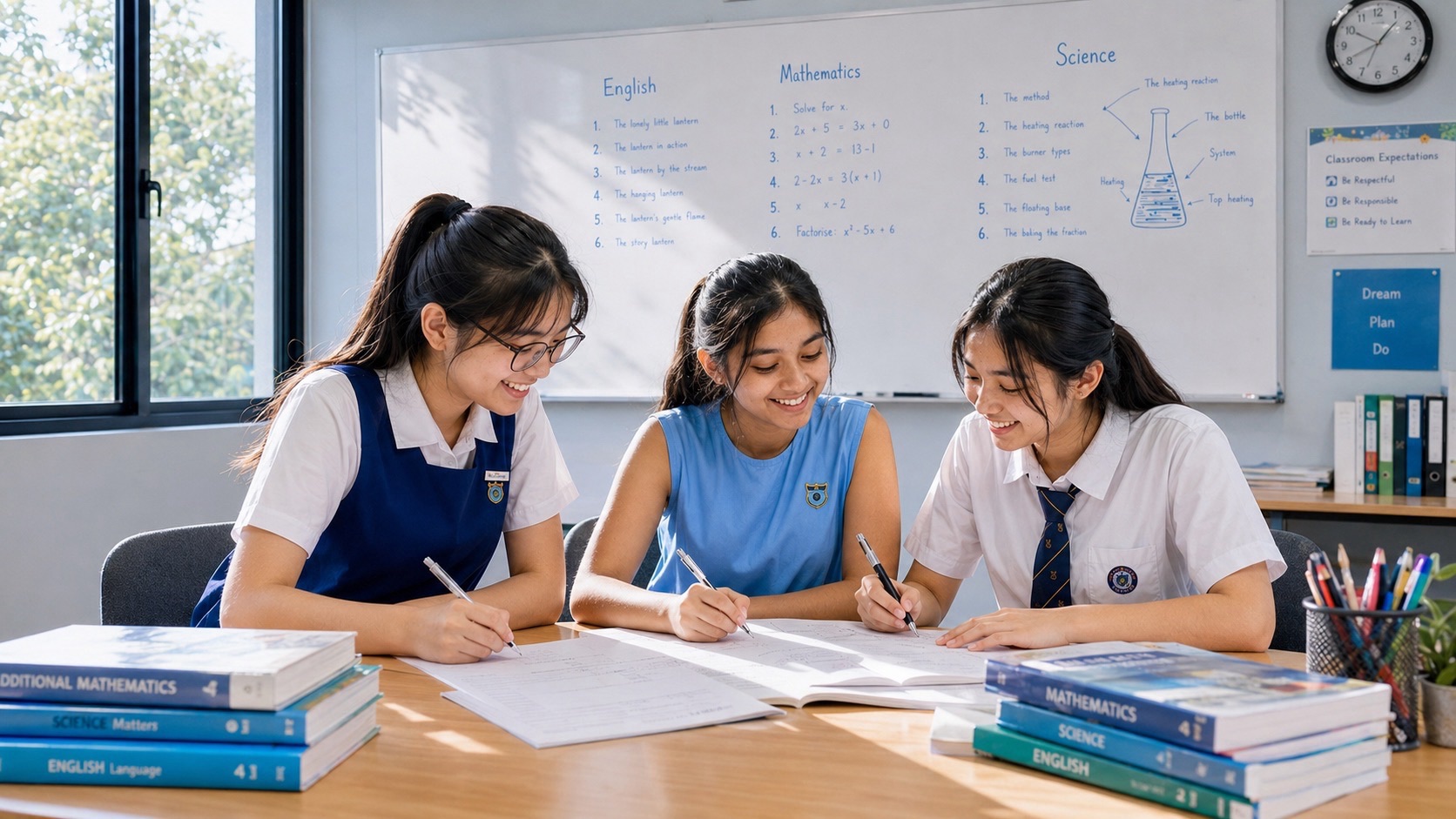
Secondary 3 G3 Principles of Accounts tuition in Bugis should begin with the pupil’s actual school work and the first incorrect account interpretation, not with a demand to finish every final-year paper. The official 2027 Singapore–Cambridge SEC G3 Principles of Accounts K342 syllabus offers POA as an elective from Secondary Three, with an emphasis on accounting as an information system and a language for sound decisions.
Did you know that one credit sale of merchandise can require two different journal pairs? The customer may owe $2,100, while the merchandise that leaves the business is carried in Inventory at $1,250. The sale-side entries represent the customer charge, but a second pair must represent Cost of Sales and the value no longer held as stock. A student who writes only one pair may have a neat but incomplete journal.
Twenty original fictional printing, art-supply and design transactions below demonstrate practical account classification, timing, stock values, accruals, prepayments and evidence. The Bugis Street, Haji Lane and Middle Road area references identify readers and imagined scenarios, not real financial data about local retailers. The immutable eduKateSG teaching reference documents premium up-to-three-pupil Mathematics tutorials at 8 Fourth Avenue near Sixth Avenue MRT; it does not confirm a Bugis POA branch or a POA class at the Maths venue.
quick
A useful tutorial starts with a genuine business event and one unaided first mistake. It teaches the full account treatment, then checks whether the pupil can solve a related but altered event without being shown a model.
- Actual POA elective begins in Secondary Three.
- The accounting equation separates assets, liabilities and residual Equity.
- Double entry must reflect the economic event, not a cash-in or cash-out slogan.
- Perpetual Inventory sales require the selling and stock-cost effects.
- Reporting dates, source evidence and integrity matter.
- Transfer is established through an unfamiliar unprompted problem after a delay.
principles
An exam-relevant elective with an accurate start
K342 is a formal upper-secondary elective from Secondary Three. A student’s school may sequence basic concepts, source documents, trading entries and year-end adjustments differently, so a tutor should not assume every student has been taught the whole syllabus in the same month. Start with the actual marked work and school teaching plan. Relevant instruction should help the learner progress from present knowledge to increasingly independent applications.
The accounting equation is a statement of claims
Assets = Liabilities + Equity groups what resources the business controls, what outsiders are owed and the residual interest of its owner. Bank is one asset; it does not define all assets. An outside loan may have supplied funds held in Bank but also creates a payable. Capital introduced by the owner does not become trading revenue merely because the business receives something valuable.
Debit and credit require account meaning
Journal directions depend on the type of account and the actual event. A Bank receipt from an external lender is paired with Loan Payable, whereas cash introduced by the proprietor is paired with Capital. A customer fee earned from completed work creates Revenue and a Bank or Trade Receivables asset depending on settlement. Students who merely memorise that ‘cash in means Sales’ will systematically misclassify several transactions.
The perpetual Inventory method has two sides
A trading-business purchase is recorded when merchandise enters Inventory, even if the supplier grants credit. At the point of sale, recorded stock cost transfers into Cost of Sales while a separate selling-price entry recognises Revenue and the customer claim or Bank. A pupil may multiply accurately and still use the selling price for the Inventory credit. That wrong category is the first misconception to repair.
Buying, selling and settling have different dates
A supplier quotation, purchase invoice, delivery note and Bank settlement do not represent one indistinguishable event. Goods can arrive on credit and be paid for later. A customer can purchase merchandise on credit and pay in instalments. The later cash movement ordinarily settles an existing Trade Payable or Trade Receivable; it does not automatically repeat the earlier purchase or sale.
Period-end adjustments explain economic time
A business may consume wages, rent or electricity before sending all the money. Conversely, it may pay insurance in advance for future months, or collect a customer fee before completing all service. The reporting date determines expense, prepaid asset and accrued or unearned liability. Drawing the actual coverage months often resolves a misconception before a journal is attempted.
Asset value is different from physical quantity
A warehouse may still hold every unit while its Net Realisable Value falls below recorded cost. Under the relevant inventory rule, the reporting value may require reduction even though no new cash movement or physical sale occurred. The syllabus also covers accounting for non-current assets and depreciation. Students must not treat acquisition payment, annual allocation, physical stock count and reported asset value as synonymous.
Evidence, integrity and auditability
Accounting information should be objective and supported by documents. Two copies of one invoice do not necessarily establish two deliveries, and a cheque already recorded in the business books can remain uncleared by the Bank. When stock records and a physical count differ, the cause should be investigated; importantly, the 2027 K342 syllabus does not require adjustments to reconcile perpetual-record ending stock to physical count. A teaching discussion about ethics should not be mislabelled an examinable journal requirement.
What a close-feedback group of three can offer
The immutable eduKateSG Mathematics teaching reference publishes groups capped at three with ninety-minute weekly lessons near Sixth Avenue MRT. Its educational advantage as a model is visibility of each individual’s first attempt. One pupil may misunderstand which document proves an event, another may select the wrong account, and the third may calculate with a misplaced decimal. Their remedies should differ, despite sharing a group explanation.
First-error repair and delayed transfer
A corrected journal made after the tutor names the account is valuable progress, but it is weaker evidence than choosing that account in a new unseen business story. Keep a small error log recording the first wrong inference, its repair, a genuinely altered independent test and a second attempt several days later. This makes the tutorial causal: it explains what changed in the learner’s understanding.
Location is readership, not class availability
A Bugis-area guide can describe fictional school fairs along Middle Road or hypothetical small creative retailers, but it should not imply actual commercial activity or a tuition branch there. The immutable venue at Fourth Avenue near Sixth Avenue MRT is established for the stated Mathematics programme. Confirm whether a POA educator or group actually exists, and where, before making any booking or recommending travel.
A proportionate family decision
Formal Secondary 3 POA may benefit from targeted support when a genuine persistent misconception exists, but more time is not always more learning. Review the pupil’s current Maths and English foundations, school assignment demands, CCA, transport, meals and sleep. A couple of well-selected independent questions can sometimes repair a problem without adding weekly tuition.
diagnosis
Collect one recent real school POA script completed without external hints. Highlight the first unsupported inference: transaction event, account class, source amount, date, journal direction or linked statement effect.
Contrast equal Bank inflows from the owner, a lender and a customer who has received a completed service. Ask for the paired account and explanation before showing a sample entry.
Use an actual transaction timeline on paper: quote, delivered merchandise on credit, accepted supplier return, payment, sold inventory and collection from the customer. Note where a student counts the same event twice.
Present merchandise at a customer selling price and a different carried Inventory cost. Collect both required pairs as a private first attempt before giving any prompts.
For an accrued expense or rent paid ahead, shade the months and mark the reporting date. Record whether the pupil starts by identifying consumption or simply writes the entire Bank amount as Expense.
Use an independent card for each member of an illustrative three-pupil group, then compare individual first errors before any shared solution is displayed.
Retest the misconception after an interval with a changed service date, payment term, valuation or journal amount. A correctly repeated original model should not be described as independent mastery.
lesson
Minutes 0–10: identify a real unaided school work error and select one specific target.
Minutes 10–25: narrate a fictional supplier invoice or owner contribution and connect it to Assets = Liabilities + Equity.
Minutes 25–45: model a purchase, sale or settlement with every relevant debit and credit pair, including perpetual stock-cost effects.
Minutes 45–60: let all three pupils solve different altered cases privately before discussion.
Minutes 60–75: connect the selected case to a short statement extract, prepayment, accrued liability or inventory valuation appropriate to the actual school chapter.
Minutes 75–85: check a duplicate source record, accepted credit note or genuine Bank-clearing timing issue without inventing an event.
Minutes 85–90: set one delayed independent transfer question, record the original first error and determine whether continued help is worthwhile.
This ninety-minute session illustrates a close-feedback method, not an advertised active POA class or confirmed Bugis venue.
cases
These twenty cases are fictional educational transactions and not real Bugis company accounts or reproduced SEAB questions. Use them as a differentiated case bank, not a requirement to complete twenty questions within a single teaching session.
Case 1: Accounting equation: more than Bank cash
Fictional evidence: A fictional Bugis design-supply business has Bank $5,000, Equipment $2,800, Inventory $1,600 and Trade Receivables $1,200. It owes suppliers $2,200 and a lender $3,200.
Worked accounting treatment: Assets total $10,600. Liabilities total $5,400. Equity is $5,200 under Assets = Liabilities + Equity. It is a snapshot residual, not this year’s Profit for the Period.
First misconception to identify: The learner omits Trade Receivables because payment has not arrived, or treats the lender’s balance as owner funding.
Independent changed test and answer: If the loan in the complete static snapshot is $2,900 with other listed values fixed, Equity becomes $5,500.
Tutor’s reasoning question: Which listed amounts are resources and which are claims on the business?
Ask the pupil to narrate the source event before choosing account directions. An identical Bank debit might reflect borrowed funds, owner Capital, an earned fee or settlement of an existing debtor. What matters is the claim or transaction behind the amount.
After the worked solution has been hidden, give the pupil a new first line to write without account-name hints. Record whether the account class, date and value were selected independently. Retest a slightly different version after several days; a corrected model is learning in progress, while a new unaided response gives stronger evidence of transfer.
Case 2: An Equipment contribution by the owner
Fictional evidence: A fictional owner contributes personally owned design Equipment accepted at $1,800 into the trading business, with no Bank transfer.
Worked accounting treatment: Debit Equipment $1,800; Credit Capital $1,800. A noncash contribution still changes business resources and owners’ Equity.
First misconception to identify: Writing no entry because no cash moved, or crediting Revenue despite no customer activity.
Independent changed test and answer: If the owner instead contributes $2,300 in Bank cash, debit Bank and credit Capital $2,300.
Tutor’s reasoning question: Who previously owned the resource, and what claim changes?
Where the case includes two dates, draw a timeline showing when goods arrived, a service was completed or cash was paid. Accounting follows those events rather than the superficial order in which numbers appear in a paragraph.
After the worked solution has been hidden, give the pupil a new first line to write without account-name hints. Record whether the account class, date and value were selected independently. Retest a slightly different version after several days; a corrected model is learning in progress, while a new unaided response gives stronger evidence of transfer.
Case 3: External borrowing creates a payable
Fictional evidence: A creative studio receives a new $3,600 bank loan in its business account and must repay it under the loan agreement.
Worked accounting treatment: Debit Bank $3,600; Credit Loan Payable $3,600. The borrowing principal is not earned service income.
First misconception to identify: Crediting Sales Revenue merely because Bank rises.
Independent changed test and answer: For a $2,900 loan, Bank and Loan Payable each increase $2,900.
Tutor’s reasoning question: Who can demand repayment, and why is that person not a paying customer?
For merchandise, separate customer price from carried stock cost. The selling-side journal and Cost of Sales pair cannot be collapsed into a single amount. This is a common source of apparently balanced but incomplete solutions.
After the worked solution has been hidden, give the pupil a new first line to write without account-name hints. Record whether the account class, date and value were selected independently. Retest a slightly different version after several days; a corrected model is learning in progress, while a new unaided response gives stronger evidence of transfer.
Case 4: Completing a design service and being paid
Fictional evidence: A fictional poster-layout studio completes a $650 client assignment and receives Bank payment on completion.
Worked accounting treatment: Debit Bank $650; Credit Service Fee Revenue $650. This is earned revenue; final profit still depends on other costs.
First misconception to identify: Calling the whole fee final profit or crediting Capital rather than Service Fee Revenue.
Independent changed test and answer: For a $780 completed job on credit, debit Trade Receivables and credit Service Fee Revenue $780.
Tutor’s reasoning question: Would a change to credit terms change whether the work was earned?
Check how the transaction affects the accounting equation and any related statement. A prepaid item leaves an asset; an accrued bill may leave a liability; a recognised sale can alter both Revenue and Inventory.
After the worked solution has been hidden, give the pupil a new first line to write without account-name hints. Record whether the account class, date and value were selected independently. Retest a slightly different version after several days; a corrected model is learning in progress, while a new unaided response gives stronger evidence of transfer.
Case 5: A service on credit and later part-payment
Fictional evidence: The same invented studio completes an agreed $1,200 service on credit and later receives a $450 Bank payment.
Worked accounting treatment: On completion Debit Trade Receivables $1,200, Credit Service Fee Revenue $1,200. On receipt Debit Bank $450, Credit Trade Receivables $450. The customer still owes $750.
First misconception to identify: Crediting Service Fee Revenue a second time when cash later arrives.
Independent changed test and answer: If the later payment is $700, the receivable remaining is $500.
Tutor’s reasoning question: Which source record shows earned work and which confirms settlement?
Do not invent evidence to force a neat total. An accepted supplier return requires a credit note, and a Bank difference should be reconciled from the cheque and statement records. A correct accountant is prepared to say what remains unknown.
After the worked solution has been hidden, give the pupil a new first line to write without account-name hints. Record whether the account class, date and value were selected independently. Retest a slightly different version after several days; a corrected model is learning in progress, while a new unaided response gives stronger evidence of transfer.
Case 6: Inventory purchased on supplier credit
Fictional evidence: A fictional Bugis stationer takes delivery of $1,600 resale stock and an invoice payable in thirty days.
Worked accounting treatment: Debit Inventory $1,600; Credit Trade Payables $1,600. Goods and debt arise before Bank pays.
First misconception to identify: Crediting Bank on delivery despite the explicit supplier credit terms.
Independent changed test and answer: If the trader purchases and pays immediately, debit Inventory and credit Bank $1,600.
Tutor’s reasoning question: Why does receiving stock create an obligation even before money leaves Bank?
Ask the pupil to narrate the source event before choosing account directions. An identical Bank debit might reflect borrowed funds, owner Capital, an earned fee or settlement of an existing debtor. What matters is the claim or transaction behind the amount.
After the worked solution has been hidden, give the pupil a new first line to write without account-name hints. Record whether the account class, date and value were selected independently. Retest a slightly different version after several days; a corrected model is learning in progress, while a new unaided response gives stronger evidence of transfer.
Case 7: An accepted supplier return reduces debt
Fictional evidence: The supplier accepts a return of $240 of the previously credit-purchased $1,600 goods, issuing a credit note.
Worked accounting treatment: Debit Trade Payables $240; Credit Inventory $240. The original payable falls to $1,360 if nothing else occurred.
First misconception to identify: Debiting Bank when the document grants only a credit against debt.
Independent changed test and answer: If the return is $300, payable falls to $1,300.
Tutor’s reasoning question: Which documents prove the original purchase and accepted reduction?
Where the case includes two dates, draw a timeline showing when goods arrived, a service was completed or cash was paid. Accounting follows those events rather than the superficial order in which numbers appear in a paragraph.
After the worked solution has been hidden, give the pupil a new first line to write without account-name hints. Record whether the account class, date and value were selected independently. Retest a slightly different version after several days; a corrected model is learning in progress, while a new unaided response gives stronger evidence of transfer.
Case 8: Part-payment after an accepted return
Fictional evidence: The firm pays $560 from Bank toward its remaining $1,360 supplier payable.
Worked accounting treatment: Debit Trade Payables $560; Credit Bank $560. A balance of $800 remains. The previous stock acquisition is not recorded again.
First misconception to identify: Debiting Inventory on payment and double-counting the purchase.
Independent changed test and answer: At a $700 settlement, payable falls to $660.
Tutor’s reasoning question: Why does the old purchase entry remain valid after the supplier receives cash?
For merchandise, separate customer price from carried stock cost. The selling-side journal and Cost of Sales pair cannot be collapsed into a single amount. This is a common source of apparently balanced but incomplete solutions.
After the worked solution has been hidden, give the pupil a new first line to write without account-name hints. Record whether the account class, date and value were selected independently. Retest a slightly different version after several days; a corrected model is learning in progress, while a new unaided response gives stronger evidence of transfer.
Case 9: Credit merchandise sale at two amounts
Fictional evidence: The stationer sells merchandise for $2,100 on credit. Its Inventory ledger shows recorded cost of the sold goods $1,250.
Worked accounting treatment: Debit Trade Receivables $2,100, Credit Sales Revenue $2,100; Debit Cost of Sales $1,250, Credit Inventory $1,250. Gross trading difference is $850.
First misconception to identify: Using the selling price to reduce stock, or omitting the stock-cost pair.
Independent changed test and answer: If stock cost becomes $1,350, gross difference is $750.
Tutor’s reasoning question: What does the customer owe versus what value leaves the trader’s Inventory?
Check how the transaction affects the accounting equation and any related statement. A prepaid item leaves an asset; an accrued bill may leave a liability; a recognised sale can alter both Revenue and Inventory.
After the worked solution has been hidden, give the pupil a new first line to write without account-name hints. Record whether the account class, date and value were selected independently. Retest a slightly different version after several days; a corrected model is learning in progress, while a new unaided response gives stronger evidence of transfer.
Case 10: An immediate cash sale still consumes stock
Fictional evidence: Merchandise with recorded Inventory cost $460 is sold for $780 and paid into Bank immediately.
Worked accounting treatment: Debit Bank $780; Credit Sales Revenue $780. Also Debit Cost of Sales $460; Credit Inventory $460. Gross difference is $320.
First misconception to identify: Writing only the Bank and Revenue pair because no receivable arises.
Independent changed test and answer: If carried cost rises to $500, gross difference becomes $280.
Tutor’s reasoning question: Which journal effect is independent of when the customer pays?
Do not invent evidence to force a neat total. An accepted supplier return requires a credit note, and a Bank difference should be reconciled from the cheque and statement records. A correct accountant is prepared to say what remains unknown.
After the worked solution has been hidden, give the pupil a new first line to write without account-name hints. Record whether the account class, date and value were selected independently. Retest a slightly different version after several days; a corrected model is learning in progress, while a new unaided response gives stronger evidence of transfer.
Case 11: Old debtor collections do not create new Revenue
Fictional evidence: A customer transfers $720 toward the prior $2,100 credit sale, with no separate sale today.
Worked accounting treatment: Debit Bank $720; Credit Trade Receivables $720, leaving $1,380 owed. No second Revenue entry occurs.
First misconception to identify: Crediting sales again on collection, overstating revenue.
Independent changed test and answer: If the client transfers $900, the remaining customer debt is $1,200.
Tutor’s reasoning question: How does the invoice date differ from the payment date?
Ask the pupil to narrate the source event before choosing account directions. An identical Bank debit might reflect borrowed funds, owner Capital, an earned fee or settlement of an existing debtor. What matters is the claim or transaction behind the amount.
After the worked solution has been hidden, give the pupil a new first line to write without account-name hints. Record whether the account class, date and value were selected independently. Retest a slightly different version after several days; a corrected model is learning in progress, while a new unaided response gives stronger evidence of transfer.
Case 12: A saleable customer return reverses two values
Fictional evidence: A customer returns saleable merchandise previously bought on credit for $300; the carried stock cost was $180.
Worked accounting treatment: Debit Sales Returns $300, Credit Trade Receivables $300; Debit Inventory $180, Credit Cost of Sales $180.
First misconception to identify: Restoring stock at $300 instead of its $180 carrying value.
Independent changed test and answer: For sale value $260 and cost $145, reverse those respective amounts.
Tutor’s reasoning question: Why does the stated saleable condition matter?
Where the case includes two dates, draw a timeline showing when goods arrived, a service was completed or cash was paid. Accounting follows those events rather than the superficial order in which numbers appear in a paragraph.
After the worked solution has been hidden, give the pupil a new first line to write without account-name hints. Record whether the account class, date and value were selected independently. Retest a slightly different version after several days; a corrected model is learning in progress, while a new unaided response gives stronger evidence of transfer.
Case 13: A 12.5% trade discount changes the invoice
Fictional evidence: A fictional wholesaler lists resale merchandise for $3,200 and grants a trade discount of 12.5% before invoicing on credit.
Worked accounting treatment: The discount is $400. The invoice is $2,800; debit Inventory and credit Trade Payables $2,800.
First misconception to identify: Recording the full list price as debt or treating the discount as a new cash receipt.
Independent changed test and answer: At a 10% discount, the invoice is $2,880.
Tutor’s reasoning question: Which amount has actually been agreed on and invoiced?
For merchandise, separate customer price from carried stock cost. The selling-side journal and Cost of Sales pair cannot be collapsed into a single amount. This is a common source of apparently balanced but incomplete solutions.
After the worked solution has been hidden, give the pupil a new first line to write without account-name hints. Record whether the account class, date and value were selected independently. Retest a slightly different version after several days; a corrected model is learning in progress, while a new unaided response gives stronger evidence of transfer.
Case 14: Freight inwards affects Cost of Purchases
Fictional evidence: The trader purchases resale stock for $5,200, has $400 in accepted Purchase Returns and pays $240 freight-in to bring stock to the store.
Worked accounting treatment: Cost of Purchases = $5,200 − $400 + $240 = $5,040.
First misconception to identify: Subtracting freight-in as if it were a customer-delivery cost.
Independent changed test and answer: If freight-in rises to $300, Cost of Purchases becomes $5,100.
Tutor’s reasoning question: Where is the stock being transported, and why does that matter?
Check how the transaction affects the accounting equation and any related statement. A prepaid item leaves an asset; an accrued bill may leave a liability; a recognised sale can alter both Revenue and Inventory.
After the worked solution has been hidden, give the pupil a new first line to write without account-name hints. Record whether the account class, date and value were selected independently. Retest a slightly different version after several days; a corrected model is learning in progress, while a new unaided response gives stronger evidence of transfer.
Case 15: Private drawings are not an operating expense
Fictional evidence: The sole proprietor withdraws $150 from business Bank to pay an unrelated personal bill.
Worked accounting treatment: Debit Drawings $150; Credit Bank $150. The owner’s private spending is not a business operating cost.
First misconception to identify: Debiting a business expense account simply because money left Bank.
Independent changed test and answer: If the proprietor removes Inventory costing $110 for private use, debit Drawings and credit Inventory $110.
Tutor’s reasoning question: Does the purpose of the payment benefit the business or the owner privately?
Do not invent evidence to force a neat total. An accepted supplier return requires a credit note, and a Bank difference should be reconciled from the cheque and statement records. A correct accountant is prepared to say what remains unknown.
After the worked solution has been hidden, give the pupil a new first line to write without account-name hints. Record whether the account class, date and value were selected independently. Retest a slightly different version after several days; a corrected model is learning in progress, while a new unaided response gives stronger evidence of transfer.
Case 16: An accrued water bill follows service consumption
Fictional evidence: The business uses $390 of water during the reporting period but has paid only $150 of that bill by closing, with no old arrears.
Worked accounting treatment: Recognise Water Expense $390 and Water Payable $240. The cost is based on consumption rather than just the Bank settlement.
First misconception to identify: Reporting only the $150 Bank payment as the full expense.
Independent changed test and answer: If $250 is paid against the same use, Water Payable falls to $140.
Tutor’s reasoning question: What remains owed even though the utility was already used?
Ask the pupil to narrate the source event before choosing account directions. An identical Bank debit might reflect borrowed funds, owner Capital, an earned fee or settlement of an existing debtor. What matters is the claim or transaction behind the amount.
After the worked solution has been hidden, give the pupil a new first line to write without account-name hints. Record whether the account class, date and value were selected independently. Retest a slightly different version after several days; a corrected model is learning in progress, while a new unaided response gives stronger evidence of transfer.
Case 17: Rent paid before year-end covers later months
Fictional evidence: A studio pays $2,400 for six equal months of rent beginning 1 November, closing its year on 31 December.
Worked accounting treatment: Each month costs $400. Two months are used: Rent Expense $800; four future months remain Prepaid Rent $1,600.
First misconception to identify: Charging all $2,400 as current-year expense.
Independent changed test and answer: If the six months begin 1 October, expense is $1,200 and prepayment $1,200.
Tutor’s reasoning question: Which months belong before and after the reporting boundary?
Where the case includes two dates, draw a timeline showing when goods arrived, a service was completed or cash was paid. Accounting follows those events rather than the superficial order in which numbers appear in a paragraph.
After the worked solution has been hidden, give the pupil a new first line to write without account-name hints. Record whether the account class, date and value were selected independently. Retest a slightly different version after several days; a corrected model is learning in progress, while a new unaided response gives stronger evidence of transfer.
Case 18: Customer fees can be received before work is earned
Fictional evidence: A firm receives $1,800 for six equal months of support and has completed four months by reporting date.
Worked accounting treatment: Earned Service Fee Revenue is $1,200 and Revenue Received in Advance is $600, representing two future months.
First misconception to identify: Reporting the whole $1,800 as earned because Bank already received it.
Independent changed test and answer: If five months are completed, earned revenue is $1,500 and advance liability $300.
Tutor’s reasoning question: What service is still owed to the customer?
For merchandise, separate customer price from carried stock cost. The selling-side journal and Cost of Sales pair cannot be collapsed into a single amount. This is a common source of apparently balanced but incomplete solutions.
After the worked solution has been hidden, give the pupil a new first line to write without account-name hints. Record whether the account class, date and value were selected independently. Retest a slightly different version after several days; a corrected model is learning in progress, while a new unaided response gives stronger evidence of transfer.
Case 19: Inventory NRV falls below carried cost
Fictional evidence: A retailer holds 100 identical items with original recorded cost $18 each and credible reporting-date NRV $16.50 each.
Worked accounting treatment: Original cost totals $1,800 and NRV $1,650. Inventory is carried at the lower $1,650, with a $150 reduction in value under these facts.
First misconception to identify: Treating an accurate original invoice as proof the year-end value cannot change.
Independent changed test and answer: If NRV is $19 per item, original cost $1,800 remains the lower figure.
Tutor’s reasoning question: Could all items still be physically present after the financial carrying value falls?
Check how the transaction affects the accounting equation and any related statement. A prepaid item leaves an asset; an accrued bill may leave a liability; a recognised sale can alter both Revenue and Inventory.
After the worked solution has been hidden, give the pupil a new first line to write without account-name hints. Record whether the account class, date and value were selected independently. Retest a slightly different version after several days; a corrected model is learning in progress, while a new unaided response gives stronger evidence of transfer.
Case 20: An unpresented cheque reconciles timing
Fictional evidence: The Cash at Bank ledger shows $2,450 while the Bank statement shows $2,780. A $330 cheque is already recorded by the firm but not cleared.
Worked accounting treatment: The Bank has not yet deducted the issued cheque: $2,780 − $330 = $2,450. No new sale or expense entry is established.
First misconception to identify: Inventing Revenue or recording the cheque again simply to make balances agree.
Independent changed test and answer: If the uncleared cheque becomes $200 with ledger fixed, the statement would be $2,650.
Tutor’s reasoning question: What evidence shows the cheque was issued and still unpresented?
Do not invent evidence to force a neat total. An accepted supplier return requires a credit note, and a Bank difference should be reconciled from the cheque and statement records. A correct accountant is prepared to say what remains unknown.
After the worked solution has been hidden, give the pupil a new first line to write without account-name hints. Record whether the account class, date and value were selected independently. Retest a slightly different version after several days; a corrected model is learning in progress, while a new unaided response gives stronger evidence of transfer.
parents
The immutable eduKateSG source documents premium Mathematics lessons in groups capped at three at 8 Fourth Avenue near Sixth Avenue MRT, including a weekly ninety-minute format for that Mathematics programme. Bugis-area learning narratives do not establish a new branch, a confirmed POA tutor or a subject-specific timetable there or at the Maths venue.
Check the real educator’s POA subject capability, the student’s actual school chapter, the confirmed teaching location, fees, timetable, group size, independent first-error assessment and total commute. Protect other subjects, CCAs, meals and sleep. A family may reasonably conclude that an independent school revision plan is preferable to extra tuition.
faq
Is formal G3 Principles of Accounts a Secondary Three elective?
Yes. SEAB’s 2027 K342 syllabus states that it is offered as an elective from Secondary Three.
Why do merchandise sales require a Cost of Sales entry?
Revenue records the customer amount, while Cost of Sales and Inventory record goods leaving at their carrying cost.
Is bank borrowing recognised as sales revenue?
No. Receiving repayable principal creates Loan Payable.
Does a customer payment on an old invoice earn another sale?
No. It normally replaces part of Trade Receivables with Bank.
What should students do if documents disagree?
Investigate the original evidence rather than inventing balancing transactions or alleging a cause without support.
Are the Bugis transactions real local company accounts?
No. All twenty are original hypothetical educational situations.
Does this article confirm POA classes in Bugis?
No. The fixed reference concerns Mathematics near Sixth Avenue MRT; actual POA provision must be verified.
sources
SEAB 2027 SEC G3 POA K342 official syllabus PDF
SEAB 2027 G3 school-candidate syllabuses
Immutable eduKateSG Secondary 1 Mathematics Clementi small-group reference
Bencoolen Secondary 3 G3 POA companion guide
series
Secondary 1 G3 Principles of Accounts Tuition Bugis
Secondary 2 G3 Principles of Accounts Tuition Bugis
Secondary 3 G3 Principles of Accounts Tuition Bugis
Secondary 4 G3 Principles of Accounts Tuition Bugis
availability
The immutable programme is a Maths teaching reference and is not proof of a currently offered Bugis POA group. Parents should verify subject, venue and actual availability directly.