
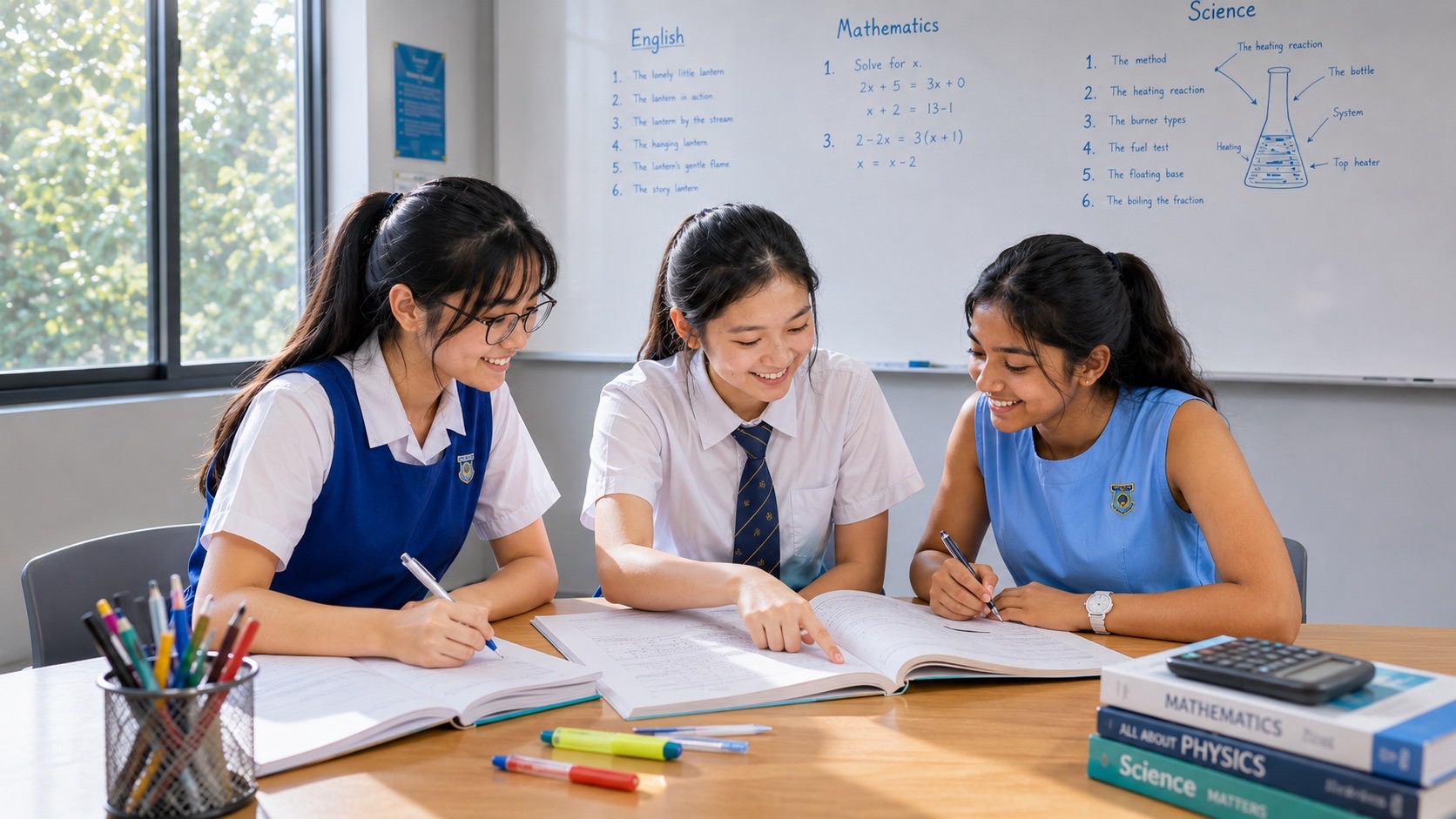
Secondary 2 G3 Principles of Accounts tuition in Bugis should be a realistic elective-choice preview, not preparation for a fictional compulsory Secondary 2 national POA exam. SEAB’s 2027 SEC G3 K342 is offered from Secondary Three. Students approaching subject selection can sample the reasoning involved, then check which options their own school genuinely offers.
Did you know that the same $500 Bank receipt may represent three different business events? Money contributed by the owner affects Capital, a lender’s loan creates an obligation, and payment for a completed service creates Revenue. The numbers are identical, yet the paired accounts and what they mean are different.
The original fictional studio, stationery and small creative-business cases below are placed around Bugis, Middle Road and North Bridge Road for reader familiarity. They do not describe real local companies’ books or a new tuition venue. The immutable eduKateSG reference remains the three-pupil Mathematics model at 8 Fourth Avenue near Sixth Avenue MRT, not confirmation of a POA timetable there or near Bugis.
The parent answer at a glance
Use a short Secondary 2 preview to understand accounting meaning and make an informed subject choice. A good outcome is a realistic picture of journals, source documents, ethical evidence and the child’s interest—not a premature promise of exam performance.
The knowledge and decisions a learner needs
- Subject availability starts with the actual school
- Accounting is a language for explaining business
- Assets and liabilities must be separated
- Debit and credit are not emotional labels
- An invoice can precede payment
- Merchandise sale has two different values
- Collecting an older debt does not create a second sale
- A reporting date can be different from a payment date
- Accuracy requires integrity and source checking
- The trial should respect interest and competing commitments
Subject availability starts with the actual school
SEAB’s G3 POA K342 is a national subject, but that does not establish that every secondary school offers every elective combination. A pupil’s school may have specific choices and allocation procedures. A short trial is a way to inform discussion with teachers and parents; it should not be sold as guaranteed placement or a new mandatory Secondary 2 syllabus.
Accounting is a language for explaining business
The subject is not simply ordinary Maths with debit and credit headings. It represents who holds a resource, what the firm owes, whether the owner contributed funding and how customers’ transactions affect performance. The best first question is what actually happened, followed by why a particular pair of accounts is affected.
Assets and liabilities must be separated
Assets such as Bank, Equipment, Inventory and Trade Receivables are resources. Trade Payables and loans are external obligations. Equity is a residual ownership claim; it does not mean that the same amount is physically sitting in Bank. An introductory learner should be able to classify each balance before computing any residual amount.
Debit and credit are not emotional labels
A debit is not necessarily bad, a credit is not necessarily good, and the words cannot simply mean cash in versus cash out. Different types of accounts increase on different sides. A Bank debit resulting from an owner contribution is paired with Capital, but the same Bank debit from a lender is paired with Loan Payable.
An invoice can precede payment
When merchandise is received on supplier credit, the business recognises Inventory and Trade Payables. Later Bank settlement decreases the liability. If a pupil records the purchase again when paying, the same goods may be counted twice. A short timeline can prevent this and later mistakes involving receivables.
Merchandise sale has two different values
A trader may charge a customer $600 for items that were recorded at $350 Inventory cost. Under perpetual inventory, a credit sale affects revenue and the customer’s claim, plus Cost of Sales and stock at the carried amount. The pupil should explain the two values before memorising the four journal directions.
Collecting an older debt does not create a second sale
An invoice can establish a claim from a sale already recognised, while a later bank remittance settles it. Crediting Sales Revenue again merely because cash arrives later would overstate activity. This example is especially useful for students who have memorised the false idea that every Bank receipt creates Revenue.
A reporting date can be different from a payment date
Insurance for future months, electricity already used but not yet paid and customer fees received for services not yet completed all reveal why accounts are organised by periods. A pupil may be comfortable with an introductory calendar and still decide not to study the subject. The learning should be age-appropriate and exploratory.
Accuracy requires integrity and source checking
Two copies of an invoice need not represent two purchases. A bank statement can lag an already recorded cheque, and stock records can differ from a physical count. These are questions to investigate with evidence, not reasons to invent transactions or accuse someone. The careful, methodical reading is a real part of accounting’s appeal.
The trial should respect interest and competing commitments
A child who enjoys explaining business events may choose the elective; another may enjoy a different academic area more. Neither interest nor one inaccurate entry predicts a career. Check available school subjects, current performance, travel to any actual teaching venue and whether the child’s week has enough room for another commitment.
What an illustrative 90-minute three-pupil lesson looks like
Minutes 0–10: discuss the school’s actual elective options and the pupil’s first impressions of business accounting.
Minutes 10–25: compare three equal Bank receipts from an owner, outside lender and paying service client.
Minutes 25–40: construct Assets = Liabilities + Equity using a small fictional trader’s balances.
Minutes 40–60: follow a credit purchase, merchandise sale at a different carried cost and later debtor settlement.
Minutes 60–75: give three different unseen transaction cards and collect private first journal pairs.
Minutes 75–85: analyse duplicate source documents or a cheque-clearing timing difference without unsupported entries.
Minutes 85–90: assign one light delayed check and invite an honest account of the child’s interest in the elective. The ninety-minute structure is illustrative, not a live Bugis POA class schedule.
20 original worked cases and independent changed questions
All twenty situations are original fictional examples, not genuine transactions from Bugis businesses or official SEAB papers. They are a case bank for individual selection, not twenty compulsory tasks for one lesson. The changed problem should be attempted with the worked example hidden.
Case 1: Resources minus external obligations give residual equity
Fictional event: A fictitious Bugis stationer owns Bank $2,600, Inventory $1,700 and Equipment $3,900; it owes suppliers $800 and an outside lender $2,400.
Correct worked explanation: Assets are $8,200; Liabilities $3,200; Equity $5,000. This position does not equal net current-year profit.
Earliest error to diagnose: Treating the loan as income or omitting Inventory from resources.
Changed independent test with check: If lender debt becomes $2,000 with other complete balances unchanged, Equity becomes $5,400.
Tutor’s probing question: Why are the suppliers’ and lender’s claims on the liabilities side?
Before showing the worked answer, ask the learner what happened in plain language. One dollar amount can represent a whole bill, a loan, a unit price, a refundable sum or a period expense. The first written response should identify its meaning before an operation or journal pair is selected.
Case 2: Owner transfers personal funds to Capital
Fictional event: The proprietor pays $1,900 of personal savings into the separate business Bank account.
Correct worked explanation: Debit Bank $1,900; Credit Capital $1,900. Owner funding is not a completed customer sale.
Earliest error to diagnose: Crediting Service Fee Revenue whenever Bank rises.
Changed independent test with check: For contributed Equipment valued $1,350, Debit Equipment and Credit Capital $1,350.
Tutor’s probing question: Who provided the asset and what kind of claim did that person receive?
After feedback, have the child hide the model and explain why the chosen figure or account belongs there. Keep an honest distinction between a correct unaided response, a correct answer after a hint, and a solution copied from the board.
Case 3: A bank borrowing increases a payable
Fictional event: A business receives a repayable $2,200 loan into its Bank.
Correct worked explanation: Debit Bank $2,200 and Credit Loan Payable $2,200. Earned Revenue is unchanged by the principal.
Earliest error to diagnose: Confusing a lender with an owner or customer.
Changed independent test with check: For a $2,800 loan, use the same pair at $2,800.
Tutor’s probing question: How is the promise to repay relevant to the credit account?
Use a short timeline if the story includes a quote, order, delivery, invoice, work completed and settlement. Their dates can differ. Misreading the first event is not repaired by computing a later number more accurately.
Case 4: Completed service paid immediately
Fictional event: A fictional graphic studio completes a $420 service and is paid into Bank on the same day.
Correct worked explanation: Debit Bank $420; Credit Service Fee Revenue $420. It is earned income but not necessarily final profit.
Earliest error to diagnose: Treating the receipt as owner funding or the entire period profit.
Changed independent test with check: If service price is $540 on credit, Debit Trade Receivables and Credit Service Fee Revenue $540.
Tutor’s probing question: What changes when the service is earned but Bank has not yet been paid?
Check the child’s chosen units and reasonableness. A flat fee repeated as a per-item rate, or a turnover stated in dollars rather than times, is a clue that the source situation was not understood.
Case 5: Credit service and later part-payment
Fictional event: A studio finishes a $760 assignment on credit, and the client transfers $310 the following week.
Correct worked explanation: At completion Debit Trade Receivables $760 and Credit Service Fee Revenue $760; at collection Debit Bank $310 and Credit Trade Receivables $310. Remaining receivable $450.
Earliest error to diagnose: Crediting Service Fee Revenue twice for one service.
Changed independent test with check: At a later $500 payment, $260 remains owed.
Tutor’s probing question: What dated evidence supports the completed job and the later collection?
A group of three should produce three separate first responses before anyone discusses the model. Learners who share a final correct number may have different underlying difficulties, so their next problems should not be identical by default.
Case 6: Inventory arrives on supplier credit
Fictional event: The shop receives $1,200 of merchandise on terms allowing payment next month.
Correct worked explanation: Debit Inventory $1,200; Credit Trade Payables $1,200. No Bank payment is asserted.
Earliest error to diagnose: Crediting Bank at delivery despite the credit terms.
Changed independent test with check: If stock is paid for immediately, Debit Inventory and Credit Bank $1,200.
Tutor’s probing question: When did the business gain control of the goods?
Before showing the worked answer, ask the learner what happened in plain language. One dollar amount can represent a whole bill, a loan, a unit price, a refundable sum or a period expense. The first written response should identify its meaning before an operation or journal pair is selected.
Case 7: Part-payment of an older supplier debt
Fictional event: The shop transfers $480 toward its previously recorded $1,200 payable.
Correct worked explanation: Debit Trade Payables $480; Credit Bank $480, leaving $720 owing.
Earliest error to diagnose: Recording a second $480 merchandise purchase when paying.
Changed independent test with check: If the payment is $700, $500 remains due.
Tutor’s probing question: Why would Inventory be counted twice if the purchase were recorded again?
After feedback, have the child hide the model and explain why the chosen figure or account belongs there. Keep an honest distinction between a correct unaided response, a correct answer after a hint, and a solution copied from the board.
Case 8: Goods sold on credit at price above recorded cost
Fictional event: Merchandise with Inventory carrying cost $900 is sold for $1,500 on credit.
Correct worked explanation: Debit Trade Receivables $1,500; Credit Sales Revenue $1,500; Debit Cost of Sales $900; Credit Inventory $900. Gross difference $600.
Earliest error to diagnose: Using the $1,500 customer price to remove stock or omitting the cost pair.
Changed independent test with check: If carried cost rises to $1,000, gross difference falls to $500.
Tutor’s probing question: Which value represents what the buyer owes, and which is the cost of goods sold?
Use a short timeline if the story includes a quote, order, delivery, invoice, work completed and settlement. Their dates can differ. Misreading the first event is not repaired by computing a later number more accurately.
Case 9: Saleable goods returned by a customer
Fictional event: A customer returns saleable goods from an earlier credit sale valued at $300, with recorded cost $170.
Correct worked explanation: Debit Sales Returns $300 and Credit Trade Receivables $300; Debit Inventory $170 and Credit Cost of Sales $170.
Earliest error to diagnose: Restoring the items at their selling rather than carried price.
Changed independent test with check: For sale value $240 and carried cost $140, reverse the paired amounts separately.
Tutor’s probing question: What extra facts would matter if the returned goods were damaged?
Check the child’s chosen units and reasonableness. A flat fee repeated as a per-item rate, or a turnover stated in dollars rather than times, is a clue that the source situation was not understood.
Case 10: An accepted supplier credit note
Fictional event: The supplier accepts return of $210 of previously credit-purchased merchandise and does not pay a Bank refund.
Correct worked explanation: Debit Trade Payables $210; Credit Inventory $210. The amount owed and goods held decrease.
Earliest error to diagnose: Debiting Bank merely because the document is named a credit note.
Changed independent test with check: For a $160 accepted return, reduce both accounts by $160.
Tutor’s probing question: Which event is proved by the credit note?
A group of three should produce three separate first responses before anyone discusses the model. Learners who share a final correct number may have different underlying difficulties, so their next problems should not be identical by default.
Case 11: Private Drawings rather than an operating expense
Fictional event: A sole proprietor takes $120 from business Bank to pay a personal family bill.
Correct worked explanation: Debit Drawings $120; Credit Bank $120. The transaction is private use rather than cost of earning sales.
Earliest error to diagnose: Recording an operating expense despite the stated personal purpose.
Changed independent test with check: For Inventory taken privately at $90 carried cost, debit Drawings and credit Inventory $90.
Tutor’s probing question: Why must personal and business expenses be distinguished?
Before showing the worked answer, ask the learner what happened in plain language. One dollar amount can represent a whole bill, a loan, a unit price, a refundable sum or a period expense. The first written response should identify its meaning before an operation or journal pair is selected.
Case 12: A rent payment covers future periods
Fictional event: The trader pays $1,800 for six equal months of rent, of which two have been used by reporting date.
Correct worked explanation: Monthly cost is $300. Rent Expense is $600; prepaid asset is $1,200 for future months.
Earliest error to diagnose: Charging all $1,800 to current Expense solely because Bank paid.
Changed independent test with check: After four used months, expense is $1,200 and Prepaid Rent $600.
Tutor’s probing question: Which coverage months are already consumed?
After feedback, have the child hide the model and explain why the chosen figure or account belongs there. Keep an honest distinction between a correct unaided response, a correct answer after a hint, and a solution copied from the board.
Case 13: Electricity consumed before all Bank payments
Fictional event: A service studio uses $430 of current-period electricity but pays only $180 of that bill.
Correct worked explanation: Current Electricity Expense is $430; Electricity Payable is $250 with no earlier arrears.
Earliest error to diagnose: Recording just $180 current expense.
Changed independent test with check: If $280 has been paid, the payable falls to $150.
Tutor’s probing question: Does the amount of electricity used change because Bank pays more quickly?
Use a short timeline if the story includes a quote, order, delivery, invoice, work completed and settlement. Their dates can differ. Misreading the first event is not repaired by computing a later number more accurately.
Case 14: Fees collected for future service
Fictional event: A studio is paid $900 for three equal months of support and has completed only one month by its reporting date.
Correct worked explanation: Earned Service Fee Revenue is $300 and unearned Revenue Received in Advance is $600.
Earliest error to diagnose: Counting all Bank cash as completed service revenue.
Changed independent test with check: After two months, earned revenue is $600 and advance liability $300.
Tutor’s probing question: What service does the business still owe the client?
Check the child’s chosen units and reasonableness. A flat fee repeated as a per-item rate, or a turnover stated in dollars rather than times, is a clue that the source situation was not understood.
Case 15: Gross trading result differs from final profit
Fictional event: A fictional seller reports Net Sales $5,400 and Cost of Sales $3,240, without details of other costs.
Correct worked explanation: Gross Profit is $2,160; Profit for the Period cannot be determined from these figures alone.
Earliest error to diagnose: Calling the whole $5,400 sales amount profit.
Changed independent test with check: If cost of sales is $3,600, gross profit becomes $1,800.
Tutor’s probing question: Which other income and expense information would be needed?
A group of three should produce three separate first responses before anyone discusses the model. Learners who share a final correct number may have different underlying difficulties, so their next problems should not be identical by default.
Case 16: Margin and Mark-up depend on the denominator
Fictional event: Net Sales Revenue $5,400 and Cost of Sales $3,240 produce Gross Profit $2,160.
Correct worked explanation: Gross Profit Margin is 40%; Mark-up on Cost is approximately 66.67%. The same numerator has different denominators.
Earliest error to diagnose: Treating the named ratios as synonyms.
Changed independent test with check: If Cost of Sales becomes $3,600, Margin is about 33.33% and Mark-up 50%.
Tutor’s probing question: What does each denominator measure?
Before showing the worked answer, ask the learner what happened in plain language. One dollar amount can represent a whole bill, a loan, a unit price, a refundable sum or a period expense. The first written response should identify its meaning before an operation or journal pair is selected.
Case 17: Straight-line depreciation allocates over time
Fictional event: Equipment costs $7,200, estimated scrap $1,200, and useful life five complete years.
Correct worked explanation: Annual straight-line depreciation is ($7,200 − $1,200)/5 = $1,200. It does not represent a new annual Bank purchase.
Earliest error to diagnose: Ignoring scrap value or confusing depreciation with cash paid.
Changed independent test with check: If useful life is six years instead, annual depreciation is $1,000.
Tutor’s probing question: What difference exists between acquiring the asset and allocating its cost?
After feedback, have the child hide the model and explain why the chosen figure or account belongs there. Keep an honest distinction between a correct unaided response, a correct answer after a hint, and a solution copied from the board.
Case 18: Bank reconciliation through an unpresented cheque
Fictional event: A Cash at Bank ledger balance is $1,640 while the Bank statement shows $1,890, with one issued $250 cheque not yet cleared.
Correct worked explanation: Statement $1,890 minus the uncleared $250 matches ledger $1,640. This is clearing timing.
Earliest error to diagnose: Inventing an extra sale or double-posting the cheque.
Changed independent test with check: If the cheque is $140 with ledger fixed, statement would be $1,780.
Tutor’s probing question: Which dated record confirms the cheque was issued and not yet presented?
Use a short timeline if the story includes a quote, order, delivery, invoice, work completed and settlement. Their dates can differ. Misreading the first event is not repaired by computing a later number more accurately.
Case 19: Stock shortage calls for investigation not an invented sale
Fictional event: A fictional shop starts with 80 items, receives 20, records 56 sold and physically counts 42.
Correct worked explanation: Expected 80 + 20 − 56 = 44. Two units differ from the count and require investigation, not a guessed cause.
Earliest error to diagnose: Claiming theft or adding sales without source records.
Changed independent test with check: At a physical count of 44 the quantities reconcile.
Tutor’s probing question: Would you adjust books without first checking the original movement records?
Check the child’s chosen units and reasonableness. A flat fee repeated as a per-item rate, or a turnover stated in dollars rather than times, is a clue that the source situation was not understood.
Case 20: A short subject trial informs rather than guarantees selection
Fictional event: An interested Secondary 2 child enjoys classifying loan and customer transactions but is unsure about long source-document questions.
Correct worked explanation: The pupil should consult actual school elective availability, current strengths, workload and interest. One correct journal cannot guarantee a subject place or career path.
Earliest error to diagnose: Treating one good Maths grade as proof POA must be chosen.
Changed independent test with check: Try a fresh unrelated transaction days later and discuss whether the child enjoys the reasoning.
Tutor’s probing question: What did the pupil enjoy or dislike, and which other electives are genuinely offered?
A group of three should produce three separate first responses before anyone discusses the model. Learners who share a final correct number may have different underlying difficulties, so their next problems should not be identical by default.
A focused fourteen-part learning and decision pathway
The following fourteen-part exploration helps a Secondary 2 pupil preview the actual reasoning of a potential Secondary Three elective. It is not an examination syllabus or guarantee of subject allocation.
Begin an elective trial with a business story
Ask a student to describe a fictional small company before introducing journal directions. Who owns it, what does it do, what resources are available, and who can demand payment? Accounting becomes meaningful when the pupil can connect the paper entries to those questions. A Bank deposit from a lender is not automatically earned income, while an owner’s Equipment contribution can affect the business even when cash stays unchanged. This narrative beginning reveals whether the student enjoys methodical source-based reasoning.
The entity boundary changes how the owner is recorded
A sole proprietor may own the business but its accounting records still separate the proprietor’s private consumption from operating costs. If the owner takes money to buy a personal gift, that is a withdrawal rather than an expense incurred to produce customer revenue. Contrast it with genuinely business-related stationery purchased for the studio. The same Bank outflow has a different meaning because the purpose and beneficiary differ. Asking ‘who benefited?’ is a useful entry-level diagnostic.
Use the equation to describe claims, not just arithmetic
Present Bank, Inventory, Equipment, Trade Receivables, Trade Payables and Loan Payable as a simple snapshot. Have the learner sort the items before calculating Equity as Assets less Liabilities. An answer that balances numerically but places a supplier debt under Assets does not demonstrate understanding. Ask what would happen if a lender advances new cash, creating an asset and an obligation together. This exercise makes later double-entry directions more intelligible because the pupil understands the underlying claims.
Debit and credit are not emotional or cash-flow labels
Avoid saying debit means bad or cash out and credit means good or cash in. Asset accounts increase differently from liability, capital and revenue accounts. Instead show three separate events that debit Bank: Capital introduced by an owner, Loan Payable from a lender, and completed Service Fee Revenue from a customer. If the pupil can name the different paired credits and explain their meaning, they have acquired a foundation rather than memorised a misleading slogan.
Document time can be more important than payment time
A supplier may send a quotation on Monday, deliver goods on Thursday and receive money in the following month. A business which obtains merchandise on credit has stock and an amount owed before its Bank balance changes. Ask the student to identify which evidence establishes delivery, invoice value and later settlement. When they write a second purchase on the payment date, the error is often failure to separate these events rather than an inability to remember how Inventory is debited.
Model a credit sale as two values and two meanings
In a fictional trading sale, a buyer may be charged $900 for items that were recorded at $540 cost. A complete perpetual-method explanation needs the $900 selling side and the $540 goods-cost side. If payment is deferred, the customer owes the selling value; meanwhile the physical stock has left the shop and its recorded cost affects Cost of Sales. This single example illustrates why accounting is not just recording deposits and withdrawals.
Collecting a debtor does not complete another sale
A client can purchase on credit on the first of the month and pay several weeks later. The later Bank receipt replaces some or all of an existing Trade Receivable. It does not recreate the original service or merchandise sale. Ask the learner to place the invoice and later remittance on a timeline and show the effect of partial settlement. If the pupil credits Sales again, explain why one customer transaction would otherwise be counted twice.
Adjustments require the period that was actually used
A simple rent prepayment can be shown using six monthly boxes. If only two months have been used at the reporting date, the current Expense reflects those two months and the remaining four months represent future cover. Conversely, electricity consumed in December but paid in January still belongs to the December reporting period. A pupil who likes these time-based classification puzzles may find POA interesting; another might discover they prefer a different offered elective.
Returns are not automatically cash refunds
If merchandise was bought on supplier credit and later accepted for return under a credit note, the supplier’s claim may decrease without Bank receiving any money. A customer return of saleable goods can reverse a selling-price effect and a separate original goods-cost effect. These scenarios train attention to payment terms and carrying values. One familiar word such as ‘credit’ or ‘return’ cannot substitute for reading the entire commercial relationship.
Ethical record keeping means resisting convenient assumptions
A physical stock shortage is not proof of theft. Several photocopies of an invoice are not evidence of repeated deliveries. A difference between a Bank statement and the company’s ledger can reflect the clearing date of a cheque. Accounting becomes trustworthy through original records, not through entries invented until a total happens to balance. Invite the student to identify what document would be needed to support each additional claim. This is a transferable habit of critical reasoning.
A trial should include one honest independent first attempt
Ask the pupil to write the first account pair before the tutor supplies any labels. Record whether the pupil chose the correct event and accounts unaided, needed a small prompt, or copied the completed example. Then change a material detail: owner contribution becomes an external loan, the customer settles immediately rather than later, or goods are returned under a credit note. A correct independent response to changed facts is evidence of transfer, not simply of short-term recognition.
Interest in POA is more than a Mathematics mark
A student who calculates quickly may dislike reading source documents or writing reasoned evaluations, while a slower student who enjoys tracing business events may grow into the subject. One error does not predict a final grade or a career. Ask what aspects of the trial were engaging, what felt difficult and which actual school electives are available. Academic load, school guidance and personal interests should all inform subject choice rather than an automatic recommendation based on marks alone.
Separate a national syllabus from the school’s real menu
K342 establishes a recognised SEC G3 elective, but a particular school may not offer every possible combination. Parents and students should read the school’s own Secondary Three subject-selection information and ask relevant teachers about requirements, timetabling and other subjects. An SEO page for Bugis cannot guarantee that a student will receive the elective, nor that a nearby centre offers related tuition. The introductory casebook can inform the decision without making promises about placement.
Make the next step proportionate to the evidence
After a short trial, a family might decide that POA is interesting and worth discussing with the school, that current Mathematics or English comprehension needs attention, or that another elective is preferable. None of these outcomes requires automatically purchasing more lessons. The immutable reference provides a small-group Maths teaching method near Sixth Avenue; it does not establish a Bugis POA teaching venue. Confirm any genuine offer directly and protect the pupil’s existing work, CCAs and sleep.
What parents should verify before arranging extra learning
The immutable eduKateSG teaching reference describes a premium maximum-three-pupil Secondary 1 Mathematics group at 8 Fourth Avenue near Sixth Avenue MRT, with weekly 90-minute lessons for that programme. An article written for Bugis readers does not imply that a POA group, subject tutor or classroom has opened in Bugis or at the documented Mathematics venue.
Confirm actual educational need, suitable subject and level provision, the real educator, venue, class size, fee, schedule and journey. In particular, optional Secondary 1 or Secondary 2 exposure must not be misrepresented as a compulsory national POA examination.
A reasonable family decision may be current Mathematics consolidation, a brief subject-choice preview, a modest independent project or no additional tuition. Preserve other subjects, CCAs, travel, meals and sleep; no grade or school elective placement is guaranteed.
Frequently asked questions
Is there an official Secondary 2 G3 POA paper?
No. K342 Principles of Accounts is offered as an elective from Secondary Three.
Does a Bank deposit automatically mean revenue?
No. It may come from an owner’s capital contribution, borrowing, or payment of an older receivable.
Are Debit and Credit simply cash out and cash in?
No. They are recording directions whose effects depend on the account type.
Why do trading sales have a cost entry?
Merchandise leaves Inventory at recorded cost, separately from the amount charged to the customer.
Does every school offer the POA elective?
Check the student’s actual upper-secondary subject offerings and allocation requirements.
Does this establish a Bugis POA tutoring branch?
No. The immutable example is Mathematics tuition near Sixth Avenue; actual POA teaching availability must be confirmed.
Official syllabus and immutable standard
SEAB official 2027 SEC G3 Principles of Accounts K342 syllabus
SEAB 2027 G3 school-candidate subject directory
Unchanged eduKateSG Secondary 1 Mathematics Clementi small-group tutorial
Bencoolen Secondary 2 G3 POA companion guide
Bras Basah Secondary 2 G3 POA companion guide
All four Bugis Secondary 1–4 G3 POA guides
Secondary 1 G3 Principles of Accounts Tuition Bugis | What Happens in SEC G3 POA Tutorials
Secondary 2 G3 Principles of Accounts Tuition Bugis | What Happens in SEC G3 POA Tutorials
Secondary 3 G3 Principles of Accounts Tuition Bugis | What Happens in SEC G3 POA Tutorials
Secondary 4 G3 Principles of Accounts Tuition Bugis | What Happens in SEC G3 POA Tutorials
Confirm genuine subject and venue suitability
This educational guide does not advertise an active Bugis POA group. The immutable reference covers small-group Mathematics near Sixth Avenue; confirm any real tuition subject, tutor and place before arranging attendance.