
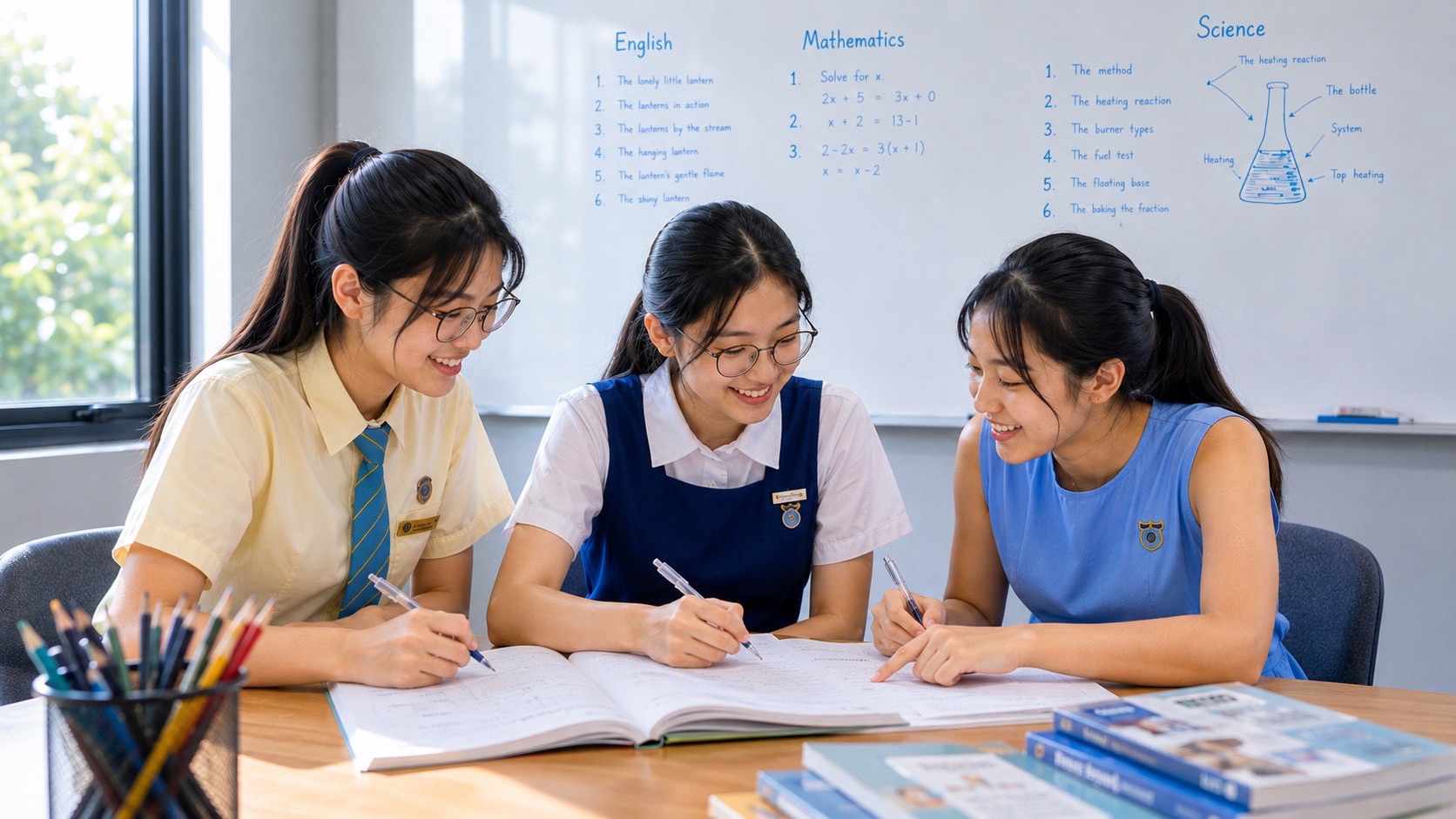
Secondary 3 Mathematics small groups tuition for Geylang families can be valuable when a teenager calculates accurately but repeatedly misinterprets averages, probability events, graphs or practical number relationships. A tutor working with three learners may be able to identify each pupil’s first mistaken decision and test whether the correction works in a new situation without help.
eduKateSG’s published three-pupil model uses a typical 1.5-hour Mathematics tutorial. Its immutable teaching reference concerns tuition near Sixth Avenue MRT in Bukit Timah; this Geylang article is a parent information guide rather than confirmation of a Geylang classroom or available seat. The actual venue, subject level, teacher, schedule and travel must be checked before enrolling.
This guide covers Singapore’s Full Subject-Based Banding and 2027 SEC Mathematics levels, worked examples of statistics and probability, and practical benefits and drawbacks of three-person tuition. It emphasises what a parent can actually verify: independent thinking, precise error feedback, a realistic timetable and progress that survives a changed question.
- Best fit: repeated errors in reading and interpreting data or probability conditions.
- Curriculum: use the correct G1, G2 or G3 Mathematics syllabus; Additional Mathematics is separate.
- Potential advantage: targeted feedback and independently tested explanations.
- Risks: group mismatch, commute, homework overload, peer pressure and tutor dependence.
- Evidence: correct method selection on new data and probability tasks without hints.
- Decision: choose tuition only if it adds necessary support beyond school and self-study.
1. A correct calculation may still give an incorrect conclusion
Secondary 3 Mathematics tests more than arithmetic. A student might calculate a mean correctly but claim it represents a typical observation despite a strong outlier. Another may use a probability formula without reading whether an object was replaced. A third might compute a rate but attach the wrong units or misinterpret a graph’s scale.
For Geylang parents, a useful diagnostic starts with a pupil’s original school attempt. Which condition was missed first? Does the student understand what the numbers represent? Is the problem choosing the model, executing the operation or communicating the result? These are different teaching needs.
Small-group tuition can create room for individual diagnosis, but the benefit is not guaranteed by the number of chairs. Each of three learners should make an independent attempt, receive feedback and then use the concept again on a fresh question without hints.
2. Full Subject-Based Banding sets the curriculum baseline
Full Subject-Based Banding allows Singapore secondary students to offer subjects at G1, G2 or G3. The G-level belongs to the subject rather than serving as a permanent overall label of a teenager. A tutor must match the actual Mathematics level, not simply the school year.
The first Singapore-Cambridge Secondary Education Certificate (SEC) examinations are held for graduating candidates in 2027, replacing separate N- and O-Level examination certificates. SEAB lists 2027 Mathematics as G1 K110, G2 K210 and G3 K310. These are distinct subject-level requirements even when the subjects share certain topics.
Parents should use official SEAB SEC overview, 2027 G1 syllabus list, 2027 G2 syllabus list, 2027 G3 syllabus list and the broader MOE Full SBB/SEC framework. The student’s school decides the current course and teaching sequence. Worked examples here develop reasoning and do not imply that every example is examinable at all G-levels.
3. Additional Mathematics is a different course
The 2027 SEC G3 list includes Mathematics K310 and Additional Mathematics K341 as separate subjects; G2 Additional Mathematics is listed separately as K232. Many Secondary 3 pupils take Mathematics without offering A-Math, while others take both.
A student may reason well about data in Mathematics yet struggle with abstract A-Math algebra. Another may manipulate functions confidently but misread ordinary Mathematics statistics. These different needs should be recognised rather than combined under one generic label.
Ask which subject and level the proposed three-pupil class actually teaches and how pupils with different combinations are handled. A child should not spend a significant portion of a lesson on work outside their school programme.
4. Worked example: mean and median communicate different information
The observations 2, 3, 3, 4 and 18 sum to 30, giving mean 6. The median, the third ordered observation, is 3. Both are correct numerical summaries, yet they tell different stories about the observations.
The unusually high value eighteen pulls the mean upwards. A question asking for a typical middle observation may be better answered with the median, while a question about the total divided equally makes the mean relevant. The choice follows the problem’s purpose.
A tutor can ask the child to justify the choice before calculating. Then change eighteen to five, producing mean 3.4 and median three. A learner who explains how the interpretation changes has achieved more than memorising two formulas.
5. A weighted mean needs the specified contributions
Imagine a hypothetical course in which a quiz counts for 20% and a larger test for 80%. A pupil scores 70 on the quiz and 85 on the test. The weighted result is 0.2 × 70 + 0.8 × 85 = 82.
The ordinary mean of the two scores is 77.5. That gives equal weight to the two assessments and therefore answers a different question. A teenager may calculate accurately but ignore the weights stated in the problem.
These figures are only an illustrative model, not a claim about a school’s actual assessment policy. A tutor should ask the child why the weighted score lies closer to the more heavily weighted result and then change the weights for a solo check.
6. The range does not describe an entire distribution
Set A consists of 2, 5, 6, 7 and 10; Set B consists of 2, 2, 2, 10 and 10. Both have minimum two, maximum ten and range eight. Yet their medians differ: six for A and two for B.
A pupil who concludes the groups are statistically identical because their ranges match has over-interpreted one summary. The range describes endpoints, not what happens between them.
Present a changed pair of data sets with the same range and ask for another useful description. The aim is to reason about what information a measure contains, not to learn more formulas without understanding their purpose.
7. A missing-number average can be modelled algebraically
Five values have mean 12, so their total is 60. Four values are 8, 10, 11 and 13, adding to 42. The missing fifth number must be 18.
Expressing the same reasoning as (42 + x)/5 = 12 shows the connection between a statistical rule and algebra. A student may know how to compute a mean yet struggle to reverse it when the question is phrased differently.
A tutor should ask what the mean tells us about the total before writing an equation. A changed question with a different number of observations tests whether the pupil can set up the model independently.
8. An average can be inappropriate without the right context
If one observation is unusually high, a median may offer a better description of a central experience than a mean. But the median is not automatically superior; if a question requires the total amount divided equally, the mean remains directly relevant.
Students sometimes try to memorise phrases such as ‘use median when there is an outlier’ without explaining why. The tutor should require reference to the actual question and what each statistic summarises.
Present two stories about the same data, one asking for a typical value and another asking for total allocation. Have the child choose and justify different measures without looking at a worked example.
9. Probability begins by identifying all possible outcomes
A bag contains four red and three blue counters, equally likely to be selected. The probability of one red counter is 4/7 because four of seven possible counters satisfy the event.
A student who writes 4/3 has confused the ratio of red to blue with red as a fraction of the total. The resulting value exceeds one, which cannot be an ordinary event probability. This is a sense check that should be learned rather than supplied by the tutor.
A changed bag composition can test whether the learner understands the denominator as the total sample space. Practice should begin with interpreting the event, not immediately multiplying fractions.
10. Without replacement changes the second draw
Two counters are drawn without replacement from the four-red, three-blue bag. The probability of two red is (4/7) × (3/6) = 12/42 = 2/7. After removing one red, there are three red and three blue counters remaining.
A student who uses (4/7) × (4/7) has implicitly replaced the first counter despite the words of the problem. The multiplication is a valid calculation for a different experiment, not this one.
A tutor can have pupils describe the bag after the first draw, then change only one phrase to ‘with replacement’. For that revised experiment, two red has probability 16/49. The teenager should explain why the answer changed.
11. A two-colour event can happen in two orders
For one red and one blue in either order without replacement, red then blue has probability (4/7) × (3/6) = 2/7. Blue then red has probability (3/7) × (4/6) = 2/7.
The paths are mutually exclusive and both satisfy the event, so the total is 4/7. A pupil who calculates only one path has answered ‘red then blue’, not the full question. Arithmetic correctness within one path does not make the overall response complete.
Ask the student to list the successful outcomes before calculating. Where the syllabus includes probability trees or diagrams, these can make events visible; otherwise a plain-language account may be enough.
12. Expected frequency does not mean a guaranteed count
If an event has probability 0.25 in comparable trials, over 80 trials its expected frequency is 80 × 0.25 = 20. This does not require exactly twenty successes in one sequence of trials.
A student may know how to multiply the probability by the number of trials but misunderstand the word ‘expected’. The mathematical model describes an average tendency, not a fixed prediction for each finite experiment.
A tutor can discuss why two runs of the same experiment may give different counts. This is a useful interpretation exercise when appropriate to the learner’s course, without pretending every G-level requires advanced probability theory.
13. Graph scales can visually exaggerate a numerical change
Consider observations 96, 99 and 102. A graph whose vertical axis begins at 94 can make the bars look dramatically different. A graph beginning at zero presents a different visual impression, although the underlying values are identical.
A student who declares that the quantity doubled by looking only at the drawn bar height has ignored the labels and scale. The correct comparison must use the actual difference or relevant percentage.
Show the same data under two scales and ask which numerical conclusions remain true. The child should explain the presentation effect without assuming that every non-zero baseline is always prohibited.
14. The graph’s axes determine what its slope means
A line through points (1, 4) and (5, 12) has gradient (12 − 4)/(5 − 1) = 2. If the vertical axis is cost in dollars and the horizontal axis is items, the result means two dollars per item.
If the axes are distance in kilometres and time in hours, the same number represents 2 km/h. The calculation alone cannot explain the physical meaning. A student needs to read both axes before deciding on the unit.
Reversing both coordinate differences leaves the gradient unchanged, whereas reversing only one makes an incorrect negative result. A rough sketch and a sign prediction can catch that mistake.
15. A flat graph segment is not always a stop
A horizontal segment on a distance-time graph means recorded distance has not changed. On a speed-time graph, a horizontal segment above zero instead represents constant nonzero speed.
A learner who memorises the phrase ‘flat means stopped’ may be correct on one diagram and wrong on the other. The problem is ignoring which quantity the vertical axis records.
Ask two pupils to interpret different graphs and a third to check the axis meaning. Then give everyone a changed graph without hints to test whether the distinction is understood independently.
16. Interpreting a table can hide a linear model
A simplified pricing table lists item quantities 0, 1, 2 and 3 with totals $5, $8, $11 and $14. The price rises by $3 per item, while the starting total at zero items is $5. The equation is c = 5 + 3n.
A student who writes c = 3n has ignored the fixed charge. Another may incorrectly treat the relationship as direct proportion. The teacher should ask why doubling n does not double c.
Using a fresh table with a different fixed fee and unit rate, the learner should identify the two components and write an equation independently. This teaches model selection rather than a memorised pattern.
17. Context matters when comparing two cost models
Suppose Service A charges c = 5 + 3n and Service B charges c = 9 + 2n. Equating them gives 5 + 3n = 9 + 2n, so n = 4. Both then cost $17.
At n = 2, A costs $11 and B $13, so A is cheaper. At n = 6, A costs $23 and B $21, so B is cheaper. A teenager who reports only n = 4 may have solved the equation but not explained the crossover.
A tutor should ask for a sentence interpreting the intersection and a changed pair of models. Independent reasoning about which plan is better matters as much as algebra.
18. A correct operation can still answer the wrong problem
A student may calculate the median when asked for a total, or solve an equation but omit a restriction about whole-number items. Such errors often occur after apparently good mathematical working.
A useful final routine is to reread the exact request, name the quantity calculated and check its units or allowed values. A ticket count of 6.4, for example, is not the maximum whole number of tickets available under a budget; the relevant inequality must be interpreted.
A tutor should select a few altered contexts where the same numerical procedure produces different practical conclusions. This encourages the learner to read before calculating and to interpret after calculating.
19. Why the group should preserve three first attempts
With three learners, one may choose a wrong statistic, another may misread a replacement condition and the third may use the correct method but fail at arithmetic. Similar final marks can conceal these different causes.
The teacher can provide targeted feedback only if each pupil attempts the problem before a model solution or peer explanation is given. Discussion should follow those original attempts, not replace them.
After a shared comparison, each student needs a fresh individual question. Parents can then see their child’s development rather than relying on an overall impression that the group was busy and collaborative.
20. A ninety-minute tutorial should follow a learning cycle
eduKateSG’s published model uses up to three students in a typical 1.5-hour session. A strong class includes retrieval of an older concept, diagnostic explanation, independent practice and a changed exit task without hints.
- 10 minutes: retrieve a prior averages, fractions or graph idea.
- 20 minutes: explain the main misconception using a correct and incorrect example.
- 25 minutes: differentiated questions while the tutor examines each student’s first steps.
- 20 minutes: unfamiliar or mixed tasks with chapter cues removed.
- 10 minutes: check interpretation, working and the exact original mistake.
- 5 minutes: set a manageable follow-up and a delayed review question.
The timings are illustrative, not a guarantee about a current Geylang class. The educational test is whether each teenager can reason after the teacher has withdrawn the scaffolding.
21. A good group match depends on curriculum and readiness
Three Secondary 3 teenagers may take Mathematics at different G-levels or arrive with different prerequisites. One could still need fraction repair, another can calculate probabilities but misreads events, and the third may be ready for more demanding applications.
A tutor can sometimes teach a shared principle with differently pitched tasks. But a group where one learner continually waits or cannot participate is not a good educational match. A smaller class is not a remedy for incompatible objectives.
Parents should ask what diagnosis guides placement, whether the group is reviewed after several lessons and when individual teaching or a different group would be recommended.
22. Peer discussion can conceal a student’s uncertainty
Some pupils learn from hearing a classmate explain why an average was inappropriate. Others are too embarrassed to admit a basic mistake in front of faster peers. These effects can occur even in a group of only three.
A thoughtful tutor gives silent first-attempt time, invites respectful discussion and checks that no one is copying another student’s response. Mistakes should be treated as information about concepts, not as a public ranking.
If the atmosphere makes the child hide confusion or become more anxious, a different setting may provide more useful teaching despite its different group size.
23. Geylang travel can change the net learning benefit
This article addresses families in Geylang, Singapore; it does not establish a currently operating eduKateSG Secondary 3 Mathematics classroom at a Geylang address. The immutable Mathematics reference describes a Bukit Timah teaching arrangement near Sixth Avenue MRT. Verify real venues, tutors, subjects and vacancies before travelling.
Geylang covers several neighbourhoods and transport connections, so the teenager’s actual trip depends on where school or CCA finishes, not simply on the estate name. Waiting, transfers, walking, meals and the return home are part of the weekly commitment.
A class may be well taught but still leave the pupil too tired for careful interpretation. Count the total time cost and its effect on school homework, other subjects and sleep when deciding.
24. Excess homework can create familiarity without transfer
A worksheet headed ‘Mean and Median’ signals the calculation before the learner reads the question. Likewise, a probability sheet labelled ‘Without Replacement’ tells the pupil which condition matters. Such practice can develop initial fluency but does not necessarily prepare students for mixed assessments.
After teaching, change the context, remove the chapter label and bring older principles back after several days. A short varied set of questions may expose more independent understanding than a large number of routine drills.
Parents should ask what each assignment is designed to diagnose and how it fits with school correction work. More questions do not automatically create better learning.
25. Over-helpful tutoring can increase dependence
A tutor who immediately points to the correct statistic or explains how the sample space changes can make each problem easy. During a school examination those hints disappear, and the child may still be unable to make the same choice.
An effective teaching sequence begins with modelling, moves through limited prompts and ends with a new independent attempt. Track the number and type of hints required and aim to reduce them over time.
Parents should request a changed problem completed without the tutor days after instruction. It is stronger evidence of retained knowledge than a perfect page copied immediately after class.
26. What the small-group evidence really establishes
The EEF small-group tuition evidence defines small-group tuition as roughly two to five pupils and reports positive average educational progress. It also emphasises diagnostic targeting and teaching quality, while showing that effects can differ across age groups and subjects.
The reviewed interventions differ in intensity and context from a weekly private 1.5-hour class in Singapore. These findings cannot justify guaranteeing a particular SEC grade or a fixed increase in marks for an individual teenager.
Use the research as a reason to ask about teacher skill, group matching, independent practice and follow-up. The actual learner’s progress is the more relevant evidence.
27. Six weeks of evidence is better than indefinite assumption
Week one can preserve original work on mean versus median, a probability event and a graph-scale interpretation. Weeks two and three address the most consequential misunderstanding. Weeks four and five revisit the same principle with changed questions and delayed retrieval.
At week six, ask for comparable but unfamiliar problems without hints. Look for correct choice of a summary, accurate sample-space interpretation, appropriate graph statements and fewer requests for the tutor’s opening cue.
School marks remain useful supporting evidence but are influenced by test content and paper difficulty. If the original difficulty persists, ask for a revised approach or different group before automatically paying for another term.
28. When self-study, one-to-one lessons or no tuition may be wiser
A student who learns effectively from school, completes corrections and can independently tackle unfamiliar tasks may not need paid weekly tuition. A planned home routine or school teacher consultation might suffice.
One-to-one lessons may be better when large prerequisite gaps need intensive repair or a child cannot participate productively in a group. Individual instruction still needs unaided practice or it can create the same prompt dependence.
The comparison of individual and small-group Mathematics tuition examines these options. A responsible provider should recommend the least burdensome support that meets the child’s needs, including stopping tuition when the original gap has been repaired.
29. Questions Geylang parents should ask before enrolling
- Which G1, G2 or G3 Mathematics level and expected examination year apply?
- Does the child take Additional Mathematics, and is it taught separately?
- What first reasoning mistake appears in an original school data question?
- How do all three pupils make independent first and final attempts?
- What happens if the group’s prior knowledge or syllabuses are incompatible?
- What are the confirmed venue, tutor, lesson time, fees and active vacancies?
- How much homework can fit with school subjects, CCA and sleep?
- What changed independent work will be reviewed after six weeks, and when would stopping be appropriate?
30. Frequently asked questions
Must every Secondary 3 student attend Mathematics tuition?
No. Many learners progress through school teaching, teacher feedback and independent revision. Private tuition is optional and should address a diagnosed need.
Are G1, G2 and G3 Mathematics the same syllabus?
No. They are distinct subject levels with different assessment requirements.
Does every teenager take Additional Mathematics?
No. Additional Mathematics is a separate subject for those who offer it.
Are all probability examples in this guide examinable at every level?
No. They illustrate mathematical reasoning. Formal revision should follow the pupil’s actual syllabus and school’s current programme.
Is a Geylang eduKateSG tuition classroom confirmed?
No. This guide is not a verified current venue or vacancy listing. Ask the provider for the actual teaching arrangements.
Does a three-pupil tutorial guarantee an improved grade?
No. Teaching quality, practice and group suitability matter. Individual grades cannot be guaranteed.
What is an early sign of better statistical understanding?
The student chooses and justifies a summary or event model on a changed task without a hint.
When should tuition be reduced or stopped?
When the originally missing skill is secure and school progress continues independently, review whether additional paid lessons still add value.
31. Sources and relevant eduKateSG guides
Official curriculum information appears at official SEAB SEC overview, 2027 G1 syllabus list, 2027 G2 syllabus list, 2027 G3 syllabus list and MOE Full SBB/SEC framework. Confirm the individual school’s assessment year and course.
The EEF small-group tuition evidence summarises wider small-group tutoring research. Average effects are not guarantees for a specific commercial class or pupil.
For related information see eduKateSG’s immutable Clementi small-group Mathematics reference, the Paya Lebar Secondary 3 Mathematics guide, the Eunos Mathematics guide and comparison of individual and small-group Mathematics tuition.
The purpose of small-group Mathematics tuition is for a teenager to read the question, choose a defensible model, calculate accurately and check an answer independently, even when its surface form differs from the last worked example.