
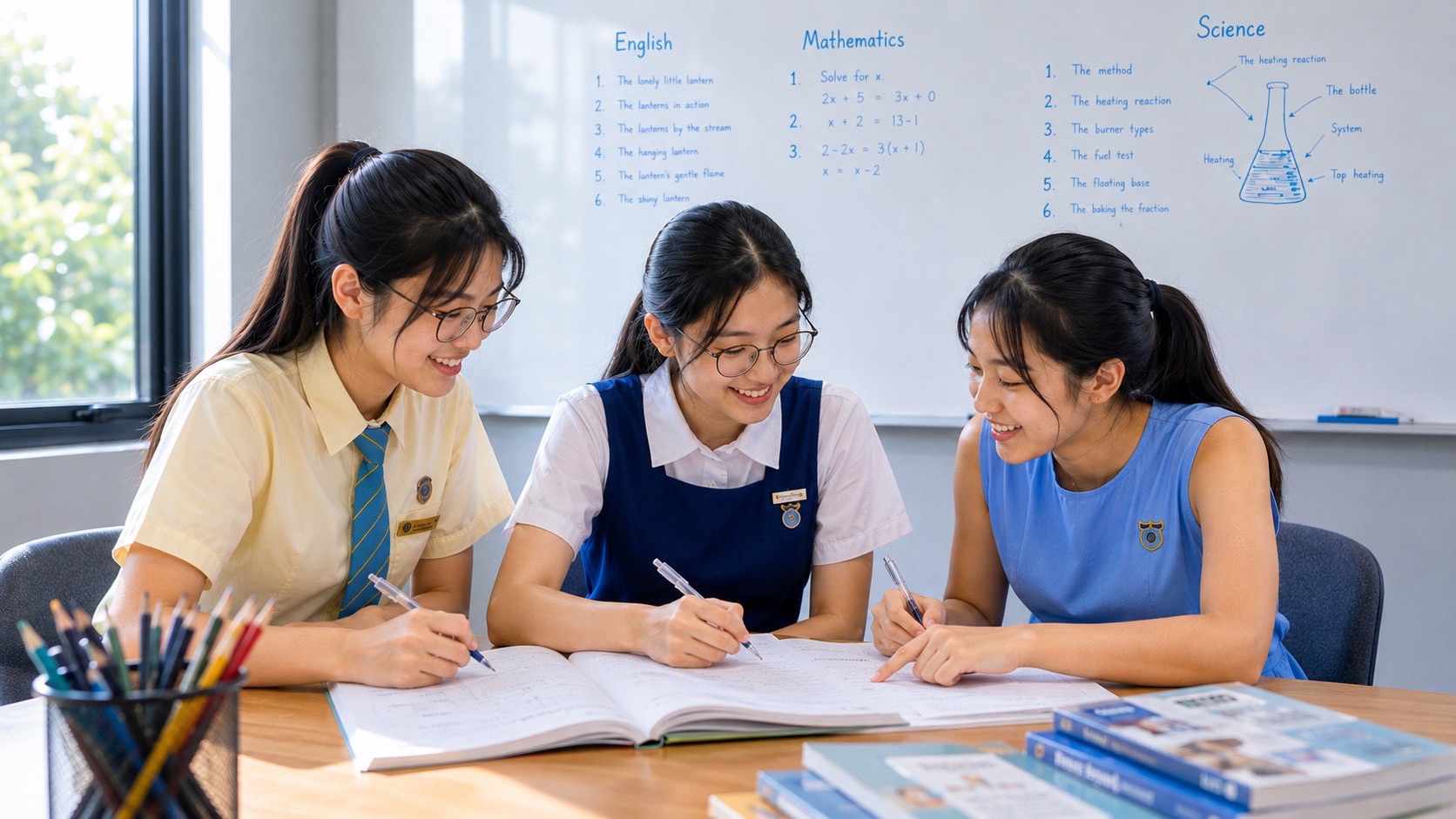
Secondary 3 Mathematics small groups tuition for Ubi families can be useful when a teenager can calculate correctly but repeatedly misinterprets statistics, probability conditions or graphs. A skilled tutor teaching three pupils can observe each first decision, correct a misconception and test whether the child can make a better independent choice on a new problem.
eduKateSG’s published model uses up to three learners in a typical 1.5-hour Mathematics tutorial. Its immutable teaching reference describes tuition near Sixth Avenue MRT in Bukit Timah; this Ubi guide does not confirm a current local classroom, timetable or available seat. Parents should check the actual teacher, venue, subject level, fees and full travel before enrolling.
This guide explains G1/G2/G3 under Full Subject-Based Banding and the 2027 SEC, then develops worked examples in averages, weighted data, probability, sample spaces and graphs. It weighs the educational benefits of targeted feedback against the consequences of fatigue, group mismatch, homework overload and dependence on tutor prompts.
- Best-fit problem: recurring mistakes interpreting data, choosing averages or reading probability conditions.
- Curriculum: confirm the correct G1, G2 or G3 Mathematics level; A-Math is separate.
- Potential benefit: feedback on each student’s own decision, followed by solo transfer tasks.
- Possible consequences: travelling, fees, incompatible peers, excess homework and over-prompting.
- Progress: new data and probability questions interpreted and justified without hints.
- Decision: use extra tuition only when it supplies genuine support not already available through school and self-study.
1. A correct statistical calculation may still answer the wrong question
A teenager can calculate a mean accurately yet claim that it describes most observations when one unusually large value dominates the total. Another may calculate a probability correctly for one order but overlook a second permitted order. These are errors of meaning rather than basic arithmetic.
Ubi families should ask for the student’s original marked data question and the first interpretation made. What does the table actually show? Which population is represented? What event was requested? A tutor who identifies the mistaken assumption can select a more useful corrective task than generic revision.
A group of three may provide opportunities to discuss different interpretations and check each learner’s work. But its educational value depends on individual first attempts and changed independent follow-ups, not simply how many pupils sit around the same table.
2. Full Subject-Based Banding determines the appropriate examination level
In Singapore, Full Subject-Based Banding permits secondary students to offer different subjects at G1, G2 and G3. These are levels of individual subjects rather than fixed labels for the entire student. A tutor should confirm the actual Mathematics level before providing examination-oriented practice.
From 2027, graduating candidates take the Singapore-Cambridge Secondary Education Certificate, replacing the former separate N- and O-Level qualifications. The 2027 Mathematics codes are G1 K110, G2 K210 and G3 K310, with distinct syllabus demands even where topic names overlap.
Parents should consult SEAB’s official SEC overview, 2027 G1 school-candidate syllabus list, 2027 G2 school-candidate syllabus list, 2027 G3 school-candidate syllabus list and MOE Full SBB and SEC announcement. The school is responsible for subject combinations and teaching sequence. Worked examples here illustrate mathematical reasoning; formal assessment preparation must reflect the child’s actual level and examination cohort.
3. E-Math and Additional Mathematics are separate subjects
The 2027 SEC G3 list distinguishes Mathematics K310 from Additional Mathematics K341, and the G2 list separately includes Additional Mathematics K232. Not every Secondary 3 student offers the additional subject. A group labelled ‘Sec 3 Maths’ should specify its actual coverage.
One learner may be comfortable with practical Mathematics data but struggle with A-Math algebraic functions. Another may be confident in abstract equations while misinterpreting a graph or an everyday percentage. The teaching target should identify which subject and skill is affected.
Before enrolling, ask how the three pupils are matched and how content is separated when their school combinations differ. A learner should not spend much of a ninety-minute tutorial watching irrelevant subject material.
4. Worked example: an outlier changes the arithmetic mean
Consider values 2, 3, 3, 4 and 18. Their sum is 30, giving a mean of six. Their median is three, the middle observation. Both are correct mathematical summaries, but the unusually large value eighteen makes the mean higher than most entries.
A pupil who always selects the mean when asked for a typical value may be ignoring the shape of the data. If the question instead requires the total amount divided equally, the mean becomes directly relevant. The right choice depends on what the user of the data needs to know.
Change eighteen to five. The new mean is 3.4 and the median remains three. A tutor can ask the teenager to predict which statistic changes more before calculating, then explain the reason after checking.
5. The median depends on position, not only the numerical total
Take the ordered values 1, 2, 3, 4 and 10, with median three and mean four. Replacing ten by thirty changes the mean to eight but leaves the median at three because the central position has not moved.
This contrast can help a learner understand why the median is often less affected by an extreme observation. It does not make the median universally better; the mean is still the appropriate measure for some questions about totals.
A tutor should ask the child to describe how each summary is constructed and why it changed or stayed constant. A fresh data set should then be interpreted without a worksheet heading telling the pupil which measure to calculate.
6. The range is limited information about a distribution
Set A contains 2, 5, 6, 7 and 10. Set B contains 2, 2, 2, 10 and 10. Both range from two to ten and therefore have range eight, yet their medians are six and two respectively.
A teenager who says the data sets are the same because both have range eight has over-interpreted the endpoints. The range does not show where the middle or most frequent observations fall.
A tutor can have pupils construct two more sets with a common range but different medians and means. Creating a counterexample can deepen the reasoning beyond repeating the largest-minus-smallest formula.
7. A weighted mean requires information about contribution
Suppose a hypothetical final score gives 30% weight to a quiz and 70% to a larger assessment. If the scores are 60 and 80, the weighted result is 0.3 × 60 + 0.7 × 80 = 18 + 56 = 74.
The ordinary mean of the two scores is 70, but it incorrectly treats both components as equally important. The challenge may be deciding how to use the stated weights, not multiplying decimals.
These numbers describe an illustrative mathematical model, not a particular school’s actual assessment policy. A tutor can change the weights and ask the learner to explain why the final result shifts towards the more heavily weighted score.
8. Combine class averages using the correct group sizes
Four learners have a mean mark of 60 and another six have a mean of 80. Their respective totals are 240 and 480. Across all ten pupils, the combined mean is (240 + 480)/10 = 72, not the ordinary mean 70 of the two given averages.
A student who averages 60 and 80 directly has given each group equal importance despite the different numbers of learners. This is a modelling error about what is being counted.
A tutor can explain the total-score approach and then change the group sizes, letting the teenager form the combined mean independently. The critical question is whether the child can identify the correct denominator and contribution.
9. Solve a missing-value average using algebra
Five numbers have a mean of twelve, so their sum is sixty. Four of them are 8, 10, 11 and 13, totaling forty-two. The missing number is therefore eighteen.
The equation (42 + x)/5 = 12 expresses the same relationship. A learner who calculates an average well from a complete list may become stuck when the question reverses the information.
Ask the student to say what the given mean tells us about the total before writing the equation. A changed number of observations and a new target mean should be solved without the tutor suggesting the method.
10. A numerical summary has a purpose, not just a formula
If a question asks what is typical, the median may be more representative when one observation is extreme. If it asks for the total shared equally, the mean is central. If it asks about the span from minimum to maximum, the range may be the relevant measure.
A teenager can know all three algorithms while selecting the wrong one for the story. The tutor should ask the child to read the question’s goal and explain the information each proposed statistic does or does not provide.
A short exercise using the same data but three different questions can be effective. The learner must choose the measure in response to the purpose rather than to the most recently studied chapter.
11. Probability begins with what counts as a possible outcome
A bag contains four red and three blue counters. With all counters equally likely to be chosen, the probability of red on one random draw is 4/7. The denominator counts all seven individual counters, not the three blue ones.
A student who writes 4/3 has given a red-to-blue ratio rather than the probability of red among all possible counters. This value is greater than one, an immediate warning that it cannot be an ordinary probability.
A tutor should ask the pupil to describe the sample space and favourable outcomes in words before calculating. Changing the bag composition after the explanation tests whether that meaning has been retained.
12. A condition of replacement changes the next draw
If two red counters are drawn without replacement from the four-red, three-blue bag, the probability is (4/7) × (3/6) = 12/42 = 2/7. The second numerator and denominator change because one red counter was removed.
An incorrect method (4/7) × (4/7) would describe the bag as unchanged. This is appropriate for a different with-replacement experiment, not the one stated. The distinction rests on reading the condition, not on multiplication speed.
A tutor can ask the student to explain what is left in the bag after the first red draw, then compare with replacement, for which the two-red probability is 16/49. A changed example should be solved independently.
13. One of each colour can happen in either order
In the same bag, red then blue without replacement has probability (4/7) × (3/6) = 2/7. Blue then red has probability (3/7) × (4/6) = 2/7.
If the question asks for one of each colour in either order, these mutually exclusive paths both count. Their sum is 4/7. A pupil who calculates only one path has performed correct arithmetic for only part of the event.
A tutor should ask the teenager to list all successful sequences before multiplying. A new problem with different colour quantities tests whether the child identifies the complete event rather than copies the preceding fractions.
14. Do not confuse a ratio with a probability
Suppose a bag has three green and two yellow counters. The ratio of green to yellow is 3:2, but the probability of green in one equally likely draw is 3/5. The quantities are related but answer different questions.
A learner who places the number of yellow counters in the denominator of the probability has confused one group’s size with the total sample space. A numerical result greater than one should trigger an immediate plausibility check.
A tutor can present several short statements and ask which require a part-to-part ratio and which require a part-to-whole fraction. This foundation supports both probability and more general mathematical interpretation.
15. Expected frequency is not a guaranteed observation
If an event has probability one-quarter across comparable independent trials, its expected frequency over eighty trials is 80 × 1/4 = 20. The actual observed number could be seventeen, twenty-two or another count.
A child who insists the event must occur exactly twenty times has confused an expectation with certainty. The multiplication may be correct, but the interpretation is incomplete.
A tutor can discuss what might happen if the same experiment is conducted twice and why the counts could differ. This should be framed at a level appropriate to the student’s syllabus without suggesting all secondary courses require advanced probability analysis.
16. The probability model depends on its assumptions
Calculating favourable outcomes divided by all equally likely outcomes requires that the events are genuinely being counted under the stated assumptions. A bag of identical counters drawn fairly is a useful simplified context; a biased selection method may not be represented by the same naive fraction.
A teenager may see a familiar question format and begin dividing numbers before noticing a condition about randomness or replacement. A good tutor makes the learner read the assumptions aloud and identify which outcome set is relevant.
Then a changed question can deliberately alter one assumption. The student should explain whether the original probability expression remains valid and why, before carrying out any new arithmetic.
17. List successful outcomes before adding probabilities
Some events can occur through several mutually exclusive paths. Others are described by overlapping sets that should not be added as though no outcome belongs to both. The correct method depends on what the question actually counts.
A tutor can teach a small sample-space table or tree diagram where appropriate to the child’s subject level. Pupils should state which sequences satisfy the requested event before performing multiplication or addition.
An incorrect event list is a diagnostic clue. Even a flawless numerical calculation will answer the wrong question if the learner has selected an incomplete or overlapping group of outcomes.
18. A probability above one is evidence that something is wrong
An ordinary event probability lies between zero and one inclusive. If a pupil reports a value such as 4/3 for the chance of drawing red, the answer cannot be correct even before looking at the marking scheme.
The problem may be an inappropriate denominator, a double-counted event or an invalid assumption about how selections are made. The tutor should use the impossible result to investigate the first wrong decision rather than just correct the fraction.
Encourage the teenager to estimate whether an event is likely or unlikely before calculating, and to check whether the numerical result is plausible afterward. This is self-monitoring rather than a substitute for proof.
19. Graph scales can change visual impact without changing data
Values 96, 99 and 102 can look very different on a bar chart whose vertical axis begins at 94. When the same data are shown on an axis beginning at zero, the bars may look much closer in height.
The numbers themselves have not changed. A student who declares the value doubled solely from visual bar height has ignored the axis origin, intervals and actual values.
A tutor can ask the child to read the figures, compute their differences and compare two presentations. An independent changed chart should then be interpreted using evidence rather than the emotional impression of the image.
20. A graph gradient is a quantity per unit of another
Take a line through (1, 4) and (5, 12). Its gradient is (12 − 4)/(5 − 1) = 2. If y represents dollars and x items, the slope is two dollars per item. If y represents kilometres and x hours, it is two kilometres per hour.
A teenager may calculate the number correctly and still use the wrong units or description. The tutor should ask what increased vertically and what quantity changed horizontally.
A changed graph with new axis labels can show whether the learner understands the ratio and not simply the gradient formula. Predicting the sign from the line direction also helps catch a subtraction-order error.
21. A flat segment does not always mean no movement
On a distance-time graph, a flat segment indicates no change in recorded distance. On a speed-time graph, a horizontal line above zero indicates constant speed. The same visual shape has a different interpretation because the axes represent different quantities.
A student who repeats ‘horizontal means stopped’ on every chart may be relying on visual recognition rather than mathematical reading. A tutor should insist on identifying axes before drawing conclusions.
Present two similarly shaped graphs with different labels, ask for explanations and then supply a new graph to interpret alone. This trains a general decision process rather than a single memorised phrase.
22. A table of prices can hide an initial fixed fee
Suppose costs for zero, one, two and three items are $5, $8, $11 and $14. Each extra item adds $3, but there is a starting charge of $5. The model is c = 5 + 3n, with gradient three dollars per item and intercept five dollars.
A learner who writes c = 3n assumes the line passes through the origin. Another who writes c = 8n has combined the fixed fee with the per-item rate. Checking the rule against multiple table entries exposes both mistakes.
A tutor can give a changed table beginning at $7 and increasing by $4, asking the teenager to infer c = 7 + 4n independently and explain what each number means.
23. Comparing pricing plans requires interpretation beyond algebra
Service A costs 5 + 3n dollars and Service B costs 9 + 2n dollars. They are equal when 5 + 3n = 9 + 2n, giving n = 4. Both then cost $17.
At two items A costs $11 and B $13, so A is cheaper; at six items A costs $23 and B $21, so B is cheaper. Reporting n = 4 alone does not tell the whole story if the question asks for a comparison.
A tutor can ask the child to write a final sentence about the threshold and then change the plans. Students should be able to form the equation from the story, not merely solve one that was supplied.
24. A graph does not prove a conclusion about an entire population
A survey graph showing responses from one class can describe those respondents. It does not automatically establish what every Singapore teenager believes or does. Even accurate percentages can support an overbroad statement if the sample does not represent the larger population.
A tutor can ask whose data are included and which conclusion the wording actually permits. This is careful interpretation rather than a requirement to teach advanced sampling theory.
The teenager should practise distinguishing ‘in this sample’ from ‘in the entire population’. A changed school-survey example can show whether the child has learned to limit a mathematical claim to the evidence available.
25. A useful group permits different explanations, not copied answers
Three students may analyse one data set using a table, a graph and an algebraic formula. Comparing these can help reveal why an average changes or how a probability denominator was chosen.
But if one confident pupil responds before the others think, the discussion can hide weak individual understanding. A tutor should give quiet first-attempt time, check peer explanations carefully and require a fresh individual task afterward.
Parents can ask for the child’s original error and a later independent example. These provide more reliable learning evidence than a workbook containing only model answers copied after discussion.
26. A ninety-minute tuition lesson should contain an independent check
eduKateSG’s established model involves up to three learners for a typical 1.5-hour tutorial. An effective lesson can test older knowledge, explain one misconception, give individual work and finish with a changed task.
- 10 minutes: retrieve earlier fractions, averages or graph reading.
- 20 minutes: clarify the most significant misconception with a valid and invalid example.
- 25 minutes: differentiated individual tasks while the tutor checks first decisions.
- 20 minutes: unfamiliar mixed data and probability questions without chapter labels.
- 10 minutes: review original errors, calculations and interpretation.
- 5 minutes: set one short follow-up and a delayed retrieval task.
The allocation is illustrative rather than a statement of a particular active Ubi class timetable. The most important part is observing what each teenager can solve without the tutor’s first hint.
27. Matching three teenagers requires more than the same school year
Secondary 3 pupils may study different Mathematics G-levels and arrive with different prerequisite knowledge. One may still struggle with basic fractions, another calculates well but misses replacement conditions, and a third needs more advanced data reasoning.
A tutor can sometimes teach a shared idea and differentiate practice tasks. But when needs are too far apart, one pupil may spend most of the session idle or unable to participate. A different group or one-to-one support could then be more useful.
Ask how group placement is determined and whether the arrangement is reviewed after several lessons. A vacant seat and a common age do not prove that the tuition is educationally appropriate.
28. Group comparison can affect confidence and honesty
Some teenagers feel reassured when classmates also make mistakes. Others become reluctant to admit a basic misunderstanding when a faster student answers each question. A small setting can magnify that visibility.
A skilled teacher protects silent thinking time, discusses mistakes respectfully and values justified reasoning rather than response speed. Group explanations must also be checked for mathematical accuracy.
If the child repeatedly hides confusion, becomes silent or feels anxious, another arrangement may be preferable. A three-person class is an instructional option, not a guarantee of emotional comfort.
29. Ubi parents should check travel from the real starting point
This is a parent guide for Ubi families. It does not verify that eduKateSG has an active Secondary 3 Mathematics classroom at a Ubi address. The immutable Mathematics reference describes a Bukit Timah tutorial arrangement near Sixth Avenue MRT. Confirm the real venue, tutor, fees, subject and availability before planning a journey.
Ubi MRT is on the Downtown Line, but the student may begin travelling at school or CCA instead of home. The weekly commitment includes buses, walking, waiting, transfers, meals and the return home.
A long commute can reduce energy for careful interpretation and displace school correction work or sleep. Compare the educational benefit with the full time and wellbeing cost, not only the advertised ninety-minute lesson.
30. Extra worksheets may disguise a failure to choose methods
A sheet labelled ‘Probability Without Replacement’ tells students the relevant condition before they read the problem. A sheet headed ‘Mean and Median’ narrows the possible techniques immediately. These cues can help with early fluency but do not test independent method selection.
After understanding is established, the tutor should remove chapter labels, mix older concepts and change the wording. A short varied set that requires interpretation may reveal much more than a long pack of routine calculations.
Parents should ask which diagnosed error an assignment targets and how the workload fits school, CCA, meals and rest. More written work is not automatically better tuition.
31. Constant hints can increase rather than reduce dependence
A tutor may identify the relevant statistic, point to the remaining counters in the bag or tell the pupil which graph unit to use before the student has considered it. The resulting answers look correct, but the decisions have been made by the teacher.
An effective sequence starts with a full model, then a guided variation with fewer prompts and ends with an unfamiliar question completed alone. The tutor should note how much assistance was needed and aim to reduce it over time.
A fresh task solved after a delay is better evidence of learning than a perfect corrected page from the original lesson. The objective is an independent learner, not permanent reliance on a tutor’s next cue.
32. Research supports considering targeted small groups, not grade promises
The Education Endowment Foundation small-group tuition research reviews small-group tuition with about two to five pupils and reports positive effects on average. It also notes that targeting identified learning needs, teaching quality and group composition matter, with a smaller and less extensive body of evidence for secondary pupils.
Those general findings cannot guarantee that a particular weekly ninety-minute private class in Singapore will raise a student’s SEC Mathematics grade by a specified amount. Programmes studied can differ in frequency, subject and implementation.
Parents should ask how the tutor diagnoses errors and checks independent learning, then evaluate the child’s actual changed-question work. Class size creates an opportunity for feedback; it is not proof of improvement.
33. A six-week progress review based on decisions, not just scores
Week one can preserve original tasks on a mean, two-draw probability and graph interpretation, noting the first wrong assumption and prompts needed. Weeks two and three focus on the most consequential misconception.
Weeks four and five revisit the principle in changed questions and include delayed retrieval. At week six, the pupil should independently select an appropriate statistic, update a sample space and read a graph using actual axis values.
School marks remain useful but vary with test difficulty. If independent reasoning is unchanged, reconsider the diagnosis, teaching method or group before committing to another identical term.
34. When one-to-one teaching or no tuition is the better choice
A learner with deep prerequisite gaps may need individual foundation repair before joining a shared group. One-to-one tuition can allow flexible pacing but still needs independent work to avoid over-prompting.
Another teenager who understands school lessons, completes corrections and steadily improves may need no weekly paid class at all. A planned home routine and consultation with school teachers can be sufficient.
The one-to-one versus three-pupil Maths comparison examines the options. Good tutoring should have a clear exit condition: once the original skill gap is repaired and independent learning is stable, reducing or stopping extra sessions may be a positive outcome.
35. Questions Ubi parents should ask before paying
- Which Mathematics subject level—G1, G2 or G3—and examination year apply?
- Does the teenager also offer Additional Mathematics, and will that be taught separately?
- What first unsupported interpretation appears in an original school script?
- How does each of three learners work alone before and after discussion?
- What happens when group members take different syllabuses or have different foundations?
- What are the confirmed classroom, tutor, fees, timetable and current vacancies?
- How much homework fits around school assessments, CCA, travel and sleep?
- Which unfamiliar tasks will be compared after six weeks, and when might a pause be appropriate?
36. Frequently asked questions
Does Secondary 3 Mathematics require private tuition?
No. Some pupils learn effectively through school teaching, teacher feedback and independent revision. Tuition is optional and should address a demonstrated need.
Are G1, G2 and G3 Mathematics identical?
No. They are separate subject levels with different requirements.
Does every Secondary 3 pupil take Additional Mathematics?
No. A-Math is a separately offered subject, and the school combination should be confirmed.
Are all the probability examples here examinable at every G-level?
No. They illustrate mathematical reasoning; formal revision must follow the actual syllabus.
Is a current Ubi classroom confirmed?
No. This is an information guide, not verification of a local teaching venue or available place.
Can three-person tuition guarantee improved marks?
No. It may enable closer feedback, but individual outcomes depend on teaching quality, group match and practice.
How can parents test progress in data interpretation?
Change the data distribution or graph scale and ask the child to select and justify an interpretation independently.
How can probability understanding be checked?
Change whether a counter is replaced after the first draw and ask the learner to explain the effect on the sample space.
When should tuition stop?
When the original learning need is securely addressed and school progress remains independent, assess whether additional paid teaching still adds value.
37. Official references and connected learning
The official 2027 SEC syllabuses are listed at SEAB’s official SEC overview, 2027 G1 school-candidate syllabus list, 2027 G2 school-candidate syllabus list and 2027 G3 school-candidate syllabus list, with MOE’s framework explained at MOE Full SBB and SEC announcement. The student’s school confirms current teaching priorities.
The Education Endowment Foundation small-group tuition research summarises the evidence on small-group tuition. Its average findings are not promises of particular grades for individual private tuition students.
For related eduKateSG guides read immutable Clementi Mathematics small-group tutorial reference, the Eunos Secondary 3 Mathematics guide, the Paya Lebar Mathematics guide, the Aljunied Mathematics guide, the simple-interest and compound-growth problem explainer and the one-to-one versus three-pupil Maths comparison.
Effective small-group Mathematics teaching should help teenagers read numerical evidence accurately, choose an appropriate model, calculate carefully and justify new answers independently, making further tuition less necessary over time.