
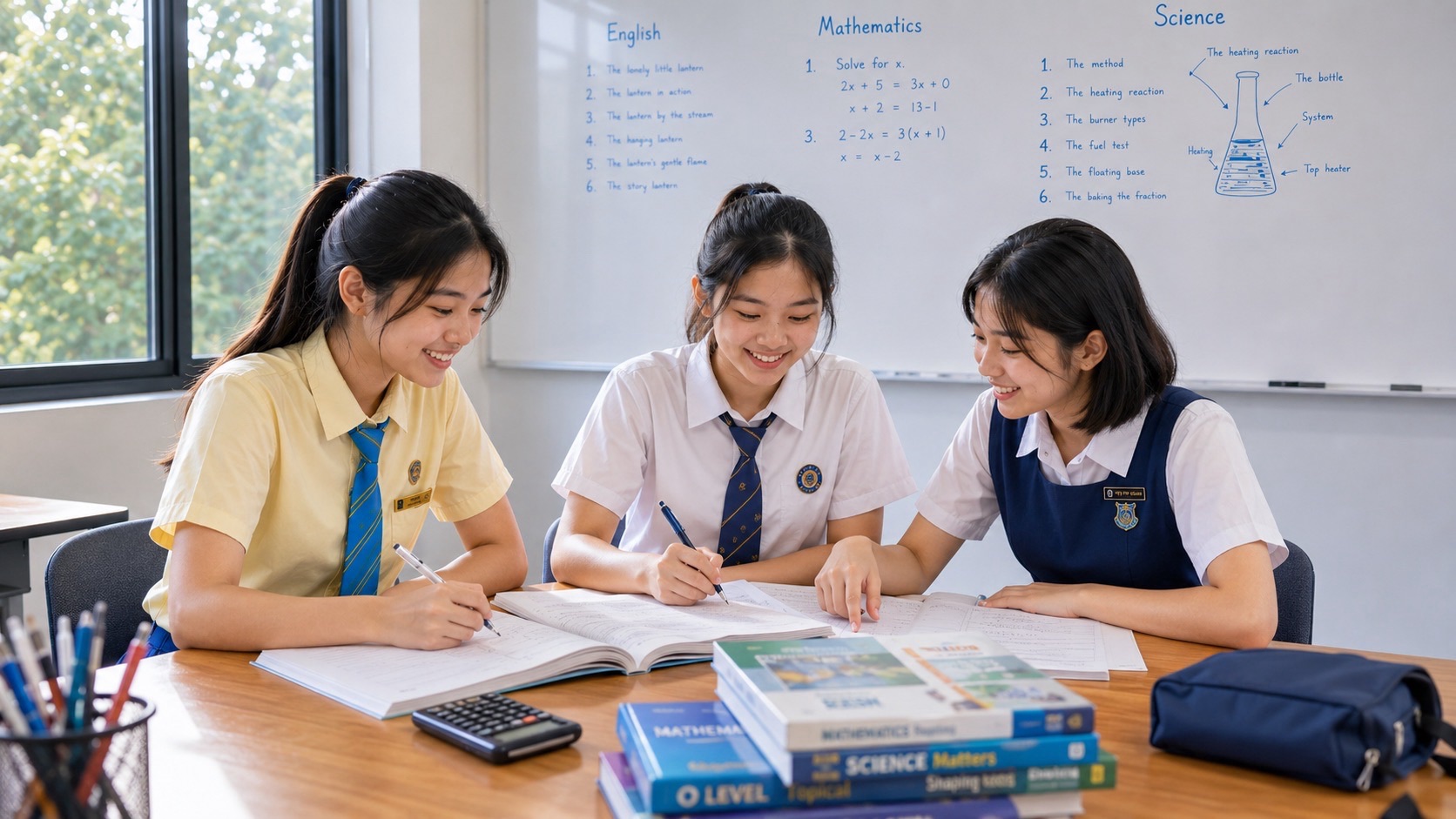
Secondary 3 Mathematics Tuition | Holland Village is where lower-secondary mathematics is reorganised into an upper-secondary system. Students encounter denser algebra, more formal graphs, geometry that demands longer chains of reasoning, and examination questions that mix topics with fewer cues. Families searching for Secondary 3 Mathematics tuition in Holland Village, Sec 3 Maths tuition, E-Math support, G1/G2/G3 Mathematics tuition or upper-secondary Maths preparation usually need help with this reorganisation rather than another set of disconnected worksheets.
The central Secondary 3 challenge is structural. A student may have survived Secondary 1 and Secondary 2 by learning one method per chapter, but upper-secondary questions increasingly require the student to choose among methods, combine them and maintain accuracy across several steps. Algebra becomes infrastructure for graphs, coordinate geometry, mensuration and later examination work. At the same time, students may be taking Mathematics at different subject levels under Full Subject-Based Banding, and some may also begin Additional Mathematics as a separate subject.
This Holland Village page therefore has a precise job. It sits under the existing Secondary Mathematics Tuition | Holland Village umbrella, links into the Mathematics Learning Hub, and keeps the separate Additional Mathematics Tuition | Holland owner intact. It does not collapse E-Math, G1/G2/G3 Mathematics and A-Math into one generic page. Instead, it explains how to make the main Mathematics pathway reliable at Secondary 3 while routing specialised A-Math needs elsewhere.
1. Secondary 3 is a reorganisation year
Secondary 3 feels harder partly because the curriculum becomes more cumulative. An algebra slip may destroy a coordinate-geometry solution. A weak percentage foundation may surface inside finance or statistics. Poor diagram reading may block trigonometric or mensuration work. The student is no longer learning only more mathematics; the student is being asked to coordinate previously learned mathematics with new content.
Adrian, one of our fictional eduKateSG residents, begins the year believing he is “bad at graphs.” A diagnostic shows that his actual problem is algebraic rearrangement. He understands gradient and intercept when they are given clearly, but he cannot reliably rewrite equations into a useful form. Once the algebra is repaired, much of the graph difficulty disappears. This is a classic Secondary 3 pattern: the visible topic is not always the root cause.
Tuition should therefore organise content around dependencies. The question is not simply which chapter comes next, but which earlier skill the chapter depends on and whether that skill is strong enough to carry new load.
2. Build an upper-secondary dependency map
A useful Secondary 3 dependency map has several foundations. Number and percentage support rates, finance and data. Algebra supports equations, graphs and formula manipulation. Geometry supports mensuration and trigonometric reasoning. Coordinate ideas connect algebra and geometry. Data handling requires numerical accuracy, interpretation and careful reading. Problem solving sits above all of them because mixed questions demand method selection.
Jo’s map may show secure number work, unstable algebra and strong geometry. Ben may have the opposite profile. Aisha may understand concepts but lose marks in multi-step execution. Ryan may finish quickly yet fail to distinguish which information is relevant. These are different upper-secondary risks.
Once the map is visible, practice can be sequenced intelligently. A student with fragile algebra should not spend every lesson grinding current graph questions while the algebraic bottleneck remains untouched. Repair the dependency, then return to the visible topic and test whether performance improves.
3. Algebra becomes infrastructure
At Secondary 3, algebra is no longer a topic that can be left behind after a test. It is infrastructure. Students need reliable control of expansion, factorisation, equations, formula manipulation, indices where required, algebraic fractions where required by the course, and the translation of verbal relationships into symbolic form. The exact syllabus depth depends on subject level, but the general principle does not change.
Mira is trained to ask three questions whenever an expression appears: What form is it in now? What form would make the next step easier? What operation preserves equivalence while moving toward that form? This replaces the habit of applying whichever algebra rule was most recently taught.
The concept of equivalent forms is especially important. 2(x + 5), 2x + 10 and, in a suitable equation, a rearranged form may all express the same underlying relationship. Flexible algebra means choosing the form that exposes the next move.
4. Factorisation should be recognised, not merely executed
Students often learn factorisation through pattern drills and then fail when the same structure appears inside a larger problem. We teach recognition cues based on structure rather than chapter labels. Is there a common factor? Is the expression a difference of squares where that technique is in the syllabus? Does a quadratic-type expression have factors that multiply and add in the required way? What is the simplest factorisation that exposes useful information?
Clara checks factorisation by expansion. If she writes 3x(x + 4) for 3x² + 12x, expanding back must recover the original expression exactly. This reversible check is quick and turns factorisation from a one-way trick into part of an algebra system.
That habit matters later because factorisation can simplify equations, reveal roots, reduce expressions or make graph structure visible. Students who see only the drill miss its purpose.
5. Equations become modelling tools
Upper-secondary questions often require students to create an equation rather than merely solve one. Cost, motion, geometry, percentage and rate problems can all be expressed through an unknown and a relationship. The modelling sequence remains disciplined: define the variable, express related quantities, state the governing relationship, solve, then interpret the answer in context.
Ethan works on a distance problem where two travellers cover the same route at different speeds. Instead of reaching immediately for a speed-distance-time triangle, he writes time = distance ÷ speed for each journey, then constructs the stated relationship between the times. The algebra grows from the situation rather than being imposed on it.
This is important because examination questions may disguise familiar mathematics. A student who knows the model can reconstruct the method even when the wording is new.
6. Graphs become an analytic language
By Secondary 3, graphs should be used to reason. Students need to connect equation form, gradient, intercept, coordinates and geometric meaning. When a graph changes, they should be able to predict what algebra changed; when an equation changes, they should anticipate how the graph moves.
Adrian compares y = 2x + 3 with y = 2x − 5. The equal coefficient of x means equal gradients, so the lines are parallel. The different constants change the vertical intercept. He then compares y = −2x + 3 and notices that the sign of the gradient reverses the direction of change.
The aim is not to memorise statements about m and c in isolation. It is to build a two-way link between symbolic form and visual structure. That connection makes later coordinate geometry much easier.
7. Coordinate geometry requires algebra and geometry at the same time
Coordinate geometry is a good example of why Secondary 3 feels more integrated. Gradient comes from algebraic change and geometric slope. Midpoint uses coordinate averages. Distance connects coordinates to right-triangle geometry. Line equations translate geometric relationships into algebra. Students who learned each earlier idea separately must now combine them.
Jo is given two points and asked to find the equation of the line through them. She calculates the gradient, chooses one point, substitutes into the line form used by her course, and then checks the second point. The final check confirms that both coordinates satisfy the equation.
For extension, she investigates parallel and perpendicular relationships where required. Instead of memorising an isolated rule, she links gradient to direction and uses a sketch to test whether the result is geometrically plausible.
8. Trigonometric reasoning begins with triangle identification
Where trigonometry appears in the student’s syllabus, the first skill is not pressing sin, cos or tan. It is identifying the relevant right triangle, the known sides or angle, and the unknown quantity. A correct ratio chosen on the wrong triangle will still fail.
Ben labels opposite, adjacent and hypotenuse relative to the specific angle in question. He then chooses the ratio connecting the known and unknown quantities. Before entering the calculator, he predicts whether the answer should be longer or shorter than a known side, or whether an angle should be acute in the given context.
Calculator mode becomes important here. Degrees and radians are not interchangeable. Students should know the mode required by their syllabus and verify it when an answer is implausible. Calculator technique is part of examination reliability.
9. Geometry should move toward structured argument
Upper-secondary geometry questions often contain several possible routes. We teach students to identify givens, constraints and target relationships before calculating. The question “What must be true before I can find the target?” is useful because it turns a complicated diagram into a dependency problem.
Aisha may need to establish an angle equality, use a triangle angle sum, then apply a property of parallel lines. She records each reason. The writing is concise, but the logic is explicit. If the final answer is wrong, the chain can be inspected step by step.
This is an examination skill as well as a mathematical one. A marker can award method credit only when the reasoning is visible enough to evaluate.
10. Mensuration and scale require dimensional control
Secondary 3 mensuration often combines shapes, algebra and unit conversion. We insist on dimensional discipline: lengths use linear units, areas use square units, volumes use cubic units. If a scale factor changes lengths by k, corresponding areas change by k² and volumes by k³. Students should understand why rather than remember three separate rules.
Ryan draws a simple dimensional table before difficult scale questions. If the length scale is 3, he records area scale 9 and volume scale 27. This prevents the common mistake of applying the same scale factor to every quantity.
Compound solids should be decomposed before formula selection. Identify the component shapes, decide what is being added or removed, convert units consistently, then calculate. Structure first, arithmetic second.
11. Percentage, finance and growth: think in multipliers
Repeated percentage change is best handled through multipliers. A 5% increase corresponds to ×1.05; a 12% decrease corresponds to ×0.88. Repeated changes can then be represented compactly and reversed where necessary. This is more robust than adding or subtracting percentages without identifying the base.
Mira analyses a quantity that grows by 4% per year for three years. Rather than calculating each year separately, she writes initial × 1.04³. She then explains that the exponent represents repeated multiplication, not “4% times three.” This distinction matters in compound growth.
Where finance contexts appear, students should also read the wording carefully: rate, time period, compounding frequency and required final quantity. A formula cannot rescue a misread context.
12. Statistics: interpretation becomes more consequential
Upper-secondary statistics should teach students to read displays, compare distributions and choose summaries appropriately. Even when a syllabus emphasises specific measures, students benefit from asking what the data actually say. A mean can be affected by extreme values. A median may better represent a skewed set. A graph scale can exaggerate or conceal visual differences.
Clara is given two datasets with similar centres but different spreads. She calculates required measures, then writes an interpretive comparison in context. The sentence forces her to connect numerical output to the question being asked.
Students should also distinguish description from explanation. A graph may show that two quantities move together; it does not automatically prove that one causes the other. Careful statistical language is part of mathematical literacy.
13. Probability should be represented before it is calculated
Probability becomes manageable when the sample space is organised. Tables, tree diagrams and lists help students see outcomes and dependencies. The representation should match the problem. A two-stage event may be clearer as a tree; paired categories may be clearer in a table.
Ethan draws a tree for two events and labels branch probabilities carefully. He checks that probabilities leaving a node sum to one where appropriate. When finding the probability of a complete path, he multiplies along the path; when combining mutually exclusive successful paths, he adds the path probabilities. The operations follow the structure rather than being memorised without meaning.
Boundary checks remain essential. A probability below zero or above one cannot be valid. That simple constraint catches many arithmetic slips.
14. G1, G2 and G3 Mathematics need accurate routing
Secondary 3 families may encounter G1, G2 and G3 subject-level language under Full Subject-Based Banding. The practical teaching question is always the same: which Mathematics subject level is the student taking now, what syllabus applies to the cohort, and what does the school assess this year? Tuition should align to the actual course rather than assume every Secondary 3 student follows one identical pathway.
The transition to the Singapore-Cambridge Secondary Education Certificate matters particularly for students approaching the 2027 system. SEAB states that from 2027 the former GCE N(T), N(A) and O-Level certificates are combined into the SEC, with subjects taken at G1, G2 or G3. The official 2027 Mathematics codes include K110 for G1, K210 for G2 and K310 for G3. Students should still check the official syllabus for their own examination year.
These codes help with administrative accuracy, but teaching remains concept-driven. A student cannot be taught effectively by label alone. The tutor needs the current syllabus, school sequence, assessment evidence and the student’s actual knowledge state.
15. E-Math language and current subject-level language
Families and older resources often use “E-Math” or “Elementary Mathematics” to refer to the main upper-secondary Mathematics subject in the pre-SEC structure. Those terms remain common in tuition searches and legacy materials, but the current system increasingly uses subject-level language. A useful programme should understand both vocabularies without confusing them.
If a student or parent searches “Sec 3 E-Math tuition Holland Village,” the underlying need is usually support for the main Mathematics course, not Additional Mathematics. This page serves that main year-specific route while preserving the existing broad owner and the separate A-Math owner.
Clear naming reduces cannibalisation academically as well as in search. Students should know which subject they are studying, which syllabus document governs it and which practice materials match that syllabus.
16. Additional Mathematics must stay separate
Secondary 3 is often when A-Math becomes a serious concern, but A-Math is not simply “harder E-Math.” It is a separate subject with different content, pace and algebraic demands. For Holland Village, the existing Additional Mathematics Tuition | Holland owner remains the dedicated route.
Jo may take both subjects. Her main Mathematics work focuses on the syllabus, graphs, geometry, statistics and examination skills relevant to that course. Her A-Math work may require more advanced algebra, functions, trigonometric techniques or calculus later, depending on syllabus. The two subjects support each other, but they should not be collapsed into one study plan.
This separation also helps diagnosis. A student struggling in A-Math may still be strong in main Mathematics, or vice versa. Different error profiles require different intervention.
17. Mixed-question recognition becomes a core skill
Upper-secondary papers increasingly ask the student to identify the mathematics rather than announce it. A question may combine percentage, algebra and graphs. Another may hide a right triangle inside a mensuration diagram. Another may require coordinate geometry after a line equation is derived. Recognition is therefore part of mastery.
We use interleaving deliberately. Once a concept is learned, it appears among unrelated problems. Adrian must decide whether an equation, graph, ratio or geometric relation is the right tool. His first step is often a short plan rather than immediate calculation.
This practice is cognitively harder than a single-topic worksheet. That is the point. Examination conditions demand method selection under uncertainty, so practice should eventually train that decision.
18. Working quality becomes a performance variable
At Secondary 3, working must be compact enough to fit time limits but complete enough to preserve logic. Too little working makes errors invisible; too much can slow the student and create clutter. The goal is selective visibility: show transformations, substitutions, reasons and intermediate values that matter.
Aisha practises one operation or logical move per line in algebra. In geometry, she labels the diagram and states key reasons. In mensuration, she writes the formula and substituted values before evaluating. In statistics, she records the relevant total or frequency. This consistent structure reduces cognitive load under pressure.
Good working is also a revision asset. When a paper is returned, the student can locate whether the failure began in interpretation, setup or execution.
19. Time management should be trained before Secondary 4
Waiting until the graduating year to learn paper management is unnecessary. Secondary 3 is the ideal time to build timing habits gradually. Students can begin with timed clusters of questions, then half-papers, then fuller mixed papers. Timing should be analysed alongside accuracy.
Ryan is fast but error-prone, so his goal is not greater speed. He needs a compulsory ten-second verification after selected steps. Mira is accurate but slow, so she works on recognition and method economy. The same time limit can expose opposite problems.
A useful record tracks minutes spent, marks attempted, marks earned and reason for unfinished work. Over time, the student learns which question types deserve more deliberate planning and which should be executed quickly.
20. Checking should be targeted by risk
“Check everything” is unrealistic in a tight paper. We teach targeted checking: substitute roots or equation solutions where possible; verify signs after expansion; inspect units in mensuration; estimate numerical magnitude; confirm calculator mode for trigonometry; reread the requested quantity; and revisit questions flagged for uncertain method.
Ben uses a risk map in the margin. A small S marks sign risk, U marks unit risk, and M marks method uncertainty. His final checking follows these marks rather than simply scanning from the first page. The system is simple enough to survive exam pressure.
Targeted checking is one of the cheapest ways to improve reliability because it converts known personal error patterns into specific actions.
21. Error logs should distinguish knowledge from execution
A wrong answer can come from not knowing, not recognising, mis-executing or failing to check. These require different remedies. If Clara does not know a theorem, she needs instruction. If she knows it but fails to recognise the configuration, she needs varied examples. If she recognises it but makes a sign error, she needs execution discipline. If she could have caught the error, she needs a checking routine.
We therefore record two labels after significant errors: stage of failure and specific cause. Over several weeks, the log reveals whether intervention is changing the pattern. The aim is not to preserve every mistake forever; it is to stop the same type of mistake recurring invisibly.
Once an error type is stable and rare, it can be retired from the active list. This keeps the system focused rather than burdensome.
22. A worked coordinate-geometry example
Points A(2, 3) and B(8, 15) lie on a straight line. The gradient is (15 − 3)/(8 − 2) = 12/6 = 2. Using y = mx + c and point A, 3 = 2(2) + c, so c = −1. The line is y = 2x − 1. Check point B: 2(8) − 1 = 15, so the equation is consistent.
The question can be extended. Where does the line cross the x-axis? Set y = 0: 0 = 2x − 1, so x = 1/2. Where does it cross the y-axis? At x = 0, y = −1. One pair of points therefore opens several connected ideas.
The deeper lesson is verification. Coordinates generate the equation, and the equation should reproduce the coordinates. Students learn to treat answers as testable claims.
23. A worked percentage-growth example
A population of 12,000 increases by 3% per year for four years. Using a multiplier, the model is 12,000(1.03)⁴. The student can evaluate this with appropriate calculator precision and round only as required. The structure is more important than the final number: each year multiplies the previous year’s value by 1.03.
Jo is then asked to reverse the process: if a quantity after four years is known, how can the starting value be found? Divide by 1.03⁴. This reinforces reversible thinking and prepares the student for more complex formula use.
A common wrong method is to add 12% once. That assumes each year’s 3% is based on the original value. The multiplier model makes the changing base explicit.
24. A worked trigonometric-structure example
Suppose a right triangle has an angle of 35° and adjacent side 8 cm, and the opposite side is required. The relevant ratio is tan 35° = opposite/8, so opposite = 8 tan 35°. Before evaluating, the student predicts that the opposite side should be smaller than 8 because tan 35° is less than 1. The estimate creates a check.
Mira then draws a second triangle with the same angle but double every side. The ratio opposite/adjacent remains unchanged. This helps her understand trigonometric ratios as shape relationships rather than calculator commands.
If the student’s course uses a different progression or has not yet introduced this content, the teaching sequence should follow the actual syllabus. The example illustrates method, not a claim that every Secondary 3 class teaches identical topics in identical order.
25. A sixteen-question mixed checkpoint
A useful checkpoint should sample upper-secondary decisions. It can include: simplifying and factorising algebra; solving a multi-step equation; rearranging a formula; constructing an equation from context; interpreting a linear graph; finding a line equation from points; percentage growth and reverse percentage; rate conversion; a multi-step geometry chain; a mensuration problem with unit conversion; a scale problem; a right-triangle problem where relevant; a statistics comparison; a probability representation; a calculator-precision question; and one unfamiliar mixed problem.
Afterwards, every lost mark is assigned to concept, recognition, setup, execution, time or checking. The student then selects the three highest-frequency causes for repair. This is more useful than simply redoing every question in order.
The retest should contain different questions with the same underlying structures. Repeating the identical question can test memory of the correction rather than transfer.
26. A seven-week Secondary 3 stabilisation cycle
Week 1 maps dependencies and diagnoses cumulative gaps. Week 2 repairs core algebra. Week 3 connects equations and graphs. Week 4 strengthens geometry, mensuration and representation. Week 5 mixes percentages, data and probability with earlier content. Week 6 introduces timed mixed practice. Week 7 retests weak structures and updates the error profile.
Aisha’s cycle may emphasise working efficiency and time because her concepts are strong. Ben’s may spend more time on algebra and sign discipline. Ethan’s may focus on translating word problems because his execution is accurate once the model is correct. A common framework can still produce different learning programmes.
The cycle repeats with new evidence. Secondary 3 is long enough to build reliability gradually; there is no reason to wait for Secondary 4 panic.
27. Small-group teaching should expose reasoning
In a three-student setting, the advantage is not simply lower numbers. It is the ability to inspect reasoning closely. One student can explain a method while the others compare it with their own. The tutor can stop an algebra transformation at the exact line where meaning was lost. Different students can be given different extension or repair questions after the same core task.
Imagine Adrian and Jo both obtain the right answer, but Adrian uses an efficient algebraic route while Jo draws a graph. Rather than declaring one method superior, the tutor can ask when each method is more useful. Ben, who has made a sign error, can use both correct solutions to locate the divergence in his working.
This creates mathematical conversation without turning the class into a lecture. Students learn that correctness, efficiency and explanation are separate qualities that can all improve.
28. Preparing for Secondary 4 begins with reliability, not paper volume
Families sometimes respond to Secondary 3 difficulty by buying more papers. Papers are useful only when the underlying skills are strong enough to learn from them. If a student repeatedly fails the same algebra step across ten papers, the answer is not paper eleven. It is targeted repair followed by a fresh mixed test.
Clara uses a ratio of practice modes: focused repair for a weak structure, mixed questions to test recognition, then timed paper sections to test execution. The balance changes as she improves. Closer to examinations, paper work becomes more prominent because the underlying network is more stable.
Secondary 3 should end with a student who knows the syllabus map, understands personal risk areas and has a repeatable process for correction. That is the best starting point for Secondary 4.
29. Parent guidance for the upper-secondary transition
Parents can help by separating three questions. First: Is the student in the correct course and using the correct syllabus resources? Second: Which mathematical dependencies are weak? Third: Which performance habits are costing marks despite adequate knowledge? These questions lead to more useful decisions than comparing total worksheet volume.
Ryan’s result may fall after a school increases paper difficulty. If his concept accuracy is stable but completion drops, the intervention should focus on timing and method efficiency. If both concept and completion collapse, deeper repair is needed. Context matters.
Families should also avoid treating subject-level labels as fixed identities. A student is a learner working within a current pathway. The useful question is what capability can be built next.
30. The Holland Village Secondary 3 route
This page owns the Secondary 3 year-and-location intent for Holland Village. The broad parent remains Secondary Mathematics Tuition | Holland Village. Secondary 1 handles transition and algebra foundations; Secondary 2 handles consolidation and upper-secondary readiness; Secondary 4 handles mixed-paper execution and examination reliability.
The separate Additional Mathematics Tuition | Holland owner remains the correct route for A-Math. The Mathematics Learning Hub remains the wider subject router. Keeping these responsibilities distinct avoids a broad local page competing with year-specific and subject-specific owners.
31. What good Secondary 3 progress looks like
Good progress is visible when the student can move through mixed mathematics without losing the underlying structure. Algebra is more accurate. Graphs are interpreted rather than merely drawn. Geometry reasons are explicit. Calculator use is deliberate. Earlier topics remain retrievable. The student can explain why a method fits the problem and can identify the cause of a wrong answer.
Marks should eventually reflect that stability, but process often improves first. Jo may stop losing sign marks before her total score rises. Ben may complete more of a paper because recognition is faster. Mira may make fewer calculator-mode errors. Those changes matter because they reduce future volatility.
The objective is a student entering Secondary 4 with fewer hidden weaknesses and a much clearer model of how to repair the weaknesses that remain.
32. Final principle: reorganise before you accelerate
Secondary 3 Mathematics tuition works best when it reorganises knowledge into a coherent upper-secondary system. More advanced content is useful only when the foundations can support it. The student needs algebra that travels, graphs connected to equations, geometry connected to justification, statistics connected to interpretation, and examination habits connected to personal error patterns.
Adrian repairs algebra underneath graph problems. Jo links equations to geometry. Ben makes sign control systematic. Aisha develops compact working. Ryan trains time management. Mira strengthens calculator and representation discipline. Clara deepens rather than rushes. Ethan learns to model before manipulating. The cast is fictional; the learning states are recognisable.
For a Secondary 3 student in Holland Village, the route is therefore precise: identify the actual subject level, map dependencies, repair algebra, connect representations, practise mixed recognition, preserve A-Math as a separate route, train timing before Secondary 4 and check the correct syllabus for the cohort. That is how the year becomes preparation rather than accumulation.
Official reference notes
SEAB’s Secondary Education Certificate overview explains that the SEC begins in 2027 and records subjects at G1, G2 or G3. The official 2027 school-candidate pages list Mathematics under the relevant levels; families should consult the current G1, G2 or G3 syllabus for the student’s examination year. This page uses current system language while recognising that older resources and search behaviour may still use E-Math terminology.