
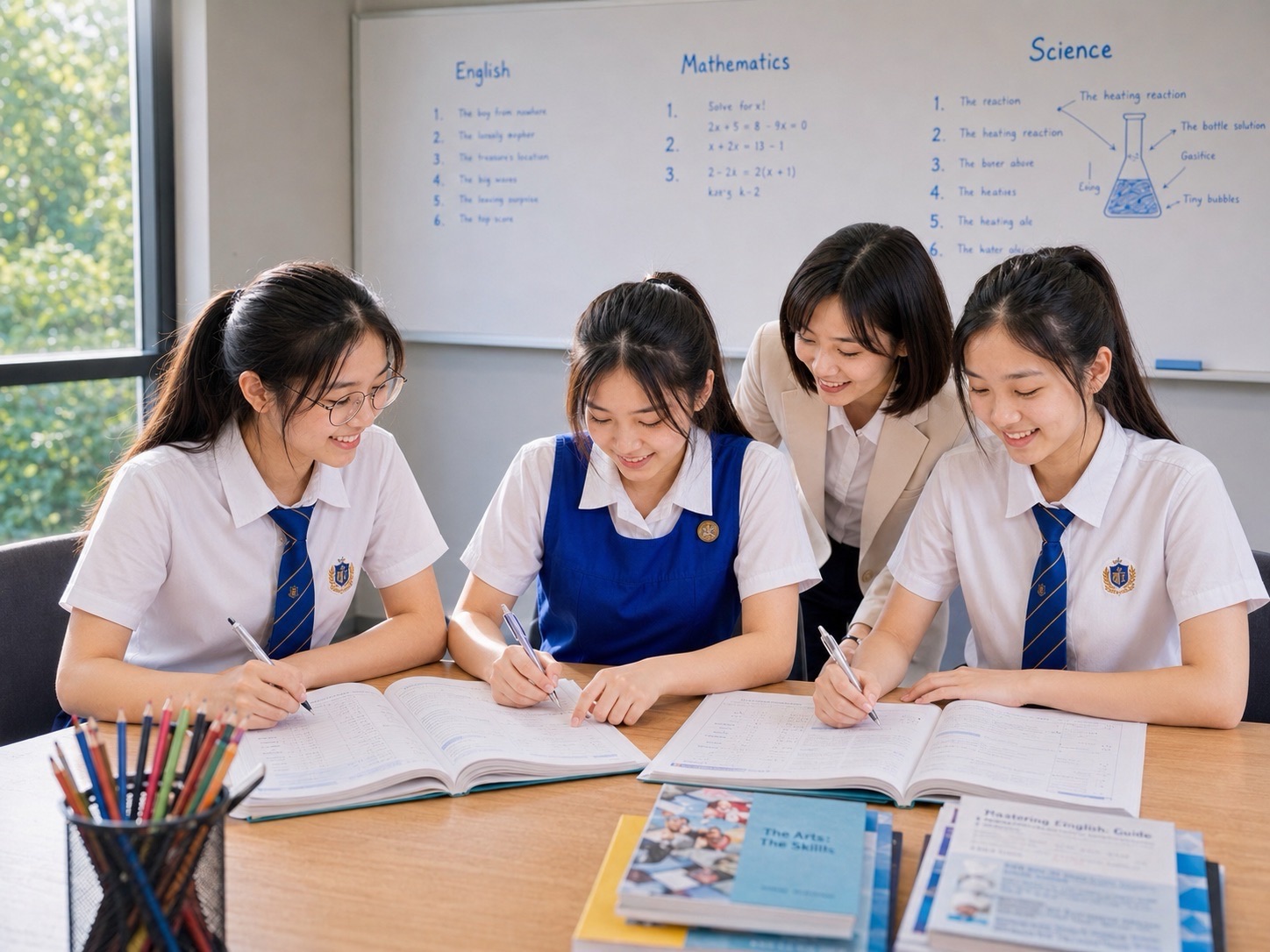
Mathematics tuition for Bukit Batok students in focused 3-pax classes. Repair foundations and prepare for PSLE, G1–G3, E-Math and A-Math.
Looking for Mathematics tuition in Bukit Batok? eduKateSG helps Primary and Secondary students repair weak foundations, understand difficult concepts and develop stable examination performance through carefully structured 3-pax tuition.
Mathematics Tuition Bukit Batok
For many Bukit Batok parents, the first sign of a Mathematics problem is not a failing grade.
It may be a child spending increasingly long hours on homework.
It may be a Primary student who can complete routine calculations but becomes lost inside a word problem.
It may be a Secondary student who follows algebra in class yet cannot begin an unfamiliar question independently.
Sometimes, the marks remain respectable. However, the parent can already see that the system underneath is becoming fragile.
The child is memorising more, understanding less and depending increasingly on familiar question patterns.
This is the point at which Mathematics tuition must do more than provide additional worksheets.
It should help the family answer a more useful question:
Where is the student’s Mathematics system becoming unstable, and what must be repaired before the next academic demand arrives?
At eduKateSG, Mathematics tuition is built around understanding the student’s present learning position, repairing important weaknesses and developing a more reliable route towards independent performance.
Students are taught in carefully matched 3-pax classes at our Bukit Timah location near Sixth Avenue MRT. The small-class structure allows the tutor to see how each student reads, represents, calculates, reasons and corrects—not merely whether the final answer is right or wrong.
One-Sentence Answer
Mathematics tuition for Bukit Batok students should identify whether the child is struggling with foundations, meaning, method, transfer or examination execution, then repair the earliest important weakness before moving towards greater speed and difficulty.
Mathematics Tuition Should Solve the Correct Problem
Parents naturally describe what they can observe.
“My child keeps making careless mistakes.”
“She understands in tuition but forgets during the test.”
“He does not know which formula to use.”
“My child was strong in Mathematics before Primary 5.”
“Secondary 1 was manageable, but Secondary 2 Mathematics has become difficult.”
“He can do E-Math but is struggling badly with A-Math.”
Each statement contains useful evidence.
However, the visible problem is not always the underlying problem.
| What the family sees | What may be happening underneath |
|---|---|
| Repeated careless mistakes | The student may be carrying too much cognitive load or using weak checking routines |
| Good homework but poor test results | The student may depend on examples, prompts or unlimited time |
| Difficulty with word problems | Mathematical language or representation may be weak |
| Formulas are memorised but misused | Meaning and conditions of use are not stable |
| Algebra suddenly becomes confusing | Earlier number and operation relationships may not have transferred into symbols |
| Marks rise and fall sharply | Knowledge is present, but performance is not yet stable |
| The student leaves questions blank | Method selection or recovery habits may be missing |
| The student practises frequently but does not improve | Errors may be repeated rather than properly diagnosed and repaired |
A child who has forgotten multiplication facts does not first need harder problem sums.
A student who understands concepts but works slowly does not necessarily need the entire syllabus retaught.
A capable student who has reached a plateau may not need more repetition. The student may need unfamiliar applications, stronger connections and finer examination control.
The quality of Mathematics tuition therefore depends on the accuracy of the diagnosis.
Start With the Student, Not the Worksheet
A school worksheet tells us what the school is teaching.
It does not automatically tell us what the student needs.
Two students sitting beside each other may be completing the same chapter while facing very different difficulties.
One may not understand the underlying concept.
One may understand the concept but have forgotten an earlier prerequisite.
One may know the method but be unable to recognise when to use it.
One may work correctly but too slowly.
Another may perform well in familiar questions but become disoriented when the wording changes.
If all five students receive the same additional worksheet, they may become busier without becoming more capable.
eduKateSG begins by reading the student’s current position.
Useful evidence may include:
- recent school examination papers;
- class tests;
- unfinished homework;
- correction work;
- recurring teacher comments;
- the student’s school and subject level;
- upcoming academic transitions;
- and the student’s explanation of what feels difficult.
The purpose is not to place a label on the child.
It is to locate the most useful point of intervention.
Mathematics Is Built in Dependencies
Mathematics is not a shelf of unrelated chapters.
It is a dependency system.
New knowledge depends on earlier knowledge remaining available and usable.
For example:
- place value supports accurate calculation;
- multiplication supports fractions and ratio;
- fractions support percentage;
- arithmetic relationships support algebra;
- algebra supports graphs, functions and equations;
- algebraic manipulation supports Additional Mathematics;
- visual representation supports geometry and mensuration;
- and working discipline supports almost every extended solution.
A weakness may remain hidden while questions are short and familiar.
It becomes visible when the student must combine several ideas inside one problem.
This explains why Mathematics can appear to become difficult “suddenly”.
The difficulty may not have begun in the current chapter. The current chapter may simply be the first one heavy enough to expose an earlier weakness.
Families can begin with How Mathematics Works, which explains Mathematics as a system of precise meanings, valid transformations and reliable reasoning rather than a collection of formulas.
The eduKateSG Mathematics Route
Our broader Mathematics learning architecture follows a progressive route:
Understand → Represent → Operate → Practise → Connect → Transfer → Perform → Review
Each stage has a different purpose.
Understand
The student learns what the mathematical object or relationship means.
This could be a fraction, ratio, equation, gradient, function or trigonometric relationship.
Represent
The student learns to express the idea through numbers, symbols, diagrams, models, tables or graphs.
Representation makes hidden structure visible.
Operate
The student learns valid procedures and transformations.
This includes calculation, substitution, expansion, factorisation, rearrangement and other mathematical operations.
Practise
The student develops accuracy and fluency through carefully selected work.
Practice should stabilise a method rather than merely occupy time.
Connect
The student learns how one topic relates to another.
This is essential because examination questions frequently combine concepts.
Transfer
The student applies learning when the question looks different from the original example.
Transfer is one of the clearest distinctions between temporary familiarity and genuine mastery.
Perform
The student completes Mathematics under school and examination conditions.
This introduces time, pressure, question selection and the need for reliable working.
Review
Errors are examined and classified so that the next round of work is more accurate.
The complete progression is explained in The eduKate Mathematics Learning System, which guides students from Primary foundations towards Secondary Mathematics and Additional Mathematics.
Primary Mathematics Tuition for Bukit Batok Students
Primary Mathematics builds the operating foundation for everything that follows.
A child is not only learning to calculate.
The child is learning how to:
- interpret mathematical language;
- recognise quantities and relationships;
- represent a situation;
- select an operation;
- maintain accurate working;
- and check whether an answer is reasonable.
These skills develop gradually across the Primary years.
Primary 1 and Primary 2 Mathematics
At Primary 1 and Primary 2, the main task is to establish a healthy mathematical foundation.
Students should develop control over:
- number sense;
- place value;
- addition and subtraction;
- early multiplication and division;
- measurement;
- simple shapes;
- patterns;
- mathematical vocabulary;
- and one-step problem-solving.
At this age, a child may produce the correct answer without fully understanding the relationship.
For example, the child may know how to perform an addition algorithm but not recognise whether a problem requires addition or subtraction.
The child may count accurately but have weak awareness of number bonds.
The child may understand the spoken explanation but struggle to convert words into a mathematical action.
Tuition should therefore protect meaning as well as procedure.
The goal is not to make early Primary Mathematics unnecessarily advanced.
It is to make the foundation dependable.
Primary 3 and Primary 4 Mathematics
Primary 3 and Primary 4 are important expansion years.
Students begin working with more substantial multiplication, division, fractions, measurement and multi-step problems.
The child is expected to manage more information independently.
This is often where an earlier dependency on memorisation begins to show.
A student may be able to complete a familiar multiplication question but not identify multiplication inside a word problem.
Another may understand fractions when diagrams are provided but become confused when the same relationship appears in words.
At this stage, Mathematics tuition should help students:
- connect operations to meaning;
- organise information;
- draw useful models or diagrams;
- explain why a method applies;
- and retain earlier topics while learning new ones.
Primary 5 Mathematics
Primary 5 is one of the most important Mathematics transition years.
The syllabus begins to integrate concepts more heavily.
Fractions, decimals, percentage, ratio, area, volume and multi-step problem-solving place greater demands on the student’s earlier number system.
A Primary 5 student may appear to be struggling with percentage when the actual weakness lies in fractions.
The student may appear careless in ratio when multiplication fluency is consuming too much mental capacity.
Long working may become disorganised because the child has not developed a consistent method of recording steps.
The correct response is not always to repeat the current chapter.
Sometimes the most efficient route is to repair the prerequisite beneath it.
Primary 5 tuition should also prepare students for the pace and integration required in Primary 6. Waiting until the PSLE year to investigate several years of accumulated weakness can create unnecessary pressure.
Primary 6 and PSLE Mathematics
Primary 6 Mathematics brings the Primary system together.
Students need to manage:
- whole numbers;
- fractions and decimals;
- percentage;
- ratio;
- measurement;
- geometry;
- area and volume;
- data interpretation;
- and complex problem sums.
They must also perform under time constraints.
The PSLE is Singapore’s annual national examination taken at the end of the final year of Primary school. The current examination information and calendar are published by SEAB.
Effective PSLE Mathematics preparation should include more than completing paper after paper.
Each paper should reveal useful information:
- Which topics are still unstable?
- Which question structures are repeatedly misunderstood?
- Is the child losing knowledge marks or method marks?
- Which questions consume too much time?
- Does the child check answers strategically?
- Can the child recover after becoming stuck?
- Are calculator and non-calculator habits controlled?
- Can learning be retrieved without a prompt?
A practice paper is valuable when it changes what happens next.
Otherwise, it becomes a record of the same mistakes appearing again.
Parents can also use the Primary Mathematics Master Index to understand the complete route from Primary 1 foundations to PSLE Mathematics.
Secondary Mathematics Tuition for Bukit Batok Students
Secondary Mathematics is not simply Primary Mathematics with larger numbers.
It introduces a different mathematical environment.
Students must become comfortable with:
- negative numbers;
- algebraic notation;
- equations;
- graphs;
- general relationships;
- formal geometric reasoning;
- statistics;
- probability;
- and increasingly abstract problem-solving.
A student who performed well in Primary Mathematics can still find this transition difficult.
This does not necessarily mean the student has become weaker.
The type of thinking required has changed.
Secondary 1 Mathematics
Secondary 1 is the bridge between arithmetic thinking and symbolic thinking.
In Primary school, students often work with quantities that can be imagined or represented directly.
In Secondary school, letters begin representing variable or unknown quantities. Rules become more general. The student must operate on symbols while preserving mathematical validity.
A common example is solving an equation.
Students sometimes learn to “move a term across and change the sign”. This may produce correct answers in familiar questions, but it hides the underlying principle: equivalent operations must preserve equality.
Without that meaning, the method becomes fragile.
Secondary 1 tuition should strengthen:
- integers;
- algebraic expressions;
- expansion and factorisation;
- linear equations;
- ratio and rate;
- geometry;
- mensuration;
- graphs;
- data handling;
- and formal mathematical working.
The objective is to make Secondary 1 a stable launch year rather than the beginning of accumulated confusion.
Read How Secondary 1 Mathematics Works for a closer explanation of this transition.
Secondary 2 Mathematics
Secondary 2 is a consolidation and positioning year.
The first shock of Secondary school has passed, but the student is now carrying a larger mathematical system.
Weak algebra begins affecting equations, graphs, geometry and future upper-Secondary work.
Students also need to prepare for the demands of their later subject route.
Under Full Subject-Based Banding, students may take subjects at G1, G2 or G3 according to their strengths, needs and readiness. This means Mathematics support should be matched to the student’s actual subject level and academic direction, not merely the student’s age or Secondary year.
Secondary 2 tuition should therefore examine whether the student is ready for:
- more advanced algebra;
- upper-Secondary E-Math;
- Additional Mathematics;
- faster school sequences;
- or a possible change in subject level.
The best time to prepare for Secondary 3 is before Secondary 3 becomes urgent.
Secondary 3 Mathematics
Secondary 3 is a major load increase.
Students encounter a wider and more interconnected Mathematics system.
Depending on their school and subject combination, this may include:
- E-Math;
- Additional Mathematics;
- algebraic manipulation;
- coordinate geometry;
- functions and graphs;
- trigonometry;
- geometry;
- statistics;
- probability;
- differentiation;
- and other upper-Secondary topics.
A weakness in one area can travel across several chapters.
For example:
- weak factorisation affects equations;
- weak algebra affects functions;
- weak fractions affect algebraic fractions;
- weak graph interpretation affects coordinate geometry;
- and poor notation makes longer solutions difficult to review.
Secondary 3 tuition must therefore protect the complete pathway into the examination year.
The aim is not only to survive the next test. It is to prevent structural weaknesses from arriving in Secondary 4.
Secondary 4 Mathematics
Secondary 4 is where learning must be converted into dependable examination output.
The student must know the syllabus, but also needs to:
- recognise question structures efficiently;
- select valid methods;
- show sufficient working;
- preserve signs and brackets;
- use notation accurately;
- manage time;
- identify questions worth returning to;
- and check without repeating the entire paper.
For candidates sitting the 2026 GCE O-Level examinations, SEAB publishes the relevant school-candidate syllabuses and examination information. From 2027, the Singapore-Cambridge Secondary Education Certificate begins for the relevant Full SBB cohort, with G-level syllabuses published separately.
This transition makes accurate class placement especially important.
Parents should confirm:
- the child’s exact Mathematics subject;
- the syllabus being examined;
- the school’s sequence;
- the examination year;
- and whether the child takes Mathematics at G1, G2 or G3.
E-Math Tuition for Bukit Batok Students
Elementary Mathematics requires broad and reliable control.
Students must work across topics such as:
- number and algebra;
- graphs;
- geometry;
- mensuration;
- trigonometry;
- statistics;
- probability;
- and real-world mathematical applications.
The main challenge is often breadth.
A student may understand most chapters individually yet struggle when topics are mixed or when several months have passed since the original lesson.
E-Math tuition should therefore build:
- retention across the syllabus;
- question recognition;
- accurate execution;
- clean working;
- flexible method selection;
- and examination pacing.
The student should not only know how to complete a question immediately after the topic has been taught.
The method should remain available later, when it appears unexpectedly inside a mixed paper.
A-Math Tuition for Bukit Batok Students
Additional Mathematics is more dependent on symbolic precision.
It asks students to recognise structure and perform valid transformations through topics such as:
- algebraic expressions;
- equations;
- surds;
- logarithms;
- functions;
- trigonometry;
- coordinate geometry;
- differentiation;
- integration;
- and applications of calculus.
A small algebraic weakness can become expensive.
One missing bracket can affect the rest of a solution.
One sign error can travel through several lines.
One misunderstood identity can prevent the student from beginning.
A-Math tuition should therefore teach students to:
- identify mathematical structure;
- understand why a transformation is valid;
- maintain accurate notation;
- select efficient methods;
- verify intermediate steps;
- and recover when an initial route fails.
Additional Mathematics becomes more manageable when students stop treating every question as a separate trick.
They begin to recognise a limited number of underlying structures appearing in different forms.
Read How Additional Mathematics Works for the full first-principles explanation.
Why 3-Pax Mathematics Tuition Matters
A Mathematics tutor needs to observe the student’s process.
The final answer provides only part of the information.
Suppose three students produce the same incorrect answer.
The first misunderstood the question.
The second selected the wrong method.
The third used the correct method but lost a negative sign.
Giving all three students the same correction would miss the actual problem.
In a 3-pax class, the tutor has greater visibility over:
- how the student begins;
- what the student notices;
- where hesitation appears;
- which method is selected;
- how working is recorded;
- where an error enters;
- whether checking occurs;
- and how much prompting is required.
The small group also preserves useful social learning.
Students can:
- explain their reasoning;
- compare methods;
- hear questions raised by others;
- learn to communicate Mathematics;
- and discover that difficulty is part of the learning process.
The class is small enough for close attention without removing every opportunity for independent thought.
A Small Class Must Still Be Properly Designed
Three students in a room do not automatically create high-quality tuition.
A small class can still become ineffective when:
- every student receives identical work;
- the tutor explains continuously;
- students copy solutions passively;
- the strongest student sets the pace for everyone;
- corrections stop at the final answer;
- or lessons simply follow school homework from page to page.
The value of 3-pax tuition comes from what the tutor can see and do with that visibility.
The tutor should be able to:
- adjust the explanation;
- choose different question loads;
- correct individual working;
- reduce prompts gradually;
- identify repeated errors;
- and confirm whether learning survives across time.
The headcount creates the opportunity.
Instructional precision creates the result.
How an eduKateSG Mathematics Lesson Progresses
A Mathematics lesson may contain several distinct layers.
1. Reconnect Previous Learning
The student retrieves earlier knowledge without relying completely on notes or examples.
This reveals whether previous work is still available.
2. Introduce or Clarify the Concept
The tutor establishes the mathematical meaning and its relationship to earlier topics.
Students should know what they are operating—not merely the sequence of buttons or steps.
3. Model a Valid Method
A clear solution method is demonstrated.
Attention is given to:
- sequencing;
- notation;
- diagrams;
- units;
- substitution;
- and logical validity.
4. Begin Guided Practice
The student works with support while the tutor observes where uncertainty appears.
The purpose is not to prevent every mistake. It is to make mistakes visible while correction is available.
5. Reduce the Prompts
The student completes similar or varied questions with increasing independence.
A method is not stable if the student requires the tutor to supply the first step each time.
6. Introduce Variation
The numbers, diagrams, wording or context change.
This tests whether the student recognises the underlying concept rather than the surface pattern.
7. Connect Topics
Questions may combine present and earlier knowledge.
This prepares the student for school examinations, where topics do not always remain neatly separated.
8. Review Errors
Mistakes are classified and corrected.
The student should know whether the failure came from:
- missing knowledge;
- misunderstanding;
- method selection;
- calculation;
- notation;
- reading;
- transfer;
- or examination control.
9. Establish the Next Step
The next lesson should respond to what the present lesson revealed.
This allows tuition to behave as a learning system rather than a weekly sequence of unrelated worksheets.
Teaching Ahead Without Creating a Hollow Lead
eduKateSG teaches ahead of the school schedule when the student is ready.
Prior exposure can be valuable.
When the topic later appears in school, the student is encountering it for the second time. This can improve participation, confidence and retention.
However, moving ahead is useful only when the foundation can carry the new material.
A student should not be introduced to advanced algebra while basic manipulation remains unstable.
The preferred route is:
Repair → Prepare → Introduce → Practise → Stabilise → Reconnect at school
This creates a genuine learning advantage rather than a temporary appearance of being ahead.
Four Common Bukit Batok Student Routes
Not every student enters Mathematics tuition from the same position.
Route 1: The Student Who Is Falling Behind
This student may have several accumulated gaps and increasing anxiety.
The correct starting work may appear easier than the current school chapter because tuition must repair the prerequisite beneath the visible difficulty.
The route is usually:
Locate → Simplify → Repair → Reconnect → Rebuild confidence
Confidence should come from increasing control, not reassurance alone.
Route 2: The Student Who Is Passing but Unstable
This student understands much of the syllabus but loses marks unpredictably.
The route may focus on:
- mixed-topic retrieval;
- working discipline;
- question interpretation;
- repeated error families;
- checking;
- and time control.
The aim is to convert existing knowledge into more stable performance.
Route 3: The Strong Student Who Has Plateaued
This student may already perform well in familiar work.
The next improvement may require:
- deeper explanation;
- unfamiliar applications;
- multiple solution routes;
- higher precision;
- stronger transfer;
- and greater control under time pressure.
Simply adding more difficult worksheets may not solve the plateau.
The student needs better resolution over why marks are still being lost.
Route 4: The Student Approaching a Transition
Important transitions include:
- Primary 2 to Primary 3;
- Primary 4 to Primary 5;
- Primary 6 to Secondary 1;
- Secondary 2 to Secondary 3;
- G2 to G3 Mathematics;
- E-Math to A-Math;
- and Secondary 3 to the examination year.
At a transition, the programme should prepare the student for the next environment before its full load arrives.
Is Travelling From Bukit Batok Worthwhile?
Bukit Batok families have several tuition options within western Singapore.
The nearest class, however, is not automatically the best-matched class.
Distance matters because students must sustain the journey every week. Travel should not create unnecessary fatigue or interfere excessively with school, sleep and family routines.
Class fit also matters.
A carefully matched 3-pax Mathematics class may provide substantially closer observation than a larger class located nearer to home.
The decision should consider:
- the student’s precise academic need;
- class size;
- tutor fit;
- lesson time;
- travel time;
- school and CCA schedule;
- the student’s energy;
- and whether the route can be sustained over the required period.
eduKateSG’s Bukit Timah classes are conducted at 8 Fourth Avenue, near Sixth Avenue MRT, by appointment.
Families travelling from Bukit Batok should assess the complete weekly routine rather than choosing by distance or reputation alone.
A consultation allows us to consider whether an available class is sufficiently suitable to justify the journey.
What Mathematics Progress May Look Like
Progress is not always first seen in the examination grade.
The earliest signs may include:
- the child begins work with less resistance;
- the student writes a correct first step;
- diagrams become more useful;
- working becomes easier to follow;
- repeated mistakes occur less often;
- the student notices an impossible answer;
- questions become more precise;
- fewer prompts are needed;
- and the child can explain why a method works.
These changes matter because marks are outputs of a deeper system.
When interpretation, method, retrieval and correction improve, examination performance has a stronger foundation from which to rise.
What Parents Can Observe at Home
Parents do not need to reteach the syllabus.
They can observe whether the child is becoming more independent.
Useful questions include:
- Can my child explain what was learned?
- Can the child begin without immediately opening the answer key?
- Is working becoming more organised?
- Are the same mistakes repeating?
- Can my child identify what went wrong?
- Is homework becoming more manageable?
- Does the child recognise links between topics?
- Are test results becoming more stable?
A single good test does not prove that the system is secure.
Similarly, one poor result does not prove that no progress has been made.
The pattern across time is more informative.
Who May Benefit From eduKateSG Mathematics Tuition?
The programme may suit students who:
- need Mathematics retaught from first principles;
- require more individual attention than a large class can provide;
- are preparing for PSLE Mathematics;
- are moving from Primary to Secondary Mathematics;
- need G1, G2 or G3 Mathematics support;
- are preparing for E-Math or Additional Mathematics;
- understand during lessons but cannot perform independently;
- make repeated errors despite substantial practice;
- have lost confidence after a difficult transition;
- or want to move from acceptable results towards distinction.
When 3-Pax Tuition May Not Be the Correct Arrangement
A responsible consultation should also identify when the programme is not the best fit.
A 3-pax class may not be suitable when:
- the student requires continuous one-to-one behavioural supervision;
- specialised learning support is required;
- the available class is academically mismatched;
- the timetable creates an unsustainable travel routine;
- the student’s present needs fall outside the programme;
- or the student is unable to participate in guided independent work.
The aim is not to place every enquiry into a class.
It is to find a route that can genuinely help the student.
Frequently Asked Questions
Does eduKateSG offer Mathematics tuition in Bukit Batok?
eduKateSG serves students from Bukit Batok and other parts of western Singapore through its Bukit Timah classes near Sixth Avenue MRT.
Classes are not physically conducted in Bukit Batok, so families should consider travel time and class fit during the consultation.
How many students are in each Mathematics class?
eduKateSG Mathematics classes are structured around a maximum of three students.
This allows close observation, individual correction and guided peer learning.
Do you teach Primary Mathematics?
Yes.
Support may include early Primary foundations, Primary 3 and Primary 4 development, Primary 5 integration and Primary 6 PSLE preparation.
Do you teach PSLE Mathematics?
Yes.
PSLE Mathematics support may include foundation repair, topic consolidation, problem-solving, mixed practice, examination strategy and detailed correction.
Do you teach Secondary 1 and Secondary 2 Mathematics?
Yes.
Lower-Secondary support focuses strongly on the transition into algebra, symbolic reasoning, graphs, geometry, statistics and preparation for upper-Secondary Mathematics.
Do you teach G1, G2 and G3 Mathematics?
Yes.
Class placement should reflect the student’s actual subject level, school syllabus and readiness.
Do you teach E-Math and A-Math?
Yes.
E-Math and A-Math are taught as related but distinct systems.
E-Math requires broad syllabus reliability, while A-Math demands stronger algebraic structure, notation and symbolic control.
Can you teach my child from scratch?
Yes, where the class fit is suitable.
Teaching from scratch means returning to the earliest prerequisite that is preventing progress, then rebuilding forward in the correct order.
It does not mean repeating every topic without diagnosis.
Does eduKateSG teach ahead of school?
We teach ahead when earlier foundations are sufficiently stable.
The purpose is to create useful prior exposure rather than rush through chapters.
My child makes many careless mistakes. Can tuition help?
Yes, but the mistakes should first be classified.
What appears careless may come from:
- weak knowledge;
- cognitive overload;
- incomplete methods;
- rushed reading;
- poor notation;
- limited checking;
- or examination anxiety.
The repair depends on the cause.
How quickly should we expect improvement?
Some execution errors can improve relatively quickly.
A deeper foundation weakness may require a longer period because earlier dependencies must be rebuilt and reconnected to current schoolwork.
Early progress should be judged through understanding, working quality, independence and error reduction as well as marks.
What should we bring for a consultation?
Where possible, bring or send:
- recent examination papers;
- topical tests;
- marked homework;
- the child’s current Mathematics subject level;
- school topics;
- examination year;
- and a brief description of the recurring concern.
This gives us better evidence from which to recommend a starting route.
Begin With the Closest Repeated Problem
Parents do not need to understand the entire Mathematics system before seeking help.
Begin with the most visible repeated difficulty.
Perhaps the child cannot interpret word problems.
Perhaps fractions and percentage have become entangled.
Perhaps algebra no longer makes sense.
Perhaps the student understands during lessons but cannot retrieve the method independently.
Perhaps Secondary 3 A-Math has exposed a weakness that was present earlier.
Bring that concern together with the student’s recent work.
We can then examine:
- what the student already knows;
- where meaning becomes unstable;
- which prerequisite is missing;
- whether methods are independently available;
- how errors repeat;
- what the school will require next;
- and whether an available 3-pax class is a suitable match.
Mathematics becomes overwhelming when several small weaknesses are allowed to merge.
The repair begins by separating them again.
Find the earliest important break. Repair it carefully. Reconnect it to the present syllabus. Then move forward with control.
Start at the Mathematics Navigation Hub
Understand How Mathematics Works
Explore the eduKate Mathematics Learning System
Read About Secondary Mathematics Tuition