
eduKate • City Hall, Singapore • Secondary 4 Geography • 2026 O-Level and 2027 SEC exam paper checks, conservation evidence and timed revision
Choose your reading route
Start with the precise exam code and the first repeated error in marked work. A weekday lesson may correct it quickly while the child is still alert; a weekend lesson can support a longer source evaluation. Either needs an independent new attempt afterwards.
Syllabus and codes · Gallery case · Worked evaluation · Timetable · Parent FAQ

Contents
Fifteen chapters on precise Geography revision and decisions
1. The first examination-year decision: 2026 O-Level or 2027 SEC, and which Geography?
2. One marked Geography paper can reveal a much more useful lesson than ten copied model essays
3. National Gallery is a documented adaptive reuse, not evidence that every plan succeeds
4. 2026 planning guidance does not mean every proposal is already completed
5. Original exam-style evaluation: access and heritage under competing constraints
6. A weighted decision matrix shows how priorities change an answer
7. An invented survey: thirty supporters can be proportionally fewer than twenty-four
8. The Padang illustrates why heritage status and everyday use are different dimensions
9. A different topic for transfer: an imaginary heat-comfort comparison
10. Describe, explain and evaluate require different shapes of response
11. Weekday or weekend Geography tuition should protect the second, unaided attempt
12. The three-learner tutorial only works when there are three separately marked scripts
13. Four-week exam revision: less repeated error, more independent reasoning
14. Parent checklist, common questions and the City Hall Geography reading ladder
The first examination-year decision: 2026 O-Level or 2027 SEC, and which Geography?
Secondary 4 Geography tuition in City Hall should begin with the student’s exact subject and examination year, not an assumption that all upper-secondary Geography materials are interchangeable. A candidate taking standalone Geography has different responsibilities from a candidate taking Humanities with Social Studies and Geography. The 2026 GCE examination listings and 2027 Singapore-Cambridge Secondary Education Certificate listings also have distinct subject codes. The tutor should verify the correct course before assigning any timed work.
The SEAB 2026 GCE O-Level syllabus list identifies standalone Geography as 2279 and Humanities (Social Studies, Geography) as 2260. For 2026 GCE N(A)-Level, the corresponding codes are 2246 and 2125. In the 2027 SEC G3 list, Geography is K329 and Humanities (Social Studies, Geography) is K335. In the G2 list, the subjects are K226 and K229. Parents should use the candidate’s actual school registration rather than a generic course label.
| Exam cohort | Standalone Geography | Humanities with Geography |
|---|---|---|
| 2026 O-Level | 2279 | 2260 |
| 2026 N(A)-Level | 2246 | 2125 |
| 2027 SEC G3 | K329 | K335 |
| 2027 SEC G2 | K226 | K229 |
The codes matter because a question’s scope, source demands and assessment format must come from the appropriate syllabus and school practice. A tutor can still teach transferable reasoning skills such as source reading, numerical comparisons and evaluation, but should not imply that every old question perfectly matches the student’s paper.
Ask for a recent marked answer and the teacher’s comments. A class should start by identifying the skill that prevented a stronger response, not by adding more general revision hours. The right materials and a precise diagnosis are more valuable than a promise of a particular grade.
This guide is written for readers considering Geography help around City Hall, but it does not claim eduKate has a current teaching branch in the Civic District. Confirm the venue, tutor and proposed group before making an enrolment decision.
One marked Geography paper can reveal a much more useful lesson than ten copied model essays
Parents often see a child who knows many case-study facts yet receives inconsistent Geography marks. The weakness may begin before content is used. The pupil might overlook a map key, compare percentages without checking sample size or answer “describe” when asked to “evaluate”. A class that adds more notes without identifying that first error may produce a thicker file but little change in independent performance.
Create a compact error code on the latest script. Mark S for source interpretation, U for units and denominator, P for explanation of process, E for selection of relevant evidence and J for an unsupported or missing final judgement. The code is a way to organise the next task, not to label the learner. Each letter should correspond to a practical correction.
| Repeated mistake | Illustrative symptom | Targeted practice |
|---|---|---|
| S | Uses the wrong map period | Source title, date and boundary identification |
| U | Ranks 30 of 50 above 24 of 30 | Compare sample shares accurately |
| P | Restates a land-use change without explaining it | Build cause-and-effect process with evidence |
| E | Adds unrelated monument history | Choose facts relevant to the question |
| J | Lists both sides and stops | Weigh criteria to reach a reasoned conclusion |
The most informative progress test is a later unseen answer. The tutor can guide a first correction, but the candidate needs to apply the idea alone to a different place or dataset. A student who now checks denominators without prompting has achieved a measurable skill gain even if a full examination score is not yet available.
Distinguish a knowledge gap from a performance gap. Some pupils do not understand the geographical mechanism; others understand it orally but fail to write it under time pressure. The intervention should match that difference. A tutor might need to rebuild a concept before more timed work, or practise a brief answer plan when the concept is already secure.
Effective tuition makes the learner increasingly independent. It does not require the child to depend on a tutor for every model sentence. Parents should value a clear diagnosis and a transfer question above the number of completed pages.
National Gallery is a documented adaptive reuse, not evidence that every plan succeeds
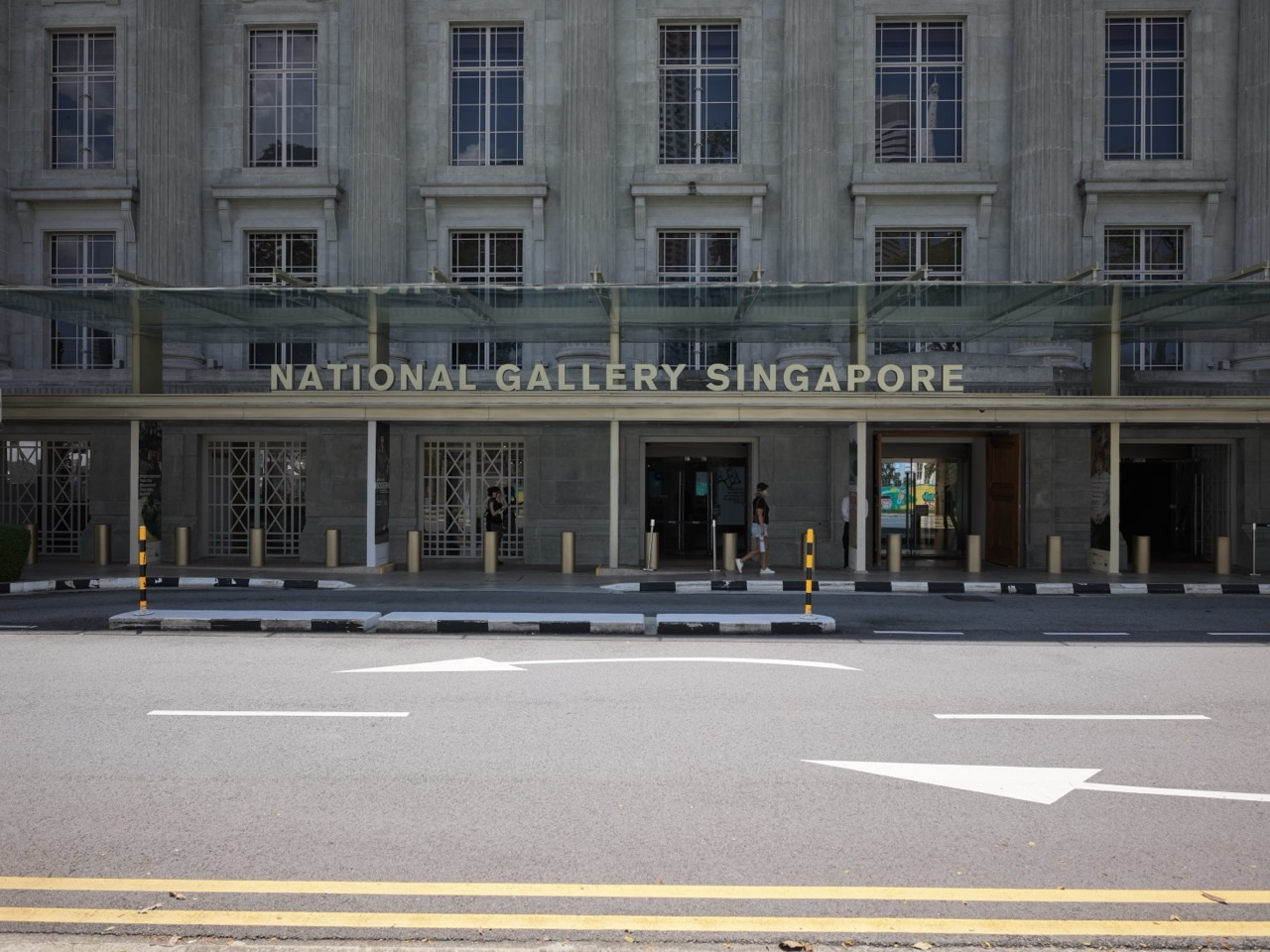
For a real City Hall geographical case, consider the transformation of the former City Hall and Supreme Court buildings into National Gallery Singapore. The Gallery’s own architecture and history record dates the buildings to 1929 and 1939 respectively and records the Gallery’s 2015 opening. URA’s conservation best-practices case study describes adaptive reuse of the two National Monuments, involving conservation, structural work, modern services and new connections.
These are strong sources for a case about the relationship between built heritage and new cultural uses. A candidate can explain that recognisable older structures can be incorporated into a modern art institution rather than simply demolished and replaced. But one successful adaptation does not establish that every listed building in Singapore can undergo identical interventions or that all possible economic and social effects have been measured.
URA’s City Hall subzone is broader than the Gallery complex. It includes civic and community institutions plus commercial and hotel uses. A statement about one museum project must not be passed off as a measured conclusion about every premises in the subzone. The source’s spatial boundary is as important as its time period.
A strong response could say: “The National Gallery example demonstrates that historic structures may be adapted to accommodate a different public function while retaining valued architectural character. Actual feasibility and benefits depend on the site’s constraints, conservation requirements and user needs.” That is defensible without inventing a precise tourism or income figure.
To test transfer, give the candidate an imaginary former office converted into a learning centre. The building and dates differ from the National Gallery. Ask whether the learner can explain what stays the same and what changes without copying the famous case paragraph. A useful examination method works beyond one familiar landmark.
2026 planning guidance does not mean every proposal is already completed
URA’s Master Plan 2025 material on heritage and culture discusses sustaining and rejuvenating the Civic District’s cultural offerings and wider city-centre proposals. A candidate using modern planning sources must read the distinction between completed work, ongoing activity and future intended change. A source published in 2026 may describe an aspiration for later years; it does not automatically certify that everything shown in a plan has been built.
Compare this with the National Gallery’s published 2015 opening and the Padang’s 2022 National Monument designation, both recorded as completed historical events. A school source may place those events beside a proposal, but the time status differs. The candidate should not merge past and planned statements into one present-tense inventory.
A simple editing test underlines verbs: “opened”, “gazetted” and “completed” differ from “planned”, “proposed” and “will be developed”. A tutor can ask the pupil to rewrite a mistaken sentence such as “The proposed improvement is operating now” into “The source describes a proposed improvement whose completion is not established here.” Such precision is valuable when the question includes current development plans.
An official planning source has authority for the intended policy direction, but it may not contain the outcome statistics needed for evaluation. A plan for more connected public spaces is not proof that every user reports improved comfort. Those claims would require observations, surveys and relevant completed-work records.
This method transfers directly to housing plans, transport infrastructure, coastal defences and park development. Source credibility and temporal relevance are different aspects of an accurate Geography answer, and candidates need to check both.
Original exam-style evaluation: access and heritage under competing constraints
Imagine a fictional civic building in a historic district. Option A retains most visible design elements while providing modest entrance improvements. Option B offers a more extensive hypothetical step-free route and service access but may require changes whose conservation feasibility is not known. Neither option is a real application for National Gallery Singapore or the Padang, and the classroom is not granting permission for work.
An examination response should identify the decision criteria before arguing for a winner. Possible criteria include protection of heritage fabric, accessible use, safety, construction disruption, ongoing maintenance and suitability for different users. Each needs appropriate information. A favourable drawing does not prove construction feasibility or low cost.
| Criterion | Illustrative option A | Illustrative option B | Critical evidence needed |
|---|---|---|---|
| Historic character | More existing fabric retained | Selected changes proposed | Specific protected features and permissions |
| Access | Limited step-free improvement | More extensive access changes | Surveyed route and accessible design |
| Upkeep and cost | Not assessed | Not assessed | Real maintenance and cost estimates |
| User experience | Unmeasured | Unmeasured | Appropriately gathered stakeholder evidence |
A weak answer states that “B is better because accessibility matters”. A stronger answer might say B could be preferred if step-free access is the main priority and conservation and technical conditions can be met. If protection of particular fabric is decisive, A may be more appropriate. The conclusion must explain the deciding factor and acknowledge missing information.
Do not invent the views of real residents, visitors or business owners. A learner can consider how different users might be affected while recognising that actual preferences must be investigated. Stakeholder awareness improves evaluation only when it remains connected to evidence rather than stereotypes.
For transfer, replace the building with an imaginary park entrance or riverfront path. The student should still select criteria, weigh alternatives and qualify the conclusion without importing irrelevant details about National Gallery. That is the essence of exam-ready judgement.
A weighted decision matrix shows how priorities change an answer
A weighted scoring activity is not an official Geography marking scheme, but it can teach why judgements depend on stated values. In this invented classroom matrix, assign 35% of the decision to heritage continuity, 35% to accessible movement and 30% to practical operation. Two hypothetical options receive ratings from one to five, with higher ratings representing stronger performance. No real civic building has been assessed with these numbers.
| Fictional criterion | Weight | Option A rating | Option B rating |
|---|---|---|---|
| Heritage continuity | 35% | 5 | 3 |
| Accessible movement | 35% | 2 | 5 |
| Practical operation | 30% | 4 | 3 |
Under these invented assumptions, A scores 5 × 0.35 + 2 × 0.35 + 4 × 0.30 = 1.75 + 0.70 + 1.20 = 3.65. B scores 3 × 0.35 + 5 × 0.35 + 3 × 0.30 = 1.05 + 1.75 + 0.90 = 3.70. Option B ranks higher, but the margin is small and entirely dependent on how the hypothetical ratings and weights were chosen.
Now give heritage continuity 50%, access 25% and practical operation 25%. A becomes 5 × 0.50 + 2 × 0.25 + 4 × 0.25 = 2.50 + 0.50 + 1.00 = 4.00. B becomes 3 × 0.50 + 5 × 0.25 + 3 × 0.25 = 1.50 + 1.25 + 0.75 = 3.50. The ranking reverses when heritage receives greater weight.
The student should conclude that evaluation depends partly on priorities and the reliability of the evidence. A numerical ranking cannot by itself establish compliance with conservation rules, technical viability or the views of affected people. This is the limitation that turns a neat calculation into a meaningful Geography discussion.
Ask each of three pupils to propose a different transparent weighting, explain why it was chosen and then evaluate a new fictional source qualitatively. The activity teaches clarity in argument rather than dependence on a magic decimal score.
An invented survey: thirty supporters can be proportionally fewer than twenty-four
A familiar numerical trap occurs when candidates compare support counts without checking sample sizes. This is a fictional consultation dataset, not real opinions from City Hall residents or National Gallery visitors. Group A contains 24 supporters among 30 respondents, while Group B contains 30 supporters among 50.
| Imagined group | Supporters | Total surveyed | Support share |
|---|---|---|---|
| A | 24 | 30 | 80% |
| B | 30 | 50 | 60% |
| Combined | 54 | 80 | 67.5% |
Group B has six more people supporting the idea, but its proportion is lower: 60% compared with 80% for Group A. The combined proportion is 54 ÷ 80 × 100 = 67.5%. It is not the unweighted mean of 80% and 60%, which would be 70%, because the two groups have different sample sizes.
Ask where the respondents came from. If one group was surveyed during a public event and the other on a routine weekday, a change in circumstances could influence the responses. Likewise, interviewing visitors near one attraction does not automatically represent every worker and resident in the wider subzone. A student should identify specific selection and timing issues rather than write only that the sample was “unreliable”.
Give a transfer problem: five of ten support an option in one small sample; seventy-two of ninety support it in another. The combined share is 77 out of 100, or 77%, not the simple average of 50% and 80%, which is 65%. Ask the learner to solve it without the first answer visible.
These calculations matter because geographical judgements depend on the quality of the underlying evidence. A candidate may produce a fluent paragraph that is still wrong if it ranks raw counts as if they were comparable rates or proportions. Accuracy in method makes evaluation more credible.
The Padang illustrates why heritage status and everyday use are different dimensions
NHB records the Padang’s gazette as Singapore’s 75th National Monument in 2022, making it the first green open space on the list. This is a heritage designation, not a measurement of all activity occurring there. A photograph may show recreation at one moment, while the monument record establishes protected status. Neither source alone supplies a complete survey of visitor behaviour, comfort or event impacts.
For a Geography assessment, the candidate should distinguish land cover, land use and legal designation. An open grassy field can be described by its surface; an image might show recreation; an official heritage record explains its recognised significance. These descriptions may be complementary rather than contradictory.
A hypothetical exam question might ask whether a protected civic green should allow a proposed event. A good answer would identify the real site’s protected character and explain that permission and effects on the landscape require actual authority assessment. The candidate should not treat the classroom scenario as a permit or assume that protection automatically forbids every form of recreation.
A source pack combining a current photograph with a dated official heritage statement is a useful challenge. Students must determine which part of an answer each source supports. The gallery building’s history and the Padang’s open-space monument status should not be merged into one claim about a single structure.
The broader lesson is that different sources answer different questions. If students learn to state what each source can establish before connecting them, their exam responses become shorter, more precise and less likely to overreach.
A different topic for transfer: an imaginary heat-comfort comparison
A learner who can evaluate conservation may still struggle with investigation data. Give a second, completely fictional source about two urban spaces, one exposed and one shaded. The numbers below are invented for teaching and are not measured conditions at City Hall, the Padang or National Gallery Singapore.
| Imagined variable | Site X: open | Site Y: shaded |
|---|---|---|
| Air temperature | 32.2°C | 31.0°C |
| Relative humidity | 66% | 72% |
| Wind speed | 1.1 m/s | 0.5 m/s |
The direct air-temperature difference is 1.2°C, with X warmer in these invented readings. But that does not prove Y feels better for every person, or that shade caused all differences. Thermal comfort depends on radiation, humidity, airflow, activity and personal circumstances. Time, instrument calibration, placement and repeated observations also affect reliability.
An answer could describe the temperature comparison and then propose a fairer method: measurements at comparable times and heights, repeated observations, and records of other relevant environmental variables. If the worksheet does not document these details, students should name them as limitations rather than imagine that the investigators controlled everything.
This cross-topic task matters because the examination may present unfamiliar material. A candidate must know the underlying logic—define a variable, compare fairly, explain cautiously and assess source limits—rather than rely on a memorised story about a single building.
The tutor should assess the transfer individually. One pupil may require numerical repair; another may need to identify confounding variables; another may be ready to suggest a more sophisticated sampling design. Close feedback makes these differences visible.
Describe, explain and evaluate require different shapes of response
A candidate can know the facts and still answer the wrong task. “Describe” asks for an observed pattern or change, with appropriate figures and comparison. “Explain” asks for the process or relationship producing a result. “Evaluate” requires weighing relevant considerations and arriving at a supported judgement. The details depend on the actual syllabus and marking demands; no single paragraph template substitutes for the question.
Consider a fictional map showing higher pedestrian crossings at point A than point B. A description reports the counts or standardised rates. An explanation explores a process that might influence the difference, while distinguishing hypothesis from evidence. An evaluation of a proposed change should consider need, feasibility, affected users and source limits. Simply mentioning the Gallery’s architectural history in every version would not make the answer relevant.
The Fencing Method can keep the response focused. Circle the command word, identify the exact spatial and time boundary, select the needed data, develop one defensible idea and remove material that the source does not support. An impressive but unrelated case-study fact should be left out.
A practical timed drill starts with a one-minute evidence plan rather than writing immediately. Learners list the two strongest facts, what process or criterion connects them to the task and one limitation if relevant. They then complete the answer in an appropriate time window based on their actual paper.
When the student finishes, check whether every paragraph advances the task. A short answer containing accurate evidence can be better than a long one full of repeated observation, unsupported certainty or decorative historical background.
Weekday or weekend Geography tuition should protect the second, unaided attempt
By Secondary 4, the scheduling dilemma is real. A weekday class can give prompt feedback on the latest marked paper but may follow a draining day of school and CCA. A weekend can support longer source comparison and evaluation, but may also crowd out revision for other subjects, rest and family commitments. The date alone does not determine educational effectiveness.
| Situation | Weekday can help when | Weekend can help when | What matters |
|---|---|---|---|
| Fresh marked error | Feedback is timely | Longer repair after rest | New problem solved unaided |
| Long school day | A calmer evening exists | Student arrives refreshed | Attention lasts to final task |
| Weekend crowded | Family recovery is protected | True independent study time remains | Short retrieval completed |
| Already performs well | No extra class may be needed | No extra class may be needed | Specific remaining weakness identified |
A tuition session is valuable only if the candidate can apply the correction on an unfamiliar question later. Ask the tutor what short return task will be set and how it will be marked. A class producing elegant model essays without independent work may feel productive but leave the student dependent on cues at examination time.
Families can review two weeks of actual work rather than rely on general claims that weekday or weekend study is superior. Compare concentration, completed responses, repeated errors and the sustainability of commuting and sleep. A few more hours of classes are not automatically more learning.
An effective tutor is willing to adjust the plan if a pupil can already answer unfamiliar questions accurately. Extra support should solve a real skill gap, not simply fill the calendar.
The three-learner tutorial only works when there are three separately marked scripts
A small group may offer attention that is harder to provide in a larger class, but the tutor must actually use it. One candidate may misread data, another may write vague explanations and another may struggle with evaluative judgements. The teacher can introduce the same source to all three while assigning differentiated questions and marking each child’s work.
A useful lesson rotates evidence-reader, process-explainer and claim-challenger roles. Afterwards every candidate completes a new problem alone. Without that step, the group’s most articulate pupil may create the appearance of shared success while others remain uncertain.
Some students need a repair pathway: rebuild percentages or question interpretation. Others need stabilisation under time limits and without notes. A confident student may be ready to compare contradictory sources or defend a conditionally preferred development option. None should be left idle because everyone is technically studying Geography.
Ask the tutor to record how much prompting was needed, not just whether the answer became correct by the end. A child who required several hints last week and now selects the right evidence alone has made identifiable progress. That progress can guide whether the weekday/weekend arrangement should continue.
Parents should confirm the actual group size, subject, tutor, fees and venue before enrolling. The Clementi Mathematics small-group reference illustrates a particular teaching philosophy; it does not confirm an available Geography branch in City Hall.
Four-week exam revision: less repeated error, more independent reasoning
A realistic four-week plan begins with the precise examination route and a marked script. Rather than copying all case-study notes again, choose the two or three recurrent errors most likely to matter. This might be misreading a source, mixing sample sizes, failing to explain a process or reaching a judgement unsupported by evidence.
| Week | Target | Independent evidence |
|---|---|---|
| 1 | Course confirmation and source diagnosis | Correct question interpretation |
| 2 | Rates, shares and denominators | Unseen numerical response without errors |
| 3 | Urban case interpretation and evaluation criteria | Relevant conditional judgement |
| 4 | Timed mixed-source transfer and error log | Fewer repeated errors without tutor cues |
Save an early and later answer that require the same underlying skill but use different contexts. If a student learnt evaluation through a civic adaptive-reuse example, the transfer question might concern a fictional riverfront or urban park. The method matters more than the memorised place name.
A parent can ask three brief questions after the session: What was the first mistake? How was it corrected? What fresh task shows the correction is now yours? This keeps tuition accountable without making a parent act as the school examiner.
Allow enough sleep and time for other subjects. An overloaded timetable may produce more hours of revision but less attention. The best weekday or weekend choice is the one that helps the candidate think accurately and independently under their actual examination conditions.
No responsible tuition guide promises a guaranteed grade improvement in a fixed number of lessons. Good progress is demonstrated by the learner’s own work.
Parent checklist, common questions and the City Hall Geography reading ladder
- Verify 2026 O-Level or N(A)-Level, or 2027 SEC G2/G3, and the exact Geography/Humanities subject.
- Bring a marked school paper and ask the tutor to diagnose the first repeated error.
- Request an independent unseen source task after guided practice.
- Keep fictional scoring matrices and surveys separate from documented civic history.
- Compare weekday and weekend travel, fatigue, school responsibilities and spaced retrieval.
- Confirm actual three-learner group where offered, tutor, venue, fees and subject availability.
- Do not rely on guaranteed grades or claims of an unverified City Hall tuition centre.
Is the 2026 O-Level Geography code the same as SEC G3? No. The published 2026 O-Level standalone code is 2279, while 2027 SEC G3 uses K329. Combined Humanities codes also differ; check the actual registration.
Does National Gallery’s 2015 opening mean the historic buildings were constructed in 2015? No. The former City Hall and Supreme Court buildings date to 1929 and 1939. The Gallery opened within the adapted structures in 2015.
Does a conservation example guarantee approval of a similar proposal? No. Every real site has its own conservation and technical requirements. Classroom proposals are analytical exercises, not planning permissions.
Are the survey percentages and air temperatures real observations? No. They are clearly fictional examples used to teach methods, not measured data for City Hall or the Padang.
Does every Secondary 4 student need extra Geography tuition? No. If a learner already uses unseen evidence accurately, independent revision and rest may be more useful. Ask what specific gap a tutor would repair.
The other City Hall guides cover Secondary 1 map foundations, Secondary 2 land-use change and dates and Secondary 3 enquiry and sampling. Each treats different school-year tasks, not interchangeable revision scripts.
Official sources and course checks: SEAB 2026 O-Level · SEAB 2026 N(A)-Level · SEAB 2027 SEC G2 · SEAB 2027 SEC G3 · National Gallery architecture and history · URA conservation best-practices case · URA Downtown Core City Hall · URA cultural district planning · NHB Padang heritage. All numerical choices, imagined surveys and design proposals in the teaching exercises are fictional. Real development requires professional assessment and applicable approvals.
To discuss a suitable tuition arrangement, contact eduKate Singapore with the child’s exact paper, marked work and realistic weekday or weekend windows. Confirm the actual Geography tutor, true group size, venue and fees. No grade or City Hall branch availability is promised. Properly taught kids shine a bright light into the future.