
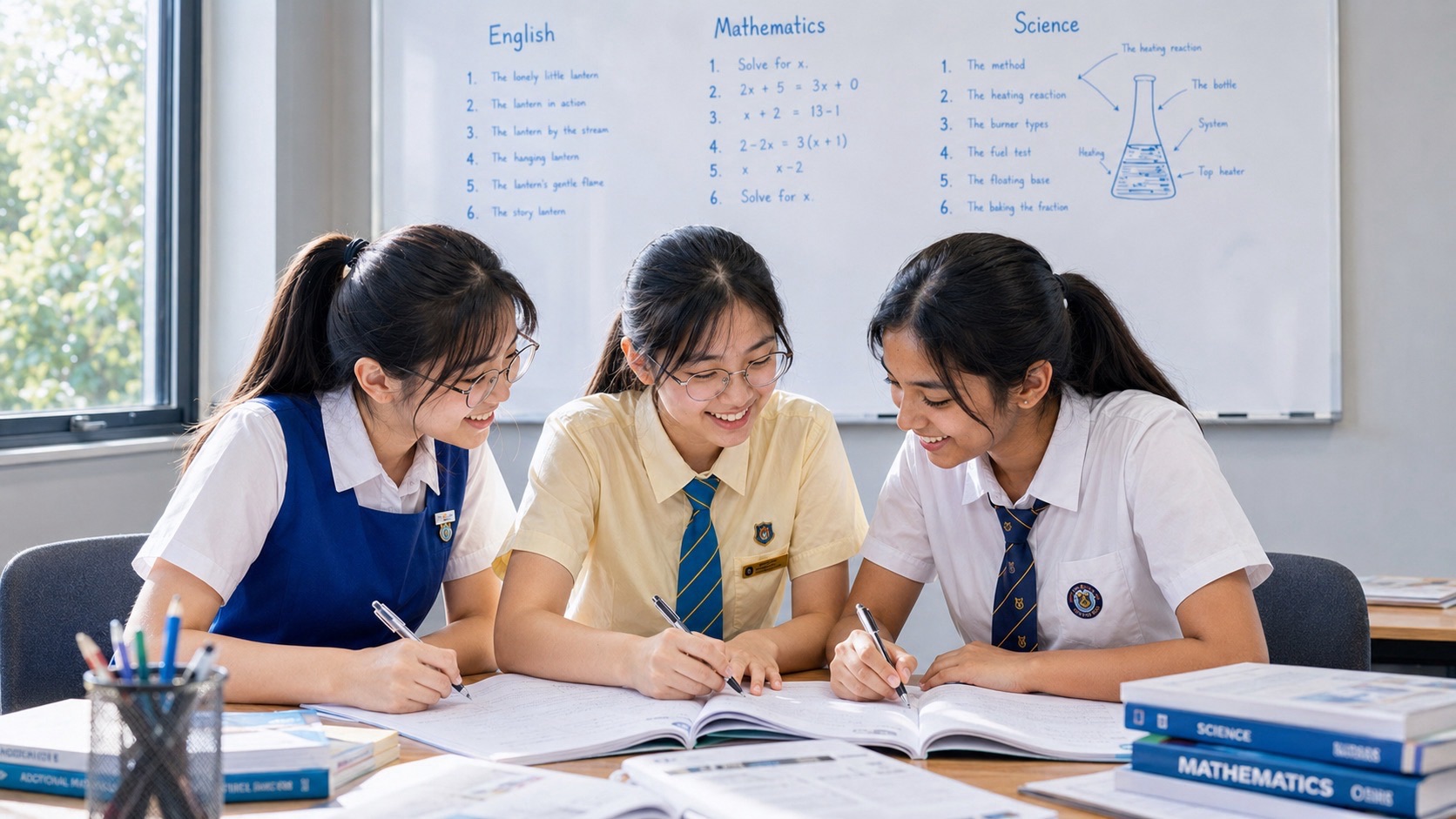
Secondary 4 Mathematics Tuition | Siglap is a year-specific final-secondary guide for families searching from Siglap, Marine Parade, Katong, East Coast and nearby eastern Singapore neighbourhoods who need reliable Mathematics performance under examination conditions. High-intent searches include Secondary 4 Mathematics Tuition Siglap, Sec 4 Math Tuition, Secondary 4 Math Tutor, E-Math tuition, G2 Mathematics, G3 Mathematics, SEC Mathematics, O-Level Mathematics, exam preparation and small-group Math tuition. The educational problem beneath those phrases is performance: how do four years of mathematical knowledge become reliable marks when topics are mixed, time is limited and unfamiliar questions require independent decisions?
This page sits beneath the existing Secondary Mathematics Tuition | Siglap local umbrella, alongside the national Sec 4 Math Tutor | Secondary 4 Mathematics Tuition owner, inside the Mathematics Learning Hub, and under How Mathematics Works. It owns only the Secondary 4 plus Siglap intersection.
Siglap is a search and travel context, not a claim of a physical branch. Families may compare classes around Siglap, East Coast, Marine Parade, Katong and Bedok, but should also compare tutor continuity, class size, marking quality, syllabus accuracy, correction systems and whether the learner can increasingly manage full papers without prompts. Current competitors foreground Sec 3–4 E-Math, separate A-Math routes, small-group classes, personal marking and exam technique. Those search signals are useful, but the student still needs a precise diagnostic and performance system.
Secondary 4 is a performance year, not just another content year
A student can know most chapters and still underperform on a full paper. The reason is compression: time is limited, topics are mixed, chapter labels disappear and unfamiliar presentations increase the cost of slow method selection.
Tuition therefore needs a performance layer. The learner must practise reading accurately, representing the problem, choosing a route, executing with visible working, checking the claim and recovering when the first route stalls.
Recovery is trainable. Draw and label. Define a variable. Reorganise data. Estimate. Try a simpler case. Write the relevant relationship. Identify a unit. These moves convert being stuck from a dead end into a process.
2026 and 2027 are different examination systems
In 2026, current Secondary 4 students may still be completing the pre-SEC national examination route. SEAB lists 2026 O-Level Mathematics as 4052 and Additional Mathematics as 4049. The 2027 SEC reference tables identify the corresponding G3 subjects as K310 Mathematics and K341 Additional Mathematics.
From 2027, the Singapore-Cambridge Secondary Education Certificate combines the former N(T), N(A) and O-Level certificate structure. Students sit subjects at G1, G2 or G3. For 2027, Mathematics is K110 at G1, K210 at G2 and K310 at G3. Additional Mathematics remains separate at G2 and G3.
A responsible Secondary 4 programme must therefore check the student’s examination year before selecting papers and syllabus documents. Durable skills such as technique, problem solving, reasoning, communication, checking and paper control remain useful, but the assessment route has to be current.
Prelims are stress tests, not verdicts
A prelim score is useful, but the paper matters more as a diagnostic stress test. Classify every lost mark by mechanism.
Did the student not know the content? Did the method fail to come to mind? Was the problem represented badly? Was the algebra wrong? Was the answer communicated poorly? Was the question left blank because too much time was spent earlier?
Two students with the same score can need opposite interventions. One needs reteaching. Another needs mixed-paper selection. Another needs algebra repair. Another needs timing and recovery.
The Secondary 4 control system
Use six actions: Read, Represent, Choose, Execute, Check and Recover.
Read identifies the command, data, conditions and units. Represent turns the problem into a usable mathematical object. Choose selects the method because it fits the relationship. Execute carries the Mathematics accurately. Check tests the result. Recover generates a next move when the route is unclear.
A tuition programme should train all six deliberately. Chapter knowledge without selection and recovery is fragile under examination load.
Algebraic control: convert knowledge into reliable paper performance
The mathematical core is signs, expansion, factorisation, algebraic fractions and equations. A common failure pattern is that small symbolic slips damage large questions. At Secondary 4, the useful response is not simply more papers. The tutor should locate the first point where the student’s process becomes unreliable.
Start by asking what the question requires, which information matters and what representation will make the relationship easiest to inspect. The student should learn to generate a first move even when the complete route is not obvious.
The repair is to use short daily retrieval and one transformation per line. Then test the skill inside mixed-paper conditions rather than only as a labelled chapter. A familiar routine question shows fluency; an unfamiliar mixed question shows whether the student can select and reconstruct the method.
Checking belongs inside the solution. Depending on the topic, use substitution, estimation, inverse operations, units, graph behaviour, bounds or an alternative route. These controls reduce recoverable marks.
Finally, retest after delay and under realistic timing. Secondary 4 readiness is not merely knowing the syllabus. It is being able to retrieve, select, execute, check and recover when the paper changes.
Functions and graphs: convert knowledge into reliable paper performance
The mathematical core is relationships, gradients, intercepts and interpretation. A common failure pattern is that graphs are treated as drawing tasks. At Secondary 4, the useful response is not simply more papers. The tutor should locate the first point where the student’s process becomes unreliable.
Start by asking what the question requires, which information matters and what representation will make the relationship easiest to inspect. The student should learn to generate a first move even when the complete route is not obvious.
The repair is to predict key features before plotting or reading values. Then test the skill inside mixed-paper conditions rather than only as a labelled chapter. A familiar routine question shows fluency; an unfamiliar mixed question shows whether the student can select and reconstruct the method.
Checking belongs inside the solution. Depending on the topic, use substitution, estimation, inverse operations, units, graph behaviour, bounds or an alternative route. These controls reduce recoverable marks.
Finally, retest after delay and under realistic timing. Secondary 4 readiness is not merely knowing the syllabus. It is being able to retrieve, select, execute, check and recover when the paper changes.
Simultaneous equations: convert knowledge into reliable paper performance
The mathematical core is two conditions and one shared solution. A common failure pattern is that mechanical elimination hides modelling. At Secondary 4, the useful response is not simply more papers. The tutor should locate the first point where the student’s process becomes unreliable.
Start by asking what the question requires, which information matters and what representation will make the relationship easiest to inspect. The student should learn to generate a first move even when the complete route is not obvious.
The repair is to verify the solution against both original conditions. Then test the skill inside mixed-paper conditions rather than only as a labelled chapter. A familiar routine question shows fluency; an unfamiliar mixed question shows whether the student can select and reconstruct the method.
Checking belongs inside the solution. Depending on the topic, use substitution, estimation, inverse operations, units, graph behaviour, bounds or an alternative route. These controls reduce recoverable marks.
Finally, retest after delay and under realistic timing. Secondary 4 readiness is not merely knowing the syllabus. It is being able to retrieve, select, execute, check and recover when the paper changes.
Quadratic relationships: convert knowledge into reliable paper performance
The mathematical core is roots, factors and graph structure. A common failure pattern is that algebra and graphs are separated. At Secondary 4, the useful response is not simply more papers. The tutor should locate the first point where the student’s process becomes unreliable.
Start by asking what the question requires, which information matters and what representation will make the relationship easiest to inspect. The student should learn to generate a first move even when the complete route is not obvious.
The repair is to connect factorisation, solutions and visual behaviour. Then test the skill inside mixed-paper conditions rather than only as a labelled chapter. A familiar routine question shows fluency; an unfamiliar mixed question shows whether the student can select and reconstruct the method.
Checking belongs inside the solution. Depending on the topic, use substitution, estimation, inverse operations, units, graph behaviour, bounds or an alternative route. These controls reduce recoverable marks.
Finally, retest after delay and under realistic timing. Secondary 4 readiness is not merely knowing the syllabus. It is being able to retrieve, select, execute, check and recover when the paper changes.
Ratio and proportion: convert knowledge into reliable paper performance
The mathematical core is scale, rates and multiplicative structure. A common failure pattern is that students revert to additive thinking under pressure. At Secondary 4, the useful response is not simply more papers. The tutor should locate the first point where the student’s process becomes unreliable.
Start by asking what the question requires, which information matters and what representation will make the relationship easiest to inspect. The student should learn to generate a first move even when the complete route is not obvious.
The repair is to use units and scale factors as controls. Then test the skill inside mixed-paper conditions rather than only as a labelled chapter. A familiar routine question shows fluency; an unfamiliar mixed question shows whether the student can select and reconstruct the method.
Checking belongs inside the solution. Depending on the topic, use substitution, estimation, inverse operations, units, graph behaviour, bounds or an alternative route. These controls reduce recoverable marks.
Finally, retest after delay and under realistic timing. Secondary 4 readiness is not merely knowing the syllabus. It is being able to retrieve, select, execute, check and recover when the paper changes.
Percentages and practical numeracy: convert knowledge into reliable paper performance
The mathematical core is change, reverse percentage and finance contexts. A common failure pattern is that the wrong base creates plausible answers. At Secondary 4, the useful response is not simply more papers. The tutor should locate the first point where the student’s process becomes unreliable.
Start by asking what the question requires, which information matters and what representation will make the relationship easiest to inspect. The student should learn to generate a first move even when the complete route is not obvious.
The repair is to name the base before calculating. Then test the skill inside mixed-paper conditions rather than only as a labelled chapter. A familiar routine question shows fluency; an unfamiliar mixed question shows whether the student can select and reconstruct the method.
Checking belongs inside the solution. Depending on the topic, use substitution, estimation, inverse operations, units, graph behaviour, bounds or an alternative route. These controls reduce recoverable marks.
Finally, retest after delay and under realistic timing. Secondary 4 readiness is not merely knowing the syllabus. It is being able to retrieve, select, execute, check and recover when the paper changes.
Coordinate geometry: convert knowledge into reliable paper performance
The mathematical core is lines, gradients, distance and midpoint. A common failure pattern is that formula recall is not enough. At Secondary 4, the useful response is not simply more papers. The tutor should locate the first point where the student’s process becomes unreliable.
Start by asking what the question requires, which information matters and what representation will make the relationship easiest to inspect. The student should learn to generate a first move even when the complete route is not obvious.
The repair is to sketch and label before choosing a method. Then test the skill inside mixed-paper conditions rather than only as a labelled chapter. A familiar routine question shows fluency; an unfamiliar mixed question shows whether the student can select and reconstruct the method.
Checking belongs inside the solution. Depending on the topic, use substitution, estimation, inverse operations, units, graph behaviour, bounds or an alternative route. These controls reduce recoverable marks.
Finally, retest after delay and under realistic timing. Secondary 4 readiness is not merely knowing the syllabus. It is being able to retrieve, select, execute, check and recover when the paper changes.
Geometry and proof: convert knowledge into reliable paper performance
The mathematical core is properties and logical chains. A common failure pattern is that visual assumptions replace reasons. At Secondary 4, the useful response is not simply more papers. The tutor should locate the first point where the student’s process becomes unreliable.
Start by asking what the question requires, which information matters and what representation will make the relationship easiest to inspect. The student should learn to generate a first move even when the complete route is not obvious.
The repair is to write concise reason statements. Then test the skill inside mixed-paper conditions rather than only as a labelled chapter. A familiar routine question shows fluency; an unfamiliar mixed question shows whether the student can select and reconstruct the method.
Checking belongs inside the solution. Depending on the topic, use substitution, estimation, inverse operations, units, graph behaviour, bounds or an alternative route. These controls reduce recoverable marks.
Finally, retest after delay and under realistic timing. Secondary 4 readiness is not merely knowing the syllabus. It is being able to retrieve, select, execute, check and recover when the paper changes.
Trigonometry: convert knowledge into reliable paper performance
The mathematical core is spatial relationships and multi-step questions. A common failure pattern is that the diagram is misread. At Secondary 4, the useful response is not simply more papers. The tutor should locate the first point where the student’s process becomes unreliable.
Start by asking what the question requires, which information matters and what representation will make the relationship easiest to inspect. The student should learn to generate a first move even when the complete route is not obvious.
The repair is to orient and label before selecting a formula. Then test the skill inside mixed-paper conditions rather than only as a labelled chapter. A familiar routine question shows fluency; an unfamiliar mixed question shows whether the student can select and reconstruct the method.
Checking belongs inside the solution. Depending on the topic, use substitution, estimation, inverse operations, units, graph behaviour, bounds or an alternative route. These controls reduce recoverable marks.
Finally, retest after delay and under realistic timing. Secondary 4 readiness is not merely knowing the syllabus. It is being able to retrieve, select, execute, check and recover when the paper changes.
Mensuration: convert knowledge into reliable paper performance
The mathematical core is composite area, surface area and volume. A common failure pattern is that hidden surfaces and unit errors leak marks. At Secondary 4, the useful response is not simply more papers. The tutor should locate the first point where the student’s process becomes unreliable.
Start by asking what the question requires, which information matters and what representation will make the relationship easiest to inspect. The student should learn to generate a first move even when the complete route is not obvious.
The repair is to decompose and track dimensions. Then test the skill inside mixed-paper conditions rather than only as a labelled chapter. A familiar routine question shows fluency; an unfamiliar mixed question shows whether the student can select and reconstruct the method.
Checking belongs inside the solution. Depending on the topic, use substitution, estimation, inverse operations, units, graph behaviour, bounds or an alternative route. These controls reduce recoverable marks.
Finally, retest after delay and under realistic timing. Secondary 4 readiness is not merely knowing the syllabus. It is being able to retrieve, select, execute, check and recover when the paper changes.
Probability: convert knowledge into reliable paper performance
The mathematical core is combined events and sample spaces. A common failure pattern is that habitual arithmetic is applied. At Secondary 4, the useful response is not simply more papers. The tutor should locate the first point where the student’s process becomes unreliable.
Start by asking what the question requires, which information matters and what representation will make the relationship easiest to inspect. The student should learn to generate a first move even when the complete route is not obvious.
The repair is to describe event structure before calculation. Then test the skill inside mixed-paper conditions rather than only as a labelled chapter. A familiar routine question shows fluency; an unfamiliar mixed question shows whether the student can select and reconstruct the method.
Checking belongs inside the solution. Depending on the topic, use substitution, estimation, inverse operations, units, graph behaviour, bounds or an alternative route. These controls reduce recoverable marks.
Finally, retest after delay and under realistic timing. Secondary 4 readiness is not merely knowing the syllabus. It is being able to retrieve, select, execute, check and recover when the paper changes.
Statistics: convert knowledge into reliable paper performance
The mathematical core is summary, spread and interpretation. A common failure pattern is that calculation is disconnected from context. At Secondary 4, the useful response is not simply more papers. The tutor should locate the first point where the student’s process becomes unreliable.
Start by asking what the question requires, which information matters and what representation will make the relationship easiest to inspect. The student should learn to generate a first move even when the complete route is not obvious.
The repair is to state what the result means. Then test the skill inside mixed-paper conditions rather than only as a labelled chapter. A familiar routine question shows fluency; an unfamiliar mixed question shows whether the student can select and reconstruct the method.
Checking belongs inside the solution. Depending on the topic, use substitution, estimation, inverse operations, units, graph behaviour, bounds or an alternative route. These controls reduce recoverable marks.
Finally, retest after delay and under realistic timing. Secondary 4 readiness is not merely knowing the syllabus. It is being able to retrieve, select, execute, check and recover when the paper changes.
Estimation and bounds: convert knowledge into reliable paper performance
The mathematical core is precision and reasonableness. A common failure pattern is that rounding happens too early. At Secondary 4, the useful response is not simply more papers. The tutor should locate the first point where the student’s process becomes unreliable.
Start by asking what the question requires, which information matters and what representation will make the relationship easiest to inspect. The student should learn to generate a first move even when the complete route is not obvious.
The repair is to estimate and preserve precision. Then test the skill inside mixed-paper conditions rather than only as a labelled chapter. A familiar routine question shows fluency; an unfamiliar mixed question shows whether the student can select and reconstruct the method.
Checking belongs inside the solution. Depending on the topic, use substitution, estimation, inverse operations, units, graph behaviour, bounds or an alternative route. These controls reduce recoverable marks.
Finally, retest after delay and under realistic timing. Secondary 4 readiness is not merely knowing the syllabus. It is being able to retrieve, select, execute, check and recover when the paper changes.
Word-problem translation: convert knowledge into reliable paper performance
The mathematical core is language into equations, diagrams or tables. A common failure pattern is that familiar mathematics is hidden by wording. At Secondary 4, the useful response is not simply more papers. The tutor should locate the first point where the student’s process becomes unreliable.
Start by asking what the question requires, which information matters and what representation will make the relationship easiest to inspect. The student should learn to generate a first move even when the complete route is not obvious.
The repair is to define quantities and relationships first. Then test the skill inside mixed-paper conditions rather than only as a labelled chapter. A familiar routine question shows fluency; an unfamiliar mixed question shows whether the student can select and reconstruct the method.
Checking belongs inside the solution. Depending on the topic, use substitution, estimation, inverse operations, units, graph behaviour, bounds or an alternative route. These controls reduce recoverable marks.
Finally, retest after delay and under realistic timing. Secondary 4 readiness is not merely knowing the syllabus. It is being able to retrieve, select, execute, check and recover when the paper changes.
Calculator control: convert knowledge into reliable paper performance
The mathematical core is entry, exact values and precision. A common failure pattern is that speed magnifies input mistakes. At Secondary 4, the useful response is not simply more papers. The tutor should locate the first point where the student’s process becomes unreliable.
Start by asking what the question requires, which information matters and what representation will make the relationship easiest to inspect. The student should learn to generate a first move even when the complete route is not obvious.
The repair is to predict, key and compare. Then test the skill inside mixed-paper conditions rather than only as a labelled chapter. A familiar routine question shows fluency; an unfamiliar mixed question shows whether the student can select and reconstruct the method.
Checking belongs inside the solution. Depending on the topic, use substitution, estimation, inverse operations, units, graph behaviour, bounds or an alternative route. These controls reduce recoverable marks.
Finally, retest after delay and under realistic timing. Secondary 4 readiness is not merely knowing the syllabus. It is being able to retrieve, select, execute, check and recover when the paper changes.
Paper strategy: convert knowledge into reliable paper performance
The mathematical core is time allocation, question order and recovery. A common failure pattern is that known mathematics is left unattempted. At Secondary 4, the useful response is not simply more papers. The tutor should locate the first point where the student’s process becomes unreliable.
Start by asking what the question requires, which information matters and what representation will make the relationship easiest to inspect. The student should learn to generate a first move even when the complete route is not obvious.
The repair is to use time budgets, stop rules and return plans. Then test the skill inside mixed-paper conditions rather than only as a labelled chapter. A familiar routine question shows fluency; an unfamiliar mixed question shows whether the student can select and reconstruct the method.
Checking belongs inside the solution. Depending on the topic, use substitution, estimation, inverse operations, units, graph behaviour, bounds or an alternative route. These controls reduce recoverable marks.
Finally, retest after delay and under realistic timing. Secondary 4 readiness is not merely knowing the syllabus. It is being able to retrieve, select, execute, check and recover when the paper changes.
Error correction: convert knowledge into reliable paper performance
The mathematical core is turning prelim mistakes into future marks. A common failure pattern is that students copy corrections without repairing mechanisms. At Secondary 4, the useful response is not simply more papers. The tutor should locate the first point where the student’s process becomes unreliable.
Start by asking what the question requires, which information matters and what representation will make the relationship easiest to inspect. The student should learn to generate a first move even when the complete route is not obvious.
The repair is to record the first wrong step, countermeasure and changed retest. Then test the skill inside mixed-paper conditions rather than only as a labelled chapter. A familiar routine question shows fluency; an unfamiliar mixed question shows whether the student can select and reconstruct the method.
Checking belongs inside the solution. Depending on the topic, use substitution, estimation, inverse operations, units, graph behaviour, bounds or an alternative route. These controls reduce recoverable marks.
Finally, retest after delay and under realistic timing. Secondary 4 readiness is not merely knowing the syllabus. It is being able to retrieve, select, execute, check and recover when the paper changes.
Mathematical communication: convert knowledge into reliable paper performance
The mathematical core is notation, reasons and final responses. A common failure pattern is that correct thinking is invisible or ambiguous. At Secondary 4, the useful response is not simply more papers. The tutor should locate the first point where the student’s process becomes unreliable.
Start by asking what the question requires, which information matters and what representation will make the relationship easiest to inspect. The student should learn to generate a first move even when the complete route is not obvious.
The repair is to write inspectable steps and concise justification. Then test the skill inside mixed-paper conditions rather than only as a labelled chapter. A familiar routine question shows fluency; an unfamiliar mixed question shows whether the student can select and reconstruct the method.
Checking belongs inside the solution. Depending on the topic, use substitution, estimation, inverse operations, units, graph behaviour, bounds or an alternative route. These controls reduce recoverable marks.
Finally, retest after delay and under realistic timing. Secondary 4 readiness is not merely knowing the syllabus. It is being able to retrieve, select, execute, check and recover when the paper changes.
Prelim-to-exam conversion: convert knowledge into reliable paper performance
The mathematical core is prioritising limited revision time. A common failure pattern is that students try to repair everything at once. At Secondary 4, the useful response is not simply more papers. The tutor should locate the first point where the student’s process becomes unreliable.
Start by asking what the question requires, which information matters and what representation will make the relationship easiest to inspect. The student should learn to generate a first move even when the complete route is not obvious.
The repair is to rank weaknesses by frequency, mark value and leverage. Then test the skill inside mixed-paper conditions rather than only as a labelled chapter. A familiar routine question shows fluency; an unfamiliar mixed question shows whether the student can select and reconstruct the method.
Checking belongs inside the solution. Depending on the topic, use substitution, estimation, inverse operations, units, graph behaviour, bounds or an alternative route. These controls reduce recoverable marks.
Finally, retest after delay and under realistic timing. Secondary 4 readiness is not merely knowing the syllabus. It is being able to retrieve, select, execute, check and recover when the paper changes.
Recovery under pressure: convert knowledge into reliable paper performance
The mathematical core is generating a next move when the route is unclear. A common failure pattern is that being stuck becomes panic. At Secondary 4, the useful response is not simply more papers. The tutor should locate the first point where the student’s process becomes unreliable.
Start by asking what the question requires, which information matters and what representation will make the relationship easiest to inspect. The student should learn to generate a first move even when the complete route is not obvious.
The repair is to train a menu of representations, estimates and simpler cases. Then test the skill inside mixed-paper conditions rather than only as a labelled chapter. A familiar routine question shows fluency; an unfamiliar mixed question shows whether the student can select and reconstruct the method.
Checking belongs inside the solution. Depending on the topic, use substitution, estimation, inverse operations, units, graph behaviour, bounds or an alternative route. These controls reduce recoverable marks.
Finally, retest after delay and under realistic timing. Secondary 4 readiness is not merely knowing the syllabus. It is being able to retrieve, select, execute, check and recover when the paper changes.
Resident case: Ryan
Ryan is a fictional eduKateSG resident used to make the performance problem visible. Ryan knows most topics but cannot finish full papers. A generic response would be to assign more full papers, but that can rehearse the same failure under time pressure.
The tutor inspects where the process first becomes unstable. Is the problem reading, representation, method selection, execution, checking or time allocation? The repair is to measure decision latency and use stop rules instead of simply demanding faster calculation.
The learner then completes a targeted drill and returns to a changed mixed-paper question. This matters because correction should lead back to performance. A skill is not truly repaired if it works only on the exact question that was reviewed.
The mechanism and countermeasure are recorded in the error ledger. On a later paper, the same risk is watched again. The case is fictional and illustrates how tuition should convert errors into a repeatable control system rather than claim a real student’s result.
Resident case: Mira
Mira is a fictional eduKateSG resident used to make the performance problem visible. Mira loses recoverable marks through algebraic slips, sign errors and premature rounding. A generic response would be to assign more full papers, but that can rehearse the same failure under time pressure.
The tutor inspects where the process first becomes unstable. Is the problem reading, representation, method selection, execution, checking or time allocation? The repair is to run short foundation retrieval and integrate checks into every solution.
The learner then completes a targeted drill and returns to a changed mixed-paper question. This matters because correction should lead back to performance. A skill is not truly repaired if it works only on the exact question that was reviewed.
The mechanism and countermeasure are recorded in the error ledger. On a later paper, the same risk is watched again. The case is fictional and illustrates how tuition should convert errors into a repeatable control system rather than claim a real student’s result.
Resident case: Ethan
Ethan is a fictional eduKateSG resident used to make the performance problem visible. Ethan gets many numerical answers but cannot communicate reasoning cleanly. A generic response would be to assign more full papers, but that can rehearse the same failure under time pressure.
The tutor inspects where the process first becomes unstable. Is the problem reading, representation, method selection, execution, checking or time allocation? The repair is to practise concise explanations, reason statements and inspectable working.
The learner then completes a targeted drill and returns to a changed mixed-paper question. This matters because correction should lead back to performance. A skill is not truly repaired if it works only on the exact question that was reviewed.
The mechanism and countermeasure are recorded in the error ledger. On a later paper, the same risk is watched again. The case is fictional and illustrates how tuition should convert errors into a repeatable control system rather than claim a real student’s result.
A twelve-week Secondary 4 operating cycle
Weeks 1 and 2 establish the performance baseline. Use recent school scripts, one mixed diagnostic paper and a short interview about where time and confidence disappear.
Weeks 3 and 4 repair the highest-leverage foundations. For many students, algebraic fluency, fractions, signs, graph reading or geometry properties still create friction in advanced questions.
Weeks 5 and 6 increase mixed practice. Remove chapter labels and ask the student to state the likely method before calculating.
Weeks 7 and 8 use timed sections and deliberate correction. Track accuracy by topic, accuracy by mechanism and completion rate.
Weeks 9 and 10 approximate realistic paper conditions more closely. Use full papers where appropriate, followed by targeted repair rather than simply another full paper.
Weeks 11 and 12 narrow the repair list. Late-stage revision should become more selective as evidence improves.
Why “do more papers” can stop working
Past papers are valuable only when they generate learning. If a student completes a paper, checks the answer key, circles mistakes and moves to the next paper, the same mechanisms can survive for months.
A better loop is paper, classify, reteach, targeted drill, changed question, delayed retest, then another paper.
Different paper sessions can have different goals. One can be fully timed. Another can be a decision paper where the student states the method before solving. Another can isolate one weak section. Another can be correction without time pressure.
The paper is a diagnostic and performance surface, not the entire teaching system.
Recoverable marks
Recoverable marks are marks lost to errors the student already has the knowledge to avoid: signs, copied values, units, premature rounding, skipped reasons, calculator entry, poor time allocation or failure to check.
Track these separately from genuine content gaps. Reducing recoverable loss can be one of the fastest late-stage improvements because it does not require learning an entirely new topic.
The aim is not perfection. The aim is a more reliable execution system.
Paper strategy
A student should know the approximate time available per mark or section, but paper strategy is more than arithmetic.
Use a stop rule. If a question is consuming time without producing progress, mark it, move on and return later. Protect easier marks from one difficult item.
Use confidence marking. A student can identify which answers deserve a checking pass.
Use a recovery menu. Draw, define, estimate, reorganise or try a simpler case.
The goal is controlled decision-making rather than panic-driven speed.
Homework near examinations
Homework should become more selective, not more chaotic. Use short retrieval for fragile foundations, targeted questions for current mechanisms, mixed questions for selection and periodic full-paper work.
Avoid filling every evening with mock exams. A tired learner may perform worse and retain less.
The best late-stage homework is chosen because it answers a diagnostic question.
What a three-student Secondary 4 group should make possible
The tutor should be able to inspect working in real time. One student may need algebra repair, another a paper-strategy intervention and another an unfamiliar extension problem.
Students can compare valid methods and learn from contrast. The purpose is not competition; it is to make mathematical thinking visible.
A small group loses its advantage if the tutor lectures for most of the session. The lesson has to produce enough student work to generate evidence.
Mathematical communication under examination conditions
Clear working helps the marker, but it also helps the student. One transformation per line can reduce algebra errors. Labelled diagrams reduce geometry confusion. Units prevent dimensional mistakes. Concise reasons reveal whether a conclusion is justified.
Reasoning and communication remain part of the Mathematics demand under the SEC system, so these habits are not ornamental.
Checking under time pressure
Checking should use low-cost controls. Estimate the scale. Substitute a solution. Check the sign. Compare units. Inspect the graph. Re-read the command word.
Do not attempt to redo every question from scratch. A good checking system directs attention to high-risk answers.
Students should also learn when not to over-check. Excessive checking early in the paper can create a timing problem later.
Choosing Secondary 4 Mathematics tuition from Siglap
Ask which examination year and subject level the programme is preparing for. Ask whether main Mathematics and Additional Mathematics are kept separate. Ask how school scripts are analysed and how corrections are retested.
Ask how full-paper performance is measured. Completion rate, decision latency, repeated error mechanisms and recoverable marks can be more informative than another total score.
Ask whether the student is learning a recovery routine. A final-year tutor should not remain the permanent source of the next step.
Frequently asked questions
Is Secondary 4 too late to start tuition?
There is no single rule. A late start can still help if the diagnosis is precise and the plan prioritises high-leverage weaknesses.
Should a student do a full paper every day?
Not necessarily. Full papers need correction and targeted repair. Daily papers without repair can repeat the same errors.
Is E-Math the same as Additional Mathematics?
No. They are distinct subjects. No local Siglap A-Math owner surfaced in the collision scan, so use the established national Additional Mathematics Tuition owner for that separate intent.
How does the 2027 SEC change Mathematics?
The SEC combines the former N(T), N(A) and O-Level certificate structure. Students sit subjects at G1, G2 or G3. Mathematics has separate G1, G2 and G3 codes, while Additional Mathematics remains separately coded at G2 and G3.
What if my child knows the content but cannot finish papers?
Measure where time goes. The problem may be method selection, over-checking, slow algebra or getting trapped on difficult items rather than general calculation speed.
What if my child panics on unfamiliar questions?
Train recovery deliberately. Being stuck is a state that can have a routine.
How should parents read prelim results?
Look beyond the total score. Separate genuine content gaps from recoverable execution errors and unattempted marks.
Official syllabus routing
SEAB states that the SEC begins in 2027. For that reference year, Mathematics is K110 at G1, K210 at G2 and K310 at G3. Additional Mathematics is K232 at G2 and K341 at G3.
For 2026, SEAB lists O-Level Mathematics as 4052 and Additional Mathematics as 4049. Use the student’s actual cohort and subject level when selecting preparation materials.
The Siglap route inside eduKateSG
Use Secondary Mathematics Tuition | Siglap for the broad local route, the national Secondary 4 Mathematics owner for the general year route, the Mathematics Learning Hub for the complete estate, and How Mathematics Works for the conceptual root.
This page owns only the Siglap plus Secondary 4 intersection.
Teaching operating manual
- Confirm the student’s examination year and subject level.
- Use school scripts as diagnostic stress tests.
- Repair high-leverage foundations.
- Train mixed-topic method selection.
- Track recoverable marks separately.
- Use stop rules and recovery routines.
- Build checking into solving.
- Retest corrected mechanisms on changed questions.
- Use full papers selectively.
- Narrow late-stage revision as evidence improves.
- Keep Mathematics and A-Math ownership separate.
- Fade prompts so the student can operate independently.
Final perspective
Secondary 4 Mathematics Tuition | Siglap should help a family understand why final-year Mathematics is not solved by paper volume alone. The objective is to convert four years of knowledge into a reliable system for mixed questions, timing, checking, recovery and cohort-correct examination performance.
The strongest evidence of progress is not that the tutor can solve a paper quickly. It is that the student can increasingly make good mathematical decisions when the tutor is not there.