
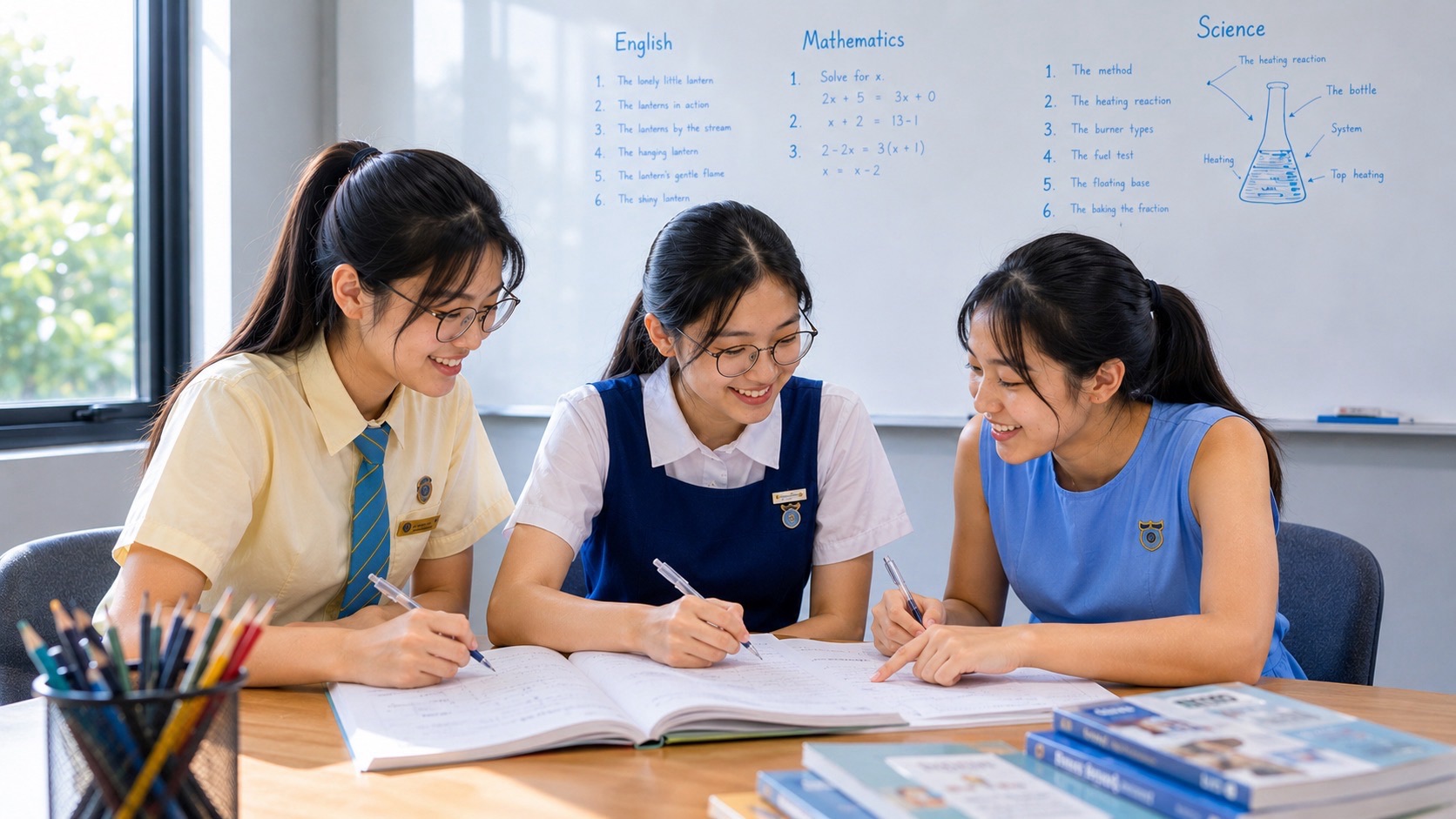
A strong Secondary Mathematics education is built through careful explanation, accurate practice and close attention to how each student thinks.
At eduKateSG, we provide 3-pax Secondary Mathematics tuition for students from Siglap and the wider East Coast area. Lessons are conducted at our Bukit Timah location near Sixth Avenue MRT, where each class is kept deliberately small so that the tutor can inspect workings, identify misconceptions and adjust the lesson while learning is taking place.
We support students across Secondary 1 to Secondary 4, including:
- G1, G2 and G3 Mathematics;
- lower-secondary Mathematics;
- upper-secondary Elementary Mathematics;
- Additional Mathematics;
- school weighted-assessment preparation;
- examination revision;
- foundation repair;
- carefully paced teaching ahead of school; and
- deeper extension for students working towards distinction-level performance.
Each weekly lesson lasts 1.5 hours. Students receive structured teaching, guided practice, independent application, correction work and focused continuation practice between lessons. Class placement begins with a parent–student consultation so that the student’s school level, current foundation and learning pace can be considered properly.
The purpose is not simply to give a student more Mathematics questions.
It is to help the student understand how Mathematics works, recognise what a question requires and produce a clear, accurate solution without becoming dependent on memorised templates.
Secondary Mathematics Changes More Than Many Students Expect
The movement from Primary to Secondary Mathematics is not merely an increase in the number of chapters.
It is a change in the nature of the subject.
Primary Mathematics is often built around arithmetic, visual models and familiar problem structures. Secondary Mathematics asks students to move increasingly towards:
- symbolic notation;
- algebraic relationships;
- formal mathematical language;
- multi-step reasoning;
- abstract representation;
- connected topic knowledge;
- unfamiliar applications; and
- greater independence.
A student who was comfortable with Primary Mathematics may therefore feel unexpectedly uncertain during Secondary 1.
The student may know how to calculate, but not how to read an algebraic expression.
The student may know a formula, but not recognise when it should be used.
The student may understand a worked example, but be unable to begin a question that looks slightly different.
These are not always effort problems.
They are often transition problems.
A good Secondary Mathematics programme makes this change visible and teaches the student how to operate inside the new mathematical environment.
The Hidden Shift: Answers Must Become Mathematical Structure
Consider the familiar statement:
3 × 8 = 24
A younger student may see this mainly as a calculation.
In Secondary Mathematics, the same relationship may appear as:
3x = 24
The arithmetic remains, but the student must now understand that:
- the letter represents an unknown quantity;
- multiplication can be written without a multiplication sign;
- the equal sign expresses a balanced relationship;
- a valid operation must be applied consistently;
- the solution must satisfy the original equation; and
- every line of working should preserve the mathematical meaning of the previous line.
This is why unexplained shortcuts eventually become dangerous.
A student may be told to “move a number to the other side” and change its sign. That phrase may appear to work in a simple equation. However, it becomes unreliable when the question contains brackets, fractions, several unknown terms or negative values.
At eduKateSG, we return to the governing principle.
Students learn why an operation is valid before they are expected to perform it quickly.
Clarity comes first.
Fluency follows.
Speed is developed after the structure becomes stable.
Why Siglap Families Choose 3-Pax Secondary Mathematics Tuition
Three students create a distinctive learning environment.
There are enough students for comparison, discussion and healthy academic momentum. At the same time, the class remains small enough for the tutor to observe how every student begins, develops and completes a question.
This matters because a wrong answer is only the visible outcome.
The more important question is:
Where did the reasoning change direction?
A student may have:
- applied a negative sign incorrectly;
- expanded only part of a bracket;
- confused an expression with an equation;
- used a formula with the wrong measurements;
- cancelled terms that cannot be cancelled;
- copied an exponent incorrectly;
- misread the scale of a graph;
- substituted into the wrong variable;
- omitted an important unit;
- rounded too early;
- selected a familiar but unsuitable method; or
- understood the concept but presented the working poorly.
In a larger class, the tutor may see the final answer without having enough time to inspect the process that produced it.
In a 3-pax class, the tutor can pause beside the student, examine the working and correct the precise mathematical decision that caused the error.
What three students allow us to do
A genuine 3-pax class provides:
- immediate feedback during practice;
- frequent opportunities for every student to answer;
- closer checking of mathematical workings;
- less opportunity to remain silent when confused;
- pacing that can be adjusted more carefully;
- questions selected for individual weaknesses;
- calm peer learning without large-class noise;
- regular explanation and think-aloud practice;
- more precise preparation before school assessments; and
- a clearer view of whether a student can work independently.
The class is small by design.
It retains the energy of learning with peers while protecting the personal attention that Secondary Mathematics often requires.
Secondary Mathematics Under Full Subject-Based Banding
Under Full Subject-Based Banding, Mathematics is offered at G1, G2 and G3 subject levels. A student’s Mathematics programme must therefore consider the actual subject level being taken rather than relying only on a broad Secondary 1, 2, 3 or 4 label.
At eduKateSG, we consider:
- the student’s current Mathematics subject level;
- the school’s topic sequence;
- the student’s earlier foundation;
- the pace at which the school introduces new ideas;
- upcoming weighted assessments;
- the student’s recurring error patterns;
- whether the student is taking Elementary Mathematics or Additional Mathematics;
- the amount of practice the student can complete responsibly; and
- the level of independence expected at that stage.
A student who understands the concepts but loses marks through inaccurate execution requires a different response from a student who cannot yet interpret the question.
Similarly, a student who is performing comfortably may need unfamiliar applications, stronger mathematical explanation and greater depth rather than another collection of routine worksheets.
From 2027, the Singapore-Cambridge Secondary Education Certificate system will operate within the Full Subject-Based Banding structure. SEAB’s published 2027 syllabus listings include Mathematics and Additional Mathematics at relevant subject levels.
The class must meet the student at the correct mathematical point.
What We Teach in Secondary Mathematics Tuition
Schools may introduce topics in different orders. Our lessons coordinate with the student’s school programme while ensuring that important prerequisite knowledge remains intact.
The precise lesson depends on the student’s level, subject pathway and current performance.
Secondary 1 Mathematics: Building the New Language
Secondary 1 is where students begin moving from arithmetic procedures towards formal mathematical relationships.
Students may work on:
- positive and negative numbers;
- order of operations;
- factors, multiples and prime factorisation;
- fractions and rational numbers;
- approximation and estimation;
- ratio, rate and percentage;
- algebraic terminology;
- simplification and substitution;
- expansion and introductory factorisation;
- linear equations;
- inequalities;
- coordinates and graphs;
- angle properties;
- polygons;
- perimeter, area, surface area and volume;
- statistical representations; and
- data interpretation.
Special attention is given to algebra, negative-number control and mathematical presentation.
A small uncertainty at this stage can reappear across many later chapters.
Secondary 2 Mathematics: Connecting the System
By Secondary 2, Mathematics becomes more interconnected.
A question may require the student to combine number skills, algebra, geometry and interpretation rather than use one isolated procedure.
Students may require support with:
- more complex algebraic manipulation;
- formulae and changing the subject;
- linear equations and inequalities;
- simultaneous relationships;
- expansion and factorisation;
- algebraic fractions;
- graphs and coordinate geometry;
- direct and inverse proportion;
- geometric properties;
- congruence and similarity foundations;
- Pythagoras’ theorem;
- mensuration;
- probability;
- statistics; and
- mixed-topic problem solving.
Secondary 2 is also an important preparation year.
Students need to enter upper-secondary Mathematics with enough fluency to manage a faster pace, longer working and greater topic density.
Secondary 3 Mathematics: Managing Acceleration
Secondary 3 introduces a significant rise in both volume and abstraction.
Students taking Elementary Mathematics may encounter:
- advanced algebraic manipulation;
- quadratic expressions and equations;
- functions and graphs;
- coordinate geometry;
- geometry and mensuration;
- trigonometry;
- set language;
- matrices where applicable;
- vectors;
- statistics;
- probability; and
- mathematical applications.
Students taking Additional Mathematics may also work on:
- indices and surds;
- logarithms;
- polynomials;
- equations and inequalities;
- partial fractions;
- coordinate geometry;
- functions;
- trigonometric relationships;
- sequences and series;
- binomial expansion;
- differentiation;
- integration; and
- applications of calculus.
The challenge is not simply that the questions are harder.
Several mathematical systems are now developing at once.
A student who has weak algebra may struggle in coordinate geometry, trigonometry and calculus even when those chapters initially appear unrelated.
Secondary 4 Mathematics: Converting Knowledge into Examination Performance
In Secondary 4, the student must turn several years of learning into controlled examination execution.
Lessons increasingly focus on:
- syllabus consolidation;
- mixed-topic recognition;
- examination-question analysis;
- efficient solution selection;
- Paper 1 and Paper 2 demands;
- time allocation;
- method-mark protection;
- clear presentation;
- checking strategies;
- recurring error repair;
- full-paper stamina;
- targeted topical revision; and
- performance under timed conditions.
At this stage, simply completing many papers may not be enough.
Every paper should reveal something.
The tutor examines:
- which topics remain unstable;
- which errors are repeated;
- where time is being lost;
- whether the student recognises question structure;
- whether the correct method is selected quickly;
- whether algebraic working remains controlled; and
- whether marks are being lost through knowledge, interpretation or execution.
Past-year and assessment-style questions become diagnostic instruments, not merely practice material.
Our First-Principles Teaching Method
A responsible Mathematics programme should do more than demonstrate one procedure and assign twenty nearly identical questions.
Students need a learning structure that remains usable after the tutor has stopped speaking.
1. Locate the First Unstable Point
Descriptions such as “weak in Mathematics” or “careless in algebra” are too broad to guide a proper correction.
A student who appears weak in algebra may actually be struggling with:
- negative numbers;
- multiplication fluency;
- fraction operations;
- symbolic reading;
- the distributive law;
- factorisation;
- equation balance;
- interpretation of written information;
- working-memory overload; or
- confidence under time pressure.
The response depends on the cause.
We inspect marked work, ask diagnostic questions and observe how the student begins a problem.
The first line of working often reveals more than the final answer.
2. Rebuild from the Earliest Relevant Gap
When an earlier skill is affecting the current topic, we return to it.
This is not unnecessary revision.
It is restoration.
A student struggling with algebraic fractions may first need to stabilise ordinary fractions.
A student repeatedly losing marks in equations may need better control over inverse operations and negative values.
A student struggling with trigonometry may have an earlier weakness in ratio, algebra or diagram interpretation.
Once the missing connection is repaired, the current chapter often becomes much easier to understand.
3. Use the Fencing Method
We begin within a clearly controlled mathematical boundary.
For example, an equation may first contain:
- positive whole numbers;
- one unknown;
- one operation; and
- a simple structure.
Once the student understands that structure, we introduce:
- negative values;
- brackets;
- fractions;
- unknown terms on both sides;
- multiple operations; and
- written applications.
Each new difficulty is introduced deliberately.
The student learns:
- where the method works;
- why it works;
- what remains unchanged;
- what the new condition changes; and
- how to recognise the same structure in another form.
The boundary expands only when the student can control what is already inside it.
4. Move from Visible Meaning to Abstract Notation
Where useful, we apply a Concrete–Representational–Abstract progression.
An idea may move through:
- a familiar quantity or real relationship;
- a number line, diagram, table or model; and
- formal mathematical symbols.
This is particularly useful when a student can repeat a procedure but cannot explain what the symbols represent.
The objective is not to keep Mathematics concrete forever.
It is to ensure that abstraction has something stable beneath it.
5. Ask the Student to Think Aloud
Students may be asked to explain:
- what the question is asking;
- what information has been provided;
- which relationship matters;
- what is unknown;
- why a particular method is suitable;
- what each line of working accomplishes;
- whether the answer is reasonable; and
- how the result can be checked.
Explanation makes understanding visible.
It also helps the tutor detect confusion before it becomes a permanent habit.
A student who can explain a method clearly is usually better prepared to adapt it when the question changes.
6. Retrieve and Interleave
A topic should not disappear simply because its chapter has ended.
Earlier material is revisited through short retrieval tasks and mixed practice.
Students may encounter algebra, geometry, graphs and number skills within the same lesson. They must decide which mathematical system applies instead of being told that every question belongs to the chapter taught five minutes earlier.
This matters because examinations do not always announce the method.
The student must recognise it.
Interleaving also reveals whether learning has become flexible or remains dependent on immediate imitation.
7. Build Examination Discipline Early
Good examination habits should not be postponed until Secondary 4.
From lower secondary onwards, students are trained to develop:
- one logical step per line;
- correct use of equal signs;
- accurate substitution;
- labelled diagrams;
- proper units;
- clear algebraic notation;
- careful copying;
- controlled calculator use;
- estimation checks;
- sensible time allocation; and
- final-answer verification.
These habits are easier to build gradually than to repair under examination pressure.
What Happens During a 90-Minute Secondary Mathematics Lesson
Each class is adjusted according to the students present, but the lesson follows a stable learning rhythm.
1. Warm-Up Retrieval
Students begin with a short selection from previous learning.
The questions may test:
- essential formulas;
- algebraic manipulation;
- arithmetic accuracy;
- earlier misconceptions;
- prerequisite knowledge; or
- a topic that has not been revisited recently.
This allows the tutor to check retention before introducing further complexity.
It also reactivates knowledge that may be required during the main lesson.
2. Concept Instruction
The tutor introduces a new idea or revisits an unstable one.
The explanation focuses on:
- mathematical meaning;
- underlying structure;
- correct notation;
- links to earlier topics;
- common misconceptions; and
- how the idea may appear in different questions.
Students are not expected merely to copy a completed solution.
They must understand why the method belongs to the problem.
3. Guided Practice
Students begin applying the idea while the tutor remains close.
At this stage, the tutor can:
- ask targeted questions;
- provide a small prompt;
- correct a misconception immediately;
- compare different solution methods;
- adjust the difficulty;
- isolate a weak prerequisite; and
- ensure that the student is doing the thinking.
Guidance is gradually reduced as control improves.
4. Independent Application
Students then attempt carefully selected questions without step-by-step support.
This is an important part of the lesson.
Understanding an explanation is not the same as being able to produce a solution independently.
The tutor observes whether the student can:
- identify the method;
- begin correctly;
- maintain control across several steps;
- recover after uncertainty;
- check the result; and
- present the solution clearly.
5. Mixed or Timed Practice
Earlier and current topics may be combined.
For students approaching school assessments or national examinations, short timing controls may be introduced.
The purpose is not to create unnecessary pressure.
It is to train the student to retrieve, select and execute within realistic conditions.
6. Error Review
Mistakes are not simply crossed out and replaced with the correct answer.
They are classified.
The student learns whether the error came from:
- a conceptual misunderstanding;
- incorrect reading;
- weak recall;
- arithmetic;
- algebraic signs;
- notation;
- copying;
- poor organisation;
- method selection;
- calculator input; or
- rushing.
Different errors require different corrections.
7. Focused Continuation Work
Home practice is kept purposeful.
The student may receive:
- a short reinforcement set;
- correction work;
- a mixed retrieval exercise;
- selected school-assessment questions;
- a micro-test;
- an algebra fluency set; or
- preparatory work for the next lesson.
The objective is not to create an indiscriminate pile of worksheets.
It is to preserve the connection between lessons.
Three Secondary Mathematics Student Pathways
Students do not enter tuition for the same reason.
A useful programme must distinguish between different starting conditions.
The Repair Pathway
This student may already be struggling with:
- fractions;
- negative numbers;
- algebra;
- equations;
- graphs;
- geometry;
- word problems;
- school homework;
- repeated low assessment scores; or
- an inability to begin questions independently.
The immediate priority is to stop further drift.
We locate the earliest unstable skill, rebuild it and reconnect it to the student’s current school topic.
The aim is not to restart the entire syllabus.
It is to repair the bridge that is no longer carrying the student forward.
The Stabilisation Pathway
This student is passing, but the results are inconsistent.
One assessment may be comfortable while the next produces an unexpected drop.
The student may:
- understand during lessons but forget later;
- make repeated sign errors;
- lose marks through incomplete working;
- struggle when topics are mixed;
- rush through routine questions;
- depend heavily on familiar question formats; or
- perform below their actual understanding during timed work.
The priority is to make performance more dependable.
Knowledge, recall, accuracy and execution must begin working together.
The Extension Pathway
This student is coping well and needs greater depth.
The lesson may include:
- less routine applications;
- unfamiliar question structures;
- multiple solution methods;
- deeper explanation;
- more demanding algebra;
- stronger proof and reasoning habits;
- timed distinction-level work; and
- preparation for future mathematical demands.
The purpose is not simply to finish the syllabus earlier.
It is to deepen control.
A student who rushes through advanced chapters without building mathematical maturity may appear ahead while remaining surprisingly fragile.
Why Algebra Receives Special Attention
Algebra is not one isolated chapter.
It becomes the operating language of Secondary Mathematics.
It appears in:
- equations;
- inequalities;
- formulae;
- coordinate geometry;
- graphs;
- functions;
- ratio and proportion;
- geometry;
- trigonometry;
- vectors;
- statistics;
- Physics;
- Chemistry; and
- Additional Mathematics.
This is why early algebra weakness should not be dismissed as a small local problem.
A student who avoids algebra in Secondary 1 may encounter the same uncertainty repeatedly in more demanding forms.
At eduKateSG, students learn to read algebra before they are asked to perform it quickly.
They develop control over:
- variables;
- constants;
- coefficients;
- terms;
- expressions;
- equations;
- substitution;
- expansion;
- factorisation;
- algebraic fractions;
- indices;
- functions; and
- symbolic relationships.
Letters should not feel like obstacles.
They are representations of quantities and relationships.
Once students understand this, algebra becomes a tool rather than a source of fear.
How We Reduce “Careless” Mistakes
The word “careless” often hides several different problems.
Telling a student to be more careful is rarely enough.
Reading Errors
The student may overlook important words such as:
- difference;
- increase;
- remaining;
- at least;
- consecutive;
- total;
- maximum;
- minimum;
- exact;
- estimate; or
- not drawn to scale.
The correction involves deliberate reading, annotation and translation into mathematical conditions.
Sign Errors
The student may lose control when negatives, subtraction, brackets and fractions appear together.
The correction requires slower symbolic handling and stronger conceptual understanding before speed is increased again.
Arithmetic Errors
The method may be correct, but a calculation is wrong.
The student may need:
- estimation;
- reverse checking;
- better number fluency;
- cleaner calculator input; or
- a more deliberate checking routine.
Copying Errors
A value, exponent, sign or symbol may change between lines.
The correction involves clearer layout and disciplined line-by-line scanning.
Method Errors
The student may apply a familiar method to the wrong problem.
This is not ordinary carelessness.
It is a recognition problem.
The correction requires comparison between question structures and a clearer understanding of why each method applies.
Presentation Errors
The student may omit essential working, use an equal sign incorrectly, leave a diagram unlabelled or provide an answer without a required unit.
The correction involves examination discipline and awareness of what the solution must communicate.
Time-Pressure Errors
The student may rush through the beginning of a paper and lose easy marks, or spend too long on one difficult question.
The correction may involve:
- timed micro-sets;
- question triage;
- checkpoint timing;
- strategic skipping and returning;
- improved familiarity; and
- a protected checking period.
We track error patterns rather than treating every wrong answer as an unrelated event.
Once the pattern becomes visible, the correction becomes more precise.
Teaching Ahead Without Rushing
Where appropriate, eduKateSG introduces a topic before it appears in school.
The purpose is not to race through the syllabus.
It is to give the student a calm first encounter.
When the topic later appears in school:
- the language is familiar;
- the notation feels less intimidating;
- the student can follow the teacher more easily;
- classroom practice becomes consolidation;
- questions can be asked more intelligently; and
- confidence begins from recognition rather than surprise.
Teaching ahead must remain responsible.
We do not place advanced content on top of an unstable foundation simply to claim faster coverage.
Sometimes the best way forward is to repair an earlier idea first.
A strong student may be introduced to future material earlier.
A student with a critical gap may need the current topic coordinated with targeted foundation work.
Both students are progressing.
They are simply progressing from different starting points.
What Progress Should Look Like
Progress is not limited to a single test score.
Parents may first notice that the student:
- begins homework with less resistance;
- asks more precise questions;
- writes clearer steps;
- checks signs and units;
- identifies mistakes independently;
- explains methods more confidently;
- remembers earlier topics for longer;
- completes routine questions more efficiently;
- remains calmer when the question looks unfamiliar;
- depends less on answer keys; and
- produces more stable school results.
Marks tend to improve when understanding, retrieval, accuracy and execution begin working together.
However, responsible tuition does not promise an instant grade transformation after one or two lessons.
The rate of improvement depends on:
- the size and age of the existing gap;
- lesson attendance;
- school workload;
- practice between lessons;
- the student’s willingness to correct old habits;
- the complexity of the current syllabus;
- the compatibility of the class placement; and
- the time available before an assessment.
Our role is to make the improvement process visible, structured and teachable.
When Should a Siglap Student Begin Secondary Mathematics Tuition?
Support may be useful when a student:
- says algebra no longer makes sense;
- repeatedly loses negative signs;
- understands examples but cannot begin homework;
- depends heavily on solution keys;
- cannot explain how an answer was obtained;
- performs well in practice but poorly during tests;
- is falling behind the school’s topic sequence;
- avoids showing working;
- takes too long to complete routine questions;
- forgets earlier topics whenever a new chapter begins;
- has inconsistent weighted-assessment results;
- is beginning Additional Mathematics with weak algebra;
- needs structured preparation for upper secondary;
- wants to move from a pass towards a stronger grade; or
- is performing well and requires deeper extension.
Parents do not need to wait for a major failure.
Early support is often quieter and more efficient because fewer layers of misunderstanding have accumulated.
At the same time, tuition is not automatically necessary for every student.
A student who is learning confidently, working independently, retaining earlier topics and progressing well in school may not need additional lessons.
Tuition should solve a real educational problem.
Access for Siglap Families
eduKateSG currently operates from Punggol and Bukit Timah. The Bukit Timah location is at 8 Fourth Avenue, near Sixth Avenue MRT.
For families travelling from Siglap by MRT, Siglap station is on the Thomson–East Coast Line. Students can travel towards Stevens, transfer to the Downtown Line and continue to Sixth Avenue. LTA’s rail information identifies Siglap on the Thomson–East Coast Line, Stevens as a TEL–DTL interchange and Sixth Avenue on the Downtown Line.
For some students, travelling to a dedicated lesson environment creates a useful separation from the distractions of home and school.
They arrive with one purpose:
to settle down, think carefully and complete a defined piece of mathematical work.
Location: eduKateSG, 8 Fourth Avenue, Singapore 268674
Nearest MRT: Sixth Avenue MRT
Format: By appointment
Class size: Maximum three students
Families should check current public-transport information before travelling, particularly during temporary engineering or service-adjustment periods.
Secondary Mathematics Class Details
Format: Premium 3-pax small-group tuition
Levels:
- Secondary 1 Mathematics;
- Secondary 2 Mathematics;
- Secondary 3 Mathematics;
- Secondary 4 Mathematics;
- G1, G2 and G3 Mathematics;
- Elementary Mathematics; and
- Additional Mathematics.
Duration: 1.5 hours weekly
Teaching approach:
- first-principles explanation;
- Primary-to-Secondary bridging where required;
- guided and independent practice;
- retrieval practice;
- interleaving;
- error analysis;
- school-assessment alignment;
- examination preparation;
- carefully paced pre-teaching; and
- extension for advanced students.
Materials may include:
- curated lesson notes;
- topical practice;
- mixed revision;
- school-assessment-style questions;
- examination questions;
- micro-tests;
- error-correction sets;
- timed practice; and
- focused continuation work.
Additional preparation may be arranged around important school assessments, subject to the existing class schedule.
Limited trial lessons may occasionally be available when the 3-pax class configuration permits. The usual first step is a parent–student consultation.
What Parents Can Bring to the Consultation
Useful materials include:
- recent school test papers;
- weighted-assessment papers;
- marked assignments;
- topical worksheets;
- the school’s current topic sequence;
- the student’s Mathematics textbook;
- teacher comments;
- examination papers;
- examples of difficult questions; and
- previous tuition materials where relevant.
We are not looking only at the final score.
We are looking for patterns.
A score of 60% may represent a significant conceptual gap.
It may also represent a capable student who understands the syllabus but loses marks through signs, incomplete working, rushed reading or weak time control.
Those students require different plans.
The consultation helps us determine whether the student needs:
- repair;
- stabilisation;
- examination conversion; or
- extension.
It also allows us to consider whether an available 3-pax group has a suitable level and learning pace.
Frequently Asked Questions
Is Secondary Mathematics tuition mainly about algebra?
Algebra is central because it supports many later topics, but it is not the only concern.
Students also need stable number skills, geometry, graphs, trigonometry, statistics, probability, mensuration, interpretation and multi-step problem solving.
Upper-secondary students may additionally require support with functions, logarithms, calculus and other Additional Mathematics topics.
My child is doing well. Is tuition still necessary?
Not automatically.
A student who learns confidently, completes work independently and continues to progress may not need tuition.
Support becomes useful when the student needs greater depth, more structured examination preparation, carefully paced pre-teaching or attention that cannot be provided in a larger environment.
My child is already failing. Will you restart from Primary Mathematics?
We return only to the foundations affecting the student’s present work.
For example, fractions may be revisited because they are causing errors in algebraic manipulation. Ratio may be repaired because it is affecting trigonometry or proportion.
The intention is not to repeat everything.
It is to restore the specific foundation that the current topic requires.
Do you follow the school’s topic order?
We consider the school’s sequence and upcoming assessments.
At the same time, an earlier weakness may need to be repaired before the school topic can become stable.
The lesson therefore coordinates with school while protecting the underlying mathematical structure.
Do you teach ahead of school?
Yes, when the student’s foundation is ready.
Pre-teaching provides a calm first encounter with the new topic. We do not rush ahead when earlier concepts remain insecure.
Do you support both Elementary Mathematics and Additional Mathematics?
Yes.
Upper-secondary students are supported according to their school programme, current subject combination and individual learning needs.
Additional Mathematics requires particularly strong algebraic control. Where necessary, foundational algebra is repaired alongside the current A-Math chapter.
How do you help students who make careless mistakes?
We separate mistakes into categories such as:
- reading;
- conceptual understanding;
- arithmetic;
- algebraic signs;
- copying;
- method selection;
- notation;
- presentation;
- calculator use; and
- time management.
The correction is matched to the actual error pattern.
How quickly should improvement appear?
Some students show stronger confidence, clearer working and better accuracy after several lesson cycles.
Larger conceptual gaps require more time.
Progress depends on the starting point, attendance, practice, student engagement and proximity of school assessments.
Can students join during the school term?
Yes, subject to a suitable 3-pax placement.
The student’s work and current level are considered first so that the group pace and support needs remain reasonably compatible.
Why not choose a larger tuition class nearer to Siglap?
A larger class may be sufficient for a student who needs only general revision and can already work independently.
A 3-pax class is more suitable when the student requires:
- close inspection of working;
- frequent questioning;
- individual pacing;
- targeted foundation repair;
- regular explanation;
- detailed error analysis; or
- a carefully managed route towards higher performance.
Will lower-secondary tuition prepare my child for Additional Mathematics?
Lower-secondary students do not need premature A-Math drilling.
They need a strong runway.
That runway includes:
- algebra fluency;
- numerical accuracy;
- confidence with symbols;
- clear mathematical working;
- graph interpretation;
- disciplined learning habits; and
- the ability to understand unfamiliar structures.
These foundations later support both Elementary Mathematics and Additional Mathematics.
Helpful Reading for Siglap Parents
- Secondary 1 Mathematics Tuition at eduKateSG
- What Happens in Secondary 1 Mathematics Tuition?
- How eduKateSG Secondary Mathematics Tutorials Work
- The eduKate Mathematics Learning System™
- MOE Secondary School Curriculum and Syllabuses
- SEAB Examination Syllabuses
Secondary Mathematics Tuition for Siglap Families
Secondary Mathematics gradually changes the way a student thinks.
Numbers become relationships.
Unknown quantities become algebra.
Graphs become mathematical stories.
Diagrams become reasoning tools.
Working becomes part of the answer.
A properly taught student does more than remember which steps to copy.
The student begins to recognise why those steps belong together.
At eduKateSG, our 3-pax Secondary Mathematics classes provide the time, attention and structure needed to develop that understanding carefully.
For students who are behind, we rebuild.
For students whose results are inconsistent, we stabilise.
For students approaching important examinations, we convert knowledge into controlled performance.
For students who are ready, we extend.
The objective is not simply to complete more worksheets.
It is to develop a student who can enter the next chapter, the next school year and the next examination with stronger foundations, clearer mathematical language and greater control.
Arrange a Parent–Student Consultation
Speak with eduKateSG about your child’s:
- secondary level;
- current Mathematics subject level;
- school results;
- recurring mistakes;
- learning gaps;
- Elementary Mathematics or Additional Mathematics needs;
- upcoming assessments; and
- longer-term academic goals.
Parent–student consultations and class placements are arranged by appointment.
eduKateSG
8 Fourth Avenue
Singapore 268674
Near Sixth Avenue MRT
Premium 3-pax Secondary Mathematics tuition
By appointment
Properly taught kids shine a bright light into the future.
Primary 4 to PSLE Mathematics Tuition in Siglap
Use the year-specific Siglap Mathematics routes for upper-primary and PSLE preparation: Primary 4 Mathematics Tuition | Siglap, Primary 5 Mathematics Tuition | Siglap, Primary 6 Mathematics Tuition | Siglap and PSLE Mathematics Tuition | Siglap. For subject-wide navigation, continue through the Mathematics Learning Hub.