
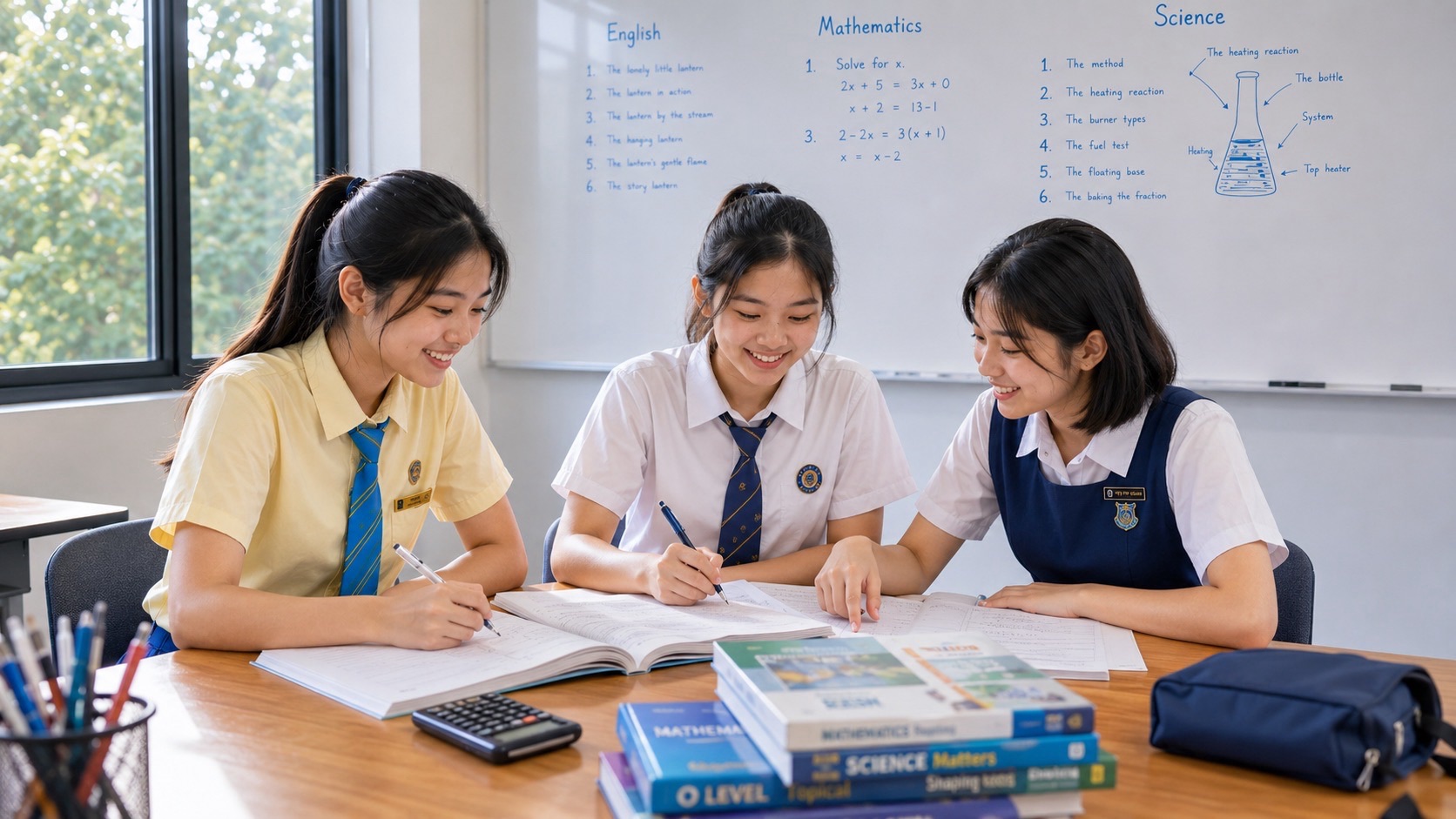
Secondary 4 Mathematics tuition for Whampoa families should be built around examination reliability rather than endless revision volume. By the final year, most students have already encountered the main ideas they need. The decisive challenge is whether those ideas can be retrieved in mixed papers, recognised without chapter labels, executed under time pressure, checked efficiently and recovered after a difficult question. Good final-year tuition therefore converts knowledge into a dependable operating process.
Parents searching for Secondary 4 Mathematics tuition in Whampoa, Sec 4 Mathematics tuition, Sec 4 E-Math tuition, G2 Mathematics, G3 Mathematics, O-Level Mathematics, SEC Mathematics or small-group examination preparation also need examination-year accuracy. A Secondary 4 student sitting the 2026 GCE O-Level examinations is not sitting the same certificate framework as a student preparing for the Singapore-Cambridge Secondary Education Certificate from 2027. Paper selection, syllabus references and revision language should follow the real examination route.
This page is the Whampoa year-specific Secondary 4 route within eduKateSG. Whampoa is the family’s local discovery context and does not imply a physical eduKateSG branch in Whampoa. The article complements the national Mathematics owners, the Mathematics Learning Hub, How Mathematics Works, and the Whampoa Primary 4–PSLE local routes. Additional Mathematics remains a separate specialist subject through Additional Mathematics Tuition.
Write the examination year and course before choosing papers
Adrian puts the target route at the top of his revision file. For 2026 GCE O-Level school candidates, Mathematics uses syllabus 4052 and Additional Mathematics 4049. For 2027 SEC school candidates, SEAB lists Mathematics as K110 at G1, K210 at G2 and K310 at G3, with Additional Mathematics separately listed as K232 at G2 and K341 at G3. This administrative clarity prevents the wrong paper set from quietly becoming the revision plan.
A prelim mark is a diagnostic object
Jo receives a 58% prelim result. Instead of treating the number as a verdict, the paper is divided into mechanisms: missing knowledge, wrong method selection, algebraic execution, reading errors, calculator entry, incomplete working, time loss and failed checking. The mark now becomes a map of causes.
Find the first invalid decision
Ben gets a mensuration answer wrong. The first error is not the arithmetic at the end; it is that he used a diameter as though it were a radius. Every later line is downstream of that decision. The repair therefore targets the first failure, not the most visible final error.
Rank dependencies by impact
Aisha cannot repair every weakness with equal intensity. Fraction control, algebraic rearrangement, percentage bases, graph interpretation, geometry relationships and unit conversion may influence many questions. High-impact dependencies receive priority because one repair can protect marks across several domains.
Read the target before calculating
Ryan marks what the question actually wants: a length, angle, probability, gradient, percentage, mean or equation solution. He also notes units and conditions. This pause prevents a common final-year failure in which a student calculates an intermediate quantity perfectly and never answers the requested one.
Question triage should be rehearsed before the examination
Mira classifies questions during practice as ready, possible or resistant. Ready questions are completed on the first pass. Possible questions receive more time later. Resistant questions are parked after a defined effort threshold. The categories are temporary, but they stop one difficult item from consuming the entire paper.
A first pass should protect coverage and accuracy
Clara uses the first pass to secure accessible marks while keeping written working visible. She does not rush so hard that routine signs, units and brackets disappear. The second pass tackles questions requiring more interpretation. The final pass returns to flagged items and performs targeted checks.
Worked example: reverse percentage
An item costs $96 after a 20% discount. The $96 represents 80% of the original price, so the original price is $120. Ethan checks forward by taking 20% of $120 and subtracting it. The reverse calculation is verified using the original direction.
Worked example: simultaneous conditions
Adult tickets cost $18 and student tickets $12. Fifty tickets produce $780. Let a+s=50 and 18a+12s=780. Substituting s=50-a gives 6a=180, so a=30 and s=20. Adrian checks both the ticket count and the revenue.
Worked example: contextual quadratic
A rectangle has width x and length x+6 with area 112 m². Then x(x+6)=112, so x²+6x-112=0. Factorising gives (x+14)(x-8)=0. The physical width is 8 m. Jo rejects the negative root because of the context, not because negative roots are always invalid.
Worked example: average speed
Ben travels 90 km at 45 km/h and another 90 km at 90 km/h. The first leg takes two hours and the second one hour. Average speed is 180/3=60 km/h, not the simple mean of 45 and 90. The definition controls the calculation.
Worked example: geometry with reasons
Two parallel lines are cut by a transversal. One angle is 68°. A corresponding angle is also 68°. An adjacent angle is 112° because angles on a straight line sum to 180°. Aisha writes the reasons so the geometry is an argument rather than a visual guess.
Worked example: probability without replacement
A bag contains 5 red and 3 blue counters. Two red counters are drawn without replacement with probability 5/8×4/7=5/14. Ryan updates the second numerator and denominator because the first draw changes the sample space.
Worked example: weighted mean
Coursework worth 40% has score 75 and an examination worth 60% has score 68. The weighted result is 0.4×75+0.6×68=70.8. Mira checks that the weights sum to one before combining the contributions.
Calculator discipline is part of examination technique
Clara writes the mathematical setup before typing. She checks angle mode where relevant, uses brackets deliberately and records intermediate values when a calculation is long. She also estimates the likely magnitude. A calculator can execute the wrong model perfectly, so mathematical control must surround the button sequence.
Checking should use a different route where possible
Ethan substitutes equation solutions back into the original, expands factorised expressions, reverses percentage calculations, tests graph points and compares measurement answers with geometric constraints. Repeating the same keystrokes is weaker than using an independent check.
Written working should remain inspectable under time pressure
Adrian does not hide three algebraic transformations in one line when signs and fractions are involved. Enough working should remain visible to locate the first invalid step and to demonstrate the method. Efficiency means concise clarity, not invisibility.
Every full paper should generate a repair plan
Jo marks the paper, classifies each important loss, groups recurring mechanisms and chooses the highest-value repair. The next session begins with that repair rather than automatically with another entire paper. Full-paper volume without correction can simply repeat the same weakness.
Past papers should be used with syllabus-year awareness
Older papers can provide excellent mathematical questions where content overlaps, but a student should know whether a resource is being used for skill practice or as a current examination simulation. For the 2026-to-2027 transition, that distinction is especially important.
Main Mathematics and A-Math need separate revision maps
Ben may take Additional Mathematics, but one difficult A-Math paper should not erase main-Mathematics practice from the week. Shared algebraic dependencies can be repaired efficiently while subject-specific content remains separately scheduled and diagnosed.
G1, G2 and G3 final-year support must follow the actual subject level
For 2027 SEC, Mathematics is offered at G1, G2 and G3. Aisha’s revision file states the actual level and examination year before paper selection begins. The level is about the subject route, not a permanent label for the learner.
A three-student final-year class should preserve independent decisions
Ryan, Mira and Clara each write the first useful move on a difficult question before discussing it. One may recognise the method, one may misread the target and one may know the method but fail to start. Independent evidence allows the tutor to intervene precisely.
Micro-timing builds speed more safely than immediate full-paper pressure
Ethan times five routine algebra questions, three percentage questions, two geometry setups or one data section. Accuracy is recorded alongside time. Only when performance is stable does the practice expand into longer mixed sections and full papers.
Use section timing to find hidden drift
Adrian may finish a paper within the overall time yet spend too long in the first half, leaving the last section rushed. Rough section checkpoints reveal where hesitation accumulates. Timing becomes measurable rather than intuitive.
Recovery after a difficult first paper should be planned
Jo does not spend the interval between papers reconstructing every uncertain answer. She stops the post-mortem, eats, hydrates, resets equipment and treats the next paper as a separate scoring opportunity. The routine protects attention from an examination that can no longer be changed.
The final fortnight should become narrower
Ben reduces resource variety as the examination approaches. He focuses on active dependencies, recurring error mechanisms, selected mixed papers and a small set of checking routines. The final days are for stable execution rather than collecting new tricks.
Equipment and logistics should be settled early
Aisha uses the same approved calculator throughout practice, knows how to check angle mode and confirms examination logistics before the final week. Simple operational uncertainty should not consume working memory during the paper.
A four-stage paper-review cycle keeps practice productive
Stage one: mark. Stage two: classify the first-failure mechanism. Stage three: repair the smallest relevant dependency. Stage four: retest it later with a fresh question. Ryan does not declare a weakness fixed because the worked solution now looks obvious.
A six-week reliability cycle creates structure
Week one diagnoses prelims or a mixed paper. Week two repairs high-impact algebra and number dependencies. Week three addresses geometry, graphs or data while retaining mixed practice. Week four adds timed clusters and a full paper. Week five focuses on recurring mechanisms and triage. Week six narrows revision and retests repairs.
Parents can ask evidence-based questions
Mira’s family can ask which error mechanism was repaired, which old topic returned, what check was practised and which question type still consumes too much time. These questions reveal the learning process without requiring the parent to reteach Mathematics.
Worked example: formula rearrangement under pressure
Given v²=u²+2as and asked to make a the subject, Clara writes a=(v²-u²)/(2s), assuming s is non-zero. She preserves the numerator as a group so the subtraction is not split incorrectly during division.
Worked example: graph intersection
Two lines meet at (4,7). Ethan explains that the point represents values satisfying both equations simultaneously. He substitutes x=4 into both and confirms y=7. The graph and algebra agree.
Worked example: multi-stage reverse percentage
An item costs $153 after a 15% discount, so the pre-discount price is $180. If $180 represented a 20% increase on an earlier amount, the earlier amount is $150. Adrian works backward through the multipliers in reverse order.
Worked example: composite area
A 7 m by 5 m rectangle has a 2 m by 1.5 m corner removed. The remaining area is 35-3=32 m². Jo sketches the decomposition before calculating. Complex-looking mensuration often becomes manageable after the figure is rewritten as familiar pieces.
Worked example: rate conversion
A machine produces 96 items in 8 minutes, or 12 items per minute. At that constant rate, 150 items require 12.5 minutes. Ben carries the units because items divided by items per minute produces minutes, confirming that the operation answers a time question.
Worked example: effect of an outlier
The values 5,6,7,7,8 have median 7 and mean 6.6. Replacing 8 with 80 leaves the median at 7 while the mean rises sharply. Aisha explains why the median is resistant to the extreme value.
Practise starting resistant questions
Ryan receives a difficult problem and has thirty seconds to write one valid first move: define an unknown, draw a diagram, identify the percentage base, write a relevant equation or list the data. He does not always finish the problem. The drill trains entry rather than complete solution.
Protect partial progress where the full route is not visible
Mira learns to preserve valid definitions, formulas, substitutions and intermediate results instead of abandoning a structured question completely. The exact marking scheme varies, but mathematically valid visible progress is more useful than an empty page.
Build a one-page examination operating manual
Clara’s manual contains first-pass rules, time checkpoints, recurring error controls, calculator reminders and the checks that most often save her marks. It comes from her own papers rather than a generic poster. The document is short enough to review before practice.
The final seventy-two hours should reduce volatility
Ethan does not open a new revision book three days before the examination. He reviews active dependencies, representative mixed questions, equipment and checking routines. New content is introduced only if it repairs a high-impact gap.
The examination morning should protect working memory
Adrian uses a compact warm-up rather than a full paper: one algebraic manipulation, one percentage or ratio relationship, one geometry setup and one short data question. Logistics are already settled so attention can remain on the Mathematics.
Use a reset routine after a resistant question
Jo marks the question, preserves any valid setup, moves on and returns later with a fresh read. The difficult item remains a local problem instead of becoming a judgement about the entire paper. If it still resists, she protects the remaining time.
Run a blank-answer audit before polishing completed work
Ben’s first final scan checks every page and subpart for missing responses. Only then does he inspect signs, units, percentage bases, calculator mode and requested quantities. Blank accessible marks deserve priority before cosmetic improvement of already-complete work.
Keep the final checklist short enough to remember
Aisha asks: Have I answered every part? Is the requested quantity stated? Are units correct? Did I preserve signs and brackets? Is the percentage base or probability denominator correct? Is any answer structurally impossible? Six strong checks are more usable than twenty weak reminders.
Current GSC evidence supports year-level Mathematics search intent
eduKateSG’s current Search Console data shows strong visibility for “secondary 1 mathematics tutor”, year-specific Bukit Timah Mathematics queries and Additional Mathematics tutor phrases. The Whampoa page keeps the exact public title restrained while using familiar Sec 4, G2/G3, E-Math, SEC and examination-preparation language naturally where it accurately describes the reader’s intent.
Whampoa local discovery should route outward, not create a competing broad root
The Whampoa cluster extends the existing local Mathematics progression into Secondary 1–4. It should point families back to the Mathematics Learning Hub, How Mathematics Works and specialist Additional Mathematics owners rather than manufacture another broad Secondary Mathematics page that competes with national architecture.
How to choose Secondary 4 Mathematics tuition from Whampoa
Families should ask whether the programme distinguishes examination years, analyses full papers by mechanism, teaches checking and triage explicitly, and keeps main Mathematics separate from A-Math. Search labels such as Sec 4 E-Math, O-Level Mathematics, SEC Mathematics and G2/G3 Math are useful only when they are translated into the correct current course.
What credible progress looks like
Progress appears when the student starts more questions independently, leaves fewer accessible marks behind, reduces recurring errors, maintains accuracy under moderate time pressure and checks without prompting. Paper scores should eventually reflect these behaviours, but the behaviours often improve first.
Secondary 4 should finish with controlled performance
The learner cannot control the exact questions that appear. The learner can control the process brought to them: read the target, identify the structure, select a method, show enough working, calculate carefully, monitor time, check intelligently and recover when one question resists. That is the durable purpose of final-year Mathematics preparation.
Continue through the Whampoa Mathematics routes
Use Secondary 1 Mathematics Tuition | Whampoa, Secondary 2 Mathematics Tuition | Whampoa and Secondary 3 Mathematics Tuition | Whampoa for the earlier year routes, the Mathematics Learning Hub for the wider estate, and the separate Additional Mathematics Tuition architecture for A-Math.
Use error clusters to decide what deserves a full reteach
One isolated arithmetic slip may need only a reminder. The same algebraic sign error appearing across several papers deserves a focused intervention. Adrian groups errors by mechanism and frequency before deciding what to do next. This keeps the final months selective: strong responses to recurring patterns, light-touch correction for isolated slips, and no unnecessary reteaching of stable content.
Use fresh variants after every important correction
Jo corrects a reverse-percentage question today. Two days later she receives a different version with new numbers and a changed context. If she still writes the correct multiplier relationship without notes, the repair is more credible. Fresh delayed variants prevent model-solution familiarity from being mistaken for learning.
Protect strong topics while repairing weak ones
Ben is weak in trigonometry, but spending every revision hour there would allow algebra, data and percentage skills to decay. His week therefore includes a concentrated trigonometry repair block plus short retrieval from already-strong domains. Final-year revision is an allocation problem: weak topics deserve attention, but strong topics deserve maintenance.
Practise the first thirty seconds of difficult questions
Aisha does not always complete the entire resistant problem during a first-move drill. She practises defining the unknown, sketching the diagram, writing the relevant formula, identifying the percentage base or listing the known quantities. The goal is to reduce blank starts. Once a mathematically valid entry appears, the rest of the problem often becomes easier to organise.
Use a paper-completion audit before detailed checking
Ryan’s final scan starts by checking whether every part has a response. A blank answer can represent lost accessible marks with no mathematical decision behind it. Only after the blank-answer audit does he inspect signs, units, percentage bases, calculator mode, and whether the requested quantity rather than an intermediate value has been stated.
Worked example: identify the first useful step
The sum of two consecutive even integers is 86. Mira defines the smaller integer as 2n and the next as 2n+2. Then 2n+(2n+2)=86, so 4n=84, n=21, and the integers are 42 and 44. The key difficulty was translating “consecutive even integers” into algebra before any solving occurred.
Worked example: compare two offers using final price
Shop A offers 18% off a $300 item, giving $246. Shop B offers a $50 discount, giving $250. Clara compares final prices rather than the numbers 18 and 50 directly. Applied questions often become simpler once unlike descriptions are converted into the same quantity.
Worked example: rate with unit reasoning
A pump moves 30 litres in 5 minutes, so its average rate is 6 litres per minute. At the same constant rate, 48 litres require 8 minutes. Ethan carries the units through the calculation: litres divided by litres per minute leaves minutes. Unit structure confirms that the operation answers a time question.
Worked example: equation check by substitution
Solving 6x-5=31 gives x=6. Adrian substitutes 6 back into the original: 6(6)-5=31. The substitution is independent of the rearrangement steps and therefore gives a useful check. Equation solutions involving fractions or brackets benefit even more from this routine.
Worked example: factorisation check by expansion
Jo factorises x²-8x+15 as (x-3)(x-5). Expanding gives x²-5x-3x+15=x²-8x+15. The reverse operation verifies the factorisation before it is used to solve the equation.
Worked example: probability through a complement
If the probability of a component failing a test is 0.07, the probability of passing is 0.93, assuming pass and fail cover the entire modelled outcome space. Ben uses complements when they simplify the work but still checks that the event pair is genuinely exhaustive.
Worked example: statistics from combined groups
Ten students have mean score 16, giving total 160. Five more students have mean 20, giving total 100. The combined fifteen students have total 260 and mean 260/15≈17.33. Aisha sees why simply averaging 16 and 20 would incorrectly give the smaller group equal weight.
Worked example: dimensional reasoning as a check
A question asks for area, but Ryan’s final unit is centimetres rather than square centimetres. Even without a model answer, he knows the result is incomplete or the wrong quantity has been calculated. Units act as a structural error detector throughout the paper.
Keep a compact list of personal red flags
Mira’s list contains the situations that repeatedly cost her marks: negative substitution, reverse percentage, radius versus diameter, angle mode, without-replacement probability, long calculator expressions and unanswered final units. The list is personal and evidence-based. It is reviewed before practice papers and refined as old errors disappear.
Use one final full paper as a systems test
Clara’s last complete practice paper tests more than content. She applies her first-pass strategy, section timing, triage, calculator discipline, checking points and recovery routine. After marking, the tutor asks whether the operating process held up. One unusual hard question matters less than repeated failures in the system.
Debrief practice papers in minutes before correcting them in depth
Ethan writes three quick notes immediately after a paper: one thing that worked, one recurring mechanism that still cost marks, and one process change for the next paper. Detailed correction can happen later. The short debrief captures fresh timing and attention evidence before memory fades.
Confidence should be calibrated against independent evidence
Adrian may feel confident after a familiar paper and struggle on a fresh variant. Jo may feel nervous even while her timing and accuracy improve. Final-year tuition tracks confidence separately from performance so reassurance or extra variation can be targeted appropriately.
The final revision file should be a control panel, not an archive
Ben’s file contains the examination year, subject level, active dependencies, stable retrieval topics, paper-timing checkpoints, calculator controls and the few checks that most often protect marks. Old worksheets are not required in the final control panel unless they contain a representative repaired example.
Whampoa scheduling should preserve cognitive energy
For local families, practical scheduling can influence final-year reliability. A lesson that consistently follows a very long school day may produce weak attention even if the material is appropriate. Travel, meals, CCA commitments and sleep should be considered when deciding whether the weekly plan is sustainable. Examination preparation needs repetition across months, not heroic sessions followed by exhaustion.
Use the final fortnight to reduce variability
Aisha narrows her resource set, repeats the checking routines that have worked, retests active dependencies and keeps sleep regular. She is not trying to maximise the number of unseen questions encountered before the examination. She is trying to make performance more stable across ordinary and difficult papers.
Use a reset protocol when one question disrupts confidence
Ryan writes any valid partial setup, marks the resistant question, moves on and returns later. The action prevents one difficult item from becoming a global judgement about the paper. On return, he rereads the target and his earlier working as though it were a new problem. Often the missing relationship becomes clearer after attention has reset.
Protect the interval between papers
Mira avoids extended answer discussions after a completed paper when another paper is still ahead. She cannot change the first paper, but she can protect working memory and attention for the next one. Her recovery routine includes food, hydration, equipment reset and only compact review notes.
Keep Additional Mathematics on a separate final-year schedule
Where A-Math is taken, Clara maintains a separate paper plan and error log. Shared algebraic weaknesses can be repaired efficiently, but A-Math-specific techniques do not replace main-Mathematics geometry, data, probability or applied work. The subject boundary remains clear throughout the final revision period.
Use official syllabus references as the final authority
Ethan checks current SEAB information when there is any doubt about the examination route. For 2026 O-Level Mathematics, syllabus 4052 remains relevant. For 2027 SEC, Mathematics uses K110, K210 or K310 according to G1, G2 or G3. Additional Mathematics remains separately coded. Current official documents outrank familiar terminology or old paper labels.
Build a final six-point execution routine
Adrian reduces months of learning into six actions: read the target; identify the structure; choose a method; show enough working; check with an appropriate second route; manage time and move if progress stalls. The routine is broad enough to apply across topics and short enough to remember under pressure.
Secondary 4 reliability means the process survives unfamiliarity
The examination will contain familiar mathematics in arrangements the student cannot fully predict. Reliability therefore does not mean memorising every possible question. It means that Jo, Ben, Aisha, Ryan, Mira, Clara and Ethan can still organise the problem when surface details change. They have a way to enter, solve, check and recover.
The final handover should preserve learning beyond the examination
Algebraic representation, proportional reasoning, graphs, statistics, estimation and modelling remain useful beyond the final paper. The operating habits built for examinations—clear definitions, visible reasoning, unit control, reasonableness checks and evidence-based correction—also support further study and everyday quantitative decisions.
Use the final delayed retest to decide what belongs on the exam-day checklist
Several days after the last major correction session, Adrian receives fresh versions of two recurring weaknesses. If the old mechanism no longer appears, the item can move off the active checklist and into ordinary confidence. If the error returns, the control remains explicit. The exam-day checklist should therefore be built from recent evidence rather than from every mistake made during the year.
Make section timing visible without turning the paper into a stopwatch exercise
Jo uses two or three rough checkpoints rather than timing every question. She wants to know whether the first third of the paper is consuming too much time, whether a long structured problem is becoming a trap, and whether enough time remains for a final scan. The clock supports decision-making; it should not become another source of panic.
Use a final answer-format audit
Ben checks whether money answers use sensible rounding, whether lengths and areas carry the correct units, whether probabilities are expressed in an acceptable form, and whether the final line answers the quantity requested. A mathematically correct intermediate value can still lose usefulness if the final response is incomplete or mislabelled.
Keep the final warm-up familiar
Aisha’s last short warm-up uses Mathematics she already knows: one algebraic manipulation, one percentage relationship, one geometry setup and one statistics calculation. The goal is not to test readiness again. It is to activate familiar routines without creating a new source of uncertainty immediately before the paper.
Whampoa families should judge tuition by the quality of the feedback loop
A strong final-year programme should be able to explain why marks were lost, what was repaired, how the repair was retested and whether it survived under mixed-paper conditions. “More papers” is not enough. The useful loop is diagnose, prioritise, repair, retest, mix, time and check. Families can ask to see evidence of that loop rather than rely only on promises about coverage.
Current search terms should remain subordinate to current syllabus accuracy
Parents may search Sec 4 E-Math, O-Level Math, G2 Math, G3 Math or SEC Mathematics. These phrases reflect real search behaviour and appear across current Singapore providers. The teaching programme still has to identify the actual 2026 or 2027 route before recommending papers or describing the examination. Search language helps discovery; official syllabus information controls preparation.
The Whampoa S4 page closes the local year progression
Secondary 1 built the symbolic transition. Secondary 2 consolidated dependencies and method selection. Secondary 3 reorganised the upper-secondary network and separated main Mathematics from A-Math. Secondary 4 now asks whether that network remains reliable under mixed-paper time pressure. The four pages therefore form a progression rather than four copies of the same tuition description.
Final principle: protect the Mathematics the student already owns
Examination preparation is often framed as acquiring more content, but many final-year marks are lost because known Mathematics is not executed reliably. The strongest Whampoa Secondary 4 plan protects what the learner already knows: make the method visible, preserve signs and units, choose sensible routes, use the calculator carefully, check with an independent method, and move on when one question threatens the rest of the paper.
That is the final-year operating system
When the questions change, the student still has a stable process. Adrian can triage. Jo can manage section time. Ben can inspect answer format. Aisha can use a calm warm-up. Ryan can recover from resistance. Mira can preserve strong topics while repairing weak ones. Clara can keep A-Math separate. Ethan can verify the correct examination route. The paper becomes a sequence of mathematical decisions rather than an unpredictable test of confidence.
Use one final systems check rather than another content marathon
The last review should test whether the examination process itself is stable. Give the student a short mixed set and observe whether the target is identified, the first move is sensible, working remains visible, calculator use is controlled and an appropriate check appears without prompting. The questions do not need to be exotic. The point is to confirm that the routines survive ordinary pressure.
If Jo still loses time after one resistant item, triage remains active. If Ben still forgets units under time pressure, the unit check stays on the final checklist. If Aisha’s reverse percentage is now stable across fresh variants, it can leave the active repair list. Final preparation becomes narrower because recent evidence tells us what still deserves attention.
Finish with an examination file the student can actually use
The final Whampoa file should fit into a few pages: examination year and subject level, active dependencies, stable retrieval topics, personal red flags, section-timing checkpoints, calculator controls, and the small number of checks most likely to protect marks. It should not become a complete archive of the year.
A concise file helps the student act. That is the standard for the last stage: every note, paper and correction should support a decision the learner can still make when the examination questions are unfamiliar.
The last delayed retest should use fresh numbers and altered wording so the student cannot rely on memory of a recent correction. If the same routines still appear independently, the preparation is genuinely stable. If an old mechanism returns, it stays visible on the active checklist. That evidence keeps the final plan honest, focused and proportionate to the Mathematics that still needs protection.
That focused plan is the final goal: reliable Mathematics, current examination routing, and a student who can still make good decisions when the paper changes.
Reliable process protects the marks already earned.
Always.