
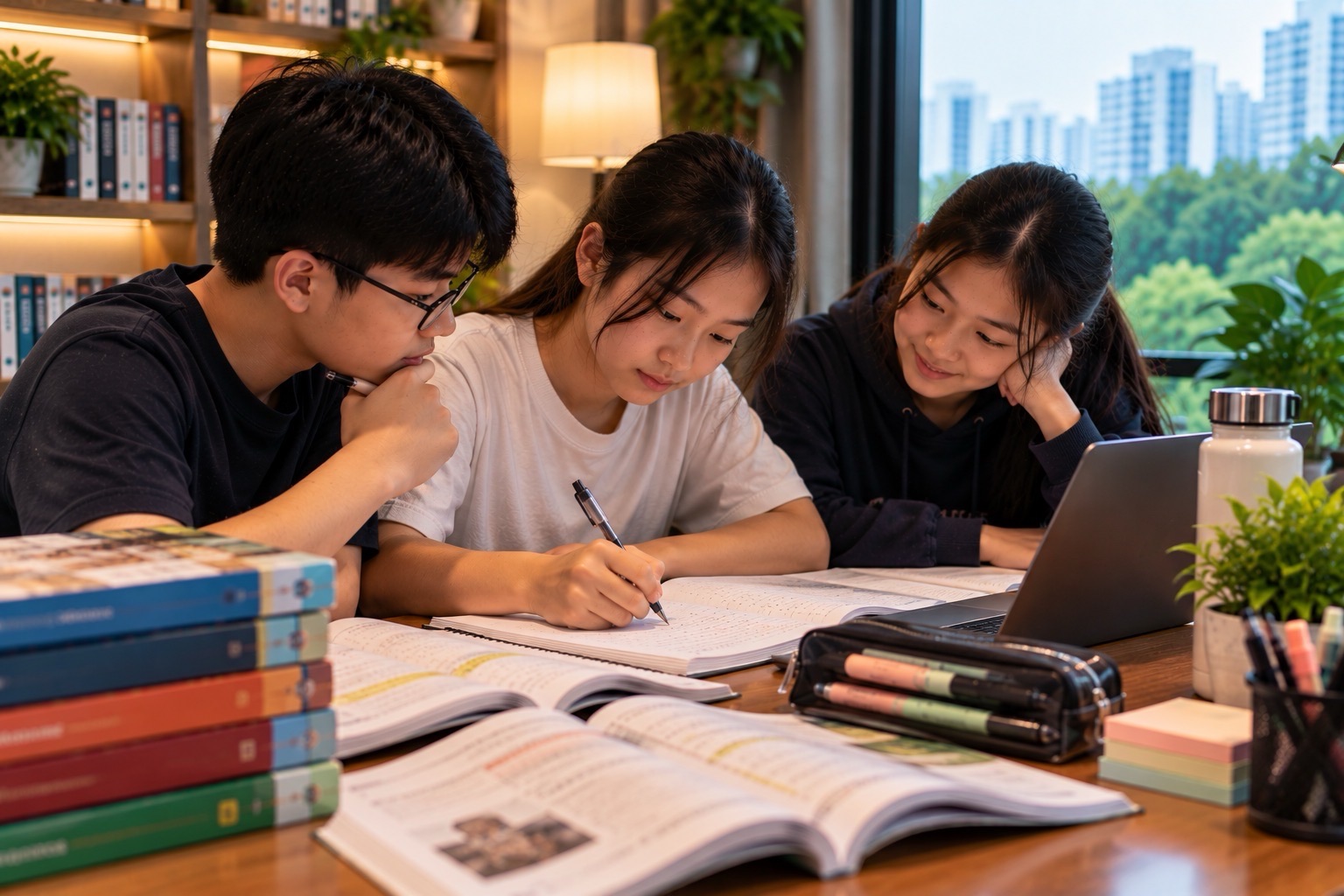
Secondary 4 Science Small Groups Tuition Jurong East | Benefits and Consequences. Secondary 4 Science small groups tuition for Jurong East students can make sense when a teenager needs a clear recovery plan rather than endless examination drilling. A carefully matched three-student tutorial can identify weak concepts, rebuild scientific reasoning and check whether the learner can apply corrections in independent questions across Physics, Chemistry or Biology.
The costs of an unfocused tuition programme can be substantial. Adding a weekly class without repairing the underlying misconception may increase exhaustion, reduce time for other subjects and encourage dependence on the tutor. Parents should compare the exact Science syllabus, quality of feedback, travel and realistic time remaining before the examination.
At a glance: Quick parent guide: identify the examination year and SEC or GCE subject; choose the two highest-impact recurring errors; ask for a four-week diagnostic-and-repair plan; verify each pupil works independently during the tutorial; and review whether the extra class has improved the student’s own answers enough to justify continuing.
- Core focus: recover from repeated errors without chasing every chapter equally.
- First diagnostic: two representative school questions and the child’s original reasoning.
- Four-week aim: repair a concept, apply it in new settings and verify retention.
- Subject match: check Pure or Combined Science, exam year and subject level before buying a programme.
- Estate caution: this page does not confirm a dedicated Jurong East teaching centre or group.
- Main consequence to avoid: so much tuition that the student loses the capacity for self-study.
What is Secondary 4 Science small groups tuition?
Small groups tuition is an educational service in which a tutor teaches a few students together, while a tutorial is the individual class session. In the eduKateSG reference model, classes are designed around three students and lessons of about 1.5 hours. The important promise of this format is not that the room contains fewer chairs. It is that a tutor has more opportunity to hear the reasoning of each learner, identify the first wrong step and help that learner answer again without assistance.
For a Jurong East family, “Secondary 4 Science” is not a single curriculum. A student may take a Combined Science pairing or separate Pure Physics, Chemistry or Biology, and the subject level and examination year matter. Parents should not be reassured merely by a tutor saying they teach “Science at Secondary 4”. They should ask which specific examination paper is covered, whether the group is compatible and how weaker learners will be supported without holding everybody back.
An effective small-group lesson is a sequence: retrieve prior knowledge, observe an attempt, diagnose the misconception, rebuild the missing idea, apply it in a different setting and inspect an individual answer. Peer discussion can help students compare assumptions and methods, but it is not a substitute for independent performance. Tuition is most defensible where it reduces future dependence on the tutor rather than simply increases the amount of completed work.
Build an examination recovery plan that does not consume the entire week
When a student performs badly in a Science test, a natural reaction is to demand more practice papers. Sometimes that helps, especially if the learner understands the content but has not practised time management. But if several errors originate from one missing principle, additional full papers can reproduce the same mistake with surprising efficiency. The pupil works harder and may feel less capable because the root cause remains invisible.
A useful recovery plan begins by sorting errors. Which questions show missing facts? Which show a scientific misconception? Which are damaged by units, graphs or calculations? Which lose marks through incomplete explanations? Which are simply unfinished because time ran out? Each category needs different treatment, and the most serious misconception may deserve attention before general timed drilling.
This prioritisation matters when a student offers more than one Science discipline. A Pure Chemistry paper cannot be treated like a generic Combined Science half, and a student taking Physics–Biology will not benefit from a schedule dominated by Chemistry. The tutor must first confirm the exact programme and distinguish work that is essential from material that is merely available in a revision folder.
A three-person group can make diagnosis faster because students hear carefully managed comparisons between methods. But the tutor must still identify each pupil’s individual bottleneck. A class that gives everybody the same question and the same model answer regardless of their mistakes is simply a small version of a large lecture.
Singapore Science pathways: 2026 GCE versus 2027 SEC
From 2027 the Singapore–Cambridge Secondary Education Certificate (SEC) replaces separate GCE N-Level and O-Level examinations. SEC subjects are examined at G1, G2 or G3 levels. For a family enrolling a student at the end of 2026, the distinction between a 2026 GCE candidate and a 2027 SEC candidate is essential. A worksheet labelled “O-Level Science” may contain useful ideas, but it should be checked against the student’s correct current-year syllabus rather than treated as a complete map of the examination.
The SEAB 2027 G3 school-candidate syllabus list identifies combined Physics–Chemistry (K326), Physics–Biology (K327) and Chemistry–Biology (K328). It also separately lists G3 Physics (K323), Chemistry (K324) and Biology (K325). The 2027 G2 list identifies combined Science subjects K223, K224 and K225. These subject codes are useful for checking materials and for making sure a student is taught at the right level. Use the 2027 G1 listing for applicable G1 subjects, not a made-up equivalent G3 programme.
| 2027 SEC Science route | Listed subject codes | Teaching implication |
|---|---|---|
| G3 Combined Science | K326 Physics/Chemistry; K327 Physics/Biology; K328 Chemistry/Biology | Prepare the correct pair; do not teach all three disciplines as if simultaneously examined. |
| G3 Pure Sciences | K323 Physics; K324 Chemistry; K325 Biology | Check each separate syllabus and depth; a generic Combined Science worksheet may not be enough. |
| G2 Combined Science | K223 Physics/Chemistry; K224 Physics/Biology; K225 Chemistry/Biology | Use G2 learning demand and appropriate papers; not all G3 tasks are automatically suitable. |
| 2026 GCE O-Level examples | 5086 Physics/Chemistry; 5087 Physics/Biology; 5088 Chemistry/Biology | Check examination year and actual subject rather than assuming 2027 codes applied in 2026. |
For the 2027 G3 combined courses, the official Science syllabus describes a multiple-choice component, written structured-response components appropriate to the two disciplines, and a practical assessment. A tutor should account for all relevant assessment forms, not just topical multiple-choice drills. Students should also continue supervised practical work through school. Examination structure, paper content and practical requirements should always be checked in the official subject syllabus for the relevant year and level.
Official sources: SEAB Secondary Education Certificate overview; G3 SEC syllabus list; G2 SEC syllabus list; 2026 GCE O-Level syllabus list. The school’s subject information should govern which code and level applies to an individual learner.
How three-person teaching differs from extra worksheets
When students work through a Science problem, mistakes can arise before the final answer appears. A learner might misidentify the quantity, choose the wrong model, interpret a graph incorrectly, omit the scientific mechanism or write an unsupported conclusion. The tutor’s opportunity in a three-person class is to notice these decision points while the child is thinking. Marking only the final answer correct or wrong misses the mechanism of the mistake.
The useful conversation is specific: ‘Which component is the voltage measured across?’, ‘What does this graph axis record?’, ‘What evidence supports that inference?’, ‘Which condition has changed?’, or ‘How do you know the result is plausible?’ Each question has a diagnostic purpose. Asking students to read a model answer repeatedly may produce recognition, but it does not establish that they can make those decisions in an unseen problem.
A good tutorial also manages peer learning deliberately. If one pupil already understands the problem, the tutor can ask them to explain the assumption behind the method, while the other pupils test it using a contrasting example. But each student must eventually put away the shared explanation and produce an individual response. Without this step, a quiet learner may appear to be keeping up while retaining the original misconception.
Parents should expect the tutor to be candid about differences in level and pace. A three-person class may be excellent for three students with compatible needs and poor for students with unrelated syllabuses or severe differences in prior knowledge. A smaller headcount does not excuse a mismatch. A good provider can recommend individual attention or an alternative group when that is the more suitable option.
Five practical learning problems parents can identify
The progression from repair to distinction has several stages
The first stage is repair. A student who cannot reliably explain a fundamental process needs to rebuild that idea before attempting sophisticated applications. The tutor might start with a labelled diagram, ask the learner to explain the cause and effect, and use a contrasting case to make the misconception visible. At this stage success means accurate understanding, not speed.
The second stage is stabilisation. The learner should retrieve the concept after a delay without notes, use the right scientific terms and distinguish it from a similar concept. A student who can explain the correct method five minutes after being told may still forget it by the next week. Retrieval and varied practice can establish whether the correction survives.
The third stage is transfer. An unfamiliar graph, different investigation, revised circuit or alternate biological condition forces the student to recognise the principle without being told which chapter applies. A strong tutor chooses questions that change surface details while preserving the underlying reasoning. This is particularly important for national examinations, which can assess known ideas in novel settings.
The final stage is performance under realistic conditions. Once the method is accurate, the student needs sufficient practice managing time, selecting questions, checking units and presenting concise explanations. Putting the timer first can train a weak method to operate quickly; putting understanding first gives speed a stable foundation.
A recovery plan with measurable checkpoints
Week one begins with a baseline in the correct subject. Keep the original answer, identify the first wrong step and ask the child to describe what they thought was happening. The tutor should name a narrow target such as choosing resistance values correctly, interpreting a rate graph or distinguishing observation from inference. ‘Improve Science’ is not a measurable target.
Week two rebuilds the target concept and tests it in two formats. If the problem is a Physics graph, the student may interpret a labelled example before seeing a graph with an altered scale. If it is Chemistry explanation, the student may link particles and observations before working with a new reaction. The tutor should record whether hints are still required.
Week three removes scaffolding. The student completes an unseen task with no leading prompts, then explains why a tempting wrong answer fails. Errors at this stage are informative; they reveal whether the concept is fragile or whether the question introduces another bottleneck. A respectful class treats those errors as evidence for better instruction, not a reason to embarrass a learner.
Week four compares fresh work with the starting sample. The questions should be similar in demand rather than identical in wording. Parents may see improved reasoning before a dramatic whole-paper score change, and the tutor should be open about that. If the target skill has not improved, the plan should change rather than automatically increase the number of worksheets or lessons.
The risk of turning tuition into a permanent answer service
Some learners become accustomed to bringing an unfamiliar question to tuition and waiting for the tutor to demonstrate the solution. The student may understand each demonstration but gradually lose confidence in tackling new work independently. A three-person class should prevent this dependence by requiring individual first attempts and reducing prompts over time.
A tutor can ask a learner to choose the scientific principle, state what they know, sketch an explanatory model and propose an answer before receiving feedback. Even an incomplete attempt is useful because it reveals the current thinking. The tutor should correct the exact point of misunderstanding, then give a new question so the student practises taking the first step alone.
Parents should observe whether homework expectations are realistic. A few carefully selected retrieval and transfer tasks can be more valuable than many repeated questions whose answers are available to copy. Between lessons, the child should revisit the weakest concept, complete a fresh problem and record the mistake without being dependent on an adult.
One sign of success is that the child begins asking narrower questions in school. Instead of saying ‘I don’t understand Biology’, the learner asks why the rate changes at a particular point or what evidence supports an inference. This metacognitive progress helps students use school teaching more effectively and may eventually reduce the need for extra tuition.
Jurong East families: who should take tuition and who should not?
A Jurong East household may have several possible tuition routes, but the best one is not necessarily the nearest or the most expensive. Start with the actual subject and the specific problem the student needs to solve. Ask whether a school consultation, independent revision, one-to-one support or a matched three-person tutorial is the least burdensome effective option.
The location named in this article identifies its intended readers. It does not establish a physical eduKateSG teaching branch in Jurong East, a current Secondary 4 Science timetable or an available place. Confirm the tutor, location, subject, fees and group format directly before planning attendance. Published Punggol and Bukit Timah references should not be confused with universal class availability.
Travel should be measured honestly. A lesson may be 90 minutes, but travelling to and from it, preparing materials and completing additional homework may occupy much more of an evening. If that time displaces needed sleep or revision for another subject, even a good tutor may not be the right choice at the right time.
Parents should also consider stopping. A student who can now identify the correct Science ideas, complete unseen questions and correct errors independently may be ready to use the tuition time for self-study. A tuition provider’s value is the capability it develops, not the number of months a family remains enrolled.
Four worked diagnostic examples for Jurong East parents
Case 1: A student repeatedly loses marks on forces
Original error: The same force diagram is misunderstood despite three full practice papers.
What the tutor should do: Return to the physical situation, identify relevant forces and the required relationship, then test an altered diagram.
Evidence of learning: Learner interprets a new force scenario alone before being timed.
Case 2: Chemistry revision consists of copying model answers
Original error: The student recognises a familiar paragraph but cannot explain the new reaction.
What the tutor should do: Ask what is observed, which particle-level or reaction principle applies, and how the evidence supports the statement.
Evidence of learning: A new reaction question can be answered without reading the model.
Case 3: A Biology data-response answer is technically possible but unsupported
Original error: The learner guesses a plausible cause that is not established by the graph.
What the tutor should do: Separate the observed relationship, possible mechanism and evidence limits.
Evidence of learning: The student gives a qualified conclusion in a new experiment.
Case 4: The pupil runs out of time after writing excessive responses
Original error: Relevant facts are buried in long paragraphs that do not match command words.
What the tutor should do: Use concise claim–evidence–scientific reason structure and appropriate timed practice after accuracy is stable.
Evidence of learning: A fresh timed question is answered completely, accurately and without unnecessary material.
What a good 90-minute Secondary 4 Science tutorial might look like
An illustrative eduKate-style 90-minute tutorial does not need to be packed with lectures. The tutor should move from retrieval to diagnosis to targeted teaching and then to independent transfer. The distribution below is one sensible example, not an independently verified timetable for any particular group or location.
| Lesson stage | Time | What the tutor learns |
|---|---|---|
| Retrieval from previous lessons | 10 minutes | Whether corrections remain available without notes after a delay. |
| Diagnostic of marked schoolwork | 15 minutes | Whether the student has a concept, representation, mathematical or language error. |
| First-principles rebuilding | 20 minutes | Whether the student can explain the needed idea using a model or diagram. |
| Guided transfer to unfamiliar questions | 20 minutes | How the student adapts when surface details are changed. |
| Independent answer and feedback | 15 minutes | Whether every learner, not just the strongest, can now reason accurately alone. |
| Error log and next retrieval plan | 10 minutes | Which narrow skill will be checked in the next meeting. |
This structure is more demanding than simply handing out a large pack of worksheets. It requires a tutor to choose well and monitor carefully. In a group of three, each learner should have chances to think silently, speak, write and be corrected. If a student only watches another person solve problems, the advertised class size has not yet delivered its educational value.
How to measure benefits after four lessons
Start with a baseline question that matches the actual subject and level, and keep the student’s original working. Record the specific errors rather than reducing the diagnosis to a percentage. After teaching and practice, use a different but comparably demanding question to check whether the student can select the right principle and complete the explanation independently.
| Point | What to record | Responsible interpretation |
|---|---|---|
| Before tuition | Original marked question, error categories and whether hints were needed. | The baseline identifies a starting point, not a forecast final grade. |
| After lesson 2 | An explanation of the repaired concept and one contrasting example. | The child may understand locally but still need retrieval practice. |
| After lesson 3 | A fresh problem with less scaffolding and explicit attention to units, evidence and command words. | Transfer to unfamiliar problems is more meaningful than copying the original correction. |
| After lesson 4 | A comparable unseen response, remaining error patterns and a parent-student review. | Improvement may be narrow and real without justifying claims about final examination results. |
A four-week review is a checkpoint, not a promise of mastery or a guarantee of an A grade. Severe foundational gaps may take substantially longer. The educational question is whether the tutor can accurately describe what changed, what remains weak and why continuing the particular group would be a good use of the child’s time. If no progress is visible, reconsider the teaching strategy, syllabus match or support format.
Benefits, consequences and realistic alternatives
| Option or consequence | Potential advantage | Possible drawback |
|---|---|---|
| Three-pax tutorial | More frequent diagnostic feedback and useful comparison of reasoning. | Different learners still divide tutor attention; poor grouping can be counterproductive. |
| One-to-one tuition | Individual pacing for severe or concentrated gaps. | May be costlier and lacks structured peer explanation. |
| Larger-group revision | Efficient broad coverage for learners with stable foundations. | Often less opportunity to inspect every pupil’s original reasoning. |
| School consultation | Access to teacher feedback and school assessment expectations. | The pupil must bring specific questions and work within school availability. |
| Self-study | Flexible retrieval and examination practice without transport. | An unrecognised misconception may persist if feedback is unreliable. |
| Adding too much tuition | May provide a sense of structure and reassurance. | Can displace independent practice, other subjects and sleep without improving understanding. |
| Not taking tuition | Preserves resources when school and self-revision suffice. | May leave persistent gaps unresolved if no other intervention works. |
For parents, the strongest reason to choose a three-student tutorial is not a universal claim that smaller is always better. It is the existence of a particular learning need—visible in genuine work—that would benefit from timely, precise correction. The strongest reason to decline is not a hostility to tuition; it may be a child’s proven ability to revise effectively, a mismatch between syllabus and class, or an unsustainable weekly timetable.
Practical Science: what tutoring can and cannot replace
Practical Science requires more than correctly recalling an experiment from a page. Students need to learn how apparatus is used safely, how observations are recorded, how variables are controlled and how conclusions are supported. A small-group tutorial can help learners interpret data, critique a procedure and prepare written experimental explanations, but should not automatically be represented as access to a supervised school-style laboratory.
A common weakness is to describe an experimental limitation merely as ‘human error’. This gives little useful information. A stronger response identifies the measurement challenge, uncontrolled condition or procedural feature that could influence the outcome and suggests an appropriate improvement. In a written tutorial, the tutor can compare two plans and show which one would produce fairer evidence, while being explicit about the limits of paper-based practice.
Families should ask the provider whether any actual laboratory equipment or suitably supervised practical experience is part of the service, or whether the tuition supports theory and paper-based practical reasoning only. This distinction matters especially where a particular subject has a national practical component. The student must continue to follow school laboratory instruction and safety requirements.
Parent checklist before enrolment
- Show the actual school record for subject, level and examination year; do not rely on the word ‘Science’ alone.
- Bring two marked answers showing the student’s unedited reasoning and the teacher’s comments.
- Ask the tutor to identify the first wrong scientific assumption, not simply provide a polished model answer.
- Confirm the group really has no more than three pupils and whether their syllabuses and pace are compatible.
- Ask how Physics, Chemistry, Biology and their different combinations are allocated and differentiated.
- Ask what is done for data interpretation, experiments, graphs, units, scientific vocabulary and unfamiliar questions.
- Check whether every pupil gives an unassisted answer at the end of a relevant lesson.
- Confirm the actual classroom, tutor, weekly timetable, fees, travel commitment and vacant place.
- Review the student’s other subjects and rest; extra tuition should not erase necessary self-study time.
- Agree a short evidence-based review of progress and a procedure for changing the plan if it does not fit.
How a Jurong East family should weigh the real weekly commitment
For a Jurong East learner, a useful rescue programme should also coordinate with school assessment schedules. If a class teaches a topic the student will not need soon while neglecting an urgent foundational error, the programme may look active but fail its purpose. Parents can ask for a one-page priority list that distinguishes must-fix topics from later enrichment.
The plan should leave room for school laboratory work and teacher consultations. Practical Science depends on supervised experience, not just predictions or written observations. A tutorial may prepare students to interpret data and design investigations but should never claim to replace a school laboratory unless the necessary actual facilities and supervision are provided.
A reasonable conversation with eduKateSG begins with what the tutor cannot promise: no guaranteed distinction, no claim that every Science variant fits one class, and no verified Jurong East centre unless confirmed. This protects the student from being placed in an appealing but unsuitable programme.
Questions Jurong East parents ask about Secondary 4 Science tuition
Can a struggling child improve in the examination year?
Targeted improvement is possible where specific gaps can be identified and there is enough time to practise, but no tutor can promise a particular final grade.
Why not do five full practice papers every week?
Repeated papers can reveal issues but will not reliably repair a misconception without feedback and targeted correction. Practice quantity should serve a clear learning purpose.
Should a weak student join a fast three-pupil group?
Only if the tutor can differentiate sufficiently. Serious gaps may need individual support or a slower matched group.
When should timed practice begin?
Once the student can solve problems correctly with limited prompts. Timing should test an established method, not pressure a fragile one.
Does this Jurong East article confirm a tuition centre here?
No. Families must verify the actual tutor, venue, class and timetable before attending.
Does 2027 SEC require new materials?
Use the correct 2027 syllabus and level first. Older questions may still help for matching concepts, but should be screened rather than assumed identical.
What is the strongest success indicator?
The student can tackle a genuinely new question, explain the relevant Science principle and correct mistakes independently.
Can three-student tuition guarantee a distinction?
No. No responsible tutor can guarantee an examination result. A small group may make more individual feedback possible, but outcomes depend on prior knowledge, student effort, subject suitability, teaching quality and many factors outside the tuition room.
Can the same tutor cover every Pure and Combined Science subject?
A tutor may have expertise across several disciplines, but each course has its own syllabus and assessment. The family should confirm the exact teaching commitment, timetable and content, rather than assume that the word ‘Science’ means simultaneous comprehensive coverage.
What if my child already understands the classwork?
Tuition may not be necessary. A pupil who can answer unseen questions independently, use school feedback and sustain a healthy revision plan may benefit more from protected self-study. Extension or enrichment should have a specific purpose rather than being sold as an automatic requirement.
Does a blog title establish tuition availability in this estate?
No. An estate-specific guide serves families in Jurong East; it is not proof of a teaching room, an available tutor or a place in a group in that estate. Confirm where the relevant programme actually runs before making a journey.
MOE, SEAB and eduKateSG reference reading
- SEAB — Singapore–Cambridge Secondary Education Certificate
- SEAB — 2027 G3 syllabuses for school candidates
- SEAB — 2027 G2 syllabuses for school candidates
- SEAB — 2027 G1 syllabuses for school candidates
- SEAB — 2026 GCE O-Level subject syllabuses
- eduKateSG — How G3 Physics and Chemistry Combined Science Works
- eduKateSG — How G3 Physics and Biology Combined Science Works
- eduKateSG — How G3 Chemistry and Biology Combined Science Works
- eduKateSG — How G2 SEC Science Combinations Work
- eduKateSG — Three-Pax Tutorials Reference and Teaching Approach
- eduKateSG — Tuition and Teaching Hub
- Secondary 4 Science Small Groups Tuition Punggol
- Secondary 4 Science Small Groups Tuition Bukit Timah
This independent parent guide explains tuition choices and educational reasoning. It is not an official MOE or SEAB publication. Official syllabuses and school communications take priority. The educational claims about potential small-group benefits describe how a suitable class can be organised; no guaranteed individual outcomes or unverified local classes are asserted.
The considered choice for Secondary 4 Science families in Jurong East
A three-student tutorial is worth considering when it creates a measurable change in the learner’s own scientific thinking. For a Jurong East family, start with a precisely identified weakness, choose an appropriately matched tutor, protect the student’s wider timetable and insist on independent evidence after teaching. The best result is a teenager who can recognise an unfamiliar problem, select a defensible scientific principle and complete the explanation without waiting for the tutor to supply the next sentence.
If the student is behind, rebuild the earliest important missing idea. If the student is coping but inconsistent, stabilise the method under varied conditions. If the student is strong, extend only for a genuine purpose. Do not add tuition merely to reproduce a school lesson in a smaller room.
Arrange a parent–student consultation
To enquire, bring the student’s exact Science subject and level, current exam year, school assessment work and repeated error examples. Ask which appropriate three-student Science group, if any, currently has an available place. Contact eduKate Singapore. Enquire via WhatsApp.
eduKateSG | Small Groups Tuition, Science reasoning and independent learning. Teaching locations and programme availability by confirmation. Properly taught kids shine a bright light into the future.