
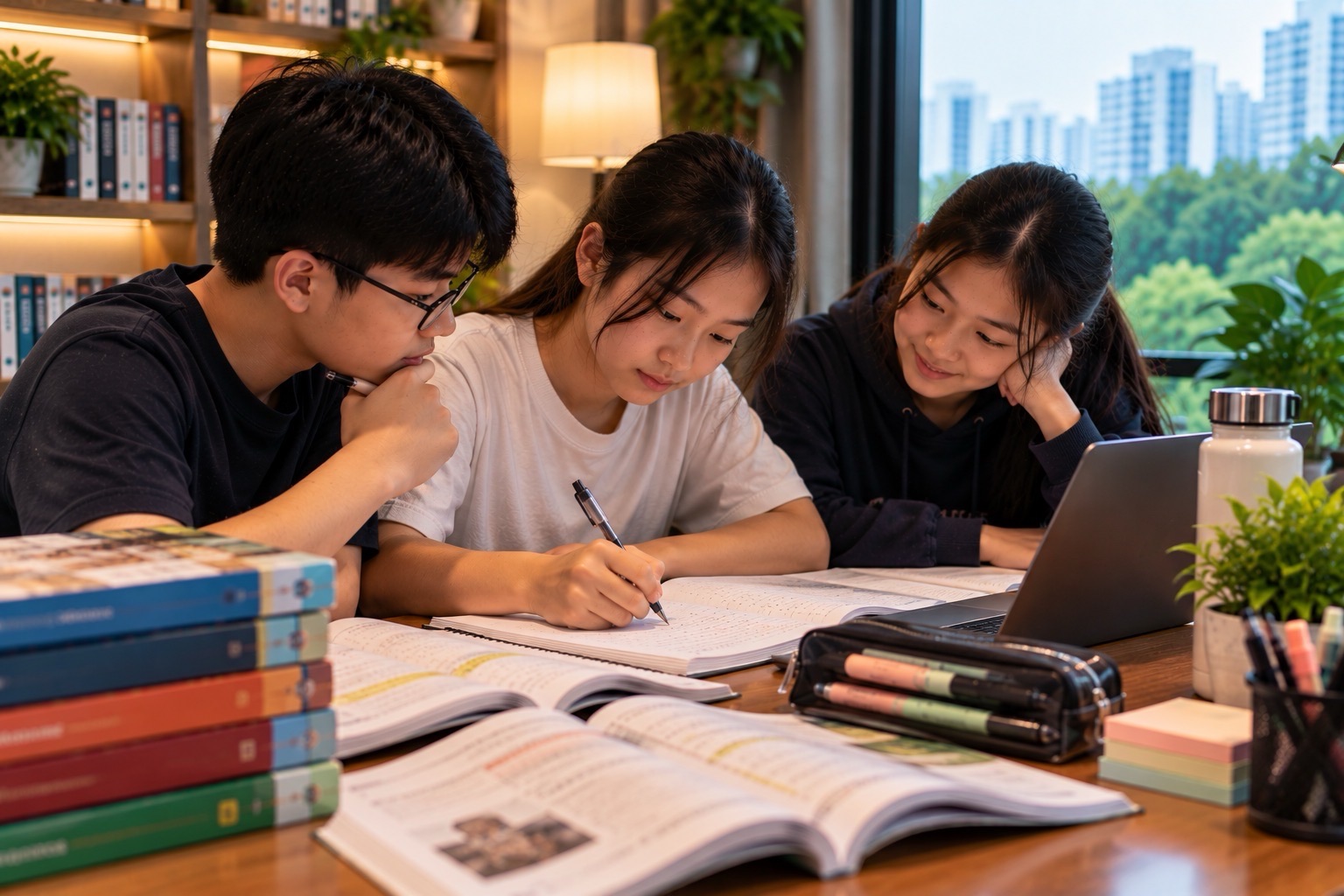
Secondary 4 Science Small Groups Tuition Kallang | Benefits and Consequences. Secondary 4 Science small groups tuition for Kallang families should begin with the student’s actual subject and level, not a generic ‘O-Level Science’ label. From the 2027 SEC examinations, G1, G2 and G3 Science pathways require careful syllabus matching. A well-run three-student tutorial can provide individual feedback, but only if the learners’ subject combinations and teaching demands are genuinely compatible.
The consequences of a mismatch are serious: irrelevant worksheets, inappropriate pacing, lost revision time and unnecessary anxiety. Parents should not assume that three students studying at different levels automatically benefit from a single class. The tutor must differentiate explicitly or recommend a more suitable arrangement, and an estate guide does not establish a physical Kallang tuition venue.
At a glance: Quick parent decision: obtain the school subject code, check the 2027 SEC syllabus or the student’s 2026 GCE pathway, review original marked answers, ask how the tutor groups students and verifies individual understanding, and confirm the actual site and timetable before paying.
- Priority: correct subject level and Science combination before enrolment
- G1: integrated Science K123 has its own syllabus; do not assume it is G3 made shorter
- G2: Combined Physics/Chemistry, Physics/Biology or Chemistry/Biology pathways
- G3: Combined Science pairs or separate Pure Sciences have distinct syllabus requirements
- Class quality: curriculum compatibility, differentiated questions and independent response checks
- Estate caution: no unverified Kallang branch or group availability claims
Matching G1, G2 and G3 Science under Full Subject-Based Banding: a practical guide for Kallang parents
For many years, families described secondary subjects using broad stream labels. Under Full Subject-Based Banding, those labels do not provide the precision needed to select tuition. A student may take subjects at different approved levels, and the SEC system examines subjects at G1, G2 or G3. A tuition provider needs the specific Science course, not a guess based on where the child lives or what the family calls the overall school pathway.
The first SEC examination in 2027 makes this especially important. The G1 Science subject K123 is distinct from the G2 combined Science subjects K223, K224 and K225. G3 includes combinations K326, K327 and K328, as well as separate Pure Physics K323, Chemistry K324 and Biology K325. Each syllabus is an actual curriculum document, not merely a different mark target for the same undifferentiated worksheet.
A parent considering a Kallang-area tutorial should ask the teacher to state which syllabus is taught and how assessment demands are addressed. A teacher who begins by checking the school subject code is being appropriately careful. More concerning is an enrolment conversation that places every Secondary 4 Science student in one class without asking whether they take G1 Science, G2 Combined Science, G3 Combined Science or separate subjects.
Correct placement also protects motivation. A pupil who is given material substantially above the current course may feel defeated despite having made reasonable progress at the assigned level. A learner whose foundations are secure may find repeated work from a different, less demanding syllabus unproductive. In both cases, the problem is not the student’s character or effort. It is a mismatch between teaching and learning requirements.
What parents should know before choosing a three-pupil group
What small groups tuition actually means in Secondary 4 Science
Small groups tuition is supplementary teaching for a small number of students, rather than a substitute for ordinary school education. The tutorial is an individual teaching session. The eduKateSG three-pax reference uses up to three learners and a 1.5-hour weekly lesson. The educational reason for choosing that format is to create more opportunities for the tutor to notice how each child is reasoning, not merely to offer a more exclusive seating arrangement.
A small group can allow one learner to describe an observation, another to question the proposed scientific explanation and a third to test the inference against data. It can also give a tutor time to diagnose an individual misconception. But a group dominated by one confident student, mismatched by syllabus or filled with passive worksheet copying can fail to deliver those benefits. Three learners in a room are not automatically an effective three-student tutorial.
The difference from one-to-one tuition is important. An individual tutor can devote the whole session to one student and change pace instantly. A small group shares attention but may create useful peer discussion. A larger revision class may be suitable for a self-directed pupil who needs structured practice rather than intensive feedback. The correct format depends on the learner’s bottleneck, level, temperament, time and finances.
The Education Endowment Foundation’s small-group tuition evidence review defines small groups as two to five learners. Its general evidence summary reports roughly four additional months of progress on average, while the smaller body of secondary-school evidence has a lower average estimate of around two months. The review is not a controlled evaluation of eduKateSG or Singapore Secondary 4 Science. Its useful lesson is that targeted teaching, tutor training and group composition matter; those averages must not be sold as a predicted result for an individual child.
What does 2027 SEC change for parents looking for Science tuition?
The 2027 Singapore–Cambridge Secondary Education Certificate (SEC) replaces the separate GCE N- and O-Level certification arrangements. It examines subjects at G1, G2 and G3 levels. Families in November 2026 need to distinguish students whose 2026 GCE examinations are already under way or completed from those preparing for the first 2027 SEC cohort. The official syllabus and the school record decide the relevant content, not a tutor’s generic brochure.
| 2027 course | SEAB subject code | Why a parent should know |
|---|---|---|
| G1 Science | K123 | An integrated Science course with its own expectations, not automatically a reduced Pure Science course. |
| G2 Combined Physics/Chemistry | K223 | A specific level and pair; check the actual Science component needs. |
| G2 Combined Physics/Biology; Chemistry/Biology | K224; K225 | Different combinations, requiring relevant teaching in their two disciplines. |
| G3 Combined Physics/Chemistry; Physics/Biology; Chemistry/Biology | K326; K327; K328 | Each pairing has its own subject materials and examination requirements. |
| G3 Pure Physics; Chemistry; Biology | K323; K324; K325 | Separate disciplines and syllabuses, not interchangeable with Combined Science. |
| 2026 GCE O-Level Combined Science examples | 5086; 5087; 5088 | Previous codes can inform source selection but should not be mistaken for 2027 SEC codes. |
Official references: SEAB SEC overview, 2027 G1 syllabus list, 2027 G2 syllabus list, 2027 G3 syllabus list and 2026 GCE O-Level syllabuses. Families should confirm the subject title and level on the student’s own school record and ensure the tutor’s planned materials match. Previous-year questions can be useful where content overlaps, but they should be screened rather than assumed to be a perfect match.
The difference between subject levels should not be treated as an assessment of a child’s worth or motivation. It establishes the current learning and examination requirements. A tutor can help a student master their assigned subject; external tuition does not guarantee school rebanding or a particular national-examination grade. Appropriate placement is more productive than using a harder worksheet to signal ambition.
The practical diagnostic: identify the first wrong decision
| Error category | How it looks | What to teach first |
|---|---|---|
| Knowledge gap | A required scientific term or principle cannot be recalled accurately. | Build a correct mental model and retrieval routine. |
| Misconception | The pupil applies a familiar rule to a situation where it does not fit. | Compare contrasting conditions and explain why the rule has limits. |
| Representation error | An axis, unit, diagram or apparatus label is misunderstood. | Translate the representation into words before calculating. |
| Explanation failure | A result is named but the scientific mechanism is missing. | Build a cause-and-effect sequence anchored to evidence. |
| Practical inference | An observation is treated as proof or important variables are uncontrolled. | Separate observation, hypothesis, test and justified conclusion. |
| Time or presentation problem | The pupil rushes or writes excessive irrelevant material. | Build concise response and checking routines after accuracy is secure. |
Bring the student’s original marked work, not only a corrected answer. The tutor should ask what the child thought at the time, where the first choice was made and why it seemed plausible. A final wrong number may hide a perfectly good concept with an arithmetic slip; an elegant paragraph may hide an incorrect scientific model. The first incorrect decision is the better starting point.
Sometimes the problem is mixed. A learner can misunderstand a concept and also lack the language to explain it. The tutor can ask for an oral explanation, a diagram and an independent written answer to see where the same uncertainty appears. The lesson should then be targeted. Giving another large worksheet without identifying the cause can simply reproduce a misunderstanding at greater speed.
An illustrative 90-minute three-pax tutorial
| Teaching stage | Minutes | Student evidence |
|---|---|---|
| Retrieve last week’s unstable idea | 10 | Can the learner state and use it without notes? |
| Inspect one marked school response | 15 | Where did reasoning first fail? |
| Rebuild one core principle | 20 | Can the pupil explain the model in their own words? |
| Apply to altered questions | 20 | Can the right idea be selected in a new situation? |
| Complete an unassisted task and review | 15 | Can each of the three students work independently? |
| Plan short retrieval and parent feedback | 10 | What precisely needs checking next week? |
This structure is illustrative rather than a statement of a verified current timetable. The teacher may adapt it to a particular class, but the core educational sequence should remain: diagnose, explain, practise, test transfer and revisit. An hour and a half of continuous lecturing provides little evidence that the individual learner can work independently afterward.
The tutor can deliberately fade assistance. Early examples may involve labelled diagrams or questions broken into steps. Later examples should remove those prompts and change the surface details, forcing a student to recognise the principle rather than imitate the last solution. This distinction between guided success and unassisted success is central to evaluating tuition.
A four-week evidence cycle parents can use
| Checkpoint | What to keep | How to interpret it |
|---|---|---|
| Baseline | Two original marked questions and the error types they reveal. | Find the highest-value learning target, not just the overall grade. |
| After two lessons | A concise, unaided explanation and one changed example. | Recognition is improving, but retention still needs testing. |
| After three lessons | Fresh, syllabus-matched work with reduced tutor hints. | Look for transfer rather than copying. |
| After four lessons | A new question of similar demand and an updated error log. | Continue, change group or reduce tuition based on demonstrated value. |
Four weeks is a review point, not a guarantee of a grade improvement. Some gaps are narrow; others need a longer sequence of teaching and independent practice. Compare problems of similar difficulty. It would be misleading to compare an easy new worksheet with a difficult school examination and claim the change proves that tuition has transformed the student’s results.
Parents should accept an honest mixed report. A learner might improve graph interpretation while still struggling to explain experiments. That tells the tutor what to do next. If no progress is visible, ask whether the original diagnosis, syllabus match, group composition or home workload needs to change. Attendance alone is not evidence of successful learning.
The consequences: fees, time, fatigue, independence
| Choice | Possible benefit | Cost or limitation |
|---|---|---|
| Three-student tutorial | Individual reasoning checks plus peer comparisons. | Attention is shared, and incompatible levels can undermine teaching. |
| One-to-one tuition | Intensive support for severe or specific gaps. | Potentially higher cost and fewer peer discussion opportunities. |
| Large-group revision | Efficient structured practice for students with secure foundations. | Less opportunity to diagnose each child’s exact error. |
| School teacher consultation | Feedback connected to the student’s school and assessments. | Time may be limited; students need focused questions. |
| Independent revision | Flexible scheduling and direct practice under examination conditions. | Persistent misconceptions may remain without feedback. |
| Adding another weekly class | May solve an error that ordinary self-study cannot. | Travel, fatigue and homework can displace other important learning. |
| Choosing no tuition | Protects money, study time and independence when the child is coping. | Unresolved serious gaps need another plan. |
The consequence of not taking tuition can matter as well. A student with a persistent misconception may waste time revising a chapter without discovering why the answers remain wrong. But it is equally true that a capable learner may gain little from an extra session. Families should choose the least burdensome effective support, not add tuition by default.
Practical Science creates another limit. A group can practise interpreting investigations, analysing data, planning fair comparisons and writing evidence-based conclusions. These do not automatically amount to supervised laboratory experience. Actual apparatus use, safe procedures and real measurements require appropriate facilities. Ask the provider precisely what is included and continue school practical learning as required by the syllabus.
What parents can do at home without becoming another tutor
A short error log is more useful than an enormous revision binder. Each entry should include what the child originally believed, why that explanation was wrong, the corrected principle and a date to try a fresh question. Retrieval after a delay tests whether the correction has become usable knowledge. Students should attempt the question before consulting the answer rather than reading the solution first.
Parents can ask open questions: what does the graph show, which variable changed, why does that scientific rule apply, and what evidence would distinguish two possible explanations? These are invitations to think, not prompts that should lead the student by the hand. If the parent supplies the entire method, the teenager may learn to wait for help rather than exercise the judgment needed in an examination.
Protect sleep and revision time for other subjects. A class that appears to cost ninety minutes may consume considerably more once travel and home assignments are included. If the child is exhausted, reduce low-value repetition before adding another commitment. The better plan is one the learner can follow consistently and use independently.
Parent checklist before paying for tuition
- Identify the exact Science subject or combination, examination year and G1/G2/G3 level.
- Show the tutor recent original marked work with student reasoning still visible.
- Ask what the first two recurring misconceptions are and what will be taught to repair them.
- Check whether a group of up to three has learners with genuinely compatible content and pacing.
- Ask what every student will complete independently during each relevant tutorial.
- Confirm whether experimental instruction is paper-based or includes real supervised apparatus work.
- Check the tutor’s actual teaching location, timetable, subject expertise and available space.
- Request fees and policies, including missed lessons, homework, and any continuing commitment.
- Compare travel, other examined subjects, meals, sleep and independent revision time.
- Agree a realistic evidence review and be willing to change the programme if it does not fit.
What differentiation should look like in a three-student class
Differentiation means providing tasks, explanations and feedback that suit each learner while preserving a coherent teaching purpose. It is not simply handing stronger students twice as many questions. A group could share a scientific reasoning skill, such as identifying a controlled variable, then apply it to different investigations aligned with each student’s actual syllabus.
Suppose one pupil studies G2 Physics/Chemistry and another G3 Physics/Chemistry. They may share concepts of electrical quantities or reaction evidence, but the expected depth, examinable content and paper demands should be checked separately. A tutor might use one clear diagram to introduce a common principle and then provide distinct written questions that match the respective course requirements.
If the third learner is taking G3 Chemistry/Biology, the overlap may be smaller. A tutor can still have moments of shared instruction on general evidence reasoning, but the student must receive the necessary Chemistry/Biology content and sufficient independent feedback. Parents should ask the teacher to explain how the full ninety minutes is allocated and what happens during periods when a learner’s subject is not part of the shared task.
It can be more honest to recommend separate groups. A class of three is not educationally superior simply because the number is low. When the composition is poorly matched, a more suitable group or individual support may use the student’s time better. The tutor should explain placement in terms of syllabus and prior knowledge rather than prestige or convenience.
How G1, G2 and G3 change the interpretation of a weak grade
A weak Science result cannot be interpreted without knowing the course being assessed. A question intended for a G3 Pure Science syllabus may not be a valid measure of a G1 learner’s current course mastery. Likewise, strong results on a much simpler practice set do not prove readiness for a different course’s examination. Parents should compare the child’s work with the correct subject-level expectations first.
Within the correct level, diagnosis then becomes more useful. Is the student missing a scientific principle? Do they understand the model but fail to apply it? Are units, graphs or experimental data causing confusion? Does the answer describe a result without explaining the mechanism? These learning problems can appear across levels, but the examples and expected depth must be appropriately selected.
A tutor working with an anxious student can begin with a question that the learner should be able to answer using current syllabus knowledge. The teacher identifies the correct reasoning, then introduces a contrasting example to test whether the concept is stable. This sequence builds confidence from actual competence rather than using unsupported promises about moving to a different subject level.
Families may ask whether tuition can help a student move to a higher level. The decision to change approved school subject levels belongs to school processes and policies; extra tuition cannot guarantee rebanding. A responsible tutor focuses on mastering the current course and can support learning that may be relevant to future school discussions without presenting a level change as a purchased outcome.
Scientific command words and levels: not a universal answer template
Students are often taught short reminders about ‘describe’, ‘explain’, ‘suggest’ and ‘compare’. These can help them distinguish tasks, but they should never replace reading the precise question and syllabus. Describing a graph asks for the pattern actually shown, while explaining that pattern requires a relevant scientific principle or mechanism. Suggesting a reason for unfamiliar evidence requires careful application of what the learner has been taught.
For example, a student may correctly state that a biological process increases as one condition changes, but fail to account for a plateau. The tutor needs to ask the pupil to read the entire graph and avoid extending the first trend indefinitely. The appropriate biological mechanism depends on the specific topic and level, so the teacher should not demand an explanation from outside the student’s required course merely because it sounds sophisticated.
Another student may describe a Chemistry practical observation correctly but immediately name a substance without the required evidence. A tutor can separate what was seen from the inferred identity, then use a matching syllabus question to train the reasoning. The task develops both scientific caution and precise language without assuming one uniform answer key for all levels.
In a three-person tutorial, learners can compare how different questions ask for different cognitive work. The teacher should check not only whether pupils know the command words, but whether they produce an appropriately detailed answer for their particular course. An independent final attempt is essential: group discussion cannot demonstrate readiness for a national examination taken individually.
Consequences of the wrong group level
A mismatched tuition group may be costly in less obvious ways. A student given unsuitable work may spend the class silently watching others, gradually deciding that they are bad at Science. Another may copy a model answer because it is beyond their current understanding. A third may finish quickly and spend most of the ninety minutes waiting. Each experience can occur in a three-person group if the teaching is poorly planned.
The financial cost can be substantial, but time is often the scarcer resource. Secondary 4 students must revise multiple subjects, complete schoolwork and preserve rest. If a tutorial consumes an evening but does not teach the exact course or fix a measurable error, it can reduce preparation rather than strengthen it. Parents should include travel and homework in the total cost calculation.
A better placement procedure starts with the school’s course information and at least one diagnostic attempt. The tutor identifies whether the available class can handle that level and pace and makes clear what the lesson will cover. Where the student needs individual bridging, or where the subject combination is incompatible, an alternative should be recommended.
A parent need not accept a claim that ‘any Science is good practice’. Broad scientific curiosity is valuable, but examination preparation is a finite project with defined requirements. Extra material may be useful for enrichment, yet it should not displace essential current-syllabus work or be represented as necessary for a particular grade.
A four-week plan for a mixed-ability but matched group
Week one should establish baseline understanding. The tutor asks each student to explain a correctly levelled Science question and records the first point where reasoning fails. The group then shares a relevant principle, such as distinguishing variables or interpreting a measurement. Individual tasks should reflect the students’ own approved syllabuses.
During week two the teacher rebuilds the concept and uses contrasting examples to expose misconceptions. A student may need a simpler diagram and explicit definitions, while another can handle a more complex application. The distinction should involve how the concept is learned and applied, not an assumption that the slower pupil should receive less thoughtful teaching.
Week three should test transfer. Each learner receives an unfamiliar syllabus-matched question and completes it without the classmate’s explanation. The tutor observes whether students select the method, interpret the data and write scientific reasons independently. New errors may show that the original diagnosis was incomplete or that a foundational concept still needs repair.
Week four compares fresh work with the starting sample. The tutor and parent can review whether a targeted error is less common, whether the learner is more willing to attempt a question and whether the class remains a good match. This checkpoint is not a promise of a grade increase. It is a mechanism to decide whether to continue, change pacing, choose individual support or return more fully to school-based revision.
Kallang locality, home schedule and honest availability
Kallang parents may have practical transport choices, but a guide cannot responsibly claim that an eduKateSG Secondary 4 Science group runs inside Kallang without confirmed programme information. The family should enquire about the actual teaching room, tutor, exact Science syllabus, class day and available place. A published three-pax model elsewhere in Singapore is not evidence of a current local vacancy.
Parents should map the entire evening, not just the advertised lesson duration. Transport, meals, preparation, the class itself and follow-up work all compete with school revision, rest and other examined subjects. When a child is already stretched, a carefully prepared consultation with the school teacher may provide more value than adding a recurring tuition commitment.
The strongest reason for a small group is a learning need that benefits from frequent individual feedback and properly matched peers. The weakest reason is simply that a tutor calls the room ‘premium’ or the class is conveniently timed. A better question is whether the pupil can now solve a fresh task at the correct subject level without hints.
A provider should be comfortable recommending against enrolment when the available group is mismatched. A family should be comfortable accepting that advice. The educational objective is competent and independent scientific reasoning within the child’s actual school pathway, not the purchase of a different level, a guaranteed grade or an impressive timetable.
Four worked Science diagnostic cases for Kallang
G1 learner given G3 Pure Physics papers
Original error: The pupil feels overwhelmed by material outside the registered Science course.
Teaching repair: Return to the official K123 syllabus and diagnose the learner at the appropriate course level.
Unassisted check: An unseen G1 Science question is explained without inappropriate higher-level content.
G2 and G3 learners use identical marking expectations
Original error: A tutor assumes one depth of response is valid for different subject-level assessment requirements.
Teaching repair: Check K223 and K326 syllabuses separately and differentiate expected science and tasks.
Unassisted check: Each student independently produces an appropriate response for their own paper.
Combined Science pairings are mixed without planning
Original error: A Physics/Biology pupil is asked to complete a Chemistry-only task as general Science tuition.
Teaching repair: Place students in matching groups or explicitly organise relevant separate tasks and feedback.
Unassisted check: Every learner’s independent task aligns with their registered Science combination.
Student copies a confident classmate’s answer
Original error: The teacher concludes the group understands because one learner speaks fluently.
Teaching repair: Require individual retrieval and written responses before confirming mastery.
Unassisted check: Quiet pupils demonstrate the principle independently, not by copying.
Parents’ questions, next steps and references
Frequently asked questions from Kallang families
Is G1 Science simply a simpler G3 Combined Science course?
No. G1 Science K123 has its own official syllabus. Use the actual course information, not an invented scaled-down G3 worksheet.
Are there Pure Physics, Chemistry and Biology papers at G2?
The 2027 G2 SEC list offers the Combined Science pairings rather than the separate G3 Pure Science subjects.
Can a mixed G2/G3 three-person class work?
Sometimes, if curriculum overlap is real and the tutor differentiates clearly; it should not be assumed or forced.
Can tuition guarantee a move to a higher subject level?
No. School subject-level decisions follow the school’s approved processes. Tuition is not a guarantee of rebanding.
Does this article confirm a Kallang teaching location?
No. Verify the actual venue, tutor, group composition and seat availability.
How should a parent decide between a group and one-to-one help?
Match the format to the pupil’s syllabus, starting point and intensity of feedback required; a group is not always preferable.
Is a three-person group always better than a larger class?
No. A smaller group can create more opportunities for feedback, but actual teaching quality, learning needs, syllabus match and engagement determine the value. A self-directed learner may use a larger revision class effectively.
Can tuition guarantee a Science distinction?
No. A responsible provider can describe a teaching plan and evidence of progress, not promise a national-examination grade.
Can the tutor cover all Pure and Combined Science programmes in one lesson?
Do not assume so. These are different examinable courses. The tutor must clarify which syllabus is taught and how learners with different needs receive relevant practice.
Does written practical preparation replace school laboratory work?
No. Data and investigation reasoning can be taught on paper, but hands-on apparatus skills and safety require appropriate supervised facilities.
What if the child performs well without tuition?
Additional tuition may be unnecessary. Preserve effective school support, independent practice and a sustainable timetable unless there is a specific new learning goal.
What if the child becomes dependent on the tutor?
Ask for independent first attempts, reduced hints and fresh problems after correction. A good programme should make the student more capable without assistance.
When should parents reconsider enrolment?
Review when the syllabus is mismatched, travel and homework cause fatigue, or fresh independent work shows little meaningful improvement.
Should a student use 2026 O-Level papers for a 2027 SEC examination?
Only after checking that the topic, demand and assessment format match the relevant current SEC subject and syllabus. Older material is not automatically useless or automatically equivalent.
Can a Secondary 4 student join partway through the year?
Possibly, but placement depends on a suitable tutor, vacancy and a realistic match with the existing group. Do not assume the entire syllabus can be repaired in a few weeks.
How long should the family measure progress?
Four lessons is a useful initial checkpoint. Complex gaps may take longer, and the review should focus on comparable unseen work rather than a guaranteed short-term grade change.
Helpful Science and small-group tuition references
- SEAB — Secondary Education Certificate overview
- SEAB — 2027 G1 SEC syllabuses
- SEAB — 2027 G2 SEC syllabuses
- SEAB — 2027 G3 SEC syllabuses
- SEAB — 2026 O-Level syllabuses
- Education Endowment Foundation — Small-group tuition evidence
- eduKateSG — Which SEAB SEC syllabus should my child use?
- eduKateSG — G3 Physics/Chemistry Combined Science guide
- eduKateSG — G3 Physics/Biology Combined Science guide
- eduKateSG — G3 Chemistry/Biology Combined Science guide
- eduKateSG — G2 Science combinations guide
- eduKateSG — Tuition and Teaching Hub
- eduKateSG — Immutable three-pax tuition teaching reference
Editorial note: this is an independent educational guide, not an official SEAB or MOE syllabus. Use the student’s registered course and the current official examination requirements. The neighbourhood in the title identifies the intended reader community, not an independently confirmed teaching site, tutor or vacant Science group.
The considered choice for Kallang parents
A Kallang family should choose Secondary 4 Science small groups tuition only where the proposed teaching addresses a specific need and can show independent progress. Begin with the actual Science paper, a marked misconception and a realistic weekly timetable. Ask the tutor for a credible plan to make the child more capable of solving unfamiliar problems without prompts. If a matching group is unavailable or the student is already doing well through school and self-study, a different choice may be better.
For a learner who is behind, repair the earliest unstable idea. For a learner who is coping but inconsistent, stabilise the reasoning in varied questions. For a strong student, extend deliberately without replacing independent thought with tutor dependence. The objective of good instruction is eventual independence, not permanent attendance.
Arrange a parent–student consultation
Bring a recent original marked Science question and the student’s official subject and examination year. Contact eduKate Singapore · Ask about suitable Science tuition on WhatsApp. Ask for current availability before travelling.
eduKateSG | Science, evidence-based correction and three-pupil tutorial design. Properly taught kids shine a bright light into the future.