
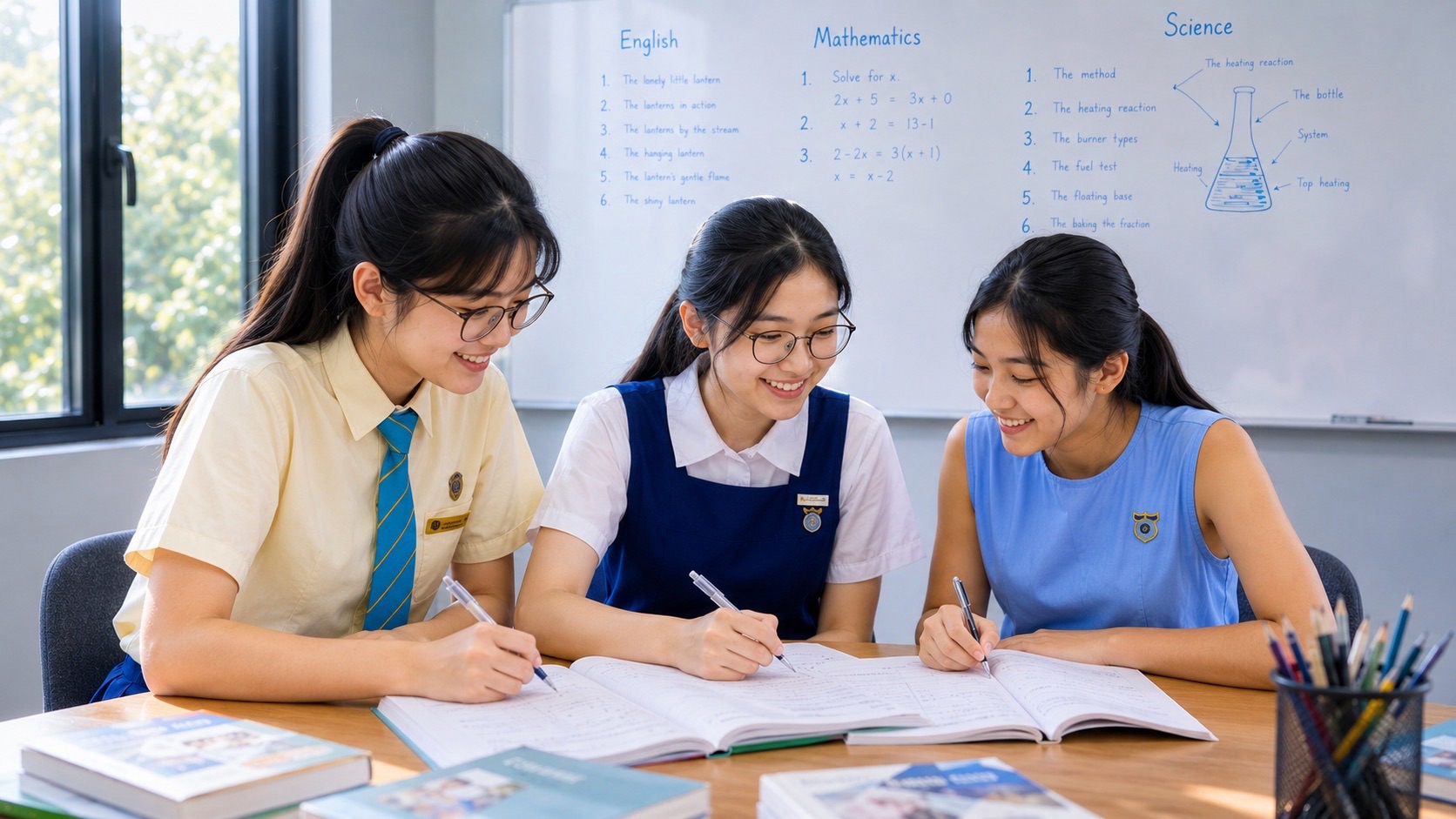
A strong Secondary Mathematics journey is not built by giving a student more worksheets.
It is built by seeing clearly what the student understands, where the reasoning begins to weaken, and what should be taught next.
At eduKateSG, our Secondary Mathematics Tuition for Buona Vista families is conducted in carefully limited 3-pax small groups near Sixth Avenue MRT. Students receive clear explanations, closely supervised practice, precise correction and a Mathematics programme adjusted to their school level and present readiness.
We support students across:
- Secondary 1 Mathematics;
- Secondary 2 Mathematics;
- Secondary 3 Mathematics;
- Secondary 4 Mathematics;
- G1, G2 and G3 Mathematics;
- Elementary Mathematics;
- Additional Mathematics;
- school weighted assessments;
- year-end examinations; and
- O-Level or Singapore-Cambridge Secondary Education Certificate preparation.
Each class is limited to three students.
Lessons are generally conducted for 1.5 hours weekly, with lesson materials, guided correction, focused continuation work and additional attention around important school assessment periods where arrangements permit. ose is not simply to help students finish the chapter.
It is to help them understand how Secondary Mathematics works.
A student should gradually become able to:
- read a question accurately;
- recognise the mathematical structure;
- choose an appropriate method;
- organise the working;
- control signs, brackets and notation;
- check whether an answer is reasonable;
- identify personal mistake patterns; and
- solve with increasing independence.
When these abilities become stable, Mathematics becomes calmer.
The student is no longer depending on memory alone.
The student is learning to think mathematically.
Secondary Mathematics Is a Four-Year Development
Secondary Mathematics does not remain the same subject from Secondary 1 to Secondary 4.
The expectations change each year.
Secondary 1 is the transition year
Secondary 1 students are moving from Primary-school arithmetic into a more symbolic mathematical environment.
They encounter:
- negative numbers;
- algebraic expressions;
- equations;
- inequalities;
- formal mathematical notation;
- coordinates;
- graphs;
- geometric reasoning; and
- longer chains of working.
The numbers may still look familiar, but the language has changed.
A student who performed reasonably well at PSLE may still feel uncertain when letters begin replacing known quantities and a single question requires several connected steps.
This does not automatically mean that the student has become weak.
The student may simply need the transition to be taught more deliberately.
Secondary 2 is the connection year
Secondary 2 Mathematics can appear manageable because students are no longer new to secondary school.
However, this is where individual topics begin connecting into a larger system.
Algebra affects graphs.
Ratio affects proportion.
Equations appear inside geometry.
Indices affect algebraic manipulation.
Coordinates and gradients prepare students for more advanced graph work.
A student may know each chapter separately but struggle when an examination question combines them.
Secondary 2 is therefore an important year for strengthening connections before upper-secondary Mathematics begins.
Secondary 3 is the expansion year
Secondary 3 introduces a considerable rise in mathematical density.
Students may begin working with:
- more demanding algebra;
- simultaneous equations;
- quadratic relationships;
- functions and graphs;
- trigonometry;
- coordinate geometry;
- statistical analysis;
- probability;
- vectors;
- mensuration; and
- Additional Mathematics, where applicable.
Students taking Additional Mathematics are also introduced to a subject that depends heavily on algebraic fluency.
A small weakness that survived Secondary 1 and Secondary 2 may suddenly become highly visible.
The Secondary 3 student is not only learning more topics.
The student is learning how different mathematical systems interact.
Secondary 4 is the execution year
By Secondary 4, Mathematics is no longer only about understanding individual chapters.
Students must retrieve several years of learning, recognise methods quickly and execute accurately under examination conditions.
They need to manage:
- mixed-topic papers;
- unfamiliar question wording;
- multi-stage problems;
- time pressure;
- calculator decisions;
- presentation of working;
- mark protection;
- checking procedures; and
- recovery when a difficult question interrupts momentum.
The Secondary 4 student may understand the Mathematics but still lose marks through execution.
At this level, tuition must strengthen both knowledge and paper performance.
The Visible Answer Is Not Always the Real Problem
When a student gets a question wrong, the final answer shows that something failed.
It does not show exactly what failed.
The student may have:
- misunderstood a keyword;
- copied a value incorrectly;
- lost a negative sign;
- expanded only part of a bracket;
- used the wrong formula;
- substituted into the formula incorrectly;
- confused an expression with an equation;
- read a graph scale wrongly;
- cancelled quantities that cannot be cancelled;
- rounded too early;
- omitted a unit;
- skipped a condition;
- chosen a familiar method for the wrong question; or
- understood the concept but organised the working poorly.
These errors may look similar on a marked paper because they all produce lost marks.
However, they require different corrections.
Telling every student to “be more careful” is not enough.
The tutor must see the exact line where the student’s reasoning changed direction.
That is one of the central purposes of a 3-pax Mathematics class.
Why Buona Vista Parents Choose 3-Pax Secondary Mathematics Tuition
Three students create a particular kind of learning environment.
There is enough class interaction for students to hear another approach, compare methods and learn from carefully selected questions.
At the same time, the class remains small enough for the tutor to inspect each student’s working.
This matters because a student can appear to understand during an explanation.
The true level of understanding becomes visible only when the student attempts the question independently.
In a larger class, a student may:
- copy the tutor’s example;
- wait for someone else to answer;
- remain quiet when confused;
- conceal incomplete working;
- avoid difficult questions;
- look occupied without progressing; or
- leave with the original misunderstanding intact.
In a three-student class, there is less room for confusion to remain invisible.
The tutor can ask:
- Why did you choose this method?
- What does this symbol represent?
- Which line caused the error?
- Can you explain the relationship?
- Is there another way to solve it?
- How can you check your answer?
- What changed between these two questions?
- Can you now complete a similar question alone?
The class is small by design.
It gives students personal attention without removing the useful momentum of learning with peers.
What the 3-pax structure allows
A carefully managed three-student class provides:
- frequent individual questioning;
- immediate feedback during practice;
- close inspection of working;
- pacing adjusted to student readiness;
- targeted repair for different weaknesses;
- more opportunities to explain answers;
- less opportunity to hide confusion;
- calm peer comparison;
- differentiated questions within the same lesson;
- closer preparation for upcoming school tests; and
- visible progress across several lesson cycles.
One student’s question may clarify an idea for the group.
One student’s mistake may become a useful correction for everyone.
One student’s strong method may show the others a cleaner route.
The group creates momentum, but the tutor remains able to see each learner.
Secondary Mathematics Under Full Subject-Based Banding
Under Full Subject-Based Banding, students can offer Mathematics at G1, G2 or G3 according to their subject level and readiness. Posting Groups are separate from the level at which an individual subject may be taken. ns a Secondary Mathematics tuition programme should not assume that every student of the same age is following an identical pathway.
We consider:
- the student’s current Mathematics subject level;
- the school’s sequence of topics;
- the student’s earlier foundations;
- the pace of school instruction;
- recent weighted-assessment results;
- the types of mistakes appearing in schoolwork;
- whether the student is taking Additional Mathematics;
- the student’s intended upper-secondary pathway; and
- how much independent practice can be managed well.
A student who understands G3 concepts but loses marks through weak accuracy needs a different response from a student who is still unstable with fractions, ratio or negative numbers.
Similarly, a student coping comfortably should not be given repetitive routine questions merely to fill lesson time.
That student may need deeper applications, unfamiliar structures, stronger explanation habits and more demanding mixed-topic practice.
From 2027, the Singapore-Cambridge Secondary Education Certificate will replace the traditional N- and O-Level examinations. Students will sit for subjects at the respective G1, G2 or G3 levels. Students graduating in 2026 remain under the existing examination arrangements. ls may change.
The need for clear foundations, accurate working and independent mathematical judgment remains.
What We Teach in Secondary Mathematics Tuition
Schools may teach topics in different sequences.
Our lessons coordinate with the student’s school programme while protecting the larger mathematical foundation.
Number fluency
Students may require stronger control over:
- positive and negative numbers;
- fractions and decimals;
- percentages;
- ratio and rate;
- factors and multiples;
- prime factorisation;
- standard form;
- approximation;
- estimation;
- indices; and
- order of operations.
These are not merely lower-secondary topics.
Number weakness can continue to cause errors inside algebra, trigonometry, statistics and Additional Mathematics.
A student who is unstable with negative fractions will not become secure simply because the question now contains letters.
Algebraic language
Students learn to handle:
- variables;
- constants;
- coefficients;
- terms;
- expressions;
- equations;
- inequalities;
- substitution;
- simplification;
- expansion;
- factorisation;
- algebraic fractions;
- formulae;
- simultaneous equations;
- quadratic relationships; and
- functions.
We teach algebra as a language.
Students should understand what the symbols mean, how the quantities relate and why an operation is mathematically valid.
Shortcuts are introduced only after the principle is secure.
Graphs and coordinates
Depending on level and syllabus, students may work with:
- the Cartesian plane;
- coordinates;
- linear graphs;
- gradients;
- intercepts;
- distance and midpoint;
- graphical solutions;
- quadratic graphs;
- exponential relationships;
- interpretation of graphs;
- drawing conclusions from data; and
- connecting equations to visual behaviour.
The objective is not merely to draw a graph.
The student must understand what the graph represents.
Geometry and mensuration
Students strengthen their understanding of:
- angle properties;
- parallel lines;
- triangles and quadrilaterals;
- polygons;
- congruence and similarity;
- circles;
- bearings;
- perimeter and area;
- surface area and volume;
- coordinate geometry;
- geometric notation; and
- diagram interpretation.
Diagrams should become reasoning tools.
Students learn to annotate information, identify hidden relationships and use known properties to construct a logical solution.
Trigonometry
Students may need support with:
- sine, cosine and tangent;
- choosing the correct ratio;
- angles of elevation and depression;
- bearings;
- three-dimensional applications;
- sine rule;
- cosine rule;
- area of a triangle;
- trigonometric graphs;
- identities and equations in Additional Mathematics; and
- checking whether answers are geometrically sensible.
Trigonometry often exposes weaknesses in diagrams, algebra and calculator control at the same time.
The tutor must determine which part is causing the difficulty.
Statistics and probability
Students learn to work with:
- tables and statistical diagrams;
- averages;
- cumulative frequency;
- box-and-whisker plots;
- standard deviation, where applicable;
- probability rules;
- combined events;
- tree diagrams;
- set notation;
- interpretation of data; and
- written conclusions.
Students should not only calculate a statistic.
They should understand what the result says about the data.
Additional Mathematics
For Secondary 3 and Secondary 4 students taking Additional Mathematics, lessons may include:
- advanced algebra;
- functions;
- quadratic equations and inequalities;
- logarithms and exponentials;
- coordinate geometry;
- trigonometric identities;
- trigonometric equations;
- differentiation;
- integration;
- gradients, tangents and normals;
- rates of change; and
- area under a curve.
The 2026 O-Level syllabus listing treats Mathematics and Additional Mathematics as separate examination subjects, reflecting their different content and demands. al Mathematics cannot be strengthened through formula memorisation alone.
Students need to recognise structures, manipulate algebra confidently and connect topics across the syllabus.
Our First-Principles Teaching Method
A strong Mathematics programme should do more than demonstrate a method and assign twenty similar questions.
Students need a structure that keeps knowledge usable after the lesson.
1. Find the exact weakness
We avoid broad descriptions such as:
- weak in Mathematics;
- careless;
- cannot do algebra;
- poor at word problems; or
- does not understand A-Math.
A student described as weak in algebra may actually be struggling with:
- negative-number control;
- multiplication fluency;
- fraction operations;
- symbolic reading;
- expansion;
- factorisation;
- equation balance;
- working-memory load;
- interpretation of written information;
- poor layout; or
- confidence under time pressure.
The correction depends on the cause.
We inspect schoolwork, ask diagnostic questions and observe how the student begins a problem.
The starting method often reveals more than the final answer.
2. Return to the first unstable point
When an earlier skill is affecting the current topic, we return to it.
This is not moving backwards.
It is restoring the floor beneath the student.
A Secondary 3 student struggling with algebraic fractions may need ordinary fraction operations repaired.
A Secondary 4 student struggling with trigonometric identities may need cleaner factorisation.
A student repeatedly failing coordinate-geometry questions may need stronger control of gradients and equations of straight lines.
Once the missing connection is repaired, the current topic often becomes easier.
3. Teach within a clear boundary
Students learn more securely when complexity is added deliberately.
For example, an equation may begin with:
- positive whole numbers;
- one operation;
- one unknown;
- no fractions; and
- a clean numerical answer.
Once that structure is stable, we may introduce:
- negative values;
- brackets;
- fractions;
- unknowns on both sides;
- algebraic denominators; and
- written applications.
Each new condition changes the problem in a visible way.
The student learns where a method works, why it works and what must change when the question changes.
4. Move from visible ideas to abstract notation
Where useful, a concept may progress through:
- a familiar situation;
- a number line, table or diagram;
- a visual relationship; and
- formal mathematical notation.
This is useful when students can imitate a procedure but cannot explain its meaning.
The aim is not to keep Mathematics permanently concrete.
It is to give the abstract notation a stable foundation.
5. Ask students to think aloud
Students are asked to explain:
- what the question is asking;
- which information is relevant;
- what relationship they can see;
- why a method is suitable;
- what each line of working achieves;
- where they became uncertain; and
- whether the final answer is reasonable.
Explanation reveals understanding.
It also reveals partial understanding.
A student may know the formula but misunderstand the quantities.
Another may understand the relationship but be unable to manipulate the algebra.
Thinking aloud allows the tutor to correct the real difficulty.
6. Move from guidance to independence
The lesson may begin with the tutor modelling a method.
The student then attempts a similar question with prompts.
The prompts are gradually reduced.
Finally, the student solves independently.
This progression matters because understanding an explanation is not the same as producing a solution alone.
The student must cross that distance during the lesson.
7. Retrieve and interleave
Topics are revisited after the original lesson.
Older and newer concepts are mixed so students must decide which method is appropriate.
This is different from completing an entire page where every question uses the same procedure.
In examinations, the chapter title is not supplied above the question.
The student must recognise the structure independently.
8. Correct and reattempt
Correction is not the final stage of embarrassment after a wrong answer.
It is part of the learning cycle.
The student should:
- identify the error;
- understand why it occurred;
- correct the method;
- complete the working properly;
- attempt a related question; and
- retrieve the correction again later.
A corrected question is not fully learned until the student can perform the method again without copying.
9. Build examination discipline early
Students develop habits such as:
- one logical step per line;
- correct use of equal signs;
- clean algebraic layout;
- labelled diagrams;
- proper units;
- accurate copying;
- controlled calculator use;
- estimation checks;
- sensible time allocation; and
- final-answer verification.
These habits should not be postponed until Secondary 4.
They are easier to build gradually than to repair under examination pressure.
What Happens During a 90-Minute Secondary Mathematics Lesson
Every lesson is adjusted to the students present.
However, a well-structured tutorial usually follows a stable rhythm.
Arrival and academic check-in
The tutor checks what is currently happening in school.
This may include:
- the present school chapter;
- upcoming weighted assessments;
- recently returned test papers;
- unfinished corrections;
- homework difficulties;
- topics the student could not follow; or
- important assessment dates.
This keeps tuition connected to the student’s real academic environment.
Warm-up retrieval
Students begin with a short set of earlier questions.
This allows the tutor to check whether previous learning remains available.
It may also reactivate a skill needed for the day’s topic.
A lesson on algebraic fractions may begin with ordinary fraction operations.
A lesson on differentiation may begin with indices and algebraic simplification.
A lesson on trigonometry may begin with angle properties and calculator control.
Concept instruction
The tutor introduces or revisits the central idea.
The explanation focuses on:
- meaning;
- structure;
- mathematical language;
- common misconceptions;
- conditions of use; and
- connections to earlier topics.
Students are expected to participate.
They may be asked to predict a step, explain a rule or compare two possible methods.
Guided practice
Students attempt selected questions with the tutor nearby.
This is where partial understanding becomes visible.
The tutor observes:
- how the student starts;
- which information is selected;
- whether the notation is controlled;
- where hesitation appears;
- whether the method remains valid; and
- how the student responds after making an error.
Prompts are given when needed, but they are not intended to replace thinking.
Differentiated practice
Three students do not necessarily need to complete every question at exactly the same pace.
One student may require a foundation question.
Another may be ready for a standard application.
A third may need an unfamiliar or multi-stage extension.
The class remains together around the same mathematical idea, while the degree of difficulty is adjusted.
Independent application
Students complete selected questions without step-by-step help.
This shows whether the method can be retrieved and executed independently.
A student who can follow the tutor but cannot begin alone has not yet achieved full control.
Mixed or timed practice
When appropriate, students work on mixed-topic questions or short timed sets.
Timing is introduced carefully.
Speed should not be built on unstable understanding.
The initial objective is clean execution.
Efficiency develops afterwards.
Error review
Mistakes are classified.
The student learns whether the error came from:
- concept;
- reading;
- recall;
- algebra;
- arithmetic;
- notation;
- calculator use;
- presentation;
- rushing; or
- choosing the wrong method.
Once the type of error is known, the correction becomes more precise.
Focused continuation work
Home practice is purposeful.
The intention is not to create an indiscriminate pile of worksheets.
Continuation work may be used to:
- stabilise the day’s concept;
- revisit an earlier weakness;
- prepare for the next school lesson;
- complete a correction cycle; or
- practise a small group of examination skills.
A shorter, carefully selected assignment is often more useful than a large quantity of unfocused work.
The Three Secondary Mathematics Pathways
Students do not all enter tuition for the same reason.
The repair pathway
This student may already be struggling.
Signs may include:
- repeated low test scores;
- difficulty beginning homework;
- weak fractions or negative numbers;
- confusion with algebra;
- dependence on answer keys;
- incomplete working;
- avoidance of difficult questions;
- falling behind the school sequence; or
- loss of confidence.
The immediate priority is to stop further drift.
We locate the earliest unstable skill, rebuild it and reconnect it to the current school topic.
The student does not necessarily need the entire earlier syllabus repeated.
The student needs the correct bridge repaired.
The stabilisation pathway
This student is passing, but the results are inconsistent.
One test may be comfortable.
The next may produce an unexpected drop.
The student may understand during lessons but:
- forget methods later;
- lose marks through signs and copying;
- struggle when topics are mixed;
- rush under pressure;
- misread questions; or
- leave difficult questions unfinished.
The priority is to make performance more dependable.
This usually requires stronger retrieval, cleaner execution, better checking and more deliberate error correction.
The extension pathway
This student is coping well and requires greater depth.
The work may include:
- unfamiliar applications;
- multi-stage questions;
- alternative solution methods;
- deeper algebraic manipulation;
- stronger explanation;
- more demanding mixed-topic sets;
- early exposure to future concepts; and
- distinction-level mark protection.
The priority is not to rush through the syllabus for appearance.
It is to deepen control.
A strong student should become more flexible, not merely faster.
Why Algebra Receives Special Attention
Algebra is not simply one chapter in Secondary 1.
It gradually becomes the operating language of Secondary Mathematics.
It appears in:
- equations;
- inequalities;
- ratio;
- percentage;
- coordinates;
- graphs;
- geometry;
- formulae;
- trigonometry;
- statistics;
- probability;
- Physics;
- Chemistry;
- Additional Mathematics; and
- later post-secondary Mathematics.
A student who avoids algebra in Secondary 1 may continue meeting the same weakness in increasingly complex forms.
By Secondary 3, the student may describe the problem as trigonometry, graphs or A-Math.
The actual difficulty may still be algebra.
This is why we pay close attention to:
- signs;
- brackets;
- like terms;
- expansion;
- factorisation;
- substitution;
- rearrangement;
- equation balance;
- indices; and
- algebraic fractions.
We want students to see letters not as obstacles, but as useful representations of quantities and relationships.
How We Reduce “Careless Mistakes”
“Careless” is often too broad a diagnosis.
Different mistakes need different corrections.
Reading mistakes
The student may miss words such as:
- difference;
- increase;
- remaining;
- at least;
- maximum;
- consecutive;
- total;
- exact;
- estimate; or
- not drawn to scale.
Correction may involve annotation, deliberate reading and restating the task before calculating.
Sign mistakes
The student may lose control when negative numbers, subtraction and brackets appear together.
Correction requires concept repair and slower symbolic handling before speed is restored.
Arithmetic mistakes
The method may be correct, but the calculation is wrong.
Correction may involve estimation, reverse checking, calculator discipline or more stable number fluency.
Copying mistakes
A value, exponent, sign or symbol may change between lines.
Correction requires cleaner layout and a deliberate line-by-line scan.
Method mistakes
The student may apply a familiar method to the wrong question.
Correction requires stronger recognition of mathematical structure.
Presentation mistakes
The answer may be mathematically reasonable, but important working is missing or unclear.
Correction involves learning what must be shown and how to organise the solution so that each step remains visible.
Time-pressure mistakes
The student may rush through early questions, become trapped on one difficult section or leave insufficient checking time.
Correction may include timed micro-sets, question selection and a more controlled paper strategy.
We look for error patterns rather than treating every wrong answer as an isolated event.
Once the pattern becomes visible, it can be trained.
Teaching Ahead Without Rushing
Where appropriate, we introduce topics before they appear in school.
The purpose is not to race through the syllabus.
It is to give students a calm first encounter.
When the topic later appears in school:
- the language is familiar;
- the notation is less intimidating;
- the student can follow the teacher more easily;
- school practice becomes consolidation;
- questions can be asked more intelligently; and
- confidence begins from recognition rather than surprise.
Teaching ahead must remain conditional.
We do not place new material on top of an unstable foundation merely to claim faster coverage.
Sometimes the correct next step is forward.
Sometimes it is sideways, to strengthen a connected skill.
Sometimes it is backwards, to repair the first unstable point.
Good pacing is not always fast.
It is accurate.
How Students Learn from One Another in a Small Group
Small-group tuition should not become three separate one-to-one lessons happening at the same table.
The group itself should add value.
Students may be invited to:
- compare two solution methods;
- explain why a method works;
- identify an error in a sample solution;
- check one another’s reasoning;
- defend a chosen approach;
- estimate an answer before calculation;
- predict how a changed condition affects the question; or
- discuss which method is more efficient.
This creates useful mathematical conversation.
Students learn that there may be several valid routes, but some routes are clearer, safer or more efficient.
They also learn that making a mistake is not unusual.
What matters is whether the mistake is inspected and corrected.
The classroom remains calm.
There is no need for large-class noise or performative competition.
The energy comes from visible thinking and steady improvement.
What Progress Should Look Like
Progress is not limited to a single test score.
Parents may first notice that the student:
- begins homework with less resistance;
- asks more precise questions;
- writes clearer steps;
- handles signs and brackets more carefully;
- checks units and final answers;
- identifies personal mistakes;
- explains methods with greater confidence;
- completes routine questions more efficiently;
- remains calmer when a question looks unfamiliar;
- depends less on answer keys;
- recovers more effectively after getting stuck; and
- produces more stable school results.
Marks usually improve when several parts begin working together:
- understanding;
- recall;
- accuracy;
- method selection;
- presentation;
- timing; and
- checking.
Responsible tuition should not promise an instant grade after one or two lessons.
The speed of improvement depends on:
- the size of the existing gap;
- lesson attendance;
- school demands;
- practice between lessons;
- the student’s willingness to correct old habits;
- the difficulty of the current topics; and
- the time available before an assessment.
Our role is to make the improvement process visible, structured and teachable.
When Should a Buona Vista Student Begin Secondary Mathematics Tuition?
Support may be useful when a student:
- cannot explain how an answer was obtained;
- understands examples but cannot start independently;
- frequently loses negative signs;
- depends heavily on model solutions;
- is falling behind the school topic sequence;
- avoids showing working;
- struggles when topics are mixed;
- performs well during practice but poorly in tests;
- takes too long to complete routine questions;
- has unstable algebra;
- is beginning Additional Mathematics without strong foundations;
- experiences a sudden drop after moving to upper secondary;
- is preparing for a major examination;
- wants more structured extension; or
- needs a stronger foundation for the next school year.
Parents do not need to wait for a serious failure.
Early support is often quieter and more efficient because fewer layers of misunderstanding need to be dismantled.
At the same time, tuition is not automatically necessary for every student.
A student who understands school lessons, completes work independently, corrects mistakes responsibly and progresses confidently may not require additional support.
Tuition becomes useful when it solves a real problem or creates a meaningful next step.
Convenient Access from Buona Vista to Sixth Avenue
eduKateSG’s Bukit Timah location is at 8 Fourth Avenue, near Sixth Avenue MRT.
For Buona Vista families travelling by train, Buona Vista is on the Circle Line. Students can travel towards Botanic Gardens, transfer to the Downtown Line and continue to Sixth Avenue MRT. Singapore’s rail network connects the Circle Line and Downtown Line through interchange stations including Botanic Gardens. students, travelling a short distance away from the immediate school or home environment creates a useful separation.
The journey marks a change of mode.
The student enters a quieter setting, completes a defined piece of academic work and returns home with clearer direction.
Location: eduKateSG, 8 Fourth Avenue, Singapore 268674
Nearest MRT: Sixth Avenue MRT, Downtown Line
Class arrangement: By appointment
Class size: Maximum three students
Secondary Mathematics Class Details
Format
3-pax small-group Mathematics tutorials.
Levels
- Secondary 1 Mathematics
- Secondary 2 Mathematics
- Secondary 3 Mathematics
- Secondary 4 Mathematics
Subject support
- G1 Mathematics
- G2 Mathematics
- G3 Mathematics
- Elementary Mathematics
- Additional Mathematics
Support is adjusted according to the student’s school programme, present subject level and readiness.
Duration
1.5 hours weekly.
Teaching approach
Lessons may include:
- first-principles explanation;
- foundation repair;
- guided and independent practice;
- retrieval practice;
- interleaving;
- error analysis;
- school-assessment alignment;
- exam preparation;
- timed micro-practice; and
- carefully paced pre-teaching.
Materials
Materials may include:
- curated lesson notes;
- topical practice;
- mixed revision;
- school-style questions;
- examination-style questions;
- micro-tests;
- correction sets; and
- focused continuation work.
Additional preparation around important school assessments may be arranged where class schedules permit.
The usual first step is a parent–student consultation.
Limited trial arrangements may occasionally be possible only when the existing three-student class configuration allows.
What Parents Can Bring to the Consultation
Useful materials include:
- recent school examination papers;
- weighted-assessment papers;
- marked assignments;
- topical worksheets;
- the school’s current chapter schedule;
- the student’s textbook;
- teacher comments;
- examples of unfinished questions; and
- questions the student finds particularly difficult.
We do not look only at the final score.
We look for patterns.
A paper showing 60% may represent a major conceptual gap.
It may also represent a capable student losing marks through weak accuracy, incomplete working or poor time control.
Those students require different plans.
The consultation helps us determine whether the student currently needs repair, stabilisation or extension.
Frequently Asked Questions
Is Secondary Mathematics tuition mainly about completing school homework?
No.
School homework may reveal current difficulties, but tuition should not become a homework-completion service.
The deeper purpose is to strengthen concepts, methods, working habits, retrieval and independent problem-solving.
Does every student follow the same worksheet programme?
No.
Students may be studying the same broad topic, but the questions and amount of support can differ according to readiness.
One student may need foundation repair.
Another may require standard application practice.
A third may be ready for extension.
My child did well for PSLE Mathematics. Is Secondary Mathematics tuition still necessary?
Not automatically.
A student who is adapting confidently, completing work independently and progressing well may not require tuition.
Support becomes useful when the move into algebra reveals a gap, school pace becomes difficult or structured extension would provide clear value.
My child is already failing. Will you restart from Primary Mathematics?
We revisit only the foundations that are affecting current Secondary work.
For example, fractions may be reviewed because they are causing algebraic errors.
The aim is not to repeat the entire Primary syllabus.
It is to repair the specific bridge that is no longer supporting the student.
Do you follow the school’s topic order?
We consider the school’s sequence and upcoming assessments.
However, an earlier skill may need to be repaired before the current chapter can become stable.
Tuition should remain connected to school without becoming trapped by the order of the textbook.
Do you teach ahead of school?
Yes, when the student’s foundation is ready.
Pre-teaching gives the student a calm first encounter with the topic.
We do not rush ahead when earlier concepts remain insecure.
How do you help students who make careless mistakes?
We separate mistakes into categories such as reading, concept, algebra, arithmetic, signs, copying, calculator use, presentation and time management.
The correction is matched to the actual pattern.
How does the class handle students from different schools?
Schools may teach chapters in different sequences.
The tutor coordinates common mathematical foundations while adjusting selected practice and assessment preparation for each student.
A suitable 3-pax placement is important.
Will lower-secondary tuition prepare my child for Additional Mathematics?
Lower-secondary students do not need premature A-Math drilling.
They need a strong runway:
- algebra fluency;
- numerical accuracy;
- symbolic confidence;
- clear working;
- graph understanding; and
- the ability to learn unfamiliar structures.
These foundations later support both Mathematics and Additional Mathematics.
My child is already strong. Will the class be too easy?
A strong student should not be held at routine practice indefinitely.
Extension may include unfamiliar applications, deeper connections, multiple methods, higher-level algebra, mixed-topic questions and distinction-level mark protection.
Placement and class compatibility remain important.
How quickly should improvement appear?
Some students show better confidence, organisation and working habits within several lesson cycles.
Larger conceptual gaps require more time.
Progress depends on the starting point, attendance, practice, current school demands and proximity of assessments.
Can students join during the school term?
Yes, subject to a suitable class placement.
The student’s level, school sequence, present results and support needs should first be considered.
Why choose three students rather than a larger class?
A larger class may be sufficient for a student who only requires general revision.
A 3-pax tutorial is more suitable when the student needs close inspection of working, frequent questioning, individual pacing, targeted correction or carefully differentiated extension.
Helpful Reading for Buona Vista Parents
Parents may continue with these eduKateSG guides:
- Understanding the Four-Year Journey of Secondary Mathematics
- How eduKateSG Secondary Mathematics Tutorials Work
- Algebra Is the Gatekeeper
- What Happens in Secondary 1 Mathematics Tuition?
- What Happens in Secondary 2 Mathematics Tuition?
- What Happens in Secondary 4 Mathematics Tuition?
- How eduKateSG Additional Mathematics Tutorials Work
- The eduKate Mathematics Learning System
- MOE Secondary School Curriculum and Syllabuses
- SEAB Secondary Examination Syllabuses
Secondary Mathematics Tuition for Buona Vista Families
Secondary Mathematics is a gradual change in how students think.
Numbers become relationships.
Unknown quantities become algebra.
Diagrams become reasoning tools.
Chapters begin connecting.
Working becomes part of the answer.
By upper secondary, understanding must also become accurate examination execution.
A carefully taught student does more than remember steps.
The student begins to recognise why the steps belong together.
At eduKateSG, our 3-pax Secondary Mathematics tuition provides the space, attention and structure needed to develop that control.
For students who are behind, we rebuild.
For students who are passing inconsistently, we stabilise.
For students who are ready for more, we extend.
We teach students to catch up, keep up and move ahead without turning Mathematics into unnecessary noise.
The objective is not dependence on tuition.
It is a student who can:
- think more clearly;
- begin questions independently;
- organise working properly;
- correct mistakes intelligently;
- manage assessments calmly; and
- enter the next stage with a stronger mathematical foundation.
Arrange a Parent–Student Consultation
Speak with eduKateSG about your child’s:
- current secondary level;
- Mathematics subject level;
- school results;
- learning gaps;
- upcoming assessments;
- Elementary Mathematics needs;
- Additional Mathematics needs; and
- intended academic direction.
eduKateSG
8 Fourth Avenue
Singapore 268674
Near Sixth Avenue MRT
3-pax small-group tuition
By appointment
Properly taught kids shine a bright light into the future.