
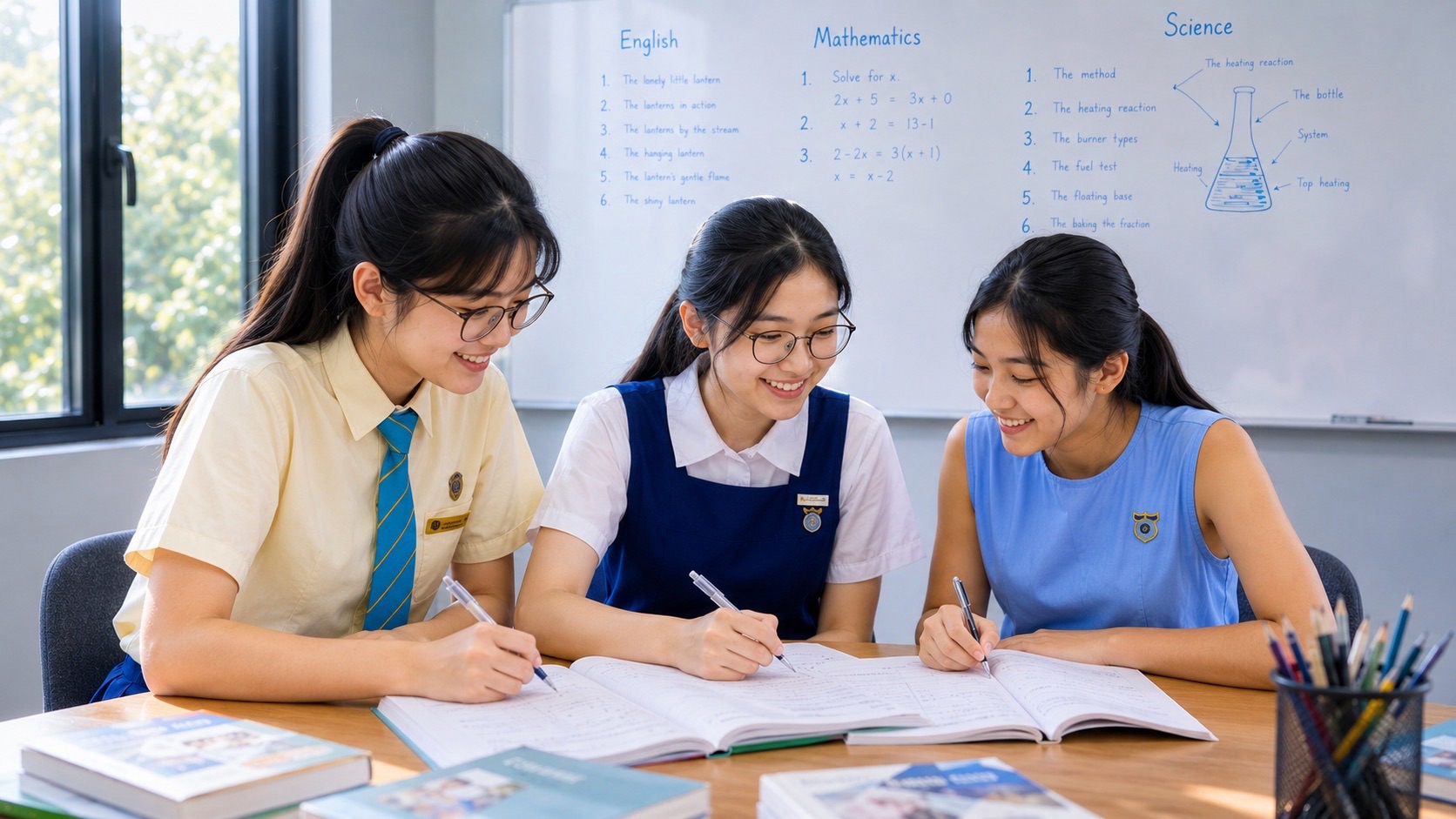
Secondary Mathematics tuition for Dover students in carefully managed 3-pax small groups.
At eduKateSG, each 1.5-hour lesson combines clear teaching, guided practice, individual correction and purposeful preparation for school assessments. Students may attend from Secondary 1 to Secondary 4, with support adjusted for their school programme, subject level, present foundation and examination pathway.
The purpose is not simply to give students more Mathematics questions.
It is to help each student understand what the questions are asking, select an appropriate method, organise the working and complete the solution with greater accuracy.
A Secondary Mathematics lesson should help the student become more capable after leaving the classroom.
That means knowing more.
It also means thinking more clearly.
Our small-group Mathematics tutorials are suitable for Dover students who need to:
- repair earlier gaps;
- keep pace with school;
- become more confident with algebra;
- reduce repeated careless mistakes;
- improve the presentation of mathematical working;
- prepare for weighted assessments and examinations;
- learn selected topics ahead of school;
- manage upper-secondary E-Math or A-Math more confidently; or
- move from competent performance towards distinction-level control.
Class size is limited to three students.
Lessons are usually conducted weekly for 1.5 hours, with teaching materials, guided corrections, selected continuation work and preparation around important school assessments. eduKateSG’s published programme describes this as a closely observed system of diagnosis, instruction, practice and correction rather than a generic worksheet class.
Secondary Mathematics Is a Four-Year Build
Secondary Mathematics does not develop as four unrelated school years.
It is one connected build.
Secondary 1 introduces a new mathematical language.
Secondary 2 strengthens the bridge into upper-secondary work.
Secondary 3 increases the level of abstraction, pace and subject demand.
Secondary 4 requires the student to execute the complete system under assessment conditions.
A Secondary 4 problem may therefore have begun much earlier.
The student who struggles with trigonometry may have weak algebra.
The student who cannot understand functions may have been uncertain about graphs since lower secondary.
The student who repeatedly loses marks in A-Math calculus may not be struggling only with calculus. The underlying difficulty may involve factorisation, indices, logarithms, equations or the interpretation of mathematical notation.
This is why our tutor does not look only at the chapter being taught this week.
We also ask:
- What earlier knowledge is this chapter depending on?
- Can the student read the notation correctly?
- Can the student begin without being shown the first step?
- Does the student understand the method or merely recognise the example?
- Can the student explain why the method works?
- Is the student’s working clear enough to inspect?
- Are the same errors appearing repeatedly?
- Can the student retrieve older methods when several topics are mixed?
- Can the student perform when the question looks unfamiliar?
Good tuition helps the student with the immediate school topic.
Better tuition also strengthens the mathematical system supporting that topic.
What Happens in Secondary Small Groups Tuition?
A well-run small-group Mathematics tutorial is active.
The student is not expected to sit quietly while the tutor completes an entire worksheet on the whiteboard.
The student must read.
Attempt.
Explain.
Write.
Check.
Correct.
Try again.
The tutor moves continuously between the three students, observing how each one approaches a question.
This matters because a wrong final answer does not tell us enough.
Two students may both obtain the same wrong answer for completely different reasons.
One may have misunderstood the concept.
Another may understand the concept but copy a negative sign incorrectly.
A third may know the method but use the wrong value from the diagram.
The correction must match the cause.
In a 3-pax lesson, the tutor has sufficient proximity to see the reasoning before the final answer appears.
That is where much of the real teaching happens.
A Typical 90-Minute Secondary Mathematics Lesson
Every class is adjusted according to the students, their current school topics and upcoming assessments.
However, a well-structured lesson usually follows a recognisable rhythm.
1. Arrival and mathematical reset
Students arrive from different school days.
One may have completed a Mathematics lesson that morning.
Another may have had a CCA session.
Another may be carrying uncertainty from a recent test.
The first few minutes help students settle into the mathematical environment.
Materials are prepared.
School updates are noted.
Urgent questions are identified.
The tutor may ask:
- What did your school teach this week?
- Which question caused difficulty?
- Is there an upcoming weighted assessment?
- Did the previous method remain clear during homework?
- Was there a repeated mistake in the latest school paper?
This keeps tuition connected to the student’s actual school experience.
It also prevents a small difficulty from being left unattended until it becomes a larger problem.
2. Retrieval from earlier learning
Students begin with a short retrieval activity.
The questions may come from the previous lesson or an older topic.
For example:
- simplifying algebraic expressions;
- solving a short equation;
- recalling an angle property;
- applying an index law;
- interpreting a graph;
- completing a percentage calculation; or
- identifying the correct trigonometric ratio.
This is not intended to create pressure.
It allows the tutor to see what remained available after the earlier lesson.
A student may understand a method when it is first explained but be unable to retrieve it one week later.
That difference matters.
Understanding during the lesson is the beginning.
Usable recall is the objective.
3. Inspection of the student’s starting point
Before giving a full explanation, the tutor may ask the student to attempt a carefully selected question.
We observe:
- whether the student understands the vocabulary;
- whether the student identifies the correct topic;
- whether the first line is mathematically valid;
- whether symbols are copied accurately;
- whether the student can explain the planned route;
- whether an earlier prerequisite is missing; and
- whether the student becomes uncertain only when the question changes form.
This gives the tutor a more precise starting point.
We avoid broad descriptions such as “weak in Mathematics” whenever possible.
A student is rarely weak in everything.
The real difficulty may be narrower:
- negative numbers;
- fraction operations;
- algebraic manipulation;
- equation balance;
- graph interpretation;
- formula selection;
- geometric reasoning;
- question reading;
- working presentation;
- recall;
- examination pacing; or
- confidence when facing unfamiliar questions.
Once the difficulty becomes specific, the teaching can become specific.
4. Concept instruction
The tutor introduces or rebuilds the central mathematical idea.
The explanation begins with meaning.
What does the notation represent?
What relationship is being described?
Why is this operation permitted?
What remains unchanged?
What condition must be satisfied?
Which earlier idea is being extended?
Students are encouraged to understand the structure before being asked to complete the method quickly.
For example, when solving:
[
3x + 5 = 20
]
a student should not depend only on the phrase “move 5 to the other side.”
The student should understand that an equation expresses balance.
Subtracting 5 from both sides preserves that balance:
[
3x + 5 – 5 = 20 – 5
]
Therefore:
[
3x = 15
]
and:
[
x = 5
]
This principle continues to work when equations later include fractions, brackets, unknowns on both sides or more complicated algebra.
A shortcut may help with one familiar question.
A principle remains useful when the question changes.
5. Guided practice
Students attempt selected questions while the tutor remains close.
Support may include:
- a question that directs attention;
- a diagram;
- a reminder of an earlier principle;
- a partial first step;
- a comparison with a familiar question;
- a request to explain the intended method; or
- a prompt to check whether the result is reasonable.
The tutor does not immediately complete the question for the student.
The purpose is to give enough support for the student to continue thinking.
As control improves, prompts are gradually reduced.
The tutor may first ask:
“What relationship do you see?”
Later:
“What should you do next?”
Eventually:
“Complete this independently.”
This movement from supported work to independent work is essential.
A student who can follow an explanation is not necessarily ready to solve alone.
6. Individual work inside the small group
Although three students share the class, they do not always complete identical work at identical speed.
One student may need an additional foundation question.
Another may be ready for a variation.
A third may require correction of a school paper before returning to the class topic.
The small-group format allows the tutor to preserve a shared lesson direction while making careful adjustments.
For example, all three students may be studying quadratic equations.
However:
- one student may practise factorising simple quadratics;
- one may compare factorisation with the quadratic formula;
- one may attempt a word problem requiring the formation of a quadratic equation.
The topic remains connected.
The level of support changes.
This is different from simply placing three students at one table and giving everyone the same worksheet.
7. Independent application
After guided practice, the student completes selected questions with minimal assistance.
This reveals whether the concept is genuinely usable.
The tutor observes:
- whether the student can start;
- whether the method remains organised;
- whether notation is controlled;
- whether the student can recover after becoming stuck;
- whether the student checks the answer; and
- whether the method transfers to a less familiar question.
This is often where hidden weaknesses appear.
A student may look confident while watching an explanation.
The same student may hesitate when required to choose the first step independently.
That hesitation is useful information.
It shows the tutor what must be strengthened next.
8. Mixed or interleaved practice
School chapter exercises often tell students what type of question they are attempting.
An examination paper does not always provide that comfort.
The student must recognise the route.
For this reason, earlier and newer topics are gradually mixed.
A short practice set may include:
- an algebra question;
- a graph;
- a geometry problem;
- a percentage application; and
- a statistical interpretation question.
The student must decide which knowledge applies.
This develops route recognition.
A student should eventually be able to see:
- that a word problem requires an equation;
- that a graph provides a relationship;
- that a diagram contains a trigonometric structure;
- that an expression should be factorised before it is simplified;
- that a probability question requires careful counting;
- or that a calculus question is asking about gradient, rate of change or area.
This ability is trained through comparison, variation and correction.
It is not created by completing one hundred identical questions in succession.
9. Error review
Mistakes are reviewed before the lesson ends.
The student is not merely shown the correct answer.
The tutor helps classify the mistake.
Was it caused by:
- an incorrect concept;
- weak recall;
- a reading error;
- an arithmetic error;
- a sign error;
- inaccurate copying;
- incorrect formula selection;
- insufficient working;
- a poor diagram;
- weak time control;
- or rushing?
The student then corrects the question.
Where useful, a similar question is attempted immediately to check whether the correction has taken hold.
The purpose is not to avoid all mistakes during learning.
It is to prevent the same mistake from becoming permanent.
10. Focused continuation work
Home practice is selected to continue the lesson.
It is not intended to create an indiscriminate pile of worksheets.
Continuation work may include:
- a short set reinforcing the new concept;
- correction of unfinished questions;
- mixed retrieval;
- selected school-paper questions;
- a small timed exercise;
- formula or theorem recall; or
- preparation for the next school topic.
The amount depends on the student’s level, existing school workload and readiness for independent practice.
The quality of practice matters more than the thickness of the worksheet.
Why Three Students?
Three students create a particular kind of classroom.
There is enough social energy for discussion, comparison and shared momentum.
There is also enough space for the tutor to inspect each student closely.
In a larger class, a student may appear to be following.
The student can copy the board.
Nod at an explanation.
Wait for the answer.
Avoid asking questions.
Complete familiar steps without understanding why they work.
In a group of three, it is more difficult for confusion to remain invisible.
The tutor can ask each student to:
- explain the first step;
- justify the method;
- identify an error;
- compare two solutions;
- complete a question independently;
- check another student’s reasoning; or
- describe what changed between two question types.
The class remains calm.
However, it is not passive.
The practical advantages of 3-pax Secondary Mathematics tuition
- More frequent tutor interaction
- Faster identification of misconceptions
- Close inspection of working
- Questions adjusted to the student
- Less opportunity to hide behind silence
- Immediate correction during practice
- More compatible lesson pacing
- Easier preparation for school assessments
- Calm peer learning
- Greater accountability
- More time for explanation
- Clearer progress observation
The class is small by design.
It preserves the useful energy of learning with others without losing the individual student inside the group.
What the Tutor Is Watching
Parents naturally look at marks.
The tutor must look earlier.
Before a mark is lost, a chain of decisions has already taken place.
The student must:
- read the question;
- identify the relevant information;
- recognise the mathematical structure;
- choose a method;
- carry out the method;
- organise the working;
- calculate accurately;
- present the answer appropriately; and
- check the result.
A breakdown at any point can produce the wrong answer.
During a 3-pax tutorial, the tutor watches the complete chain.
Can the student begin?
Some students understand solutions after seeing them but cannot generate a starting point.
This may indicate weak route recognition.
Can the student explain?
A student may complete a familiar procedure but be unable to explain why it works.
This may indicate memorisation without stable understanding.
Is the working inspectable?
Crowded, incomplete or disorganised working makes errors difficult to locate.
It can also cause new errors.
Does the student recognise variation?
A student may solve the exact question practised in class but struggle when the numbers, wording or diagram change.
This indicates that the method has not yet become flexible.
Does the student check?
Some students treat checking as something done only when extra time remains.
We teach checking as part of the method.
Does the student recover?
Strong students do not always know the answer immediately.
However, they can often return to known information, test an idea and regain direction.
Recovery is an important mathematical skill.
The Three Main Student Pathways
Not every Dover student enters tuition for the same reason.
A useful small-group programme must recognise different starting points.
The Repair Pathway
The repair pathway is for a student who is losing control.
The student may:
- be failing or close to failing;
- avoid Mathematics homework;
- depend heavily on answer keys;
- struggle to begin questions;
- have weak lower-secondary foundations;
- feel that school is moving too quickly;
- copy methods without understanding them; or
- believe that Mathematics is something they simply cannot do.
The immediate priority is stability.
We locate the earliest weakness affecting present work.
Then we rebuild from there.
A Secondary 3 student struggling with algebraic fractions may need to revisit ordinary fractions.
A Secondary 4 student struggling with trigonometric equations may need to repair algebraic manipulation.
A student struggling with graph questions may need clearer understanding of coordinates, scale or substitution.
Returning to an earlier skill is not moving backwards.
It is restoring the floor beneath the current topic.
The first objective is to help the student feel:
“I can begin.”
Then:
“I can follow.”
Then:
“I can complete this.”
Confidence becomes more useful when it is attached to genuine control.
The Stabilisation Pathway
The stabilisation pathway is for a student who can cope but cannot perform consistently.
The student may:
- pass one test and struggle in the next;
- understand during class but forget later;
- perform well in topical work but poorly in mixed papers;
- make repeated sign or copying errors;
- rush through easy questions;
- struggle with unfamiliar variations;
- know the method but present it poorly; or
- lose confidence under timed conditions.
The foundation may already exist.
However, the system is unreliable.
The priority is consistency.
We therefore work on:
- retrieval;
- variation;
- working discipline;
- error patterns;
- mixed practice;
- question recognition;
- checking routines; and
- controlled timing.
This is where many capable students make substantial progress.
They do not always need more content.
They need their existing knowledge to become more dependable.
The Extension Pathway
The extension pathway is for students who are already coping well.
These students may need:
- less routine applications;
- unfamiliar question structures;
- stronger mathematical explanation;
- multiple-solution methods;
- faster but controlled execution;
- deeper connections between topics;
- more demanding algebra;
- distinction-level precision; or
- preparation for future upper-secondary Mathematics.
Extension is not simply rushing into the next chapter.
It is deepening the student’s control.
A student aiming for high marks must learn to protect simple marks while remaining composed when facing difficult questions.
At this level, small leaks matter.
One missing condition.
One sign error.
One misread scale.
One incomplete final answer.
One poor decision about time.
Distinction training helps the student reduce these leaks.
Secondary 1: Learning the New Language
Secondary 1 Mathematics is not simply Primary Mathematics with more difficult numbers.
It introduces a more symbolic environment.
Students begin working more formally with:
- negative numbers;
- algebraic expressions;
- equations;
- inequalities;
- mathematical notation;
- geometric properties;
- coordinates;
- graphs;
- data; and
- multi-step reasoning.
A student who performed well in Primary 6 may still require time to adjust.
The student may be trying to use Primary-school strategies inside a Secondary-school problem.
Our Secondary 1 tuition therefore focuses on transition.
Students learn that:
- letters can represent quantities;
- an equation expresses balance;
- working communicates reasoning;
- diagrams contain information;
- mathematical language must be read carefully; and
- methods should remain valid when the question changes.
The aim is to build a stable runway into Secondary 2.
Secondary 2: Strengthening the Bridge
Secondary 2 is often underestimated.
Major national examinations may still appear distant.
However, the mathematical bridge into upper secondary is being built.
By the end of Secondary 2, students should be developing stronger control over:
- algebra;
- equations;
- graphs;
- geometry;
- ratio and proportion;
- percentages;
- mensuration;
- statistics;
- problem interpretation; and
- the presentation of working.
This is also an important period for subject-level readiness and future Mathematics pathways.
A student may still be passing while carrying fragile algebra, uncertain graph knowledge or repeated careless errors.
These weaknesses become more expensive in Secondary 3.
Secondary 2 tuition therefore focuses on consolidation and readiness.
We want the student to enter upper secondary with a working system, not simply a collection of recently memorised chapters.
Secondary 3: Managing the Upper-Secondary Jump
Secondary 3 changes the pace.
Mathematics becomes more abstract.
The questions become longer.
Topics connect more frequently.
Students must manage increasing school commitments while adapting to upper-secondary expectations.
For students taking Additional Mathematics, a second mathematical subject enters the timetable.
E-Math and A-Math support one another, but they are not identical.
E-Math develops broad fluency across algebra, geometry, graphs, statistics, probability, mensuration and applications.
A-Math places heavier demands on algebraic manipulation and may involve functions, logarithms, trigonometry and introductory calculus, depending on the school sequence and syllabus.
The Secondary 3 student must therefore develop:
- stronger algebraic control;
- better route recognition;
- clearer working;
- greater independence;
- more stable recall;
- better management of unfamiliar questions; and
- an understanding of how current topics support Secondary 4 work.
Secondary 3 tuition should not be entirely reactive.
It must repair present weaknesses while building forward.
Secondary 4: Examination Execution
Secondary 4 is the execution year.
By this stage, knowing individual chapters is not enough.
The student must be able to:
- recognise what a mixed question requires;
- select an efficient method;
- maintain accuracy through longer working;
- protect straightforward marks;
- manage difficult questions without losing composure;
- allocate time sensibly;
- check strategically; and
- complete the paper within the required conditions.
A student may know a large portion of the syllabus and still underperform.
The difficulty may involve execution rather than content.
For example:
- too much time is spent on an early difficult question;
- easy marks are lost through rushed arithmetic;
- incomplete working prevents method marks;
- unfamiliar wording causes panic;
- the student does not return to skipped questions;
- checking is unstructured;
- or one error affects several later lines.
Secondary 4 tuition therefore changes emphasis as examinations approach.
Lessons may increasingly include:
- mixed-topic revision;
- targeted weak-topic repair;
- timed micro-sets;
- paper sections;
- complete papers;
- error-led revision;
- method selection;
- answer presentation;
- checking routines; and
- examination strategy.
The goal is not simply to complete more papers.
The goal is to become better at completing papers.
Mathematics Under Full Subject-Based Banding
Under Full Subject-Based Banding, Mathematics can be offered at G1, G2 or G3 subject levels, according to the student’s learning needs and school arrangements. MOE explains that English Language, Mother Tongue Languages, Mathematics, Science and Humanities subjects are offered at G1, G2 and G3.
This means Secondary Mathematics tuition should not be built around one generic programme for every student.
We consider:
- the student’s current subject level;
- the school’s topic sequence;
- the student’s earlier foundation;
- the speed at which topics are being introduced;
- upcoming school assessments;
- current performance;
- recurring mistakes;
- the student’s ability to practise independently; and
- the student’s intended pathway.
A G3 student who understands concepts but repeatedly loses marks through poor accuracy requires a different response from a student who is still uncertain with fractions and negative numbers.
A student who is comfortable with routine questions but struggles with variation requires different work from a student who cannot yet begin independently.
The subject level guides the demand.
It does not replace diagnosis.
E-Math and A-Math Require Different Forms of Attention
At upper secondary, some students study both Mathematics and Additional Mathematics.
SEAB lists Mathematics and Additional Mathematics as separate examination subjects for the 2026 GCE O-Level cohort.
They overlap, particularly in algebraic skill, but the learning demands are not identical.
E-Math commonly requires broad control
Students may need to manage:
- numbers and calculations;
- algebra;
- equations;
- graphs;
- geometry;
- mensuration;
- coordinate geometry;
- trigonometry;
- statistics;
- probability; and
- practical applications.
The challenge is often breadth, interpretation and the ability to switch methods across a mixed paper.
A-Math commonly requires deeper symbolic control
Students may need to manage:
- more demanding algebra;
- quadratic relationships;
- indices and surds;
- logarithms;
- functions;
- coordinate geometry;
- trigonometric expressions and equations;
- differentiation;
- integration; and
- connected multi-step problems.
The challenge is often depth.
A weakness in algebra can travel into several A-Math chapters.
The tutor must therefore distinguish between:
- a chapter-specific difficulty;
- a prerequisite weakness;
- a notation problem;
- a route-recognition problem; and
- an execution problem.
Giving the student more calculus questions will not solve a factorisation weakness.
Giving more trigonometric identities will not solve poor algebraic manipulation.
The repair must begin at the correct point.
Our First-Principles Teaching Approach
Mathematics becomes fragile when students memorise procedures without understanding the conditions beneath them.
At eduKateSG, we return to the principle whenever necessary.
Understand before accelerating
Students first learn what a method means.
Speed is developed after the structure becomes secure.
Repair from the first unstable point
We do not rebuild the entire syllabus unnecessarily.
We return to the earliest missing skill affecting the present topic.
Build within a clear boundary
A new method may first be taught using a clean and controlled question.
Complexity is then added deliberately.
For example, equations may progress through:
- positive whole numbers;
- one unknown;
- one operation;
- negative values;
- brackets;
- fractions;
- unknowns on both sides; and
- written applications.
The student can see what remains constant and what has changed.
Move from visible relationships to notation
Where useful, a concept may begin with:
- a familiar situation;
- a number line;
- a table;
- a diagram;
- a graph; or
- a concrete relationship.
The formal notation follows.
Ask the student to think aloud
Students may be asked:
- What is the question asking?
- What information is available?
- Which relationship matters?
- Why is this method suitable?
- What does this line of working accomplish?
- Is the answer reasonable?
- How can the answer be checked?
Explanation reveals understanding.
It also reveals confusion early.
Revisit learning
Topics return after the original lesson.
The student must retrieve and use them again.
This helps knowledge remain available across the school term.
Connect topics
Algebra supports equations.
Equations support graphs.
Graphs support functions.
Functions support calculus.
Geometry supports trigonometry.
Number sense supports nearly everything.
Students should gradually see Mathematics as a connected system rather than separate boxes.
Why We Pay Attention to Working
Working is not decoration.
It helps the student think.
It allows the tutor to diagnose.
It protects method marks.
It makes checking possible.
It reduces confusion in longer questions.
Common working problems include:
- skipping too many steps;
- completing difficult mental operations too early;
- squeezing several ideas into one line;
- using equal signs incorrectly;
- changing a number or symbol between lines;
- failing to label values;
- substituting before writing the formula;
- omitting units;
- drawing unclear diagrams; and
- presenting a final answer without sufficient reasoning.
We help students develop habits such as:
- one logical step per line;
- consistent notation;
- labelled diagrams;
- visible substitution;
- correct units;
- appropriate mathematical statements;
- clear final answers; and
- deliberate checking.
This is not neatness for its own sake.
It supports accuracy and performance.
“Careless” Is Not a Complete Diagnosis
Parents often hear:
“My child understands but is careless.”
Sometimes that is true.
However, “careless” can hide several different problems.
Reading errors
The student may miss words such as:
- increase;
- decrease;
- remaining;
- total;
- difference;
- at least;
- consecutive;
- maximum;
- minimum; or
- not drawn to scale.
The correction requires deliberate reading and annotation.
Sign errors
The student may lose control when negative numbers, subtraction and brackets appear together.
The correction may require concept repair, not merely a reminder to be careful.
Copying errors
A number, exponent or symbol changes between lines.
The correction requires clearer layout and line-by-line scanning.
Arithmetic errors
The method is correct but the calculation is wrong.
The correction may involve estimation, reverse checking or stronger numerical fluency.
Method errors
The student applies a familiar method to the wrong structure.
The correction requires better route recognition.
Presentation errors
The student knows the idea but does not show enough working or provide the requested form of the answer.
The correction requires examination discipline.
Time-pressure errors
The student rushes early, becomes stuck for too long or leaves no time to check.
The correction requires timed training and paper strategy.
Once the error is correctly classified, the student can apply the correct repair.
Teaching Ahead Without Rushing
Where appropriate, we introduce selected topics before they appear in school.
The purpose is not to race through the syllabus.
It is to give the student a calm first encounter.
When the same topic later appears in school:
- the vocabulary is familiar;
- the notation feels less intimidating;
- the student can follow the school teacher more easily;
- school practice becomes consolidation;
- questions can be asked more precisely; and
- confidence begins from recognition rather than surprise.
Pre-teaching works best when the underlying foundation is ready.
We do not place advanced work on top of an unstable base merely to claim faster coverage.
Sometimes the most progressive move is to slow down and repair what the next topic will require.
Supporting School Assessments
Secondary students usually manage several demands at once.
These may include:
- daily schoolwork;
- topical tests;
- weighted assessments;
- project commitments;
- CCAs;
- mid-year revision;
- end-of-year examinations;
- preliminary examinations; and
- national examination preparation.
The tuition programme therefore changes across the year.
During regular teaching periods
The priority may be:
- concept development;
- school-topic support;
- foundation repair;
- teaching ahead; and
- gradual retrieval.
Before a weighted assessment
The priority may shift towards:
- the school’s tested topics;
- common question forms;
- mixed practice;
- identified weak areas;
- timed micro-sets; and
- correction of recent schoolwork.
Before major examinations
The priority may increasingly involve:
- syllabus coverage checks;
- mixed-topic papers;
- error-pattern revision;
- time management;
- answer presentation;
- checking strategy; and
- paper execution.
Assessment preparation should not begin only when the student receives a revision timetable.
Strong performance is built through the habits established earlier.
What Progress Should Look Like
Progress may first appear outside the test score.
Parents may notice that the student:
- begins homework with less resistance;
- can identify which topic a question is testing;
- asks more precise questions;
- writes clearer working;
- makes fewer repeated sign errors;
- checks units and final answers;
- explains methods more confidently;
- completes routine questions more efficiently;
- remains calmer when a question looks unfamiliar;
- corrects mistakes with less help; or
- produces more stable school results.
Marks usually improve when several parts begin working together:
- understanding;
- recall;
- route recognition;
- accuracy;
- presentation;
- checking;
- timing; and
- confidence.
Responsible tuition does not promise an instant grade after one or two lessons.
The pace of improvement depends on:
- the student’s starting point;
- the size of the existing gap;
- attendance;
- school demands;
- practice between lessons;
- willingness to correct old habits; and
- the time remaining before an assessment.
Our role is to make the improvement process structured, visible and teachable.
When Should a Dover Student Begin Secondary Mathematics Tuition?
Support may be useful when the student:
- is unable to begin school homework independently;
- repeatedly says that algebra makes no sense;
- loses control of negative numbers;
- cannot explain how an answer was obtained;
- performs well in topical worksheets but poorly in tests;
- depends heavily on examples or answer keys;
- produces untidy or incomplete working;
- is already behind the school sequence;
- makes the same errors in several papers;
- takes too long to complete routine questions;
- is entering Secondary 3 without stable lower-secondary foundations;
- has begun A-Math and is struggling with the pace;
- knows the content but underperforms during examinations; or
- wants carefully structured extension.
Parents do not need to wait for a serious failure.
Early repair is often quieter.
There are fewer accumulated gaps.
Confidence has suffered less damage.
The student has more time to rebuild without immediate examination pressure.
At the same time, tuition is not automatically necessary for every student.
A student who is learning confidently, completing work independently and progressing well may not need additional lessons.
Tuition becomes useful when it provides something that the student’s current system is not providing reliably:
- clarity;
- close correction;
- structure;
- accountability;
- foundation repair;
- extension; or
- assessment preparation.
Access from Dover to eduKateSG Bukit Timah
eduKateSG’s Bukit Timah location is at 8 Fourth Avenue, Singapore 268674, near Sixth Avenue MRT. The centre’s published information lists attendance by appointment.
For families travelling by train, Dover MRT is on the East–West Line. Students can travel one stop to Buona Vista, transfer to the Circle Line towards Botanic Gardens, then use the Downtown Line to Sixth Avenue. Singapore’s official rail information identifies these stations across the East–West, Circle and Downtown Line networks.
For some students, travelling a short distance away from the immediate school or home environment creates a useful transition.
School has ended.
The distractions of the day are set aside.
The student enters a calm learning space with a defined purpose.
The lesson begins.
The work is completed carefully.
The student leaves with a clearer understanding of what to do next.
Location: eduKateSG, 8 Fourth Avenue, Singapore 268674
Nearest MRT: Sixth Avenue MRT, Downtown Line
Class format: 3-pax small-group tuition
Attendance: By appointment
Class Details
Format: Premium 3-pax small-group tutorials
Levels:
- Secondary 1 Mathematics
- Secondary 2 Mathematics
- Secondary 3 Mathematics
- Secondary 4 Mathematics
- Upper-secondary E-Math
- Upper-secondary Additional Mathematics, where applicable
Subject support:
- G1 Mathematics
- G2 Mathematics
- G3 Mathematics
- E-Math
- A-Math
- School assessment preparation
- Examination preparation
Duration:
1.5 hours weekly
Teaching may include:
- first-principles explanation;
- foundation repair;
- guided practice;
- independent application;
- retrieval;
- interleaving;
- error analysis;
- route-recognition training;
- working discipline;
- school-topic coordination;
- carefully paced pre-teaching;
- timed micro-practice; and
- examination execution.
Materials may include:
- curated lesson notes;
- topic practice;
- mixed revision;
- assessment-style questions;
- school-paper corrections;
- micro-tests;
- error records;
- selected examination questions; and
- focused continuation work.
Additional preparation around important school assessments may be provided according to class arrangements and the student’s needs.
The usual first step is a parent–student consultation.
Limited trial arrangements may occasionally be possible when the existing 3-pax class configuration permits.
What Parents Can Bring to the Consultation
Useful materials include:
- recent school test papers;
- weighted assessments;
- marked assignments;
- topical worksheets;
- examination papers;
- the school’s current topic schedule;
- the student’s textbook;
- teacher comments;
- examples of unfinished homework; and
- questions the student repeatedly finds difficult.
We do not look only at the final percentage.
A score of 60% may represent different student profiles.
One student may have serious conceptual gaps.
Another may understand the subject but lose marks through sign errors.
Another may work too slowly.
Another may omit working.
Another may perform well in familiar topics but struggle when questions are mixed.
Those students should not receive identical plans.
The consultation helps us determine whether the immediate priority is:
- repair;
- stabilisation;
- extension;
- examination execution; or
- a combination of these.
Frequently Asked Questions
Are all three students taught the same work?
The students usually share a common level or lesson direction, but questions and support can be adjusted.
One student may need foundation repair while another attempts a more demanding variation.
The small group allows this adjustment without losing the benefit of shared discussion.
Is 3-pax tuition the same as one-to-one tuition?
No.
One-to-one tuition provides complete individual attention.
A 3-pax class combines close tutor attention with peer energy, comparison and discussion.
Students can observe other approaches, explain reasoning and learn that mistakes are a normal part of mathematical development.
Will the tutor follow my child’s school topic order?
The tutor considers the school sequence and upcoming assessments.
However, an earlier skill may need to be repaired before the current topic can become stable.
For example, a student studying algebraic fractions may first need to correct ordinary fraction operations.
Do you teach ahead of school?
Yes, when the student’s foundation is ready.
Pre-teaching gives the student a supported first encounter with an upcoming topic.
We do not rush ahead when prerequisite knowledge remains insecure.
My child understands in class but performs poorly in tests. What is happening?
The difficulty may involve retrieval, mixed-topic recognition, time pressure, working presentation, checking or unfamiliar question forms.
We observe the student’s performance process rather than assuming that more explanation alone will solve the problem.
My child keeps making careless mistakes. Can these be reduced?
Yes, but the mistakes must first be classified.
Reading errors, sign errors, arithmetic errors, copying errors, method errors and timing errors require different corrections.
Is Secondary 1 too early for Mathematics tuition?
Not automatically.
Secondary 1 is an important transition into algebra and more formal mathematical thinking.
Support can be useful when the student is struggling with that transition or when the family wants a stronger foundation.
However, a confident and independent student may not require tuition.
Is Secondary 2 an important year?
Yes.
Secondary 2 connects lower-secondary foundations to the greater demands of Secondary 3.
It is a useful time to repair weak algebra, graphs, geometry and working habits before upper-secondary pace increases.
Can tuition help after my child has already started failing?
Yes.
We locate the earliest unstable skill affecting the present work and rebuild from there.
The student does not necessarily need to repeat every earlier chapter.
The repair should be precise.
Can tuition help a student who is already doing well?
Yes.
A capable student may benefit from unfamiliar variations, deeper connections, stronger explanation, improved speed, examination strategy and distinction-level precision.
How do E-Math and A-Math lessons differ?
E-Math requires broad control across several mathematical areas and strong performance in mixed applications.
A-Math usually requires deeper algebraic control and more sustained symbolic reasoning.
The programme is adjusted according to the subject and the student’s actual weak points.
How quickly should improvement appear?
Some students show improved working habits and confidence after several lesson cycles.
Larger conceptual gaps require more time.
Progress depends on the starting point, attendance, practice and proximity of assessments.
Can a student join during the school term?
Yes, subject to a suitable 3-pax placement.
The student’s level, current school topic, pace and support needs should be reasonably compatible with the class.
Why travel from Dover instead of choosing a large class nearby?
A large class may be sufficient for a student who needs general revision.
A 3-pax tutorial becomes valuable when the student needs close inspection of working, frequent questioning, individual correction, carefully matched pacing or targeted repair.
Helpful Reading for Dover Parents
Parents may also find these eduKateSG guides useful:
- How eduKateSG Secondary Mathematics Tutorials Work
- What Happens in Secondary 1 Mathematics Tuition?
- Secondary 1 Mathematics Tuition at eduKateSG
- The eduKate Mathematics Learning System
- MOE Secondary School Curriculum and Syllabuses
- SEAB Examination Syllabuses
The broader eduKateSG Secondary Mathematics framework describes Secondary 1 as the transition year, Secondary 2 as the bridge year, Secondary 3 as the upper-secondary pressure point and Secondary 4 as the execution year.
Secondary Mathematics Tuition for Dover Families
Secondary Mathematics becomes manageable when its parts are taught in the correct order.
Numbers become relationships.
Relationships become algebra.
Diagrams become reasoning tools.
Graphs become mathematical stories.
Working becomes visible thought.
Mistakes become information.
Practice becomes controlled performance.
A properly taught student does more than remember a procedure.
The student begins to recognise why the procedure works, when it applies and how to adapt when the question changes.
At eduKateSG, our 3-pax Secondary Mathematics tutorials provide the attention and structure needed to make that development visible.
For students who are behind, we rebuild.
For students who are coping but inconsistent, we stabilise.
For students who are ready for more, we extend.
For examination students, we train execution.
The objective is not merely to complete another worksheet.
It is to develop a student who can enter school Mathematics lessons with stronger foundations, clearer thinking and greater control.
Arrange a Parent–Student Consultation
Speak with eduKateSG about your child’s:
- school level;
- Mathematics subject level;
- present results;
- recurring mistakes;
- learning gaps;
- upcoming assessments; and
- longer-term Mathematics pathway.
eduKateSG
8 Fourth Avenue
Singapore 268674
Near Sixth Avenue MRT
3-pax small-group Secondary Mathematics tuition
By appointment
Properly taught kids shine a bright light into the future.
Earlier Dover Mathematics routes
For upper-primary local discovery before Secondary Mathematics, use Primary 4 Mathematics Tuition | Dover, Primary 5 Mathematics Tuition | Dover, Primary 6 Mathematics Tuition | Dover and PSLE Mathematics Tuition | Dover. These are local discovery routes rather than branch-location claims.