
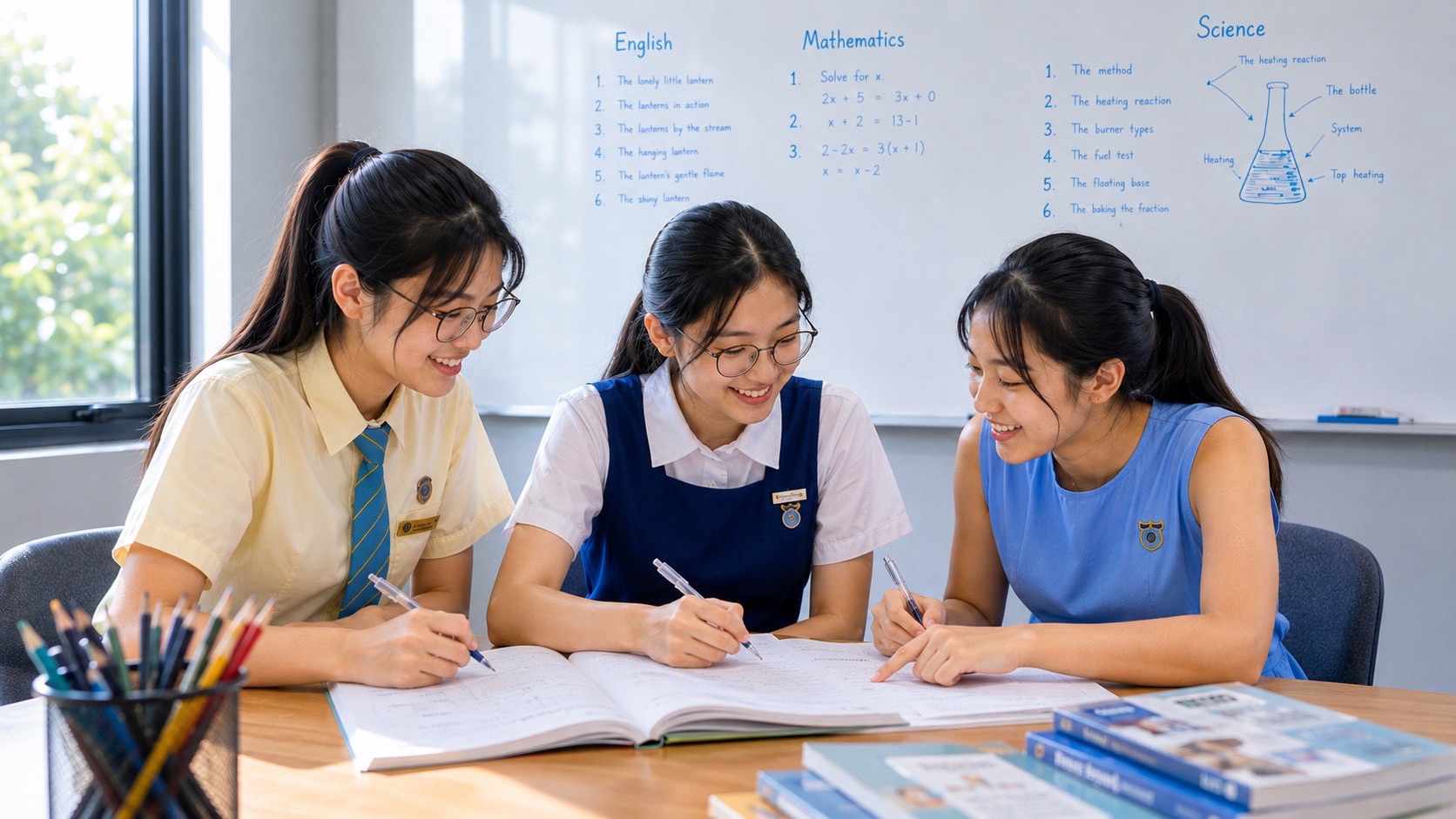
Secondary Mathematics tuition should give a student more than additional worksheets.
It should provide a clear place to understand what school Mathematics is asking, repair the exact point where learning has become unstable and practise until the student can work independently.
At eduKateSG Punggol, we provide premium 3-pax Secondary Mathematics tuition for students from Secondary 1 to Secondary 4.
Our small-group tutorials support:
- Secondary 1 Mathematics;
- Secondary 2 Mathematics;
- Secondary 3 E-Mathematics;
- Secondary 4 E-Mathematics;
- Secondary 3 Additional Mathematics;
- Secondary 4 Additional Mathematics; and
- G1, G2 and G3 Mathematics pathways according to the student’s school programme and readiness.
Each 1.5-hour lesson combines clear teaching, carefully selected questions, guided correction and close observation of the student’s working.
The purpose is not simply to help students complete more Mathematics.
It is to help them understand how Mathematics works.
Students learn to read mathematical language, recognise structures, select suitable methods, control algebra, organise multi-step solutions and respond calmly when a familiar topic appears in an unfamiliar form.
Our Secondary Mathematics tuition in Punggol is suitable for students who need to:
- repair gaps carried forward from Primary Mathematics;
- adjust to the pace and abstraction of Secondary Mathematics;
- become more stable in algebra;
- improve accuracy and working presentation;
- keep pace with school;
- prepare for weighted assessments and examinations;
- learn slightly ahead of the school schedule;
- strengthen E-Mathematics;
- begin or stabilise Additional Mathematics; or
- build towards more dependable upper-secondary performance.
Class size is limited to three students.
This allows the tutor to inspect how each student thinks, not only whether the final answer is correct.
Secondary Mathematics Is a Four-Year Learning Journey
Secondary Mathematics is sometimes treated as a collection of separate chapters.
Students learn integers, algebra, equations, graphs, geometry, statistics and trigonometry. They complete a chapter, sit for a test and then move to the next topic.
However, Mathematics does not truly grow chapter by chapter.
It grows through connections.
A student’s ability to solve a Secondary 3 equation may depend on number skills learned in Primary 5, fraction control developed in Primary 6 and algebraic habits formed in Secondary 1.
A Secondary 4 trigonometry question may require the student to:
- read a diagram accurately;
- recognise the relevant triangle;
- recall the correct relationship;
- substitute values correctly;
- manipulate an equation;
- use the calculator accurately;
- round appropriately; and
- present a complete answer with the correct unit.
The final question may appear to be about trigonometry.
The student’s success depends on several earlier systems operating together.
This is why a student can appear comfortable in one chapter and suddenly struggle in another. The new topic may not be the real problem. It may simply be the first place where an older weakness becomes impossible to avoid.
A good Secondary Mathematics tutor therefore looks beneath the current chapter.
The tutor asks:
- Which earlier skill is carrying this question?
- Where did the student’s reasoning first change direction?
- Is the problem conceptual, procedural or computational?
- Does the student understand the method or only remember its appearance?
- Can the student recognise when the method should be used?
- Can the student still use it when the question changes?
Secondary Mathematics tuition becomes useful when it makes these hidden connections visible.
The Hidden Mathematics Problem: The Wrong Answer Is Only the End of the Story
When a student receives a question wrong, the written answer shows only the final outcome.
It does not automatically reveal the cause.
Two students may obtain the same wrong answer for entirely different reasons.
The first student may not understand the concept.
The second may understand the concept but copy a negative sign incorrectly.
A third student may know the method but misread the question.
A fourth may perform every algebraic step correctly and then enter the wrong value into the calculator.
The correction must match the cause.
Consider the equation:
[
3(x-2)=15
]
A student may make several different mistakes:
- divide by 3 incorrectly;
- expand only the first term;
- treat (3(x-2)) as (3x-2);
- change a sign without applying a valid operation;
- lose the bracket;
- reach (x=7) but copy (x=5) as the final answer; or
- obtain the correct answer without understanding why it works.
Writing the correct solution on the board is not enough.
The tutor must identify the student’s exact mental move.
At eduKateSG, we inspect:
- how the student begins;
- which information the student notices;
- which information is ignored;
- how the student chooses a method;
- what each line of working is intended to do;
- where symbols change unexpectedly;
- whether the answer is checked; and
- whether the student can explain the reasoning afterwards.
This is one of the central purposes of a three-student class.
The tutor has time to watch Mathematics happen.
Why Punggol Parents Choose 3-Pax Secondary Mathematics Tuition
A class of three creates a particular learning environment.
There is enough interaction for students to hear another explanation, compare methods and participate in carefully managed discussion.
At the same time, the group remains small enough for the tutor to observe every student closely.
This balance matters.
A completely individual lesson can become overly dependent on one tutor-student interaction. A large class may provide energy, but individual errors can remain hidden for too long.
A 3-pax Mathematics tutorial sits between these two conditions.
Students receive personal attention while still learning within a small peer environment.
What becomes possible in a three-student class
The tutor can:
- check every student’s working regularly;
- ask each student to explain a method;
- adjust the level of questions within the same topic;
- notice repeated sign or notation errors;
- compare alternative solution methods;
- slow down for a missing foundation;
- extend a student who is ready;
- respond to upcoming school assessments;
- prevent a quiet student from disappearing into the class; and
- confirm whether learning has become independent.
Students also benefit from hearing how another learner approaches the same problem.
One student may use algebra.
Another may begin with a diagram.
A third may recognise a numerical pattern.
The tutor can compare these approaches and show which method is most efficient, which is most general and which is safest under examination conditions.
The class is small by design.
It keeps teaching personal without removing the useful momentum of learning alongside others.
Secondary Mathematics Under Full Subject-Based Banding
Under Full Subject-Based Banding, Mathematics may be offered at G1, G2 or G3 subject level. The student’s Mathematics route should therefore be understood according to the subject being studied, rather than reduced to a broad label about the student.
At eduKateSG Punggol, we consider:
- the student’s current Mathematics subject level;
- the topics being taught in school;
- the pace of the school programme;
- the student’s earlier foundations;
- current school results;
- upcoming weighted assessments;
- the types of errors appearing repeatedly;
- the student’s level of independence; and
- the longer Mathematics pathway ahead.
A G3 student losing marks through weak accuracy requires a different response from a student who is still unstable with fractions, ratios or directed numbers.
A G2 student preparing to take Mathematics at a more demanding level may need stronger foundations, greater question variation and better symbolic fluency.
A student coping comfortably may require deeper applications and more disciplined explanation rather than additional routine practice.
The subject level helps us understand the route.
It does not replace a careful reading of the individual student.
For examination-year students, preparation must also follow the syllabus applicable to their cohort. The 2026 GCE O-Level syllabus list includes Mathematics and Additional Mathematics as separate subjects, while the Singapore-Cambridge Secondary Education Certificate begins using the new G-level examination structure from 2027.
What We Teach Across Secondary Mathematics
The exact topic sequence may differ between schools.
Our tutorials coordinate with the student’s current school programme while protecting the mathematical foundations needed for later work.
Secondary 1 Mathematics: Entering a New Mathematical Language
Secondary 1 is a transition year.
Students move from the more concrete environment of Primary Mathematics into a system that uses:
- variables;
- negative numbers;
- algebraic expressions;
- equations;
- inequalities;
- formal notation;
- coordinates;
- geometric reasoning; and
- longer chains of working.
The numbers may look familiar, but the language has changed.
Students can no longer depend only on arithmetic procedures and familiar model-drawing patterns. They must learn to operate within a system of symbols and valid transformations.
Important Secondary 1 foundations include:
- directed numbers;
- factors and multiples;
- fractions and rational numbers;
- algebraic terms and expressions;
- substitution;
- expansion;
- simple factorisation;
- linear equations;
- ratios, rates and percentages;
- basic geometry;
- mensuration;
- coordinates;
- graphs; and
- data interpretation.
The aim is to build a stable mathematical grammar before later topics become more demanding.
Secondary 2 Mathematics: Consolidation Before the Upper-Secondary Jump
Secondary 2 is often underestimated.
It is not merely another year between Secondary 1 and Secondary 3.
It is where early Secondary Mathematics must become stable enough to carry a wider load.
Students may encounter greater depth in:
- algebraic manipulation;
- equations;
- graphs;
- geometry;
- congruence and similarity;
- Pythagoras’ theorem;
- mensuration;
- statistics;
- probability;
- rate and proportion; and
- mixed-topic applications.
At this stage, a student may still pass individual chapter tests while remaining unstable when several topics appear together.
Secondary 2 tuition should therefore help students:
- retain earlier concepts;
- recognise which method a question requires;
- connect algebra to geometry and graphs;
- manage longer working;
- become less dependent on examples;
- correct weak habits before upper secondary; and
- prepare for the possible introduction of Additional Mathematics.
The objective is not merely to finish Secondary 2.
It is to enter Secondary 3 with a Mathematics system that can carry greater pressure.
Secondary 3 E-Mathematics: More Topics, More Interaction
Secondary 3 Mathematics introduces a broader and more demanding environment.
Students may be managing E-Mathematics alongside Additional Mathematics and several other examination subjects.
The challenge is no longer limited to understanding a new chapter.
Students must retain older topics while continuing to learn new ones.
Depending on the syllabus and school sequence, Secondary 3 work may include:
- indices and standard form;
- algebraic manipulation;
- equations and inequalities;
- coordinate geometry;
- graphs and functions;
- trigonometry;
- bearings;
- similarity and congruence;
- mensuration;
- sets and probability;
- statistics; and
- real-world applications.
The tutor must now teach both content and control.
Students need to know:
- what the question is asking;
- what information matters;
- which method is suitable;
- how to organise the solution;
- when calculator use is appropriate;
- how to check the answer; and
- how to protect marks under time pressure.
Secondary 3 is where Mathematics becomes increasingly examination-facing.
Secondary 4 E-Mathematics: Consolidation and Examination Execution
Secondary 4 is not simply a final round of chapter teaching.
It is a year of integration.
The student must retrieve knowledge from several years, select methods without chapter labels and execute accurately within a limited time.
Secondary 4 tuition may include:
- targeted topic repair;
- structured syllabus revision;
- mixed-topic practice;
- timed question sets;
- school preliminary paper preparation;
- past-year examination questions;
- analysis of repeated error patterns;
- calculator discipline;
- checking strategies;
- paper planning; and
- final-answer presentation.
At this stage, the tutor must distinguish between several possible problems.
A student scoring 55% may have serious conceptual gaps.
Another student with the same score may understand most topics but lose marks through incomplete working, poor time allocation and repeated arithmetic mistakes.
Those students should not receive identical revision plans.
Secondary 3 and Secondary 4 Additional Mathematics
Additional Mathematics is not simply E-Mathematics with more difficult numbers.
It is more algebra-intensive, more abstract and more structurally connected.
Students may study:
- advanced algebra;
- quadratic functions;
- equations and inequalities;
- polynomials;
- partial fractions;
- indices and surds;
- logarithms;
- coordinate geometry;
- trigonometric functions and identities;
- exponential relationships;
- differentiation;
- integration; and
- applications of calculus.
A small algebraic weakness can travel through an entire A-Math solution.
One incorrect sign may affect:
- factorisation;
- root calculation;
- graph behaviour;
- differentiation;
- substitution; and
- the final answer.
Additional Mathematics tuition must therefore strengthen the student’s symbolic control.
Students need to understand not only what steps to perform, but why those steps remain valid as expressions become longer and less familiar.
Our First-Principles Teaching Method
A strong Mathematics programme should do more than demonstrate one procedure and assign twenty similar questions.
The student needs knowledge that remains usable after the lesson.
1. Diagnose the exact weakness
We avoid broad descriptions such as:
- weak in Mathematics;
- careless;
- poor at algebra;
- cannot do word problems; or
- does not understand.
These descriptions may be true, but they are not precise enough to guide teaching.
A student described as weak in algebra may actually be struggling with:
- multiplication facts;
- negative numbers;
- fraction operations;
- bracket control;
- symbolic reading;
- expansion;
- factorisation;
- equation balance;
- copying accuracy;
- working memory; or
- confidence under time pressure.
We inspect the student’s work and locate the first unstable point.
2. Rebuild from the first unstable point
When an earlier skill is affecting present work, we return to it.
This is not moving backwards.
It is restoring the floor beneath the current topic.
A Secondary 3 student struggling with algebraic fractions may first need to stabilise ordinary fraction operations.
A Secondary 2 student struggling with equations may need better control over inverse operations and negative numbers.
A Secondary 4 student repeatedly losing marks in trigonometry may need to improve diagram interpretation rather than memorise another formula list.
Once the missing connection is repaired, the current topic often becomes easier.
3. Establish a clear learning boundary
We introduce one controlled structure before adding variation.
For example, equation solving may begin with:
- whole-number coefficients;
- one unknown;
- one operation;
- positive values; and
- a clean equation.
Once the structure is secure, we add:
- negative values;
- brackets;
- fractions;
- unknowns on both sides;
- algebraic denominators; and
- written applications.
Complexity is introduced deliberately.
The student learns where the method works, why it works and what changes when a new condition is added.
4. Move from visible meaning to abstract notation
Where useful, we move through:
- a familiar quantity or situation;
- a diagram, model, table or number line; and
- formal mathematical notation.
This is particularly helpful when a student can repeat a procedure but cannot explain what the symbols mean.
Symbols should compress understanding.
They should not replace it.
5. Ask students to think aloud
Students may be asked to explain:
- what the question is asking;
- which information is important;
- what relationship they can see;
- why a method is suitable;
- what each line of working does;
- whether another method is possible; and
- whether the final answer is reasonable.
Explanation reveals understanding.
It also allows the tutor to detect confusion before it hardens into a repeated habit.
6. Retrieve and interleave
Mathematics must remain available after the original lesson.
We therefore revisit earlier topics and mix them with newer work.
This prevents the student from succeeding only because the worksheet has already announced the method.
In an examination, a question does not usually say:
This is a simultaneous-equations question. Please use simultaneous equations.
The student must recognise the structure independently.
Mixed practice trains that recognition.
7. Build examination discipline early
We teach students to protect marks through:
- one logical step per line;
- correct use of equal signs;
- accurate copying;
- clear diagrams;
- labelled axes;
- appropriate units;
- calculator discipline;
- estimation;
- answer checking;
- sensible rounding;
- controlled timing; and
- complete final statements.
These habits should not be left until the final examination year.
They become more reliable when built gradually.
What Happens During a 90-Minute Secondary Mathematics Lesson?
Each lesson is adjusted to the students, but the tutorial follows a stable rhythm.
Warm-up retrieval
Students begin with selected questions from earlier learning.
This helps the tutor check:
- what has been retained;
- which skills have weakened;
- whether a previous correction is holding; and
- which knowledge must be reactivated for the day’s lesson.
Concept instruction
The tutor introduces or revisits the central mathematical idea.
The explanation focuses on:
- meaning;
- structure;
- notation;
- valid operations;
- common misconceptions; and
- connections to earlier topics.
Guided practice
Students attempt carefully selected questions with the tutor nearby.
The tutor may prompt the student to notice a relationship, explain a decision or check a suspicious step.
Support is gradually reduced as control improves.
Independent application
Students complete selected questions without step-by-step assistance.
This is an important stage.
A student may appear to understand while following an explanation but become unable to begin once the tutor stops prompting.
Independent practice reveals whether the concept is genuinely usable.
Variation and mixed practice
The same idea is presented in different forms.
Numbers may change.
The unknown may move.
A diagram may be rotated.
A written question may replace a direct equation.
Earlier topics may be combined with the current one.
Students learn to identify the structure beneath the surface appearance.
Timed practice
When appropriate, students complete short timed sets.
The purpose is not to create panic.
It is to develop controlled speed after the method has become stable.
Error review
Mistakes are classified.
The student learns whether the error came from:
- weak understanding;
- incorrect reading;
- poor recall;
- arithmetic;
- algebraic manipulation;
- notation;
- calculator entry;
- incomplete presentation;
- poor organisation; or
- rushing.
The correction is then matched to the error.
Focused continuation work
Home practice is purposeful.
It may include:
- reinforcement of the current concept;
- correction of a repeated error;
- retrieval of an earlier topic;
- preparation for the next lesson; or
- practice for an upcoming school assessment.
The intention is not to create an indiscriminate pile of worksheets.
It is to continue the learning process precisely.
Three Secondary Mathematics Student Pathways
Not every student enters tuition for the same reason.
The repair pathway
This student may be struggling with:
- basic number operations;
- fractions;
- negative numbers;
- algebra;
- word problems;
- school homework;
- repeated test failures; or
- an increasing sense that Mathematics no longer makes sense.
The immediate priority is to stop further drift.
We locate the earliest unstable skill, rebuild it and reconnect it to the student’s current school topic.
Repair does not mean repeating every earlier chapter.
It means finding the exact bridge that is no longer carrying the student forward.
The stabilisation pathway
This student is passing, but performance is inconsistent.
One assessment may be comfortable.
The next may produce a sharp drop.
The student may:
- understand during lessons but forget later;
- lose marks through signs and copying;
- struggle when topics are mixed;
- depend heavily on familiar question formats;
- work too slowly; or
- become unsettled under test conditions.
The priority is to make performance more dependable.
Knowledge, accuracy, retrieval and execution must begin operating together.
The extension pathway
This student is coping well and requires greater depth.
Extension may include:
- less routine applications;
- unfamiliar problem structures;
- multiple solution methods;
- stronger mathematical explanation;
- more demanding algebra;
- mixed-topic reasoning;
- greater efficiency; and
- preparation for upper-secondary or Additional Mathematics.
The objective is not simply to rush through more chapters.
It is to deepen control.
A student who finishes the syllabus early but cannot respond when a question changes has moved ahead in pages, not necessarily in Mathematics.
Why Algebra Receives Special Attention
Algebra is not one isolated chapter.
It becomes part of the operating language of Secondary Mathematics.
Algebra appears in:
- equations;
- ratios;
- percentages;
- formulae;
- graphs;
- coordinate geometry;
- geometry;
- trigonometry;
- statistics;
- functions;
- Physics;
- Chemistry; and
- Additional Mathematics.
A student who avoids algebra in Secondary 1 may continue to meet the same difficulty in increasingly complex forms.
This is why we teach algebra as a language.
Students learn to understand:
- variables;
- constants;
- coefficients;
- terms;
- expressions;
- equations;
- identities;
- functions;
- substitution;
- expansion;
- factorisation; and
- valid transformation.
They also learn that mathematical symbols carry relationships.
For example:
[
3x+2
]
is not merely a collection of symbols.
It describes a structure:
- (x) is a variable;
- (3x) means three times (x);
- (2) is a separate constant term; and
- the addition joins two unlike terms that cannot simply be combined.
Once students learn to read algebra accurately, longer expressions become less intimidating.
The page may look crowded.
The underlying rules remain controlled.
How We Reduce “Careless” Mistakes
“Careless” is often too broad a diagnosis.
Different errors require different corrections.
Reading errors
The student may overlook words such as:
- difference;
- increase;
- decrease;
- remaining;
- at least;
- at most;
- consecutive;
- total;
- exact; or
- not drawn to scale.
Correction requires deliberate reading, annotation and translation of language into mathematical relationships.
Sign errors
The student may lose control when negative values, subtraction and brackets appear together.
Correction requires stronger understanding and slower symbolic handling before speed is rebuilt.
Arithmetic errors
The method may be correct, but the calculation is wrong.
Correction may include:
- estimation;
- reverse checking;
- stronger number fluency;
- cleaner written calculation; or
- more disciplined calculator entry.
Copying errors
A value, exponent or symbol may change between lines.
Correction requires cleaner layout and a deliberate line-by-line scan.
Method errors
The student may apply a familiar method to the wrong question.
Correction requires better recognition of mathematical structure.
Presentation errors
The student may omit:
- essential working;
- a mathematical statement;
- a unit;
- an inequality sign;
- a labelled axis;
- a final conclusion; or
- the required degree of accuracy.
Correction requires examination discipline and awareness of what a complete mathematical answer contains.
Time-pressure errors
The student may rush through accessible questions, become trapped on one difficult item or leave insufficient time for checking.
Correction may require:
- timed micro-sets;
- question triage;
- better paper sequencing;
- decision points for moving on; and
- a controlled checking routine.
We maintain an error pattern rather than treating every wrong answer as an unrelated event.
Once the pattern becomes visible, the correction becomes more precise.
Teaching Ahead Without Rushing
Where appropriate, we introduce topics slightly before they appear in school.
The purpose is not to race through the syllabus.
It is to give the student a calm first encounter.
When the topic later appears in school:
- the language is familiar;
- the notation is less intimidating;
- the student can follow the teacher more easily;
- school practice becomes consolidation;
- questions can be asked more intelligently; and
- confidence begins from recognition rather than surprise.
Teaching ahead is especially useful when the student’s foundations are secure.
However, pre-teaching should not become uncontrolled acceleration.
We do not place new Mathematics on top of an unstable base merely to claim faster syllabus coverage.
For one student, the correct next step may be a new topic.
For another, it may be the repair of a skill taught two years earlier.
Both students can still move forward.
They simply require different starting points.
What Progress Should Look Like
Progress is not limited to one test result.
Parents may first notice that the student:
- begins homework with less resistance;
- asks more precise questions;
- writes clearer steps;
- loses fewer signs;
- checks units and rounding;
- recognises familiar structures;
- identifies mistakes independently;
- explains methods with greater confidence;
- completes routine questions more efficiently;
- remains calmer when a question looks unfamiliar; and
- produces more stable school results.
Marks generally improve when several systems begin working together:
- understanding;
- memory;
- recognition;
- method selection;
- accuracy;
- working presentation;
- time control; and
- final-answer checking.
Responsible tuition does not promise an instant grade after one or two lessons.
The rate of improvement depends on:
- the size of the existing gap;
- the student’s current school level;
- attendance;
- practice between lessons;
- competing school demands;
- willingness to correct old habits;
- confidence;
- the complexity of the syllabus; and
- the time remaining before an assessment.
Our role is to make the improvement process visible, structured and teachable.
When Should a Punggol Student Begin Secondary Mathematics Tuition?
Support may be useful when a student:
- says Mathematics no longer makes sense;
- struggles to begin homework independently;
- understands examples but cannot answer variations;
- repeatedly loses negative signs;
- has unstable fraction or percentage skills;
- copies methods without understanding them;
- avoids showing working;
- depends heavily on answer keys;
- performs well during practice but poorly in tests;
- takes too long to complete routine questions;
- forgets topics soon after learning them;
- is falling behind the school sequence;
- has started Additional Mathematics and feels immediately overwhelmed;
- is passing but producing highly inconsistent results; or
- wants a stronger foundation before the next school year.
Parents do not need to wait for a serious failure.
Early support is often quieter and more efficient because fewer layers need to be dismantled.
A Secondary 1 student may need help completing the Primary-to-Secondary transition.
A Secondary 2 student may need stronger foundations before the upper-secondary jump.
A Secondary 3 student may need to stabilise E-Math while entering Additional Mathematics.
A Secondary 4 student may need targeted repair and disciplined examination preparation.
The correct starting time is not determined only by the calendar.
It is determined by the student’s present learning state and the amount of runway still available.
Secondary Mathematics Tuition in Punggol Central
eduKateSG Punggol is located at 83 Punggol Central, Singapore 828761. The Punggol location provides a local small-group tuition option for families in Punggol and the surrounding North-East area.
A local class can make weekly attendance easier to sustain.
Students can arrive, settle into a focused learning environment and complete a clearly defined piece of academic work without a long cross-island journey.
The location may be convenient for families around:
- Punggol Central;
- Punggol MRT;
- Waterway Point;
- Punggol Field;
- Punggol Drive;
- Punggol Walk;
- Punggol Place;
- Edgefield;
- Sumang;
- Matilda;
- Northshore;
- Punggol Coast;
- Sengkang; and
- nearby North-East neighbourhoods.
Class placement remains by appointment because each tutorial is limited to three students.
The student’s level, school programme, pace and learning needs must be reasonably compatible with the class.
Class Details
Format: Premium 3-pax small-group tutorials
Levels:
- Secondary 1 Mathematics
- Secondary 2 Mathematics
- Secondary 3 E-Mathematics
- Secondary 4 E-Mathematics
- Secondary 3 Additional Mathematics
- Secondary 4 Additional Mathematics
Subject pathways:
- G1 Mathematics
- G2 Mathematics
- G3 Mathematics
- E-Mathematics
- Additional Mathematics
Duration: 1.5 hours weekly
Teaching approach:
- first-principles explanation;
- foundation repair;
- guided and independent practice;
- retrieval and interleaving;
- variation training;
- error-pattern analysis;
- school-assessment alignment;
- examination discipline; and
- carefully paced pre-teaching.
Materials may include:
- curated lesson notes;
- topic practice;
- mixed revision;
- school-aligned questions;
- assessment-style questions;
- past-year examination practice;
- micro-tests;
- error-correction sets; and
- focused continuation work.
Additional preparation around important school assessments may be included according to the student’s needs and class arrangements.
The usual first step is a parent-student consultation.
Limited trial lessons may occasionally be possible only when the existing 3-pax class configuration permits.
What Parents Can Bring to the Consultation
Useful materials include:
- recent school test papers;
- marked assignments;
- topical worksheets;
- the school’s current topic schedule;
- the student’s Mathematics textbook;
- teacher comments;
- report-book results;
- past examination papers; and
- examples of questions the student finds difficult.
We are not looking only at the final score.
We are looking for repeated patterns.
A paper showing 60% may represent a serious conceptual gap.
It may also represent a capable student who understands most topics but repeatedly loses marks through signs, copying, calculator use, incomplete presentation or poor time management.
Those students require different plans.
The consultation helps us determine whether the student needs:
- repair;
- stabilisation;
- extension;
- school-topic support;
- examination conditioning; or
- a carefully managed combination of these.
Frequently Asked Questions
What happens in Secondary Mathematics small-group tuition?
Students receive concept instruction, guided practice, independent application, mixed-topic retrieval and detailed error correction.
The tutor observes not only the final answers but how each student reads, selects methods, organises working and checks results.
Why limit the class to three students?
Three students allow meaningful peer interaction while keeping each learner visible.
The tutor can inspect individual workings, ask frequent questions, adjust pacing and correct small errors before they become repeated habits.
Does the tuition follow my child’s school topic order?
We consider the school’s sequence and upcoming assessments.
However, an earlier weakness may need to be repaired before the current school topic can become stable.
The lesson therefore balances school alignment with foundation repair.
Do you teach ahead of school?
Yes, when the student’s foundation is ready.
Pre-teaching gives the student a calm first encounter with the topic.
We do not rush ahead when earlier concepts remain insecure.
My child is already failing. Will everything restart from Primary Mathematics?
We return only to the foundations affecting the student’s present Secondary Mathematics work.
For example, fractions may be revisited because they are causing algebraic errors.
The aim is not to repeat the entire Primary syllabus. It is to repair the specific bridge that is no longer carrying the student forward.
My child is passing. Is tuition necessary?
Not automatically.
A student who learns confidently, completes work independently and produces stable results may not require additional support.
Tuition becomes useful when performance is inconsistent, school pace is difficult, important foundations are uncertain or the student needs structured extension.
Is Secondary Mathematics tuition mainly about algebra?
Algebra is central, but it is not the only concern.
Students also need stable number skills, geometry, graphs, trigonometry, statistics, probability, accurate reading, clear presentation and multi-step problem-solving control.
Can E-Math and A-Math be supported together?
Yes.
For upper-secondary students, the tutor considers how the two subjects interact.
A-Math often exposes algebraic weaknesses that also affect E-Math, while E-Math examination demands require their own topic coverage, paper strategy and working discipline.
The subjects are related but should not be treated as identical.
How do you help students who make careless mistakes?
We classify mistakes into categories such as:
- reading;
- concept;
- recall;
- arithmetic;
- signs;
- copying;
- notation;
- calculator entry;
- presentation; and
- time management.
The correction is matched to the actual pattern.
How quickly should improvement appear?
Some students show better confidence and cleaner working within several lesson cycles.
Larger conceptual gaps require more time.
Progress depends on the student’s starting point, attendance, practice, school workload and the time available before assessments.
Can students join during the school term?
Yes, subject to a suitable 3-pax placement.
The student’s level and support needs are first reviewed so that the class pace is reasonably compatible.
Why not choose a larger Mathematics class?
A larger class may be sufficient for a student who needs general teaching and broad revision.
A 3-pax tutorial is particularly useful when the student requires:
- close inspection of workings;
- frequent questioning;
- individual pacing;
- targeted foundation repair;
- detailed error correction; or
- a more carefully managed route through E-Math or A-Math.
Helpful Reading for Punggol Parents
- How eduKate Punggol Secondary Mathematics Tutorials Work
- Secondary Mathematics Tuition at eduKateSG
- What Happens in Secondary 1 Mathematics Tuition?
- What Happens in Secondary 2 Mathematics Tuition?
- What Happens in Secondary 3 Additional Mathematics Tuition?
- What Happens in Secondary 4 E-Mathematics Tuition?
- Understanding How Mathematics Works
- MOE Secondary Mathematics Syllabuses
- SEAB Examination Syllabuses for School Candidates
Secondary Mathematics Tuition for Punggol Families
Secondary Mathematics is where numbers become relationships.
Algebra becomes a language.
Diagrams become reasoning tools.
Earlier topics begin interacting with later ones.
Working becomes part of the answer.
By upper secondary, the student must not only know Mathematics.
The student must retrieve it, recognise it and execute it accurately under examination conditions.
A carefully taught student does more than remember the correct steps.
The student begins to understand why the steps belong together.
At eduKateSG Punggol, our 3-pax Secondary Mathematics tutorials provide the space, attention and structure needed to build that understanding properly.
For students who are behind, we rebuild.
For students who are coping but inconsistent, we stabilise.
For students who are ready, we extend.
For examination-year students, we consolidate and refine execution.
The objective is a student who can approach Mathematics with stronger foundations, clearer reasoning and greater control—whether the next step is Secondary 2, upper-secondary E-Mathematics, Additional Mathematics or the final examination.
Arrange a Parent–Student Consultation
Speak with eduKateSG about your child’s:
- school level;
- Mathematics subject level;
- current results;
- learning gaps;
- repeated error patterns;
- confidence;
- upcoming assessments; and
- suitable 3-pax class placement.
eduKateSG Punggol
83 Punggol Central
Singapore 828761
Premium 3-pax Secondary Mathematics tuition
1.5-hour weekly tutorials
By appointment
Properly taught kids shine a bright light into the future.