
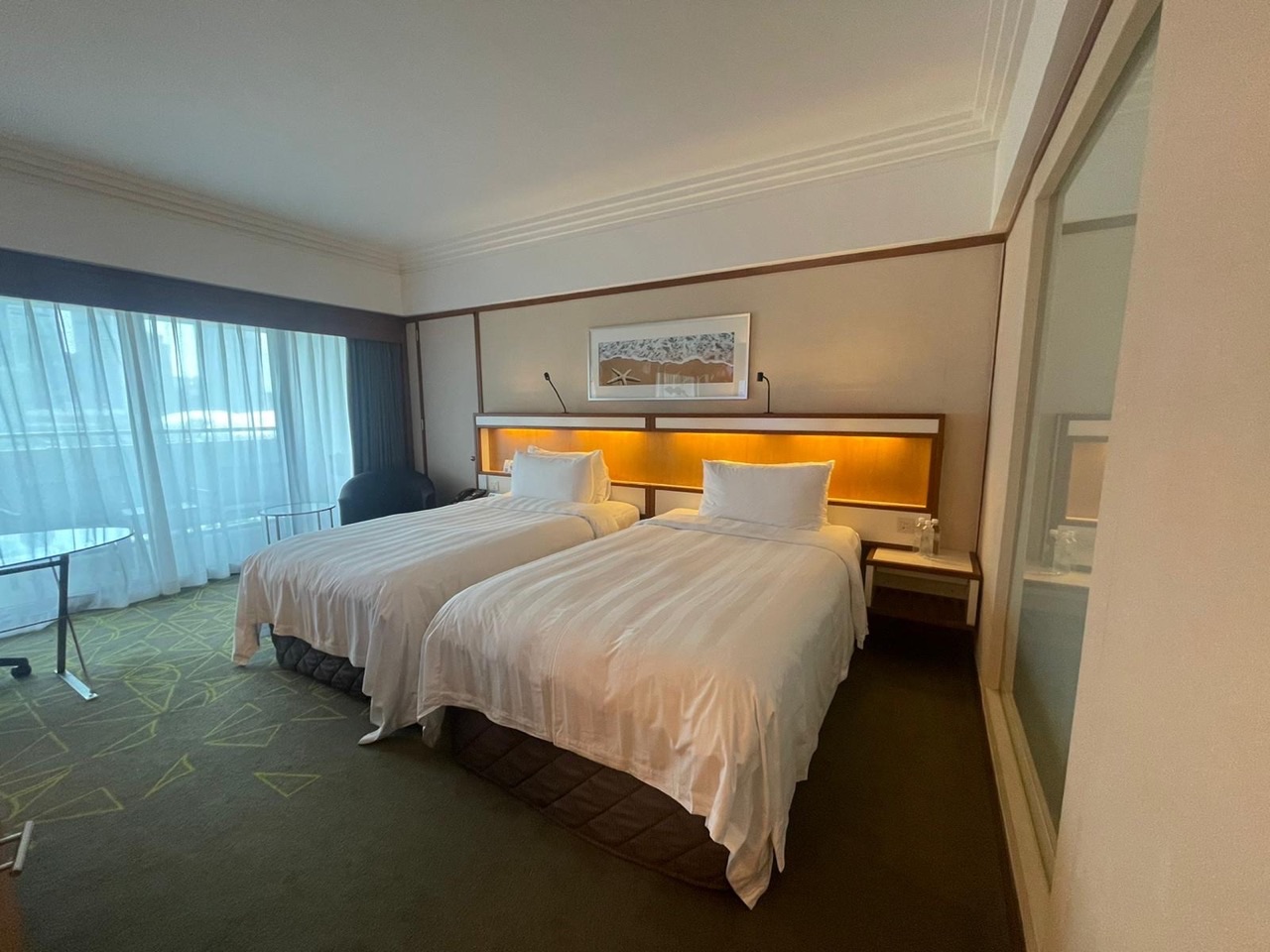
Should you book a Singapore hotel staycation to escape haze, and is an air-conditioned hotel room guaranteed to have cleaner air? A comfortable enclosed room can reduce some outdoor exposure compared with a long open-air holiday itinerary, but hotel air conditioning alone is not a guarantee of high-efficiency PM2.5 filtration. Before booking or changing a stay, check NEA’s current air-quality readings, follow MOH’s personal haze guidance for the travellers, and ask the actual hotel about room ventilation, smoke-related arrangements and which facilities are operating. A rooftop infinity pool, outdoor breakfast terrace and garden path can still be exposed to regional smoke. Do not assume a haze forecast automatically creates an entitlement to cancel a non-refundable room without fees.
This Singapore haze hotels and staycations guide is for local families, tourists already in Singapore, caregivers travelling with older people, couples, parents with babies and anyone assessing an overnight room as a respite option. It explains the difference between the hotel bedroom and shared spaces, air conditioning versus particle filtration, children’s facilities, rooftop pools, hotel gyms, outdoor dining, arrival journeys, booking conditions, housekeeping, medical access and whether staying at home may be simpler. The guide builds a practical two-day itinerary and compares alternatives without ranking hotels or claiming any named property offers a certified “haze-proof room.”
Singapore’s official tourism website Visit Singapore now explicitly flags the current haze and sends visitors to haze.gov.sg for the latest advisories. That is a sensible model for travel planning: tell visitors where to check environmental conditions rather than making guarantees from yesterday’s photographs. The NEA 17 October 2026 advisory forecast Unhealthy to Very Unhealthy PSI for 18 October, but that is a dated forecast, not the permanent status of Marina Bay, Sentosa or any hotel. A meaningful staycation can still happen with a well-chosen itinerary when the people and actual conditions make it appropriate.
The first decision: why book a hotel at all?
A Singapore resident may want a change of scenery, a special meal, a family celebration, a romantic weekend, a pool session or simply a cooler environment. These goals are not identical. A pleasant hotel room can serve a celebration or rest, but a haze episode does not make a hotel medically necessary for every HDB household.
If your existing home already has comfortable ventilation and appropriate particle management, a staycation may add cost and unnecessary outdoor travel without clearly improving exposure. If your home has a serious comfort or maintenance problem, an appropriate temporary room might be worth considering, but it still requires verification and may not be a substitute for formal support or healthcare.
For visitors who are already booked, the question is different: preserve necessary lodging while adjusting outdoor sightseeing. There may be no reason to cancel the whole trip when some appropriate indoor experiences remain available, although personal health and travel obligations matter.
The best decision begins with purpose, actual room conditions, health and cost rather than assuming luxury branding equates to measured air quality.
The one-hour PM2.5 guide for hotel guests
Singapore measures the one-hour PM2.5 concentration in micrograms per cubic metre. MOH’s current haze guide classifies it as Normal (0–55), Elevated (56–150), High (151–250) or Very High (251 or more). Healthy adults should reduce strenuous outdoor activity at Elevated, avoid strenuous outdoor activity at High and minimise outdoor activity at Very High.
Children, older people, pregnant women and people with chronic heart or lung conditions need more cautious recommendations. At Elevated, vulnerable people are advised to avoid strenuous outdoor activity, and at High or Very High to avoid outdoor activity. A child eager to use an outdoor hotel pool is still a member of the vulnerable group.
The 24-hour PSI forecast supports next-day planning and uses Good, Moderate, Unhealthy, Very Unhealthy and Hazardous categories. It cannot directly measure the air in a hotel’s bedroom or confirm a pool’s operating hours. Check current one-hour PM2.5 before outdoor parts of the itinerary.
A hotel reservation should not be interpreted as permission to ignore the health guide; the purpose of the stay can be adjusted without making every open-air amenity mandatory.
Your bedroom and the rooftop pool are different environments
A hotel room with doors closed may have different exposure conditions from a rooftop pool, open-air deck or landscaped courtyard. The room’s actual ventilation system, filter maintenance and pathways for outdoor air determine particulate conditions. Temperature does not establish filtration performance.
Outdoor hotel pools can involve strenuous swimming, sun exposure and long time sitting by the water. A glass-edged rooftop pool may look enclosed in photographs but still be fully outdoors. Its water quality does not measure airborne PM2.5. A roof or overhang can protect from rain while remaining open at the sides.
An enclosed hotel gym can have a different indoor environment, but it is not automatically medically suitable for someone who is unwell or has chronic respiratory symptoms. Always confirm whether the exact gym or class remains operating and its real ventilation arrangement.
Treat each facility separately: room, pool, gym, children’s club, restaurant and rooftop bar may have different conditions and operator decisions.
Cooling is not necessarily smoke filtration
A central hotel air-conditioning and mechanical ventilation (ACMV) system can differ greatly from an HDB split-unit air conditioner. Some buildings treat fresh air centrally; some areas have local units; shared hallways and restaurants may use different air handlers. These arrangements cannot be inferred from the appearance of one cool lobby.
NEA’s April 2026 indoor-air guidance recommends maintained fans, filters, ducts and seals, appropriate outside-air handling and safe operation. It recognises that opening windows can be unsuitable when outdoor air quality is poor, but also emphasises the importance of adequate ventilation.
A guest can ask the hotel for factual information about room windows, filtration and smoke-related procedures. The hotel may not have a separately measured PM2.5 value for every bedroom, and it should not invent one. A polite question is more useful than assuming every prestigious property uses a specified HEPA standard.
If the guest requires a high level of environmental control for a medical condition, consult the relevant clinician and discuss needs directly with the accommodation provider rather than rely on marketing terminology.
Does a hotel window open during haze?
Some hotel bedrooms have sealed windows, while others have operable windows or balconies. An enclosed window can help limit some direct outdoor-air entry, but the room still has a ventilation system that should be properly operated. A balcony door is a separate opening, and the higher floor alone does not guarantee lower PM2.5.
Do not seal hotel vents, disconnect smoke detectors or cover ventilation grilles with towels or tape. Those actions can create safety and comfort problems and may violate hotel rules. Report obvious smoke infiltration or malfunctioning ventilation to hotel staff instead.
If a room is uncomfortable, ask about appropriate adjustments or another room when available under the actual reservation terms. A guest cannot assume an automatic free upgrade because an outdoor pollution advisory was issued, but the operator may be able to explain the system or available options.
The Singapore Haze Air-Con Maintenance Guide explains cooling, filter ratings and ventilation in greater technical detail.
Hotels do not automatically function as official haze shelters
Singapore has designated People’s Association community haze shelters under a public programme, typically in selected community venues when the 24-hour PSI reaches the specified activation range. A private hotel is a commercial lodging provider, not automatically an officially designated haze respite centre.
The PA Community Haze Shelters page links the relevant directory and contact information. Residents who need suitable temporary respite can assess those official resources where applicable before paying for a hotel room.
A hotel is also not a clinic. If a person has severe breathlessness, chest pain, collapse or other emergency symptoms, seek urgent medical care, calling 995 in Singapore. A luxurious room or high-floor view is not a substitute for clinical treatment.
The goal of a staycation may still be enjoyment, comfort or celebrating a special occasion. It is enough to describe that purpose honestly without marketing medical protection the property has not established.
Marina Bay: keep the indoor and outdoor portions separate
Hotels around Marina Bay offer famous city views, dining, retail and other amenities. Visitors may choose to photograph Marina Bay Sands, walk beside the ArtScience Museum or enjoy an evening on the waterfront. These experiences have different indoor and outdoor segments.
A hotel stay may include many hours in a cool bedroom or enclosed dining room, but the planned sunset photography, rooftop swimming and long promenade walk are exposed to the surrounding air. A sea breeze or impressive skyline does not measure the actual PM2.5 concentration.
When the current guide recommends reducing outdoor exposure, a visitor may prefer a suitable enclosed museum, indoor retail area or quiet hotel activity, subject to the venue’s real opening and booking arrangements. This preserves the vacation’s purpose rather than forcing a list of landmarks.
Our Singapore Haze Tourist Guide explains how to adapt major visitor itineraries across the island.
Sentosa: a resort is not a sealed environmental bubble
Sentosa is attractive because it combines hotels, attractions, beaches, gardens and outdoor recreational areas. The island setting does not guarantee clean air when regional smoke reaches Singapore. Ocean breezes can move pollution as well as disperse it, and individual properties have different indoor configurations.
A family may book a resort primarily for an outdoor pool or beach programme. If MOH’s advice makes prolonged outdoor play unsuitable for the children, a hotel room alone may not deliver the expected holiday experience. Ask what indoor facilities are genuinely available and appropriate rather than assuming every resort has a children’s club with identical programmes.
Some attractions are partly indoors and partly outdoors, and entry tickets can have separate change or refund conditions. Contact the actual provider when planning alternatives. Do not treat a hotel cancellation rule as automatically applying to an independent attraction booking.
A changed itinerary can still be satisfying if guests identify the reason for travelling and adjust the parts that expose them unnecessarily.
Changi and airport hotels: transit exposure matters
A traveller staying near Changi Airport may have an early flight, an accessible transport need or a layover. The hotel can reduce some travel burden, but the journey between terminal, hotel and transport pickup still deserves attention during haze. Air-conditioned airport premises and outdoor taxi queues can have different conditions.
Haze may affect regional travel, but never invent a flight cancellation from the appearance of the runway or skyline. Check the airline, airport and ferry operator for actual schedule information. Hotel bookings, airline tickets and travel insurance can be governed by separate contracts.
A traveller with asthma or chronic heart disease should keep prescribed medication available and plan essential travel according to medical advice. Do not stop a necessary journey solely because another visitor posted an undated photo.
Our Singapore Haze Travel Guide covers flight visibility, ferry travel and cross-border arrangements more fully.
Family staycations with toddlers
A young child may be excited about the pool, playground and hotel breakfast. Parents should evaluate each part separately. The pool may be outdoors; a breakfast area may have a semi-open terrace; an indoor kids’ club may impose minimum ages, supervision requirements and separate booking or payment.
Do not assume that every hotel offers childcare or will accept an unsupervised toddler. The actual operating rules, health conditions, age limits and availability matter. A child with asthma may need individual precautions even if the facilities are open.
For infants, normal feeding, safe sleep and comfortable temperature come before recreation. Never create an airtight stroller cover to protect against haze or place a portable purifier inside a cot. A hotel stay does not remove ordinary infant safety needs.
See Singapore Haze Babies and Toddlers for stroller, nursery and breathing concerns.
Kids’ clubs and indoor family activities
An indoor kids’ club may preserve the social and play aspect of a staycation without requiring prolonged outdoor exposure, if it is operating and suitable for the child’s age and health. But it must not be treated as a certified low-PM2.5 space merely because the entrance says “air-conditioned”.
Parents can ask about supervision, age rules, whether the programme includes outdoor segments and how children with symptoms are managed. Some activities may be relocated; others may be booked out or unavailable. Do not describe a service as free or included unless the actual reservation confirms that detail.
A simple indoor family plan may be enough: a story, drawing, a favourite meal, board game or suitable gentle movement. The purpose is togetherness, not extracting the maximum number of facilities from the room rate.
The Singapore Haze Playgrounds Guide offers more ways to replace exposed play while preserving child development.
Hotel swimming pools: the exposed deck problem
A family may spend less time in the water than on the surrounding deck. Changing, waiting, watching younger children and taking photographs all add to the outdoor portion. During High one-hour PM2.5, MOH advises vulnerable people including children to avoid outdoor activity.
Water clarity and pool hygiene are not measurements of air quality. A clear blue pool can be surrounded by smoky air. The actual enclosure matters: a roofed teaching pool may have open sides, and a rooftop infinity pool may be entirely exposed.
If the pool or specific lesson is closed, follow the hotel’s operating and booking instructions rather than entering an area because a blog says the property normally has a pool. Lightning, maintenance and weather may separately change opening status even after haze improves.
For swimmers’ health and ActiveSG parallels, read Singapore Haze and Swimming.
Hotel gym workouts after postponed outdoor exercise
A gym can offer an appropriate alternative to a cancelled outdoor run or ride for some healthy people, but intensity and individual health still matter. An athlete who missed two long workouts does not need to run double distance on a hotel treadmill simply because the equipment is available.
A fully enclosed fitness room can have different air conditions from an open-sided terrace, yet filtration and ventilation must be assessed according to the actual system. A cool room is not medical fitness clearance for someone with persistent wheeze, significant cough, heart disease or other symptoms.
Choose an effort suited to the person’s normal programme and recovery. If unwell, obtain medical advice rather than perform a “haze detox workout”. A rest day is a valid part of a sustainable holiday.
The Singapore Haze Indoor Fitness and Return to Outdoor Sport guides explain training alternatives.
Breakfast buffets, alfresco restaurants and food hygiene
A hotel breakfast may be served in a fully enclosed dining room or on an outdoor terrace. A terrace with umbrellas or a retractable roof can remain exposed to outside air. The meal’s duration matters even though guests are not exercising.
A family with vulnerable children or older relatives may choose a suitable enclosed dining option when available. But indoor air management still depends on the actual venue. An air-conditioned restaurant can produce cooking emissions and have open doors, while proper food handling remains an entirely separate hygiene concern.
Use the hotel’s published meal reservation and operating details. Do not assume every rate includes breakfast, room service or food delivery without extra charges. A simple meal in a comfortable room may sometimes achieve the purpose more easily than a long queue at a busy buffet.
For the distinctions between air quality and food hygiene, see Singapore Haze Hawker Centres and Singapore Haze Food and Water.
Housekeeping and room cleaning during haze
Hotel housekeeping can introduce local dust or chemical odours through vacuuming, sprays, carpet treatment and other work. Regional haze may be the reason a guest is paying attention to air, but not every odour in a corridor comes from transboundary smoke.
A guest with sensitivities may ask for practical, reasonable information about housekeeping or fragrance use. The hotel can explain its actual policies and services. Do not expect a facility to guarantee that every room is completely free of allergens, particles or chemicals without a proper assessment.
Cleaning workers may also have outdoor duties, including moving carts across open service areas or handling deliveries. Occupational safety is distinct from the guest’s personal holiday choice; relevant employers should consider worker exposure under MOM guidance.
Good service is about communicating factual conditions and helping guests choose practical options where available, not making medical promises.
Windows, balconies and high-floor myths
A high-floor room or balcony can offer an extraordinary view, but building height does not prove that regional haze particles are absent. Wind, building openings and actual atmospheric conditions matter. A balcony is an outdoor space even if it is attached directly to the suite.
Closing an operable window during poor outside air may help reduce smoke entry in a suitable room, but hotel ventilation systems still require proper operation. Do not obstruct grilles, sensors, fire equipment or escape paths.
A person choosing a hotel primarily for a sunrise balcony breakfast should therefore consider whether the outdoor experience is likely to be suitable under the current forecast. Paying extra for a view cannot guarantee visibility or health conditions.
For the underlying visual physics, Singapore Haze Photography explains why the skyline’s appearance is not a pollution instrument.
Booking a hotel when haze is already forecast
Before payment, read the room type, dates, cancellation deadline, deposit terms, occupancy policy and whether add-on facilities are included. A flexible reservation can preserve options, but its price and terms may differ from a non-refundable offer. Do not choose solely by a promotional headline.
If haze is a material reason for the stay, ask whether the actual room is enclosed, how ventilation is managed and what alternatives exist if outdoor amenities are affected. The hotel may be able to answer some questions but cannot guarantee future weather or regulatory conditions.
Do not assume travel insurance covers voluntary changes caused by a forecast. Any policy has its own covered events, exclusions and claims process. Read the actual wording rather than relying on a generic article.
Likewise, a package sold through a third-party website may require changes through that booking platform instead of directly through hotel reception.
Why refunds depend on the actual booking terms
Hotels.com’s current terms of service provide a useful general illustration: accommodation cancellations and changes are governed by the travel provider’s rules and restrictions, and some rates are non-refundable or subject to fees. That contract applies to bookings made through that provider under its terms; it is not a universal rule binding every hotel and platform.
A haze advisory does not create an automatic full-refund guarantee for every staycation. Whether a hotel offers a date change, credit, refund or goodwill gesture depends on the actual booking, provider, circumstances and applicable consumer rights. Do not threaten staff with an invented nationwide policy.
Save the original confirmation, rate conditions, dates, cancellation request and response. Ask clearly whether an alternative date or room is available. If an issue remains unresolved, the relevant consumer or dispute channel may be appropriate depending on the contract.
A family should avoid waiting until the check-in counter to discover that a booking could have been changed earlier through the platform.
A worked example: two rates, one uncertain weekend
A parent is choosing between a hypothetical flexible hotel rate of S$260 and a non-refundable rate of S$220 for one night. The flexible option costs S$40 more, but it may allow a change or refund only under its actual conditions. The cheaper rate costs less if the family uses the booking, yet may produce a larger loss if they decide not to travel.
The arithmetic difference is S$260 − S$220 = S$40. That number alone does not determine which option is preferable: the parent must consider cancellation deadlines, probability of changing the plan, health, what amenities the family wants and the actual provider’s rules. It would be wrong to state that paying S$40 guarantees unlimited free changes.
This is an illustrative financial comparison, not a quote from any hotel or current market price. Its value is the decision method: identify what flexibility is actually offered before comparing the cost.
A family can also choose not to book a new staycation when the outlook is uncertain. Waiting or planning a low-cost home weekend may sometimes be a better fit.
A two-day example for a Singapore family
Friday evening: The family checks the 24-hour PSI forecast, reviews hotel booking terms and identifies which activities are indoors or outdoors. A child has asthma, so the family keeps the child’s prescribed plan central. The parents ask the hotel whether a kids’ club is actually operating and whether the room has a suitable enclosed environment.
Saturday morning: Before travelling, they check NEA’s current one-hour PM2.5 and MOH advice. If conditions are High, the family removes an optional outdoor pool and waterfront walk from the itinerary. It uses a practical transport route with minimal unnecessary exposure and confirms check-in and indoor facilities.
Saturday afternoon: The family spends time in the room or an appropriate confirmed indoor activity, preserving rest and connection. If the child is unwell, medical care takes precedence over the booking.
Sunday: The family rechecks conditions rather than assuming a better forecast means the rooftop is safe. It checks actual checkout and facility rules, avoiding an improvised long outdoor excursion to “make the stay worthwhile.”
This is a planning scenario, not a report of actual current availability at any hotel.
Another example: visitors from overseas
A visiting couple arrives in Singapore after seeing a dramatic headline about haze. Their hotel is operating, and they have a mix of outdoor and indoor activities planned. The correct response is not to assume their holiday is certainly ruined, nor to deny the pollution.
They check Visit Singapore’s current visitor advisory and NEA measurements, then reconsider prolonged outdoor tours according to personal health. They contact named operators about tickets and scheduled programmes, and preserve accommodation and other essential travel arrangements as appropriate.
If flights or ferries are affected, they confirm actual changes with the transport provider rather than assuming a skyline photo proves every journey is cancelled. If they require medical attention, they follow Singapore’s proper healthcare pathways.
Their holiday may shift toward suitable museums, indoor dining or quieter activities, with a more ambitious outdoor itinerary on a better-air day.
When a hotel is not the best alternative
If the household’s aim is simply to escape anxiety about haze, paying for a room may not address the underlying concern. The family may already have a comfortable home with appropriate particle cleaning and safe ventilation. A hotel stay adds the cost of accommodation, transportation, food and potentially unfamiliar air conditions.
For a resident whose home is uncomfortable or who needs community respite, Singapore has separate public and social-service options that deserve consideration. The People’s Association’s Community Haze Shelters programme lists designated spaces subject to activation and current operations.
If a person is medically unwell, a hotel booking is not a treatment plan. A GP, polyclinic or hospital may be needed depending on severity. Severe chest pain, breathing difficulty or collapse requires urgent help; call 995.
A home-based family day can still be enjoyable. The measure of a good plan is whether it meets the family’s needs safely and reasonably—not the price of the room.
Hotels and employees: do not forget outdoor staff
A hotel guest may remain inside while doormen, gardeners, pool attendants, valet staff, delivery drivers and maintenance workers spend hours outdoors. These employees have different occupational exposure patterns from somebody taking a short trip to reception.
Relevant employers should use MOM’s haze workplace guidelines to assess work duration, exertion, vulnerable staff and controls. A respirator is not a substitute for every other measure, especially where breathing resistance and heat matter.
A hotel may modify an outdoor guest programme while continuing indoor services. Staff communication and operational planning should identify the affected task rather than announcing vague changes with no reason or timeframe.
A guest can help by giving clear pickup instructions, not expecting unnecessary outdoor waiting and respecting staff when an amenity is temporarily unavailable.
Family health: asthma, pregnancy and older guests
MOH identifies children, older people, pregnant women and those with chronic heart or lung disease among groups needing more cautious outdoor activity advice. A healthy adult enjoying a hotel gym does not establish whether an older parent with heart failure should spend two hours on an open rooftop.
For asthma, follow the person’s prescribed plan and seek medical advice when symptoms worsen. Pregnant people may need to adjust extended outdoor trips and seek individual advice about exercise. Older guests may require accessible rooms, lifts and transport that reduce unnecessary travel and exertion.
A hotel should never be described as having “medical-grade air” unless it has relevant evidence. Even with good filtration, severe breathlessness, chest pain or other emergency signs require healthcare rather than another room change.
The Singapore Haze Heart Health, Pregnancy and Seniors guides cover these personal decisions.
Accessibility and mobility during a staycation
A wheelchair user or person with mobility limits may need suitable room access, lifts, toilet facilities, a safe drop-off point and accessible routes to dining or attractions. A hotel may be accessible in some areas while a rooftop deck or certain pool features are not. Confirm the actual configuration rather than relying on a broad marketing label.
A haze-related change to the itinerary should not create unsafe stairs, long outdoor detours or inaccessible pickup arrangements. If someone uses a medical device or prescribed medicines, keep them available during check-in and travel rather than packing them far away.
A family may consider a hotel closer to the necessary destination, reducing commute exposure. But such travel planning must fit the person’s actual health and care needs, not simply the shortest advertised distance.
For disability services and accessible travel, see Singapore Haze and Caregivers.
What to ask before confirming a stay
A concise list of useful questions can save disappointment: Is the room type fully enclosed? Does it have operable windows or a balcony? Can the hotel explain its actual ventilation and filter maintenance arrangements? Are the pool, gym, kids’ club and indoor dining area open for the booking dates? What are the age limits and any supervision requirements? What does the cancellation policy actually allow?
Ask separately about transfer from the station or airport, accessibility and any outdoor waiting areas. A person with a health condition may need a lower-exposure route rather than a famous skyline view. Another family may care mainly about quiet sleep and a normal breakfast.
Do not insist on an indoor PM2.5 number the hotel has not measured. A truthful operational answer is more valuable than a fabricated reading.
Read the written booking terms rather than accepting an informal assurance that “haze will definitely be refunded.” Dates, rates and third-party arrangements matter.
A hotel staycation comparison table
| Feature or decision | What to verify | Haze-specific concern | Alternative when unsuitable |
|---|---|---|---|
| Air-conditioned bedroom | Actual room and ventilation | Cooling is not certified PM2.5 filtration | Comfortable home room or verified option |
| Rooftop infinity pool | Outdoor operation, supervision | Open-air inhalation during swimming | Postpone, rest or suitable indoor activity |
| Hotel kids’ club | Age, supervision, programme and room | Some activities may go outdoors | Family reading, games or confirmed enclosed play |
| Hotel gym | Actual enclosure and hours | Intense exercise and room air | Appropriate lighter movement or rest |
| Breakfast terrace | Enclosure and service | Long outdoor seating during poor air | Confirmed enclosed meal option |
| Haze cancellation request | Original rate and booking provider | No automatic universal refund | Ask about permitted date change |
| Room balcony | Whether it is open-air | High floor is not pollution-proof | Use suitable indoor spaces |
| Traveller with chronic illness | Personal medical advice and transport | Haze vulnerability and symptoms | Necessary care and exposure reduction |
| Community respite need | Actual PA designated shelter | Hotel is not official shelter | Confirm public options and access |
Frequently asked questions about hotels and haze
Is a Singapore hotel room safer than an HDB flat during haze?
Not universally. It depends on the actual indoor environment, filtration, outside-air entry and the journey. A well-managed home may already be comfortable. A hotel is not automatically a medical-grade refuge.
Does air conditioning in a hotel filter PM2.5?
Not necessarily. Cooling and particle filtration are different functions. Central ACMV may have filters of varying effectiveness, and actual maintenance matters. Ask for factual information rather than assuming a particular standard.
Is a rooftop hotel swimming pool safe during Unhealthy haze?
Use current one-hour PM2.5, the swimmer’s health and effort, and the actual pool operation. An open-air rooftop pool is exposed to outdoor particles even when the water itself is clean.
Will hotels automatically refund bookings when PSI exceeds 100?
No universal automatic refund rule follows from a haze forecast. Booking-platform and property terms differ. Review the actual rate and provider’s cancellation or change conditions.
Can a non-refundable hotel booking be moved?
Some providers may offer flexibility or goodwill, but that depends on the specific booking and terms. Contact the correct property or platform and keep the written reply.
Does travel insurance automatically cover haze?
Do not assume so. Coverage depends on the actual policy’s insured events, exclusions and required evidence. Check with the insurer before treating a forecast as a covered cancellation.
Is Sentosa cleaner because it is surrounded by the sea?
No reliable permanent guarantee follows from its location. Wind can transport or disperse regional smoke. Use NEA’s live reading, not the sensation of an ocean breeze.
Are kids’ clubs automatically open when a hotel is operating?
No. Clubs may have independent opening schedules, age rules, capacity, supervision and temporary changes. Confirm the actual programme and room before travel.
Can an infant use a hotel air purifier?
Only in an appropriate safe configuration under the actual device and room instructions. Do not put appliances or loose covers inside a cot. Ordinary feeding, safe sleep and clinical care remain central.
Is a high-floor room above the haze?
Do not assume height provides a smoke-free atmosphere. Conditions depend on winds and building air handling, and visibility is not a direct PM2.5 reading.
Can I keep a hotel balcony door open during haze?
Outdoor smoke may enter through an open door. Check current air quality and the room’s actual ventilation arrangement. Do not obstruct required vents or safety equipment.
Can I cancel only the outdoor part of a hotel package?
That depends on how the hotel and any third-party operators package and book the services. Contact the responsible providers and read the actual terms.
Are hotel gyms appropriate when outdoor sport is cancelled?
They may be a suitable alternative for some healthy individuals if indoor conditions and health permit, but intense exercise and the actual room still matter. Symptoms require appropriate care.
Does a rain shower guarantee better conditions for a rooftop dinner?
Rain can change local conditions but does not guarantee an end to regional smoke. Recheck current readings before a lengthy outdoor meal.
Is the hotel breakfast buffet free for all guests?
Not necessarily. Inclusion depends on the room rate and package. Verify reservation details before relying on an amenity.
Are hotel rooms the same as PA community haze shelters?
No. PA operates a designated respite programme at selected community venues, subject to its own triggers and hours. A hotel is commercial lodging unless explicitly designated otherwise.
Should someone with asthma stay at a hotel instead of seeing a doctor?
A room is not medical treatment. Follow the prescribed asthma plan and seek professional care for worsening symptoms. Severe breathing difficulty requires emergency assistance.
Can hotel employees still work outdoors during haze?
Employers must consider applicable MOM workplace risk guidance for exposed duties. Hotel workers’ exposure may be longer than a guest’s brief outdoor trip, and job-specific controls matter.
How can a family avoid paying for amenities it cannot use?
Read the booking inclusions, ask about the actual facilities and prepare an indoor alternative. If a specific amenity is central to the stay, consider the cancellation or change terms before committing.
Is a staycation necessary for children’s wellbeing during haze?
No. Suitable home activities, rest, reading and indoor movement can preserve a child’s development and family connection without an expensive overnight booking.
Continue through eduKate’s Singapore haze network
The regional foundation is How Haze Works | SEA 2026. For visitors, see Singapore Haze Tourism and Singapore Haze Travel, Changi and Ferries.
For hotel-specific family amenities, consult Singapore Haze Swimming, HDB and Park Playgrounds, Indoor Fitness and Weekend Family Activities.
For the rooms and health questions read Singapore Haze Air-Con Filters, HDB Windows and HEPA, Community Haze Shelters and Singapore Haze Health.
Official references and review note
Primary sources: Visit Singapore Official Tourism Advisory, NEA Haze Portal, MOH Haze Advice, NEA 17 October 2026 Update, NEA Indoor Air Guidance, April 2026, Hotels.com Terms and Cancellation Provisions, PA Community Haze Shelters and MOM Workplace Haze Guidelines.
Prepared in October 2026 as a family accommodation and travel-planning guide, not live hotel availability, a booking guarantee, a legal interpretation of a particular contract or a certified indoor-air assessment. A good staycation is one where the actual room, family health, itinerary and price fit what you are trying to achieve.