
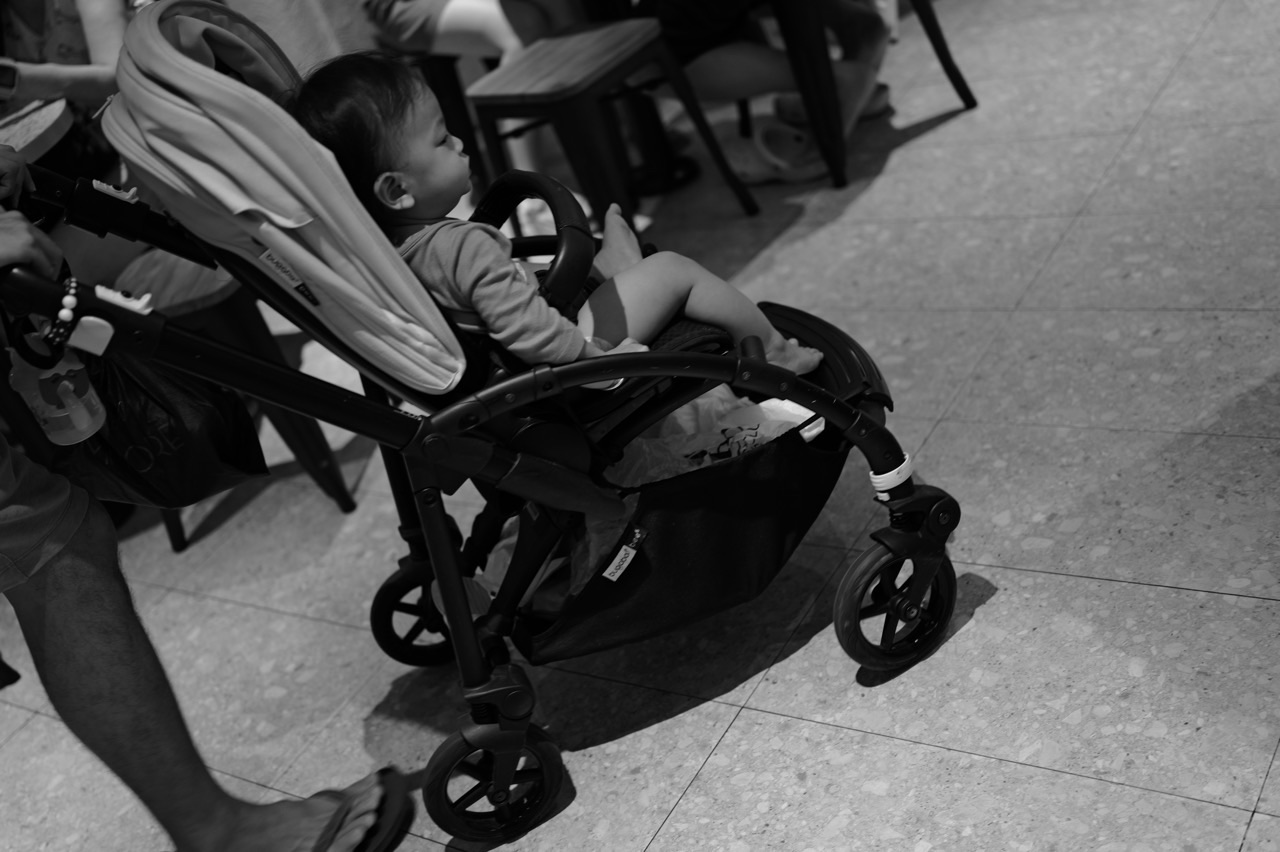
What should parents do for babies and toddlers when Singapore’s haze becomes unhealthy? Keep unnecessary outdoor time short, check the NEA one-hour PM2.5 reading when planning an immediate journey and use MOH’s haze advisory for the more cautious guidance that applies to children. If you have an infant, the first priority is not to buy a tiny N95 respirator: there are no international certification standards for children’s masks, and mask fit is especially difficult for babies. Choose a comfortable, appropriately ventilated indoor environment, follow normal safe-sleep and feeding routines, and seek medical advice promptly if your child appears unwell. A distressed or struggling-to-breathe baby needs medical assessment, not a better-looking PSI reading.
This Singapore haze guide for parents of babies, infants and toddlers explains the home, stroller, childcare and healthcare decisions that matter most. It covers infants from birth, nursery-aged children, preschoolers, caregivers, babies with respiratory concerns, indoor air purifiers, air-conditioning, childcare drop-offs, playground changes, naps, essential clinics and what an actual ECDA haze advisory requires. It differs from a general Singapore haze school guide because a child who cannot yet explain wheezing, discomfort or dizziness requires close adult observation, and normal infant-care routines cannot simply be replaced by a school timetable.
In October 2026, families have good reasons to pay attention without treating every grey sky as an emergency. The NEA update published on 17 October forecast Unhealthy to Very Unhealthy PSI for 18 October and directed people to one-hour PM2.5 for immediate decisions. This is a dated forecast—not a promise about readings throughout the month. The most reliable parent response is calm, current and specific: look at the measured air, the child’s condition, the journey and the actual childcare arrangements.
First, what does an infant actually need today?
A baby needs feeding, safe sleep, appropriate temperature, hygiene and attentive caregiving. Haze can change outdoor routines but should not cause parents to abandon these ordinary essentials. Start with the real schedule: Is a clinic appointment necessary? Is a childcare transfer unavoidable? Was the family merely planning a stroller walk or playground visit? The last category is usually easiest to postpone.
If the home is already comfortable, unnecessary travel to a distant shopping mall or attraction may create more outdoor exposure than simply staying in a suitable room. An open-air balcony, sheltered corridor or covered void deck remains connected to outdoor air. A roof provides shade and rain cover, not certified particle filtration.
For a new parent, decision overload is itself a problem. Agree on one official air-quality source, one family plan and one person who checks updates before essential trips. No one needs to refresh five apps every few minutes or compare screenshots from yesterday to decide whether to feed a baby.
The practical goal is not a perfectly sealed house or a guarantee of zero particles; it is sensible exposure reduction while meeting the child’s health and developmental needs.
What the one-hour PM2.5 reading means for children
Singapore reports one-hour PM2.5 concentration in micrograms per cubic metre. MOH’s guide divides it into Normal at 0–55, Elevated at 56–150, High at 151–250 and Very High at 251 or more. For vulnerable people including children, MOH advises avoiding strenuous outdoor activity at Elevated and avoiding outdoor activity at High and Very High. The health status, duration and intensity of exposure all matter.
Babies are not doing sprints, but prolonged time outside may still be unnecessary. A child sleeping in a stroller at an open-air café is breathing surrounding outdoor air even if the child is physically inactive. Do not convert MOH’s exertion terms into a false claim that a quiet baby is automatically protected during prolonged outdoor exposure.
The 24-hour PSI forecast helps plan tomorrow’s activities and uses Good, Moderate, Unhealthy, Very Unhealthy and Hazardous categories. When the forecast is Unhealthy, MOH advises children to minimise prolonged or strenuous outdoor physical exertion; as the forecast worsens, advice becomes more cautious. Use the full latest table rather than assuming one fixed number covers every situation.
The infant’s actual symptoms still override the wish to complete an outing. Air-quality data describe the environment, not a diagnosis.
Do babies need N95 masks during Singapore haze?
The safest general approach is to reduce infants’ unnecessary outdoor exposure rather than improvise a tight-fitting respirator. MOH’s October 2026 mask advice states that there are no international certification standards for masks intended for children, although a particular children’s mask may be considered in limited cases for children without heart or lung conditions when it maintains a proper seal. That is not an endorsement for placing adult N95 respirators on infants.
Very young children cannot reliably report breathing discomfort or maintain a correct seal. Do not fasten an adult respirator, plastic cover or improvised fabric over an infant’s nose or mouth. An infant’s sleep or stroller arrangement must not introduce suffocation, overheating or restricted breathing hazards in a misguided attempt to exclude particles.
Masks can also increase breathing resistance. Older people, pregnant women and people with significant heart or lung conditions have special MOH cautions. For infants and young children with respiratory concerns, discuss any proposed mask or medical device with a qualified healthcare professional instead of relying on a product advertisement.
For older children, the key protection remains following the activity guide and ensuring an appropriate indoor environment. Our detailed Singapore Haze N95 and KN95 Guide separates adult respirator use from children’s special concerns.
Are stroller rain covers useful for blocking haze?
A stroller rain cover is primarily designed for weather protection, not for tested high-efficiency particulate filtration. It should never be represented as an air-tight clean-air bubble. Restricting ventilation, trapping heat or fitting a cover incorrectly may introduce serious problems, particularly in Singapore’s hot and humid climate.
Check the stroller manufacturer’s instructions and do not improvise plastic wrapping, adhesive seals or a DIY air-cleaning device around an infant. A parent cannot reliably determine the oxygen, carbon dioxide or PM2.5 conditions inside such a homemade enclosure merely by watching the baby.
If you must take an infant out for an essential appointment, keep the journey practical. Prefer appropriate transport arrangements that reduce avoidable outdoor waiting, and move into the suitable indoor destination promptly. Avoid adding unnecessary shopping or park stops after the appointment.
A short necessary outing should not become a reason for panic; an optional two-hour waterfront stroller walk, however, can simply happen on a more suitable day.
What ECDA tells Singapore preschools to do about haze
The Early Childhood Development Agency’s official haze FAQ says preschools should follow the Early Childhood Development Centre Code of Practice, monitor NEA advice, use 24-hour PSI forecasts to plan future outdoor activities and one-hour PM2.5 readings to modify immediate outdoor activities. This means a centre may continue ordinary indoor care while adjusting a planned outdoor session.
The whole-of-government haze response announced in August 2026 says that at Unhealthy air-quality levels, preschools minimise prolonged outdoor activities and strenuous indoor physical activities. Children with underlying chronic heart or lung conditions are exempted from outdoor activities and physical exercise. The response also describes air purifiers at preschools and at least one enclosed room with air cleaning for temporary accommodation of unwell children.
These are published measures, not evidence that any single private centre has a particular indoor PM2.5 concentration. Parents should ask their actual centre how it is implementing the current guidance and what happens when a child has symptoms or an individual medical plan.
A classroom can remain open even when the outdoor playground, field trip or scheduled garden activity is changed. Do not infer islandwide centre closures from the cancellation of a single outdoor event.
Are normal infant outdoor experiences still mandatory during haze?
Under ordinary conditions, ECDA expects childcare programmes to support appropriate outdoor play. Its infant outdoor-activity FAQ describes a regular outdoor experience for infants from six months onwards, and its preschool outdoor-play FAQ covers broader gross-motor activity requirements.
Those ordinary educational expectations are not a command to expose infants to unsuitable haze conditions. The ECDA haze-specific FAQ directs providers to adapt outdoor activity using NEA’s forecast and immediate readings. A preschool can support motor development, sensory play and social interaction through suitable indoor arrangements when outdoor activities are modified.
Parents should ask how the day’s routine changes. Will the infant be taken to an exposed garden? Are there appropriate indoor gross-motor activities? How are children with asthma or other chronic conditions managed? Who will contact the family if the child becomes unwell?
A clear, factual question is better than assuming that every child’s outdoor exposure is unchanged or, conversely, that all development opportunities have stopped.
Why home air-conditioning is not the same as particle filtration
A split-unit air conditioner can cool a baby’s room without necessarily delivering high-efficiency PM2.5 filtration or fresh-air exchange. The relevant issues are actual room ventilation, the filter system, smoke entry from outdoors and indoor particle sources. A comfortable temperature does not certify clean air.
The NEA indoor ventilation guidance updated in April 2026 recognises that outside air quality may be poor during haze. At such times, opening windows is not automatically the best approach; however, ventilation and building safety still need to be maintained appropriately. Do not seal air vents permanently or run a poorly ventilated enclosed room without regard for indoor pollutants.
Avoid creating smoke or unnecessary particles inside the home. Cigarettes, incense, aerosol sprays, burning products and some cleaning practices may add pollutants. The goal is to reduce sources indoors as well as limit entry of smoky outside air.
For a practical room-size and filtration explanation, use Singapore Haze at Home: HDB Windows, HEPA and CADR. The right purifier depends on the room and its actual performance, not on a nursery-themed advertisement.
Should an air purifier run near a baby’s cot?
A suitable particle air cleaner may help reduce indoor fine particles when correctly sized, maintained and positioned according to the manufacturer’s instructions. But it is not a medical device for diagnosing or treating a baby’s respiratory symptoms and cannot guarantee particle-free air.
Keep appliance cords, movable objects and unstable equipment away from the baby’s sleep space. Do not direct strong airflow into the baby’s face or place a device where it creates an entrapment or electrical hazard. Use ordinary safe sleep arrangements and avoid adding accessories to the cot in the hope that they will filter haze.
A purifier’s noise and operating setting matter. A unit advertised with a high smoke CADR may deliver less cleaning at its quietest speed. Read credible ratings, change filters as instructed and avoid models that deliberately generate ozone or other undesirable by-products.
If the household cannot buy a device immediately, do not conclude that the parent has failed. Reducing indoor smoke sources, planning practical outdoor exposure and seeking appropriate support remain worthwhile actions. Product ownership is not the sole measure of responsible caregiving.
Baby sleep, nighttime cough and room comfort
Haze can coincide with disrupted family routines: parents close windows, change outings and become more alert to small sounds from the cot. It is important not to attribute every cough or restless night to pollution. Infections, feeding problems, temperature and other causes may also be involved.
Keep established safe-sleep principles. A baby should sleep in an age-appropriate safe sleep environment without loose items, improvised plastic covers or appliances placed inside the cot. Avoid overheating the room, while also avoiding a strong fan aimed directly at the infant. Room comfort should be handled with safe ventilation and temperature management.
For a baby who has significant coughing, rapid or difficult breathing, poor feeding, lethargy or unusual colour, seek appropriate medical assessment promptly. Serious breathing difficulty requires urgent help. The parent should not wait for the next NEA update to decide whether a baby needs care.
For older children and adults, the Singapore Haze and Sleep Guide covers nighttime symptoms and bedroom routines more generally.
Feeding and breastfeeding during haze
Normal breastfeeding, formula feeding and hydration routines should continue according to the child’s age and medical guidance. Haze is not a reason to dilute infant formula, give an infant unadvised water, change milk brands or start a special “detox” supplement. The baby’s nutritional needs remain individual and age-dependent.
If a parent must travel outdoors to purchase supplies, plan a necessary journey efficiently or use an appropriate delivery option. Keep feeds, sterilisation, safe storage and hand hygiene as the priority. Avoid introducing smoke from cooking or strong cleaning products into the feeding area.
A breastfeeding parent may need comfortable seating, water for themselves and practical family help, especially when outdoor errands are less convenient. Haze does not turn ordinary infant feeding into an emergency unless the child has concerning symptoms or supplies are genuinely unavailable.
When the baby is unwell or feeds poorly, contact a qualified healthcare professional. Do not attempt to compensate by giving unprescribed remedies for “haze toxins.”
What symptoms should a caregiver look for?
A baby cannot tell you, “My chest feels tight.” Caregivers should look for changes in breathing effort, unusual rapid breathing, persistent wheezing, struggling to feed, marked sleepiness, blue or grey coloration or other concerning behaviour. Symptoms are not all caused by haze; respiratory infections and other conditions can develop during the same week.
In Singapore, emergency medical assistance can be reached by calling 995. Severe breathing difficulty, blue lips or collapse are emergency signs. For less severe but persistent or worsening symptoms, seek appropriate medical assessment rather than relying on an internet article to determine the cause.
A child with an existing respiratory condition may have a prescribed care plan. Keep medications accessible and do not modify doses or borrow another child’s medicine based on the outdoor reading alone. The family’s doctor can advise on the child’s individual needs.
The MOH haze page also describes the Haze Subsidy Scheme for eligible patients. It should help with access to care, not determine whether symptoms are serious enough to require attention.
The October 2026 Haze Subsidy Scheme and young children
MOH announced the Haze Subsidy Scheme from 12 October 2026. The announcement covers Singapore Citizen children aged 18 and below at participating Public Health Preparedness Clinics, along with certain other eligible groups. All Singapore Citizens are eligible under the announced scheme at polyclinics for covered haze-related conditions.
The official press release specifies rates and conditions and names upper respiratory tract infections, bronchitis, asthma, allergic rhinitis, conjunctivitis and chronic obstructive pulmonary disease among covered diagnoses or complications. Do not assume any visit at any private clinic is subsidised automatically; participation, eligibility and the treated condition matter.
If a young child is ill, seek the appropriate medical help without trying to delay care until an administrative detail is confirmed. Emergency signs require an emergency response. For routine questions, the clinic can explain the relevant current subsidy arrangements and what documents are needed.
These October 2026 details may change in later haze episodes. Use the live MOH page and participating clinic information rather than permanently repeating one dated fee table.
Parent drop-offs: the whole journey counts
A short walk from the HDB lift to an air-conditioned vehicle may be different from an hour of outdoor errands with a stroller. Parents can reduce unnecessary exposure by preparing bags, checking transport options and avoiding multiple open-air stops. A sheltered walkway protects from rain but not automatically from fine smoke particles.
If an infant-care centre is a long walk from the MRT, consider whether a practical transport arrangement can reduce exposed waiting. Avoid unsafe rushing across roads or crowding a vehicle simply to cut a few minutes outside. Road and transport safety remain non-negotiable.
For a toddler, carrying a favourite quiet activity can make a changed commute easier. The parent can explain that outdoor play will happen when the conditions are more suitable. Keep explanations calm and factual; children learn the emotional tone of adults around them.
Our Singapore Haze Commuting Guide explains covered walkways, bus stops, cars, taxis and necessary trips in greater detail.
HDB balconies and open-air playgrounds
Singapore HDB estates have many useful shared spaces: void decks, sheltered paths, outdoor exercise areas, community gardens and playgrounds. These facilities help children explore their neighbourhood, but they do not all provide the same degree of enclosure. A covered playground may remain open at the sides and admit smoky outdoor air.
A baby does not need an extended daily outdoor stroll through poor haze to demonstrate good development. Safe, age-appropriate indoor floor play, reading, interaction and movement may preserve the day’s learning purpose. A parent of a toddler can make ordinary activities—sorting, music, picture books and simple safe movements—part of a pleasant indoor routine.
Avoid turning every cancelled outdoor activity into screen exposure. A child may benefit more from responsive conversation, toys, songs and predictable naps than from hours of television. The point is to adapt the setting, not replace the child’s developmental needs with a rigid alternative timetable.
The Singapore Haze Weekend Family Guide offers other family alternatives for older children.
Can you visit an indoor playground during haze?
An enclosed indoor playground may avoid extended time in an outdoor park, but it is not guaranteed to be cleaner simply because it is air-conditioned. Actual air quality depends on the venue’s ventilation, filtration, crowding and indoor sources. Public hygiene, supervision and age-appropriate equipment remain important.
A toddler’s trip may involve outdoor waiting, carpark transfers and a large amount of movement. Compare the complete journey against a safe home activity. If the parent is anxious or the child is unwell, there is no developmental emergency requiring an indoor playground visit that day.
Check the venue’s current hours and age restrictions. Some spaces are designed for older children and may be unsuitable for babies. Never assume a community haze shelter doubles as a children’s playground or childcare centre; those are separate programmes with separate rules.
A calm afternoon at home is a legitimate choice. The goal is healthy, engaged caregiving, not finding a paid replacement for every outdoor walk.
Air purifiers at preschool: what parents can ask
The government’s August 2026 inter-agency haze response states that preschools have air purifiers and at least one enclosed room equipped for temporary use by children who become unwell. Parents can reasonably ask a centre how it maintains those systems, how outdoor activities change and how staff notify caregivers if a child’s condition requires attention.
The existence of an air purifier does not mean all rooms have identical filtration. Likewise, the presence of one designated room does not mean every child is permanently isolated during haze. Centres must manage ordinary care, education, supervision and symptoms according to official and operational guidance.
Parents of children with asthma, chronic lung conditions or other vulnerabilities should share relevant information through the centre’s established private processes. Medication arrangements need to follow the child’s clinical plan, not a generic article.
The most useful communication is specific: “Will the outdoor infant activity proceed today? Is my child’s prescribed medicine accessible? Who will call if there are respiratory symptoms?” Avoid demanding medical detail about other families.
A two-child family: infant and primary pupil
A family in Punggol has a baby and a Primary 4 child. The older child may still attend school with an adjusted PE programme, while the baby remains at home with a caregiver. Their needs are not identical. The parent should not automatically assume that because school stays open, a baby should join an optional outdoor family run.
The older child can help with a suitable indoor activity such as reading picture books to the younger sibling. This preserves social connection and gives the older child an age-appropriate role. It does not mean the older child becomes responsible for infant safety or medication.
If the parent needs to collect the older child, plan transport and supervision safely. A baby left in a stroller outside a pickup gate for a long wait has exposure, even if the child is not exerting physically. Identify a safe and practical arrangement for the whole family.
The Singapore Haze School Guide is the companion for the older child’s educational arrangements.
A three-generation family: grandparent and newborn
A newborn may be cared for by a grandparent while the parents work. Older adults and infants both require cautious consideration under MOH’s haze advice, although their particular needs differ. A caregiver with heart or lung disease may need to avoid unnecessary outdoor errands while keeping the baby’s routine stable.
Simplify trips, arrange supplies and make sure everyone knows who can provide relief if the caregiver is tired or unwell. Keep important healthcare contacts accessible. Do not assume the grandparent must leave home to take the infant for a long walk because that is how the family usually spends the morning.
For the grandparent, a comfortable indoor routine and appropriate social interaction can be helpful. For the baby, feeding, safe sleep and responsive care remain central. A family can protect both people without treating them as identical.
Our Singapore Haze and Seniors Guide covers older caregivers, clinics and home life in more detail.
What not to buy in a panic
A haze headline can trigger rushed purchasing of tiny masks, untested stroller air-cleaning accessories, expensive “detox” gadgets, scented products and oversized purifiers. No product should be bought on the assumption that it replaces basic exposure management or treatment for illness.
Ask whether the product has credible, relevant evidence. For a particle air purifier, smoke CADR and room size matter. For a mask, certification, actual fit and wearer suitability matter; infant use raises additional risks. For a stroller cover, manufacturer safety and ventilation are relevant. A product with an attractive baby photograph is not necessarily appropriate for protecting against haze.
Avoid generating extra indoor pollutants with incense, essential-oil diffusers, fragranced sprays or ozone-producing devices. The aim is cleaner indoor air, not covering a smoky smell with another chemical source.
If a family needs help with a practical resource, check official community information and healthcare services rather than unverified promotional messages.
A simple family checklist for a hazy morning
| Parent question | Best first check | Practical response |
|---|---|---|
| Is today’s stroller walk necessary? | NEA one-hour PM2.5 and MOH child guide | Postpone long optional outdoor time |
| Does the infant need a mask? | MOH children’s mask caution and clinician | Do not improvise adult N95 or sealed covers |
| Is childcare open? | Actual centre and ECDA guidance | Confirm adjusted outdoor programme |
| Is home air comfortable? | Windows, ventilation, indoor sources and filtration | Manage smoke entry without creating other hazards |
| Does the baby have symptoms? | Breathing, feeding, colour and alertness | Seek appropriate medical care promptly |
| Can a parent go to a clinic? | Symptoms, transport and MOH scheme | Keep necessary care accessible |
| What about older siblings? | School messages and personal guide | Preserve learning with modified outdoor activity |
| Where can the family get respite? | Verified PA programme if applicable | Confirm hours, access and suitability |
Frequently asked questions about Singapore haze and babies
Is haze dangerous for a newborn?
Infants are part of the child population for whom MOH advises more cautious outdoor exposure. Actual risk depends on pollutant conditions, duration and individual health. Reduce unnecessary time outdoors, use a suitable indoor environment and seek medical care for concerning symptoms rather than predicting harm from a single PSI number.
Should I put an N95 mask on a baby?
Do not improvise an adult N95 on an infant or use an airtight stroller enclosure. There are no international certification standards for children’s masks, and fit and breathing comfort are critical. Prioritise exposure reduction and obtain qualified medical advice for special circumstances.
Can a baby still go to infant care when the PSI is Unhealthy?
Follow the actual centre’s operating instructions and ECDA’s haze guidance. Preschools can adjust outdoor activities while continuing ordinary indoor programmes. A child who is unwell or has individual medical needs may require different arrangements.
Do ECDA preschools have air purifiers?
The government’s August 2026 haze response stated that preschools are equipped with air purifiers and have at least one enclosed room with air cleaning for temporary care of children who become unwell. Ask the specific centre about current operations rather than assuming every room has an identical measured air quality.
Can a baby sleep in an air-conditioned HDB room during haze?
A comfortable room can be appropriate, but air conditioning alone does not guarantee high-efficiency particle filtration. Maintain ordinary safe sleep, suitable temperature and ventilation, and do not put loose covers or devices around the baby’s face.
Do stroller rain covers filter haze?
They are not certified particulate filters simply because they cover a stroller. Do not improvise airtight coverings that could restrict ventilation or increase heat. Reduce unnecessary outdoor stroller time and follow manufacturer safety instructions.
Is an indoor shopping mall always better than home?
Not automatically. A home room may be comfortable and avoid a lengthy journey. A mall’s actual indoor air and the outdoor journey differ. Compare the real situation rather than treating every air-conditioned building as a certified refuge.
Should babies drink extra water to clear haze?
Do not change age-appropriate feeding or give an infant extra water or formula dilution without qualified medical advice. Continue the child’s normal feeding plan. Caregiver hydration and infant feeding are different subjects.
Can haze cause coughing in a baby?
Air pollution may contribute to respiratory irritation, but cough can have many other causes, including infection. A baby with persistent, worsening or concerning breathing symptoms needs medical assessment. Do not diagnose haze from the timing alone.
When should I call for emergency help?
Severe breathing difficulty, blue lips, collapse or an infant who is seriously unresponsive requires urgent help. In Singapore, call 995. For other concerning symptoms such as poor feeding or rapid breathing, seek prompt medical advice.
Is a playground under a roof protected?
Not necessarily. An open-sided sheltered playground can admit outdoor particles. Use current MOH child guidance and consider exposure duration, not just whether the equipment is shaded.
Will my baby miss development if outdoor activities are postponed?
A temporary change need not eliminate developmental opportunities. Suitable indoor movement, age-appropriate toys, songs, conversation and responsive care can continue. Consult the childcare provider if you have specific developmental concerns.
Can a young child collect free N95 masks?
Eligibility and actual collection procedures are defined by the People’s Association’s current October 2026 programme. Mask eligibility does not mean that every mask is appropriate for every young child. Check MOH guidance and avoid using an unsuitable respirator.
Is the MOH Haze Subsidy Scheme available for young children?
MOH’s October 2026 announcement covers eligible Singapore Citizen children at participating PHPC clinics and all Singapore Citizens at polyclinics for covered conditions. Check current details, and seek urgent medical attention when needed regardless of subsidy administration.
Should I cancel vaccination or a medical appointment because of haze?
Do not unilaterally abandon necessary healthcare. Contact the provider about the appointment and plan a practical, lower-exposure journey. For an ill infant, clinical advice is especially important.
Read next in the eduKate haze ecosystem
The master scientific explanation is How Haze Works | SEA 2026. For parents and schools, continue to Singapore Haze Schools, Preschool, PE and Exams and Singapore Haze Weekend and Family Activities. For home air see HDB Windows, HEPA and CADR.
For special health issues, read Singapore Haze and Pregnancy, Singapore Haze and Asthma, Singapore Haze and Seniors and Singapore Haze Eye Health. For necessary journeys, use Singapore Haze MRT and Commuting. The learning bridge is MOE Reference 86: Haze and Monitoring Literacy.
Official sources and editorial scope
Primary references: MOH Haze and Mask Guidance, NEA Haze Portal, NEA 17 October 2026 Situation Update, ECDA Preschool Haze FAQ, NEA Government Agency Haze Measures August 2026, NEA Indoor Ventilation Guidance and MOH Haze Subsidy Scheme Announcement.
Prepared as an October 2026 Singapore family guide, not a medical diagnosis, infant respiratory-device prescription or live childcare operating notice. Babies deserve suitable air and attentive care, not hurried gadgets or an exhausting outing. Use the latest official advice and qualified clinical guidance whenever symptoms or individual conditions warrant it.