
What happens to Singapore’s birds, otters and forests when haze blows in from regional fires? Haze is an airborne pollution event that can affect the outdoor environments shared by people, plants and wildlife. But it is not scientifically sound to claim that a particular bird has been injured, that every otter has fled Singapore or that wildlife numbers are falling solely because the sky looks smoky. The reliable starting point is NEA’s regional haze information and the ASEAN Specialised Meteorological Centre’s hotspot data, while local wildlife observations should be interpreted with care. For residents, the immediate health decision is to check MOH’s personal outdoor-activity guide before a long birdwatching or park visit. If a wild animal is injured, trapped or in obvious distress, contact the Animal and Veterinary Service rather than attempting a risky rescue.
This Singapore haze, wildlife and biodiversity guide is for families, birdwatchers, photographers, nature volunteers, school students and park visitors who want to understand the environmental story beyond the PSI number. It explains the distinction among fire hotspots, smoke transport and local animal sightings; how birds, otters, insects and vegetation fit into Singapore’s ecosystems; why changes in visibility are not population measurements; how to behave near wildlife during smoky weather; and what ecological learning can continue indoors when a nature walk is postponed. It also addresses Borneo and Sumatra as source-region landscapes without claiming that a single photograph proves the cause of an individual animal’s condition. The master regional article is How Haze Works | SEA 2026; this branch focuses on everyday nature experiences in Singapore.
Singapore’s October 2026 haze demonstrates the need to keep evidence time-stamped. On 17 October 2026, NEA reported smoke transport from fires in Kalimantan and smoke visible over Sumatra, with shifting winds affecting Singapore’s exposure. That is a dated regional observation, not proof that a particular otter in Bishan or a kingfisher at Sungei Buloh inhaled a measured dose. Ecology is complex. A responsible guide can explain plausible routes of impact, conservation context and personal safety while acknowledging where local field measurements would be needed.
The three environmental questions are different
The first question is where the smoke comes from. Regional fire hotspots, vegetation burning, weather patterns and winds help explain transboundary haze. NEA and the ASEAN Specialised Meteorological Centre provide tools for monitoring these factors. A satellite hotspot is not a direct measurement of an individual Singapore park’s animal exposure.
The second question is what the air is like now. NEA’s one-hour PM2.5 measures fine particles for immediate decisions about outdoor activity. It does not record the breathing patterns, feeding behaviour or population size of wildlife in a wetland. A reading for an area is useful environmental context, but it cannot substitute for ecological field study.
The third question is how an animal or habitat is doing. That may require observation over time, appropriate field methods, species knowledge, veterinary assessment and comparison with normal patterns. One unusual sighting or quiet morning is not enough to conclude that haze caused a biological change.
Keeping these three questions separate makes nature education more rigorous and prevents dramatic but unsupported claims during a stressful environmental event.
What regional smoke means for a city surrounded by nature
Singapore has dense urban housing, waterways, parks, nature reserves and coastal environments within a relatively small island. Regional smoke can be transported across these landscapes, while local temperature, rain and wind may influence how air feels. A forest canopy or a coastal breeze cannot guarantee that outdoor air is particle-free.
Plants, wild animals and people occupy some of the same spaces but respond through different biology and behaviour. People use official health advice to decide whether to exercise outdoors. Wildlife does not consult the PSI, and species differ in habitat, activity and exposure pathways. It is therefore misleading to write as if one universal human threshold directly predicts injury for all species.
Trees and wetlands offer critical ecological functions. Protecting habitats remains important whether the sky is clear or smoky. But an islandwide regional haze event cannot be solved by standing under one tree or assuming that a reservoir has filtered all airborne particles.
Good nature journalism explains both the importance of ecosystems and the limits of available evidence.
Birds at Sungei Buloh: observation is not a rescue mission
NParks’ birdwatching guide explains that Singapore hosts native and migratory birds and recommends appropriate places to observe them in parks and nature reserves. Sungei Buloh Wetland Reserve is a particularly valuable site for wetland and migratory bird experiences.
During haze, a birder may be tempted to make a long trip to document the unusually grey mangroves or find out whether fewer birds are visible. However, poor visibility itself can reduce the observer’s ability to see animals, and a change in the number of birds counted in one outing is not automatically a real population change. Tide, season, time of day, observer effort and weather all influence what is seen.
If MOH guidance calls for reducing prolonged outdoor activity, postpone optional birdwatching. A person with asthma or chronic heart disease may require greater caution. The ecological curiosity is valuable, but the field outing should not put observers at unnecessary risk.
Do not disturb birds to obtain a better view. NParks advises quiet observation, avoiding playback of bird calls that can stress birds, and leaving nesting birds alone without sharing nest locations publicly.
Bukit Timah and Central Catchment: protect rainforest habitat
NParks’ Central Catchment Nature Reserve guide identifies native forest species, including birds, reptiles and the critically endangered Raffles’ Banded Langur. The Bukit Timah Nature Reserve is another important conservation area with rainforest habitat and visitor routes.
These landscapes matter because biodiversity depends on habitat quality, ecological connections and long-term protection. Haze may make distant views less distinct, but a single smoky day does not establish the number of animals living in a reserve or whether any particular species has declined. Meaningful ecological claims need careful monitoring.
The human decision is easier: long forest walks and hill climbs can be strenuous, especially in humid weather. A shaded trail is not necessarily a protected air environment. Families can postpone field visits when personal health guidance warrants it and use existing maps, field guides and photographs for learning.
Never enter restricted areas or disturb wildlife to photograph supposed “haze damage.” Park rules and conservation priorities continue to apply during an environmental episode.
Singapore’s otters: water-quality success and correct context
The Animal and Veterinary Service’s otter information describes the Smooth-coated Otter and Asian Small-Clawed Otter in Singapore. Smooth-coated Otters have returned to waterways after improvements in water quality and habitat conditions, and AVS identifies them as indicators of healthy aquatic ecosystems.
This story is about long-term river and ecological recovery. Do not reverse it into an unsupported claim that every temporary smoky day must make Singapore’s waterways unfit for otters. Air-quality measurements, reservoir treatment, ecological water quality and otter behaviour are related environmental subjects but not interchangeable measurements.
Otters can be observed in places such as Bishan-Ang Mo Kio Park and waterways near urban estates. AVS advises watching from a distance and avoiding contact or feeding. Otters are wild animals, and their appearance does not mean they want food or a close photograph.
A family can appreciate the otter conservation story without chasing a group through busy paths during haze. A postponed outing may be the safer and more respectful decision for both people and animals.
What to do when an otter or another wild animal appears distressed
AVS advises the public to call its Animal Response Centre on 1800-476-1600 when encountering an injured, distressed or trapped otter. Trained responders can assess the situation. Do not attempt to capture, feed, restrain or treat an otter yourself, especially when young animals and protective adults may be nearby.
The same broad principle applies to unfamiliar wild animals: avoid unnecessary contact, keep a safe distance and use appropriate AVS reporting channels for genuine wildlife emergencies. A smartphone photograph can sometimes help responders understand the situation, but do not create a crowd or block the animal’s exit to take one.
Do not assume that an animal resting in the shade is sick because the air is hazy. Resting can be normal behaviour. Equally, a visibly injured or trapped animal should not be ignored simply because nobody has measured its pollution exposure.
A useful wildlife report states the time, precise public location, species if known and actual observed behaviour. It should avoid inventing a diagnosis.
Free-roaming chickens, mynas and everyday urban birds
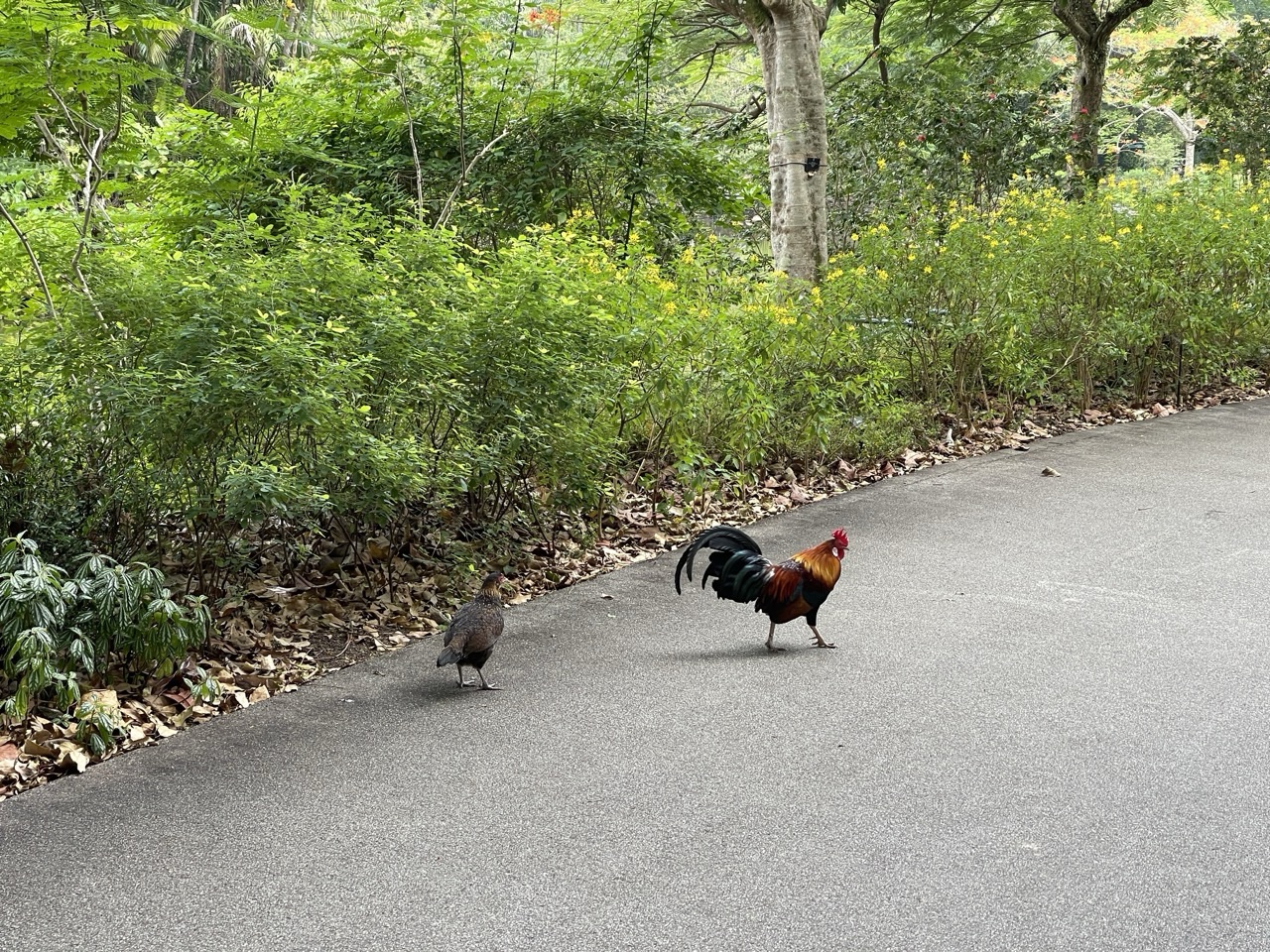
Wildlife in Singapore is not limited to famous nature reserves. Free-roaming chickens, mynas, crows, kingfishers and other birds occur in various urban or semi-natural settings. Residents may observe them near parks, canals, gardens and HDB estates. Their presence is a reminder that biodiversity and ordinary city life overlap.
During haze, a resident may notice birds behaving differently or fewer animals at a familiar location. Such observations can be recorded carefully but should not be presented as proof of haze effects without considering time of day, human activity, weather and seasonal changes. An absence of sightings is not the same as an absence of animals.
Feed wildlife only when specifically permitted under applicable rules; in Singapore, feeding of wildlife is generally prohibited without approval. Food left out may create other issues and encourage animals to approach people or roads.
Parents can teach children to observe quietly and leave animals’ living spaces undisturbed. A strong nature habit is built through patience and respect rather than feeding or chasing wildlife for entertainment.
Are regional peat fires a biodiversity issue?
Fires in forest and peatland landscapes can have ecological consequences in the regions where burning occurs, including habitat loss, changes to soil and effects on plants and animals. Those source-region impacts are distinct from what can be proven at a particular Singapore park during smoke transport.
NEA has linked the October 2026 transboundary haze to fires in Kalimantan and Sumatra and reported how wind direction influenced smoke movement. The ASEAN Specialised Meteorological Centre provides hotspot information that helps researchers and governments understand regional fire patterns.
For a school project, explain the chain correctly: fire or burning can release smoke; atmospheric conditions can transport particles; the smoke affects air quality in downwind places; and land-use changes can affect habitats where burning occurs. Each step may require different evidence.
Avoid claiming that every haze event comes from the same farm, organisation or species habitat without relevant data. The causes and locations can change, and satellite cloud cover can limit observation.
Peat, smoke and the difference between local and regional effects
Peatlands contain accumulated organic material. When they dry and burn, fires can become persistent and generate smoke. Land clearing and fire management are important issues across parts of Southeast Asia, but the exact events and outcomes should be based on verified regional information.
In Singapore, an elevated PM2.5 reading indicates fine particles in the air. It does not tell the reader precisely which peatland burned or what happened to each wildlife population near the fire. Source attribution requires meteorology, hotspot information, fire data and sometimes additional analysis.
This is why the How Haze Works | SEA 2026 hub is useful. It connects land, weather, smoke chemistry and public-health consequences without pretending that one number explains everything.
A student can appreciate the broader biodiversity problem while remaining honest about uncertainty in a specific case.
Haze and migratory birds: do not confuse timing with causation
Singapore lies along migration pathways used by various birds. The timing of bird movements, tide cycles, feeding opportunities and habitats can change the numbers seen during a visit. A birdwatcher who sees fewer migratory birds during a smoky morning has made an observation, not automatically established that haze caused the change.
A careful comparison would need records of observer effort, date, weather, location and species, ideally collected using consistent methods across relevant periods. Even then, establishing causes can require further ecological expertise. A single anecdote on social media cannot substitute for that analysis.
NParks’ birdwatching information encourages quiet observation and respect for nesting birds. Those standards remain relevant during haze. The desire to document an environmental event does not justify disturbing wildlife or entering restricted wetland areas.
If the outdoor conditions are unsuitable for a long observation session, use authorised public species guides and previously collected records indoors to continue learning.
Butterflies, bees and pollinators: explain without overclaiming
Singapore’s parks and gardens support a variety of pollinating insects. Their activity can be influenced by flowering plants, weather, habitat and time. Air pollution may be one environmental consideration among many, but this article cannot assign a measured behavioural effect to each species during October 2026 without appropriate local study.
A gardener may notice fewer butterflies on a particular afternoon. It is sensible to record the observation along with light, rain and plant flowering. It is not sound to declare that all butterflies in Singapore have disappeared because PM2.5 reached a particular band.
For a school investigation, students can design an observation log that distinguishes habitat, time, weather and sightings. They should not intentionally remain outdoors during poor air quality to obtain data. Earlier photographs, published biodiversity materials and suitable indoor work can support the learning objective.
Pollinators contribute to ecological networks, so caring for plants and habitat remains worthwhile even when fieldwork is postponed.
Plants under haze: leaves, dust and photosynthesis
Particles can settle on leaf surfaces and affect how a plant appears. Depending on species, exposure and environmental conditions, pollution may influence plant functions. But a dusty leaf does not automatically mean the plant is dying, and not every yellow leaf can be diagnosed as a haze effect.
Plants also face ordinary challenges involving light, water, soil, pests and temperature. Sudden relocation from a sunny balcony to a dark room can create problems unrelated to smoke. A gardener should follow species-appropriate care and avoid unverified chemical leaf treatments.
NParks’ Gardening 101 resources explain how to provide appropriate growing conditions. A child can learn about photosynthesis and plant adaptation from these materials without spending several hours outdoors during a poor-air episode.
Our Singapore Haze and Gardening Guide explains HDB planters, community gardens, safe washing of produce and why houseplants cannot replace a rated air purifier.
Nature photography: an image is not a wildlife health assessment
Haze can make forests, wetlands and skyline backgrounds appear pale and atmospheric. A photographer may capture a striking scene, but the colour or softness of an image does not determine pollutant concentration, identify a fire source or diagnose the health of a bird.
Light, distance, moisture, camera settings and editing all change appearance. A telephoto lens can emphasise atmospheric layers without telling the viewer the actual PM2.5. If publishing an environmental photo, include its capture date and location, and link to the relevant official measured data when making numerical claims.
NParks’ photography guidance covers respectful nature photography and identifies permit requirements for commercial work. Never disrupt animals, block public trails or enter a protected area to obtain a more dramatic image.
The Singapore Haze Photography Guide explores visual ethics and equipment in depth.
Human health comes first during a nature trip
Birdwatching, wildlife walks and outdoor photography can involve long exposure, especially when visitors wait quietly for animals to appear. A sheltered hide may remain open to surrounding air. A reservoir breeze, forest canopy or coastal wind is not proof of low smoke particles.
Check the latest one-hour PM2.5 before departure and follow the MOH guide for the person involved. At Elevated, healthy people should reduce strenuous outdoor activity; at High, avoid strenuous outdoor activity; at Very High, minimise outdoor activity. Children, older people, pregnant people and people with chronic heart or lung disease need more cautious advice.
A person can value wildlife deeply while postponing one outing. In fact, deferring a trip may avoid pressuring other visitors or family members into unnecessary exposure. Wildlife conservation is a long-term interest that should not depend on completing every planned visit.
For trail specifics, read Singapore Haze Hiking: MacRitchie, Bukit Timah and Rail Corridor.
What should parents tell children about animals during haze?
A child might ask whether the birds can breathe or whether the otters are safe. A helpful response acknowledges the real concern without inventing outcomes: air pollution affects the environment, different animals may respond differently, and scientists need evidence to understand the effects on particular species.
You can explain that adults track smoke and fine particles, protect people’s outdoor activities and conserve ecosystems. A single bird on a branch cannot tell us whether all birds are healthy or unwell. The kindest way to help wildlife is to respect habitats, avoid feeding or disturbing animals and contact trained responders when genuine distress is observed.
Children can continue learning inside with picture books, species identification cards, online park guides or a family photo collection. That preserves the interest without requiring a field trip when conditions are unsuitable.
The lesson is about care combined with accuracy: we protect what we value better when we measure and describe it correctly.
School science: build a haze-and-biodiversity investigation
A science teacher can create a useful inquiry without sending students outside into an unhealthy haze. Present a map of regional fire hotspots, one-hour PM2.5 readings, a Singapore biodiversity guide and dated animal photographs. Ask the students to identify which statements are measurements, observations, hypotheses and unsupported conclusions.
For example, “NEA measured one-hour PM2.5 at a particular range on 17 October” is a measurement with a source and time. “Fewer otters were seen on a student’s route” is an observation requiring context. “The haze caused all otters to leave that river” is a causal claim that needs much more evidence.
Students can also compare the local conservation history of otters with regional forest-fire impacts. The former concerns long-term waterway rehabilitation; the latter involves different landscapes and mechanisms. Combining them carelessly would obscure both stories.
The MOE Reference 86 on Haze Monitoring Literacy and Why Science? Environmental Data offer a foundation for reading evidence carefully.
Four nature situations across Singapore
Bishan otter encounter. A family sees a group of otters near a waterway. They keep a respectful distance, do not feed them and avoid crowding cubs. A child asks whether haze is harming them. The adults acknowledge that a single sighting cannot establish their health and use AVS resources to explain otter habitat.
Sungei Buloh birding group. A planned long observation session falls on a day when the one-hour PM2.5 guide calls for reduced outdoor activity. The group postpones the optional outing, reads about migratory birds indoors and plans a later visit. The conservation interest continues without an unnecessarily long exposed trip.
Bukit Timah student fieldwork. A teacher wants a rainforest biodiversity lesson. Rather than requiring a strenuous hike during poor air, the class compares NParks species guides and historical photos, making a table of observations and questions to investigate on a future suitable day.
Punggol community garden. Residents notice dust on plants and fewer visible insects in one afternoon. They record the observation with time and weather, continue appropriate plant care and avoid concluding that all pollinators have died. A short garden task and suitable indoor learning can coexist.
These are learning scenarios, not dated wildlife census results or real-time reports from the named places.
A wildlife and haze evidence table
| Observation or question | What it supports | What it does not prove | Best source or action |
|---|---|---|---|
| Regional satellite smoke plume | Smoke transport context | Health of one Singapore otter | NEA and ASMC data |
| Elevated one-hour PM2.5 | Current regional air-quality concern | Exact dose inhaled by every bird | NEA monitoring and MOH human guide |
| Fewer birds seen on one visit | A dated observation | Population decline caused by haze | Consistent long-term bird records |
| Resting otter by a waterway | The animal was seen resting | Injury or smoke poisoning | Observe from distance; AVS if distressed |
| Dusty leaf surface | Visible deposited material | A diagnosed plant disease | Plant-specific horticultural assessment |
| Hazy wildlife photograph | Visual appearance at capture time | A numeric pollution level | Timestamp, camera context and NEA |
| Injured or trapped animal | A genuine welfare concern | Cause of its condition | Contact AVS animal response |
| Cancelled nature walk | Human activity adapted to air | All wildlife in the park has disappeared | Revisit when conditions and rules allow |
Frequently asked questions
Does haze harm Singapore wildlife?
Air pollution can affect environments and organisms, but the effect on a particular species, population or animal requires evidence. Do not infer precise outcomes from a hazy skyline alone. Habitat conservation and appropriate scientific monitoring remain important.
Can birds breathe during a haze episode?
Birds continue to breathe air, and environmental particles can be a concern in principle. But this article cannot diagnose or quantify the exposure of an individual wild bird from regional PM2.5. Observe responsibly and report genuine injury or distress through appropriate channels.
Have Singapore’s otters left because of haze?
Do not make that claim without reliable dated population data. Otter distribution and behaviour are influenced by habitat and other factors. AVS describes otters in Singapore’s waterways and provides practical encounter guidance; one missing sighting is not a census.
Where do Singapore’s otters live?
AVS identifies smooth-coated otters in waterways, parks and nature areas, including places such as Bishan-Ang Mo Kio Park and Sungei Buloh. Observations vary; use the official guide and keep a safe distance from wild animals.
Should I feed otters or birds when the air is smoky?
No. Feeding wildlife can interfere with behaviour and raise safety and ecological concerns, and wildlife feeding is regulated in Singapore. A haze episode does not create permission to feed or capture wild animals.
What if an otter looks injured?
Call AVS’s Animal Response Centre at 1800-476-1600 for an injured, trapped or distressed otter. Do not attempt to restrain or treat the animal yourself. Give responders accurate location and observed details.
Does a forest block PM2.5 from regional fires?
Tree cover can influence local environments but is not equivalent to an enclosed high-efficiency particle filter. Use the current NEA readings before long forest walks and follow MOH’s personal activity guide.
Are Sungei Buloh birdwatching hides safe during haze?
A hide may shelter visitors from sun or rain but can still be open to outdoor air. The proper human decision depends on current PM2.5, time outdoors, exertion and personal health. A hide’s roof does not guarantee a particular particle concentration.
Does haze always explain fewer migratory birds?
No. Migration timing, tide, season, observer effort and weather can change sightings. Establishing a haze-related change requires careful data and study rather than one afternoon’s count.
Do Singapore plants remove all haze particles?
No. Vegetation provides ecological benefits but a houseplant or shaded path should not be treated as a certified air cleaner. Correctly sized particle filtration may be needed in a suitable indoor room.
Will haze kill every butterfly or bee?
There is no basis for predicting that outcome from the sky’s appearance alone. Pollinator responses depend on species and environmental context; claims of mortality or population change need reliable studies and observations.
Can children study wildlife without an outdoor field trip?
Yes. NParks species guides, photographs, maps and earlier field notes support indoor science and geography activities. A postponed hike does not mean the educational purpose has been lost.
Can I photograph wildlife during haze?
Consider current public-health outdoor activity guidance, park rules and wildlife welfare. Do not chase or disturb animals for photos, and label environmental images accurately with dates and locations.
Is haze always caused by fires in one specific country?
Regional smoke sources can vary. NEA’s October 2026 updates described smoke from Kalimantan and Sumatra and changing wind transport. Use the specific dated regional evidence rather than permanently assigning every event to one place or actor.
Are Singapore reservoir otters evidence that PUB drinking water is safe?
Otters can indicate aspects of aquatic ecosystem health, but their presence is not a drinking-water compliance test. PUB uses its own treatment and testing system for tap water. Do not substitute wildlife sightings for laboratory results.
What if an animal is resting near a path?
Give it space and observe quietly. Resting alone is not proof of disease. If the animal is injured, trapped or clearly distressed, use AVS’s official help channel instead of attempting a direct rescue.
Continue exploring the eduKate Singapore haze ecosystem
For source regions, fire and smoke movement, begin with How Haze Works | SEA 2026. For human nature outings use Singapore Haze Hiking, Singapore Haze Photography and Singapore Haze Cycling.
For household animals and plants, read Singapore Haze Pets and Singapore Haze HDB Gardening. For nature-learning alternatives and children see Singapore Haze Weekend Family Activities and Singapore Haze School Activities.
The evidence branch includes MOE Reference 86: Haze and Environmental Monitoring Literacy, How Singapore Connects: PSI and Air Quality Monitoring and Why Science? Air Quality, PSI and Environmental Data.
Official sources and editorial scope
Primary references: NEA Haze Portal, NEA 17 October 2026 Situation Update, MOH Haze Health Guidance, NParks Birdwatching, AVS Otters in Singapore, NParks Central Catchment Nature Reserve, NParks Photography and Wildlife Etiquette, and ASMC.
Prepared in October 2026 as a Singapore nature and environmental-literacy reference, not a wildlife census, veterinary diagnosis or live park-opening notice. Respect people, animals and the limits of available evidence. Singapore’s ecosystems remain worth understanding and protecting even on days when an outdoor visit is postponed.