
SimplyGo is Singapore’s account-based public transport payment system. EZ-Link is a travel-card brand, and an EZ-Link card is not automatically the same thing as a contactless bank card. You can pay for eligible MRT, LRT and bus journeys with a SimplyGo EZ-Link card, a supported contactless bank card, a compatible mobile wallet or a suitable concession card. The important rule is to use the same card or wallet payment method to tap in and tap out.
If you searched for SimplyGo EZ-Link, MRT fare Singapore, how to pay for MRT, SimplyGo app, missing entry or exit, contactless bank card for buses or EZ-Link card refund, most confusion comes from mixing the payment object, the ticketing technology and the actual fare calculation. A bank card can work without being topped up, while a stored-value card may need funds. An account-based fare may not show its final amount at a fare gate.
Quick summary: Identify the exact card you have; use one card or one wallet consistently for entry and exit; check concession eligibility rather than assuming every card is discounted; look up trip history in the official SimplyGo system; and check a card’s expiry and refund conditions before replacing it. This chapter turns those practical actions into clear vocabulary.
SimplyGo vs EZ-Link vs contactless bank card: quick comparison
| What you use | Where payment comes from | What to remember |
|---|---|---|
| SimplyGo EZ-Link | Value associated with a supported SimplyGo travel card | Keep enough funds, and check trip records in the app or kiosks |
| Supported contactless bank card | Debit or credit account linked to the card | No separate transit-card top-up; take the correct card out of your wallet |
| Supported mobile wallet | Bank card added to the phone or wearable | Tap out with the same wallet device, not its separate physical card |
| Concession card | Approved concession product under its conditions | Discount depends on eligibility and card type, not the reader alone |
| Older EZ-Link product | Card-based stored value where supported | Displayed fare and balance behaviour can differ from SimplyGo cards |
42 Singapore transport fare terms explained
Learn what the term refers to before deciding whether it is a charge, card, technology, eligibility rule or an action you must perform at a reader.
| Word or phrase | Plain-English meaning | Practical meaning for your journey |
|---|---|---|
| SimplyGo | The account-based fare payment ecosystem | Includes contactless bank cards, mobile wallets, and compatible travel cards. |
| EZ-Link | A brand of contactless payment cards | Not every EZ-Link product uses the same backend ticketing technology. |
| SimplyGo EZ-Link | EZ-Link card compatible with account-based ticketing | Trip costs are shown via backend records rather than immediately at the gate. |
| Legacy EZ-Link | Older card-based stored-value product | Can show value and fares differently; check product and compatibility. |
| ABT | Account-Based Ticketing | Fare records are processed by a backend system associated with the card or account. |
| CBT | Card-Based Ticketing | Ticketing records and stored value are handled on the card under the older system. |
| Contactless bank card | Tap-enabled debit or credit card | May pay directly for public transport without buying a separate travel card. |
| Mobile wallet | Phone/watch payment system | A supported bank card can be presented through Apple Pay or other compatible wallet. |
| Token | Identifier used by a payment device | Physical and mobile versions of a card may be treated as separate transit identifiers. |
| EMV | Payment-card technology standard | A contactless bank card can be accepted for transit if it meets relevant conditions. |
| NETS | Singapore electronic-payment network | Specific accepted NETS card products depend on the current transit rules. |
| Tap in | Record journey entry | Do this at the start of each MRT/LRT or bus journey as required. |
| Tap out | Record journey exit | Use the same physical card or same wallet device as entry. |
| Fare gate | Barrier validating train entry or exit | Does not itself prove the fare’s final amount for account-based cards. |
| Bus card reader | Device that records card boarding and alighting | A successful tap matters for accurate distance-based fare calculation. |
| Fare | Amount charged for a trip | Can depend on distance, service type, payment method and concession status. |
| Distance fare | Fare calculated from travel distance | An example of a pricing rule, not the number of train stations alone. |
| Transfer | Continuing a journey with a connecting service | Fare integration depends on published transfer conditions. |
| Transfer time limit | Allowed time between qualifying trip legs | Miss the criteria and a new journey/fare treatment may apply. |
| Missing entry | No valid boarding or entry record | Can lead to a higher or default charge; check for correction channels. |
| Missing exit | No valid alighting or exit record | Can trigger a default charge even if you travelled a shorter distance. |
| Claim | Request for review of a fare or card issue | Submitting a claim is not a guarantee it will be approved. |
| Journey history | Record of trips or transactions | Check in the SimplyGo app or eligible kiosks. |
| Estimated fare | Preliminary displayed trip amount | May differ from final settled bank transactions or later adjustments. |
| Posting | When a transaction appears in a bank account | The timing may differ from the actual ride. |
| Concession | Discounted fare for a qualifying group | Not obtained simply by using a contactless bank card. |
| Concession card | Travel card linked to eligibility | Types include student, senior and other approved concession groups. |
| Monthly travel pass | Product covering qualifying travel over a period | Cost-effectiveness depends on eligibility, travel frequency and scope. |
| Adult monthly travel card | A travel card or product for adult passes | Distinct from a contactless debit card used for each trip. |
| Stored value | Money held for travel on the relevant card | Account-based cards and bank cards can handle payment differently. |
| Top-up | Adding value to a stored-value travel product | Unnecessary when eligible contactless bank cards pay directly from a bank. |
| Auto Top-Up | Automatic reload of a compatible card | Requires activation and has product-specific conditions. |
| Low-value alert | Warning about insufficient available funds | May signal that a top-up is needed before travel. |
| Card expiry | Date after which a card may stop working | Different from the end date of a student’s concession entitlement. |
| Refund | Return of qualifying remaining card value | May require presenting a card or contacting a ticket office. |
| Card clash | Interference from multiple tap-ready cards | Taking the intended card out of the wallet reduces misreads. |
| Foreign bank card fee | Possible extra charge for eligible foreign-issued bank cards | Check the stated card scheme and prevailing daily administrative charges. |
| Tourist pass | A visitor-oriented transport product | Not always the cheapest choice for every itinerary. |
| Fare calculator | Official tool to estimate specific travel cost | Use current routing and fare information rather than an old screenshot. |
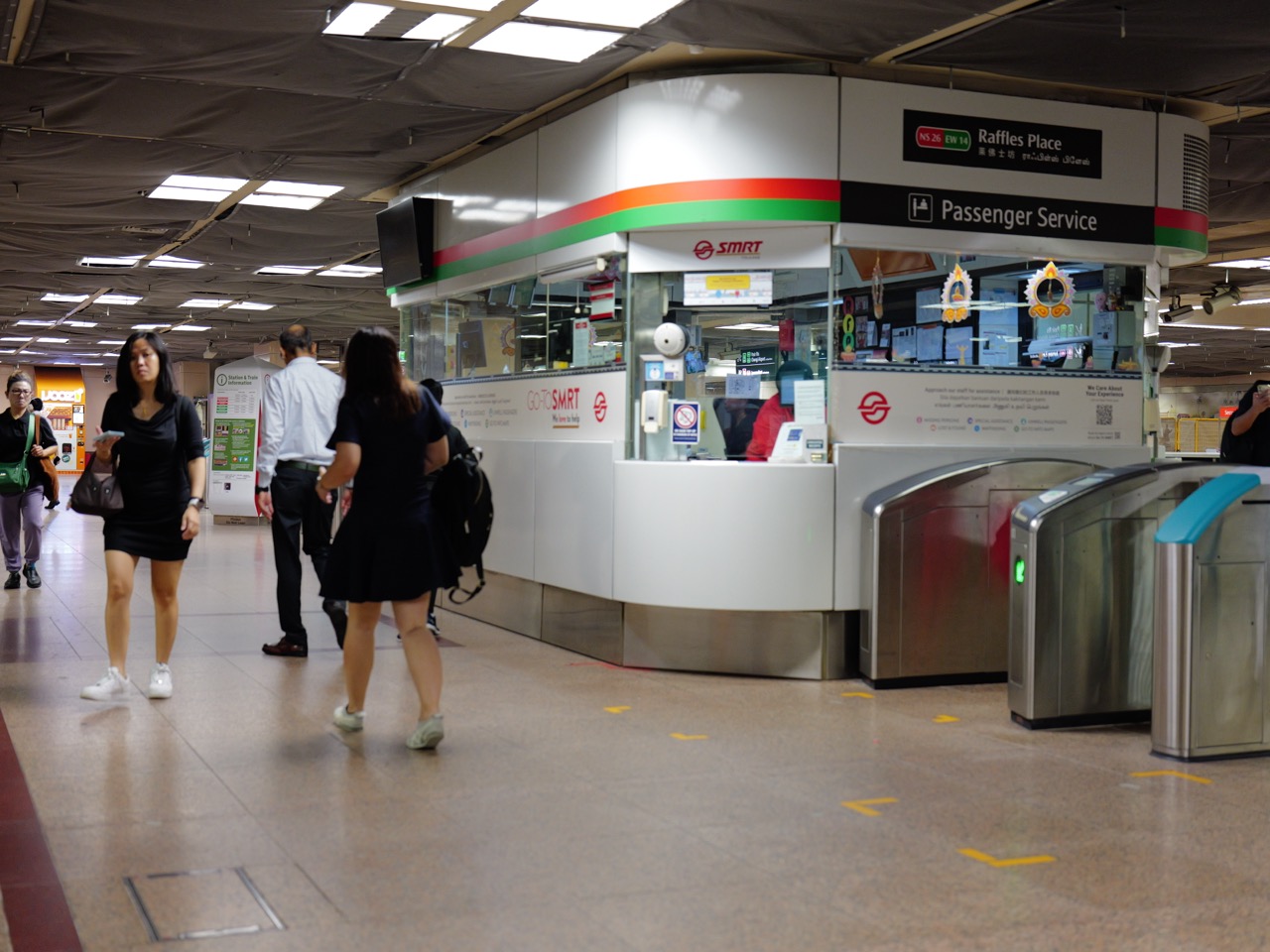
| Passenger Service Centre | In-station assistance point | Useful when a gate rejects a card or a fare record is unclear. |
| Ticketing Service Kiosk | Self-service machine for card and trip information | Available services differ by model and card type. |
| Payment dispute | Question about an unexpected charge | Check trip history before escalating via the official dispute channel. |
How a bus or MRT journey becomes a fare
1. The reader identifies a payment method
A bus card reader or MRT fare gate needs to recognise one eligible payment method. That is why a wallet containing several contactless cards can create a ‘card clash’ or accidental use of the wrong card. A card that was charged for a trip may not be the one you thought you used. Remove the intended card from the wallet when tapping, or hold a single supported phone or wearable near the reader.
2. Entry and exit are recorded
For trains, the entry gate and exit gate define a journey. For buses, you tap on boarding and alighting. The system then uses relevant distance-based fare and transfer rules. A valid entry is not a substitute for a valid exit. One missing tap can change the recorded trip and its calculated cost.
3. The backend calculates the account-based fare
SimplyGo EZ-Link and eligible bank-card journeys use account-based processing. The fare and stored-value details may not be displayed immediately on the fare gate screen. That does not necessarily mean the fare is zero or that a charge has been lost. It means the final transaction record is checked in a different place, such as the SimplyGo app or supported ticketing kiosks.
4. The payment is posted or reconciled
A bank statement may show a transport charge at a different time from the actual ride because of transaction processing. Do not assume a notification’s timestamp identifies the exact boarding time. Compare the official journey history, the card that was presented and the bank transaction before raising a dispute.
Why you must use the same mode when tapping in and out
A physical contactless bank card and that card added to Apple Pay or another mobile wallet may represent different payment identifiers. SimplyGo specifically advises not to tap in with the physical bank card and tap out with its mobile-wallet version. The system can treat these as separate journeys and record a missing entry or exit. The safest rule is not just ‘use the same bank account’; it is use the same physical card or the same supported wallet method for both taps.
Imagine a commuter tapping a physical Visa card at the start of a train journey. At the destination they tap the phone using the same Visa card saved in their wallet. The commuter thinks they used one card, but the ticketing system may see two different identifiers. The resulting fare issue is not solved by proving that both payment methods draw from one bank account; it is solved by keeping entry and exit consistent and reviewing any incorrect charge through official channels.
Missing entry, missing exit and card clash
| Problem on screen or statement | Possible explanation | Practical response |
|---|---|---|
| Missing entry | Entry did not record on the intended card | Check whether a second card or wallet was used; review trip history |
| Missing exit | Exit was not recorded or used another identifier | Verify the last tap and submit an eligible claim if incorrectly charged |
| Card clash | Multiple tap-ready cards were detected | Present one card outside the wallet and try again as directed |
| Low value | Travel card has insufficient usable funds | Top up through an accepted channel and follow synchronisation guidance |
| Unexpected deduction | Settlement, missed tap or another card may be involved | Compare timestamp, trip details and actual payment method |
| Expired card | Validity period has ended | Check replacement/refund options at an official ticket office |
SimplyGo’s published guidance explains that certain missing-entry or missing-exit trips incur a default fare treatment. The exact amount and claim window can change, so avoid memorising an unsourced penalty figure. First identify which record is wrong, then use the provider’s documented fare-claim process rather than contacting an unrelated seller.
Concession fares: being a student or senior is not the card itself
A concession is an entitlement under a published set of rules. Singapore has different concessions for eligible students, seniors, persons with disabilities, certain Workfare recipients and other qualifying groups. A generic contactless bank card normally charges regular adult fares, even if its owner happens to be a student or senior. To receive a concession, use the approved card or eligible arrangement and check its conditions.
The word ‘eligibility’ is important. A student may have a school card, but the fare privileges and travel passes associated with it can depend on school type, age and current status. A visitor buying a tourist pass has a different product from a resident using an adult monthly pass. Rather than asking only ‘How much is the card?’, ask, ‘Which fares, routes and dates does this pass actually cover?’
How to check MRT fares and transfer rules
SimplyGo publishes adult fare tables and official journey-planning information. Its adult fare page lists fares as updated on 27 December 2025. For a specific trip, it recommends using the Travel Guide to obtain an exact fare rather than guessing from distance alone. The service type matters too: trunk buses, express services and concessions need not have identical charging structures.
Transfer fare rules are designed to treat qualifying connected trips differently from completely new journeys. But a traveller should not assume that every pair of trips qualifies. A transfer may be constrained by elapsed time, service combination or other published rules. One of the most useful vocabulary distinctions is between transfer (a connected journey meeting conditions) and new trip (one that does not).
Adding value, card expiry and refunds
A SimplyGo EZ-Link card has different administrative requirements from a bank card. Some travel cards need top-ups to maintain sufficient value. Top-ups through particular machines or mobile channels may take effect differently; SimplyGo guidance notes that some top-ups may need a kiosk tap to synchronise immediately. Before travel, check the card type, value and the accepted top-up channel.
From 29 August 2026, SimplyGo states that EZ-Link and SimplyGo EZ-Link top-ups are no longer available at AXS Stations. That change illustrates why a guide listing every historical top-up place becomes unreliable: a station kiosk or official SimplyGo channel may still be supported while an older third-party option is discontinued. Use the current ‘where to top up’ instructions rather than an old article.
When a card expires, a person may be eligible to obtain a refund of remaining value or a replacement card through the official ticket office process. Auto top-up arrangements may require separate termination or reactivation and refund routes can vary by card type. The word ‘refund’ must be separated from ‘new card cost’; the purchase price of a replacement card may include a non-refundable component.
Foreign-issued cards and extra charges
Many supported foreign-issued contactless bank cards can be used for transit, but SimplyGo states that foreign-issued Mastercard and Visa debit or credit cards may incur a S$0.60 daily foreign bank card administrative fee, under the conditions on its current guidance. That fee is not the train fare itself and it does not mean all foreign visitors pay it on every kind of card. Travellers should also check bank exchange-rate and foreign-currency charges separately.
Common misunderstandings corrected
| Misleading claim | More accurate version |
|---|---|
| SimplyGo and EZ-Link are identical. | SimplyGo is an account-based payment system; EZ-Link includes different card products. |
| I need to buy an EZ-Link card before any MRT trip. | Eligible contactless bank cards and wallets may pay directly for trips. |
| The gate didn’t show a fare, so I wasn’t charged. | Account-based transactions may be shown in the app or backend instead. |
| My physical bank card and phone wallet are always interchangeable for one journey. | Use the same actual payment method for entry and exit. |
| All student and senior bank cards receive concession fares. | Concessions depend on valid eligible concession products. |
| A top-up works through every machine used last year. | Top-up channels can change and vary by card product. |
| If the bank statement has a later date, the trip is fraudulent. | Check the actual journey history and payment processing before concluding. |
| SimplyGo EZ-Link pays for ERP and car parks like an EZ-Link motoring card. | SimplyGo states its SimplyGo EZ-Link product does not pay motoring charges. |
A useful checklist for everyday commuters
- Decide which single physical card or mobile wallet you will use today.
- Check that the payment method is supported and has sufficient funds or credit.
- Tap in and out consistently, and do not leave multiple contactless cards together at the reader.
- If entitled to concession fares, use the appropriate valid concession card rather than a generic bank card.
- Check the SimplyGo trip history when a charge seems wrong; note the relevant journey details.
- If your card is near expiry, read the official card refund and replacement process.
- For a visitor, compare a bank-card fare, possible administrative fee and tourist-pass price for your actual itinerary.
Frequently searched SimplyGo and EZ-Link questions
Can I use my Visa or Mastercard for MRT in Singapore?
Supported contactless Visa and Mastercard cards can pay for eligible public transport travel under SimplyGo. Other accepted schemes include supported American Express and NETS products. Check card acceptance conditions and foreign-issued card charges.
Do I need the SimplyGo app to use a contactless bank card?
SimplyGo says you can use an eligible contactless bank card without signing up for a SimplyGo account. The app is useful for trip-history checks, notifications and managing certain products.
Why doesn’t the MRT gate show my SimplyGo fare?
On account-based cards, fares and remaining value are processed through the backend, so an immediate display at the gate is not necessarily available. Check the SimplyGo app or supported kiosk.
Can I tap in with my card and tap out with Apple Pay?
You should not switch between a physical bank card and its mobile-wallet representation during one trip. SimplyGo warns that this can create separate entry/exit records.
What is the difference between EZ-Link and SimplyGo EZ-Link?
SimplyGo EZ-Link is an EZ-Link product compatible with account-based ticketing. The older card-based product may have different value-display and administrative behaviour.
How can I find the exact MRT fare?
Use the official SimplyGo fare tables and Travel Guide for the intended journey and card category. Do not assume one fixed charge for every number of stops.
What should I do about a missing exit charge?
Check trip history and the card or wallet used at each reader. Then follow SimplyGo’s fare-claim instructions if the charge is incorrect.
What happens when my EZ-Link card expires?
Review the provider’s current expiry, refund and replacement procedures. They differ by card and top-up arrangement; use a ticket office or official service channel.
Practise the words through four journeys
| Exercise | Situation | What the reader learns |
|---|---|---|
| 1 | A commuter carries three cards in one wallet | Card clash is a reader issue, not a new fare policy |
| 2 | A commuter uses phone payment on the return tap | Physical and wallet tokens can be distinct |
| 3 | A senior uses an ordinary debit card for a trip | Concession depends on the approved card or programme |
| 4 | A visitor compares a bank card and tourist pass | Total journey cost includes card-specific charges and itinerary |
Related eduKateSG reading
- Singapore Vocabulary | MRT Wayfinding and an Accessible City — directions and accessibility vocabulary.
- Singapore Vocabulary | Public Transport Courtesy — language for sharing trains and buses.
- Singapore Vocabulary | Car Ownership and COE Terms — how another kind of travel cost works.
- Master Vocabulary — understanding and using words.
- Vocabulary Articles & Knowledge — related practical topics.
Official transport information
- SimplyGo: contactless bank-card FAQs — use, device consistency and billing.
- SimplyGo: SimplyGo EZ-Link FAQs — account-based cards and trip history.
- SimplyGo: adult public transport fares — official dated tables.
- SimplyGo: EZ-Link card FAQs — expiry, refunds and top-up issues.
- SimplyGo home — live services and support.
Reviewed 3 November 2026. This article teaches transport vocabulary and practical checks; fares, card products, top-up channels, charges and conditions can change. Use the latest official information for your actual journey.