
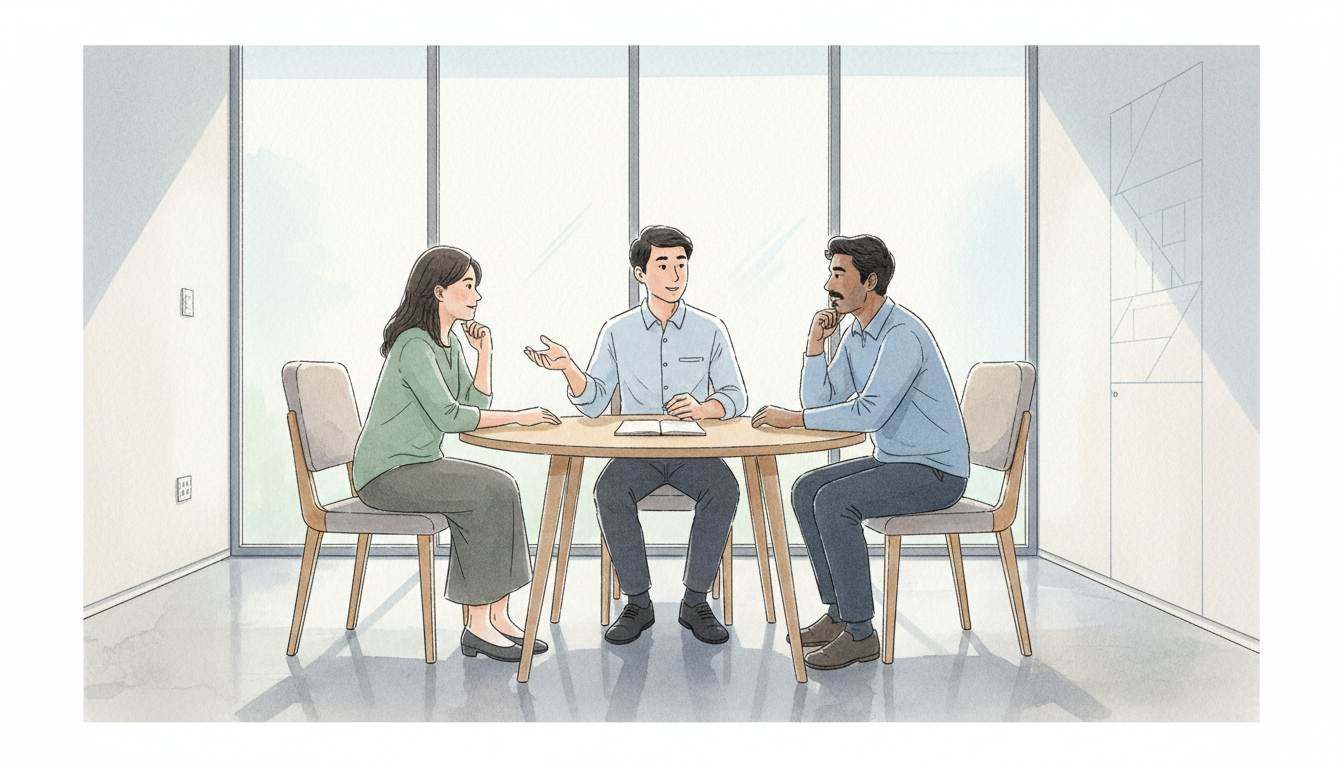
Cultural disagreement may concern a mistaken date, a broken permission, competition for space or different values. I would not rush those into one general call for harmony. This guide shows how to distinguish the issues and choose a safe, fair process that can lead to a realistic action.
The worked cases are fictional. Mediation is not a substitute for legal remedies, independent investigation, safeguarding or emergency protection. Professionals and responsible authorities must handle the actual high-stakes matters in their setting.
Five reading routes
Chapter index
Identify the disagreement · Chapters 1–3
Build a fair process · Chapters 4–6
Respect rights and truth · Chapters 7–9
Support durable dialogue · Chapters 10–12
Resolve practical conflicts · Chapters 13–15
1. A cultural disagreement is not always a misunderstanding
When people disagree over an exhibition, a festival, a shared cultural space or the use of recorded stories, they may be describing different problems. One person challenges a historical fact, another seeks recognition, another needs physical access and another alleges a broken agreement. A mediator who treats them all as a simple failure to communicate may overlook the choice that actually matters.
The Gold Standard of Cultural Conflict Mediation is a careful process for identifying the dispute, protecting participants, clarifying facts and authority, enabling meaningful dialogue and reaching workable outcomes where agreement is appropriate. Mediation is not a universal substitute for legal remedies, safeguarding, investigation or professional decisions.
Start with the problem stated by each participant in their own terms. Ask what event or decision triggered it, whose rights or responsibilities may be involved, what cannot safely be discussed in a joint session and which outcomes are within the participants’ power to agree. The process should not promise harmony before understanding the dispute.
2. Separate facts, interpretations, values and interests
A museum caption can contain an incorrect date, an interpretation of an object and a judgment about why a tradition matters. Different kinds of disagreement need different methods. A disputed date may be checked against records; a value disagreement requires people to explain priorities; a contractual issue may require review of a signed agreement.
Ask each party to distinguish the claim they can support from the conclusion they prefer. A performer might say a video was edited beyond agreed use; the organiser might believe a broad publicity clause permitted it. The documents and intended use matter more than repeating how upset either person feels, while the experiences are still relevant to a workable response.
A useful mediator summarises without deciding the historical truth from personal intuition. Where expertise or independent investigation is necessary, the process can refer the question to competent people rather than demand that every participant agree on a claim it cannot establish.
3. Protect safety, dignity and the right not to mediate
Mediation requires an appropriate setting and meaningful voluntary participation. Where threats, coercion, serious discrimination, significant abuse or major power imbalance are present, a joint meeting may be unsafe or inappropriate. The affected person should not be pressured to reconcile in order to receive protection or access to an established complaint process.
Conduct a suitable intake and consider separate discussions, professional safeguarding or formal routes. Explain what mediation can and cannot achieve, including whether information may be confidential and the limits of that confidentiality under law and organisational duty. Participants should know how to stop the process.
UNESCO’s Intercultural Dialogue Programme develops dialogue as a means of navigating difference and conflict. It does not replace an organisation’s safety responsibilities or turn every cultural dispute into a matter solvable through facilitated conversation.
4. Clarify the mediator’s role and potential conflicts
A mediator does not become the cultural authority for every group at the table. The role is to support a fair process, clarify issues and help parties examine choices within the limits of the appointment. Impartiality concerns how people are treated; it does not require pretending that unsupported facts and verified evidence deserve equal weight.
Explain who appointed the mediator, what information they will receive, which decisions they can make, and how conflicts of interest are managed. An organiser involved in the disputed exhibition may be a suitable contact for solving logistical problems but not the right independent facilitator when their own conduct is central to the complaint.
Distinguish facilitation, mediation, arbitration, professional review and legal decision-making. These processes have different authority. A responsible mediator should refer a question beyond their competence instead of disguising a binding decision as the product of voluntary agreement.
5. Make language access and participation usable
People may appear to agree simply because they cannot follow the vocabulary, speed or social rules of a meeting. A cultural dispute involving several languages may require qualified interpreting or translated materials and enough time for questions. Family members should not automatically be made responsible for sensitive professional translation.
Choose formats suited to participants’ communication, mobility and other needs. Explain in advance how turns will be taken, what will be recorded, which documents matter and how a person can raise a concern privately. Make it possible to participate without revealing unnecessary medical or personal information.
Cultural Accessibility and Cultural Translation provide companion methods. Access is a condition of an informed process, not a courtesy added after an agreement is drafted.
6. Listen for unequal power and hidden costs
A large institution can pay advisers and wait through several meetings; an individual performer may lose income each time a session is rescheduled. A resident may worry that disagreeing with a public authority will affect future use of a community venue. These concerns shape what participants are able to say.
Discuss practical barriers and, where appropriate, provide support consistent with the programme’s rules. A smaller or separate session may allow someone to explain a problem without a public confrontation. Do not pressure participants into agreement merely because a funding deadline approaches.
Fair treatment also requires clarity about authority. A community representative might describe a widely shared concern without having a mandate to release another individual’s recording or waive a whole group’s rights. The process should not use power imbalance to create an apparent consent that was never valid.
7. Do not turn cultural diversity into a licence for harm
Respecting cultural difference does not require an organisation to excuse threats, discriminatory exclusion or misuse of personal material. Likewise, protecting rights does not mean that a mediator must endorse a single stereotype of any community. The situation requires an examination of facts, applicable standards and the people affected.
The UNESCO Universal Declaration on Cultural Diversity connects cultural diversity with dignity and human rights. It provides a useful normative reference, but the actual remedies and lawful duties depend on jurisdiction and context.
Ask what interests or rights are at stake, which limits are non-negotiable and which practical arrangements remain possible. Dialogue may help people understand each other, but it cannot require someone to relinquish legal protection as the price of being listened to.
8. Handle competing histories through sources and scope
An exhibition about a market may be criticised because its caption treats one family’s recollection as the history of every stallholder. One group seeks a corrected date; another wants a different episode remembered. These requests are not identical, even when both are voiced as a dispute about cultural representation.
Separate source review from a negotiated editorial process. Historians or archivists can test dates and provenance; affected contributors can explain missing experiences or misleading framing; a responsible institution decides the final public interpretation under its actual duties. The mediator should not invent consensus where documentary evidence or community perspectives remain divided.
An outcome may be a corrected label, a clearly attributed additional account, a research plan or an explanation of why a particular claim cannot be adopted. Accurate disagreement may serve the public better than a falsely unanimous statement.
9. Define remedies people can actually deliver
An agreement that says “respect culture” can sound reassuring but be impossible to test. A useful resolution identifies an action, responsible party, evidence of completion, timing and process for new concerns. The action might involve correcting a caption, changing a tour route, clarifying rehearsal access or seeking fresh permission before publishing a video.
Some issues cannot be resolved by the parties in the room. A museum may lack authority to return an object without legal review; a festival coordinator may not control the streets outside its venue; an archive cannot retract every authorised copy already distributed. State those limits before promising an outcome.
Use a small decision record with only necessary information. Confidential or sensitive details should be handled according to the agreement and applicable requirements. A concise, workable next step is often more valuable than a lengthy declaration of friendship.
10. Keep room for ongoing disagreement and review
An effective process need not end in identical beliefs. A resident can continue to dislike a proposed exhibition while recognising that their account was recorded accurately and their access concern was addressed. A museum can maintain a scholarly interpretation while displaying a relevant unresolved debate.
Agree how future evidence or changing circumstances will be handled. The parties might schedule a label review after new records emerge, evaluate a trial event route or appoint a suitable contact for corrections. Record which questions remain open rather than pretending mediation settled all historical and ethical issues.
UNESCO’s framework for measuring intercultural dialogue illustrates that constructive engagement involves skills and conditions, not merely one conversation. A local project still needs its own appropriate review.
11. Worked case: a community mural omits living residents
In a fictional neighbourhood, the council unveils a heritage mural showing historic shopkeepers but excluding the people who run the shops today. Residents object that it portrays their work as a vanished relic. The artist says the commission was explicitly about the past and fears that every requested change will undermine the design.
An appropriate facilitator first identifies the actual choices: historical accuracy, credits, explanatory wording and possible additions. The parties examine source records and the commission. They may agree on a revised contextual plaque or a complementary contemporary panel without demanding that the original artwork represent every person.
The process succeeds if each party understands what changed and why. It need not produce universal approval of the mural. The agreement should say who will deliver the correction and how future issues can be raised.
12. Worked case: a performance recording is reused beyond its understood scope
A fictional cultural festival posts an edited rehearsal clip as a commercial advertisement. A performer says they agreed only to internal rehearsal documentation, while the producer believes an event participation form covered publicity. The disagreement concerns an actual use and agreement, not only cultural sensitivity.
Review the relevant documents, the recording, the context in which consent was sought and any applicable rights. The parties may seek suitable professional advice before discussing options such as suspending the clip, negotiating a limited licence or revising future recording practices. The mediator should not invent a legal answer if the contract is genuinely disputed.
Any resolution should identify which versions are affected, who can authorise new releases and what will happen to existing public copies where practicable.
13. Worked case: a festival uses the last affordable rehearsal hall
A fictional festival secures exclusive use of a community hall for several weeks, displacing a small dance group that rehearses there year-round. Organisers say the festival will celebrate local culture; dancers say they are losing the very space needed to sustain their practice.
The issue can be mapped as competing claims to scarce time, affordability and continuity, with relevant booking rules and contractual obligations. Participants review alternate schedules, financial support and future access with the responsible venue manager. A mediator can help clarify needs without ignoring the institution’s safety or budget duties.
A workable arrangement might share dates or fund temporary space, provided the actual parties have authority to agree. The cultural lesson is that public spectacle and everyday transmission must be considered together.
14. Worked case: a translated exhibition caption causes offence
A fictional museum translates a recorded proverb into another language. Its label changes an affectionate form of teasing into a harsh statement about a neighbouring community. Visitors protest and staff insist the translation is technically literal. The issue includes language evidence and the dignity of the people represented.
The institution obtains competent language and cultural review, checks the source audio and corrects misleading wording. Contributors are informed appropriately, and the translation workflow is revised. Dialogue can address the impact of the mistake, while source checking determines what the speaker actually said.
The correct remedy does not require visitors to agree on every interpretation of the proverb. It requires the public account to stop asserting a meaning the evidence cannot support.
15. Review safety, fairness, evidence and the durability of agreements
A mediation report should not claim that cultural conflict has been eliminated because participants shook hands. Examine whether people could take part voluntarily and safely, the right questions were identified, important evidence was reviewed and any agreed actions were completed.
Use a proportionate follow-up: Who was responsible for the correction? Was the venue arrangement implemented? Was a disputed recording removed or lawfully reauthorised? Can someone report a recurrence without beginning a public fight? Where the process could not resolve an issue, document that limit and any referral.
The gold standard is fair, informed dialogue that can produce defensible practical outcomes without sacrificing rights or rewriting history. A decision to stop mediation and use a more appropriate process may itself be the responsible result.
| Conflict type | Evidence or condition | Appropriate direction |
|---|---|---|
| Disputed fact | Source records and expertise | Evidence review and correction |
| Rights or safety risk | Consent, law and protection needs | Specialist or formal referral |
| Resource conflict | Booking rules, needs and capacity | Workable authorised arrangements |
| Interpretive differences | Perspectives and public claims | Fair dialogue and bounded account |
Frequently asked questions
Must every cultural conflict go to mediation?
No. Safety risks, legal rights, coercion and formal duties may require investigation, protection or another process.
Does impartiality mean all factual claims are equally supported?
No. Fair process can still recognise differences in the evidence supporting a claim.
Can a mediator decide who owns cultural heritage?
Not merely by acting as mediator. Such questions may require law, evidence, professional review and authorised decision-makers.
What if parties disagree after mediation?
A workable process can document unresolved differences and focus on the actions within participants’ authority.
Are mediation discussions always confidential?
No blanket promise is safe. Explain the agreement, legal duties and relevant exceptions before participation.
Should an interpreter be used?
Where needed for informed dialogue, choose suitable competent assistance and plan its role and confidentiality.
Can a cultural organisation correct a caption without formal mediation?
Often a direct evidence-based correction process is more appropriate. Choose the least burdensome responsible route.
What makes an agreement useful?
Clear actions, responsible parties, boundaries and a process for checking completion or addressing later concerns.
Is this professional mediation or legal advice?
No. It is educational editorial guidance, not a mediator credential or legal determination.
Connected Gold Standard culture and mediation guides
Choose the published specialist guide that owns the actual next issue: rights, evidence, interpretation, community participation or professional mediation. These editorial links do not certify a mediator or guarantee an outcome.
- The Gold Standard of Culture
- Cultural Participation
- Cultural Rights
- Cultural Governance
- Cultural Representation
- Cultural Translation
- Cultural Exchange
- Cultural Co-Creation
- Cultural Interpretation
- The Gold Standard of Community
- Community Mediation Services
- The Gold Standard of Museums
- Culture Further Reading Index
- Gold Standard Master Collection
- Deep Reading Index
Official dialogue and heritage reference routes
- UNESCO — Intercultural Dialogue Programme
- UNESCO — Measuring Intercultural Dialogue
- UNESCO — Universal Declaration on Cultural Diversity
- UNESCO — Ethical Principles for Intangible Cultural Heritage
UNESCO resources inform constructive dialogue and rights contexts, but they do not settle local legal disputes, override safeguarding or validate particular mediation agreements. Seek professional and responsible authority guidance as needed.