
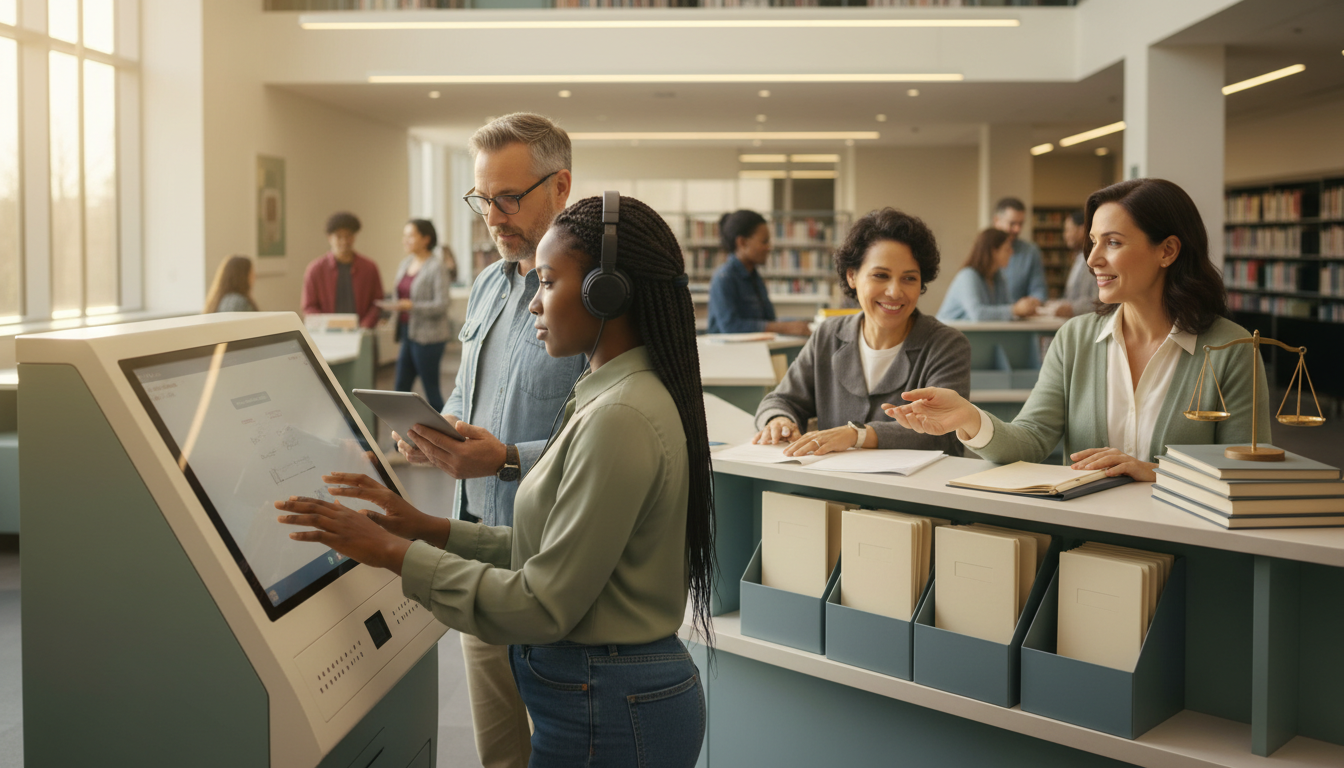
Culture is not genuinely open because a sign says “everyone welcome.” I would ask whether people can discover, reach, understand, create and contribute to the cultural experience in forms that make sense to them. This guide turns that question into practical tests.
The worked cases are fictional learning scenarios; no museum, theatre or service is being ranked or certified. International rights and design standards inform the discussion, but the law and professional duties of the actual setting must be checked separately.
Five reading routes
Chapter index
Map the person’s route · Chapters 1–3
Make access understandable · Chapters 4–6
Enable language and digital access · Chapters 7–9
Respect cultural boundaries · Chapters 10–12
Test what changes · Chapters 13–15
1. Accessibility means joining cultural life, not merely entering a venue
I can look at a museum entrance, see an accessible doorway and conclude too quickly that the experience is open to everyone. The route may still include unreadable labels, inaccessible audio, a confusing booking system or a workshop where only some visitors are allowed to create. An open door is important; it is not the full test.
The gold standard of cultural accessibility means enabling meaningful opportunities to discover, understand, participate in, create and contribute to cultural life. The UN Convention on the Rights of Persons with Disabilities, Article 30 provides a rights reference for cultural materials, programmes and places in accessible formats. It also recognises the opportunity to develop creative and artistic potential.
Begin with a practical question: what does a person need to do before, during and after the experience? The answer may involve booking, transport, reading, sign-language support, a quiet space, affordable participation or the ability to raise a concern without losing dignity. Each barrier needs an actual design decision.
2. Map the whole journey instead of counting access features
A venue may list an accessible lift, but a first-time visitor might not know which entrance reaches it. An online booking page may support keyboard navigation but offer no useful description of the show’s sensory demands. A guided tour may be accessible in principle but require standing through a long introduction.
Draw the journey from discovery to return home. Examine the promotional page, booking, transport information, arrival, ticketing, movement, orientation, the cultural encounter, rest facilities, assistance, feedback and follow-up learning. Invite people with different access needs to test those routes rather than assuming staff can simulate unfamiliar experiences.
Record evidence of actual tasks completed, not only facilities installed. Can a visitor find an accessible entrance without calling three departments? Can someone understand the exhibit with the formats offered? Can a participant make a meaningful contribution to the workshop? A route that succeeds in practice is more useful than an impressive checklist never tried with real users.
3. Understand disability access and wider exclusion without conflating them
Disability-related barriers may involve mobility, sight, hearing, sensory processing, cognition, communication or other access needs. Other forms of exclusion can involve language, ticket price, working hours, childcare, geographic distance, digital equipment or a sense that the institution is not welcoming. These issues can overlap, but they do not have identical solutions or legal frameworks.
A museum may need accessible physical routes and audio description, while a community archive may need translated guidance and a low-cost way to request records. A performer with a disability may face barriers in rehearsal, backstage facilities and contract arrangements that the visitor-facing access statement does not mention.
Describe the actual barrier before prescribing a feature. Treat different people as individuals; do not assume that everyone with a similar diagnosis or cultural background prefers the same assistance. The question is what choices an institution makes available and whether people can exercise agency over how they participate.
4. Make information about access reliable before arrival
An access page should help a person plan, not simply reassure them. Explain the entrance, physical route, distances where useful, rest opportunities, toilets, assistance contacts, booking requirements, language and communication supports, sensory features and known limitations. If an accessibility feature is temporarily unavailable, update the page promptly.
A visitor may choose not to attend if the information is uncertain. That is not a failure of interest; it is evidence that access depends on trustworthy advance communication. Avoid generic claims such as “fully accessible” when the organisation has not tested the whole activity for the needs it implies.
Offer an alternative contact route when possible. A digital form alone may be difficult for some users. An informed staff member who can describe the site or discuss an accommodation can prevent a wasted journey. The goal is not to promise that every request can be met, but to make planning and choices possible on accurate terms.
5. Design exhibitions for different ways of understanding
A person may engage through written labels, audio, tactile models, pictures, demonstrations, captioning, sign language or conversation. These methods are not interchangeable, and adding all of them mechanically may not suit every exhibition. Start with the interpretive purpose, then ask which formats can convey it faithfully.
Short, plain-language labels can help many readers, but do not erase necessary complexity or describe a culture as if it has one permanent meaning. Offer deeper interpretation where appropriate. Audio description should communicate information important to the work, not invent feelings or actions that the evidence does not support. Touch opportunities require suitable objects or replicas and professional collection-care advice.
Test whether visitors can explain the intended cultural idea rather than simply identifying an object. If the accessible version is so abbreviated that it removes the central evidence, the institution has delivered a different learning opportunity. The Gold Standard of Cultural Interpretation explores that connection between source accuracy, context and comprehension.
6. Make live performances accessible without erasing artistic purpose
A theatre or music performance has timing, sound, movement and atmosphere that matter artistically. Accessibility planning should begin while the production is designed, not after the stage and rehearsal are fixed. Depending on the event, relevant measures might include captioning, audio description, sign-language interpretation, accessible seating and routes, relaxed performances or clear sensory information.
Consult the people who will use the measures and the artists whose work is being interpreted. Captions need accurate timing and sound context; audio description should be prepared by competent professionals; sign-language provision requires appropriate qualified personnel and visibility. A quiet or relaxed option should be explained accurately rather than portrayed as a lesser version of culture.
Consider performers and crew too. An audience may have accessible seating while the rehearsal room, backstage route or production meeting excludes a disabled artist. A gold standard allows people to create cultural work, not merely watch others make it.
7. Treat language access as part of genuine participation
When the cultural encounter crosses languages, accessibility depends on more than providing another text file. The Gold Standard of Cultural Translation explains how names, oral testimony, register and cultural context can be reviewed so that the additional language genuinely conveys the intended meaning.
Language can determine whether a visitor understands a heritage object, whether a resident can contribute to a local consultation or whether a learner can follow a guided activity. A translated headline alone rarely delivers full access. Important terms, historical context, safety messages and rights information may need careful linguistic work.
Choose languages based on the real audience and the cultural setting. Explain meanings that have no simple word-for-word equivalent. Review translations with people competent in the relevant language and context. Do not automatically replace original terms when retaining them helps preserve meaning; thoughtful bilingual explanation may be stronger.
UNESCO’s Languages Matter guidance on multilingual education provides a related educational perspective. Cultural access and school language policy are different settings, but both ask whether people can understand and use information in forms that meet their needs. Language Education is the deeper learning route.
8. Remove avoidable barriers in digital cultural experiences
A digital exhibition may be available worldwide yet difficult to navigate with a keyboard or assistive technology. Videos may have no captions, images may lack meaningful alternatives and interactive maps may require gestures that some people cannot use. Large download sizes or compulsory accounts may also prevent access for visitors with limited connectivity.
Use the W3C Web Content Accessibility Guidelines 2.2 as a reference for web design and testing. Its success criteria address technical accessibility, but a website still needs accurate cultural content and usable workflows. A technically compliant interface can confuse visitors when labels and explanations are inadequate.
Test essential tasks across suitable devices and assistive technologies: finding a collection, opening an object, understanding its description, using controls and requesting help. An image’s alternative text should describe relevant content without falsely identifying people or inventing historical facts. Digital access is strongest when it is both technically operable and interpretively honest.
9. Let visitors choose assistance without losing privacy
People should not need to disclose more about a disability or personal circumstance than is reasonably necessary to obtain support. A booking form can ask about a practical adjustment without requiring an intimate medical history. Assistance should not presume incapacity or force a public explanation at a crowded counter.
Train staff to ask useful questions, explain available options and respect a person’s decision. A companion may help someone navigate, but staff should address the participant directly where appropriate. An accessibility plan that works only when one exceptionally kind employee happens to be on duty is not reliable.
Keep any necessary access information proportionate and secure under the applicable privacy rules. Document service arrangements without turning visitors into research subjects. Consent to receive help is not consent to become a photograph in the venue’s marketing.
10. Protect cultural rights and living heritage while widening access
Some heritage materials carry privacy, copyright, customary or community access restrictions. Accessibility does not automatically mean every item can be published without limit. A responsible project seeks meaningful access consistent with the rights and agreements that govern the material.
An archive might provide an accessible catalogue and a mediated request process for restricted recordings. A practitioner might agree to explain a craft publicly while withholding a private ceremonial element. The institution can make those conditions clear instead of implying that an unavailable recording is simply forgotten.
The Gold Standard of Cultural Rights helps distinguish participation, expression, intellectual property and cultural consent. The aim is to avoid using one person’s rights as an excuse to ignore another’s, while seeking proportionate, transparent ways for people to learn and create.
11. Worked case: a museum’s ramp does not connect to its story
In a fictional local museum, the main entrance has a new ramp and staff proudly report improved access. Yet the exhibition’s most important object is explained only through a small-print panel inside a dark case. A visitor with low vision can enter but cannot understand the argument the curators want to make.
The institution reviews the key interpretive claim, consults visitors and creates an accessible explanation with appropriate audio or readable text and a clear path to the evidence. It does not simply enlarge every caption without checking whether the route is usable. The museum tests the new version with people who were previously excluded.
Success is observed in the tasks now possible: finding the object, understanding its significance, recognising the limits of its interpretation and locating help. The repair demonstrates that physical access and access to meaning are different but connected responsibilities.
12. Worked case: a performance is accessible to viewers but not performers
A fictional community theatre adds reserved audience seating and captions but schedules rehearsals upstairs in a room without an accessible route. One performer cannot reach rehearsals independently, and organisers suggest that they participate only in the final public celebration.
An inclusive production review begins before casting and scheduling: suitable rehearsal space, role expectations, support for communication, safe backstage access and a clear plan for performer feedback. Professional artistic decisions remain possible, but barriers unrelated to the artistic role should be examined instead of silently converted into exclusion.
The outcome is not measured by a publicity photograph of a diverse cast. Ask whether the performer could participate in the full work, whether production processes changed and whether the organisation can repeat the arrangement responsibly. Audience and creator access belong in the same cultural standard.
13. Worked case: a heritage walk depends on one digital ticket
A fictional neighbourhood heritage walk markets itself to families and older residents but requires visitors to download an app, create an account and scan a changing code at a poorly signed entrance. Some residents who helped preserve the local memories cannot register, while organisers record large online bookings and assume the experience is open.
The team introduces a suitable alternative booking route, clearer printed directions and a staffed contact while retaining the convenience of the app for people who prefer it. The walk tests the approach with residents and first-time visitors. It also provides information about steps, distance, rest points and the visit’s actual pace.
The improvement is not the number of download links added. It is that intended participants can discover, enter and understand the experience through a workable choice of routes. Digital convenience should widen rather than narrow cultural life.
14. Worked case: multilingual labels distort an oral tradition
A fictional exhibit offers translations of an oral-history excerpt in four languages. The text appears generous, but a key relationship term is translated as a formal job title in two versions. Visitors infer a hierarchy the speaker did not describe.
The team consults relevant language and cultural expertise, checks the original recording, revises the explanation and documents the correction. A short translator’s note may explain why the original expression was retained or qualified. If the contributor agreed to the use, the revised text should remain consistent with the actual scope of that agreement.
Language provision is only meaningful when the meaning is trustworthy. Access and interpretation must be audited together, especially when a small mistranslation can reshape what visitors believe about a community.
15. Audit access from the point of view of a real participant
A useful accessibility audit traces tasks rather than counting every feature as equal. Ask whether someone can find the activity, understand what it involves, book or request an alternative, travel, participate, make a contribution and obtain a response when something fails. Examine who tested each stage and which assumptions remain unverified.
Separate physical access, digital access, interpretation, staff support, economic barriers and creator participation in the review. Some improvements can be implemented quickly; others require professional design, capital work or changes to programme policy. Assign responsibilities and say what will be reviewed later.
Do not claim a universal cultural-accessibility score from a single visit. Explain the evidence and remaining limitations, and give people a reliable way to report new barriers. The gold standard is a system willing and able to repair exclusion, not a permanent badge awarded after one successful opening.
| Access task | Evidence | Improvement decision |
|---|---|---|
| Plan the visit | Accurate advance information and booking options | Repair missing routes |
| Understand the culture | Usable accessible formats and comprehension checks | Improve interpretation |
| Take part or create | Workshops, backstage and participation feedback | Remove avoidable barriers |
| Correct problems | Reports, owners and dates of fixes | Repeat access testing |
Frequently asked questions
Is cultural accessibility only a wheelchair ramp?
No. Meaningful access also includes information, interpretation, communication, sensory needs, booking, cost and opportunities to create or contribute.
Does accessibility require identical experiences for everyone?
No. Different formats and choices may offer equitable opportunities without making every encounter technically identical.
Can cultural materials remain restricted?
Yes where legitimate rights, agreements or sensitive context require limits. Institutions should still explain available routes for permitted access.
Are captions and audio descriptions interchangeable?
No. They serve different information and access needs, and both require appropriate quality and timing.
Should performers’ access be part of an event plan?
Yes. Creator, backstage and rehearsal access can matter as much as public seating.
What standard applies to accessible websites?
WCAG 2.2 is a widely used W3C accessibility reference; technical compliance should be combined with testing real user tasks.
Can visitors request assistance privately?
Responsible institutions should offer proportionate ways to discuss practical adjustments without unnecessary disclosure.
How do we check improvement?
Test representative tasks with relevant participants, document actual barriers fixed and keep a route for further corrections.
Is this an official accessibility certification?
No. It is an independent educational guide; formal duties depend on applicable laws, standards and the actual venue.
Connected Gold Standard articles
Use the specific route responsible for the next problem: interpretation, participation, rights, learning, festival production or tourism. Links are to published editorial guides, not certifications of organisations.
- The Gold Standard of Culture
- The Gold Standard of Cultural Rights
- The Gold Standard of Cultural Participation
- The Gold Standard of Cultural Interpretation
- The Gold Standard of Cultural Education
- The Gold Standard of Cultural Festivals
- The Gold Standard of Cultural Tourism
- The Gold Standard of Museums
- The Gold Standard of Community
- The Gold Standard of Language Education
- Culture Further Reading Index
- The Gold Standard Master Directory
- Deep Reading Index
Primary rights, design and education references
- United Nations CRPD Article 30: Participation in Cultural Life
- United Nations CRPD Article 21: Access to Information
- W3C Web Content Accessibility Guidelines 2.2
- UNESCO Languages Matter: Global Guidance on Multilingual Education
These sources are official reference frameworks, not blanket statements that every organisation meets its duties. Apply relevant local accessibility requirements and test the actual cultural experience with the people who use it.