
Make the inference visible before trusting it
A restoration target must remain anchored to ecological integrity while recognising that climate, disturbance regimes and feasible future states are changing.
Reference ecosystems are models assembled from sites, records, knowledge and ecological processes. They are not frozen photographs. Climate change, altered hydrology, species movements and cumulative pressures can make historical conditions increasingly unlikely, while monitoring drift can make apparent change that is only methodological. The gold standard separates those processes, uses several evidence lines and revises targets through a documented rule that protects ambition instead of quietly lowering it.
Frame the claimROUTE 02 · CHAPTERS 4–6
Work the evidenceROUTE 03 · CHAPTERS 7–9
Test transferROUTE 04 · CHAPTERS 10–12
Audit and continue
Open the chapter contents · Visit the Ecology root
Chapter contents
01 · Frame the claim
02 · Work the evidence
03 · Test transfer
1. Build the reference as a model, not a favourite site
A reference model should describe the composition, structure, function, exchanges, physical setting and threat regime expected without the focal degradation, while accounting for ecological change. It can draw on multiple relatively intact sites, historical sources, Indigenous and local knowledge, palaeoecological evidence, process models and regional comparisons. No single site has to embody every desired attribute. State the spatial and temporal scale, the confidence attached to each evidence line and the conditions under which the model applies. A nearby site may share geography but not soil, fire history or hydrology. A historical photograph may show structure but not function. The reference becomes defensible when its pieces and their limits are visible, rather than when one apparently pristine place is treated as timeless truth.
2. Separate ecological reference drift from measurement drift
A reference can appear to change because the ecosystem changed or because observers, instruments, classifications and sampling frames changed. New taxonomic names, altered plot boundaries, observer turnover, sensor replacement and shifting survey seasons can create artificial drift. Before revising ecological targets, reconcile methods and estimate discontinuities. Use overlapping calibration periods, permanent plots, reference vouchers, protocol crosswalks and common data standards. Ecological drift is evidence that the expected system itself is moving; measurement drift is a change in how it is seen. They can occur together. If a reference-site decline appears only after a new method was introduced, adjustment may be needed. If independent indicators show the same directional change under stable methods, the ecological interpretation strengthens.
3. Recognise nonstationarity in climate and disturbance regimes
Stationarity assumes that the range and timing of environmental conditions remain broadly stable. Under changing temperature, rainfall, sea level, fire, storms or species interactions, the historical distribution may no longer describe the future operating environment. Nonstationarity does not erase history. It changes how historical evidence is used: as a record of relationships, resilience and lost conditions rather than a guaranteed endpoint. Identify the drivers expected to move, their time horizon and the uncertainty across plausible futures. Distinguish a directional trend from ordinary variability and a regime shift from a short disturbance. Targets should specify the planning horizon because a condition feasible for the next decade may be unstable over the next century.
| Observed shift | Possible explanation | Evidence check |
|---|---|---|
| Species decline | Climate or local pressure | Independent sites and drivers |
| Abrupt index jump | Protocol change | Overlap calibration |
| Seasonal timing shift | Phenology or survey date | Fixed windows and raw dates |
Construct several reference projections rather than one deterministic future. An ensemble might include a historical reconstruction, contemporary intact sites, process-based climate or hydrological scenarios and a locally informed desired-state model. Compare where they agree on essential attributes and where they diverge. Stable elements can become firm targets; uncertain elements can receive ranges, staged decisions or monitoring triggers. Weighting should reflect relevance and evidence quality, not whichever projection makes success easiest. Avoid blending incompatible futures into a single average ecosystem that no process would produce. The point is to preserve alternatives and identify robust actions, such as restoring tidal exchange or reducing invasive pressure, that improve integrity across several plausible reference trajectories.
5. Adjust targets without silently surrendering integrity
A climate-adjusted target can change species composition, density, hydrological timing or disturbance tolerance while retaining the project’s ecological purpose. Revisions should be tied to documented drivers, evidence thresholds and protected attributes. Some historical species may remain essential; others may lose climatic suitability. Functional processes, native diversity, habitat connectivity and evolutionary potential can provide anchors when exact composition is uncertain. State whether the change is an adaptation of the restoration target, a transition to a different native ecosystem or a decision to manage for another value. Do not label continued degradation as inevitable climate adjustment. A target revision should explain which ambition is preserved, which assumption changed and who authorised the change.
| Target layer | Possible adjustment | Protected anchor |
|---|---|---|
| Composition | Climate-suitable native range | Native integrity and diversity |
| Structure | Future disturbance tolerance | Habitat complexity |
| Function | Seasonal operating range | Key flows and interactions |
6. Worked example: a tidal marsh under rising sea level
A fictional estuary project initially targets the plant zones observed in a 1990 reference marsh. Ten years later, the restored site shows repeated drowning at the lowest elevation while the reference marsh has migrated upslope. Survey methods are stable, tide-gauge data show a directional rise and elevation models indicate that the original low-marsh area will continue to lose suitable inundation conditions. The team does not simply lower its vegetation target. It revises the spatial reference model to include landward migration corridors, sediment-accretion capacity and a range of native zonation patterns under three sea-level scenarios. Success now requires functioning tidal exchange, native cover within elevation-specific bands and protected accommodation space. Historical zonation remains a comparison, but not a frozen map imposed on a moving coast.
Target revision should occur through a schedule and explicit triggers, not whenever results disappoint. Triggers may include a sustained climate threshold, repeated reference-site change, failure of a key process despite threat removal or new evidence that the original state is infeasible. Define who reviews the evidence, which community and rights holders participate and which attributes cannot be changed without a new mandate. Between reviews, prioritise actions valuable under many futures: reconnecting flows, reducing chronic stress, enlarging habitat, restoring structural complexity and protecting genetic diversity. Keep provisional adaptations reversible where possible. A trigger is a prompt for assessment, not an automatic permission to weaken the target.
| Governance element | Predefine | Failure signal |
|---|---|---|
| Review | Date and evidence owner | Only reviewed after poor results |
| Trigger | Driver and threshold | Vague appeal to climate |
| Mandate | Who may revise | Target changes without affected groups |
8. Changed-context transfer check: a bleaching-prone coral reef
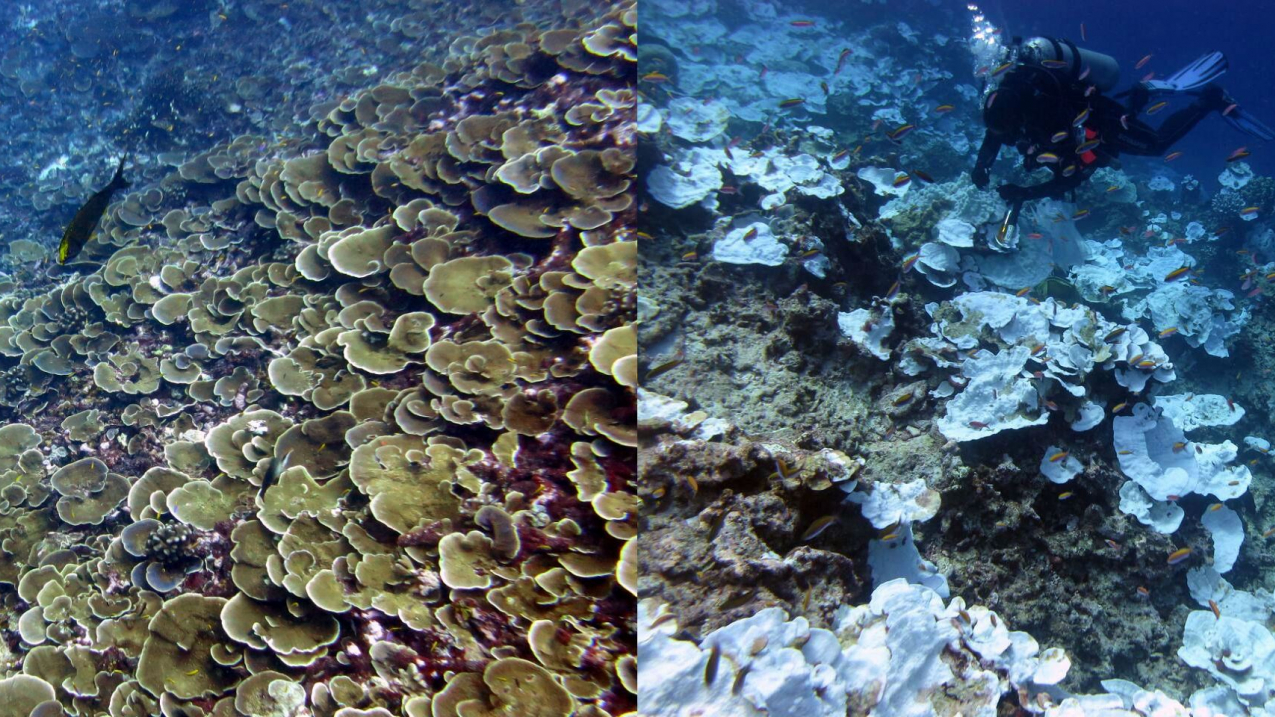
A reef reference based on past coral cover may be unattainable if thermal stress repeatedly exceeds earlier regimes. The transferable method is to separate monitoring change from ecological change, assemble multiple reference lines and preserve essential functions while scenarios diverge. The changed context adds strong disturbance pulses, slow structural recovery and uncertainty about species-specific heat tolerance. A climate-adjusted target might track living cover, recruitment, structural complexity, herbivory, water quality and connectivity rather than one historical species mix. It should not treat heat-tolerant dominance as complete recovery if habitat structure and trophic function remain impaired. Local stress reduction still matters, but it cannot be represented as control over global warming.
Historical reference conditions are not automatically obsolete, and future climate projections are not observations. A moving baseline can reveal real change but can also normalise loss if each degraded generation becomes the new target. Climate adjustment is not a licence to introduce any species predicted to tolerate heat, ignore cultural values or abandon threatened native taxa. Process targets can also be vague unless linked to measurable attributes. Reference sites may themselves be degraded or unusually buffered. Scenario ensembles do not assign certainty to the future, and model agreement can share the same assumptions. Restoration cannot compensate for every external driver; mitigation, protection and policy may be required beyond the site.
Archive the original reference model, evidence sources, indicator definitions, survey protocols, raw observations, reference-site condition, climate and hydrological data, scenario versions, assumptions, protected attributes, review triggers, decision minutes and every target revision. Show how method changes were reconciled and which ecological signals remained after calibration. Compare outcomes under the original and revised targets so a reader can see whether apparent success came from ecosystem improvement or a changed rule. Record dissent and community or rights-holder input. An independent reviewer should be able to reconstruct why the target moved, which future it anticipates and whether the project retained a credible path toward ecological integrity.
| Audit layer | Retain | Failure signal |
|---|---|---|
| Reference | Sites, records and confidence | Single idealised baseline |
| Change | Methods and environmental drivers | Drift source unresolved |
| Decision | Versions, reasons and trade-offs | Success redefined silently |
Should a reference model ever change? Yes, when new evidence or environmental change warrants a transparent revision. Is the newest condition the best baseline? No; recent conditions may already be degraded. Can historical ecosystems still guide restoration? Yes; they reveal composition, processes and variation even when exact recreation is infeasible. What makes a target climate-adjusted? It explicitly links revisions to projected or observed drivers and preserves stated ecological values. Can targets use ranges? Yes, when natural variation and future uncertainty make one point misleading. Does changing a target mean failure? Not necessarily, but the reason, trade-off and effect on claimed success must be visible.
12. The gold standard lets targets move without losing their anchor
A robust restoration target is neither a museum label nor a promise to accept whatever arrives. It uses history, current reference sites, ecological mechanisms and plausible futures to define integrity across change. The gold standard distinguishes real nonstationarity from measurement drift, revises targets through declared triggers and shows what is preserved when exact composition must adapt. This allows restoration to remain ambitious, testable and honest in a climate that no longer guarantees the past.
Contents · Previous chapter · Ecology root · Return to Ecology
Continue through verified routes
Core route
- Ecology: subject root and specialist index
- The Gold Standard of Education: learning transfers into life
- The Gold Standard: eduKate Singapore
- How X Works: systems and first-principles hub
Specialist route
- Recovery criteria, interval censoring and multistate return to baseline
- Observer turnover, calibration drift and long-term monitoring consistency
- Colonisation credit, extinction debt and delayed community response
- Functional redundancy, response diversity and resilience