
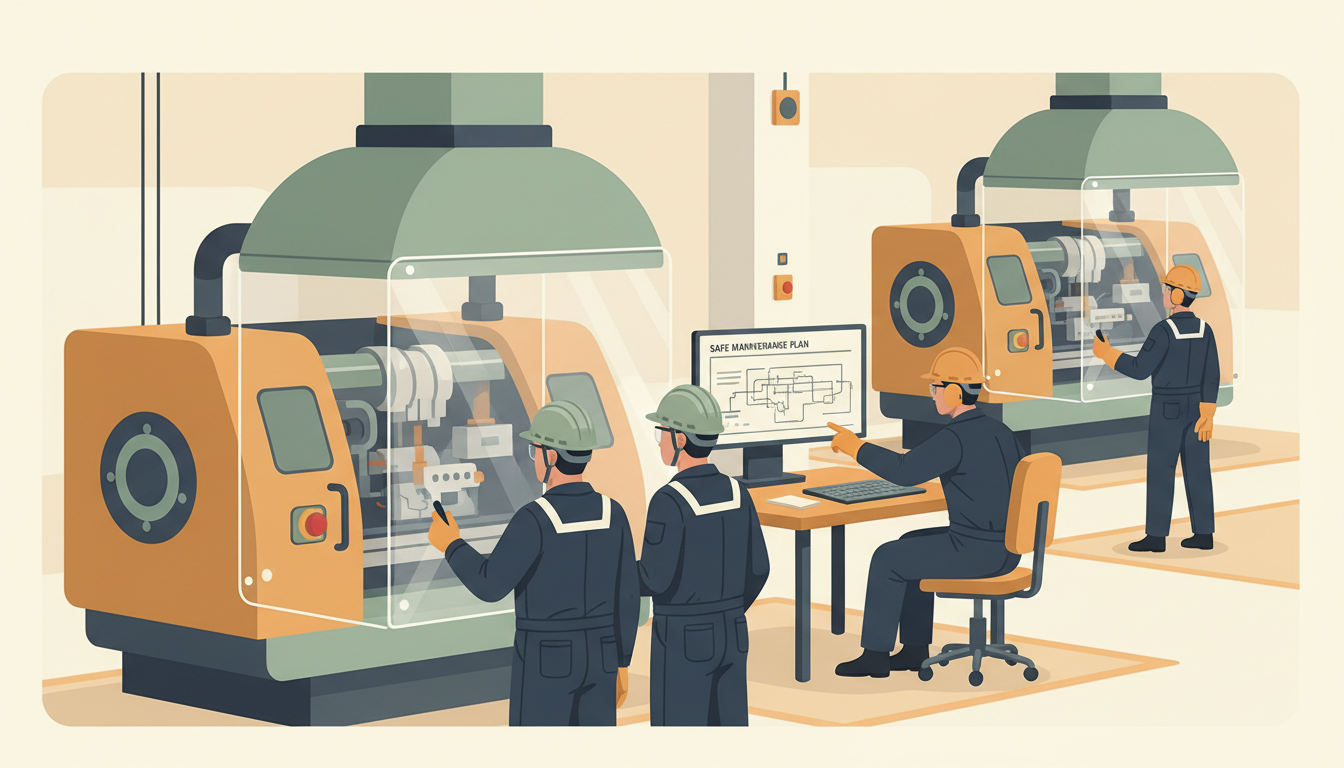
Factories, laboratories, workshops and service workplaces can appear incident-free while workers continue to encounter harmful dust, chemicals, noise or heat. Industrial hygiene makes those less visible exposure pathways measurable and controllable before illness develops.
The Gold Standard of Industrial Hygiene begins with recognition of real tasks, follows substances and physical agents along their exposure pathways, then selects, tests and maintains controls. It distinguishes scientific exposure assessment from a simplistic compliance score and connects international methods with Singapore’s current official monitoring guidance.
This guide contains 32 subject-specific chapters, two fictional calculation exercises, exposure-assessment diagnostics, an operational audit and links to primary occupational health authorities.
Chapter index
Exposure recognition, monitoring and worked TWA · Chapters 1–11
- Industrial hygiene prevents illness by controlling exposure
- Distinguish health exposure from incident prevention
- Begin with process knowledge and worker tasks
- Model source, pathway and person
- Recognise toxicological hazard separately from actual risk
- Build groups with similar exposure profiles
- Plan monitoring around decisions and uncertainty
- Personal samples and area samples answer different questions
- Measure both duration and intensity
- Worked example: calculate a fictional time-weighted average
- Interpret units and detection ranges accurately
Measurement quality, physical agents and source controls · Chapters 12–22
- Design representative air-sampling conditions
- Calibrate and protect sampling equipment
- Handle nondetects and uncertainty honestly
- Chemical mixtures need more than one-number thinking
- Noise is an exposure and a measurement problem
- Heat stress depends on more than air temperature
- Particles and aerosols require the correct fraction
- Ventilation must capture the hazard effectively
- Apply the hierarchy of controls in the right order
- Evaluate substitution for new and hidden hazards
- Use personal protection within a managed programme
PPE, surveillance, verification and connected roots · Chapters 23–32
- Keep hygiene controls working after installation
- Biological hazards require pathway-specific precautions
- Respect the distinct purpose of health surveillance
- Evaluate variability instead of trusting one average
- Worked example: calculate reduction without assuming safety
- Communicate results to people who face exposure
- Review regulations without confusing jurisdictions
- Audit the full exposure-control loop
- Frequently asked questions about industrial hygiene
- Connect to the wider Gold Standard ecosystem
1. Industrial hygiene prevents illness by controlling exposure
Industrial hygiene is the disciplined anticipation, recognition, evaluation and control of workplace agents and conditions that can harm health. It concerns inhaled chemicals, dust, fumes, noise, heat, biological hazards, skin contact and other exposures that may not cause an immediate visible injury. The objective is to prevent harmful exposure through sound workplace design, measurement and effective controls.
A gold-standard programme does not end when an inspector sees workers wearing protective equipment. It asks which hazard exists, who is exposed, by which pathway, how much and for how long, whether controls reduce that exposure and what further evidence is needed. OSHA’s Industrial Hygiene guide provides a foundational statement of the discipline.
2. Distinguish health exposure from incident prevention
Industrial safety often centres on acute events such as entanglement, fire, falls and immediate injury. Industrial hygiene focuses on exposures that can create illness or physiological stress, sometimes after repeated or delayed effects. The disciplines overlap, but a factory can have few reported accidents while workers still breathe contaminants at concerning concentrations.
Combine the perspectives without merging the measurements. Incident counts are not a substitute for exposure assessment, and an air-monitoring programme cannot establish that moving machinery is mechanically safe. Coordinated hazard control addresses both the sudden event and the harmful condition that persists unnoticed.
3. Begin with process knowledge and worker tasks
Before sampling, map materials, chemical products, equipment, work cycles, by-products, maintenance tasks, cleaning methods and job changes. Ask workers what actually happens during startup, breakdowns and unusual orders. A standard operating procedure may describe ideal practice while exposure occurs during an informal workaround.
Identify who spends time near the source, including subcontractors, cleaners and temporary workers. Document which shifts and seasons differ. Good recognition is an investigative activity: a measurement campaign designed before understanding tasks may miss the most consequential exposure.
4. Model source, pathway and person
An industrial hygiene assessment traces a source of hazard, its environmental pathway and the worker receiving exposure. Dust generated by a cutting machine may travel through the air to a breathing zone; solvent droplets may contact the skin; excessive noise may propagate to nearby tasks. The relevant route affects both measurement and control selection.
Do not assume reducing airborne concentration removes every risk. A substance may also present important skin or ingestion hazards, and biological agents may use different transmission routes. Use chemical and process-specific knowledge to identify all material pathways rather than measuring the easiest one only.
5. Recognise toxicological hazard separately from actual risk
Hazard concerns a substance or condition’s potential to cause harm. Risk depends on exposure and other factors such as route, intensity, duration and susceptibility. A highly hazardous chemical in a verified closed system may present a different occupational risk from the same material handled manually in an open vessel.
Safety data sheets help identify relevant hazards and precautions, but they do not measure the actual exposure of a particular worker. A gold-standard risk assessment integrates material information with observed work conditions and appropriate exposure data. Never claim a product is safe solely because it is sold for workplace use.
6. Build groups with similar exposure profiles
Workers can be grouped for exposure assessment when tasks, materials, controls, locations and schedules make their exposure circumstances reasonably comparable. These are often called similar exposure groups. Job titles alone may be misleading when the same title covers both enclosed machinery and open manual mixing.
State why workers were grouped and what variation was observed. Revisit groups when production methods or staffing change. A small sample from quiet daytime work should not silently stand for a group also responsible for noisy night maintenance and unplanned cleanups.
7. Plan monitoring around decisions and uncertainty
Every sampling plan should answer a purpose: estimate a worker’s full-shift exposure, characterise a short high-exposure task, confirm that a ventilation modification helped or locate an emission source. The plan needs an appropriate sampling method, target workers, periods, expected variability, analytical limits and quality controls.
Monitoring is not automatically required on the same schedule everywhere. Singapore’s Ministry of Manpower hygiene-monitoring requirements discuss toxic substances and noise monitoring by competent persons. Employers must check the currently applicable rules for their specific hazards and workplaces.
8. Personal samples and area samples answer different questions
An area sample measures conditions at a fixed place or in a defined environment. A personal sample is designed to better represent what a particular worker encounters as they move through tasks, using an appropriate device and sampling location. Neither is universally superior; the question determines the useful method.
An air monitor fixed beside a machine may show an emission trend yet fail to represent the breathing-zone concentration of someone who walks between several areas. Conversely, personal exposure data may not identify the location of a leak. A robust assessment may need both source characterisation and worker-representative sampling.
9. Measure both duration and intensity
A high but brief concentration may have a different significance from lower exposure sustained for a whole shift. Occupational limits can be expressed in different forms, including time-weighted averages, short-term limits and ceilings, according to substance and jurisdiction. They are not interchangeable.
Record task timing and concentration together. Avoid interpreting a single instantaneous meter reading as a whole-shift average or claiming that a shift average proves there were no important peaks. Follow substance-specific sampling requirements and qualified professional interpretation.
10. Worked example: calculate a fictional time-weighted average
Assume a worker experiences a fictional agent at 40 parts per million for two hours and 10 parts per million for six hours, with an otherwise uniform eight-hour shift and no other relevant exposure. The time-weighted average is [(40 × 2) + (10 × 6)] ÷ 8 = (80 + 60) ÷ 8 = 17.5 ppm.
This number is a mathematical example only, not a safe level or a comparison with a legal exposure limit. Whether TWA is the relevant measure depends on the specific agent, current applicable standard, peaks, analytical method and additional exposure routes. A competent assessor must verify those conditions before drawing a workplace health conclusion.
11. Interpret units and detection ranges accurately
Gas measurements may use parts per million by volume, while particulate concentrations may use mass per unit air volume. Converting between ppm and mg/m³ for gases requires molecular properties and temperature-pressure assumptions. A dust concentration reported in mg/m³ cannot be compared with an unrelated gas threshold in ppm.
Check units on instruments, laboratory reports and dashboards. Preserve calibration conditions and the limit of detection. Automated unit conversions can make errors look precise; record every conversion and the assumptions that permit it.
12. Design representative air-sampling conditions
Choose the duration, flow rate, collection media and number of samples according to the target contaminant and validated method. Capture work practices that realistically determine exposure, including production speed, ventilation status, tasks performed and unusual events. Record whether the sampled shift was typical, deliberately worst-case or otherwise selected.
Representativeness is not guaranteed by the amount of data collected. Ten measurements from one unusually quiet shift may be less informative than well-selected observations across the conditions that matter. Review the plan with the competent occupational hygiene professional responsible for its interpretation.
13. Calibrate and protect sampling equipment
Air-sampling pumps, direct-reading instruments and other measurement tools require appropriate calibration checks, maintenance and handling. Record pre- and post-sampling flow checks where the method requires them, sample identifiers, dates, operators, blanks and chain-of-custody information. Missing calibration evidence can undermine an otherwise convincing result.
Review field blanks and analytical quality-control outcomes rather than assuming every laboratory number is exact. Equipment may work correctly during a demonstration but behave differently under vibration, humidity, dust or long shifts. Keep rejected samples visible in the assessment record with reasons.
14. Handle nondetects and uncertainty honestly
A result reported below a detection or quantification limit is not necessarily zero exposure. The laboratory method may be unable to distinguish a sufficiently small concentration reliably. The handling of nondetects affects average estimates and should follow an appropriate documented method.
Report the relevant analytical limit and do not arbitrarily replace every nondetect with zero or the same estimated concentration without disclosing the choice. Where decisions depend on small differences near a threshold, method uncertainty can be material. Seek statistical and industrial hygiene expertise rather than treating a printed decimal as absolute truth.
15. Chemical mixtures need more than one-number thinking
Workers may encounter several chemicals simultaneously, and possible interactions depend on their toxicology, pathways and endpoints. Some assessment approaches use additive calculations for specified agents or shared effects under relevant standards, but no universal mixture formula safely replaces toxicological evaluation.
List co-occurring substances and workplace conditions, review the exposure basis for each and verify whether applicable rules address mixtures. Do not compare a sum of unrelated concentrations with a single chemical’s limit. A robust assessment states what was and was not evaluated.
16. Noise is an exposure and a measurement problem
Noise assessment considers sound level, duration, frequency characteristics and the exposure of workers over time. Decibels are logarithmic; increasing sound level by about 3 dB corresponds to roughly twice the sound intensity under comparable conditions, but it does not mean people perceive exactly twice the loudness.
Noise monitoring and hearing conservation may be required under workplace-specific rules. Singapore MOM guidance distinguishes area and personal noise monitoring and the involvement of competent personnel. Do not apply an exposure limit borrowed from a different country’s standard as if it were local law.
17. Heat stress depends on more than air temperature
Physical work, radiant heat, humidity, air movement, clothing, metabolic workload and acclimatisation influence heat strain. A simple room thermometer may not adequately characterise thermal exposure. Appropriate assessments can use more suitable indices and task-specific professional guidance.
Control by reducing heat at source, improving environmental conditions and planning work-rest, hydration and supervision appropriate to the hazards. Medical vulnerability and symptoms require qualified assessment. An article cannot prescribe universal safe work durations or replace emergency response for suspected heat illness.
18. Particles and aerosols require the correct fraction
Airborne particles vary in size, composition and ability to reach different respiratory regions. Sampling conventions may distinguish inhalable, thoracic and respirable fractions. A mass measurement for one defined fraction cannot automatically be treated as a measurement for another.
Assess how material is generated: cutting, grinding, welding, combustion and powder transfer produce different mixtures and size distributions. Select a validated method suited to the target hazard and clarify whether the result represents dust mass, a particular substance within that dust or a particle-count measure.
19. Ventilation must capture the hazard effectively
General ventilation can dilute some contaminants, while local exhaust ventilation aims to capture emissions near their source before they disperse into breathing zones. Effectiveness depends on hood placement, airflow, enclosure, cross-drafts, maintenance and worker behaviour.
Do not confuse a fan’s presence with verified exposure control. Smoke visualisation, flow checks, measurements and task observations may all help under competent assessment. A system designed for one process might be inadequate after a machine upgrade or a change in the material being handled.
20. Apply the hierarchy of controls in the right order
The NIOSH hierarchy of controls prioritises eliminating hazards, substituting safer alternatives, engineering controls, administrative controls and personal protective equipment. Controls nearer the top often reduce dependence on perfect human behaviour.
The hierarchy is a decision framework rather than a promise that every substitution is harmless. A process redesign that removes a hazardous solvent may be preferable to asking every worker to manage respirator use indefinitely. If a hazard cannot be eliminated, combine controls appropriately and verify their effectiveness.
21. Evaluate substitution for new and hidden hazards
Replacing one chemical or process with an apparently safer option can change toxicity, flammability, emissions, ergonomic burden, waste and energy demand. Evaluate the substitute’s full hazards and working conditions rather than relying only on a reduced warning label or a supplier’s marketing statement.
Test real exposure and operational impact after substitution. A water-based formulation might reduce one solvent exposure while introducing other maintenance or microbial issues. The objective is lower overall harm under realistic use, not simply changing the name of the material in the inventory.
22. Use personal protection within a managed programme
Respirators, gloves, hearing protection and other equipment can reduce exposure when appropriately chosen, worn, maintained and used. They also have limitations and require training, inspection and, where applicable, fit testing or medical review. Issuing the equipment is not the same as achieving effective protection.
Prefer effective upstream controls when possible, and do not assume that a mask protects against every chemical or airborne particle. The NIOSH PPE overview explains PPE’s place within a broader control programme. Selection for real exposure requires competent site-specific assessment.
23. Keep hygiene controls working after installation
A local exhaust system may lose capture performance when filters load, ducts are altered or a machine moves. An enclosure may be left open during cleaning. Record operating parameters, inspections, maintenance, worker feedback and follow-up exposure data.
Design change triggers: new chemicals, higher production, different task arrangements or repeated complaints should prompt reassessment. The completion of an engineering project is not proof that exposure remains controlled months later. Industrial hygiene is ongoing verification, not a single inspection report.
24. Biological hazards require pathway-specific precautions
Workplaces can encounter biological material through healthcare, animal handling, water systems, waste management and some industrial processes. Hazard recognition should identify relevant agents or conditions, credible routes of exposure and people at risk. Monitoring methods and controls differ from those used for ordinary chemical vapours.
Use appropriate biosafety and infection-prevention guidance, including engineering and administrative controls and suitable PPE. Do not apply a gas sampling method to infer a biological infection risk. Health and safety decisions involving potentially infectious material need competent specialist review.
25. Respect the distinct purpose of health surveillance
Exposure monitoring measures conditions that workers encounter. Medical surveillance and other occupational health examinations assess health-related information according to relevant law and clinical practice. Neither should be used carelessly as a substitute for preventing exposure at source.
Singapore’s MOM workplace health surveillance guidance describes circumstances requiring monitoring and examinations for specified hazards. Maintain confidentiality and role-based access to medical information, and follow applicable procedures for notifying workers and regulators.
26. Evaluate variability instead of trusting one average
Exposure may vary between workers, shifts, production lots and maintenance periods. A single average can conceal a high-exposure subgroup or short peaks. Use appropriate statistical methods and representative samples to characterise a population, with uncertainty and the limits of the sampling design.
Before reporting compliance or improvement, ask whether the sampled workers, tasks and conditions adequately represent the group at risk. Do not treat a favourable measurement from one low-demand day as evidence that controls will succeed under heavy production or emergency repair.
27. Worked example: calculate reduction without assuming safety
Suppose a fictional airborne-agent assessment reports a baseline concentration of 28 mg/m³ and a follow-up concentration of 9 mg/m³ under appropriately comparable testing conditions. The observed absolute difference is 28 − 9 = 19 mg/m³. The proportional reduction is 19 ÷ 28 × 100 ≈ 67.9%.
This improvement does not establish that 9 mg/m³ is acceptable or legally compliant. The relevant substance, permissible exposure basis, sampling duration, peak exposure and analytical uncertainty remain unknown. The percentage describes change between two measured values; it is not a health-risk rating or a licence to reduce further controls.
28. Communicate results to people who face exposure
Workers need information they can understand about what was measured, why monitoring occurred, whether the results indicate concern, which controls are required and how to raise a new exposure issue. Translation, practical demonstrations and opportunities to ask questions can matter more than a dense technical report.
Protect confidential personal and medical data while sharing necessary workplace hazard information. A numerical monitoring result is not useful if the person operating the process cannot recognise a failing ventilation system or knows no safe way to report it.
29. Review regulations without confusing jurisdictions
Industrial hygiene requirements differ by country, substance, industry and worker circumstances. A US OSHA reference provides scientific and programme context but does not replace Singapore law. Singapore employers should check the applicable Workplace Safety and Health legislation, MOM instructions and current competent-person requirements.
Do not publish a universal monitoring frequency or exposure limit without identifying the actual rule and substance. Requirements can change, and industry-specific provisions may apply. A gold-standard compliance checklist is versioned, jurisdiction-specific and reviewed by someone accountable for the workplace.
30. Audit the full exposure-control loop
Choose one priority task and trace the agent, source, pathway, potentially exposed workers, recognition evidence, sampling plan, method validation, measurement results, uncertainty, applicable reference basis, control selection, worker briefing and follow-up verification. Ask what would change if production doubled or a maintenance step required opening the enclosure.
Assign an owner for unresolved exceptions. A completed report that cannot trigger repairs or reassessment is an archive, not a working health programme. Industrial hygiene earns credibility when the evidence changes the environment in which people work.
31. Frequently asked questions about industrial hygiene
Is industrial hygiene mainly about cleanliness? No. It assesses and controls workplace exposures that could harm health. Can an area monitor substitute for every personal sample? Not always; the worker’s movement and decision purpose matter. Does PPE prove the risk is controlled? No; suitability, fit, maintenance and upstream measures are also relevant.
Is a result below the detection limit the same as zero exposure? No. Does a lower concentration guarantee legal compliance? No; the substance, time basis and applicable rule are essential. Is a single clear test enough forever? No; process changes and variability can require reassessment.
32. Connect to the wider Gold Standard ecosystem
Continue through Industrial Safety for immediate hazard prevention, Industrial Metrology for measurement quality, Ergonomics for task design, Risk Management for decisions and Measurement for rigorous comparisons.
Primary sources are the OSHA Industrial Hygiene booklet, NIOSH controls hierarchy, NIOSH PPE guidance and Singapore MOM monitoring requirements. Calculations are fictional learning examples. Real exposure-control decisions require competent evaluation of actual conditions.
Browse The Gold Standard master collection · How X Works hub